Catégories
The Editors Cut

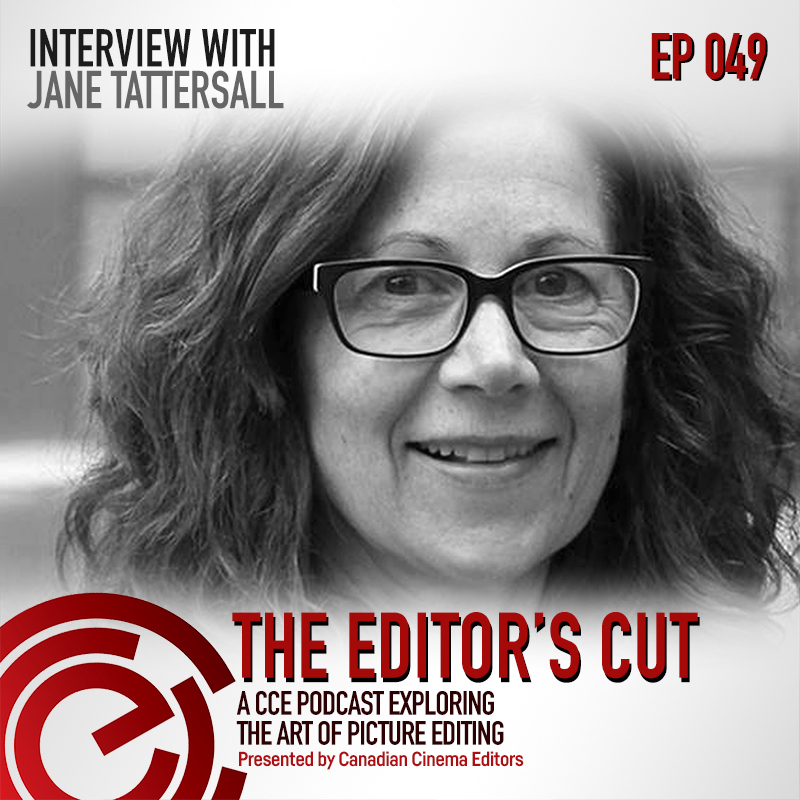
Episode 049: Interview with Jane Tattersall

The Editors Cut - Episode 049 - Interview with Jane Tattersall

Episode 49: Interview with Jane Tattersall

Today’s episode is an interview with the recipient of the CCE Career Achievement Award for 2021 — Jane Tattersall.

This episode was generously sponsored by IATSE 891

This award is presented to a non-editor who has shown great support for Canadian editors and the editorial profession over the course of their career. Jane has been a fixture in the Canadian post-production industry for over 30 years. Her enormous support for Canadian filmmakers, from our most recognized artists to first-time storytellers, has fostered incredible growth of talent across our industry. 

Jane’s sound work has taken her to studios beyond Canada, including stints in Berlin, Brussels, Budapest, London, LA, Skywalker, and New York. Numerous credits, nominations and awards followed and today Jane counts over 170 credits (film and television), and over 100 nominations and awards. Jane’s recent sound supervising includes THE HANDMAID’S TALE, THE NORTH WATER and 13 MINUTES.

À écouter ici !

Abonnez-vous là où vous écoutez vos balados

Que voulez-vous entendre sur L'art du montage?

Veuillez nous envoyer un courriel en mentionnant les sujets que vous aimeriez que nous abordions, ou les monteurs.euses dont vous aimeriez entendre parler, à :

Crédits

Un grand Merci à

Jane MacRae

Alison Dowler

Hosted and Produced by

Sarah Taylor

Design sonore du générique d'ouverture

Jane Tattersall

ADR Recording by

Andrea Rusch

Mixé et masterisé par

Tony Bao

Musique originale par

Chad Blain

Soundstripe

Sponsor Narration by

Paul Winestock

Commandité par
IATSE 891

Catégories
The Editors Cut

Episode 048: In Conversation with Madison Thomas

The Editors Cut - Episode 048 - In Conversation with Madison Thomas

Episode 48: In Conversation with Madison Thomas

Today’s episode is the online master series that took place on August 27th, 2020. In Conversation with Madison Thomas.

This episode is sponsored by Annex Pro/Avid

Named one of Playback’s 2019 Five to Watch, Madison Thomas is a Writer, Director and Editor from Winnipeg, Manitoba. Her work reflects her mixed cultural roots, Ojibwe, Saulteax, Russian and Ukrainian. Thomas draws inspiration from experiences growing up in the inner city and has committed herself to diverse representation in her work.

This episode offers a look at a unique and impressive career in which Thomas has often taken on multiple roles and frequently edits her own work.

This experience includes being a Senior Editor- as well as Researcher and Director – on four seasons of the CSA-nominated CBC / APTN series Taken, which shares the true stories of Canada’s Missing and Murdered Indigenous women. Thomas also wrote, directed, and edited her feature film Ruthless Souls, which was selected as part of Telefilm’s inaugural Talent to Watch program, as well as her web series The Colour of Scar Tissue.  

Also a rising star in scripted television, Thomas was a writer on season 3 of the CBC/CW series Burden of Truth. 


This conversation was moderated by award winning filmmaker Cazhhmere.

À écouter ici !

The Editor’s Cut – Episode 048 – Interview with Madison Thomas

Madison Thomas:

One of my tricks is, especially if I’m struggling with an edit, I’ll go in and I’ll cut a scene that I’m very

confident about and I know I can bang it out.

Sarah Taylor:

This episode was generously sponsored by Annex Pro Avid.

Hello, and welcome to The Editor’s Cut. I’m your host Sarah Taylor. We would like to point out that the

lands on which we have created this podcast, and that many of you may be listening to us from, are part

of ancestral territory. It is important for all of us to deeply acknowledge that we are on ancestral territory

that has long served as a place where indigenous peoples have lived, met, and interacted. We honor,

respect, and recognize these nations that have never relinquished their rights or sovereign authority

over the lands and waters on which we stand today. We encourage you to reflect on the history of the

land, the rich culture, the many contributions, and the concerns that impact indigenous individuals and

communities. Land acknowledgments are the start to a deeper action.

This episode is the Master Series that took place on August 27, 2020. In conversation with Madison

Thomas. Named one of Playback’s 2019, 5 to Watch. Madison Thomas is a writer, director, and editor

from Winnipeg, Manitoba. Her work reflects her mixed cultural roots, Ojibwe, Saulteaux, Russian and

Ukrainian. Thomas draws inspiration from experiences growing up in the inner city and has committed

herself to diverse representation in her work. Today’s episode offers a look at a unique and impressive

career in which Thomas has often taken on multiple roles and frequently edits her own work. This event

was moderated by award-winning filmmaker, Cazhhmere.

[show open]

Cazhhmere:

Hi everybody. My name is Cazhhmere. I’m a filmmaker. I tell stories of many, many different formats.

Everything from music videos to commercials, documentaries, short films, long-form narratives, and

anything and everything in between. And I am today joined with my lovely friend and co-creator on

some projects, my friend Madison Thomas, filmmaker extraordinaire. I like using big words like that.

Madison Thomas:

I like it.

Cazhhmere:

Yeah, so we’re here today as part of the Master Series. We’re going to be talking about editing, but it’s

going to be a little different because Madison and I we are both directors first, editors second, I guess we

will say, but we’ll get into the story of how we became editors. I won’t necessarily say we became editors

by necessity, but part of it does have to do with that, but before we get into that, I’m going to let

Madison introduce yourself.

Madison Thomas:

Right on. Thanks Cazh. Thanks so much for agreeing to chat with me today. Super, super happy to be

here. So my name is Madison Thomas. Like Cazh mentioned, I am both a director and editor. I also write.

[foreign language 00:02:52]. And yeah, I’m a filmmaker. First and foremost I would say storyteller, really

because film’s the medium I use the most. But storytelling is very much how I describe myself and how I

like to carry myself through the world and what I think my gift is, in theory, but yeah. So like Cazh

mentioned, I am a director first. Writing and directing are both loves of mine, but a bit of my journey,

editing has become a big part of it, so.

Cazh, I know that’s been your journey as well. I know we chatted a little bit about this before, but

chicken before the egg. Which one came first for you? For me, my first paid gigs were editing and I was

doing directing alongside, so the journeys were the same for me. And I got a little bit of background

during high school, I was lucky enough to attend Sisler High School in Winnipeg’s North End. Which is a

pretty large school, even though we were in inner-city with a lot of low-income kids. We did have a

pretty robust program and an amazing teacher that came in, in my Grade 10 year named Jamie Leduc,

who really built a film program from scratch. Gave me my first exposure that way. My first paid gigs were

editing, so I had dual entry. Was it the same for you?

Cazhhmere:

Me? No, actually. My first paid gigs were music videos.I sort of became a filmmaker by fate, I guess. You

know what I mean? Growing up, all I ever wanted to do was make music videos. That was it. That was

the end-all, be-all for me. Music videos, music videos. That’s a whole long story of how I got there, but

dream came true. I ended up being very fortunate enough to make music videos.

I was born in Halifax so when I came here to Toronto after a long journey, working with music

and stuff, I was able to start making music videos gratefully to Much Fat, which was called Video Fat at

the time.

I started editing simply because it first started as a suggestion through a mentor of mine and

another fellow Canadian director by the name of R.T. Thorne. Shout out to R.T. We had a music video

company together, and he and a friend of his, and I was a director on their roster. We were, I would say

in hindsight, at the height of our music video careers or just on the brink of it, I should say, but I wasn’t

getting what I wanted out of my music videos.

I just didn’t like them for some reason. I knew how I wanted them to look, but when I saw them

on TV, this is when they were still playing videos on TV, I wasn’t proud of them. People saw them. Looked

great, had great cinematographers, were shooting on film, all that sort of stuff at the time. Everything

was there. I had all the tools that you needed to make a great video. I just wasn’t pleasing myself.

R.T. said, “You should try cutting your music video. Editing gives you a different eye, a different

perspective. You know how to cut it. I sit in every session through hours and hours with my editor,

saying, ‘No, do this, do this, do this, let’s try this.'” He’s like, “You know what you want, so how about

you try and physically do it yourself and see what happens?”

He’s like, “You might try to see your stuff differently on set. You’ll start to see your edits while

you’re on set. All that sort of stuff.” And he was right. I started to get what I wanted out of my videos for

a number of reasons.

A lot of it was because, even as I was writing treatments, I could see it playing from start to finish

in my head and know exactly how it was going to be, so from the treatment to the shot list to the

storyboard to being on set and executing the shots. By the time I’m in the edit room, I already knew. The

video could just edit itself because there was some magic button. You know the auto button? If there

was just auto edit, it could do it. So that’s when it started.

And then it became a consistent thing out of necessity just because, especially in the music

world, we all know as the internet started to dominate the world, it affected a lot of things. Particularly

music industry, film industry, budgets, and stuff. People were spending less money on things, and in the

totem pole of filmmaking, music videos sits very low, and naturally their budgets suffered the most.

So there just wasn’t any money for editors. If I still wanted to make music videos look big and

grand and feel … We’re in Canada, so budgets were already small. But at a time, like I said, much music,

if you want your videos to play against other US artists, it’s going to look a certain caliber. It takes a lot of

going through corners and bending over backwards and cutting corners to make that stuff happen.

Madison Thomas:

Yeah, it’s like you mentioned, caliber because that was a big part of it. So mine wasn’t very much focused

on visuals. Yes, I wanted to control how the visuals were communicated. But for me, because I come

from a bit of a narrative background, especially my Indie days really making something out of nothing. As

you know, having to work in both narrative and documentary, it’s a little easier to do that with

documentary.

Cazhhmere:

For sure, yeah.

Madison Thomas:

Low budget is a little more accepted. So, for me, the caliber was, okay, the little budgets that I do have,

the little arts grants that I do have, I want to put all that on the screen.

Cazhhmere:

Exactly.

Madison Thomas:

Why I’m going to learn how to edit and why I’m going to make that such a big part of my skill set, is that I

don’t have to spend money on someone else doing that then.

Cazhhmere:

Yeah, that’s what it was. Now that I knew how to edit my videos and get what I want out of it, when it

came time to money like you said, you want to put all of that on screen. So honestly, it was like I’ll just do

it myself. Fine, I’ll cut it myself. Take whatever amount it was out the budget for the editor, cut it out. I’ll

do it. It still sucks, because I’m still now doing twice the work for one check as opposed to the work of

two checks. But that’s really how it came about.

Madison Thomas:

That’s what you do when you’re an artist, I feel.

Cazhhmere:

But I feel like that was our transition because especially in filmmaking now, that was maybe at least 10

years ago, probably more that that transition started. But we’re in an era of filmmaking where it’s very

much a do it yourself era.

Madison Thomas:

A hundred percent.

Cazhhmere:

Until you get to the big budgets. So I feel like we look at it as a necessity then, but it was setting us up for

what’s now become the norm in a sense.

Madison Thomas:

Totally.

Cazhhmere:

So I want to ask you a question. We’re talking about how learning to edit as a necessity was also a step

into learning more about the storytelling process. So explain how that statement is true for you in your

experience of becoming an editor?

Madison Thomas:

For sure. With a lot of my early editing gigs, they were generally like assistant editor or eventually

moving up to junior and senior editor for documentary films. I think my first love as an artist was to make

narrative films. Then that whole process of writing, casting, that whole thing. Because I think that’s also

very much the classic story of filmmaking, like the general populace is sold, that’s what they’re told. The

glitz and glamor of it, so obviously I was very attracted to that especially coming from a poorer

background.

I had no family in film. I had no family in the arts, period. I am by far the black sheep of the

family. I have a couple of younger cousins finally being weird and artsy, finally. So I had zero idea of what

this industry was other than what this high school teacher had taught me.

So getting into editing via documentary was super interesting because it’s so not the form of

storytelling you’re told. But I’ve found I took to it really naturally, actually. Telling things non-linear,

abstract representations and ideas that were being presented from the interviews.

One of my very first gigs and one I’m very thankful for, I think was fundamental to my journey as

a filmmaker, was working on the TV series Taken. It was a docu-drama series and it explored the missing

and murdered indigenous women and girls here in Canada. And in our final season we actually looked at

two-spirited men as well.

And with sharing their stories, both in a documentary format with their families sharing their

stories both of their case, the disappearance, or their murder. But also who they were as a person, who

they were when they were a kid and who they were going into adulthood if they got that far. But it was

really interesting being able to work on a hybrid show like that, where we had the classic documentary

storytelling but we also had recreations. They were told but in non-classic, where we did a lot of that

abstract work and stuff.

And for a long time I didn’t really understand why that came so naturally. It was one of those

interesting things as an artist’s journey, you can realize things in retrospect. But I realized that going to

Prague actually. So I was lucky enough to attend Prague Film School in 2011 while I was going to

university. That same high school film teacher actually was like-

Cazhhmere:

Fancy place to be going to school.

Madison Thomas:

Pretty fancy place. I got very, very fortunate. I was the first Canadian Indigenous person ever to attend.

Cazhhmere:

Awesome.

Madison Thomas:

My first high school film teacher, Jamie Leduc … I was going through my first year at the University of

Winnipeg. And not knocking UW by any means. It’s got a special place in my heart and I did learn a lot

there, but he saw that I clearly wasn’t getting out of the film program what I was looking for. Which was I

think at that time just looking to who I was as a storyteller and how I was different and molding that

part. So I think he saw. He’s like, “You need to go somewhere where they’re going to focus on that.”

And Prague had a Summer intensive program. You basically did a year of film school in a

condensed three months. And my editing professor there was actually the senior editor of Friends for

eight seasons. And so a very interesting person to be teaching at this very prestigious arts film school.

However, he went on after Friends to edit some very, very prominent European films. And he really

talked about his process just in terms of how he stayed sane editing a sitcom with fixed cameras and

fixed angles all the time. And it was all about his philosophy in editing.

I mean we chatted about this a little bit briefly in some of our collaborations, Cazh, but the idea

of the ghost in the room. So his philosophy and I’ve definitely brought this forward into my editing. I find

it very useful because I think especially if you come from a more of a technical background when it

comes to editing, you can get very bogged down by the 180 rule. Cutting from a wide down to a

medium. Those conventions that were taught.

Cazhhmere:

Things as a director I don’t understand. This is a math class, I like the shot, put it there!

Madison Thomas:

Exactly. If it feels right, it feels right. And that was a big part of his philosophy. Imagine you’re a ghost in

the room and I think this gets a little bit more complex when you get into perspectives and different

styles of editing which I really worked on with Ruthless.

But his concept was when in doubt, if you’re the ghost in the room, what is your eye drawn to?

That’s what your next cut should be. So his example was always someone walks into a room holding a

book. Well, I’m interested in the room at first. Where is this person? What are they walking into? Is it

dark, is it warm? Is it inviting? Do they know this place, do they not? I think even if you’re a technical

editor you have to ask yourself those storytelling questions, because that’s what the audience is going to

be asking.

And so a person walks into a room with a book. They put the book down and they open the

book. Well, I’m very curious what the hell this book is. Got to a cut of the book if it’s interesting. Now I’m

actually curious about what that girl feels about the book. Is she curios about it, is she scared by it, any

of those things? So a lot of his philosophy had to do with focusing on the emotion. And that was how he

stayed sane editing Friends was as long as he could focus on that, it didn’t matter that it was the same

cuts and shots. He can always make it interesting and alive because there was always feelings.

Cazhhmere:

I want to talk about Taken again. So through editing on the show Taken, you ended up directing on this

show as well, right?

Madison Thomas:

Yeah.

Cazhhmere:

Tell me about that and how editing on the show beforehand prepares you for this new task now as

director on the same show and just as a director in general?

Madison Thomas:

Totally. So as I was saying before while I was getting these, while I was my paid gigs were editing

documentaries and stuff. I was also doing a lot of narrative, Indie, no-budget, very low-budget stuff at

the same time. So it was like exercising both muscles quite a bit. So my co-workers knew that I was also a

director, that was a big part of it. I told them I was a director, that’s also I think a thing a lot of young

filmmakers really struggle with is actually voicing what they want to do in this industry. Because your first

job is very generally not where you want to end up, unless you’re lucky or have a lot of money I guess.

I made it very known that I was a director and I wanted to direct narrative as well as

documentary. So first of all, my producers and bosses knew that. But in terms of as a storyteller within

Taken because I was editing it when you’re a senior editor especially and you’re overseeing all the

episodes. That was 13 per season. I worked with 13 different directors. I learnt a bunch of different

styles. It was actually incredibly good training. You see what they pick, you see how if they did cover

something properly they had enough material to cut the scene together. If they didn’t, you were

struggling as the editor, you had to find creative decisions. So it was actually very interesting backwards

training that way in terms of what material to get.

But when the opportunity came up and funnily enough, this is how a lot of opportunities come

up in film, I think is someone unfortunately got fired from one of the directors, mid season. With the

show having such sensitive topics, they were hesitant to bring on someone who completely didn’t know

because they were interviewing with the family members, that relationship had already been established

with the other director. However having been part of the show and very familiar with the episode and

what the story we already had, the producers felt confident in asking me to just take on the second-half

of directing that.

Cazhhmere:

Sure, who’s more familiar with the show then the editor who’s seen everything?

Madison Thomas:

Yeah, all the episodes, not even just a particular episode.

Cazhhmere:

Yeah, actually speaking of which, there’s a question from the audience that while we’re talking about

editing, you being an editor on a TV show before working as a director on a TV show. So I just want to

answer this question because it will tie into … The question is, what is the role of an editor in

pre-production? So given that you were an editor on Taken on the show, what involvement did you have

if any in the pre-production of Taken? Or if not, just what is the role of an editor in pre-production on any

project really?

Madison Thomas:

For sure. So I would say from the documentary point-of-view, generally the only person from

post-production that will come on, really early in the process will be … In narrative film they’re called the

DIT, the digital imaging technician. We usually say editing assistant or something along those lines, or

media manager in documentary. So they’ll generally come on very early on because the way a

documentary is filmed is generally in huge chunks.

In Taken, we would film a season over eight months because we would do interviews spread

over the year because we are going across Canada getting interviews. And then we would do recreations

of classical film shoot all in one week. We did a shoot in Winnipeg, we did a shoot in Victoria. So it was

all very interspersed so collecting that footage was a really fundamental job from day one of

development. That would generally come on then.

However, after season one because I was such a big part of both editing and directing I would

generally stay on from early days of development until the end. So on that particular show, I as the editor

had a say in certain things from early on. I would say, and Cazh, tell me if you had a different experience,

generally in post-production isn’t super involved until generally footage starts really rolling in.

Cazhhmere:

Yeah, until footage starts really rolling in or I guess especially because having the editing experience and

directing experience if I’m thinking of some crazy stuff especially coming from a music video where we’re

all about aesthetics. So the crazier the shot, the crazier the angle, the better. My mind can tend to go

there with narrative stuff because I’m a storyteller but I’m also visual so I want it to look pretty and nice

too. So if I’m thinking of a crazy shot and especially if my producer or my DP or both are giving me some

push on it. I might go ask my editor, to be like, “Am I crazy? Tell them this shot works. Tell them, tell them

this works. Tell them it’s going to make sense.” It’s going to cut seamlessly and I’m not just being abstract

for the sake of being abstract or whatever the hell. You know what I mean?

Madison Thomas:

Totally.

Cazhhmere:

So if it’s something more intricate like that. And if it’s just some straight forward documentary or just a

straightforward narrative or anything, yeah, I probably wouldn’t feel the need to involve my editor too

much. We’ve had some discussions, because I’d be like my shooting style and pasting and all that still

takes a part in it,right? So I’ll probably just have some conversations, preliminary chats with the editor

because obviously I’m not just going to pick any editor to cut whatever it is.

So I’ve obviously picked them for a reason because of our styles and where I see things going in

lines whatever that may be. So we’ve already had chats. And then I may pick their brain a little bit as I’m

planning out different shot lists and things like that. But it’s pretty much conversation, it’s not like they’re

involved in full on pre and pro-meetings or things like that.

But there are some cases where they are. When you’re dealing with something that’s a lot of CGI

and effects going on, that’s a whole different ball game. Then the editors are very much involved in the

pre-, pro-process.

Madison Thomas:

Totally. But yeah. I mean I think that’s just good practice no matter what end of things you are on, if

you’re a director hiring an editor or if you’re an editor working with the director. Or if your case like me,

it’s where I edit most of my own work. I’ve had a couple instances as the director where someone else

has edited my work, generally, more director-for-hire gigs. But generally the things that are made by me,

developed by me to fruition, I generally edit.

I’ll get into a little bit more when we get to Ruthless, but I think I’ve realized my line with that is

features. For my next feature I will have a big hand at editing it however I do want to bring on a second

person just for those fresh eyes and fresh creative part of it. As my stories get bigger, I’m finding I’m

going to need that extra creative person.

Cazhhmere:

For sure. Absolutely. Since we’re talking about all this visual stuff and everything, I want to talk about

some of your work, your actual work. We’ve seen you reel, but let’s dive into all this experience that

we’re talking about and let’s see it in action.

Madison Thomas:

This is my narrative web series, released in 2018. It’s called Color of Scar Tissue. We made this under the

funding with the Imaginative and APTN Web Series Pitch Contest. I’ve had to say that so many times in

interviews that I’m good at it now. On the day when I was trying to thank the sponsors, I had the biggest

queue card ever because it’s such a mouthful.

But it was wonderful funding that basically was made available through a pitch contest to myself

and my producer, Darcy Waite. Won that contest in 2017 and we were able to go on and create this four

episode web series that follows three sisters that are from mixed-indigenous ancestry, Ojibwe and

Finnish. And range from looking completely indigenous to completely white-passing.

And as after the death of their parents, their oldest sister Bow gets custody of the younger two

and they have to move from rural Manitoba to Winnipeg’s North End which is the neighborhood I grew

up in. And the series just looks at their relationship as sisters. The social context that come with basically

colorism within a family as well as their new dynamics now that one is taking on the mom role.

So this is the first few scenes of the whole series. The whole series is available on YouTube on

APTN if you want to check it out and see where they end up. But one thing editing-wise that I really

wanted to play with this was the disconnect between the sisters. I really wanted to play on that.

And so earlier we were talking about the 180 rule and editors sometimes getting bogged down

by that. I was like you know what I feel like we can do some interesting stuff with artfully breaking that

rule in this. And use it in a way to showcase the fact that they’re literally not seeing eye-to-eye at this

point.

Particularly the oldest sister and a youngest sister. Obviously, classic story of the middle sister

really caught in the middle, so you actually see her catch the right eye line once in a while, and she acts

as our anchor. And so we were able to do this with just a very clear cut pathway of the environment of

their new home. We settle in this wide for quite a while so you really get the layout. So the different eye

lines are more of a stylistic thing versus confusing to look at.

So that’s what we went for with this. I always like to do with my edits, think about instead of the

classic shape of the story, the classic arch of the story because a lot of my work is very cynical in nature

which has a lot to do with indigenous storytelling and just what I’m drawn to. Comes from documentary

as well. I really think about films with a pulse versus an arch. I think you come from music Cazh, I think

you really understand what I mean by that.

Cazhhmere:

That feeling of rhythm, I get it.

Madison Thomas:

It’s a rhythm. So you’ll notice with this for the first couple of minutes with this clip it’s very much … It

starts with this very, very long drawn out uninterrupted 360 clip that suddenly goes into these altered

eye lines stuff. So there’s a really interesting off rhythm of this first episode but I really wanted to use the

editing to basically show how off their whole life is right now.

Yeah, using it as an extension of the storytelling versus just technical laying out as it’s scripted.

What is the best way to learn editing?

Cazhhmere:

I have a quick answer to that. Just edit. That’s literally how I learned when I first started because of music

videos. When R.T. suggested cutting it. He was like, “You know what you want so just figure out how to

do it.” And so I knew how to cut, in, out, grab the clip, put it on the timeline. And I just started going

from there.

If there was something I wanted to do music videos, sappy songs, there’s a lot of cross dissolves

going on. So I was like right here needs a cross dissolve. How do I do that? Just call my editor and be like,

“I’m going to ask you a lot of questions throughout this.” It’s like, “No problem Cazh. If you need to figure

out how to do something just ask me, I’ll show you how.”

Sometimes he don’t know the answer. I’m like how do you do that dreamy dissolve is what I

called it. He like, “You mean a cross dissolve?” I’m like, “Yeah.” He’d be like, “Oh, here. There’s a function

for it right there.”

I learned to edit by editing. That’s the easiest way. And especially YouTube tutorials if you don’t

have an instructor or an editor to help you do that, are your best friend. When I started doing it wasn’t

as evolved as it is now. But even still now, when I’m editing something if I’m like, oh, you know what?

This would be cool. How do I do that? I’ll just, how to YouTube, how to blah blah blah. That’s the best

way.

What’s your answer to that? What do you think the best way to learn editing?

Madison Thomas:

Yeah, I think I’d echo all that. Especially when it comes to technical little things like that. I’m not in any

way saying don’t go to film school or all that. But if the thing that’s hindering you is the technical stuff,

there is a YouTube tutorial for all of it.

What I think you really need to develop in terms of editing is what is your personal story telling

style and what is the current project you’re cutting. The ability to be able to recognize what it calls for,

what rhythm it should have, how the story should unfold, that all just comes to experience.

Cazhhmere:

Anyone can put it in and out, grab the clip drag it down to the timeline, repeat, repeat, repeat until you

have whatever it is. Whether it’s a music video, a short film, whatever. But is it good? That’s the thing

that comes with time and experience. And the more experience and trial and error, and doing it again

and doing it again until you figure out what your oomph is.

Madison Thomas:

And I would say really, really early, as early as you can, and I mean this as a writer, as a director, as an

editor, as a creative in general, you’ve got to show people your stuff. And you have to go through the

grilling experience of sitting there and watching it with them. Which is awful, I still hate doing it. I’ve only

actually sat through my feature at a public screening a handful of times now and it never gets easier. But

you need to be in the moment with your audience as any step of story telling and see how your story is

getting received. See in the moment how it’s making people feel.

Cazhhmere:

That’s a good [inaudible 00:27:43] if it’s good.

Madison Thomas:

Is it good? Are people walk away talking about it? Talking about how it made them feel? What it brought

up for them? That to me is the marker of a good film, not a perfectly well-pasted piece of art.

I feel like… When you get into the mainstream films, and especially TV, I write and direct a lot

for TV. And there’s a set rhythm and way stories are told. If you get into the writing world in TV, it’s like,

end of act three, something big and exciting has to happen. So you have to artificially get to that because

that’s what audiences are familiar with. But for the type of stuff I like to make, I don’t want to be bound

to that per se.

Cazhhmere:

Where are some of the best places you go to when you need to learn something editorial-wise?

Madison Thomas:

Like technical or artistic, do you think?

Cazhhmere:

Both. What are some of your tools that you use?

Madison Thomas:

Yeah, for sure. I mean, music is a huge one for me. Really early on both writing, directing, editing. Editing

specifically I’ll usually make a playlist and some of it will end up being tent music that I’ll use in my cuts.

But some of it is literally just to get me into that sense, into that mode.

I always like to step back. And this comes from that ghost in the room philosophy, it’s just my

extension of it that I’ve felt as a filmmaker because a lot of my work in the narrative side. And I think this

stems from documentary world, is really character focused and character driven. In my opinion all stories

should be, regardless of genre but some people don’t agree with me on that. Some people are like,

action, big set pieces, that’s enough. But who’s in that action and the big set pieces? Whose perspective

are we actually seeing the story through?

And so whenever I’m doubt about you know, what an edit should be or how a story should be

told, I try to pull back to, okay, whoever’s perspective I’m in, what are they feeling right now? What in

this current moment I’m in and the story, how are they doing?

So with Color of Scar Tissue with that clip there, each episode that follows, follows a different

sister. So they all feel very different. The younger sister’s is a lot more snappy-cuts and a lot more frantic

because she’s a young teenager in a brand new environment and she doesn’t have anything to ground

herself to.

And the second episode, it starts with the middle sister smoking a lot of weed. So that’s the state

she’s in, so the cuts are very long and leg weighted and a little awkward. She immediately gets high and

immediately has this interaction with this woman. And this is actually… When I played with the dialogue

in terms of I didn’t cut to the other person when you would normally think you would. I would stay on

the sister because I wanted to know how she was feeling.

So that’s one of my go to. That’s my pistol in my holster that’s right there. I have some other

weapons hidden here and there but that’s my go to, is just whose perspective are we in, what are they

feeling, does that dictate the edit?

Cazhhmere:

The edit has a personality.

Madison Thomas:

Edit has personality. I also like to say if you’re editing good, editing should be empathy as well. I think it’s

incredibly important that even if you are just purely an editor and you’re not the person who crafted the

story or directed the story or got to know the actors, I understand that for me personally I’m so involved

and it’s so easy to be involved. Only because I’ve been ingrained since the first word on the paper, so

obviously if I need to edit it, it’s a no-brainer that I’m still that involved.

But if even if you’re just a pure editor, I think you do need to fall in love with the story a little bit,

I think if you’re going to be effective in the emotional storytelling part of it. Or at least be able to reflect

what the director wanted. Because you’ve got to remember, the director is going to have that feeling

with it. So I think if you can lock in with that with your director. And I know you’ve worked with other

editors more than I have, Cazh. So I think that those early conversations in pre-production, you better

make sure you’re jelling there.

Cazhhmere:

I’m all about a relationship and vibe to me. And I’m a feeling creator in all aspects of it. And I don’t need

the world’s most awarded editor. I need somebody that I can sit in a room with for 90 hours or for 3

months, whatever the format.

Madison Thomas:

Totally. I feel like there’s that conception too that if you’re an editor you can just be like … Because we do

spend so much time alone, you just be not a people person and stuff. I’m not saying you have to be the

most extroverted person. Editing is a brilliant place for introverts and introverts are my favorite people in

the world. However, you are going to be with a director or with someone for long cuts and you’re going

to be a big part of that person’s creative process. So at least make sure you gel with that person. That’s

what I would say.

Cazhhmere:

Why I like the gel and the vibe is because the editor, I’m obviously going to choose somebody that knows

what they’re doing. I’ve seen their work, resume, all of that. So I know that you know what you’re doing.

So you’ve got technical on lock. And me being the vibe, mood creator that I am, I’ve got the feeling on

lock. So together, we should be able to come up with some magic. You know what I mean? So, that’s my

thing.

Because I’m not questioning. I don’t question your skill. I know you can click, click, cut grab and

tell me what shot’s working, all the technical 180s and all those rules. I know that because I’ve seen your

work. I know it. I’ve read your resume, I know you can do that. But if we can do this, then it’s going to

turn out like smooth butter. You know?

Madison Thomas:

Totally. In terms of that, collaborators in general, where I don’t work with a lot of other picture editors,

period, just because I do proxy edit a lot of my own work, although that is slowly, slowly shifting. I do

work with very prominently the same post production sound team for a lot of my work. Obviously there

are instances where I have been hired purely as an editor where I can’t really bring them on. But I try real

hard because they make my work look better and I really do feel films live and die on the sound design.

In can really make or break a movie.

I think a film like Blair Witch, that film is 80% just shaky black screen, but the sound sells it and

gets you into that vibe and that perspective. And so you can make a brilliant picture, edit it, that can be

just butchered by a bad sound edit.

So when I found my collaborators really early on in my career, which was really fortunate to find

two guys that were very aligned with the types of projects I wanted to make, my style. And now we just

have that short hand. We have fifty projects together amongst the three of us.

So now when they come on to do my sound edit, there’s not really too much of a pre-production

meeting anymore because they know what I need and what I want, and I know if something is different

than the other fifty projects we’ve done, that’s the only thing I really need to communicate to them.

That’s like Danny Chodirker and Justin Gorm for me. Danny Chodirker’s done a lot of my post

production sound and Justin Gorm is an absolute brilliant composer. That’s the music part as well. I try to

get good temp music in there to give him an idea of what I’m looking for and stuff, but there’s always a

bit of an assurity to me that Justin’s going to do the composing at the end, and it’s going to be brilliant,

so I don’t need to worry about the temp music that’s in so much.

Cazhhmere:

I want to talk about your film, Ruthless Souls that you wrote, direct and edited. Three hats. Three hats,

right? Jack of all trades, just like the main character, Jackie, in the film. Who reminds me of you to be

honest with you, I’m not going to lie. I’m like oh, Madison wrote a movie about herself. An alternate

version of herself.

Madison Thomas:

An alternate version for sure. It’s funny you mentioned that because someone in the media had asked

me that at film festival once. I was like am I? Because it feels so hard to separate yourself as a writer

some times from a character, especially when they have similar attributes to you just in terms of Jackie’s

background and stuff. What I settled on I think is Jackie could very well have been me had certain

supports in my life not been there, or had I made certain choices. Which goes to tell you a lot about who

she is as a character. She was super fun to write.

Yeah, this is my feature film, Ruthless Souls. This is the Talent to Watch with Telefilm Canada

which is a great program for first and second time feature film makers, teams. So again, Darcy Waite, the

same producer as my web series. And yeah, just in terms of team, Cazh you were saying earlier,

cinematographers, I had the same cinematographers from the web series do this feature. Because we

had that short hand. I knew they could get me what I wanted with this.

But this was actually a really interesting film editing wise. This was where wearing all three of

those hats became a very interesting thing but I really pretty much wrote the script for the edit knowing

that it was going to be quite complex in terms of being this interwoven, more art house film that had

these three distinct editing styles that came along with them.

But I actually three different DOP’s in the project. So Tyler Funk shot the modern, the present

day life of Jackie. Which for the most part, we see unfolds in real time. That’s one linear aspect of the

film.

We also see several flashbacks or more abstract scenes some of which are a little bit prompted

by drug use. That was done by Jordan Popowich who’s a bit more an abstract shooter that I used. And

throughout the film, we also see Jackie talk direct to confessional cameras. So Andrew Luczenczyn built

hand-held rig that our actor could actually manipulate along with him. It was a bit of a dance doing that

one.

But knowing that those three styles were going to have very distinct different rhythms and very

distinct different pieces, we kinda worked into the script. The montage beats were written much more

how they’re actually seen in the film versus in the more safe script version. So it’s all very connected

from the very beginning.

This first clip is actually just the first three minutes of basically the intro of the film. And it

introduces the two main elements, the modern and the flashback. The confessional follows directly after

where this clip ends, and that’s setting that up.

And again, focusing on the emotion of where the character’s at in this very first scene that she’s

in. The way we’ve set it up is that this character very rarely drinks heavily. It’s a.. thing she knows is not

very healthy for her to do, but this is the one year anniversary of her partner passing away. So it’s a night

where she makes an exception for that. So she’s in a bit of an altered state, she is trying to keep

memories at bay. The memory specifically of the day he died in the hospital. So that’s where you see

these flashbacks come up in a bit more quite literally flashes that she’s trying to keep at bay and trying to

distract herself with her work. So kinda motivating the cutting back and forth versus just crazy cutting

just for crazy cutting.

Also for the earlier question of how do you learn editing, I’m not going to lie, every year when I

teach, I teach film as well for young people and youth. I think I was part of that very first generation that

had a bit of editing technology in schools. Now all schools have editing technology from elementary it

seems. So my students come in and technically they’re way better editors than I am, so I feel like I learn

something from them every year.

Cazhhmere:

My teacher had to bring in, and I… in hindsight, I don’t know where he got the money for it, but… he

brought in a whole Avid system when I was in high school. This was like-

Madison Thomas:

And it [inaudible 00:40:03] Cazh?

Cazhhmere:

It was the late ’90s. Yeah, he brought it in. That was my English media class. I’m actually just realizing

now that that was a whole Avid system that he brought in. I mean where’d he get the money for that?

You’re an English teacher and guidance counselor in a downtown high school. Why do you have the iMac

with the colorful back and the whole system? I have questions now….

Madison Thomas:

He hooked up. This question here. “How many hours are you editing a day?”

For me, it’s totally flux. It has a lot to do with timeline projects. There’s definitely been days

where I’ve absolutely edited 10 hours plus and it sucks. But TV editing, that’s a very common timeline is

cutting an episode in a day. That was usually our schedule was cutting a half hour rough cut in a day and

then prior cuts. So it fluxes. In an ideal world, I generally would like to not do more than four hours

straight just for my eyes, but that’s just me.

Cazhhmere:

Pretty much the same. I mean it depends on project turnaround time.You know? When’s the delivery, all

that stuff. I could spend two hours editing or I could spend 13 hours.

Madison Thomas:

Yeah!

Cazhhmere:

I’ve turned around a music video in a day. Back when I was actually actively doing music videos as my

sole format of filmmaking. You know?

I remember it was shot on film. We shot film. In house flats. Flew this back to Toronto. Send the

film for processing. And then because it was film, we color corrected because it’s film so we color

corrected everything. Then I went to edit. Turned it around in a day. Delivered the rough edit to

management and the label.

Madison Thomas:

That’s wild. I will say I would never do it again. I absolutely never-

Cazhhmere:

No, I would never do it again.

Madison Thomas:

I would never cut a whole film on it, but I did a workshop once where we actually edited on scene back.

Cazhhmere:

Crazy.

Madison Thomas:

Old big machines and actually cut film, taped it back together. I was so happy to experience it just to a

little bit experience what … Because a lot of the first early editors were all women. Like, it’s really post

production has been the one non-feminine job, like hair, make-up that has always been very prominently

women. But, like I remember learning that in film school that a lot of the early film editors were women.

That’s dope. That’s super cool. It’s like we’ve always been that really fundamental part of story telling.

Cazhhmere:

My theory, this is the nice theory, it’s because they could just keep them locked in the room to keep

them. So when they watch editor, it’s just a name on the screen. And if the lady’s got a name like Syd,

that could be anybody. You know what I mean?

Madison Thomas:

You got it in there Cazh, that’s the important thing.

Cazhhmere:

I know. But we got it in there. I don’t know what happened. Listen. Open the door and we’ll take it. I’m

not mad at it. I’m just saying my theory at the time, well of course they would allow us to do that,

because they don’t have to see us. I’m locked in the room. Nobody knows any better.

Madison Thomas:

Not no more. We’re on the Zoom world. We’re being broadcast across.

Cazhhmere:

Exactly. We’re here.

Madison Thomas:

Yeah. So that’s interesting. We’re talking about the first Ruthless clip. This was actually a really

interesting and totally out of character thing for me. I usually edit everything super out of order. Ahh..

but with this project, because it was such an amalgamation of these three different styles and I really

wanted to make sure they were inter-cutting the way that they were in my head, on the script, I was

editing this opening sequence while we were filming. Because I knew this opening sequence was going

to.. like, encompass all three styles? I was like ‘Hey, if I can nail this, then I know the rest of the film

would work.’

Cazhhmere:

Okay, I get you.

Madison Thomas:

But for the most part, my process is usually… Like… Stab and go. One of my tricks especially if I’m

struggling with an edit, I’ll go in and I’ll cut a scene and I’m very confident about it. I know I can just bang

it out, [snapping fingers sound] real quick, just get my confidence up and get me into editing mode. And

then I’ll go to a scene I’m like… Not worried about.. Or just not looking forward to cutting… Or.. You

know, those scenes where you didn’t get the coverage you wanted per se. It’s like, its going to be tough

to cut together. That was how we did that with Ruthless.

Cazhhmere:

Awesome. I have another question here. “How to save your eyes in a dark room editing.”

Madison Thomas:

So this was actually a trick that I learned from our post supervisor on Taken. Linda Nelson who’s totally

brilliant and has been and editor forever, she would make us put a timer on our phone, usually every half

hour or so. And if you go to the window and you focus on something really far away, it can’t be within 20

feet of you. It expands your irises and basically flexes that muscle so your eyes don’t get stuck on just the

computer screen perspective. Does that make sense?

Cazhhmere:

hum…

Madison Thomas:

I might also just be one of the very lucky people who doesn’t feel eye strain a ton when it comes

to screens, but I do that pretty religiously. So, maybe it’s helping. Hey, worth a try.

Cazhhmere:

Wait another five more years and then ask me if you feel that eye strain… Because I used to think the

same thing. And now, I’m a lot older than I look, just in case anybody’s wondering why I keep talking like

those old days. Anyways, neither here nor there. I’m starting to feel the affects of spending the greater

part of the last 15-16 years in front of screens. On set, in front of screens. Post production, front of

screens. And as a director, it’s a lot more screens because it’s not just the post editing screens. Then

you’ve got to color correct, color grade. It’s screen, screen, screens on top of screens. Lights, bright

lights, everything. Yeah, it’s all starting to take a toll on my eyes.

Madison Thomas:

Yeah, dark mode wherever you can as well. I don’t know if there’s any truth to this. I don’t wear glasses,

but an editor I worked with on a documentary had those lenses that apparently cut out the blue light.

Apparently there’s also some backwards to that though like you can’t wear those outside because it cuts

the blue of the sky which is a big thing that makes you happy.

Cazhhmere:

Oh, that would beMadison

Thomas:

So you’ve got to be careful. You can only wear them for the screen. But he does say they do help. So I

would say if you’re in a position where you’re staff editor or something and you’re doing those eight

hour days straight at a screen, like, anything you can do to help.

I think you’ve got to also take care of your posture and your neck. I’m finally necessarily in a

proper chair. I knew that could really with headaches and those sorts of things. I’m feeling a difference

with that. So..If you’re going to be sitting a desk, you might as well invest in it. We’re all in Zoom world

right now so we’re all here a lot more.

Cazhhmere:

Yeah. I worked with a cinematographer once who he always wore shades. The only time he didn’t wear

shades was when he looked into the lens. Like when he put into the view finder. You know?

Madison Thomas:

Right.

Cazhhmere:

I always asked him why. He said, “I’ve got to protect my eyes. This is my money makers.”

Madison Thomas:

And sure, for editors the same.

Cazhhmere:

Same thing, yeah. You need your eyes as an editor, definitely.

Madison Thomas:

Totally. Should we set up this next clip?

Cazhhmere:

Yeah, set up this next clip for us from Ruthless.

[play clip]

Madison Thomas:

This is actually the end of act two. So Ruthless is sectioned into three different parts because Jackie is

basically struggling with three different things. She’s struggling with basically the break up of her two

best friends who have been her only closest support her whole life. So one section focuses on her

dealing with the fracture and friendship on one side. And then the second part deals with the fracture

and friendship on the other side. The third part is Jackie coming into her own end, sorting out her grief

and the guilt she’s feeling around her partner’s death.

Basically this second clip is the end of act two. And it’s essentially her again, really focusing in.

The whole film, the editing style really follows Jackie’s emotional state. But also, she’s altered. She’s a

character who is smoking weed pretty constantly so there’s a bit of a languidness to the cuts at certain

points.

At this point in the film, her and her friend Rini have gone to a party and taken some

mushrooms. The editing has gotten quite trippy. But in the midst of her little drug trip, of course her

friend has decided this is a great time to have an emotional heart to heart as you do.

Cazhhmere:

Typical.

Madison Thomas:

Typical. So she basically is in her altered state and through this conversation has to finally deal with a few

of the memories that she was actually pushing back at the very start of the film in the earlier clip we saw.

A lot of having to deal with that her partner, Tony, died and the memory of being in that hospital and

learning that news.

So at the very end of this clip, we actually see Jackie in real time get the news of his death.

Again, this is being writer, director and editor on this project, I always knew this moment was going to be

a very long held moment, mostly because I knew my actor could do this. Editing can also be a way you

can both highlight and cover performances, both ways on the narrative side. Thankfully in this film that

was not a case I had to do with anyone. I wasn’t cutting around any performances. I was more torn

between beautiful choices. It’s a great problem to have. Very thankful to my actors for that.

But I always knew this was going to be a very intense moment and a moment we really need to

be right there with Jackie, thus her looking directly into the camera. So with her being in this altered

state and her not really being able to escape these memories because of the drugs, it feels drastically

different than the opening sequence where she was actively fighting it back. That’s what dictated the

edit.

And again, playing with music. It’s a song that triggers the memory. But with this one again, I

wrote very much to the edit. But I also knew that there would be extreme flexibility after with two of the

main elements, the flashback and the confessionals really could go in any order.

We actually tried an insane amount of different options with the edit just to see if there was any

different flows we wanted to organize. Obviously there were certain sequences that were tied together,

but there were some that we tried in a bunch of different places.

It was a really interesting post process. My producers were very creatively involved because like I

said, going forward as an editor I think on features at least, I will very much not step back, but bring on

another creative eyes and mind just because there was definitely times in the edit where I definitely felt

like I was losing track of the story, just with how malleable it was and how many options we did have in

front of us.

So having the producer be able to step back and be like oh, this is working. Okay, this section

feels a little muddy now. Let’s put this back over here. Having that involved was great.

Oh, “How to understand the [inner/ limited 00:51:01] space.” Great question.

Cazhhmere:

What do you say to that, Madison?

Madison Thomas:

Yeah. It has to do a lot with your internal clock and internal style and pace and rhythm. As an editor,

getting to read the script really early is a good way to get a sense of that, especially if it’s not your

project. I guess it’s how fast you think the story’s going based off the script. And then when you see the

footage, is that reflected?

And in terms of space, I think it’s pretty easy to catch what the person’s intent was based on

what they covered. I know for Ruthless, the reason you see so many big wide shots and you see that loft

in it’s entirety, it’s that we built that loft in it’s entirety so we knew we could shoot 360 no matter what

we were doing.

But a lot of space, physical space has to do with logistics of the film and style of it. That being

said, on the flip side… Like to counter act those big wides in the environment, we’re also in with Jackie

quite a bit, physically close. Because we’re right there along for her emotional journey, so we played

kinda with both of those sides of things.

But yeah, with rhythm, I think it’s a lot of also trial and error. Just trying a lot of different type

music. And then I would also say do a few passes of your cut without any temp music. Obviously this is

something I had the luxury of doing because I have a composer who’s going to be cutting in later. But I’m

always cognizant of the idea of not getting locked into what a temp music track is doing. Just because it’s

swelling to a certain point doesn’t mean my editor and composer has to hit the same point. You know?

He can make it whatever he wants. I think once you understand time signatures and those sorts of

things, as the editor, you can make those calls. But nothing wrong with learning a little music theory for

those I think.

Cazhhmere:

I agree.

Madison Thomas:

A question from Maureen here. “Did you do test screenings with the film? How did watching with an

audience affect the edit?”

Yeah, so we didn’t do a full blown test screening. Just in terms of budget we didn’t have that in

the post production budget to be able to do a full test audience. But we showed it to a crazy amount of

people. So we got both notes formally, just typed up notes. They watched it separately.

We did watch it with small groups of people just to again get that live action moment. Actually

by the time we got it to that point for this project … For other projects I’ve done, test audiences have

changed the rhythm of the edit significantly. For this one, it really didn’t. By the time we were showing it

to people, a lot of things were hitting where we wanted them to, so it was more tweaking certain things

or a scene that we were holding onto because we all liked it, wasn’t landing ever with an audience. So

we’re like okay it. Fine.

Cazhhmere:

Wow. [inaudible 00:53:52] “Can you say your editing process A to Z?”

Madison Thomas:

Yeah, as best as I can. If I have it my way, I have an assistant who does all the really, really boring parts of

syncing the footage and organizing the footage and labeling it. If I don’t have to do that, I don’t want to.

You know? That’s generally what assistants are for anyways, but if I have to, that’s usually your first day.

Depending on if it was a project I wrote and directed or not, if it’s something that I’m coming on

as purely as an editor, I watch everything first and foremost. I do apply the same philosophy I do with

reading a script for the first time as a director. I always have a notebook. And when I’m screening the

footage, I always write down first impressions or thoughts just because I actually find those first gut

feelings are generally the right ones. And if you watch things too many times, you’ll start second guessing

yourself. So I generally try to stay pretty, not lost to those first gut things, but I always keep that list really

close by. That has a lot to do with performance pics and angles and shots and those sorts of things in

narrative. But in doc, it’s also sound bites and those sorts of things.

And then yeah, like I said before, I don’t generally ever edit beginning to end. I usually just start

usually somewhere in the middle.

Cazhhmere:

You start somewhere.

Madison Thomas:

Yeah, I’ll piecemeal my cut together that way. And I usually don’t put in temp music until full sequences

are cut. I’ll usually leave that pretty quiet for a while until I really like there is a rhythm to the scene. You

do have to just get your assembly down. I think as much as I’ve said, focus on perspective and emotional

arcs and all those things. That’s more of a fine cut thing. That you just cut to have to get your assembly

down. So..

Following that philosophy of not getting too bogged down with is this the right moment, like.. Or

the rhythm of the cutting and all that kind of stuff. I think you need to see your piece as a whole.

Cazhhmere:

Absolutely. We have the last question here. “When you are only an editor on a project, your salary

depends on footage time or any other?”

It doesn’t really depend on footage time. Usually everything is different. Sometimes it’s hourly,

the number of hours put in. Or just a rate that’s negotiated before the project begins between editor and

producer.

Madison Thomas:

Yep. My preference to be honest when I’m quoting people, and everyone’s a little bit different on this in

terms of what their rates are and those kinds of things. I don’t like to do hourly because I actually feel

like my strengths as an editor is how fast I am. Coming from doc world, coming from TV world, it’s pretty

common practice to cut half an hour of TV in a day. That said, if my wage is hourly, it’s actually a

disservice to myself to go fast.

Cazhhmere:

It is, yeah. I remember back in the day some editors used to do that hourly thing. Now it’s pretty much a

negotiated rate that’s agreed upon before the project starts.

Madison Thomas:

Yeah, so for me, it’s either a daily rate and we decide on the amount of days that we think this is going to

take. And we understand that there might be some fluctuation if I get into a project and like ‘Oh, we

need an extra day or.. actually can I get this done in a few less days.’ Or, in a preferred world, I like just

doing a flat fee, whole project. Then I can go at the speed I want. My speed is actually a gift that way. I’m

also just to be totally honest, not great at negotiating and money and all that kind of stuff. I understand

we all need to pay rent, but that’s not why I do film.

Cazhhmere:

I hear you.

Madison Thomas:

Always been a challenge for me.

Cazhhmere:

Me too! But it comes with the territory. You know? Those things I don’t like that have forced me as a

filmmaker is talking about money. And to be honest, talking to people. I’m an introvert. I’d rather just be

in my cape and create. But when you’re also the director, it involves talking to a lot of people. And with

that being said, I’ve had fun talking to you, Madison.

Madison Thomas:

Oh my God, yeah. Always a blast.

Cazhhmere:

Just like our writing sessions. During COVID, Madison and I are working on a project together. We are

co-writers on a project and we were supposed to be in the same room and have our writer’s room. And

unfortunately our writer’s room has been Zoom for the past five months.

Madison Thomas:

Our writer’s room looks like this. Every writer’s room I’m in looks like this. That means that obviously

what this time has allowed us all to do is connect on a different level. I don’t know if we would have

chatted with Maureen and all the great people at this organization otherwise. So, you know as tough as

all these times are, I think it’s all bringing us together. And hey, we’re all post nerds here. Our workflow is

largely not affected.

Cazhhmere:

[Exactly! crosstalk 00:58:26] anyway.

Madison Thomas:

Start sharpening those editing tools. Now’s the time!

Cazhhmere:

Yeah. And I’m the glass is always half full type person, so it’s a little different, but it’s also brought some

really dope and amazing things like us having this massive series this evening. And it’s been fun. And I

got a chance to finally watch your film which I was excited about and I loved.

So thank you. Thank you all so much. Maureen, thank you. It’s so great to connect with both of

you. Thank you so much. Yes, so great to connect with all of you and I’m glad that we got a chance to

connect now that Madison and I are working together. And I’m going to be calling Maureen’s phone

again some time, you know?! As well… So this is all great. This brings us, like I said, COVID has kept us

connected in ways we normally wouldn’t have, so it’s been pretty awesome. I thank you all for having me

and I thank you for having Madison.

Any last words before we go?

Madison Thomas:

No, just thanks so much everyone. Miigwetch. Much love to you all. Take care of yourselves out there

and keep nerdy. That’s all we can do at this point.

Cazhhmere:

I’m born a nerd, going to die a nerd. Take care everybody, bye, bye.

Sarah Taylor:

Thanks so much for listening today and a big thank you goes to Madison and Cazhhmere for taking the

time to chat with us.

A special thanks goes to Jane MacRae. This episode was edited by Danny Santana. The main title sound

design was created by Jane Tattersall. Additional ADR recording, by Andrea Rusch. Original music

provided by Chad Blain and Soundstripe. This episode was mixed and mastered by Tony Bao.

The CCE has been supporting Indspire – an organization that provides funding and scholarships to

Indigenous post secondary students. We have a permanent portal on our website at cceditors.ca or you

can donate directly at indspire.ca. The CCE is taking steps to build a more equitable ecosystem within our

industry and we encourage our members to participate in any way they can.

If you’ve enjoyed this podcast, please rate and review us on Apple Podcasts and tell your friends to tune

in. ‘Til next time I’m your host Sarah Taylor.

[Outtro]

The CCE is a non-profit organization with the goal of bettering the art and science of picture editing. If

you wish to become a CCE member please visit our website www.cceditors.ca. Join our great community

of Canadian editors for more related info.

Abonnez-vous là où vous écoutez vos balados

Que voulez-vous entendre sur L'art du montage?

Veuillez nous envoyer un courriel en mentionnant les sujets que vous aimeriez que nous abordions, ou les monteurs.euses dont vous aimeriez entendre parler, à :

Crédits

Un grand Merci à

Jane MacRae

Jana Spinola

Hosted and Produced by

Sarah Taylor

Monté par

Danny Santa Ana

Design sonore du générique d'ouverture

Jane Tattersall

ADR Recording by

Andrea Rusch

Mixé et masterisé par

Tony Bao

Musique originale par

Chad Blain

Soundstripe

Sponsor Narration by

Paul Winestock

Commandité par
Annex Pro/Avid

Catégories
The Editors Cut

Episode 047: In Conversation with Nena Erb, ACE

The Editors Cut - Episode 047 - In Conversation with Nena Erb, ACE

Episode 47: In Conversation with Nena Erb, ACE

This episode is the online master series that took place on August 25th, 2020. In Conversation with Nena Erb, ACE.

This episode is sponsored by Annex Pro/AVID

The Editors Cut - Episode 047 - In Conversation with Nena Erb, ACE

We discuss Nena’s television career which started as a PA in the art department of MADtv and has progressed to being an Emmy winning editor on HBO’s documentary series Project Greenlight and Insecure. She has also worked on Crazy Ex Girlfriend and the Apple series Little America. We talked about her work on Insecure which landed her an Emmy win in 2020 and most recently an Eddie award nomination.

This master class was moderated by Sarah Taylor.

À écouter ici !

The Editor’s Cut – Episode 047 – Interview with Nena Erb, ACE


Nena Erb:

I have a really weird method of cutting. 


Sarah Taylor:

Oh, tell us, tell us! 

Sarah Taylor:

Hello, and welcome to The Editor’s Cut. I’m your host, Sarah Taylor. We would like to point out the lands on which we have created this podcast, and that many of you may be listening to us from, are part of ancestral territory. It is important for all of us to deeply acknowledge that we are on ancestral territory that has long served as a place where indigenous peoples have lived, met, and interacted. We honor, respect, and recognize these nations that have never relinquished their rights or sovereign authority over the lands and waters on which we stand today. We encourage you to reflect on the history of the land, the rich culture, the many contributions, and the concerns that impact indigenous individuals and communities. Land acknowledgements are the start to a deeper action.


Sarah Taylor:

Today’s episode is the online master series that took place on August 25th, 2020 in conversation with Nena Erb ACE. We discussed her television career, which started as a PA in the art department of Mad TV and has progressed to being an Emmy-winning editor on HBO’s documentary series, Project Greenlight and Insecure. She’s also worked on Crazy Ex-girlfriend and the Apple series, Little America. We’ll talk about her work on Insecure, which landed her an Emmy win in 2020 and most recently, and Eddie award nomination. This event was moderated by me. 


This podcast contains language and content that some may find disturbing or offensive. Listener discretion is advised. 


[show open]


Sarah Taylor:

Welcome Nena Erb ACE. We’ve got to add the ACE. It’s very exciting. 


Nena Erb:

I don’t know, CCE sounds kind of interesting too.


Sarah Taylor:

Well you’d have to move to Canada, but that’s okay. You can have both. Thanks so much for joining us today. We do have lots to cover. We have some clips to show, lots of questions to ask. But first I’m going to give a little bit of a bio on Nena. She is an Emmy winning editor based in Los Angeles. She has edited projects for HBO, Apple, Universal, Killer Films, and many others. In 2016, she received an Emmy award for her work on HBO documentary series, Project Greenlight. In addition, she has received two ACE Eddie nominations for her work on season three of HBO’s comedy drama series Insecure, which is what we’re going to talk about today. Well, season four.

And the other would be for CW’s acclaimed, a series Crazy Ex-girlfriend. Nena’s received her second Emmy nomination in 2020 for her work on season four of Insecure, which I was really excited that I had got to know Nena through back and forth about doing this event. Then I saw that she was nominated for an Emmy and I got really excited, and I was like, I emailed her in the middle of the night, “Congratulations.” So congratulations to you.


Nena Erb:

Thank you so much, and thank you for having me. 


Sarah Taylor:

Yes. I’m so glad that you could Join us today. So to get things going, tell us where you’re from and how you ended up in this world of film, television, and specifically editing?


Nena Erb:

Well, I’m originally from Taiwan, Taipei, Taiwan but we pretty much grew up in South L.A. and I’ve been there ever since. I didn’t go to film school. I went to art school and ended up being a PA in the art department on Mad TV and did that for a while and bounced around production. Nothing felt the right fit, so I just kept trying different things. It wasn’t until I was working as an associate producer that I really understood what editing was about, because the editor I was working with he completely opened my eyes and then showed me how you can shape characters and change the tone, and how much control you have over the story. 

Of course after that, I was like, I was hooked. There was no turning back. So I learned the software and he was kind enough to hire me as his assistant, and here I am many, many years later. 


Sarah Taylor:

What was one of the first jobs you had that made you be like, “I am an editor now. This is it. I’m a real editor.”?


Nena Erb:

Gosh, it’s so hard to say because honestly there are days when I’m not sure that I’m an editor on a show for the first time, whether it’s a pilot or if I’m in a first season show or even my first season on Insecure, which is last season, I wanted to make sure that I did a really good job. When you’re new, you want to make sure you fit in. You want to make sure you’re getting the tone right, the pacing right, the look right. All of it has to be … You have to blend in seamlessly with the team and your work has to be seamless. 

And so yeah, whatever I’m in those environments, I don’t feel I’ve made it until the first screening, and until I know that the producers are happy. Then it’s like, okay, I’m okay. I’m good. I can keep editing.


Sarah Taylor:

I feel that’s a really common thing that happens is like, because every project has a whole … Because everything’s different. You have different people to work with, different stories to tell, and then once you get the ball rolling, you’re like, “Wait a minute, I got this. It’s okay. I know what I’m doing. This is great.” First I want to ask, because you started doing more work in unscripted, is that right? And then moved to scripted. How did that process work from being an assistant or an editor in the unscripted world and then making that jump to be in scripted? Because I feel a lot of people will want to make those transitions, and so how did yours work?


Nena Erb:

Well it took a long time, easily a span of like 10 years. What happened was I had started in non-fiction and there’s a show called Curb Your Enthusiasm that came around, they were looking for an assistant. I thought this is the perfect chance for me to get into scripted television. I interviewed. Didn’t get the job.


Sarah Taylor:

Darn it.


Nena Erb:

Yeah.


Sarah Taylor:

I was like, “I didn’t see that one. That was exciting.” Anyway …


Nena Erb:

Didn’t get that job at all. But the interesting thing is I befriended the editor. His name is Steve Rasch ACE, and I became friends with the associate producer whose name was Megan Murphy. And we just kept in touch, and at one point in the season they needed some extra help for a short, very short term. I went in there and helped him out, and that kind of took my friendship with them to a different direction. Steve became my mentor, Megan became a really good friend and a champion. After that I think Curb wrapped, she took a job on a reality show, and I happened to be on that show.

I didn’t know that she was … I knew that she worked there, but I didn’t know she was keeping an eye on my work. 


Sarah Taylor:

Oh wow.


Nena Erb:

She was just secretly watching my cuts and evaluating me, I guess. After that she had a show that also included improv comedy, and she knew that I could handle copious amounts of dailies with different lines and the camera everywhere else, so she brought me on and that was my very first scripted credit. 


Sarah Taylor:

What was that show? 


Nena Erb:

Lovespring International. 


Sarah Taylor:

Then have you worked with her since then? Have you kept that relationship going through the years? 


Nena Erb:

Yeah, definitely. She’s hired me to do music editing for one of Jeff Berlin’s movies. Then later on she hired me to do some editing for one of his movies as well. 


Sarah Taylor:

That’s awesome. 


Nena Erb:

Yeah.


Sarah Taylor:

I think that’s something to be said about our industry too, is that you make those connections with people and you become their friends or you just you’re friendly with people and they want to work with you because they like you right? And they want to keep bringing you back because they want to spend time with you and you do good at your work and all that stuff so, something to be said about making sure we keep our relationships good with people in the world in the industry. 


Nena Erb:

Yeah, definitely.


Sarah Taylor:

So, I’m curious as every editor I think has slightly different processes on how they handle dailies, and when they get to look at scripts, or how they look at the notes and all that kind of stuff. Do you get to have a look at the scripts before you start? Do you have any input in scripts, or the scripts before you get to start post? It’s probably different in TV because it’s a pretty fast turn around and the writer’s room is happening now for Insecure, but you’re not part of that. So yeah. What is your process with that? Do you get to be part of the table read, like that kind of thing? Then what happens once you get in the edit suite and you start cutting?


Nena Erb:

Typically I’m usually getting the scripts a day or two before the table read. Unless it’s something really, really glaring, we don’t really chime in about the scripts. There’s a whole team of people that get paid to do that, so I’m just happy to read it and show up with a table read, show up at their tone meetings, and then once the dailies come in, what I’ll do is I’ll watch everything including just the nothingness in between resets, because I’ve found reaction shots that have bailed me out many times in those moments. I watch it from the first frame to the last frame. As I’m watching it, I’m cutting it in my head too. And of course, if I love a performance, I’ll just make a note of that or I’ll put a locator on it. After that I start cutting. I have a really weird method of cutting. 


Sarah Taylor:

Ooh tell us, tell us.


Nena Erb:

I like to do multiple versions of every scene. Because sometimes there might be two or three performances of a certain line that I like, so I’ll have different versions with different performances, different ways to get into the scene, out of a scene. My first pass is not perfect. I’m just trying to put it all together, put the bones together and then I’ll move on. The next morning while my assistant’s prepping dailies, I’ll come in and I’ll watch all those different various scenes. And it always happens that there’s one version that’s going to jump out, or maybe parts of one version end up another. Once I pick those versions, then I clean it up and polish it and make sure it’s perfect. 

Usually by then dailies are ready for the next day and it all starts over again.


Sarah Taylor:

That’s a really great way of doing it, because then you have those fresh eyes on it in the morning time where you’re like, in the heavy of it during the afternoon or whatever the day before, and then you get those fresh eyes and yeah things do pop out right?


Nena Erb:

Yeah.


Sarah Taylor:

Have you ever found that with doing that process where you have all these different variations of the same scene that you have been able to audition them for the director if they’re like, “Oh, something doesn’t feel right.” Do you bring those other versions up and say, “Oh, I tried it this way.” or is it just go away because you’ve already picked your favorite? 


Nena Erb:

Sometimes. Very rarely, but sometimes I’ll have two versions that are just like, I can’t pick. Either one works. If that’s the case, I’ll pick one that might reflect the script more, and just so … because I know that writers want to see their words on it, so it’s kind of important to present that. And then as you know when you’re cutting, there’s always things where like, “Hmm, that’s got a bull’s eye on it. I know that people are going to bump on that,” or those parts kind of like, “It’d be better if those lines are switched.” I have a log of all the scenes, and there’ll be a version of that. And if they’re in the room and they’re like, “I’m not so sure about this area right here.” I will say, “You know what? Let me show you this other version I was working on. And that’s when I show it to them. Yeah.


Sarah Taylor:

What’s your typical schedule for, like I say for Insecure?


Nena Erb:

Well, I usually start cutting the next day so I can stay up to camera and make sure that nothing is missing or that there’s no issues with the dailies. Then after the last two dailies, we have three days to finish our editors cut, typically like two days for editing, the last day’s reserved for music, because music is a huge thing and it takes a long time. After all the songs.


Sarah Taylor:

How is your relationship with your assistant? What stuff do you rely on them for in your process? 


Nena Erb:

Oh my gosh. My assistant is amazing. She’s my teammate. I bounce things off of her often and especially with music because sometimes you’re like, I love all three of these songs, but I know I can’t put three right there, so I’ll play them for her and she’ll usually help me narrow it down. And sometimes I’ll realize once we’re narrowing it down, like, “Oh wait, this song would actually work great in another scene or another episode.” I trust her opinion and I’m always … We have an open door policy. She cuts whatever she is drawn to. We work on it and yeah and once she cuts something, I’m very open to putting it in the episode and screening it with the producers and directors.

Sometimes I’ve been able to convince directors to let her jump in and get a little practice in to do notes. Because it’s easy for me and her to work because it’s very … we have a relationship, a friendship. I think when you’re on the hot seat with a director who’s breathing down your neck, it’s a whole different experience. It’s something that I think it’s important for them to go through, and so I’ve done that to her a few times and she’s done amazing all those times. So yeah, I definitely treat my assistant like a number of the team. 


Sarah Taylor:

Have you used the same assistant for a long time, or is it depending on the show that you’re on?


Nena Erb:

I’ve been working with Lynarion for about three years going on four, I think. Prior to that I had an assistant for, I think one season, it was … I walked into a pre established show that had an assistant that they wanted me to use. Then prior to that, I had an assistant for about five years. I try to work with the same people.


Sarah Taylor:

Now when also comes to your process and stuff. Is there anything that you need to have in your edit suite or that is a must have shortcut or something that you do all the time that if you didn’t have, you’d be like, “I need that thing,”?


Nena Erb:

I mean there are so many things.


Sarah Taylor:

Well, tell us the things. I have many too. 


Nena Erb:

I like to have my tea there. I like to stand, I like to have my bench a certain way so that people aren’t behind me. I have it setup, so I’m able to talk to them face to face. It sounds really strange, but it works great. I highly recommend it. 


Sarah Taylor:

Do you have a monitor behind you for them to screen …? How does that set up work? That sounds really good. I’m curious.


Nena Erb:

Yeah. Pretend your desk right now is your [inaudible] right? And I’m the producer. I’m actually sitting this way, but I can talk to you and then he’d be right there. For them it’s like a living room area you know?


Sarah Taylor:

Yeah, yeah.


Nena Erb:

For me, I can … Once I do something, I can poke my head out and talk to them about stuff. I just think that it’s better when they can see your face. But I just think that it’s … when you can see someone’s face when you’re working on notes and stuff, I feel you can establish a rapport quicker. Trust is built quicker too so …


Sarah Taylor:

And then can you watch them when they’re watching easier that way? Like you could see their reactions and be like, “Oh yeah, I was right. That’s not working.”?

Nena Erb:

Yeah. I try to watch them, but I don’t want to be like … You know? Because then they’ll feel very self-conscious. But I always like sneaking a little peak, and especially in areas where I’m not 100% sure that it’s working, so…


Sarah Taylor:

That’s a good technique, and you’re usually always cutting in AVID. Is that your main software? 


Nena Erb:

Yes definitely. Yep. I wanted to teach myself Premiere during COVID, but I kinda never got around to it.


Sarah Taylor:

There’s a lot of things that we have to sort through during COVID so I can understand that. Is there a project that’s been maybe stood out to you either because it was super challenging and then you had to overcome something to make it be whatever it ended up being, or it was like, “Hey, this works really good. It’s smooth sailing.”? I don’t know if that ever happens, but has there been one thing that’s really stood out to you? 


Nena Erb:

Yeah, yeah. It was last year, I worked on a series called Little America. It’s a series that I don’t think would have gotten made even five years ago. It’s a series about the immigrant experience. Each episode is completely different one could be comedy, another one could be drama, and so as an editor, it’s really nice to have all those different genres to stretch your creative muscle. For that, I mean that I loved just the ability to be able to jump between the two genres, and also I’m an immigrant and I never thought that I would be working on a show that’s about the immigrant experience, something that I’ve actually gone through and I can relate to. 

I love that the show runners, they didn’t want to paint them as stereotypes that you normally see, you know? So that was great. It was great to be able to humanize them and show them as normal people. It was…I think there’s a lot of criticism about the show because we didn’t involve politics, but I think that it was important for them not to do that, because it’s not about an agenda for us. It’s just about showing immigrants as normal human beings. Someone that might be related to you. 


Sarah Taylor:

Yeah. I really enjoyed the series. I think if you did include the political side of it, then people who might not have watched it and then might have realized, wait a minute, that person is like me, or made it relatable. I, of course, watched year two shows episodes, which I loved. Do you want to talk a little bit about, was it called The Silence? That was the episode title, right? 


Nena Erb:

Yeah.


Sarah Taylor:

For people who haven’t seen it, it’s an episode where basically the whole thing takes place at a silent meditation retreat, so really there’s no dialogue. But Nena did a brilliant job, and it was funny, and there was … It was so good. I was laughing then I was crying. It was great. Anybody who hasn’t seen it yet, please go watch Little America, The Silent. And then the other one was called The Sun?


Nena Erb:

The Sun yeah.


Sarah Taylor:

Which was heartbreaking, but also very good. How did that work for you, to cut almost … They were 30 minute episodes, right?


Nena Erb:

Yeah.


Sarah Taylor:

With really no dialogue. Did you add sound effects? Were you shaping the soundscape and all that stuff? Because man, it was good. There was lots of good moments. 


Nena Erb:

Yeah. That’s probably the hardest thing I’ve ever edited so far. I’m sure there’s going to be harder things coming up. But up until now, that’s probably the hardest one, because there is no dialogue. Certain times the performance can be really subjective when there isn’t dialogue surrounding it, propping it up. The first cut came in a little along, it had a lot of different storylines, and watching it felt like you’re just watching a documentary. Not really sure who the main characters are, or who you’re supposed to be following, because you’re following multiple people. We slowly chipped away at it, chipped away at it. Because in the beginning there was a scene with dialogue that set up everything. 

Then in the middle there was a little more dialogue, and then there’s all the dialogue in the back. Through experimentation we got rid of all the dialogue in post, and we had to get rid of many, many different characters stories so that Sylviane’s can rise and you end up realizing, “Oh, I’m supposed to be following her. This is her journey as a seeker. She’s here, she’s looking for love, she’s looking to belong. That story finally bubbled up to the top after 50 some odd versions. 


Sarah Taylor:

Wow. 


Nena Erb:

Yeah, it was … We did a lot of different versions. I think I did like 10 one night. It was ridiculous. 


Sarah Taylor:

Wow. Well you wouldn’t tell by watching it. It looks great. I liked that there was no setup. Right? I feel like you guys … Yeah, you did a great job of … Everybody kind of has … Maybe not everybody, but there’s a vision of what a silent meditation looks and there’s like … You’re like, “Oh, okay. They’re not talking. Okay. Yup. That’s how it goes. Yep. This makes sense.”


Nena Erb:

Yeah. Lynarion, my assistant, she did a phenomenal job with the sound design. She really did. It was so good that when we got to the stage, I think we had to go back to what she had a lot of times.


Sarah Taylor:

Nice. 


Nena Erb:

Yeah. That was an interesting mixed day. 


Sarah Taylor:

You’re like, “Actually it was better before, sorry.”


Nena Erb:

Yeah. They were great with it though. Cool, very, very understanding of it. They were able to still add their own little touches, but yeah, she knocked that out of the park. The sound design was so great. 


Sarah Taylor:

Yeah. It was really good. Did you want to talk about The Sun and how that came together, that episode?


Nena Erb:

That one came together more traditionally I think. But of course, anything compared to The Silence and all those versions that we did seem easier. I wouldn’t say it was easy, but … But yeah, that one was … It was interesting for me because I didn’t want to demonize Syrians. It’s about a Syrian man who seeks asylum because his father discovered he was gay and is trying to kill him. It’s a heartbreaking story. At the same time it was very important to the director and to myself and producers to make sure that we didn’t shamed him into that, “Oh, you should be more accepting,” kind of a role. We tried to explain why these mercy killings or whatever they’re called are done in that culture. That was, I think, probably the most eyeopening experience for me to be able to really scrutinize all the different performances to make sure like, “Okay, this is emotional, but not too sappies.” Because you don’t want to like … anything too syrupy. 

When the guy’s explaining why the father is hunting him. And also we couldn’t be too angry either. Then now you’re demonizing the father and the whole culture, religious reasoning behind it. For the tone it was really tough to find the right balance, but I think we did okay. 


Sarah Taylor:

Yeah. I think that’s such an important thing to talk about and that you have those discussions because it’s so easy and in a lot of media, it’s so easy for that to be … Well, you’re just, you’re the bad guy period. But he’s a whole human and there’s reasons why he believes a certain thing, and there’s culture, and there’s religion, and there’s … We all have good and evil. It’s good to have stories that where you see, well that’s really crappy, but also I can see where he’s coming from right?


Nena Erb:

Right.


Sarah Taylor:

I think we definitely, as editors can help shape those things. And yeah, you’re right. The fact that you took that time to really look at all the reactions or all of the takes and say to you know … To be thinking about that while you’re cutting, because that could be lost on … Other people might not, or if that’s not brought up in whatever you might miss it and then we’re telling a completely different story. 


Nena Erb:

Yeah. Definitely.


Sarah Taylor:

It’s a reminder to all the editors out there that we do have a lot of control in the edit suite. We can really shape things to be impactful, I think right?


Nena Erb:

Yeah.


Sarah Taylor:

Yeah, I think you did a fantastic job on that one. 


Nena Erb:

Oh thank you. 


Sarah Taylor:

So yes, everybody, please go watch Little America. It was a really great series. Highly recommend it. Apple TV. Well, speaking of things to watch, so Insecure. This was season four. Yes. We’re watching clips from season four. I’m a huge fan of Insecure, and when I was looking to see who we could bring on for the master series, I discovered that Nena had cut Insecure and I got very excited. I was like, “We must interview Nena.” Then I saw all of her other credits and I was like, yes, she’s got lots of good stuff. This is great. I’m a fan of, and familiar of your work and a fan of your work. We have a few clips to watch. Do you want to maybe set up the series and we’re going to watch self-care Sunday as the first clip, just so in case people haven’t seen it or…?


Nena Erb:

Yeah. This is episode six. It’s basically the first few scenes of the episode. It comes after the block party episode where Issa and Molly, her best friend, they have the big blow out. Of course neither wants to apologize to the other, because they all feel like they’re right. Even though the block party was a huge success in this episode, Issa’s feeling a little empty, and she’s missing her friend. And so throughout the entire episode, she’s constantly checking to see if Molly’s called and Molly hasn’t. This is her kind of … We’re not going to show this part, but the episode’s all about her trying to prove that she’s not a selfish bitch. What we’re about to see is the aftermath of a fight that happened between her and her best friend.


[clip plays]

Bitch, do you hear yourself? Nobody has more drama than you, Issa. You still the same selfish bitch you always been. You need to figure out your shit and stop using people.

Last night was lit. 

When’s the next one? 

Where were those bomb tacos from? 

Thought that shit was going to be whack.

But that shit was tight. 

The most fun I had an Inglewood in a minute. 

I can’t believe Vince Staples was there.

We need more events like this. Even my grandma was out there dancing.

Tonight in the South L.A. niggas gathered for fried chicken, cocoa butter, and violence. But as always, you can count on Shannon on the scene.

Yo, just checking in on you. Don’t let that Molly fuckshit ruin how well you did today, you killed it Iss. By the way, did you invite mom, because she keep blowing my-

Hey, morning after update. It looks we are waiting on deposit returns from four vendors. But in the meantime, I did have a few questions about something that you was telling me that-

You okay girl. What was that last night? What happened with y’all. Okay this baby won’t stop crying. Why you reaching for my titty, ain’t nothing in there. Is that a Wheat Thin? That’s a Wheat Thin.

So what am I supposed to do now? 

That’s a good question. You fucked up.

I didn’t fuck up. She fucked up. 

And she got you fucked up.

Fucking right.

That’s what the fuck I’m saying. 

I should probably reach out though. 

Reach out? Have you noticed that you’re always the one reaching out and apologizing.

The fuck.

Yeah. Let her reach out to you. She’s wrong too. Effortless bars.

Okay. Yeah. But what do I do while I wait? 

Relax, relate, release. Take care of you. 

Self-care Sunday. 

I’m sorry, what? Speak up.

I said self-care Sunday. It’s when you take care of yourself on a Sunday. 

I know what that means. I read too. 

Okay. 


Sarah Taylor:

I love the mirror talks always. They’re my favorite scenes. Tell us about this scene and why you chose it to talk about.


Nena Erb:

Yeah. I feel like every season there’s always an outlier episode. I had that in season three as well, and I feel this is very similar. There’s a lot of use of the graphics from social media, and the whole concept of the half of the screen being taken up by her brother, her assistant and social media stuff, the YouTube clip. It’s always taken up by somebody else but never Molly. It’s like the two halves and half of one’s gone. That was kind of the idea for me anyways. I wasn’t in the writers room so I don’t know what they had. But for me, cutting, I was always, I had that in mind. The amazing thing was we never discussed what any of the graphics would look, or whether it would be picture and picture or exactly 50/50 split. It went back and forth multiple times.

Knowing that that could be very, very challenging, the notes process and it could change a million times. I just decided, I made a decision, let’s just do half and half and Lynarion made all those graphics which are phenomenal.


Sarah Taylor:

Yeah.


Nena Erb:

Yeah. I think it presented well, and so there wasn’t a single note. 


Sarah Taylor:

Nice. 


Nena Erb:

And all the graphics.  I had a lot of notes from the VFX team.


Sarah Taylor:

Yeah.


Nena Erb:

[crosstalk 00:29:47] put that together, but yeah, I was relieved and amazed that Lynarion did such a great job with that, that we just sailed through. There’s a phone conversation that we’ll probably take a look at later, but that was also a continuation of … Originally it was supposed to be a split-screen conversation, and we tried it that way but it … I don’t know. I didn’t feel like we still needed to use a 50/50 visual language that we used earlier, because it comes from after she had her chat with her mom. So maybe she’s starting to feel whole, so I didn’t feel like we needed to split the screen. That was just a crazy, crazy concept that I ran with. 


Sarah Taylor:

I hear you. Well, it worked, and I think, yeah, it had lots of good, good … Well, there was lots of good things of what was on the other screen. The graphics or that YouTube lady. Like [laughs]. Do you want to touch on music for this series and why music is such a big part of the series, and what that process is like in the edit suite? 


Nena Erb:

Sure. Yeah. Music is a huge character. Issa’s a big fan of music. She’s always said that she wants a great show, but she wants the music to be dope. We’re always trying to use artists that are unreleased or about to release when the episode drops. It’s a whole timing thing that our music supervisor Kier Lehman has to deal with. He’s been able to find all these incredible artists that I had never heard before. So yeah. We have like thousands and thousands of songs to choose from. 

Sarah Taylor:

Wow.


Nena Erb:

It’s got to be West coast, it’s got to be the right vibe. It’s got to sound great. It’s got to have lyrics that fit the scene. There’s a lot of different boxes that we need to tick, and so that’s why it takes forever. But I feel like we’re doing okay with the choices that we’re making. Yeah. Issa always has ideas too, because maybe she’ll be driving into work and she’ll hear a song and she’ll say, “Oh, let’s try that there.”


Sarah Taylor:

One question that popped up in the thing was does she ever come to the edit suite and work with you?


Nena Erb:

Yes.


Sarah Taylor:

What is it like working with her? I think she’d be really fine but …


Nena Erb:

She’s great. She’s super smart. She’s able to look at herself and be very objective. I know that that can be really hard sometimes for producers who are also acting in the episodes, but she’s great. The first time I worked with her, I wasn’t sure what to expect. But, within minutes it felt I was hanging out with a friend criticizing what’s on TV. 


Sarah Taylor:

That’s awesome. Do think that growing up … Because when did you move to L.A.? You were a young child when you moved to L.A.?


Nena Erb:

Yeah.


Sarah Taylor:

Do you think that growing up in L.A. is helped you work on the show because you are from L.A.? Do you feel that’s a benefit for you? 


Nena Erb:

I think so. I feel it has … South L.A. in particular that whole neighborhood that the show is based on, or based out of, was where we settled when my family and I immigrated here. So yeah. So that community has always been very, very special to me because it was our first experience in a whole new country. It could have gone south really bad but it didn’t, because like … It was incredible. Our neighbors embraced us and just helped us along. I had friends almost immediately.


Sarah Taylor:

That’s great. 


Nena Erb:

Yeah, so growing up in that area, it’s always been very special so … I love featuring South L.A. so…


Sarah Taylor:

I feel like that’s a really special part of the show, is that you have these really great drone shots and just street shots of the space, and it’s like a character in itself I feel like. And … So yeah, I was curious to know if there’s … what you felt there was that connection. Thinking back to when you were your young self, did you ever think that one day you’d be making a show based in that community? That must be pretty wild to think about. 


Nena Erb:

Yeah, definitely. I did not think that would happen and I made it a point not to say anything in my interview because I didn’t want that to be … I didn’t want that to sound fake because it’s not.


Sarah Taylor:

Yeah for sure.


Nena Erb:

For sure, people have like, “Oh yeah, I love that city,” and stuff, like using it in the interview. But for me it was a very personal thing so I didn’t tell Issa until we were done with season three. 


Sarah Taylor:

Oh, she must’ve felt … That must’ve been a special connection there-


Nena Erb:

Oh yeah.


Sarah Taylor:

… to talk about that yeah.


Nena Erb:

It’s so interesting because South L.A. changes. It’s always changing, constantly evolving. From season to season, we have to shoot new exterior’s. Things are just different. 


Sarah Taylor:

Do you want to show the next clip? I guess it would be the phone call. 


Nena Erb:

This comes after an entire episode of her giving an older man a ride. He’s this prickly old man who’s making her life miserable, but she’s just trying to prove that she’s not a selfish bitch.


[clip plays]

Hey.

This is Kelli, may I ask who’s calling?

Kelli it’s Issa. You called me. 

I know I called your ass, but you’re ignoring me like you’re my biological father. Where you been? Are you okay? 

Yeah. I’m okay. I’ve just been busy. 

Okay. Well have you called Molly yet? 

Uh-uh (negative).

Why not? 

Because she hasn’t called me. 

So that’s it. That’s a wrap? Issa, come on. I know you’re upset right now, but maybe if y’all sat down and talk face to face, you could work it out. 

Are you giving Molly the same energy? 

Yes. I’ve been calling that bitch too. Look when me and Tiff let our shit sit too long, we almost didn’t come back from it. 

I just don’t want to be the one to reach out this time. 

Okay. So what? If she doesn’t call, y’all just never going to speak again. 


Sarah Taylor:

I really liked the pacing in that one, and them walking and stopping and …


Nena Erb:

Oh yeah, yeah. That was a very deliberate choice. I wanted to make it seem like they were going to potentially meet in the middle. As a symbolism of them coming to accord and she’s going to go call Molly. But they never do meet in the middle so … and she never calls Molly. 


Sarah Taylor:

Nothing is solved.


Nena Erb:

Yeah.  I had a little fun cutting that once I didn’t like what it looked like as a split-screen. I tried that other concept of trying to make it seem like they’re mirroring each other as they’re getting closer and closer together only they really weren’t. I’m glad that in the end Issa likes this version better. 


Sarah Taylor:

Yeah. Yeah. I think it worked really well. When you’re in this show, because the framing is very … a specific style of framing for a lot of the shots and stuff. Are you at all ever helping with that process? Where like, if it’s in the suite you’re maybe punching in a little bit or shaping things differently to make sure it fits into that vibe I guess is … I don’t know?


Nena Erb:

No, no. I think that look was established since the pilot, and all of our DPs and our directors have honed in on it, and they’re very aware of when to shoot these short-sighted shots and when not to. Because we don’t use them a lot. We use them sparingly. There might be one potentially two in an episode, but not … It’s typically just one. 


Sarah Taylor:

Yeah. But it’s still like, to me when I see it just … I’m like, “Oh yeah, that’s the style of the show.” It’s interesting, I’ve never actually thought to count how many shots are like that, but that there’s only one shot like that in an episode or maybe two that it still is something that I’m like, yeah. That’s part of the show. That’s fun.


Nena Erb:

Yeah.


Sarah Taylor:

What is it when you’re hiring an assistant? Is there certain types of skills that you expect from your assistants? 


Nena Erb:

I have to get along with them. That’s the most important one, and hopefully they want to be a teammate. I like assistance that want to cut, because I like having someone to bounce certain things off of. That only comes with someone who wants to be an editor, right? 


Sarah Taylor:

Yeah.


Nena Erb:

Skills, they’re always evolving. Right? Because I feel like our digital media is constantly changing, so as long as they can do the normal things prep dailies, and maybe script sync scenes, that’s kind of it. Sound design is very important, but I feel like both of the assistants on Insecure this past season are Louis and Lynarion. However they have spoiled me because they’re both so good at everything. Like everything. The effects, temp effects, sound design. Like all of it. It’s going to be hard to replace Lynarion, it really will be. But she’s on her way to editing so I’m pretty excited for her. 


Sarah Taylor:

That’s awesome. You’ll have to get her to be like, who’s the next person like you come my way?


Nena Erb:

Yeah. She’ll have to do the first round of interviews.


Sarah Taylor:

Yeah. Have you ever had moments of creative differences with the director and had to stand your ground to get the approval for the cut that you knew was the right creative direction? 


Nena Erb:

No. 


Sarah Taylor:

Oh, that’s good. 


Nena Erb:

Yeah.


Sarah Taylor:

You lucked out.


Nena Erb:

I pick my battles. I try to see it from their point of view, and I know that the director’s cut is a director’s vision and I try to make sure that I’m able to provide that for him or her. If it’s completely off the mark, I know it’s going to get changed. 


Sarah Taylor:

Yeah. 


Nena Erb:

There’s no reason to get into it with them. There’s no reason. I just want to make sure that they’re comfortable and they are happy with what we’re turning in, and putting their names on. So, yeah, I don’t get into it. 


Sarah Taylor:

I think that’s the biggest difference between a film and television, is that the producers always have the final round. So, if something doesn’t make pass the producers, it doesn’t matter if you fought with the director about it, the producer is going to change it or vice versa, right? 


Nena Erb:

Yeah. 


Sarah Taylor:

Yeah. Do you have any techniques or things that you’ve learnt over the years on how to deal with different personality types in the edit suite? Because every director coming in, every producer coming in, they’re all different. They all have their own quirks and stuff. So, how do you navigate it for yourself in the edit suite, and how do you communicate with all the different people? 


Nena Erb:

Well, if it’s a director I haven’t worked with before, I usually try to introduce myself either at the table read or at the tone meeting, make sure they have my contact information. I always … I offer this to every director. I always tell them …I go, “Hey, if you have a scene that you’re a little nervous about, that you’re not sure about, let me know. Shoot me an email, shoot me a text, whatever it is, and I’ll make sure that I cut that first the next day, so you can take a look at it and see if your concerns were valid, or if it was just something that you just weren’t sure, but now that you see it, it’s fine. I find that that really calms them down a lot, and it starts us off on a good foot. So, that’s typically what I do, and I always let them know like my job is to make sure their vision is realized, especially in TV. I think that means a lot to them because they don’t usually get that. 

With producers, it just comes from being in the room with them and trying to read their vibe, and understanding what their internal pacing is and what they respond to in terms of jokes or performances, and really observing them, I think. For a lot of editors, myself included, it can be a little frustrating after you’ve explored all the different avenues of what the scene could be from the dailies, and then they want to like dig into it and start from scratch because they haven’t seen all the things, but it occurred to me that they want to do that, not because they don’t trust me, but because they haven’t gone through all the different avenues that I have. I think of myself as a little tour guide at that point, and we always typically come back to the version that I had or some form of that, because I think once you get to know all the material, I mean, everyone kind of agrees on what’s working and what’s not, or at least I hope so, because you should be a good fit with your show runners. 


Sarah Taylor:

For sure, that helps. But that’s a good point of … I feel like maybe early on in careers or yeah, the more experience you have, the more you realize like, okay, no, I’m here as part of the team. Yeah, you do trust me, that I’m providing you with the cut that I think is right, but it’s okay for you to look at other scenes, or other takes. It doesn’t mean that I sucked at my whatever, right? I feel like it takes some time to realize that we can all … or we’re creating something together, right? 


Nena Erb:

Yeah. 


Sarah Taylor:

And maybe, luckily … being fortunate to work with directors and producers that you can collaborate with, I think that’s a huge thing to get that confidence up for young editors or new editors, that they can work together to make the thing. 


Nena Erb:

Definitely. 


Sarah Taylor:

What are your current thoughts or ideas on what you think the future of post is, now that we’re living in a different world right now? What are your feelings on where things might go in L.A. and for you in the future? 


Nena Erb:

Everything is uncertain. I imagine we’ll be working from home a lot more with the potential going into an edit bay, if there’s a tough scene that the director or the producer wants to work with you on in person. There’s been shows that have a protocol in place where if that is to happen, they’ll have an edit bay set up. If you’re going to go in, you’re both going to get tested. It has to happen like a week from the time that you have to in or something. Then of course, you’re sitting far apart with the mask, but honestly, I’m happy to work from home, if it means that my family and I stay safe. 


Sarah Taylor:

Yeah, yeah. But it’s pretty amazing how much you can do from home and how … even just Zoom, like right now. I have Zoom calls with my directors and stuff, and I was doing that before COVID, just because we were in different places. So, it is handy how our technology works. But do you feel like you’ll miss that face to face, or to have those conversations in person, or in the same room? 


Nena Erb:

Absolutely. Yeah. I think the rapport will be there, if you’re working with someone you’ve worked with before, but I think if you’re doing a new show with a new team, it might take a little longer for you to establish trust and get on the same page, I guess, with the other person. So, that’s going to be really interesting. I am curious to see how that’s going to go. 


Sarah Taylor:

Yeah. As we all are. And every location is different, right? Every place that … yeah. I know more films are coming up to Canada to shoot because we have less numbers, but then it’s like, yeah, it’s just a wild. The new world. What are your thoughts about making the post-world more equitable, in light of the Black Lives Matter movement and all these other things coming to light. What are your thoughts on how we can make the post-world more equitable and how we can have a different looking people behind the computer shaping these stories, right? 


Nena Erb:

Yeah. This is so interesting. I was just actually talking to Netflix about this.


Sarah Taylor:

Oh, good.


Nena Erb:

Yeah. I had just a general meeting with them and someone asked me like what I thought of including apprentice editors again, and I thought that was a great idea because apprentice editors, it used to be a thing that they would have on films. Someone that comes in that’s the entry level assistant, the apprentice, and they would learn from the two … the first and second assistants and be involved in the environment without a lot of risk. I feel like they should bring that back. 


Sarah Taylor:

Totally. Yeah. 


Nena Erb:

That would help a lot of people build credits and have a resume, so that they can be up for jobs and be considered, because I feel like you can have diversity programs all you want, but if they’re coming out without credits, I don’t know that they’re going to get a chance. You know? I mean, everybody’s always going to say, “Oh, well, here’s two candidates. This person has a lot more credits and you’ve got none.” I think if there are apprentices and they can have like a list of credits on projects, I think it’ll be a lot more helpful. It’s similar to the DGA training program. 

I don’t know if you guys saw that up in Canada, DGA, they pick I think two or three … I don’t remember how many people they pick, but they basically put them on a feature film for a month, put them on another one for a month, put another one for a month, and then they do TV shows. By the time they’re done, they have a tremendous resume and they know how all the different genres work and they can run the set on anything. So, I think if we can do that, I think that’ll make a big difference. 


Sarah Taylor:

That’ll be huge. I think that’s something that’s just missing for a long time now, that we have come to the digital world where we don’t need to be in this expensive cutting film. We’ve lost that, where we’re passing our knowledge down as much, right? Especially in our smaller industries, like within Canada. I hardly ever have an assistant, let alone am I able to help somebody as much as maybe somewhere like in L.A. where you can have assistants. Then if we can do this apprentice thing, so many doors I think would open for people, and I think it’s so important. 

And it’s just to share our craft so that people can learn, and they’re not flailing. People are flailing trying to figure it out on their own. They could learn from somebody who has great experience. So yeah, I think that would be fantastic. I know the DGC has trainee programs, but I don’t know … I don’t think I’ve ever seen it for editing. I don’t think it’s in the editing realm, but that would be fantastic. Do you have a story of your own authorship that you may want to tell one day? 


Nena Erb:

No. I don’t … 


Sarah Taylor:

You like to help others tell stories. That’s fair. 


Nena Erb:

Yes. I mean, honestly, I don’t think my life is that interesting. So, I’d rather tell other people’s stories. Yeah. 


Sarah Taylor:

That’s awesome. Keith asks … his question’s about the speed of editing. Do you or any of your assistants ever take time to pick up visibility? Is it something you allow your assistants some time to acquire, or do you expect it to be right away … how fast they edit? 


Nena Erb:

I don’t really expect my assistants to edit fast. I know that takes time. It took time for me. I think a large part of it comes with practice, but also the ability to really understand the material that you’re working with. If you know where all the bodies are buried, so to say, I think you can solve problems quicker, and I think that’s the perception of speed. When someone’s giving your note and you’re like, oh, right, okay. I can do this, this, this, and this. It’s because you’re accessing what you know, the tools that you have to work with. Because I feel like once you’re … a quick type of … I mean, it’s all the same, right? I think really, the speed comes from how quickly you’re able to solve a problem rather than the actual physical act of executing it. 


Sarah Taylor:

What advice would you have for a new learning film student who wants to become an editor? 


Nena Erb:

Oh, wow, there’s so many. Let’s see. Gosh. Well, American ACE. They have an internship program that is hugely valuable and it introduces you to all kinds of different genres, puts you in rooms. I mean, now everything’s virtual, but back when you can send someone to an edit bay, they would have you in a feature film room for a week. They would have you in an episodic TV room for a week. They would have you in a documentary reality room for a week, so you understand the workflow, and then they do a week in your mix house, your sound houses, your online facilities, so that you can understand, okay, all these things that you’re doing when you’re assisting, that’s where it goes and you understand why it has to be a certain way. So, I think it’s just such a great program that recent graduates should definitely apply. I don’t know if you guys have something similar. 


Sarah Taylor:

We have a mentorship program, yeah, and for the CCE that we just started this year … 2019, so last year, but going through this year, and we had a pilot project in Toronto. So, eventually we’re going to try to do it across Canada, but so, yeah, right now in Toronto it’s happening. Of course, it started pre COVID. So, we had all these things set up where people were getting to go into edit suite. So, they’re doing it virtually and stuff now, too, but it’s very similar. But more, they’ve been paired with an editor or an assistant that they’re … So, then they get to be mentored with that editor or assistant that they’re paired with. Yeah, we’re definitely trying to get that going more as a program, similar to what ACE is offering, because I think that’s huge. 


Nena Erb:

Yeah. And also, I think the interesting thing is, with everybody being home because of COVID, you can reach out to people whose work you admire because chances are they’re hanging out. They might be open to just having a Zoom coffee with you. 


Sarah Taylor:

Yeah. 


Nena Erb:

I think so much of this business is about relationships. I would just make it a point to reach out to someone new once a week or once a day, if you’re really ambitious, and yeah. Get to know a lot of people, establish and foster the friendships, and eventually they’ll become your network and they’re going to be able to help you move up, move around. So, all that, in addition to trying to cut as much as you can for practice, those are all things that I would suggest. 


Sarah Taylor:

Awesome. Can you speak more about the interview process? How do you prepare and what’s the best piece of advice you would give to put your best foot forward in an interview? 


Nena Erb:

Well, I typically try to get the script, if it’s a new project or a pilot, and I’ll read it a couple of times. I always try to think, okay, for this scene … if I have questions, I write them down. If there’s something that I really connect with, I write it down. If I can think of music that would go great with the scene, I write that down. You want to come in with questions about the characters, the story. You want to bring something to it as well. So, maybe that’s a music thing, maybe it’s something else that you’re envisioning, or maybe you read the scene and you suddenly have a concept of how they can shoot it. That might be worth bringing up, just to spitball. But yeah, it’s really just doing your prep, and when it’s possible … because sometimes I’ll get a script and I’m meeting them in the … the meeting’s next morning, so I don’t have time to watch other programs or other movies that the producers have done before, because it helps to know some of their work, too. 


Sarah Taylor:

Keith says he’s been teaching himself for the past six months and he’s been waiting to pick up freelance jobs to build his portfolio, and he wants to become assistant editor. So, he’s wondering how he should approach that. Is it more important to meet and make friends, which is kind of what you just said, with post-production people, or have a demo reel? Do you also have any good advice on how he can reach that goal of becoming an editor? 


Nena Erb:

Well, I don’t think you need a reel, if you want to be an assistant editor. I think it’s more important to meet people and connect with editors that you get along with, that will potentially need an assistant. That would be probably the quickest way to get a job as an assistant, but if you want to edit, then a reel is important because it helps to be able to show people what you’re capable of. And in terms of being an editor, I think for most people, they work their way up from being an assistant, so then it’s just finding an editor that will mentor you. And I would just try to do my job as best as possible, as fast as possible, so that I can cut something every day, you know? And I think sometimes, if your time allows and if your editor is cool with it, I would just try to cut something every day and then see at the end of the week, okay, how many minutes is that? Is it three minutes? Is it five minutes? And then if it’s five, the next week you aim to do seven- 


Sarah Taylor:

Oh, yeah. 


Nena Erb:

 … and the next week 10, you know? So, that’s how you build up your speed and how quickly you solve problems, right? Yeah, I think making sure that you can keep up is going to be really, really important on your first editing job, because you don’t want to not be able to deliver on that deadline. 


Sarah Taylor:

For sure. Yeah. And if you are in Canada … Keith, I don’t know if you’re in Canada … we, pre-COVID, had lots of gatherings with editors. We’d have pub nights and stuff like that, but we are … as you know like events like this … yes, so he’s in Canada. Yeah. So, events like this, you can connect and learn from editors. Then also, we have Edit Con every year in Canada, where it’s like a full day of chatting with editors. Again, this year it’s probably … it’s going to be online, but those moments, getting out and going to networking events where you’re just connecting with editors and talking edit … because we all get excited and we all want to talk about it … is huge. So, yes, keep up with the CCE and hopefully when we have in-person events again, you can make some of those in-person connections. Another question from Sabrina. She says, as an editor, do you feel having a reel or series of reels put together as important? Or do you only provide examples of your work upon request from specific productions? 


Nena Erb:

It’s funny. When I first got an agent, she said to do a reel. I never got around to it, but I said, “Hey, I don’t have time to cut a reel, but here’s what I can do. I can do a website, and I’ll just put certain scenes up,” and she’s like, “That’s fine.” So, that’s been that, and honestly, I don’t know how many people have looked at it, if at all, but I imagine that if I was starting out, I imagine people would want to see something. So, I think that would be a helpful thing to do. 


Sarah Taylor:

I feel like it’s more, now, examples of a piece of work or, yeah like a scene or something is really important because you … well, I can’t say anybody can put together a montage of the cool music track and a bunch of clips, but to get your story sense or your pacing sense or whatever, the actual pieces of work is important. Do you have any tips for people who want to make the move to Hollywood or to L.A., and try to get into that world? Because yes, I feel like it would be daunting, but what are your ideas on that? 


Nena Erb:

Yeah, I think it’s definitely possible. Absolutely. I would save money, a lot of money. because you want to make sure that you have a nice cushion, because there are times when you’re not working and it might be a month or two, and you don’t want to … It’s really stressful if you don’t have that financial cushion. So, I would plan and save as much as you can. I would … and as you’re saving, reach out to editors and assistants, depending on wherever you are level-wise in terms of your career. Reach out to people whose work, I guess, you admire or assistants who you know that have done really difficult V effects, movies. Whatever skill that you want and whatever job that you want, reach out to those people and try to make a connection. 

Again, when you’re meeting people, I would try to find out what they like as a person, rather than just all talk about working. And definitely don’t ask for a job. Get to know them first, because it becomes very awkward when you meet someone for the first time and then they hit you up for a job, and it’s like you want to help them, but you just met them. So, it’s a little difficult to know what their skill sets are, to know what their personality is like, and who they’re going to fit with. So, it just puts the other person at a very awkward position. So, I would definitely reach out, try to foster a genuine friendship, and maybe by the time you save up your money, you’ll know many, many people, and you move here and they can help you out. 


Sarah Taylor:

That’s awesome. Are there any groups or things … like, there’s ACE, but is there anything else in L.A. specific that editors connect on or events that they go to, or anything like that? 


Nena Erb:

I think Blue Collar Post Collective. 


Sarah Taylor:

Oh, yeah. Yeah. 


Nena Erb:

Yeah. I think they’re pretty big and they’re great with welcoming people that are coming into L.A. or California. I believe it’s based in L.A., but I’m not 100% sure. They’re phenomenal. They’ve been very helpful. They sponsor people to go to EditFest every year. Yeah, I think that’s a great organization to connect with. 


Sarah Taylor:

So, Derek is asking, are there any techniques to use to build pacing in your edits? 


Nena Erb:

No. I rely on my gut. It’s always … it’s an internal thing. I can’t really explain it, but yeah, it’s all just up here. And I think it’ll come to you with practice … come to anybody with practice, I think. You’ll know what the pacing for a certain scene is, if you want it to be comedic versus dramatic. I think after … it just comes with practice. You’ll learn to trust your gut. 


Sarah Taylor:

What are your thoughts on temp music and cutting with music when you’re assembling? What is your ideas on … 


Nena Erb:

I don’t work with temp music when I’m assembling. I don’t do music until after I’m done, because I want to make sure that the scene can stand on its own without dressing it up with music. So, yeah, I don’t do that. 


Sarah Taylor:

What editors would you advise people to study their techniques and style? Do you have any favorite editors? 


Nena Erb:

I love Anne V. Coates and how throughout the years, her work is always changing and growing, and she experiments and she wasn’t afraid to try different things. I’m a big fan of her work, and other editors … it’s really just whatever you gravitate towards. I think it’s going to be tough to emulate and to copy another person’s style. I think you have to find your own because I think it has to feel natural to you, right? if you’re always trying to do something that someone else did, and if it doesn’t feel right to you, I don’t think that that would be a good fit. 

So, for me, yeah there’s lots of editors whose work I admire, but at the end of the day, I don’t ever approach a scene and go, oh, Anne Coates would cut it like this. It’s really just what I find in the dailies that speaks to me. And there are times when I’m like, I don’t like the scene. I know that I can do more, and then I’ll think of the crazy stuff that she did, in Out of Sight, and now it’s like, okay. I’m going to step away, kind of free my mind up, so I can think outside the box. So, there’s been times like that, where something she’s done has reminded me to take a risk. 


Sarah Taylor:

Yeah, totally. I think that’s really interesting when you start to hear other editors techniques, and I think I watched something with a Mindhunter and how they were using lots of picture to picture takes of one actor from another scene, and then … and that was one of the first times I heard that and I never really thought about that. I was like, oh, my god, that’s such a great idea. We can do that. The technology’s there, and of course they shot it in a way that it would be also easier to do those things, but yeah, when you start hearing how people break apart things and put things back together, and then you just have that … It’s not even that it’s their specific technique. It’s how they accomplished something for that specific show, because every show has its own style. So, as an editor, our style is dictated by what the show is or what the film is, right? 


Nena Erb:

Yeah. 


Sarah Taylor:

But to learn how people craft something with what they have and within that style, you can … yeah, you have those little things in your pocket, which I think is really fun. Do you think it’s necessary for somebody to go to film school … which you did not, but you went to art school … or is it better to find a mentor? 


Nena Erb:

I didn’t go to film school, so I can’t really speak to that part of it. I think mentors are very important. I’ve definitely had many throughout my career and I don’t know that I would have the same path without them. So, I highly suggest getting a mentor and film school is not bad. I’ve always wondered if I would have liked film school. If I had the time, I’d probably do it, but is it necessary, I don’t know that it is because I know so many people that didn’t go to film school and they have phenomenal careers. 


Sarah Taylor:

What is the role of an editor in pre-production? We touched on you get the script before the table read, but maybe tell us that. You get the script, you read through it. When you’re at the table read, what are you looking for? What are you there to get when you’re watching the table read? 


Nena Erb:

If it’s a comedy, I try to pay attention to which jokes are getting the biggest laugh and which jokes aren’t. I think the only show where I’ve been more involved with pre-production has really been Crazy Ex-girlfriend, because of all the musical numbers. They have dance, concept meetings, they have different … There was just a lot of different meetings to go into the prep of it, and sometimes they’ll want to do something that’s really out of the box and they want to make sure that the editor is there to make sure that they can do it and have it be cut together. So, that’s really the only show where I was involved from the pre-production standpoint, I guess. 


Sarah Taylor:

Yeah. What was it like working on My Crazy Ex-girlfriend, having to be a musical and having all those major dance numbers? Did you love that? Was it fun or was it challenging? What did you like about that show? 


Nena Erb:

I loved it. It was so fun because every episode has at least two, if not … I think eight is the most we’ve had in an episode, and it can range so wildly in terms of genre. You can have an episode where you’re doing Simon and Garfunkel, and then the next piece is an ’80s hip hop song, and then the next piece … and we’re still in the same episode, could be hard rock. So, yeah, it definitely … I think, as an editor, you have a wide palette to choose from, and I think that’s always exciting, and it’s fun. It’s fun. The lyrics are great. They’re hilarious. The visuals are fun to cut and because they’re not the same genre, I enjoy doing the research for it because that sometimes will always inspire something else, too. So, I really enjoy that. 


Sarah Taylor:

What would you recommend people do when it comes to researching things about what they’re going to get into in the edit suite? 


Nena Erb:

Well, I think there’s a wealth of information on the internet now. I think if it’s a first season show, I would definitely research the creator, because chances are, they did a pilot somewhere, provided it’s a 

TV show. Yeah. So, there’ll be articles about it, I think, because pilots, when they get picked up, it’s always in the trades, and they’ll interview them. Or maybe they’ve given interviews on other projects they’ve done. See what their creative viewpoint is, if possible, if there’s articles about that. And if they’ve done a show before that, take a look at an episode or two, because I think that’ll really inform what they like and that’ll help you. As you’re starting to cut dailies, you’ll have their taste in your mind, so you can try to give them something that you think they’re going to like. 


Sarah Taylor:

Charmaine says, do you ever find that your first cuts are super cutty? What’s your protocol for resolving that and pacing it out? 


Nena Erb:

I’m not a person that likes to cut a lot. I cut when it’s necessary. I don’t find that my first cuts are super cutty. I find that they might be … they should be more cutty. Yeah. But also, I think it … so much is dictated by the story that you’re telling, right? If it’s a moment that was kind of frenetic, yeah, I’m going to do more cuts. But if it’s a moment where they’re … there’s an episode in season three where Issa is walking down the street with Nathan, and the entire thing is like a very before sunrise episode. For that one, their chemistry was so good. I just let it play. I had some really, really long takes that just … unless the story dictated a cut, I just let it go. I really let the story dictate how often I cut, when I cut, if I cut. 


Sarah Taylor:

Totally. Yeah. Curious about … so, Andrea is curious about what mouse you use. 


Nena Erb:

I have it right here. I’ll show. 


Sarah Taylor:

Excellent. 


Nena Erb:

It’s one with a track ball, but I’ve mounted it so it’s vertical. Your elbows will thank you. 


Sarah Taylor:

That makes total sense. Yeah. Any other pieces of equipment, gear that you … You said you like to do standing … a standing desk, 


Nena Erb:

There’s a new piece of equipment that I’ve recently discovered and think it’s the best in the world. It’s the cube tab. 


Sarah Taylor:

And what is that? I don’t know what that is. 


Nena Erb:

I’m pretty sure Ruben introduced us to that. It’s basically a little cube, electrical outlet that basically, you plug it in and it has different prongs. So, you can plug different things into this cube that is now plugged into your outlet. Does that makes sense? 


Sarah Taylor:

Yeah, yeah. That’s awesome. 


Nena Erb:

You can put all kinds of stuff on it. You used to have one outlet and now you have three.


Sarah Taylor:

Is it USB things that you can put in, or is it other plugs, just like another …


Nena Erb:

I think it’s just more electrical plugs. It’s really ever used on set, because they have  lots of things to plug into it. 


Sarah Taylor:

For sure. Yeah. Well, I know for myself, I get a lot of hard drives, so there’s definitely a lot of things to plug in and I only have so much room on my backup generator thingy. Yeah. Did you have a home system set up and have you been working at home during this time? 


Nena Erb:

Well, we finished the final episodes of Insecure at the beginning of lockdown. 


Sarah Taylor:

Okay. 


Nena Erb:

The cuts were mostly done, so it was just a matter of approving mixes and doing VFX shots, but I had a laptop and one extra monitor that was always set up. I wouldn’t call it a full system by any stretch of the imagination, but I imagine that my next job, we’ll probably set one in there and we’ll see. Personally, I don’t want to use my own system, even if I had one. I would rather the show rent me one, because I don’t want to be responsible for getting it back up if it crashes.


Sarah Taylor:

Yup. 


Nena Erb:

I’m not a technical, so … I turn it on and that’s about it. So, yeah. 


Sarah Taylor:

Do you find that your assistants are super technical? I wonder, there’s a special skillset where I find some editors are like, “No, I don’t want to do the technology,” but then the assistants seemed to be really, really good with the technology. 


Nena Erb:

I’ve met many assistants that were phenomenal and they were very tech savvy, which is great, because I’m not, and they can just help troubleshoot much better than I can. I find that very interesting because it’s got to be such a different frame of mind to do your work as an assistant, and then have to switch so that you’re thinking with the creative part of it for editing. 


Sarah Taylor:

Yeah. 


Nena Erb:

That’s got to be a tough thing to juggle on a daily basis, if you’re trying to cut after your assistant duties, but … 


Sarah Taylor:

Yeah. I find … because I often have to do both. So, I find for myself, when I’m sinking and stuff, I’m turning off a certain part of the brain, right? Then when it comes to creativity you’re turning it back on, it’s almost like folding laundry, so you can just do it. It’s like you’re doing the motions or whatever, and then when it comes to the … sometimes it feels harder, like you’re working harder, because your brain is working harder to do the actual editing, if that makes sense.


Nena Erb:

Yeah totally.


Sarah Taylor:

So, sometimes it’s nice to take that break. If I’m feeling stuck on a cut, I’ll be like, go sync to the next 

whatever I need to sink or whatever I need to prep. I can go do that to take a break from the story issue or whatever it might be. So, if you’re able to do that … maybe I just do that because I have to do that. Derek is asking, do you think … does age come into play when you’re hiring an assistant? 


Nena Erb:

For me personally? No. No. I’ve just got to make sure I get along with the person and that this person is a team player. If my assistant isn’t great, we’re both going to go down. Yeah, not just him and not just me. We’re both going to go down. So, yeah, it has to be someone who’s going to have my back and do the work, and someone that I want to have a drink with and hang out with. 


Sarah Taylor:

Having a connection is … yeah. But then you can trust each other, right? You have each other’s back, right? 


Nena Erb:

Yeah, exactly.


Sarah Taylor:

We have a question from Sabrina. She’s going to talk. I’m going to allow you to speak. Go ahead, Sabrina. 


Sabrina:

Hello. Thank you so much for doing this. Anyways, my question was about cutting different genres. Do you find … is there a genre that you really, really want to cut, that you have yet to? Or do you find you can jump around fairly easily, or was it difficult to switch around? Do you find you get pigeonholed very easily if you stick to a certain genre and you’re not able to move around as easily? 


Nena Erb:

Oh, gosh. A few years ago, I was very deliberate in terms of picking a drama and picking comedy, and then in the last few years, there’s this new blend of comedy that has a lot of drama in it, like Insecure and similar to Crazy Ex, and something like a Little America, too. So, I’ve been trying to do that more, but I’ll tell you, I think it’s … even though it has both comedy and drama, I don’t know that a true drama, like something like Game of Thrones, would even look my way. And actually, I don’t really … I enjoy the Game of Thrones, but I don’t know if I would want to cut that, to be honest. But yeah, so a true drama, I don’t think, would come my way, which is unfortunate. So, yeah, I think people do get pigeonholed. 


Sarah Taylor:

How long are you in the edit suite, usually? 


Nena Erb:

It’s usually … I try to not go past 12, because then I’m just fried, but there are times when you have to do more than 12, depending on the deadline, if you have a shorter amount of time to turn in an episode or a scene over, but yeah, I try not to go past 12. It’s usually about 10, 11-ish, somewhere around there. Again, a lot of it’s going to depend on how many dailies you get. I’ve had directors that shoot nine hours of dailies. So, for someone like me that wants to watch everything, my days are going to be long. But then you have other directors that shoot three hours a day, then it’s like, oh, it’s perfect. I can watch it all. I can cut it, and I can be home for dinner. 


Sarah Taylor:

Yay! 


Nena Erb:

You know.


Sarah Taylor:

Do you do any color correcting when you edit? If so, do you have any tips for how someone new to that process should go about it? 


Nena Erb:

I don’t really do a lot of it. I will, if a scene … if the dailies come back and it’s not quite right, if it’s too dark, or I’ll probably just drop a color effect on it and up the gamma, just so you can see the image better. But yeah, typically I don’t do color correcting. 


Sarah Taylor:

Are you typically involved in the color timing when it comes to it at the end? Are you in for that, or just for sound? 


Nena Erb:

Just for sound, yeah. I’ve been invited to color sessions on other shows, but on this show, it’s very much the TPs domain. 


Sarah Taylor:

That was a big … when I first started talking to editors down in L.A., it was a surprise that you were included in even the sound. That wasn’t something that often … sometimes you’re invited. Well, in my experience anyway. It wasn’t something that was part of the process. You just handed it off and then you were onto the next thing. It wasn’t part of the contract or anything like that. Then I heard editors getting to do that and I was like, well, that makes so much sense. Then now, there’s been a few times where I’ve gotten to and then, yeah, it’s been huge. So, I’m glad that that’s part of the process down in the States, but I’d be curious to hear what other editors in Canada have experienced, because yeah, I don’t think it’s as common. 


Nena Erb:

Well, I think it’s so important because there’s a few times where they’ll drop dialogue lines. I will often replace dialogue from another take, but put it in the mouth of … so, the videos from audio, and then in the mix, I’m like, wait a minute. That’s not the one I put in there. I think it’s important for editors to be able to mix because no one’s going to know, other than you. You’re the one that knows it the most.


Sarah Taylor:

Yeah, totally. When you’re in those sessions, are they taking your direction? Are you in control? Like, you and the director are in control of what’s happening? Can you say, “No, that’s wrong,” and like be okay with that? 


Nena Erb:

Yeah, we usually screen it and then I jot down time code and notes, and then we go through the list of notes and we go to the time code, and they play it and they’re like, “Oh, okay. I see what you mean.” Then you know address it. Some people do it after I leave. Some people do it during. It just depends on how much time you have and all of the mixer. 


Sarah Taylor:

I think, also, sometimes … often things get like lost in the translation to the sound system, right? So, you’re like, “How did you … why did you change that?” And it’s like, oh, it just didn’t connect properly, or whatever, right? It’s a simple thing to change, but if you’re not there to do it … Do you have anything on the goal coming up in the future that you know of yet? 


Nena Erb:

Yeah, potentially. Potentially. I’m not sure if I should talk about it just yet.


Sarah Taylor:

That’s fair. That’s fair. That’s good to hear that things are coming. That’s good. 


Nena Erb:

Yeah. Yeah, there’s production that’s slowly trickling back in. Of course, no one wants to be the first, so there’s always a show that’s going to be the first early adopter. So, we’ll see what happens. 


Sarah Taylor:

Yeah. 


Nena Erb:

And hoping that no one gets sick and we can all go back to work, and yeah. 


Sarah Taylor:

Yeah. It’s definitely … yeah. It’s been a long time. So, hopefully it all works out. It’s been really great. You’ve given us a lot of great advice and insight on your workflow and your process, and your mouse, which these are important things. We need to hear these things, and I’m looking forward to keeping my eyes open for the Emmy’s, to find out if you win. I’ll be cheering for you, regardless. Do you have any last advice, or any other last tips that you want to share with us before we call it a night? 


Nena Erb:

You know, I just think, yeah, just keep meeting people. This is such a great time right now, just to meet whoever you want. I would take advantage because I don’t know that we’re going to ever have such access to people that would normally be not within reach at all. 


Sarah Taylor:

Yeah, totally, because they’d be in their edit suite for 12 hours a day, not able to talk to us on Zoom. So, thank you for letting me reach out to you and talk to you about one of my favorite shows, and for taking the time to chat, all things editing. I wish you the best of luck in the future. I hope that everything gets picked up. 


Nena Erb:

Thank you so much. 


Sarah Taylor:

And I’m so grateful that you took the time to spend with us today. So, thank you again, Nena. 


Nena Erb:

Well, thank you so much for having me, and thank you all for coming.


Sarah Taylor:

Good night, everybody. 


Nena Erb:

Bye.


Sarah Taylor:

Thank you so much for joining us today and a big thank you. goes to Nena for taking the time to sit with us. A special thanks goes to Jane MacRae, Jenni McCormick and Ruben Lim. The main title sound design was created by Jane Tattersall, additional ADR recording by Andrea Rusch. Original music provided by Chad Blain and Soundstripe. This episode was mixed and mastered by Tony Bao. 


The CCE has been supporting Indspire – an organization that provides funding and scholarships to Indigenous post secondary students. We have a permanent portal on our website at cceditors.ca or you can donate directly at indspire.ca. The CCE is taking steps to build a more equitable ecosystem within our industry and we encourage our members to participate in any way they can.  


If you’ve enjoyed this podcast, please rate and review us on Apple Podcasts and tell your friends to tune in. ‘Til next time I’m your host Sarah Taylor.


[Outtro]

The CCE is a non-profit organization with the goal of bettering the art and science of picture editing. If you wish to become a CCE member please visit our website www.cceditors.ca. Join our great community of Canadian editors for more related info.


Abonnez-vous là où vous écoutez vos balados

Que voulez-vous entendre sur L'art du montage?

Veuillez nous envoyer un courriel en mentionnant les sujets que vous aimeriez que nous abordions, ou les monteurs.euses dont vous aimeriez entendre parler, à :

Crédits

Un grand Merci à

Jane MacRae

Nagham Osman

Jenni McCormick

Reuben Lim

Hosted and Produced by

Sarah Taylor

Design sonore du générique d'ouverture

Jane Tattersall

ADR Recording by

Andrea Rusch

Mixé et masterisé par

Tony Bao

Musique originale par

Chad Blain

Soundstripe

Sponsor Narration by

Paul Winestock

Commandité par
Annex Pro/AVID

Catégories
The Editors Cut

Episode 046 : In Conversation with Sonia Godding-Togobo

The Editors Cut - Episode 046 - In Conversation with Sonia Godding-Togobo

Episode 46: In Conversation with Sonia Godding-Togobo

Today’s episode is the online master series that took place on August 18th, 2020: In Conversation with Sonia Godding-Togobo.

This episode is sponsored by Jaxx: A Creative House & Annex Pro/Avid

Sonia is a film and television editor to know. Her rise in the industry is nothing short of prolific. After 20 years, she has acquired an assortment of credits including editing television programs for the Oprah Winfrey Network, Channel 4, The Discovery Channel, HGTV and the BBC. In this episode we discuss the award-winning CBC POV documentary Mr. Jane and Finch, a portrait of long-standing community activist and amateur documentarian, Winston LaRose.


This talk was moderated by Sedina Fiati, a performer, producer, creator and activist for stage and screen. She holds a BFA in Music Theatre from the University of Windsor and is also a graduate of Etobicoke School of the Arts. Sedina is very active in the Toronto media arts scene advocating for increased representation of people of colour, LGBTQ+, D/deaf and disabled artists on camera and in all creative and crew roles.

À écouter ici !

The Editor’s Cut – Episode 046 – “In Conversation with Sonia Godding-Togobo”

Sarah Taylor:
This episode was generously sponsored by JAX:A Creative House, and Annex Pro/Avid.

Sarah Taylor:
Hello, and welcome to The Editor’s Cut. I’m your host, Sarah Taylor. We would like to point out the lands
on which we have created this podcast, and that many of you may be listening to us from, are part of
ancestral territory. It is important for all of us to deeply acknowledge that we are on ancestral territory
that has long served as a place where indigenous peoples have lived, met, and interacted. We honor,
respect, and recognize these nations that have never relinquished their rights or sovereign authority
over the lands and waters on which we stand today. We encourage you to reflect on the history of the
land, the rich culture, the many contributions, and the concerns that impact indigenous individuals and
communities. Land acknowledgements are the start to a deeper action.

Sarah Taylor:
Today’s episode is the online master series that took place on August 18th, 2020 in conversation with
Sonia Godding-Togobo. Sonia is a film and television editor to know. Her rise in the industry is nothing
short of prolific. After 20 years, she’s acquired an assortment of credits, including editing television
programs for the Oprah Winfrey network, Channel 4, the Discovery Channel, HGTV and BBC. In this
episode, we discuss the award-winning CBC POV documentary Mr. Jane and Finch, a portrait of a
long-standing community activist, and amateur documentarian, Winston LaRose .

Sarah Taylor:
This talk was moderated by Sedina Fiati, a performer, producer, creator and activist for stage and screen.
She yields a BFA in music theater from the University of Windsor. Sedina is was very active in the Toronto
media art scene, advocating for increased representation of people of color, LGBTQ+, deaf and disabled
artists on camera and in all creative and crew roles.

[show open]

Sedina Fiati:
Welcome everybody. Sonia, tell us right off the top, Mr. Jane and Finch won a CSA. This is amazing. Like
what, a Canadian Screen award. This is a year for black people. I mean every year is a year for black
people to see this film when speaks so much to this moment and what you need to know. Just to start
back, tell us how you became an editor. Why were you attracted to it?

Sonia Godding-Togobo:
Okay. I kind of became an editor officially, I think in 2003, but I wanted to become an editor when I was
in film school, I went to Humber. And while I was there, it was clear that everyone wanted to produce,
everyone wanted to direct, which I liked those departments and those crafts, but I was , “Well, first of all,
if we leave this place and everyone wants to direct and produce, none of us are going to be doing that.
So none of us are going to be working in that field.” And I quickly learned that editing is where the magic
happened. When I would work on my film projects, I quickly learned that editing is where it actually
happens. You don’t have a film until it’s edited.

Sonia Godding-Togobo:
And so for me, it was while I was in school, I was just if I can master this craft, then I can really learn the
art of storytelling via editing. And so, yeah, I quickly was attracted to editing while at school and
everyone would give me their projects. I was dating somebody at the time who was like, “Oh, you’re a
really good editor.” So my friends wanted to direct they would send me their projects and I would edit
their projects. And I liked the isolation of it. I liked the fact that I was left alone to just create something
that blew people’s minds. My goal was always to sort of enhance directors visions or producers visions.

Sonia Godding-Togobo:
I always wanted to create something that felt magical and better than their own expectations. So out of
film school, my first gig was with a post house called Post Producers Digital. I learned to assisting editing
there. And from there quickly moved around the city. I worked in animation, I was working as an
assistant editor. At that time we were hooking up decks, right? Instead of knowing codecs and all that,
that assistants have to know now I was literally physically hooking up super beta decks and digital beta
decks.

Sonia Godding-Togobo:
I mean, I’m sure there’s some young people in here that don’t even know what that means. Really
showing my age, but it’s cool. So yeah, I really learned the chops of assisting editing, and I was always
lucky enough to work with folks who let me edit stuff while I was assisting in editing. And so I remember
the first film that I worked on was for my mentor, Alison Duke. She worked on a film called Deathly
Silence for the CBC. I literally was working at Nelvana at that time. So I would go to Nelvana and I would
assist to edit there and then I’d go and work on Alison’s film afterwards. That’s when I fell in love with
documentary and I knew I wanted to work in documentary as an editor and director. And so the rest is
history.

Sedina Fiati:
Amazing. Okay. What was the name of the production house you worked at as assistant editor?

Sonia Godding-Togobo:
Post Producers Digital, which it does not exist anymore.

Sedina Fiati:
Which is what I thought.

Sonia Godding-Togobo:
I mean, there’s still post houses, of course, but there was tons of posts houses at that time. There was so
many of them because commercials were big in the city at the time and obviously series where the big
King street was the Mecca for post houses. So we had tons of them on and off King and queen street at
the time. And so I gained ground at Post Producers digital.

Sedina Fiati:
So further question to that, you just marked such an important moment in film and television. In that
move from analog to digital. And what were the big differences? Because I know now you can edit from
home quite easily without needing thousands and thousands of dollars of equipment and the freedom
that gives people. I’m so interested, and even just going from all of that to now, everyone can edit not as
well as professionals, mind you, not at all, but everyone is learning that craft. I even feel like 10 year olds
are learning it.

Sonia Godding-Togobo:
My daughter doing TikToK videos. Right?

Sedina Fiati:
Right? Yeah.

Sonia Godding-Togobo:
It’s literally an editing app for sure. Absolutely.

Sedina Fiati:
Totally. Yeah. Tell me about that trajectory and that was for you moving from this analog world to this
digital world where things are a lot different. And even then needing to go in editing studios. You don’t
even need to do that as much anymore. So yeah. I’d love to hear your thoughts on that.

Sonia Godding-Togobo:
One of the things that I keep telling folks timing is everything and I was at the right place at the right
time in terms of where I was in my career and also where I was physically, right? So I was at a place
called Nelvana, like I mentioned, and they literally just started going through the transition. And so they
were editing on avid and they had to get a dongle and they had these big part drive systems that you had
to buy. They were hundreds of thousands of dollars and the editors there were used to working on avid
and suddenly this thing called Final Cut Pro came out. Final Cut Pro also with those first digital cameras,
which I’m going to butcher because my memory. I think it was the Panasonic camera. I can’t remember
which one it was, but there was a Panasonic camera that everybody started using and it was still tape at
the time, but it had that look.

Sonia Godding-Togobo:
And so after that period they went to DSLR. And I think Final Cut Pro was really what made the digital era
along with Canon and Panasonic and Sony sort of come to where we are now. Instead of using these big
cameras with these big tapes, it just, everything started becoming smaller. And then the editing software
became more comprehensible in terms of being able to digitize this footage and use this footage. And in
a way that was more comprehensible, right? And you didn’t need a dongle, you could edit from your
laptop. I remember the day, literally one of the editors who I was assisting for say, “Wow, I can edit on my
laptop. I can edit my pitch down.” He was so ecstatic about that, right? And so that shift changed a lot. It
changed the industry hugely. As an editor it allowed you to access more genres, right?

Sonia Godding-Togobo:
For me anyway, I was at the time, like I said, working in animation, but I was really into drama and I was
really into short films. And so my friends, because of the medium changing they had access to these
cameras. So they were like, “Oh, we need someone to edit it. Sonia edits. Let me send her my stuff.” And
why that was good is that I was able to practice the craft, learning the craft, and then also just develop a
little demo reel. And so would I be here if the digital era didn’t happen? Who knows? Right? I know that
it allowed me access and it enabled me to be able to afford to be in this medium. Let’s keep it real.
Right?

Sonia Godding-Togobo:
I remember buying my first Mac and being able to install Final Cut and work my friend’s music videos
from home. Right? Opposed to having to be hired by somebody else to do that.

Sedina Fiati:
Another followup question to that though, do you feel there’s a sense of community that was a little lost
from having to physically leave your house and go places? You know what I mean? As opposed to you
could edit it in your pajamas, as you said, it’s now become an even more solitary art form?

Sonia Godding-Togobo:
Right? That’s a good question. I think even at that time, everybody was still especially is expected to be
in the office at work. Right? So you could edit from your Pj’s, people weren’t. Even now I think literally
it’s because of COVID that we’ll see a big shift in terms of editing from home. But prior to that last year, I
was in edit suites all the time. All the time. It was more independents that I would edit from home. But
most production companies, they want you in office because of that face-to-face collaboration, which is
a crucial part to editing when you’re working with somebody directly. Even right now I’m working on a
project and I have my junior editor here because it’s much easier to collaborate face to face than it is via
virtually. Right? So I think there’s something to being sad about being in isolation and working from
home. But I still think it’s much more efficient to work Face-To-Face. I say that and everyone going to
look at me like, “No, don’t say that. I work from home.”

Sonia Godding-Togobo:
Well I do too. There’s something about, I think that face to face collaboration that you can’t replicate
virtually. I’ll say it. I’m sorry. I’m sorry y’all.

Sedina Fiati:
No, it’s true though. It’s true. It’s that collaboration piece, right? That instead of writing a bunch of
emails or a bunch of notes, or even chatting back and forth on this kind of chat. To see someone to hear
them and understand what they’re saying is way different. You know what I mean?

Sonia Godding-Togobo:
Listen, we can do 90% of our job here. My thing is, I think there’s still should be space for seeing each
other [inaudible 00:10:08]. I think we can do [inaudible 00:10:10] job. I’m not trying to be in the office
for no reason y’all [crosstalk 00:10:13].

Sedina Fiati:
No, but when you do have that time, let it be valuable. You know what I mean? We’re not meeting just
for the sake of meeting. It’s just, this is going to be valuable time for us to really dig deep into the work
and we have done the preliminaries. So, okay. All right. Who are some editors that you look up to? Or
even just overall mentors in the possibility models within the industry?

Sonia Godding-Togobo:
The first editor who unofficially took me under their wing was this woman named Susan Maggi. She’s old
school. She cut a lot of Clement Virgos films, and we would have phone calls where she would just kind
of let me ask her questions. I’d ask her about how do I move into the industry? What’s it like? What kind
of stuff should I start doing? And she was very generous with her time and very generous with her
advice. And she wasn’t a possibility model. But let me be honest, I didn’t have many because only black
woman I knew who was editing.

Sonia Godding-Togobo:
I remember when I mentioned to another mentor, I said to her, I want to get into editing. And she was
like, “Oh my God, you’re the first black woman I’ve ever heard say that.” Right? So do it, but just know
that there’s not many of you. So there’s lots of folks that of course inspired me from an editing
perspective but just to seeing somebody that looks like you, we all know how important that is. I didn’t
really have that. And so when I think about mentors, all my mentors, they came from other parts of the
industry. Somebody like Alison Duke, who I mentioned earlier, the first black woman who let me work on
a project directly, right? Who let me put my hands on her documentary film, A Deathly Silence.

Sonia Godding-Togobo:
There were others but I was really inspired by a lot of American filmmakers. I was really inspired Kasi
Lemmons, Spike Lee of course. Those are the big two that but I remember literally seeing Eve’s Bayou.
Oh, of course John Singleton, rest in peace with Poetic Justice. When I saw Poetic Justice, I was like, oh
my God, I want to do this. I want to make these films. I want to be able to tell the stories that are
important to me.

Sedina Fiati:
I have another question I was going to ask you later on but I’ll ask you now and then maybe we’ll show a
clip. So how does your eye as a black woman affect the work that you do and how you edit, how you
direct? Why is it important to have a black editor?

Sonia Godding-Togobo:
Right now? You just go it in. Okay.

Sedina Fiati:
I know there are so few black women, black people period, doing editing. I’m sure there’s more now
especially with a younger generation with more accessible technology, but still it’s still just this is one of
the overlooked positions that is actually so important. Why isn’t it important to have the black women’s
eyes, especially if it’s a black project?

Sonia Godding-Togobo:
Well, this is the thing, right? There’s two ways to answer that question. The way that feels authentic to
me is I can’t separate myself from being a black woman, right? How I view the world. And so I think what
I bring is a sense of compassion, a sense of storytelling that really lends to a certain level of uniqueness.
And so I think in terms of my own personal sensibilities, I kind of came up through music television and
worked much back in the day. So I know music sensibilities are a big part of the work that I do and the
projects that I even am attracted to. But at the end of the day, storytelling is storytelling.

Sonia Godding-Togobo:
I do hear that. I don’t only have to edit black projects, I love them because really rare, but that’s an
ingrained number one. And two, I think there’s universal realities, right? There’s universal themes that
obviously crossover race, gender, class, sexuality, and for me is good storytelling is good storytelling. I
just think I bring myself to every project and I bring a lot of heart and compassion and honesty. I feel I
bring a lot of honesty to my storytelling. So I hope that comes across in the work that I do.

Sedina Fiati:
Yeah. And it’s interesting, you talking about your lens on storytelling, right? That is unique to you and
give a project to different editors and they’re all going to see different things. But it’s important for me if
I could have a black woman’s eye I would want that. Even for a project that isn’t necessarily about black
people because I’m interested in that eye because that storytelling eye hasn’t been given enough voice.
Has not been given enough space. So we don’t even know what that means. We’re still deciding it. I think
we have a lot of clues because I think as black storytellers, storytelling is actually in our DNA. It’s an
important part of who we are as people is to be able to tell stories, period.

Sedina Fiati:
And be able to tell engaging stories. Not even just stories, engaging stories. Because black people are just
like, if you’re boring I’m not going to listen to you.

Sonia Godding-Togobo:
Did you see that meme that came out a few weeks ago about black people?

Sedina Fiati:
Which one?

Sonia Godding-Togobo:
It was about black storytelling. And it was like, when somebody says this person right here showed up. It
was little points that we use to emphasize our stories. Mind you, when this is mind you, listen to this part
right here. [laughter]. Yeah. I just thought it was really cute because there is definitely vernacular. And
there’s a way that we tell stories that I think. Yeah.

Sedina Fiati:
Yeah. I don’t know if you remember this thread last year on Twitter, that was the black dissertation
thread. It gave me life. I don’t know if-

Sonia Godding-Togobo:
That was brilliant.

Sedina Fiati:
Wasn’t it so good? What did someone say? It was such a great prompt on Twitter she just be like, “What
is your real black dissertation?” And just the storytelling that came through. I’m going to be there in 10
minutes. Meditations on blackness and relationship time. They actually told so many stories just within a
made up dissertation title. So in general black Twitter gives me life. But yeah. Okay. Speaking of your
storytelling eye and such, tell us about Shella Record. I think this is such a cool project. When I read
about it at hot docs, I just was like, what is this? This genre bending? Yeah.

Sonia Godding-Togobo:
So cool filmmaker approached me and actually I was [inaudible 00:16:04] again timing, right? I was
coming out of a lot of reality, and if you know its cool, but I wanted to take from that. And [inaudible
00:16:13] time that I wanted to edit documentary because Flanagan who was the director of Shella
Record approached me about this film. And he had gotten my contact, I think, he said from Leah Marin,
which was pretty cool because I had never worked with Leah. We had the talk, I’ve met Chris on my
vibed with Chris, I liked what he wanted to do. I think he said it early on in our conversations that he
wanted a black woman or a woman of color to be on the project.

Sonia Godding-Togobo:
He knew he was making a film about a Jamaican woman. And so I said, cool. Yeah. I like that fact that you
had that awareness. Part of the intro, there’s kind of two interests to this film, the second intro to Shella
Record where it’s really setting up Chris’s mission, who he is as an artist. And with this, I think it was cool
because we went back and forth on it a bit and we were structurally trying to figure out how the film was
going to work. I always big up Chris, because he would come up with these ideas and I’d be like, “Okay,
I’ll try it.” and then they would work. So. Yeah, I remember us talking about the intro and he’s a really
strong writer and he came up with this idea about linking the earlier opening or I think we did this part
first. It was his sort of final section.

Sonia Godding-Togobo:
And so, yeah, this is a little bit about him and his love of music and the whole mission of the film. And I
think we did it in maybe two minutes. I’ll preface the second clip when Chris showed me a really loose
assembly of his film, I don’t even know if I told Chris this, but this part here is the part that I was like, “Oh
my God, we have a film. This is magic.” And so I love this second clip. A little change we tightened the
scene or whatever, but I just love the organic-ness of the second clip.

Sedina Fiati:
Yeah. Where can we watch it?

Sonia Godding-Togobo:
Okay. So the timing is amazing because Shella Record actually has its premier television slot. Isn’t that
cool?

Sedina Fiati:
And then do you think it’s going to be on Gem?

Sonia Godding-Togobo:
Yes. It’s going to be on Gem.

Sedina Fiati:
Amazing.

Sonia Godding-Togobo:
Amazing. Congrats to you Chris, once again, it’s not easy to make an independent film and then get that
acquisition afterwards so it’s a big deal. I’m really happy that that happened because it’s such a cool
project.

Sedina Fiati:
A quick note about it. Tell us a little bit about this decision to use subtitles

Sonia Godding-Togobo:
Yeah, Chris and I went back and forth about it. I personally don’t think we needed subtitles with the IDs,
but I get it, for him his audience needed that. Right? My audience wouldn’t need that.

Sedina Fiati:
Yeah.

Sonia Godding-Togobo:
So I get it. And you’ll see in another film that we’ll go to later, we purposely did not put subtitles on
anyone who had accents. And so yeah, it’s a decision that has to be made. And so, yeah, I mean, Chris
felt he need the clarity. Listen, my patois isn’t the greatest. So at the times.

Sedina Fiati:
True.

Sonia Godding-Togobo:
But yeah, I mean that was a choice that Chris made.

Sedina Fiati:
You know what? It’s so familiar to my ear. I know I’m not Jamaican but I’ve been around so many
Jamaicans and my sister is Jamaican so it was so familiar but I hear you. Sometimes, especially some
folks who are very immersed in Jamaican culture, the way that one of the gentlemen was, it’s just, yeah,
maybe it would make sense to have them on there.

Sonia Godding-Togobo:
Right, right, right, right. Right. Exactly.

Sedina Fiati:
And then this segues right into talking about Mr. Jane and Finch. But yeah, tell us how do you choose
projects? What’s important? I feel it at the beginning of your career, I’m sure you were just, for the most
part, you had to say yes to a lot of things. And then now you’re at the point where you’re like, okay, what
am I going to choose to do? And so how do you make those choices?

Sonia Godding-Togobo:
I don’t think I’m quite there. I’m en route to that. There was a few things that since COVID happened,
Black Lives Matter resurgence happened.

Sedina Fiati:
Mm-hmm (affirmative).

Sonia Godding-Togobo:
I got a lot of phone calls, which is interesting. But for me perspective is really important. What’s the
perspective and why is the perspective that? And so I’m really interested in people who have boundaries,
I’m really interested in folks challenging stereotypes. I’m really interested in folks giving us something like
with Mr. Jane and Finch. Jane and Finch, hello you had this stigma and one of the things that Ngardy was
really big on was getting rid of that stigma and helping us dissect that stigma. And so I’m interested in
things that kind of push the envelope truth be told. I’m really interested in illuminating a brilliance, the
complexity of black folks. I am. So projects that have that I’m like yay, I’m in. And then obviously timing,
right?

Sonia Godding-Togobo:
I’ve gotta be available first of all. And it’s got to feel relevant. And then also I think there’s something
about the collaboration process that I’m learning about. How important it is. We can’t always know how
well you’ll collaborate with somebody, right? And so figuring that out, I’ve started to learn how to figure
that out, right? Can we vibe? Can we work together? Is this something that we can collaborate well on?
Because the collaboration process in post is everything. It really is. In these two projects I was really
lucky. It wasn’t to say that we agreed on everything, but we had a mutual respect whereby we could
hear each other out when there were disagreements or different points of view.

Sedina Fiati:
Oh, very cool. Okay. Mr. Jane and Finch, let’s talk about this. Another amazing project that you’re part of.
How did you come to be involved with it?

Sonia Godding-Togobo:
Alison who’s the producer on the film, Ngardy, who’s the director producer on the film and myself, we
worked on [inaudible 00:21:15] films called The Akua Benjamin legacy project, which was about profiling
and pioneering black activists and individuals. And so we worked on that project and we got on really
well. Ngardy had me look at one of her films and it was brilliant. And I gave her a little bit of notes. At
that time Ngardy just had a baby. So I know she was really busy and she was looking for someone to help
her with the vision. It was such a good film in the end and [inaudible 00:21:44] reading process was
pretty smooth. And so I think from there, she felt like [inaudible 00:21:49] Mr. Jane and Finch and it was
a pleasure because I hadn’t worked with Alison since maybe six or seven years prior to that.

Sonia Godding-Togobo:
And so working with her again was pretty smooth. It just felt really good. And so when they joined
forces, Alison and Ngardy, and brought me in and it was like a trifecta. It was just really good to have
three sort of strong women working together on a project. And we just had a nice synergy and I think it
shows, I hope, in the project.

Sedina Fiati:
Yeah. What are we looking for in this film? And just tell us a little bit what it’s about.

Sonia Godding-Togobo:
So, similar to Chris’s film, I picked the introduction and you actually see some similarities. You’ll see in
the introduction of our main protagonist, who in this film is Winston LaRose. And he just kind of gives
the bio in terms of who he is as an elder in our community. I just love everything about it because he’s
80 and in this sequence, you see him running on a track, you see him doing a plank. It was mind blowing
when I saw that stuff. And so I felt really good starting the film with that footage because it set it up like
this is not your average 80 year olds, right? This is not your average granddad.

Sonia Godding-Togobo:
So that was cool. And then you see him walking through the mall, which is where his community office
was. And he’s just got so much swag. He’s just so cool. Well, I do love that opening sequence. Oh my
God, the second clip it’s heavy, but I picked that part because it’s relevant. It’s Mr. LaRose, Winston
LaRose interviewing Mr. Ubowo, Isaac Ubowo. So whose son went through some traumatic stuff and
who ends up dying? And so there’s this really intimate conversation that’s happening between the two
of them. It’s actually probably my favorite part of that film because when we think about activism, it’s
usually people protesting, aggressive, fist in the air.

Sonia Godding-Togobo:
And yeah, that’s good, right? I think that’s generally good for young people, but I feel like seeing Mr.
LaRose in this role, it just really reminds us that activism can look different and how it evolves as you get
older. Such a strong intimate conversation. And then it’s just the history of police brutality in our
community, right? It’s implied. And some folks might see it as paranoia, but it’s just such our lived
experience. And I feel this clip really speaks to that.

Sedina Fiati:
Thank you for sharing. Yeah. That was such a beautiful film. And using Mr. Jane and Finch as an entry
point for understanding a much maligned and misunderstood community, it was just brilliant. It still had
so much hope personally. Personally I’m always looking for hope and joy. Well, we need the sorrow, we
need what’s difficult. I’m interested in black joy and I’m interested in black progression as well.

Sonia Godding-Togobo:
I’m so glad you said that Sedna because two things Patty was really clear about when we started this, she
did not want to re-trigger, re traumatize, re stigmatize people from Jane and Finch and the community.
Really clear about that. And so we were really clear about when we’re choosing footage, how we chose
footage and even at the end he lost, but we wanted to end it up on the up because you know what?
Man, he’s 80. So we just felt that piece around black joy, it’s just so needed. And so that’s important to
me too.

Sedina Fiati:
Yeah. I’m so interested as to how the vision of the film evolves from this idea that you all had to this final
product.

Sonia Godding-Togobo:
Yeah. But as you know like in docs, right? It happens all the time because you really find the story in the edit. And so initially the film about a elder filmmaker who had been filming the black community in Toronto for close to 25, 30 years. And so initially Ngardy had wanted to really profile him as a, sort of an archivist documentarian. This man who had been documenting black Canada, literally, the greats in our community. And so while she was in development, he announced that he was going to run for city council. So I was like, okay. And so we were committed when we started the film to tell these stories alongside each other, but then it became clear that essentially we had to choose. And so we chose the
story of him running for city council, which was brilliant because it was such a momentous year with our
city council.

Sonia Godding-Togobo:
So that was pretty cool because we also got to tell that story. Right? And so we did get his archive in the
film, we got that little history section. I call it a philosophy section because we really understand
Winston’s headspace as to why activism is important to him. And so we got to see sort of his evolution
as an archivist. And that’s where we got to put his archive in the film. It was a little bit of the broadcaster,
it was a little bit of, hey guys, choose one story here, and so that made it easier for us. When the
broadcaster was like this is the story I want you guys to focus on.
Sedina Fiati:
How do you think just politically as well, Mr. Jane and Finch is a part of this moment of reckoning,
uprising for black lives. And what a triumph for all of you to make this. We were like as black people, I
feel we’re ready. We’ve been ready, we done been ready. And for you to make this. Yeah. So what are
you thinking of it in terms of sort of given the timeline, because so interesting your initial impetus was a
film was to document his documentary, but then it just actually became about him. So just tell me about
what is going through all y’all’s minds, as you think about this moment that we’re having and what the
role that Mr. Jane and Finch plays within that?
Sonia Godding-Togobo:
I think it’s crucial. I think if the timing is so crucial because, number one, I have not seen a story like this
told about any black person in Canada ever. We don’t get to see our elders on screen and we know what
elders are in our community, but I don’t think folks outside of the community really necessarily get that.
And so for me it really gave window to this whole idea of eldership. And then again, like I said before,
this idea about what activism looks, there’s a very narrow perspective of what activism means. And I feel
he just represents a more nuanced version, a different version that folks are not necessarily familiar with.
Sonia Godding-Togobo:
There’s people literally who sit down and just talk to folks who need help with reading their mail. There’s
a scene where he’s reading an elderly woman’s mail for her. What? Their scenes, where he’s talking to
parents whose kids need help. If that’s not activism, I don’t really know what is. And so I feel it serves of
reminder that there’s not one way to do things. It serves as a reminder that we need all of these
multi-pronged approaches to solving problems. Yeah. That’s what I love about the film, that’s why I think
it’s timely. And I just have so much reverence for elders. There’s so much to learn from them and so I just
love the fact that we were able to give space to somebody who dedicated 30 years of his life to a
community that he wasn’t even from.
Sonia Godding-Togobo:
He used to travel in from Hamilton every day to go be in that community because he was like this
community needs help. It’s been stigmatized and I’m going to help change the stigma. I don’t know if
that’s not commitment. I don’t know what is it? So I just find him so inspiring.
Sedina Fiati:
Yeah. You bring up such good points that your editors, I picked up on it, in terms of what is activism? And
what people think it is versus what it actually is in practice.
Sonia Godding-Togobo:
Mm-hmm (affirmative).
Sedina Fiati:
And I think immediately images come to your head about when you heard the word activism was
marching in the streets, protesting writing letters, standing up the city council. You think about all those
things, but from Mr. Jane and Finch, for Winston, it’’s also, as you said for you to capture those moments
of tenderness, of caring, that is hugely a part of what the revolution is about. It isn’t always about
running for city council, which is great too, but what led him to that point was so many moments of
caring. For those to be captured and then for you of course, to be able to draw that out in the
storytelling, I think is so beautiful. And speaks to the eye that you have and the lens that you have on the
work. So.
Sonia Godding-Togobo:
I want to give props to the producers and the director. It was a journey to get there. When the story got
turned on its head, we had to turn ourselves in our heads and just kind of approach it differently. I
always tell folks, there’s always a point where you’re like, what is this about? What is the film about?
What are we doing here? And so it’s part of the process. I always big up Ngardy because there was one
point where we were in that and Ngardy was just like, no, we got to tell a little bit about who he is as a
man and his motivations, because it’s consistent. Why he’s running for city council is the same reason
why he documented black Canadians. It’s about uplifting us. It’s about us knowing who we really are. It’s
the same motivation. And so once we were able to connect those dots, it changed everything.
Sedina Fiati:
Yeah. That’s amazing. Talk to me a little bit about that moment when you said, if they ask what is this
about? And it’s a really scary moment, right? There’s from production to post, it’s scary. Because in
production everyone has a sense of what they’re doing. You’re like we’re doing this thing, we have a
thing and there’s suddenly what are we doing again? Whoever directors, producers, everyone’s like do
we have faith in and what was done? That this is actually going to come together? And it could be, as
you said, a scary and confusing moment. So what are some ways you navigate through that with folks
who are, what’s going on? I’m not sure.
Sonia Godding-Togobo:
Yeah. You just got to breathe through. I literally repeat to myself, everything is, figureoutable. Literally
those are the things that I say to myself. It’s always coming back to the intention but then at the same
time letting go of that. It’s a weird dance that you do, right? Because footage tells the story. The footage
tells the story, you just have to lean into it. I’m old school in that way. I’m willing to surrender to what the
footage shows, right? You’ve got to be able to obviously craft it, but the footage of itself has its own
story. And so leaning into that and finding that, I feel like that’s really what my job is. And then being able
to represent the audience in the edit suite in terms of clarity and emotional potency, that’s what my job
is.
Sonia Godding-Togobo:
My job is to say, hey, yeah, this is what hits, this is what misses. Just leaning into the mess, leaning into it.
It’s okay. Honestly, that advice was given to me by some editors that I worked with years ago, it’s a puzzle
and it’s going to change and you’re not going to know where you’re going sometimes, but just lean into
the processes and trust it.
Sedina Fiati:
Yeah. I feel like also as a producer, I’m now asking the editors to perform miracles. You’re just, “Okay, I
have a thing I’m unsure about what this is going to be, or I am sure.” Which is rare. And then it’s, “okay,
work some magic here.” And you know what else is magical? It is, it sounds so cheesy but it just is, does
all these disparate parts and then you get first cut. Right? And you’re like, “Oh, okay. Okay.”
Sonia Godding-Togobo:
And I also will say this too, right? The format helps, right? For us, we were part of a series of
documentary films that has a particular format. And there’s times where you fight the format. Right?
There’s times where you’re just like, “Oh, this is the form.” And there’s times where you’re grateful for
the format.
Sedina Fiati:
Right.
Sonia Godding-Togobo:
Because it helps you make decisions, right? So I think that’s, there’s something about editing a television
documentary versus editing a documentary for trickle release, right. They’re different. And so I think just
understanding the format is a big part of the decision-making too. I just cut something for a young
filmmaker in the NFP. And first of all this film maker, her name is Olivia Combs, it’s one of those places
you see this talent you say, Oh my God, she’s gonna blow up. She’s just so talented. And it was really
smooth. It was really smooth to the very end and Leah who was the executive producer on it was like,
“Yep. See, it always happens, it always happens. The edit is smooth there’s things like legal, you have to
think about, right?
Sonia Godding-Togobo:
This ability to be flexible and not rigid. I don’t even know if I was born that way, but I definitely became
that way as a result of being an editor, right? There’s something about being flexible that I think lends
itself to good storytelling. Or if you’re okay with being flexible, I think that helps. I don’t know, that’s me.
Some people may disagree with that, but I think that helps myself my storytelling.
Sedina Fiati:
Yeah, sure. I hear you. As you said, everything is solvable. You know what I mean? Before It’s just like,
“No, we didn’t get the sound, but we got something,” You know what I mean? Something was messed up
with the picture but okay. Okay. I hear you as a constant problem solving that you have to do creative to
tell that story the way it should be told. And it also, I’ve always found that I always use challenges as
opportunities. Are there opportunities to learn, opportunities to try something new, opportunity to be
more creative. I always view them that way. So yeah. You were born flexible.
Sonia Godding-Togobo:
Yoga. Yo, it’s the yoga!
Sedina Fiati:
Okay. All right. Let’s get to some questions. We’ve got a few here so Let’s get to them. Okay. Any post
houses you would recommend for an up and comer here in Toronto, specifically Urban Post.
Sonia Godding-Togobo:
Recommend for an up and comer. Okay. Urban Post. Yeah, Urban Post. Is that the post house we worked
with Ngardy? I think that was where we worked. I can’t remember. I’m not the one to answer that
question because I work in post houses. And so I feel I shouldn’t necessarily recommend one, but I would
say, do your research, talk to the people that work there. If you can get your hands on one of the editors
that worked there, because they’ll give you the in. And more so than a post house find an editor that you
like their work, you’ve seen their work, you’ve seen their credits or whatever, and find one that will be
willing to mentor you and bring you in.
Sonia Godding-Togobo:
I don’t know, someone correct me, but I feel the post house model is different now because there aren’t
that many and a lot of us are working as freelancers. And so if you can find an editor who’s willing to sort
of train you a bit and then recommend you out, I think that’s a good look. A company that has a lot of
shows that you can work your way up in is where you want to be. So somewhere like a CineFlix or Cream
would be good. Oh yeah, media group, Hello, they’ve got a whole youth training program called
pathways to industry and maybe that’s something we need to look at in terms of assistant editing. I think
that’s a good idea actually, because that’s a whole other beast. But I would say find an editor more so
than a post house.
Sedina Fiati:
Well, that segues to another question about, as someone who is searching for a mentor, what steps did
you find worked for you to find one that fit?
Sonia Godding-Togobo:
I think you ask around. You talk to people that you know and you network. I was pretty good at
networking at a young age. Talk to people that you whose work you admire, if you can get in contact
with them drop an email and drop a LinkedIn, but then that personal face-to-face, which is hard,
obviously during COVID always helps too. When you go to those networking events, I feel like that’s a
good entry point. But then also I think just in terms of mentorship and you want to make sure that the
person that whose work you like has the capacity to be a mentor because mentorship, that’s a serious
thing.
Sonia Godding-Togobo:
Somebody may be a very good editor, but they may not be a good mentor. Right? Or even have the
capacity to mentor. Right? And so I think you just got to have an honest conversation about what your
expectations are both ways and hope that it works out. I don’t know, mentorship, I feel , it’s like a dying
thing. I don’t know, maybe that’s just me. There’s people who’ve asked me to mentor them and I’m very
particular because I’ve got to see that you’re committed if I’m going to spend time mentoring somebody.
And in the past, that was really hard. Seeing folks who had the commitment to the gig because editing is
not an easy gig. Let me just say that. Editing is not easy. Right?
Sonia Godding-Togobo:
And so it takes a certain amount of commitment and stick-to-it ness that I struggled to find in a lot of
mentees. I found one, she’s literally in the hallway right now and I’m going to work with her because I
see that she’s got that. I think if you can prove that you’re committed and you can prove that you’re
willing to learn most folks who have the capacity, we’ll bring you in.
Sedina Fiati:
How was it working editing animation? What experience did you have with animation to know how to
work with it?
Sonia Godding-Togobo:
Okay. So animation. So I was working for this company that was producing all the big animated shows.
And so Nelvana then they did all these big animated series. It was cool because literally shows that I was
grew up watching, they had produced. It is so different than what I thought. From an assistant editing
perspective what you would do is you would edit together the drawings, the storyboards of stuff before
it got animated. That was a lot of what I did was called animatics at that point. And so you would edit
that together with sound effects and sort of create the vibe. And then the animators would take that and
then create the animation. Right?
Sonia Godding-Togobo:
And then the senior editors would take that footage and trim it down and give them notes on if things
needed to be corrected in terms of color and whatnot. So it’s its own beast but if that’s something you
want to learn, you definitely need to hook up with an animated producer or an animation house if you
want to learn animation as well. And you’d have to go through that whole process. Right? Look for the
animation studios. So Nelvana is one and there’s another one that’s I don’t know the name of it, If it
comes to me, I’ll mention it. But look for those places and see if you can get in. See if you can get an
internship.
Sedina Fiati:
That’s the way it is. I mean, from my perspective, as a producer and an actor, editors, there’s not that
many of you. It’s a smaller pool of people, because of that mentorship is really key as you said, and it
probably won’t be terribly hard to find somebody. It’s not there’s tons and tons and tons of people who
want to be editors. I feel I could be wrong, but my impression of it is it’s a small community of people
who do this and a lot of you know each other.
Sonia Godding-Togobo:
Yeah. And the hard thing is that we’re always busy. That’s the hard-
Sedina Fiati:
Yes, right?
Sonia Godding-Togobo:
Just busy. Editing the full-on gig. It’s really full on. You know, it’s just the time capacity that’s hard for
folks. It’s not about sitting in the edit suite. I don’t think that’s what mentorship looks like for editors, but
it’s really is the time piece.
Sedina Fiati:
Yeah. Just finding that time and yeah, whatever you can avail yourself in terms of any funding as well. If
there’s funding that you can find and CTE has a mentorship program. Oh, great. CCE is offering a one
year free associate membership to new members, identify as BIPOC. That’s amazing. Some thoughts
from my end, just to give you some my for some newcomers, which I suspect are also on this call,
definitely check out ACTRA Toronto. I used to be the co-chair of the diversity committee and still a
member and ACTRA has two programs. They have the Yap program, which is a partnership with real
world. So if you’re looking for projects to edit that will actually be seen in a festival that is one way. Just
go and network with Yap. And then also they have talk, which is the Toronto ACTRA committee.
Sedina Fiati:
They do one project every year that there’s funded and supported by ACTRA. So that too is another way.
Just wedge yourself in. And also for folks who identify as black, indigenous, or people of color, there’s
Bipoc TV and film, who’s been doing all kinds of work. They’ve been staggering. I don’t know how they
do it all. It’s just been a lot. They have a great Facebook group, which is probably another place you
might even be able to find a mentor as well. If you posted in there and say, hey, I’m looking for a mentor.
Who’s out there? Who has some time to take me on?
Sedina Fiati:
No matter what aspect of the industry you’re in, you will do better if you network and make
relationships really be out there attending things like this. This is how the inroads happen, there’s no
magic. It just is a lot of relationship building and a lot of work. It’s worth it in the end. Another question,
but have a few more…
Sonia Godding-Togobo:
I thought you would have asked if Sonia get nominated for CCE? Yes. I got nominated for Mr. Jane and
Finch, which is-
Sedina Fiati:
Amazing.
Sonia Godding-Togobo:
So, y’know…
Sedina Fiati:
That’s amazing. Congratulations, very much deserved. As you said for docs the story is made in the
editing, so much of it. So congratulations. All very well deserved. I remember when I watched it at the
Toronto Black Film Festival, it was a full theater, which is great. People from Jane and Finch were there,
which was great and there was so many wonderful reactions. That’s something I clocked. People were
really invested in it. I was invested of course. There was a big emotional investment to what was
happening. Laughter and gasps and tears so this is such a wonderful offering. You’re just hitting it out of
the park for a Stella Record.
Sonia Godding-Togobo:
Thank you. Timing, right? Timing is everything in this business. If I don’t know if that’s luck or being
prepared or whatever, but the timing just worked out.
Sedina Fiati:
Yeah, very much so. How do we nurture this next generation of editors and specifically black editors?
What do you think needs to happen? So that there’s more people. And there’s more black women doing
it, more black men doing it, do you know what I mean?
Sonia Godding-Togobo:
I think mentorship is huge. I think folks who are outside of the black community, it’s a hard business to
get into, but there’s lots of programs that are popping up that are really good and I think creating that
portal or pipeline is really important. I think reaching outside the film schools, I think a lot of the film
schools are good and listen, I will always recommend a film school. For me I did well with it. But there’s
programs like Pathways To the Industry that OEM media group is running.
Sonia Godding-Togobo:
Programs that are around the city, Centre for Young Black Professionals runs a film program as well.
Right? Getting post-production programs in those types of environments. I don’t know, I just think being
here and having a commitment to bringing somebody in, that’s something that I’m committed to. And I
think as people who work in the industry yourself, when you see that young talent or if you see
something in somebody who may not have even tried post, maybe it’s something that you recommend. I
think it’s just even like, “Hey, you should try this. Do you know that this career exists too?” Right?
Because I think a lot of the times folks might run to the producing of the directing because that’s what
people know, but there’s not knowing that editing is such a big part of a business as well.
Sonia Godding-Togobo:
I feel like the younger generation, I just see them, right? They’re so amazing first of all, I would like to big
of gen Z because-
Sedina Fiati:
Me too. Big up Gen Z, big time.
Sonia Godding-Togobo:
They are so dope, right? They’re so smart. They’re so on-point. There’s such a efficiency, a go get it-ness
that I really admire. The fact that they do so much, Right? I think that’s dope. So I was big up that
generation for their ability to just get it done. I think it’s been really encouraging to the next generation
and letting them know what the challenges are, being authentic about what those challenges are really
allows for things to be made and [inaudible 00:45:22] had like, “Oh, I can do this too.”
Sedina Fiati:
Yeah, for sure. What is on tap for you? What are you working on right now that you’re excited about?
Sonia Godding-Togobo:
Listen, there’s so much happening. Can’t really speak about some of them, but there’s a series that’s
coming out in October called Enslaved: Stories From The Ocean Floor. That was produced with CBC and
Channel 4 in the UK and Epics in the States. And that’s a pretty big series. I worked on it for about two
months. It’s a huge series. It’s with Samuel Jackson and a Afua Hirsch and Simca, oh my God, whose
name I’m just going to butcher so I’m not going to try right now. It’s a pretty amazing series that’s coming
out in October. So I’m looking forward to that, seeing that on air. Got to touch it a little bit.
Sonia Godding-Togobo:
Yeah. There’s a few things that are just kind of in development, floating around. I’m hoping to be working
on my first feature drama in January of next year. That’s it for now really.
Sedina Fiati:
That’s great. That’s amazing. Good luck on October 2nd is when the virtual CCE awards are going to be so
fingers crossed, say your prayers. It would be amazing if you won and I’ll just steal a question from
amazing podcast that I’ve listened to called Here To Slay with Roxanne Gay and Tracie McMillan Cottom,
they’re two amazing women and they just sit down and talk about all kinds of thoughts. How can we
support you?
Sonia Godding-Togobo:
Can you all become editors so that I can give some of this workload? What about that? You know what?
Honestly, for me, it’s really a personal thing. Those one line texts like, “Hey, you good?” That means so
much to me. During COVID when folks were doing that, coworkers, friends who just dropped that line
and be like, “Hey, you good? What’s up?” Because editing is such an isolating field.
Sedina Fiati:
Mm-hmm (affirmative).
Sonia Godding-Togobo:
A lot of editors are introverts, but some of us aren’t and we appreciate the face to face and the
interaction with folks. I think just staying connected, you can reach it out and that’s important to me and
just remind me that it’s okay to promote myself. I even feel bad, I think I promoted this three hours
before it started, you know what I mean? It was just so busy. So the support is tell me to take time for
myself, tell me to rest, it’s okay to rest. I don’t always have to be so busy. But I think from a more just
professional standpoint or just drop me a line, send me a DM. A thing I always tell folks, let me know if
there’s anything you want me to take a look at and I’m always happy to do that with folks.
Sedina Fiati:
That’s wonderful. Okay. A couple things actually. Where are you at in terms of programs that you’re
using?
Sonia Godding-Togobo:
So I still love Avid, Avid is my best friend. I love Avid. I love it, that’s how excited I am. Because every time
I go on something else, when I go and premier I’m like ughhh.. That’s how I feel. I literally feel, okay, I can
use this, but I don’t love it, right? FCP 10, nobody uses, I still use that sometimes.
Sedina Fiati:
The way you said it. You’re [crosstalk 00:48:23].
Sonia Godding-Togobo:
Quick projects. There’s some things that I do like about it, but generally nobody uses it. They mess that
program up when they went to the 10, when they went to the X. Premier is the one that everyone loves.
I use it now. Actually Chris and I had to migrate our project from Final Cut to Premiere and that’s when I
was forced to become familiar with it and since then I’ve make myself do projects in premiere just to
continue to learn. And so, yeah, I’m pretty good at it now, but I could be better. But Avid is for me. Yeah.
That’s the one that I always use it.
Sonia Godding-Togobo:
There’s this whole thing of the younger generation not sure about, or being told that Avid’s no longer
industry standard, it’s a lie. Avid is still industry standard for sure. So you can get your on a version do it
it’s worth.
Sedina Fiati:
It’s lasted, It sounds like. Because Avid’s the one you said you started at, you know what I mean? And
that FCP, I bet you’re like, you know what? It’s spinach is to kales, spinach is still good.
Sonia Godding-Togobo:
Exactly.
Sedina Fiati:
Kale shouldn’t get all of the attention. It’s good too, but spinach is the OG super food and Avid is the OG
editing suite. It still is solid. Even if it isn’t as fancy or as well-marketed as Adobe.
Sonia Godding-Togobo:
Exactly good analogy. For sure. Thank you so much Sonia, you are such an amazing woman and juggling
Parenthood and juggling this really extensive editing career and directing and activism. I know you do
activism as well, so I’m in awe of you. So thank you for sharing so much of yourself with us today.
Sedina Fiati:
Thanks everyone.
Sonia Godding-Togobo:
Bye.

Sarah Taylor:
Thank you so much for joining us today. And a big, thanks goes to Sonia and Sedina for taking the time to
sit with us. A special thanks goes to Jane McCray. This episode was edited by Charlotte Pang. The main
title sound design was created by Jane Tattersall, additional ADR recording by Andrea Rusch. Original
music provided by Chad Blain. This episode was mixed and mastered by Tony Bao.
The CCE has been supporting Indspire – an organization that provides funding and scholarships to
Indigenous post secondary students. We have a permanent portal on our website at cceditors.ca or you
can donate directly at indspire.ca. The CCE is taking steps to build a more equitable ecosystem within our
industry and we encourage our members to participate in any way they can.
If you’ve enjoyed this podcast, please rate and review us on Apple Podcasts and tell your friends to tune
in. ‘Til next time I’m your host Sarah Taylor.

[Outtro]

The CCE is a non-profit organization with the goal of bettering the art and science of picture editing. If
you wish to become a CCE member please visit our website www.cceditors.ca. Join our great community
of Canadian editors for more related info

Abonnez-vous là où vous écoutez vos balados

Que voulez-vous entendre sur L'art du montage?

Veuillez nous envoyer un courriel en mentionnant les sujets que vous aimeriez que nous abordions, ou les monteurs.euses dont vous aimeriez entendre parler, à :

Crédits

Un grand Merci à

Jane MacRae

Nagham Osman

Hosted and Produced by

Sarah Taylor

Monté par

Charlotte Pang

Design sonore du générique d'ouverture

Jane Tattersall

ADR Recording by

Andrea Rusch

Mixé et masterisé par

Tony Bao

Musique originale par

Chad Blain

Sponsor Narration by

Paul Winestock

Commandité par
Jaxx: A Creative House & Annex Pro/Avid

Catégories
The Editors Cut

Episode 045 : Mental Health with Rebecca Day

Episode 045 - Mental Health with Rebecca Day

Episode 45: Mental Health with Rebecca Day

It’s been one year since our worlds have changed and we thought it was a good time to check in on our mental health.

This episode is sponsored by IATSE 891

Sarah Taylor sits down with psychotherapist Rebecca Day to talk about our mental health as creatives in the midst of a pandemic. 

Rebecca Day is a qualified psychotherapist and freelance documentary producer. She founded her company, Film In Mind in 2018 to address mental health in the film industry and has spoken at festivals such as Berlinale, IDFA, Getting Real Documentary Conference, WIFT and Sheffield DocFest on the issue. She offers therapeutic support and supervision to filmmakers working in difficult situations and with vulnerable people, as well as consultancies and workshops on mental health in the film industry. 

Her previous feature, Becoming Animal, directed by Emma Davie & Peter Mettler was a Scottish/Swiss co-production and premiered at CPH Dox in 2018. She is currently working with the impact team on Evelyn, an intimate and poignant film about death by suicide, made by academy award-winning director Orlando Von Eisendel at Grain Media and is producing a documentary with first-time feature director, Duncan Cowles titled, Silent Men.

For more info about Rebecca go to Film In Mind.

Another great mental health resource in Canada is Calltime: Mental Health. The site has a learning centre where you can take online courses about mental health as well as many resources. Links to help with general mental health, depression, anxiety, sleep, alcohol and addiction, suicide, BIPOC and LGBTQ+ resources. There is loads of information!

À écouter ici !

Sarah Taylor:

This episode is generously sponsored by IATSE 891.

Sarah Taylor:

Hello, and welcome to The Editor’s Cut. I’m your host, Sarah Taylor. We would like to point out

the lands on which we have created this podcast, and that many of you may be listening to us

from, are part of ancestral territory. It is important for all of us to deeply acknowledge that we

are on ancestral territory that has long served as a place where indigenous peoples have lived,

met, and interacted. We honor, respect, and recognize these nations that have never

relinquished their rights or sovereign authority over the lands and waters on which we stand

today. We encourage you to reflect on the history of the land, the rich culture, the many

contributions, and the concerns that impact indigenous individuals and communities. Land

acknowledgements are the start to a deeper action.

Sarah Taylor:

It’s been quite the year, right? Feel like it’s a good time to check in with our mental health, so

today, I’m bringing you a conversation I had with psychotherapist Rebecca Day. Rebecca’s a

qualified psychotherapist and freelance documentary producer. She founded her company, Film

in Mind, in 2018 to address mental health in the film industry. She has spoken at festivals such as

Berlinale, IDF, Getting Real documentary conference, WIFT, and Sheffield Doc/Fest on the issue.

She offers therapeutic support and supervision to filmmakers working in difficult situations and

with vulnerable people, as well as consultancies and workshops on mental health in the film

industry. Her previous feature, Becoming Animal, directed by Emma Davie and Peter Mettler,

was a Scottish-Swiss co-production and premiered at CPH:DOX in 2018. She’s currently working

with the impact team on Evelyn, an intimate and poignant film about death by suicide made by

Academy-Award-winning director Orlando von Einsiedel at Green Media and is producing a

documentary with first-time director Duncan Cowles, titled Silent Men.

[show open]

Sarah Taylor:

Rebecca Day, thank you so much for joining us today. You’re based in London, is that correct?

Rebecca Day:

Well, actually in the Lake District in the north of England. It’s not in a city, which is lovely.

Sarah Taylor:

Oh, awesome! So thank you for joining us from all the way over the pond. Today, we’re going to

talk about mental health. We’re in a really trying time in the world, and I think it’s a good time to

check in and see how we’re all doing and maybe talk about things that can make our lives as

creatives a little bit easier. I’m really interested to learn about your journey, because you have a

company called Film in Mind, and you’re a psychotherapist, but you’re also a filmmaker. So can

you tell us a little bit about where you’re from, how you got into the film industry, and then how

Film in Mind came to be?

Rebecca Day:

Yeah, of course. Well, firstly, thank you for having me. It’s a real pleasure to be here. Yeah, I’ve

been working as a documentary producer for about… I think it’s coming on to 15 years, actually,

now. I’m still producing a little bit, but I’m pretty much almost full-time now as a

psychotherapist. I worked pretty much all in independent documentary, so feature-length films

being made for cinema, very tricky, challenging funding routes; tricky, challenging stories; lots of

really moving, emotional subject matter. Also, a really varied stuff over the years, and moving

around that independent international film circuit and just really getting to know the industry on

that level.

Rebecca Day:

During my time doing it, I guess there were just parts of the producing work that resonated with

me more than other parts, so it would be more of the emotional connection work, the outreach

and audience engagement stuff that I started working on, really appealed to me, and I wanted to

find out how I could connect with that more in the work that I was doing and sort of moving

away from some of the budgeting kind of stuff. Which I guess I was good at, but it didn’t really

speak to me from a passion perspective, I suppose, and I started my psychotherapy training a

few years ago, I think. 2016, I think it was, and qualified a couple of years later.

Rebecca Day:

And it was during that transition period that I started to make these connections between the

therapy world and the world of documentary in particular. I’m starting to see this with the fiction

world now as well, but at the time, it was very much about documentary, and it was this

realization that people making documentaries are immersing themselves in very much the same

difficult content, if I can use that word, because obviously, we wouldn’t use that word as a

therapist, but I can (as a) filmmaker. Subject matter, stories, being immersed with people in that

way, but without the support structures and without the training, really, to emotionally hold

themselves safe while doing that work.

Rebecca Day:

I’d experienced through colleagues, my own experience as well, and friends of mine, seeing

people drop out of the industry from burnout and exhaustion, or relationships breaking down

because we didn’t have the time to communicate effectively with each other, and a lot… I guess

lots of emotional strain that wasn’t being talked about that I then really wanted to address once

I’d gone through my training and realized that I kept writing about this in all of my essays. Yeah,

so it kind of came out of that, and then I created Film in Mind. I set it up as a private practice,

really, just reaching out to the film community and saying, “I’m here for therapy,” and it’s kind of

snowballed from there. I work with clients as a therapist, hourly sessions, weekly or fortnightly,

all around the world, all on Zoom. There’s not many filmmakers in the Lake District. And then

speaking on.. speaking in events and festivals and doing a little bit of training.. as well. So..Yeah,

it’s really varied and really rewarding work.

Sarah Taylor:

Do you find that a lot of your clients are actually in the film industry? Like did you really, like

they’ve tapped into that, and they’ve found you.

Rebecca Day:

Yeah. Yeah. Yeah. I have a.. Yeah! I do work with clients who aren’t in the film industry as well,

but it’s a very small percentage of my work. The majority of my clients are… mostly directors, but

I do have a lot of other practitioners working in different departments coming for support as

well, and sometimes we focus completely on the work, and I’d say for the most part, you know,

it’s all the other stuff that life chucks at us that comes into the therapy as well.

Sarah Taylor:

Totally, yeah. I think it’s really interesting, and I’ve never really sat back to think about it, but as a

therapist, you’re trained on how to give yourself space and time to process and not to take on

other people’s stuff. That’s what I’m assuming. And as the documentary editor, I’m really digging

into these people’s stories, and they’re stories that are traumatic, and there’s all sorts of things

that we discover in the edit suite.

Sarah Taylor:

But yeah, we don’t have the tools to see that, “Oh, I’m feeling really stressed right now,” or, “I’m

feeling really anxious right now. Well, maybe it does have something to do with what I’m

working on, and it’s not just something’s wrong with me, but it’s how I’m consuming and

absorbing the information that I’m looking at all day long.” So I’m just commenting on how

fantastic it is that you saw that, and you decided, “I’m going to pursue this, and I’m going to help

people unpack all this information, and how do we protect ourselves?” And so I’m just curious, is

there something that you could suggest as a first way of maybe shifting our mindsets into how to

keep ourselves safe when we’re working on content that’s really challenging?

Rebecca Day:

Yeah, I think the first, most important thing is for us as a community to recognize that the work

we do is emotionally challenging. That’s the first part, because we seem to work in a culture

where we’re not allowed to admit it. It’s that sort of show-no-weakness kind of attitude, and it’s

not a weakness to say that when you’re sitting for hours editing really hard footage that that is

going to have a strain on you emotionally. That’s one of the first things we learn as therapists, is

don’t shy away from the work, but learn how to do it safely, because the work is always going to

be challenging, and if this is where you want to be, then there’s things that you can put in place

to make sure that you can show up for your clients. And I think for me, it just felt exactly the

same for filmmakers. It wasn’t saying, “Don’t do that work, because it’ll be too hard for you.” It’s

saying, “How can you do it in a way that keeps you strong and keeps you healthy and keeps you

really present in it?” And the first step of that is saying, “Oh, no, this is going to be difficult for

me, but that doesn’t make me weak.” It’s that recognition of it.

Sarah Taylor:

Yeah. Yeah, and I think once you have those realizations, it’s things like, okay, well, I know that

the first few weeks of doing a new doc, when I’m looking through all the footage and really

getting to know what’s happening, I might not overbook myself, or I might need to make sure I

put in place things that make me feel good after I’m done working, or that sort of thing. But we

can’t do that until we acknowledge that yes, this is going to be challenging, and that is okay. So

that’s really great.

Sarah Taylor:

As you know, as a filmmaker, obviously, we aren’t in a career that is stable or constant. There’s

always stuff that’s happening where we don’t know when the next gig’s going to be, or we don’t

know how long the project might be, or now we’re in the middle of a pandemic that has been

almost a year. And so how do we, as creatives, stay healthy and avoid burnout or avoid

depression when we’re kind of always trying to catch the next thing in some ways?

Rebecca Day:

It’s a really good question, Sarah, because I think if you had asked me that question

pre-pandemic, my answer probably would’ve been quite similar. I think the pandemic has added

a layer onto what we were already experiencing. Especially in the doc world, we were starting to

recognize that we were in a mental health crisis before the pandemic hit, and conversations

around burnout and depression were happening, but they were happening very quietly and

behind the scenes. I think what the pandemic has allowed us to do is, in some ways, made us

realize how resilient we are because we are used to working with uncertainty.

Rebecca Day:

Some ways, we’ve actually been quite well-equipped to cope with this, because we’ve been used

to that sort of shifting world around us and never really knowing on, but in other ways, I’ve really

noticed as well that the industry just galvanized and were like, “Right, what can we do? How can

we survive this? How can we get through it?” And there was sort of this huge lead as well for a

pause and just to use the time that we had to… You know..When work was being canceled, and

all of that was happening, just to say, “This is time for you to kind of heal from the ten years, or

however long you’ve been working in the industry, to heal from all of that potential burnout that

you’ve been suffering,” and for people to notice where they were at, to take stock.

Rebecca Day:

And I’m hearing that had happened to lots of people, but on the flip side, there was also that

real FEAR of, “I CAN`T… I don’t feel creative. I can’t muster the energy to work on these projects

that I’ve been putting off and now have time to do,” or whatever we have been placed with…

And I think what we weren’t really talking about or recognizing is that we were all experiencing

some kind of collective trauma. I think we probably understand that a bit better now, but we

were kind of living in this sort of weird state of fear, quite prolonged, lengthy period of fear. Well,

when your brain is in sort of protective mode, actually can’t be creative. That part of your brain

shuts down, because it’s in survival mode.

Rebecca Day:

So I talked a lot at the beginning of the pandemic about just being kind to yourself and not

pushing yourself too hard and waiting for the creativity to come back, because your body kind of

needed to come back down to Earth and feel safe again before you could start being creative.

And it’s very possible that some people are still in that place.

Sarah Taylor:

Yeah, yeah. Yeah, that’s really… makes me think. Totally, that makes sense, and we put a lot of

pressure on ourselves, because it’s like, “Well, what else am I supposed to do right now? I’m

home. I can’t go anywhere. I should be able to make this thing, and I should be able to make it

really great, but I can’t.” So to hear, “Yeah, well, your brain is on overdrive, and you’re working

through something that is something we’ve never dealt with before.” And..Yeah… And I know for

some people, they were then trying to do their work and have their kids at home and have their

spouse at home, and maybe they had no one at home, and they were alone. So we’ve really had

to work through… a lot of heavy things, I feel, during this time.

Sarah Taylor:

On the flip side, though, it kind of, for me anyway, showed how important the work we do is,

how people then turn to the TV or to films to kind of maintain some sort of comfort. And we got

to see all these shows and binge-watch the shows that we never got to watch before because we

were too busy and learned stories from people that we didn’t necessarily know about before,

because we had this time to just kind of be. So for me, it made me proud of the work that I do

put out in the world, because sometimes, in a moment of crisis, a world crisis, people took time

to reflect and be in those moments with those films and those shows. So there’s two sides to

everything, I guess.

Rebecca Day:

Yeah, absolutely.

Sarah Taylor:

Yeah. I kind of touched on, some people were isolated and alone, and as editors, we typically do

work alone most of the time. So now, there’s people that are working alone and not able to see

people, so do you have any advice or tips about how to deal with that isolation and that

loneliness that’s happening normally, maybe, in our work, but also extra now because of the

pandemic?

Rebecca Day:

I guess it really depends on your living situation, doesn’t it, because some people might be

working alone in their job, but as soon as they finish, they’re then dialing into a noisy family and

all of that brings. So you might find that what you’re not getting is any head space to yourself.

And then there could be people with different experiences, who are living alone and are really

craving that human contact and I guess it’s about trying to make the most of the things that you

are allowed to do, whether it’s going for a walk with a friend… I can´t imagine for editors, it must

just feel exhausting, the thought of getting on Zoom and talking to a friend.

Sarah Taylor:

Yes.

Rebecca Day:

Having been on screen all day, and… Yeah, I definitely have Zoom fatigue, it became a thing quite

quickly, because I do all of my work on Zoom now. I find that going for a walk and having a phone

call instead was a really nice way to connect with people. I don’t know what it’s been like where

you are, Sarah, but we’ve always been allowed to exercise with one other person as well. I like

exercising on my own, because it gives me head space, but I’ve also used it as an excuse to meet

up with a friend and have a walk or a run, just to have some contact with someone. I guess it’s

about finding those ways that you can connect that also take you off the screen, which is really

hard.

Rebecca Day:

In the long term, when we’re not finding ourselves in a pandemic, loneliness and isolation is

something that filmmakers, not just editors, but directors and especially documentary makers,

obviously, because we work in really small teams, talk about a lot. Maybe the times they only

really connect with other people is when they go to a film festival, and one of the things that has

been really useful for me as a therapist, and I wish I’d had this when I was producing full time, is I

do peer-to-peer… We call it peer-to-peer supervision, but it’s really a catch-up with two or three

other therapists once a month, and we schedule it in monthly. We put two hours aside for it, and

we make sure that everyone has a chance to talk. So it’s useful to structure it so that if

somebody has an issue that they want to bring, something… so it’s not just a free-flowing

conversation, that there’s space for people to bring the thing that’s on their minds. That can be a

really useful sort of constructive but supportive place just to share and feel safe in doing that.

Sarah Taylor:

Especially as a freelance editor, for myself, I don’t work with other editors unless they are

working in their edit suite in their house or wherever they are, and that is the thing that I hear a

lot of people say that they miss about not working in a studio, and I think a lot of people who

had worked in studios pre-pandemic miss that you can go down the hall, and you can sit in the

edit suite, and you can say, “Hey, I just need a break from my screen,” or, “Hey, can you come

look at this edit?” So to actually give yourself the permission to schedule in time to be like, “Hey,

let’s watch my cut,” that’s brilliant. That’s such a great idea. I hope that people take that and do

it, because I think I’m going to have to implement that into my schedule.

Rebecca Day:

Yeah, I think so. And obviously, nobody’s getting paid for that time, but I see it as a really crucial

part of my work, you know.. To set that time aside. And if it’s once a month, it doesn’t feel like a

huge commitment out of your working schedule, but it feels really nourishing and important.

Sort of keep me steady.

Sarah Taylor:

Yeah. And I think we often get those kind of… I know when I go to, say… because before, with

the CCE, we would have pub nights, and we would get to talk shop, and we’d meet and have

different talks and stuff, and I would always get energized after that, because I got to sit with an

editor and talk about editing for three hours, and it was just the best thing ever. So yeah, to

implement that into your schedule and make that part of being an editor, yeah, that’s a brilliant

idea. Thank you for that one.

Rebecca Day:

You’re welcome.

Sarah Taylor:

Something else I think is really interesting and something I worked through as a freelancer is

setting boundaries of when I’m working and when I’m not working, and I think it’s really hard

right now, too, because a lot of people are working from home, to kind of blur the work time

with life time, and like, “Well, I’m here all day anyway. I’ll just work for 12 hours.” Do you have

any suggestions or ways of you know, setting boundaries for yourself, to say, “This is what’s good

for me,” and then being able to relay that to the directors or the producers you’re working with?

Rebecca Day:

Yeah. I mean, it’s easier said than done, isn’t it? But just set your working hours.

Sarah Taylor:Yes

Rebecca Day:

I would just really strictly set your working hours right at the very beginning when you establish

that relationship. You know that if things overrun or you’re working on something really that you

don’t want to step away from, and you want to continue for another hour, you as the editor then

have the choice about whether or not you want to extend for an hour or you know offer a couple

of hours over your weekend, if that’s what’s needed. You get to choose that. But if you set really

strict working hours, there are the ones you commit to, and then you have the choice and

flexibility of whether or not to play with those hours as and when it’s needed, but only when it

feels critical.

Rebecca Day:

You know, I’m really strict about my weekends. It helps that I have a child, so I kind of need to be,

you know but I do occasionally work at the weekends when I have to. But it is that moment

critical moment of, “What’s the benefit of doing this at the weekend if I can’t fit this into the

week?” So it has to be.. I have to kind of talk it through, mull it through, in my head and make

sure that my family’s okay with it and just have those really strict boundaries. Once you get into

the habit of it, it starts to feel very easy. It’s just breaking the habit of being available all the time.

Sarah Taylor:

Yeah, yeah. I think with technology being in our hands to answer the email or the thing, it is

really easy to just always be on. I found for myself I didn’t set those boundaries until I had a kid,

too, and then I was like, “Well, I can’t. I physically can’t be in my edit suite, because I have to take

care of my child.” So…

Rebecca Day:

I was just going to say about notifications, Sarah, one thing you could do is just turn your

notifications off, but maybe a more helpful thing, because I know people find that difficult, is I

turn off the description of the notification, so when it comes to my phone, I can see I have an

email, but I can’t see who it’s from or what’s in it, and I find that so helpful. Because then I’m

like, “Okay, there’s an email. I’ll choose to look at it when I.. I have time. But if you can see the

content, it’s really hard to step away from it then.

Sarah Taylor:

Yeah, yeah. Especially when you’re really excited about a project, and you’re like… there’s that

other side of it where you really want to actually do the work, but you need to allow yourself to

have time to reset and settle, I think.

Rebecca Day:

Yeah.

Sarah Taylor:

Sometimes that’s even hard, when you’re really passionate about what you’re working on. You

might want to work all the time. Something you said earlier is not giving yourself mental space

for yourself, and I think sometimes we miss that. If you are a caregiver to children or you have

other responsibilities, you still have to incorporate time for just you. Because I know for myself,

sometimes, I’m like, “Oh, well, I worked for eight hours today. I was by myself. That’s me time.”

But it’s not me time, because I’m working, and I’m doing other things. I’m not doing just what I

need to do to be a full human. Do you have any thoughts on what we could do to allow ourselves

to have those times?

Rebecca Day:

Yeah, again, I guess it’s listening to your instincts, isn’t it? I understand what you’re saying,

especially when you talk about really enjoying your work, because I love my work. I’m so happy

to do the job that I do and to sit down at my desk and connect with people in this way, but that

doesn’t mean that I want to do it all of the time, and I still try to set those boundaries between

work, life, and that time that I need for myself. If I can feel myself getting irritable or too tired or

a bit detached from my work, that’s often a sign for me. It’s just either wanting the day to end or

not really being 100% present. That’s when I notice that, “Okay, I need to take an hour to myself

with nobody else and go for a walk or go for a run,” or whatever it might be. Or just cook with

nobody else around. Or you know… The weather’s getting warmer, gardening tends to be my

thing as well.

Sarah Taylor:

I just got into gardening last year, and I was like, “Why have I missed this all these years? It’s so

relaxing.” I loved it.

Rebecca Day:

Me too. Yeah, it was last year for me as well. Through the lockdown.

Sarah Taylor:

Yeah, the lockdown brought out all sorts of things that we could invest in or look into.

Rebecca Day:

Yeah, yeah.

Sarah Taylor:

We talked a little bit about this earlier, about working on traumatic content. Do you have a

suggestion on if we know… “Okay, I’m going to start this project, and I know it’s going to be really

heavy.” Is there a way of looking at it or prepping ourselves to feel like we have more control of

our emotional state while we’re working on something that’s very dramatic?

Rebecca Day:

I think it’s really wise to say to yourself that yeah, you could be traumatized from working on

this. And again, the same as I said before, that doesn’t mean you shouldn’t do it, but there’s

things that you can put in place to make sure that you’re resilient through it. The first question to

ask is, “Am I likely to be traumatized because this is really challenging, or am I likely to be

traumatized, or am I doing this project, because I relate to the trauma?” Because if there is

something I’ve known from a lot of people are drawn to work because it’s something they see

themselves in or a subject they’re familiar with. If that’s the case, and it’s a processed for you, I

wouldn’t say, “Don’t do it,” but I would say, “Make sure that you’ve processed it emotionally first,

or at least while you’re working on the project.” And the best way to do that is with a therapist.

They’re hard questions to ask. They’re big questions to ask yourself, but you don’t want to

potentially be re-traumatized or traumatized in the middle of that work. I don’t know if the

editing world talks about vicarious trauma very often.

Sarah Taylor:

I don’t think I’ve ever heard that phrase, so tell us. Tell us more.

Rebecca Day:

It’s not something we talk about usually in the film industry, but it’s second time trauma.

Therapists obviously understand this quite well, the idea that you can be traumatized from

sitting with someone else’s trauma, from supporting someone, or helping someone else cope

with their own trauma. Which I realize editors aren’t communicating directly with the people

who might be revealing their trauma in the footage, but you’re witnessing it over and over and

over again quite repetitively as well. So vicarious trauma is a very real risk, and there’s certain

ways that you can notice that might be happening.

Rebecca Day:

The first and most simple thing is a mood check. If you’ve finished a day of editing, and you’ve

stepped away from the computer, are you coming away with rage, or sadness, or anger that feels

out of proportion to how you normally might feel? And it could be that you’re holding onto

something. The other feeling you could have is feelings of guilt. Say, if you’re working on

something like a climate change documentary, or something like that, or something that’s sort of

speaking to the politics of our time, and you’re sitting there with all that guilt, what’s happening

in the world, and again, it’s out of proportion to how you might normally feel about something.

You’re holding all of that, and you’re not able to switch off from your work. That’s another

indication of vicarious trauma. The other thing to be wary of that you can notice is detachment.

So, if you feel yourself having no emotions to it, detaching from it, again, that’s the brain’s way of

saying, “This is too much.” You don’t want to be surrounded by it.

Sarah Taylor:

So if you notice those things, any of those four, I think you said, what should you do?

Rebecca Day:

I think you should ask yourself if you’re getting enough breaks. Are you working seven days a

week? Because if you are, that’s probably not wise. Are you stepping away from your computer,

even if it’s just for five minutes every hour, to just make sure that you have a break from the

screen and just to clear your head? Are you eating enough? Are you sleeping enough? And then

lastly, do you need extra support? So, wherever that’s speaking to a therapist, or again, that idea

peer-to-peer supervision would be really helpful in that sense. I’m also working with filmmakers

in a supervisory way as well, so where it’s not the personal that they’re bringing to the therapy,

but it’s completely work-related. So looking at projects and the effects that they’re having on

you. Yeah.

Sarah Taylor:

So if you’re working on a film that you know is going to be something heavy, you could have

somebody like you on hand and be like, “Okay, I’m starting to feel detached, or I’m starting to

feel whatever it might be. I think I need to talk to this.”

Rebecca Day:

Mm-hmm (affirmative).

Sarah Taylor:

Yeah.

Rebecca Day:

Yeah. It’s a step towards normalizing it, isn’t it?

Sarah Taylor:

Yeah, yeah, and knowing that, “Oh, I can listen to myself, and I can step away,” because again, in

this industry, and I feel like a lot of it’s shifting because of us being in a moment of reflection

with COVID, that we are like, “Get it done, go, go, go. Get it as much as we can cut out. You

know?” And we are not looked at necessarily as humans with emotions. You work your 12-hour

day, you work seven days a week, because we have a deadline, and there’s notes to do, or

whatever. And this is why I want to talk about this stuff, so that we can normalize it, like you say,

to normalize that we do, are going to feel things, and that that’s normal and that we can get the

supports we need, if we continue to talk about it.

Rebecca Day:

Absolutely. I think the need for normalizing it is so, so important. In terms of long working hours,

you know as a therapist, I have a set number of clients that I would see in a day, and however in

need somebody is, I won’t squeeze in another appointment, because I have to have the energy

to be there for them. It’s more dangerous for me to show up for a client and be exhausted and

without the energy to actually engage with them than it is to squeeze them in. You know? And

so those sorts of boundaries are so important, and I think it really applies here in filmmaking as

well, in terms of energy levels that you have for your edit. So if you’re working 12 hours a day,

seven days a week, I would suggest that you’re probably working at half your capacity during

some of that time.

Sarah Taylor:

For sure!

Rebecca Day:

To reduce that, you might be working at 75% of your capacity rather than 50%.

Sarah Taylor:

Yeah, that’s something that I noticed. I started to really tune into myself and be like, “Okay, well,

this is when I’m the most creative, so let’s do this type of work when I’m most creative.” The

theory of working smarter instead of working harder, and I think we, by, again, talking about it

and sharing how you work as an editor can allow other people to take that time to reflect and be

like, “Oh, well, when am I the most creative? Maybe I do work best at one in the morning

because I’m a night owl,” or whatever. And just to be like, “That’s how I work, and that’s how I do

my best work, and I don’t have to be working for 12 hours a day, because I’m going to be sitting

there for six just zoning out at the screen and not actually doing anything.

Rebecca Day:

Yeah.

Sarah Taylor:

Yeah, I think we as creatives and as editors have to take that time to just reflect and be like,

“Well, what’s best that I can bring to the job to do the best job I can do?” And definitely, for me,

no more than eight hours in the edit suite, because I’m not productive anymore.

Rebecca Day:

Mm-hmm (affirmative).

Sarah Taylor:

Yeah. Another thing that we as freelancers, because a lot of editors are freelancers, we usually

get work through word of mouth, and going to events and networking, and meeting new

producers or directors, and now we can’t do that, and a lot of people have been kind of forced to

try to network online. So I don’t know if you have any ideas or thoughts on how to be more

comfortable, even just selling yourself and being like, “I do this work. I’m really good,” but also

doing it online.

Rebecca Day:

It’s really hard, isn’t it? Because I’m not naturally comfortable online either. And thankfully,

because there’s not many of us doing this work as therapy for film, there’s not a huge amount of

competition for me at the moment, so I don’t have to do an awful lot of marketing, which is a

real relief, because I’d be terrible at it. So I really sympathize with that. I really miss film festivals.

I love going to those places and just those spontaneous meetings that you have with people that

lead to really fulfilling working relationships.

Rebecca Day:

It is something that will start again. I know it will, I just don’t know when, and I know everyone

else feels the same, so I guess all we can do at the moment is just show up for the online stuff if

it feels useful, and to know that if you’re going to show up and can’t find the opportunity to

speak, then maybe it’s not the most useful thing for you. But also, I guess there’s something

about being proud of the work that you’ve done and shouting about it if you can, if that’s what

you want to do. I know a lot of people feel quite awkward about that, don’t they? About going

online, going on Instagram or Facebook or whatever the platform is that you use and saying, “I

worked on this amazing documentary,” and really owning the role that you had in that, whatever

film it was that you made. Maybe that’s where we need to be a little bit louder and a little bit

more confident. I don’t have a brilliant answer for that one, I’m afraid.

Sarah Taylor:

Well, even that’s helpful. I’ve found over the time… We..I was introduced to you through a panel

at a random virtual coffee with filmmakers, and I was like, “Well, I’ll just go.” And my plan when I

went to that event was to just do some work and listen, and then it was actually really engaging,

and I was just into it. So sometimes, you can actually find those moments via this weird Zoom

world, that we can.. Somebody might say something that sparks something, and we can.. it’s

almost like we have the permission even more so now to just be like, “Hey, can I connect with

you? Because..you know? Can I have your email? Can we exchange later?” And we can connect

with people from around the world in our house, which is nice, but we have to still put ourselves

in that situation in order to make those connections.

Which, I guess in reality, even we’d still have to go to the event to go and network in person,

which can be really challenging, too, and a little nerve-racking, especially… often as editors, like

we said earlier, we work by ourselves, and we might work with a huge team of people, but we’ve

never met them. So we go to these events, and you’re like, “I worked on this film. Hey, I worked

with your footage,” or, “I saw your name in the credits. I put your name in the credits, but I’ve

never met you.” And to have that courage to go up and say, “Hi, this is who I am,”. It also, I think

that even extends to posting about what you work on and being like, “Hey, this is what I did.”

Again, giving yourself permission to just be proud of what you do and how you contribute to

stuff.

Rebecca Day:

Yeah. And knowing how you feel comfortable communicating and socializing as well, because I

notice that since I’ve been working in the film industry as a therapist, I feel a lot more confident

in myself than I did as a producer. I always felt that I wasn’t loud enough as a producer. I’m

naturally quite a quiet person, and for some reason, that’s more acceptable in the role. I feel like

it’s more acceptable now than when I was a producer, and so I’ve just become more at ease, I

think, with my voice and how I can use it in a way that I was as a producer. So I guess it’s

knowing yourself in that way as well, and saying, “How far am I willing to go out of my comfort

zone?”

Sarah Taylor:

Something else that I’ve encountered over the years is a lot of… I guess this kind of relates to

cheerleading for yourself, but the negative self-talk we often have as creatives, where it’s like,

“Oh, this isn’t going to be good. I don’t know what I’m doing.” Every project’s different, and

there’s always challenges, and how to maybe deal with what you might be telling yourself when

you’re in the midst of doing something, and the creativity it’s not there? Especially this year,

where you were mentioning earlier how our brains weren’t being creative because we were in

trauma. So how can we practice speaking to ourselves better?

Rebecca Day:

I really like that question. I think kindness goes a long way, and the kindness that you offer

yourself, as well as the kindness that you need and are hopefully receiving from other people.

Getting to know your critical voice is a really crucial thing. Everyone has one, but some people’s

critical voice is a lot louder than others, I think. I attended a training course recently, and we did

a little bit of work on the inner critic. There were 120 people in the course, and everyone was

communicating over the chat box on Zoom, and when they moved on to the inner critic part,

they asked us, you know, we did a sort of self-reflection exercise on our critical voice, and you

were asked to identify it. Get to know it. Could you describe it?

And it was amazing the amount people that were like, “Yes, it’s me when I was ten,” or, “Oh, it’s

my mother,” or, “It’s my…” And… Really how intimately people knew it when they were

prompted in the right way, of going, “Where is that criticism coming from, and how can I

challenge it kindly?” So not shut it down. It’s there for a reason. Imagine a world where you

didn’t have a critic. We’d all be enormous egos. It’s there for a reason, but if it’s dominating,

what does it need? How can you sort of talk to it in a compassionate way to try and reduce that

criticism down so it’s not destabilizing for you, or paralyzing? Again, useful with a therapist.

Sarah Taylor:

Yes. Yeah. You’ll learn those things. Well, that does bring to me the question of what kind of tips

do you have for self-care for creatives and for keeping ourselves healthy and well in our mind

during normal being in this industry and also amidst a pandemic?

Rebecca Day:

Yeah, I think I’ve said to you before that there’s… We’ve talked about a lot of this already, I think,

in the podcast.

Sarah Taylor:

I think so, yeah.

Rebecca Day:

About self-care and setting boundaries, stepping away from the screen, finding the thing that

relaxes you. Don’t listen to your friend or Instagram or your parents who think you should be

doing the thing that works for them. I mean, it’s nice to get tips and advice, and you can take

that and try things, but it might not be the thing for you. So the important thing is when you

discover something that relaxes you, do that thing, because for everybody, it’s different. Like you

and I were talking about gardening. We only discovered that last year, and I find it so soothing,

and I can’t even really describe why. Sometimes, I can go for a run, and it can make me feel really

anxious, and other times, it can make me feel great, and it’s just knowing what I need in that

moment as well. So there’s not just one thing that works, it’s, “What do I need right now, in this

moment?”

That’s always a really good question, “Is the thing that I’m about to do what my body is asking

for, or does it need to be something else?” Because sometimes we’re too exhausted to exercise,

but that’s often the go-to kind of thing, and maybe you just need to curl up and read a book or

cook yourself some nice, healthy food. It’s different for everybody, but just allowing yourself that

question, “What do I need right now in this moment to feel more stable?” or calmer, or whatever

it is that you’re going through, is that first step, I think. The self-care is every day. Something

every day to take care of yourself is really important.

Sarah Taylor:

That’s key, hearing you say “every day,” because I feel like often, we… go to the… “Oh, I guess I

should pause,” when you’re already at that state of almost at the end, almost about to burn out,

or almost about to break down, or whatever. You’re like, “Whoa, I should go to the gym, or I

should whatever…” But just like you say, with that peer-to-peer support, like, maybe schedule

yourself in. Like, “Okay, I’m gonna give myself… It doesn’t matter what time of the day, but I need

to give myself an hour to just do whatever feels right for today,” to give yourself that space.

Rebecca Day:

Yeah.

Sarah Taylor:

Can people from Canada or around the world reach out to you if they find what you’ve said in

this episode helpful and maybe want to work with you on the therapy side of things?

Rebecca Day:

Yeah. Yeah, they absolutely can. You could… I’m a little bit active on Instagram, I guess. You can

contact me that way, but my email is on my website, filminmind.co.uk. I couldn’t get .com,

annoyingly. So yeah, I can be contacted that way. I’m hoping to have some other therapists that I

can work with soon, because I’m getting very busy. But yeah, if you know of any

editors-turned-therapists out there, then let me know. Maybe we should have somebody

specifically with it.

Sarah Taylor:

That would be amazing! Hey, any listeners out there who are editors-turned-therapists, we have

a new colleague.

Rebecca Day:

Yeah, yeah, exactly. I mean, it’s a natural progression, it seems. I think I’ve used this phrase quite

a lot, but I do find that this industry naturally attracts people who are very compassionate and

caring, so I’m not surprised often that a lot of people who’ve worked in the creative roles end up

moving into therapy.

Sarah Taylor:

Well, there’s a thing that a lot of editors say, is that the edit suite is a therapy room, because we

deal with the emotions and feelings of the directors we work with, and so in a way, yeah. We’ve

already listening to everybody’s problems. We obviously don’t have the training, which is why it’s

important to talk about this stuff.

Rebecca Day:

That’s an interesting thing to bring up, Sarah, and I don’t know if you were about to close there,

but just the idea of caring for others as well, because it’s not just the subject matter that you’re

sitting with. It is the fact that you’re often sitting in the room as the person that the director can

talk to about what they’re going through, and that is exhausting. You are sitting in the therapist’s

chair then, but without anywhere to take it, and you can’t be that person for the director as well

as working through all of that footage. I mean, of course a relationship needs to be established,

but when we’re talking about boundaries, that needs to be really clear as well in that

relationship, because it has to be healthy and working. So if it’s exhausting you, then maybe

there needs to be a conversation about where else you can both get some extra support from.

Sarah Taylor:

Yeah. I think it’s interesting, because in the doc world, often the filmmaker can be part of the

documentary, right? They’re the ones that… they’re searching for whatever answers there are.

And so I’ve definitely experienced seeing directors work through their own stuff as… It is a form

of therapy for them to tell the story that they’ve been meaning to tell or wanting to tell, and they

go through a transformation. And you, as their editor, you’re joining them. You’re seeing it

happen. You’re seeing it unfold.

And I know for myself, it’s hard not to take some of that on, because I think in some ways, too,

some of the personalities of people who are in the role of editor, we do feel emotion deeply, and

which is, I think, why we’re drawn to this type of work. So, yeah..What we’ve talked about, I

think, is really helpful that you know. Acknowledge that that’s happening. Ask the questions, or

ask for help. Or, yeah, set the boundary, like, “I can’t talk about this right now. I’m not in the right

space to talk about this right now,” or whatever it might need to be. But to know that you have

control to do that and that it’s safe for you.

Rebecca Day:

Yeah. Something about it being… “Oh, this feels like a bigger conversation outside of what we

need to achieve today, so how can this happen for you?” Because you’re working with the

director at their most vulnerable, I think, in the edit room. Their whole film is sitting there before

them. The both of you are responsible for putting it together, and they’re bringing all of their

emotion and sometimes years and years of filming that material into the room.

Sarah Taylor:

Yeah. These are the things that we maybe don’t realize, don’t think about, don’t talk about, but

have a huge impact on what we deal with and go through every day.

Rebecca Day:

Yeah.

Sarah Taylor:

I don’t know. Maybe for some people, because we haven’t been able to have in-person edit

sessions with our directors and whatever this year as often, maybe… I’m curious if people have

noticed a difference in how they feel, because maybe they’re not having to have that role of

therapist to the person anymore, and that kind of thing.

Rebecca Day:

Wonder if you’ve experienced increased anxiety from your directors for being…

Sarah Taylor:

Farther?! In some ways, people have had to adjust, and then it’s also a moment where people

are like, “Oh, it does work. It’s okay. We can still do this. It’s okay.” And I feel like for me, I like to

work alone on stuff, and then I’ve had people who… “No, I want to sit with you for the eight

hours,” and I’m like, “But I don’t like that…” And now, it’s like, “Oh, no, she can still do the job,”

or, “We can still get it done,” and schedule two hours to do the thing. But every editor’s

different, and every director/producer’s different.

Sarah Taylor:

But I know for myself during this whole thing of the pandemic and also being a freelancer for…

I’ve been working on my own for almost 12 years, and so I know how I work, and I know how I

operate now, and having this time to really just be like, “No, this is how I need to do things, and

this is good, and I’m glad that I know…” It’s kind of given me more confidence, in a way, to be

like, This is how I can get things done at the best that I can get them, and now I have had the

time to figure it out, and that’s good. And, so just letting ourselves have the time and to not have

to take every project on and be constantly working, to give the time to actually look inside.

Rebecca Day:

Yeah. And then ask for what you need as well..

Sarah Taylor:

Yeah, yeah.

Rebecca Day:

State the terms for how you are at your most productive and your most creative and your best.

Yeah.

Sarah Taylor:

I think that’s the biggest thing I learned recently, was to say, “I work the best by doing this, and

to provide you the best edit, this is how I can do it for you. And if that works for you, then we can

work together. If that doesn’t work for you, then maybe I’m not the editor for you.” But to allow

yourself to… And sometimes, you can’t do that. Sometimes you need to take a job because you

need the money, but to know what your ideal is and to be able to voice that.

Rebecca Day:

Yeah. But normally, you find that the more confident you are about that, people have a lot of

faith in that. They really do.

Sarah Taylor:

Totally. Well, this has been really enlightening, and you’ve given me some things to think about. I

just want to thank you for taking the time.

Rebecca Day:

You’re welcome. Thank you so much for having me.

Sarah Taylor:

It’s been fantastic. Thank you so much, and I will make sure that I link your website into the show

notes, and hopefully, you don’t get too much more busy, but yes. Thank you for supporting our

community.

Rebecca Day:

Yeah. No, if anyone needs to reach out for some advice. That’s always welcome. It’s always good

to hear from people, and the aim is for this type of support to become really normal and

standard practice within our industry, so the more we’re talking about it, the more we’re

reaching out, and the more support I can provide for people, the better, really. This is just the

beginning of it. So..Yeah.

Sarah Taylor:

Awesome. Well, thank you so much.

Rebecca Day:

Thanks for having me. It was really nice to talk.

Sarah Taylor:

Thanks so much for joining us today, and a big thank you goes to Rebecca for sharing such

wonderful information. If you would like to learn more about Rebecca, head to her website at

www.filminmind.co.uk. Another great resource here in Canada is called Calltime: Mental Health.

The site has a learning center where you can take online courses about mental health as well as

many resources. Links to help with general mental health, depression, anxiety, sleep, alcohol and

addiction, suicide, and BiPOC and LGBTQ+ resources. There’s loads of information. Just head to

calltimementalhealth.com. Special thanks goes to Jane MacRae. The main title sound design was

created by Jane Tattersall, additional ADR recording by Andrea Rusch. Original music provided by

Chad Blain. This episode was mixed and mastered by Tony Bao.

The CCE has been supporting Indspire – an organization that provides funding and scholarships to

Indigenous post secondary students. We have a permanent portal on our website at cceditors.ca

or you can donate directly at indspire.ca. The CCE is taking steps to build a more equitable

ecosystem within our industry and we encourage our members to participate in any way they

can.

If you’ve enjoyed this podcast, please rate and review us on Apple Podcasts and tell your friends

to tune in. ‘Til next time I’m your host Sarah Taylor.

[Outtro]

The CCE is a non-profit organization with the goal of bettering the art and science of picture

editing. If you wish to become a CCE member please visit our website www.cceditors.ca. Join our

great community of Canadian editors for more related info.

Abonnez-vous là où vous écoutez vos balados

Que voulez-vous entendre sur L'art du montage?

Veuillez nous envoyer un courriel en mentionnant les sujets que vous aimeriez que nous abordions, ou les monteurs.euses dont vous aimeriez entendre parler, à :

Crédits

Un grand Merci à

Jane MacRae

Jana Spinola

Animé, produit et monté par

Sarah Taylor

Design sonore du générique d'ouverture

Jane Tattersall

ADR Recording by

Andrea Rusch

Mixé et masterisé par

Tony Bao

Musique originale par

Chad Blain

Sponsor Narration by

Paul Winestock

Commandité par

IATSE 891

Catégories
The Editors Cut

Episode 044: In Conversation with Tom Cross, ACE

The Editors Cut - Episode 044

Episode 44: In Conversation with Tom Cross, ACE

Today’s episode is the online master series that took place on August 4th, 2021.

This episode was generously sponsored by Annex Pro/AVID

TomCrossMasterSeries

Tom Cross, ACE and Sarah Taylor discuss his career journey from video store clerk to assistant editor to Oscar awarding winning editor. As well as his collaboration with director Damien Chazelle on the films WHIPLASH, LA LA LAND and FIRST MAN. They also talked about the anticipated release of NO TIME TO DIE and what it was like working on the James Bond series.


Tom Cross, ACE is a BAFTA and Academy Award winning film editor for his work on WHIPLASH. He received his B.F.A. in Visual Arts from Purchase College and began working on commercials in NYC before transitioning to independent films.

He edited Michel Negroponte’s sci-fi documentary W.I.S.O.R. and then was an Additional Editor on James Gray’s WE OWN THE NIGHT and TWO LOVERS.  For director Travis Fine he edited THE SPACE BETWEEN and ANY DAY NOW. Cross subsequently edited the short film version of WHIPLASH, for Director Damien Chazelle. Later, they collaborated on the feature film version which won the 2014 Sundance Audience Award and Grand Jury Prize.

In addition to the best editing Oscar and BAFTA, Cross’s work on the feature also received an Independent Spirit Award. Cross received his second Academy Award and BAFTA nominations for Damien Chazelle’s musical LA LA LAND. He went on to win the Critics Choice Award and ACE Eddie award for best editing. Other credits include the comedy-drama JOY for David O. Russell, Scott Cooper’s western HOSTILES, starring Christian Bale and Rosamund Pike and the 20th Century Fox musical THE GREATEST SHOWMAN (Directed by Michael Gracey). Prior to working on NO TIME TO DIE with Editor Elliot Graham, he cut Damien Chazelle’s FIRST MAN for Universal Pictures and Dreamworks. Cross’s work on the Neil Armstrong movie received ACE Eddie and BAFTA nominations and eventually a Critics Choice Award for Best Film Editing.

À écouter ici !

Sarah Taylor:

This episode was generously sponsored by Annex Pro Avid. Hello and welcome to the Editor’s Cut. I’m

your host, Sarah Taylor. We would like to point out that the lands on which we have created this

podcast and that many of you may be listening to us from are part of ancestral territory. It is important

for all of us to deeply acknowledge that we are on ancestral territory that has long served as a place

where indigenous peoples have lived, met, and interacted. We honour, respect, and recognize these

nations that have never relinquished their rights or sovereign authority over the lands and waters on

which we stand today. We encourage you to reflect on the history of the land, the rich culture, the many

contributions, and the concerns that impact indigenous individuals and communities. Land

acknowledgements are the start to a deeper action.

Sarah Taylor:

Today’s episode is the online master series that took place on August 4th, 2020 in conversation with

Tom cross ACE. Tom and I discussed his career journey from video store clerk, to assistant editor, to

Oscar award-winning editor, as well as his collaboration with director Damien Chazelle on the films,

Whiplash, Lala Land and First Man. We also talked about the much anticipated release of no time to die

and what it was like working on the James Bond series. This podcast contains language and content that

some may find disturbing or offensive. Listener discretion is advised.

[show open]

Sarah Taylor:

Thank you so much for joining us today.

Tom Cross:

Thanks for having me.

Sarah Taylor:

I’m sure that you all know that Tom Cross is an Oscar award-winning editor and he’s worked on many

films, but notably whiplash, Lala land, First Man, and no time to die that we’re all waiting to see. But we

have lots to talk about today. So we’re just going to get into the first question, which is, tell us where

you’re from and why editing. What got you to pursue editing?

Tom Cross:

Yes, well, I was born in Wisconsin… Milwaukee, Wisconsin, but very quickly, I basically moved to

Rochester, New York where I primarily grew up. I mentioned Wisconsin because it’s both Rochester and

Wisconsin have these heavy, brutal winters. And so I always think of that as being a large part of my kind

of upbringing and stuff like that. The changing seasons and stuff I grew up in Upstate New York and my

mother was an artist. She painted sculpture. My dad was… Did administrative work for organizations

such as the Red Cross. He was an early peace core member. So my mom was an artist, but my dad was

not an artist, but he was a movie lover.

Tom Cross:

And so I grew up, watching a lot of movies and, I can remember early on him taking me to a movie.

Some movies at the public library. And one of them was this French film Wages of fear, which was

amazing to see because I… It had subtitles. It was a French film. I didn’t speak the language and I don’t

really remember the subtitles. I just remember understanding it. I remember understanding the

characters and their emotions, and it was this thrilling story. And so I just remember being really

affected by it. And the thing that was… That I remember about my parents is that they always made

space for me to watch movies, to enjoy them. And there was nothing overtly highbrow about that. It

was just this acceptance that movies were fun to watch. They were great. They were great stories. And

so we went to the movies a lot. We went to… There was a movie series at the university of Rochester. So

even when I was a kid and getting into high school, my parents would take me to these college

screenings of movies and all kinds of movies.

Tom Cross:

So I don’t know. I kind of grew up loving movies and for some people, it’s like they have a passion for

literature and books and they just sort of devour all these books. For me it was movies. So, I grew up at a

time when videotape and video stores started getting big. And so I would go out to the movie theater to

watch movies, but I would also like rent videos all the time, seeing all these movies. And then, my

parents… My dad in particular lovingly kind of encouraged it and he would buy me books about movies.

Like the art of watching movies and things.

Tom Cross:

And he would just kind of encourage it. And somehow I decided with the help of my parents, that I

would try to go to film school. And at that time I thought I wanted to make my own films. I thought I

wanted to be a director. So I went… I ended up going to this very small art school that had this film

conservatory. It was a school called, now it’s called Purchase college. When I went, it was known as the

State University of New York at Purchase SUNY Purchase. And it was a small film conservatory. And I

went to school there thinking that I wanted to do my own films.

Tom Cross:

And as the school and the curriculum took me through the different steps of the process, acting, writing,

producing, directing, editing. I found that I really gravitated towards editing after I graduated, and my

friends and I from film school had to start looking for work. I kind of knew that I wanted to get into

editing. That was the thing that kind of, I don’t know, it kind of attracted me. I think early on when I

started really getting to know movies and watch movies. I mean, I loved certain things about it. I love the

performances. I love the photography, but I… But it was the editing that I really kind of… I don’t know if

that sparked my imagination. I remember watching… Early on watching Alfred Hitchcock movies. And so

many of his movies are full of these sort of very visual set pieces, the shower scene in psycho or any

number of scenes and the birds, the end of strangers on a train. I mean, they’re all these things that now

I look at and think of as editing masterpieces. And so, I don’t know, I think that always kind of sparked

my imagination.

Tom Cross:

So when I got out of college, I eventually got a job as kind of an apprentice editor or low guy on the

totem pole at a commercial editing company. And I think that was kind of key for me because at the

time technology was evolving and nonlinear editing was coming in. It was just getting introduced. Avid

was new. And I got into commercials. I didn’t know anything about advertising, but I knew I wanted to

get into an editing room. And commercials were the ones… We are the only places at the time that

really had Avids. And so that was kind of a big deal to get a job where you had an… You had access to

this amazing new technology. And so there were a lot of things that I think suited me. I mean, it was

something that I could sink my teeth into. I remember editing in college and really just the time would

go by and I’d be editing all night. And it was something that suited me more than directing actors or

producing.

Sarah Taylor:

I bet a lot of editors can relate to that idea that time flying by in the edit suite. And you’re like, Oh, wait a

minute, 12 hours just passed. I guess this is something I should do. It feels good.

Tom Cross:

The [crosstalk 00:07:45] coming up.

Sarah Taylor:

Yeah. Like, Oh wait! I haven’t gone to sleep yet. What was the first job… Your first job in the industry

that really made you feel like I am an editor, I’m a real editor.

Tom Cross:

It’s funny because every job I… And I feel like I pass it some sort of benchmark where I say, okay, now

this job. Like I remember when I got Whiplash and no one… I really had no idea how, where that movie

was going to take me. All I knew was that it was a brilliant script. And I was just in sync with this director

but one of my first thoughts was, Oh, good, it’s a union job. That means that my… I’ll get a certain wage

and my health insurance will be paid for. So when I got that job, I was like, okay, now I’m a real… This is

a real thing. My first real editing job, a union job. And so I think all along the way, I still do that. I still like,

I don’t know. I remember.

Tom Cross:

So my very first job working at the commercial editing company, I remember I was on salary. I worked at

this company that had 30 employees or something. And of all different ages. I mean I was the young kid

whereas a lot of other people, the editors were much older. And I remember being aware that that was

my first adult job. Before that I had worked in video stores. I did that in high school as my first job ever

working in a video store. And even when I got to college, I got a job in New York, just at a video store.

And that was certainly amazing because I was around movies. I love movies. But the commercial editing

job was like, Oh wow! I get a salary. I get paid vacation. I get sick days. And I get health insurance. And

meanwhile, I’m learning from all these grownups who are around me. And so that, I remember being

aware that, wow! This is my first professional job. And what’s ironic is now, I’ve worked freelance ever

since. So I don’t have sick days. I don’t have paid vacation. We’re not in the same wave.

Sarah Taylor:

Yeah, exactly.

Tom Cross:

So that’s the only straight job I’ve ever held that way. Even the bond movie now, it’s like, Oh! Now I’m

cutting like a bonafide, franchise blockbuster. So with each movie, there’s something that becomes…

that’s real about each one of them, if that makes sense.

Sarah Taylor:

No, that totally makes sense for sure. Yeah. That’s the also… The joy of the work that we get to do is that

every project is different and is exciting, and there’s something… Usually there’s something that we can

learn from and take away from, which is awesome. I’m thinking we will talk a little bit about your

process. Like, when do you get the scripts? And do you get to have input in the script? And how do you

watch your dailies? Like all that kind of stuff. Just give us a little Coles note of your process.

Tom Cross:

I think like many of us, or all of us, I’m eager to get the script and eager to sort of see if there’s

something I latch onto. How do I respond to what… That’s the starting point. So like in the case of

Whiplash, that was one of the best scripts I’d ever. And so when I got that, it just got me so excited and

because it’s such an intense story and the intensity and the emotion is just, if anyone’s out there and

you can find the script online, if you read it, I mean, to me, all that intensity, so much of that is baked

into the writing… Into Damien Chazelle’s writing. And he’s not afraid to embellish in a certain way to

kind of enhance that. Just enough to I think, give you the ideas that you need. You can… I mean, when I

read the script, I could picture the cutting in my head.

Tom Cross:

So that’s an example of a script where I thought it was so perfect. I mean, I got different drafts and he

would change things, but I didn’t really have much to say about that one. What’s really funny though, is

that the script… I mean, the order of scenes and things change quite a bit, once we got into the cutting

room… So it’s not like the script was the final draft or the final order on everything. Once we got the

footage and once we got into the cutting room. Once I was with Damien, then I did have opinions and I

had things to say. And it’s almost like it was better. I was more comfortable and in a better place to react

once I had it in the building blocks and the form that I could work with.

Sarah Taylor:

Yeah, totally.

Tom Cross:

I mean, I thought the script and I’ve said this before, no pun intended. And I thought the script was tight

as a drum. Like I didn’t need to do anything to it. So I didn’t really comment on that one. I mean, on

other projects, I can remember if something doesn’t make sense, like on the bond project and No time

to die. If that was a script that was written at… A lot of it was written and continued to be written as

they were shooting. And a lot of that had to do with the change in directors. Danny Boyle was going to

direct it until he dropped out and Cary Fukunaga came on. And it went through a lot of different phases,

creatively, script wise.

Tom Cross:

And so, there were often questions about that. That I, and my brilliant co-editor Elliot Graham, like we

would bring up these questions to the director and often we bring them up if there was a curve. We had

a really good relationship with the producers and we could all communicate about what made sense and

what didn’t make sense or… So that was something where we could chime in and actually we were

expected to chime in, which was great.

Tom Cross:

There are other situations like when I worked on Joy with Teva Russell. The script was extremely

ambitious and had brilliant things in it, but it was also very, very big. And I think we all knew that it

would really go through immense changes in the editing room and part of why we knew that it was

because, I was working with three editors who had worked with David before. I had never worked with

David. So Jay cast and Alan Baumgarten Chris Tellefsen, they… J especially could tell me, what this is

going to change. So we ha… When I asked like, how’s the script and he was like, well, in a sense, there

isn’t one, because it’s going to be rewritten heavily.

Tom Cross:

So that’s an example of where there might’ve been things to comment on in the script, but it was…

That’s one where I kind of, I would listen a little bit of wait and see mode. Let’s… Like, I love the stuff I’m

seeing. It’s brilliant. I don’t know how it’s going to flow, but what I’m getting from these other editors

who’ve worked with them before that this is part of the process and that we’re going to revisit this and

discover this in the cutting room. And what’s really funny too is, initially when I was approached to work

on Joy, this was shortly after Whiplash came out. When I was approached to do that, I was beside myself

because I’m such a fan of David’s movies. And I was just so excited to do it.

Tom Cross:

And I was called up a friend, an older friend. I said, Hey, it looks like I’m going to work on David O

Russell’s next picture. And he was like, and I’m really excited. And he was like, great, how’s the script?

And I was like, I have no idea. I haven’t seen it yet. But that’s one of those things where it’s like, normally

the script is so important to what we do and it is, but that was something where it’s just a dream to

work with that filmmaker and everything else will follow. So that’s my roundabout rambling way of

talking about my input on script.

Sarah Taylor:

Yeah, no, I like it. Some editors don’t even get to read it until it’s about to be shot. So you’re there,

they’re shooting, you’re getting dailies. Do you have a technique? Do you have a way of doing it?

Tom Cross:

It differs and it evolves. I found that it evolves with every project. I learned stuff from every project. So

early on, I really would kind of replicate… Try to replicate what some of my mentors had done. Tim

Squires an editor I worked with early on and John Axelrad. I would just try to follow a lot of the steps

that they take. And with each of my projects I kind of make it my own because the challenges are

different than the challenges they had and the challenges that I saw that they had.

Tom Cross:

So, I mean, basically what I tend to do is I like to have… I cut an avid and I like to have everything as

visual as possible. So I’m not really a text person. I know some editors I’ve worked with in the past really

are deeply into text and descriptions. I’m a frame view guy. I like to see everything arranged in the little

tiles and the setups in a certain way. And basically, I… When I open up a bin that my assistants have

arranged, I’ll look at the last take of every setup just to kind of get a feel for what the parameters of the

coverage are. And then I’ll go back.

Tom Cross:

Once I do that, once I get a feel for where everything goes, what are the angles, how deep is the

coverage, then I’ll go back to the beginning and starting with, take one for setup, I’ll watch everything.

So I’m one of those guys that doesn’t really dig into cutting until I watch everything. Who knows maybe

that may, with the next movie, maybe I’ll be buried and that’ll change. But that’s what I’ve been doing

now for the past several movies. And I like to kind of make select roles. And so I will, if it’s a simple

dialogue scene, I will start kind of either dropping local caters on little things. I like, or in the case of First

Man, I kind of developed a different way for myself to work. Because that had… First Man had a lot of

cinema verite and improv footage, almost like documentary type footage. So every take was often

different. So that was much harder.

Tom Cross:

So for example, my simple idea of like, Oh! Let me look at the last take of every set up to see where it

goes. That often didn’t work because every take was different. So, and by the way, that’s the way it was

kind of on David O Russell’s picture as well. Like you’d only get a partial idea of where things would go

because they would… The camera would do any number of things-

Sarah Taylor:

Right.

Tom Cross:

In each take, lot of takes within takes. That’s the same with First Man. So in the case of something like

First Man, I mean, I’ll… My assistants always will build all the footage. I have all the tiles, but they’ll also

build little camera rolls or daily rolls. That… A little sequence I’ll have at the bottom of the bin. And so in

that case, I’ll take the camera and I’ll duplicate it and then I’ll just start watching it, like from start to

finish. So I’ve got all the footage and I’ll start dropping locators that represent, in points and out points.

And then I’ll go through the footage that way.

Tom Cross:

And depending on the footage, if it’s not dialogue, if it’s visual, I can even double speed, double time,

depending on what it is. And I can still drop my end points and out points. And I try to be exact when I’m

doing my end points and outpoints, because I figured now is the time to really… I can save myself in the

decision-making later if I do it now. And so I’ve got like a keyboard Maestro macro that will go through

and kind of use my end points of my own outpoints and cut up the daily roll to just a little select role.

And then if it’s a massive… Like on First Man, if it would be this massive select role, I’ll hand it over to

one of my assistants who will then I’ll asK to put it into script order. So that’s a whole other big task. And

one that I’m lucky I can do.

Tom Cross:

I have people to hand it over to. Because in that movie I had a big enough crew. But put in script order

and then they’ll hand it back. And depending on the scene, sometimes it’s almost like based on my cuts.

The screen almost begins to cut itself-

Sarah Taylor:

That’s great.

Tom Cross:

because all the pieces are now together. And then I start just going through it.

Tom Cross:

But my process in general, whether it’s a dialogue scene or verite footage is to really just sketch it out

quickly. And if I can sometimes just work silently, because I can cut faster without the… With the sound

turned down and I’m just try to get a shape for it, and I will… I think sometimes in a way that probably

scares some of my editing cohorts that I’ve worked with… I’ll leave this really rough thing. Like I’ll put it

on the shelf and I’ll move on to something else. And if they look at it or if I show it to them or something,

they’ll be like, Oh my God! This is so rough. And it’s like awful or whatever, but I’ll go back to it. And I

find that like, just by putting… Just getting away from it, move on to something else and then come

back. I feel like I’ve almost like softened up the footage a little bit and even just being away from it for a

couple hours or half a day.

Tom Cross:

I returned to being much more objective and then I can dive into it and start finessing it. So that’s a little

bit of my internal process in terms of showing when I get to showing the director, I really try never to

show them anything that is that rough. I always really try to polish it. Polish the dialogue. I like to do a

lot of that myself. If I have the time, if I don’t have the time I give it to my assistants, but I love to polish

dialogue, add in sound effects, hard effects. I love to put it in that stuff backgrounds and the music. So

that’s the stuff. So what I’m presenting is definitely something I think of as polished. But internally I

don’t have any qualms about roughing something together just to get an impression just to move on.

Sarah Taylor:

Yeah. So does it gets you to your pile of dailies, right? Like sometimes you can get hung up on something

and then you’re like, Oh! The day’s gone. And I have all these other scenes to attack.

Tom Cross:

Yeah, I’m very guilty of getting stuck in the weeds on something. And so I really try to remind myself just

to bang these things out and come back to it. That’s the same with alternate versions. I mean, if I have

ideas to do them, I’ll do them, but I really try to get through something fast. I mean, look, I’ll… On First

Man, I would tell my assistants, what do we have? Give me the oners to do, so as Martin Carver, my

great first assistant who I worked with on No time to die. I mean, he would just say, here’s another one

for you to top and tail, meaning cut off the head and tail of it, that’s it.

Sarah Taylor:

But then you feel I’ve done some, something it’s off the list I can get onto the next thing. Yeah.

Tom Cross:

And even though there’s not much cutting to do. What’s the big deal about that? I mean, I had to look at

the footage. I had to organize it. I had to really note where everything is and so I have accomplished

work. So that is a value. So I was trying to get, I try to like, especially if I’m getting buried in footage, I try

to do the easy stuff first just to get it off my plate. And so it also warms me up.

Sarah Taylor:

That’s a great technique. You mentioned your assistant. Is there anything specific, like how you like to

work with your assistant?

Tom Cross:

It’s almost like when you work with filmmakers and directors. I think you want to be really… You just

want to be really comfortable with your assistants. You know, I really, and maybe this comes from my

many years assisting and stuff like that, but I just love the… I love the camaraderie of the crew. I love

having… I love working with a crew and I’ve been lucky to work with fantastic people.

My first assistant John Tau is someone who I’ve been with since before Whiplash. He started with me on

this movie any day now. And as we’ve gone on and Damien Chazelle’s movies, Damian’s become

comfortable with them too. And like some, a lot. And we do.

Tom Cross:

We give them a lot of creative work to do. So like John would… I’d like to give my assistant scenes to cut.

And I was lucky to work for some editors who would do the same with me. But part of it is that it’s kind

of win-win because, I need the help. That’s a big part of it is that. Like, wow! I’m getting buried on

perfect cases. First Man, I’m getting buried in footage. I need the help. So I’ll give John. John take these

scenes. Take a stab at these. So I like to work creatively that way. But even when I’m not doing that in

general, I mean, I like to… I trust them. And so, like on No time to die. I was… These are my… These are

the first eyes and ears on stuff that I’m working on. So I would often tell my assistants to come in and

can you take a look at this? What do you think? They could look at the somewhat objectively.

Tom Cross:

That’s how I like to work. And of course, a lot of editors like to do that too. And I think that’s a benefit of

working with great people, is that you can get these other point of views and you can… They can see

something that I’m missing. And just… I like to not only have people to bounce ideas off, but I like having

people that I like to have lunch with too.

Sarah Taylor:

So that’s a bonus, yes?

Tom Cross:

That’s that’s huge for me. I mean, I’m… I remember talking with one editor about a certain no-nonsense

or like, nothing bad, a good editor. But the comment was like, Oh yeah, so-and-so yeah. He… He’s a

great editor, but he’s not there to make friend meaning he’s all business, he’s there to cut. There’s

nothing wrong with that at all. Because that’s the job and that’s what we do. But in a way, I am there, I

am there to make friends because I consider my crew, we become like a family. And it sounds like a

cliche, but-

Sarah Taylor:

It’s true though.

Tom Cross:

But it is true. And those are… So that’s my goal is to work with people that I will consider a family. So I

don’t… If I can help it, I don’t like to have drama. I don’t like to have… It’s not what I’m looking for. It’s

not in my… I just think,… Don’t think it’s in my personality. I like to spend time with crew people that I

want to spend time with.

Sarah Taylor:

Speaking of spending lots of time with people, you and Damien have worked together a lot. So how did

that relationship get started? Like you… Did the short film of Whiplash. Is that when you first connected

with him?

Tom Cross:

Yeah. Well, my relationship with Damien really kind of sprung out of the seeds that were planted during

my assistant editor years. When I was assistant editor I met and worked with this producer named

Cooper Samuelson and we kept in touch. He remembered me and I also reminded him of myself

because every time I had a little project or if I cut an indie film I would email him and he was on my list.

“Hey, I worked on this movie. I want to invite you to the screening.” He was always very supportive, had

words of support.

Tom Cross:

But he didn’t call me for a lot of jobs that much but there was one thing he did call me for and it was the

Whiplash short, which at the time we didn’t think of it as a short film. He called me and said, “Hey, I’ve

got this little,” it was almost like a sizzle reel that he needed cut. And we’re doing this sizzle reel so that

we can get financing for this feature film and it’s a great script and all this stuff. So I said, “Wow, yeah, I’d

love to do this. It sounds great. Send me the script.” And he sent me the script, which I mentioned

before, was one of the best thing I’d ever read and I said, “Wow, I would love to do this. It just feels like

this would be a great project to do.” And it was weird. It was a story about a jazz musician but somehow

it felt all intense. It felt very subjective and I could, in that way, when I read the script I’m like oh in the

right hands this could be very cinematic.

Tom Cross:

And so I did some research on the director and the director had done one film, an Indie film called Guy

in Madeline on a Park Bench. A black and white, 60 millimeter cinema verite musical that the director

made as his thesis film and he cut it himself and I watched this film and I was just like this is so brilliant.

This is so beautiful. And it was very exciting. It was nothing like Whiplash but it was so beautifully cut, so

beautifully executed. It was poetic, it was lyrical, it was musical, it was great. So I was into it. And then

Damien is a fan of James Gray’s films and I had worked as an assistant editor/additional editor on two

movies for James Gray, We Own the Night and Two Lovers. So I had some credentials that Damien was

interested in and we reached out to each other and we met up and had coffee and we started talking

movies and editing and we found that we had a lot in common in terms of what we really loved from

Hitchcock, Scorsese, Fincher, things like that. And we really hit it off.

Tom Cross:

And so we decided let’s do this sizzle reel together and the sizzle reel kind of evolved into this short film.

I mean it was really always a short in that it had a beginning, middle and end. It kind of functioned as

this self contained thing and then very quickly the short won an award at Sundance and the financing

came through and then the idea all along was that whoever worked on the short film would be able to

work on the feature. And once the financier came in, they had their own ideas about who they wanted

to work on the movie and I was not part of those ideas. And so Damien wanted me to do it and luckily

Cooper and [inaudible 00:29:46], one of the other producers, they fought for me.

Tom Cross:

I was only allowed to cut it after Cooper came up with this plan where he said, “Look, if it doesn’t work

out with Tom, we’ve got this other, more experienced editor waiting in the wings.”

Sarah Taylor:

No pressure.

Tom Cross:

Yeah. And it was a friend of mine, someone I had assisted before so he was doing me a favor by lending

his name. But it didn’t end up coming down to that. That wasn’t needed. So in that way I was very lucky

but there’s been a couple movies where I hadn’t done a movie, Whiplash is a small movie, but I hadn’t

done a $3 million movie before on my own so I was not the first choice to do it. And similarly, La La Land,

that was, at the time, a $20 million, I think it ended up being a $30 million movie. But I hadn’t cut a

movie of that size before. So initially, I think I was very vulnerable in terms of getting picked to do it and

I think the deal was only sealed because I think Damien, I think he insisted by that point. I can’t

remember if he had editor approval. He may have at that point, I’m not sure. But then all the success

from Whiplash helped that. But it’s been more precarious than it would seem sometimes.

Sarah Taylor:

Well yeah you have that relationship with the director but then yeah, the director doesn’t always have

the control to pick who they get to work with. But clearly your relationship is strong enough that he’s

able to fight for you or get the right people to fight for you so that’s a great thing to have.

Tom Cross:

And certainly at this point now, he exerts a lot of creative control over his productions now. But

Whiplash, he did not have the final stand in that at all. So I was very lucky.

Sarah Taylor:

It turned out really good for you in the end.

Tom Cross:

Very, very lucky.

Sarah Taylor:

Well, let’s jump into, maybe, a Whiplash clip and then we can talk a little bit more about Whiplash.

[clip plays]

Sarah Taylor:

So, Whiplash is an intense film. Are you a drummer?

Tom Cross:

I’m not a drummer. I used to play piano and violin when I was a kid but I am definitely not a, don’t

consider myself a musician. I probably would have a hard time to read sheet music now to save my life.

So I’m not a musician. Damien Chazelle was a drummer, competitive jazz drummer, and so he is a

musician. In terms of cotting Whiplash, I always saw it as it’s so much about music but I always really

saw it more about just emotion and I saw it transcending just being a technical music movie. All that

being said, it was important to Damien that it really feel authentic, that it really speak to the musicians

in the world who were interested in jazz music and would appreciate this.

Tom Cross:

So it was very important to him that the drumming look realistic. Miles Teller is not a jazz drummer. I

think he had done some rock drumming in his time but they had to tutor him and train him, which they

did before and during the shoot. So all the big numbers, the big musical numbers, they had a

pre-recorded track with professional musicians playing on a pre-recorded track. But it was Miles, for the

most part, doing the drumming visually, pantomiming. There’s only a handful of shots here and there

where we might use an insert shot or a double. And I think there’s a couple of shots where it’s actually

Damien’s hands drumming. But most of it is Miles Teller doing it.

Tom Cross:

It’s another way that I think Damien wanted to make it feel realistic and make it really feel like this world

that these characters are living in. One way of doing that was to show all these little details and so he

used inter photography to really put the viewer in that place, really revel in these closeups of musical

instruments and part drum keys, tightening snare drums and things like that. So number one that helps

create the texture of this world that these characters are living and breathing. But at the same time, he

knew that we would use these pieces, these insert shots, these closeups, we would use those for stylistic

purpose, we’d use them for rhythm, we’d use them for transitions. We would use them to help the

energy.

Tom Cross:

So in a way, how do you make something exciting where characters are just sitting in chairs? They’re not

even rock musicians running around a stage. Literally they have to stay put. One way Damien figured out

was through these little details and he came up with the most amazing coverage of that stuff. Because

Damien always wanted to have the movie feel like a war movie. He wanted it to be intense like the

stakes are life and death and so it was like how do you do that? This is kind of, the way he shot it and the

way he wanted it put together is kind of an execution of that idea.

Sarah Taylor:

Did you guys sit together in the edit suite a lot to make sure that the drumming was right and to get that

back and forth or were you still able to do a lot of it? What was your working style?

Tom Cross:

So Damien’s style in general is he loves the editing process so once he’s done shooting, he’s always

there. We’re locked together in this editing room for hours and hours and hours. And Whiplash, we had

a very accelerated schedule. They started shooting the movie early September, like September 3 I

remember is when they started shooting. We had to send a cut to Sundance in the first week of

November and we had to lock picture or we locked picture for Sundance December 6. So started

shooting September 3, locked December 6 and then played in Sundance in January.

Sarah Taylor:

Yeah that’s tight.

Tom Cross:

It was very fast. So we were in the cutting room not 24 hours a day but close to that. 20 hours a day. We

did these all night sessions and it was very intense but he’s a great collaborator. And even within being

together and even with him being a perfectionist and his brilliance touches all of our work and when I

say all of our work I mean Justin Hurwitz, the composer, me, [inaudible 00:41:48] the photographer, et

cetera, et cetera, everyone. He’s a great collaborator. So when it came to my input and my suggestions,

that’s why he wants me there. That’s what I’m there for. And so he has very clear ideas what he wants

but he wants a creative partner to be the sounding board or to tell him when something’s not working

and how do we make it work? And so the section we looked at, those are some of the scenes that

comprised the short film, that are the short film. So we worked out a lot of the stylistic things and the

way we wanted to establish the tension in the short film. And we got that to a place where both of us

were really, really happy with it.

Tom Cross:

And so when it came time to do the feature, Damien, who is always very well prepared going into these

things, he had drawn himself these crude story boards for the entire movie and he even had created

these crude animatics for the musical scenes and he would draw these stick figures and he would shoot

them with his phone and he would throw them into iMovie or Final Cut or whatever and he’d put them

together in this way and it was great. But for that section we just watched, he said, for this section, his

instruction to me, was let’s just rip off the short, just follow the short exactly. And so when I put

together this scene, the rushing and dragging, all of that stuff, I just said, “That’s great. All we have to do

is just copy ourselves.” So I just literally cut it exactly like that. And what we found is when we watched

the first cut when Damien was done shooting, that was the section that was the biggest problem. It

didn’t work at all. It did not work at all. And we spent more time working on that section you just saw

and the surrounding scenes than on the end of the movie. It was much harder.

Tom Cross:

And a big problem with it was that it just did not cut. It didn’t cut the same way. This sounds kind of

obviously now in retrospect but our editing concepts were based on other footage. It was based on the

footage from the short, which was different. Even though he tried to replicate the shots and you have

different performances, even the actor who played Andrew in the short film, it’s a different actor, it’s

Johnny Simmons who is brilliant in his own way in the short, but it’s different for Miles Teller who’s in

the feature.

Tom Cross:

So what we found was that we had to cut it, a lot of it, cut it very differently to make the tension, to

make the character of Fletcher scary because in our first cut of it it just seemed sort of mechanical. It

didn’t seem very intrinsic. Fletcher didn’t seem very scary, Miles Teller played it differently than Johnny

Simmons. They both played it brilliantly but in different ways and so I had to cut it differently. If you look

at the short film, when he’s slapping Andrew, that’s cut very differently than the way it’s cut in the

feature. So we had to almost just use the short as a starting point and toss out our preconceived notions

and just approach it on it’s own merits.

Tom Cross:

I always think of it as us using every trick in the book just to get that emotion out because there are a lot

of stolen moments, there’s little moments, both visually and a lot of audio that’s stolen from the short

film. We took different pieces of JK Simmons’s performance when he’s berating Andrew, we took some

of those audio pieces from the short film because we liked that performance better. There’s a like that

JK said almost by accident. He flubbed it in the short. He was supposed to say, “I’m going to gut you like

a pig,” or something like that and then he accidentally said, “I’m going to fuck you like a pig.” That was

more vulgar and intense and scary and so we used that in the short and JK didn’t do the take for the

feature but then Damien liked the audio so we took it from the short.

Tom Cross:

And there’s close up insert shots of instruments. I’m not sure if they were in this scene but in the

surrounding scenes there’s close ups of insert shots of tightening drum keys and things like that in the

short film. There’s a lot of split screens that we ended up using to combine performance pieces so when

JK is berating Andrew and Andrew starts crying and he says, “Is that a tear?” There was only one take of

a tear going down and it didn’t happen at the moment we wanted so we did a split screen and timed

different takes. Actually JK and Andrew. And then we recycled it. The tear is we used one tear for raking

and it comes down and then at the very end when you have a two shot and JK is berating him and you

see another tear go down, that’s the same tear.

Sarah Taylor:

Nice.

Tom Cross:

Every trick in the book, whatever it takes to get the emotion out of it. So that section, the scene you

played, was very hard. The other thing I’ll mention about it, and this really speaks to Damien’s, I think,

his brilliance as a story teller is that the section, the rushing and dragging section appears the way

Damien really designed it and that is that he wanted it to play as a back and forth where the coverage

and the pieces don’t really change that much. There’s other places in the story where you need an

abundance of coverage, you need different pieces and angles and that’s what helps make it exciting and

that’s what helps make it, in some cases, feel overwhelming and feel like abundance. Whereas in a scene

like this, the rushing and dragging, the whole point is to feel uncomfortable. And so he insisted that we

cut it in a very simple back and forth way and really stick to the same angles. We’re really cutting just

back end shot, counter shot. And the angles, the sizes don’t change really, JK starts moving in closer, he

walks closer as he approaches he gets closer and closer. But the camera angles aren’t really changing.

Tom Cross:

And that’s really a Damien strategy where he knew that if you don’t vary up the coverage, the audience

is going to start feeling more and more uncomfortable. You’re really going to start holding your breath

and you’re like when is this going to end? And as a viewer, you’re waiting for that angle change and

normally, when we cut stuff as editors, that’s part of our repertoire, we know to keep people interested

and invested, we need to place emphasis. We need to change the size, we have to change it up because

otherwise it gets boring. Well this is part of Damien’s point is it needs to be uncomfortable. So that’s

something that I learned by doing this with Damien. I never really thought of it that way but when there

are times where there’s power in redundancy, if that makes sense.

Sarah Taylor:

Totally. I don’t really like Fletcher at all.

Tom Cross:

Nor I.

Sarah Taylor:

Terrible. Do you want to touch a little bit on what it was like riding the wave of Whiplash? It made it to

Sundance and then you made it to the Oscars.

Tom Cross:

That was all, just to do the movie, like I said before, just to get a script like that and to be able to cut the

movie, that was already a win for me as an editor. I had been an assistant editor for many years kicking

around in different genres. I worked in reality, episodic TV, commercials, fashion videos, industrial

documentary, et cetera, et cetera. And so by the time I really decided I wanted to just cut full time, I was

just chomping at the bit to cut anything. And like many editors, at some point you reach the end of your

rope and you say I’m so desperate to cut I’ll cut anything. And I was at that place and I said yes to a lot of

different things. I went on interviews for jobs that had less than stellar scripts, had a lot of problems and

most of these things are jobs that I didn’t get. But I would have shown up to do them. That’s something I

always remind myself is that I have to be … I was at a point where I was so desperate to cut that I was

not picky. But when this came along, I knew enough to know that this was a fantastic opportunity, I just

didn’t know how fantastic it was going to be. I just knew it was a great story and had a lot of potential.

Tom Cross:

And so like I said before too, I was very lucky that I was not superseded or replaced along the way. There

were a couple points where I could have been pushed out and even when the movie went to Sundance

and was a big hit, Sony Classics bought the movie, I was just crossing my fingers that they would not

have studio changes that they would want to execute. And Sony Classics, I don’t think they do that so

much but other studios when they buy a movie, they buy an Indie, often they have things they want to

do to it. And I’ve been on movies that that’s happened with, movies where I was an assistant. And so I

was kind of waiting for that shoe to drop. And I’m convinced that the movie was so modest and small,

I’m convinced that it just went under the radar and people just loved it on it’s own merits and didn’t feel

the need to tinker with it. So I dodged bullets a couple times there.

Tom Cross:

And being a movie lover and having grown up as a kid watching, with my parents watching

Tom Cross:

Watching the Academy Awards on TV, that was part of this almost mythic Hollywood existence that I

could only dream of. Getting all those awards is a dream come true. I think the best thing that has

happened out of all of that is that because of the work, I get to meet and be connected with other

editors. I got to meet editors who I idolize, and it’s because they know the work, they’re familiar with

the work. So in terms of the awards and all that stuff, I don’t take any of that lightly and it literally has

been life-changing for me. If all that stuff with Whiplash didn’t happen, I wouldn’t have cut James Bond,

which was another lifelong dream to do.

Tom Cross:

So all that stuff, I’m just very grateful for. And again, the best part is it’s allowed me to connect to other

editors and especially editors whose work I admire. I’m an editor buff so I am always… If I learn that Joe

Hutshing is somewhere and I want to go say hi to Joe Hutshing, or I want to go… At the last ACE Eddies I

went to, I’d never met this editor, Frank Urioste who cut Die Hard and Basic Instinct and RoboCop. I

idolized his work so I’m like, “I got to go meet Frank Urioste.” And what’s great is I could meet him and

say, hey and it could come out that I worked on La La Land or Whiplash and he knows the work. And so I

think as a total movie geek editor buff, I think that’s probably the biggest plus that’s come out of all of

this.

Sarah Taylor:

That’s awesome. Speaking of La La Land, we have a clip. It’s the opening of the movie. Did you want to

intro it at all or have anything to say before we watch it?

Tom Cross:

I’ll mention the beginning of La La Land changed quite a bit from what it originally was, the way it was

originally shot, and the way it was originally conceived. But what I will say about this section is that it’s

supposed to be one unbroken take and it’s made up of, I forget whether it’s three or four interlocking

pieces, I have to watch it and remember. So it’s made up of these interlocking pieces that have these

specific join points, a la Birdman, a la 1917, a la Hitchcock’s Rope, that are supposed to make it seem like

one unbroken take. What I will say is that as originally conceived, the piece that we end up with, the last

piece used to be the first piece. That’s how it was conceived. And so what you see now in the movie, we

moved things around and it’s executed differently. And we did that for a bunch of reasons, which I can

talk about after, but I’ll set the table by saying that.

[clip plays]

Sarah Taylor:

Tell us about cutting that scene.

Tom Cross:

Well, so the original idea that Damien had for the beginning of the movie was it was always going to

start with a vintage logo that would segue into like a cinema scope logo, 20th century Fox, 1950s cinema

scope, widescreen logo. And then it was supposed to go to a main title sequence, which was just going

to be basically old fashioned title cards, beautifully done, but done in the style of an old Hollywood

movie. And it was going to have as a backdrop, a palm tree, and the background colors were going to go

from day to night. It was going to go through this whole cycle of colors and no image, other than that.

And then the palm tree, it was going to segue to the final card directed by Damien Chazelle. It was going

to have this palm tree over this blue sky.

Tom Cross:

And then the title would come up that would say winter. And then it would pan down to this wide shot

we have where you see that all the traffic on the freeway going off into infinity toward downtown Los

Angeles. So the idea was this main title sequence was going to serve as an old fashioned overture in the

way that if you ever watch any of these old roadshow musicals, like West Side Story. And I think

Tarantino replicated that for Hateful Eight, where you basically have music play, you might have a still

image and then we would have titles changing over it. But he wanted to musically go through all the

different melodies that you would hear later on in the movie. And so in that way, it would serve as an

overture.

Tom Cross:

Then we were going to go to the traffic number. But the difference is, as I mentioned, we changed the

order of some of the events. The way it originally was shot and intended was that we were going to start

on this wide shot, where you were looking down on the traffic and the freeway goes off to infinity and

the joke was that it would say winter, and this is winter in Los Angeles. It basically doesn’t look like

winter at all. There’s no snow. It’s just the sun beating down. And the camera was going to move down

and discover Ryan Gosling, playing, monkeying around the tape deck. Then the camera was going to go

to Emma Stone and she was going to be reading her sides in her car and then the camera from there.

Tom Cross:

So basically the original idea was to introduce Ryan and Emma first. Then the camera was going to pan

from Emma, rotate 180 degrees and start panning past these cars where all these people are singing

different songs or humming different pieces of music to the different car radios and that’s… There was

going to be a stitch there. So that’s the shot that the number begins on now, but it was going to be

preceded by… And so the reason we had a problem with it is because the way it was in its original

configuration, we meet Emma and Ryan. Then we pan away from them. Then we go to this musical

number where people are humming in their own cars. And then a woman gets out of her car and starts

the whole number. We go to this whole number and it was supposed to end with people closing their

doors.

Tom Cross:

At that point, there was no title card there because the title had happened already in the title sequence.

So they would slam the doors. Then you’d start hearing honking. And then we would cut for the first

time. And we’d cut to Emma in her car being honked at by Ryan. Then we’d go back to Ryan. So when we

did it originally, it always seemed a little weird that we met our main movie stars and then we went

away from them because Emma and Ryan were not part of the musical number. And then when we

would go back to them and something always felt a little strange about that. It didn’t sit well. And so

while we were cutting… We actually for several months, we lived with the movie, a version of the movie

without the traffic scene. We cut that musical section out. So the movie would start with the main title

sequence. And then I think it just went to Emma and Ryan honking at each other or something like that.

Yeah. And that’s it, no musical number.

Tom Cross:

And then we went on with the movie and we even previewed that version for an audience once. And

that version didn’t work at all. It was completely weird. We thought we were solving a problem because

the traffic thing was so weird, but what became really bad is that in that version, we didn’t have the

musical number. The first musical number where people break into song is with the roommates, with

Emma’s roommates later on. And that’s like 15… Yeah. It’s a while away, like 15 minutes into the movie.

And when they start singing, it’s weird because it’s like, “Wait a minute. Is this movie we’re watching?.

Oh, okay. What’s going on?” Yeah.

Tom Cross:

So it really reminded us that we needed to create a roadmap for the audience to understand that they

were going to be in this musical. So we were scratching our heads and went back to the drawing board

and we’re like, “Okay, well, what do we do? How do we fix this?” And also by the way, when we had the

main title sequence, which we thought was very important to establish a tone and sound and music and

the traffic sequence, the movie was way too long. It’s already a very hefty movie because you have the

whole story and then you have an epilogue at the end of the story. So it was just way too long. So we

had these problems on our hands.

Tom Cross:

And so somewhere along the way, we came up with this solution where we got rid of the main title

sequence, dropped that. And we started with the traffic number and we figured… And we had to take, it

was a risk. We took a leap of faith that visual effects could make the stitch, make this join between these

two shots because basically when the people slam the doors, when they close the doors at the end of

the sequence where the title La La Land comes up, when they close the doors, there’s a visual effects

transition that transitions to the first opening shot, which by the way, was shot on different days and

actually has different cars in them. So they were able to do… It’s still a little bit of magic to me.

Tom Cross:

When Damien and I did it in the cutting room, we just put like a dissolve, which totally did not work. You

could see the dissolve. Cars are different. Where the scene ended up on that shot and where that shot

started, if that makes sense, the end of the last piece, the beginning of the first piece, the composition is

pretty much the same. But again, they were shot on different days and there are different cars there. It’s

not exact, it’s not identical. So we just put a dissolve to do the transition. And we tried to come up with

like, “Do we do a trick where when the title La La Land comes up, that’s where you do your transition?”

But that didn’t work either.

Tom Cross:

So we left it to our visual effects company to work on. And I think they ended up doing basically a CG

takeover of some sorts where they just held and did a CG takeover of this traffic. And if you really

examine it, when the camera comes around behind Ryan, when you’re close, you can see when the

camera, if you look for it, there are cars in front of him. When the camera comes down and then the

camera’s in the cars in front of Ryan disappear for a moment. When the camera moves to a point where

they come back in they’re different cars.

Sarah Taylor:

I’ll rewatch it.

Tom Cross:

If you really scrutinize it, you’ll see. Anyway, they made that work. I think what is always a great lesson

for me from working on that scene is to think outside of the box for solutions. I think for the longest

time we kept telling ourselves, “Well, this is designed to be a one or all this stuff stitches together in a

very specific way. There’s no way you can change it. You can’t get out of it. You’re stuck. We don’t have

any coverage. You don’t want to cut. Even if we did, it’d be weird to cut to. We don’t have any.” But it’s

just a reminder to think outside of the box. And we somehow came up with this idea. Well maybe if we

move the first piece to the end and somehow make this transition work, stitch it together, we can

actually make this make sense.

Tom Cross:

And so what we ended up with was something that I think we found worked for the story, which was set

up the world. We don’t know the characters yet. Set up wide. Set up the world like here’s LA, here are

people in cars, traffic. We don’t know who these people are, but it’s okay. They kind of become the

Greek chorus of the movie. And then when the musical number’s done punctuated by coming on with

the title saying, this is La La Land, and then the title disappears. Now we focus in on specific characters.

Now we meet Ryan Gosling, Emma Stone. That makes more sense. But it took some outside of the box

thinking for us to arrive at that.

Sarah Taylor:

Now, where are the three points that you cut?

Tom Cross:

They were basically the first, I think when the woman comes out of the car and she’s dressed in yellow.

We’ve just panned past all these cars, that’s all a single take. And when she gets to the car, she starts

singing. At some point we whip pan around and it’s really on these whips that usually the transitions

happen. So yeah, that’s an easy transition there. So it’s on one of those whips. And then there’s a couple

of whips later where that happens. And those are basically the standards.

Sarah Taylor:

Yeah, totally.

Tom Cross:

I will say that there’s additional composite work within even those pieces. There were a couple points

where we wanted to, I think change the parkour guy into an [inaudible 01:09:54], is a different piece.

And then there’s a different piece when we were panning past the cars in the beginning of the

sequence, there was one extra in the background who fell asleep in his car because they shot this on

location. Obviously, hours and hours of shooting.

Sarah Taylor:

In the hot sun.

Tom Cross:

Yeah. If we want to change out a performance. So that’s a comp we comped in. So there’s a little point.

And then there’re speed changes all over to sync up the music more perfectly with the pre-recorded

music. And there’s also some moments where in the background, you see some dancers standing up on

the cars. There were a couple of dancers that were comped in later to add some symmetry that wasn’t

there on the scene on the day. It was intended, the way they shot it, was intended to be all pretty much

in camera, knowing that they’d have to clean up some of the crew trucks in the background, but

everything was as much as possible and tended to be in camera. But we did end up doing some

embellishing later.

Sarah Taylor:

That’s a fun one. You saying in camera work brings me to First Man, because from my understanding

there wasn’t very much visual effects. A lot of it was in camera for the space stuff.

Tom Cross:

Yeah. A lot of in-camera for… That’s the way Damien wanted to do it. Yeah.

Sarah Taylor:

Yeah. I was surprised to hear that. That’s really cool. So I’m sure that there’s maybe challenges with that,

or maybe there wasn’t challenges with that. But we have one more, the last clip. Do you want to say

anything about the clip before we jump to that?

Tom Cross:

Only to say that with this movie, Damien really wanted to do something, he was hoping to do something

that people hadn’t seen in terms of space movies. And the classic space movies, there are so many giant

movies that loom really large in the Pantheon of sci-fi and space movies, the biggest one being 2001: A

Space Odyssey, which is shot in large format, is very much about the futuristic look. It’s very minimal. It’s

very clean. It’s almost antiseptic.

Tom Cross:

And so with First Man, he wanted to go away from what had been done so well before in 2001, in

Interstellar, in Gravity, he wanted really to make a movie that felt like the astronauts were filming it

themselves. He wanted something very gritty and very documentary like because he felt like… Very

machine age was his big thing because I think something he and Josh Singer, the screenwriter, learned

when they were doing the research was these space capsules are really more like tanks and more like

these machine age things, as opposed to these futuristic space age crafts. And so he wanted to highlight

the low-fi quality of what the astronauts had to deal with. And he figured a great complimentary way of

doing that would be to also go with this more low-fi cinematic approach.

[clip plays]

Sarah Taylor:

Does that bring back memories of the edit suite?

Tom Cross:

It does. I had a lot of help working on that movie. I mentioned my first assistant John To, who did

additional editing on the movie. I also brought in a friend, Harry Yoon an editor, a friend to do some

additional cutting. And then my whole crew was just stellar. That was the hardest movie I ever worked

on. That was just to… The footage was amazing. The footage was beautiful. I remember every time my

assistants would be

Tom Cross:

Prepping the footage, they would call us in the room. And someone would call us in the room and say,

“Take a look at this,” and they point out some amazing stunt that was done in camera or something like

that. Like Neil Armstrong ejecting from this lunar landing training vehicle. And so it was very beautiful,

but there was so much of it. There was so much footage. And you can see by this scene, not only was

there a lot of footage, it’s done in this verite, very scrappy sort of style. So it’s very challenging to

organize and piece together. And there are, also, you can see by this clip, there’s an enormous amount

of insert photography too. There was tons of insert photography.

Tom Cross:

And when you’re doing something like First Man, you are also somewhat responsible for the technical

authenticity part of things. And that’s something that Damien was very sensitive to. And we were

constantly checking with experts. And this happened during the script phase, that happened during the

shooting, happened during the editing phase. And it happened after we were done with kind of rough

cuts of it. We really had to make sure we were doing [inaudible 01:19:22]. Are we being true to things

on a technical level? So the scene in the craft, that’s a scene again, Damien is very prepared when he

goes into shoot these things. And that’s a scene that he had previs for, but what we ended up with was

entirely different from what was visualized. Some of the essence is the same, where you end up. And

some of the building blocks like the shot of the craft mounted camera, where the earth seems toSarah

Taylor:

Spinning, yeah.

Tom Cross:

… be spinning around that, we knew that was going to be a building block. But where we use it and how

often we use it, that’s the sort of thing that organically would change when Damien and I were cutting

the scene. With Damien and all his movies, he doesn’t like to start at the beginning. When he comes in

after filming is wrapped, we don’t really start at the beginning. He likes to start at the end. So we start at

the last scene, and we start cutting that together. And part of it is that usually the last scene, I mean, the

way he looks at it often is that the last scene should be maybe the best scene of your movie, or basically

should be your best scene. And so it’s going to be a big one. And it was that way for Whiplash, it was

that way for La La Land, and it was that way for First Man in a lot of ways. And when I say the last scene,

with First Man it was really the entire Apollo 11 landing on the moon. And so the last section.

Tom Cross:

And so with Damien, we knew that if we got through the end of the movie, we would check a huge thing

off our list in terms of our to-do list. But we could also, if we got it to a place where we were happy with,

it would help inform how we kind of feather everything into that last section. But then also we could feel

good about accomplishing something.

Sarah Taylor:

That’s always the best.

Tom Cross:

That’s always a good thing, right? But in some ways, this section with Gemini 8 spinning, that whole

section was a monster. We knew that if that whole section, if that doesn’t work, then the movie’s not

going to work. So yes, Apollo 11 was obviously, we’re leading up to that. Everyone is going to see the

movie because of that. But Gemini 8 is the thing that in some ways people know the least about. And in

some ways it’s harrowing because it was a mission that almost turned into a disaster. And so anyways, it

was very daunting to work on.

Tom Cross:

But it was kind of breaking it up into, into several sections. So we had mission control, which was all this

verite footage of all these technicians and mission control. And that was all shot in this verite style. And

then there was the footage at home with Janet Armstrong played by Claire Foy with her sons, and all

these interactions that she has with this little squawk box that she’s trying to listen in on the mission.

Tom Cross:

And then there’s the mission itself in the Gemini 8 capsule. And so again, I feel lucky as an editor

because with Damien I got to go on these very different journeys. I got to cut Whiplash, which has a

certain sort of editorial style. La La Land is also a very different style in a lot of ways, one with a lot of

long takes and montages and stuff like that, but it’s much more lyrical and slow. And then this movie,

which is very scrappy. I mean, I think he liked to do things rhythmically. You can see it when they’re

getting into the space capsule, not in this clip, but before when they’re getting in the space capsule and

their getting buckled in. There are a lot of pieces that Damien wanted to use that we tried to cut in a

way that would create a certain sort of rhythm with these buckles and doors closing.

Tom Cross:

But it’s not the same rhythmic precision that you have with Whiplash. With whiplash, he wanted cuts to

be kind of, as he put it, done at right angles. To be very, almost mathematical. But this, it’s much more of

a scrappy sort of feel. And you can see it more in the mission control scenes, and also the press

conferences that happened later on where he wanted it to really feel like a 1960s or 70s cinema verite

movie, like by the Maysles or by D.A. Pennebaker. He wanted it to feel very documentary in theory,

jagged in a way, if that makes sense.

Sarah Taylor:

Totally. A lot of people are commenting on the sound cues, the audio cues you used for the space

spinning. And did that stuff happen with you in the suite?

Tom Cross:

Yes. Well, and that happened very transparently with Ai-Ling Lee, our sound designer. She started early

on in the process. During the process when I was in dailies, she would kind of start creating a whole

library that I could use of sound design and sound effects. So space launches, things like that. So she

would build us a library. And sometimes along the way we would request things. I remember my friend

Harry Yoon did a first cut of the multi-access trainer, where the astronauts are strapped into this

gyroscope thing and they spin it around. Well, he did an early cut of that and a first cut of it. And he had

Ai-Ling, to give to Ai-Ling to sort of fill it out with some sound.

Tom Cross:

And so once Damien came in, and we started working with Damien, we already had a lot of this temp

sound figured out. And then it was further embellished when I worked with Damien. So we added

things. We added animal sounds. So in Gemini 8 spinning, there’s a lot of animal sounds in there that

Damien and I laid in and we started working with. And then Ai-Ling embellished those, and then she

added her own, things like that. So that’s one that it was meant to be very overwhelming and very

subjective.

Tom Cross:

And if you see the section where they’re in the capsule, for example, when they’re being buckled into

the capsule, and we just see Ryan Gosling’s eyes, so much of that is just sound. Because pictorially, at

some point you’re just seeing a bunch of eyes, and maybe you’re seeing a POV of some gauges, but

there’s not much. It’s very minimal pictorially. We really lean on Ai-Ling’s sound to kind of tell the story

with all the creeks and stuff. And so in terms of cutting, very different from La La Land, very different

from Whiplash. We had to cut it in a way where we were kind of, picture wise, it would get very spare,

but we would leave room for Ai-Ling’s sound. And we would put sounds in ourselves or get sounds from

her to do it while we were picture cutting. But then we’d hand it over to her and she would embellish,

and then she’d hand it back and we would embellish again. So we had a little sort of back and forth with

her. Yeah.

Sarah Taylor:

One other question I was wondering, since Ryan Gosling was in two, in La La Land, and then in First Men,

was that a benefit that you’d already seen how he works, and did that help you in editing First Man? Or

was it just so different that it didn’t really matter?

Tom Cross:

I mean, a little bit of both. First of all, he doesn’t really have any things, bits or ticks, or anything. So he’s

such a talented… He’s a movie star who’s a great actor. He’s both.

Sarah Taylor:

That’s good.

Tom Cross:

He holds the screen like a movie star, but then he is a great actor. And so the performances are just

stellar. So they are obviously very different. But I think the thing that was nice about it being Ryan and

having that history is that I like to think that he trusted us in terms of the work we were doing. So Ryan

came in, he came in on La La Land to give his opinion on some things. And he definitely did that on First

Man.

Tom Cross:

And contrary to what might be the stereotype or the cliche about actors wanting you to show them

more, Ryan was the opposite in a lot of ways. Often he would say, “You know what? I think we’re on my

face for too long here, and we’re not getting anything.” So he’d be the harshest critic in some ways like

that. But also there were many scenes where he would really have some ideas. We’d go through takes

with him. And he would say, “What about this take? Should we try this?: And a lot of times he would

help us take it to that next level. In the scene where Neil Armstrong is telling his boys that he might not

come back alive before he goes on Apollo 11, I mean, there are a lot of pieces that Ryan helped us kind

of mine and put in. So he was a great collaborator.

Sarah Taylor:

Oh, that’s awesome to hear. I want to ask you about how you got onto No Time To Die and what that

was like for probably young Tom Cross, who I’m assuming watched a lot of the James Bond films.

Tom Cross:

I grew up a total Bond geek. I mean, I saw, when I was a kid, it was Roger Moore in the movie theater. I

would see Sean Connery Bond movies on TV. I just loved it. So out of all the success and all the heat that

happened with Whiplash, I said to my agents, I’m like, “I’m not sure what I’m supposed to do with this. I

don’t have any instructions or requests other than if there’s any way you can get me on a James Bond

movie, I would love to.” I don’t have a soft spot. I mean, I grew up with the Star Wars movies and stuff,

and of course it’d be a dream to work on that, but I didn’t really have any overt sort of a bucket list

things in that way, but the franchise that I really had a soft spot for was Bond.

Tom Cross:

And so I said, “Get me on a Bond movie.” I didn’t know any sort of organic way that that was going to

happen. And so I think it really came about because they were looking for two editors. And Elliot

Graham, whose work I completely admire. He did brilliant work on the movie Milk and Steve Jobs,

amongst many other movies. He was already going to cut the movie for director Danny Boyle, when

Danny Boyle was going to direct it. And so I think they knew that they had him. And he had worked with

Cary Fukunaga before who ended up being chosen for the director.

Tom Cross:

But I think they had a very ambitious schedule. And I think they knew that they would need two people.

And so my name somehow got thrown into the hat. And they were considering Linus Sandgren, the

cinematographer of First Man, Damien’s collaborator, for No Time To Die. And so they set up a special

screening of First Man before it came out. They screened for Cary Fukunaga and Barbara Broccoli. And

they were looking at Linus’s work. And I think somewhere in there, they probably also thought about

me. And so I think that’s how it came about. And so I just obviously jumped at the chance to do this. It’s

kind not a lot of people get to do this, and I certainly am a fan. So it was amazing.

Sarah Taylor:

And did it meet your expectations working on it?

Tom Cross:

I mean, more than met my expectations. I had a lot of great things that satisfied the inner child. But it’s

great also do it, collaborate with another editor so I didn’t have to bear the whole weight of the movie,

neither did Elliot. I mean, the two of us could do it together. We’d show scenes to each other all the

time. We bounced off each other all the time. And we had an amazing crew. It was an all British crew

who were incredible. And my first assistant, Martin Corbett actually had worked on Quantum of Solace.

So it was actually his second Bond movie. And our visual effects editor, Billy Campbell had worked on a

couple of Bond movies before that too. So we had kind of had a veteran crew to a certain extent.

Tom Cross:

I had some of the most fun I’ve ever had on a movie on that movie, on No Time To Die. When we had to

go to Matera, Italy to film some of the opening sequences for No Time To Die, that was some of the

most fun I’ve ever had on a movie. We got to go to this beautiful place in Italy that I brought my family

along. And I got to edit action scenes with Bond’s Aston Martin DB5. So to see that car which I grew up

seeing in old movies, right? So it was cool.

Sarah Taylor:

Well I had more questions, but I feel like I should let people ask you questions too. So I’m going to open

it up to the audience.

Audience Question:

Hey, Tom, I’m big fan of all the Damien Chazelle movies.

Tom Cross:

Thank you.

Audience Question:

I had a question about editing styles, and whether editors have certain cutting styles, or do they just

serve the story at the end of the day?

Tom Cross:

That’s a great question. There’s a big part of me that thinks that editors should not have their own style.

By the way I’m saying this, and I don’t think it’s black and white. I don’t want to be completist about this.

But I usually think that editors aren’t supposed to have your own style, that the style and your cutting is

supposed to be informed by the project, and by the dailies, by the footage, by the performances you’re

getting. All that being said, I think if you look at people’s work, I think you do often see a style. And it

might be one that maybe the editors themselves are aware of. They might not be aware of it at all.

Tom Cross:

But I think there is an organic thing that just happens with people. I mean, we all approach editing and

working on movies, we all approach it with our own different experiences. I have a family, I have two

children. I have my own life experiences. Those are different from everyone else’s. And so every person

brings their own life and their own selves to the table. And that can’t help but be informed how you cut

it. And so I think there is probably an inherent thing, an inherent something within each person.

Tom Cross:

I know that when I was starting out, or when I was getting into being a film lover, I would watch movies

edited by Jerry Greenberg who edited The French Connection and Apocalypse Now. And he used to be

Brian De Palma’s editor. And his movies were filled with these amazing set pieces, these little almost

self-contained action sequences that would be cut in a certain way that I would look at these things and

start to recognize things that I thought were stylistic choices. And I don’t know if that was intentional. I

never really got to speak with him about that.

Tom Cross:

But I think there’s a way that you can look at others and say, “Oh, that’s kind of like this person.” I think

if you look at the work by Hank Corwin, I think he has this brilliant style, that his cutting is really

amazing. And he does apply it to most of the movies that he works on. But again, I think he would also

say that what he applies and what he does is informed by the footage. And so the reason, my first thing

out of the gate was I don’t think an editor should have a style is just that I think the most important

thing is to really follow what your film is and follow what the footage is.

Tom Cross:

So since Whiplash, I’ve done little work on little projects where some people have said, “Well, I want it

to be like Whiplash.” But if it’s shot differently, if the intent is different, then you have something that

might feel forced, or something you might not be able to accomplish. Because it is so dependent on how

it’s shot and what it really wants to be organically, if that makes sense.

Audience Question:

First of all, I’d like to thank both of you for doing this. This is a very fascinating talk.

Tom Cross:

Thank you for listening.

Audience Question:

I was just wondering if Tom, you could speak a little bit about what specific values or qualities that you

look for in assistant editors.

Tom Cross:

Okay. Sure. I look for people who ideally love what they do. I mean, I love editing. I love what I do. When

I show up with filmmakers, I go to work shot from a gun in the morning. And I want to work with people

who want to be there. I want to work with people who are passionate, who love movies. And I want to

work with people who want to spend time with me because invariably they’ll have to. And so like I said, I

like to have lunch with my crew. It gets very different when the directors come in, because then often

it’s just me and the director. With Damien, he loves getting to know the crew, but then when we’re

working together, it’s often just us. So it’s breakfast, lunch, and dinner. Or maybe not breakfast, but it’s

us together.

Tom Cross:

But when I’m in dailies, it’s just all about me and the crew. And so when I worked on First Man, every

day I would say to the crew, “Let’s go for a walk on the backlot.” And we’d go for a long walk, probably

too long, but we’d walk in the backlot of the studio, and look at all the standing sets and facades, and we

would just chat along the way. And I would get to know people. But I think it’s similar to probably, what

you want to project as an editor to filmmakers, you want to bring your passion to it. And you want to be

someone who people are going to want to spend time with.

Tom Cross:

So I think I look for that in the people that I hire for my crew, if that makes sense. And of course, above

all else, I assume that they are good at what they do. In other words, they know how to work with crew.

I like people who are good with people, who can work with crew, where there’s not any drama. But I

look for people who can kind of run the cutting room in a way, take care of all of that stuff. But definitely

personable. Personable and passionate.

Audience Question:

Hey. I was curious if you could speak to your experience co-editing on the Bond film. I guess when you

mentioned a bit how you came onto the project, but did you meet with your co-editor a little bit

beforehand to see if you guys got on? Was the chemistry there necessary in terms of bringing you on

board? How did you guys work out differences in your opinions on edits, and how’d the process go?

Tom Cross:

It went really well. It went great. But I will say that when you work with editors, I think it’s all about

casting. I think editors have to be cast well, because not all editors are the same. People have different

personalities. And I think Elliot and I were cast very well. I think that a lot of times we found,

aesthetically, we were on the same side of the coin. I think sometimes where we differed was just

different approaches in terms of process. Like, “Hmm. I don’t think this scene works here, but maybe we

should wait for a screening before we really make the decision.” Whereas Elliot might say, “You know

what? I don’t think it works either. I think we should cut it out sooner than later,” or vice versa.

Tom Cross:

I mean, I think where we differed was more the process in some ways. But differed, not so much that we

couldn’t get along. We always came back to the same place. We always were very unified as a team. And

I think that’s an important thing. And I’ve done this on Greatest Showman, I did this on David O. Russel’s

Joy. To a certain extent, you have to kind of check your ego at the door. And it also requires a lot of

restraint and self-discipline in terms of not being too precious about your work. You have to be

passionate. That’s the biggest thing you bring to this in some ways. You got to be passionate about what

you’re doing. But at the same time a director, like on other movies, I’ve worked on David O. Russell,

worked with Michael Gracey on Greatest Showman and Cary on this.

Tom Cross:

I mean, a director might say, “Look, I want this other editor to take a crack at something,” and you have

to be okay with that, or not okay with it. But if you’re not okay with it, maybe that means then these are

the scenarios where you want to try to avoid them. But I always try to approach it still as a passionate

storyteller. But at the same time, I try not to be too precious about it. It’s very different because you

realize that you’re not the only one sort of steering this vehicle.

Sarah Taylor:

Two things that you need to have in your edit suite to keep you safe during your edit.

Tom Cross:

This will sound like a cop-out. But to do my work, I really need a scene picture wall cards. I’d like to have

scene cards on the wall that illustrate all the scenes in the movie. I need that because I tend to lose track

of what scene comes after what scene. It’s another way of, for me, to kind of look at the blueprint of the

movie. So that’s one. Everything else is either a must or disposable.

Sarah Taylor:

Maybe like a plant, a special plant or something.

Tom Cross:

Assistants have put plants in my room, and that’s been great. I always forget about it. I mean, I guess,

again, it’s another cop out. It sounds so boring, but I mean an electric desk. I mean, I stand and I sit, and

to be able to change that up and moving it up and down. It sounds so geeky. I feel like I should have

something a little more Zen.

Sarah Taylor:

No, I think that’s important. That’s good for your body. So yeah why not?

Tom Cross:

That’s a good thing. I mean, I guess, I don’t know. I guess I’ll leave it at that.

Sarah Taylor:

That’s great. Well Tom, thank you so much for taking the time to sit with us.

Tom Cross:

Thank you so much. I love doing this. And thank you to all the Canadian cinema editors. Thank you.

Sarah Taylor:

Awesome. Okay, bye everybody.

Tom Cross:

Bye-bye.

Sarah Taylor:

Thank you so much for joining us today, and a big thank you goes to Tom for taking the time to sit with

us. Special thanks goes to Jane MacRae and Jenni McCormick. The main title sound design was created

by Jane Tattersall, additional ADR recording by Andrea Rusch. Original music provided by Chad Blain.

This episode was mixed and mastered by Tony Bao.

The CCE has been supporting Indspire – an organization that provides funding and scholarships to

Indigenous post secondary students. We have a permanent portal on our website at cceditors.ca or you

can donate directly at indspire.ca . The CCE is taking steps to build a more equitable ecosystem within

our industry and we encourage our members to participate in any way they can.

If you’ve enjoyed this podcast, please rate and review us on Apple Podcasts and tell your friends to tune

in. ‘Til next time I’m your host Sarah Taylor.

[Outtro]

The CCE is a non-profit organization with the goal of bettering the art and science of picture editing. If

you wish to become a CCE member please visit our website www.cceditors.ca. Join our great community

of Canadian editors for more related info.

Abonnez-vous là où vous écoutez vos balados

Que voulez-vous entendre sur L'art du montage?

Veuillez nous envoyer un courriel en mentionnant les sujets que vous aimeriez que nous abordions, ou les monteurs.euses dont vous aimeriez entendre parler, à :

Crédits

Un grand Merci à

Jane MacRae

Nagham Osman

Jenni McCormick

Hosted and Produced by

Sarah Taylor

Design sonore du générique d'ouverture

Jane Tattersall

ADR Recording by

Andrea Rusch

Mixé et masterisé par

Tony Bao

Musique originale par

Chad Blain

Sponsor Narration by

Paul Winestock

Commandité par

Annex Pro/AVID

Catégories
The Editors Cut

Episode 043: In Conversation with Jeremy Harty, CCE & Cory Bowles on the film Black Cop

he Editors Cut - Episode 043

Episode 43: In Conversation with Jeremy Harty, CCE & Cory Bowles on the film Black Cop

This episode is the online master series that took place on July 21st, 2020.

This episode was generously Sponsored by Filet Production Services & Annex Pro/Avid

The Editors Cut - Episode 043 - Black Cop group photo

The CCE partnered with BiPOC TV and film to bring you In Conversation with Jeremy Harty, CCE and Cory Bowles about the movie Black Cop. On its release in 2017, Black Cop garnered critical acclaim as an unapologetic challenge of race and police. With a range of visuals from body cam to camera phones – dash cam to traditional camera work, Black Cop made use of multiple techniques to bring a fast paced hyper connected narrative to life. Edited by Jeremy Harty, CCE and was the directorial debut for Cory Bowles. 

This event was moderated by Shonna Foster.

À écouter ici !

Sarah Taylor:

This episode was generously sponsored by Filet Production Services and Annex Pro Avid. Hello and welcome to the Editor’s Cut. I’m your host Sarah Taylor. We would like to point out that the lands on which we have created this podcast and that many of you may be listening to us from are part of ancestral territory. It is important for all of us to deeply acknowledge that we are on ancestral territory that has long served as a place where indigenous peoples have lived, met, and interacted.

Sarah Taylor:

We honor, respect, and recognize these nations that have never relinquished their rights or sovereign authority over the lands and waters on which we stand today. We encourage you to reflect on the history of the land, the rich culture, the many contributions, and the concerns that impact indigenous individuals and communities. Land acknowledgements are the start to a deeper action.

Sarah Taylor:

Today’s episode is the online master series that took place on July 21st, 2020. CCE partnered with BIPOC TV and Film to bring you in conversation with Jeremy Harty CCE and Cory Bowles about the movie Black Cop. On its release in 2017, Black Cop garnered critical acclaim as an unapologetic challenge of race and police. With a range of visuals from body cam to camera phones, cam dash, to traditional camera work, Black Cop made use of multiple techniques to bring a fast-paced hyper-connected narrative to life.

Sarah Taylor:

Black Cop was edited by Jeremy Harty CCE. It was the directorial debut for Cory Bowles. This panel was moderated by Shonna Foster.

[show open]

Shonna Foster:

Thank you, everybody, for joining us today. Of course thank you, Cory and Jeremy and the CCE for hosting this. I’m very excited. It’s my first time moderating something. See how it goes.

Jeremy Harty:
My first time attending one, so.

Shonna Foster:

Excellent. We’re in the same boat, Jeremy. I guess I’m going to assume maybe that everybody’s watched the movie, but for those who haven’t, my little spiel about Black Cop is it’s a film which explores racial profiling and police violence through its main character Black Cop played beautifully by Ronnie Rowe, who goes through an entire work shift interacting with people and choosing to treat white civilians that he encounters the way that black people are often treated by the police.

Shonna Foster:

The film incorporates archival footage, as well as dash cam, body cam, and cell phone footage to tell the story almost entirely from the POV of Black Cop. What I most appreciate about this film is how

unapologetic it is and how it’s strategic and unconventional in the way that it handles insular moments of Black Cop. Just a black man, in general, moving to the world, whether he’s in uniform or not.

Shonna Foster:

I love that Black Cop truly takes up the space in this film, and that it’s us, like we’re invited to live in his head and in his car and in his space and experience his life through his own vantage point as we go on this journey with him. I guess we can start there, a kind of two-part question. So a lot of the film is internal dialogue and monologue. Those are several moments where he’s speaking directly to camera and I guess I would like to know what challenges did this present in the editing process?

Shonna Foster:

In discussing that, did you craft the story around the running monologue when you were in the cutting room and how did that all go down?

Jeremy Harty:

Really, this is Cory’s vision, so I went with his lead. There were times where we were doing little bits and messing around on certain sections, because he had a copy of all the footage and I had a copy of all the footage. We came to certain things that maybe my perspective being a white male, being out of the process I could ask him things, because I haven’t lived the life of a black person in these troubling times and stuff. I had to like fall back on him.

Jeremy Harty:

I’d like to think, maybe, that sometimes I could bring a different perspective to certain things too. It was a good collaboration though, I think. I’m not really great at answering questions, because I don’t get out much. I stay here behind my desk and I’ve got a wall of monitors here and a desk that rises, so when people come in the room they can’t see me and this is new for me.

Cory Bowles:
That’s true about the wall. There’s a wall just behind you.

Jeremy Harty: Yeah.

Cory Bowles:

Yeah. It was a really good collaborative process. I find it when I’ll explain certain things to Jeremy and I have a hard time articulating exactly what it is that I want. So, a lot of times we’ll play around and he might say, “Well, why don’t you show me kind of what you want with an edit?” Then, he’ll take it and sort of tighten it, flip it, turn it, give me some things, and then I find a lot of the discovery of the piece, obviously, for anyone that’s interested in making films, a lot of the movie is built, that’s your third part, basically, your edit is making sometimes a whole new movie.

Cory Bowles:

So, with this one it’s always surprising and we really push each other to get something new. It always changes as well, because we had such good performances by Ronnie, we were like, “How do we

enhance his performance and pull it out even more?” It can get frustrating, because you have all these great options when you have-

Jeremy Harty:

A lot of great options. This is the first dramatic piece that I’ve done that’s been this long, and seeing Ronnie on camera and seeing all the dailies and stuff, it was really nice to have the options that we had. Even when he’s not speaking his face is just speaking volumes. He’s just got that presence of him. It’s really strong, really strong. Amazing casting, so lucky to get him. But Cory has that ability of… He’s worked with enough different people in all the aspects of his life that he can bring them in when he has a project and this was the big first one. Hopefully, not the last.

Shonna Foster:

Not at all. Off that note, Jeremy, so Cory, he described your relationship as one where you both push each other as much as you can in the process. He shared with me that you are a cinephile who will often use references from classic movies to inform your process, and that you also do research on films that a director likes. What were some of the references you may have used for this film and from those references, what are the elements that would have influenced cutting this film?

Jeremy Harty:

Really, Cory’s the lead for that. I like to watch a lot of different films, and basically, because I’m cutting comedy all the time, I find that watching more and more comedy, so it doesn’t really relate to this, but when Cory says, “Okay. There’s this film, there’s this scene that I’d like to talk about. They did this and that film.”

Jeremy Harty:

I would go with him and whatever library of stuff he was talking about, I tried to watch them all again just to get a refresher of what’s going on. There’s so many things you can cherry pick little bits from other films that are out there and stuff. I really just look to him for that kind of stuff.

Jeremy Harty:

Then, I like to noodle things in the suite and mess around. I’m trying not to curse here. I tend to curse like a sailor. But I’m pulling it back as best possible. There’s certain things… One memory I have is I was listening to different songs on iTunes one day while I was cutting and looking through dailies and stuff, and a song was recommended in my iTunes list, and I really gravitated towards it.

Jeremy Harty:

Then, I played it to Cory and he was like… You should tell the story, man, because you got the connection there.

Shonna Foster: Yeah.

Cory Bowles:
Which one is it? You had a lot of songs lined-

Jeremy Harty:
Well, it’s the Zeal & Ardor stuff.

Cory Bowles:
Oh, yeah. Well, I loved Zeal & Ardor too. It was like-

Jeremy Harty:

But I’ve never known about them that like from you and I just heard them by chance in my iTunes stream.

Cory Bowles:

Right. Yeah. They ended up basically almost soundtracking the whole movie. I just reached out to them and asked if I could use a song, and then Aaron took over, our producer, and was like, “Let’s get a jam.” All of a sudden we had… His whole album was ours for free almost. I think we made them take money from us. They were giving it to us for free.

Cory Bowles:

Yeah. I guess was that [inaudible 00:08:00]. I mean there’s so many music stories, I didn’t even know that one. I just remember when you were throwing me like beans and cornbread, some other tunes like-

Jeremy Harty:

Yeah. Well, how did I get that in my head? I don’t know. It’s been a while like the Zeal & Ardor stuff is really what struck me, and then we’ve had… There were other sections that we tried some of their other songs and they stuck into. Then, you had some other songs that you were working on because you write and you do your own stuff too.

Cory Bowles:

Yeah. It’s funny because I remember going after Charles Bradley song for the very first part. It was how long for the… I remember not being able to let go of that song. I remember calling up, at that time, we were so excited, because we were just calling up people out of the blue and being like, “Can we use your songs?” Explain in the thing.

Cory Bowles:

People are like, “Yeah. Sure, man.” Publishing is going to be cool with it. If anyone makes a movie, and it’s really hard to secure music. We didn’t have the time or the money to actually like… We had a music supervised. We didn’t really have the time or money to go through these insane label contracts. We were just like, “Look, can you like… We will give you kit back, whatever you need, but can we use the song?” I remember that how long song at the beginning, I was so married to it-

Jeremy Harty:

Yeah. You had it in the cut for a while, man. You were like not letting go. You’re like, “Oh, we’re going to get it. We’re going to get it.”

Cory Bowles:

Then, they-

Jeremy Harty:
Let’s have an alternate.

Cory Bowles:

… they stayed shape. They’re like, “Yeah. We want 35k for the song.” I was like, “Well, that’s more than my lead actor is going to make and that’s like one third-“

Jeremy Harty:
That’s more than the post budget.

Cory Bowles:

Yeah. He’s like, “[inaudible 00:09:30] part of my movie?” I was like, “Take a hike, man. Give it to us for free if you’re going to be like that much. I’ll give you some…” They were like, no. Then, I was… Zeal & Ardor to the rescue. It actually ended up being a stronger song with black spiritual death metal. It was really nice. It’s always fun when we lay music in to tracks. We always experiment quite a bit.

Jeremy Harty:

Yeah. Like in the workout scene, just like changing the cuts a few frames here to land on certain beats and stuff like that. Sometimes I’m not 100% sure whether or not my system is perfectly in sync. I’m looking to Cory saying, “Does that seem like bang on to the beat for you and, or on the offbeat?”

Jeremy Harty:

I’m not musically inclined, but Cory was like, “Dude, you got that on the offbeat.” I’m like, “I don’t know what the heck you’re talking about, man. I just cut it because it kind of worked for me. That’s it.” But that was a fun scene. Yeah. I also have a copy of the film here if you want me to pull up anything too, Cory. We can show people or two.

Cory Bowles:
Oh, yeah. Oh, you know what? If you want to show the workout scene, that’s great.

Jeremy Harty:
Yeah. We can show anything, man.

Shonna Foster:
We could show the whole movie.

Cory Bowles:

This was right after he gets profiled. So, this is like the sort of triggering incident in the movie where a Black Cop gets profiled, if anyone hasn’t seen it. Then, after he stands for… We have a two-minute scene where he’s just standing and he’s recollecting, and it’s everything coming to a head, and then the next scene we show him venting out his energy and we put it on…

Cory Bowles:

Actually, the first song we got for Zeal & Ardor, which is the Devil is Fine. Which we even named our company after the song. Yeah. This was a fun one to cut and play music to. It was a really strong scene.

Jeremy Harty:
I have it kind of queued up here.

Speaker 12:
[crosstalk 00:11:14] (singing)

Speaker 13:
My dad used to say that a change in attitude is due to blacks-

Shonna Foster:
Can we talk a little bit about the scene before the one going, the one where he gets profiled?

Jeremy Harty: Yeah.

Shonna Foster:

Can you talk a little bit about cutting that process? What’s very interesting about this scene is you don’t really see the cops who… We never see the cops who stop him in full, and can you talk a little bit about that choice and what it was like cutting that? Because there’s focus on elements of them, but we never get to experience who those men are, we’re really focused on just Black Cop himself, and so how did you choose, Cory, the things you were going to focus on in that scene?

Cory Bowles: Okay.

Shonna Foster:
Like hands and radios and these sorts of things.

Cory Bowles:

Sure. That whole scene is an example of the collaboration of the whole team. I had a certain way that I knew what I wanted going into that scene, and the main thing I wanted was to focus on his confusion, the frustration, the fear, and what it’s like in that moment and how where someone is like, “Oh, you’re just being pulled over by the police.”

Cory Bowles:

It’s like, no, what’s really happening to you at that moment and what’s that, so many things. So my original way I wanted to shoot it was just basically never seeing the cops. I always just wanted to keep it on him. I wanted to do the thing where I pushed in close. The cinematographer, Jeff Wheaton, who had come with this scene. We need to do really extreme close-ups. We need really hard stuff.

Cory Bowles:

He’s like, “I want to slow down the frames. I want to like really pop in.” Then, we were able to sort of… Once I knew what he was trying to interpret, I was like, “Okay. We went with him and we just played that night.” It was a lot of times where I’d be like never put this person in focus. We’d be like pop into the mouth, get the car.

Cory Bowles:

Then, I think we ran the scene quite a long time. It was really challenging. When it came time to cut, that’s where it was like, “Okay. We’re going to from a nice free scene into something really claustrophobic and something panicky.” We played with that, actually, in different cities. Yeah. We spent a long time-

Jeremy Harty:
There was a lot on that one. Yeah.

Cory Bowles:

It might have been the first scene, the first actual thing we really spent time on cutting in the movie, I think, when I went to Calgary.

Jeremy Harty:

Yeah. That was one of those scenes that kept on getting reworked, because there was certain elements that we’re just missing the focus here or you want to make the tension a little bit more, so you want to use this shot and insert something else. Man, I just remember the last shot of him just putting the earbuds on. That was a conversation you and I had a lot of times about keeping that one shot for the whole way.

Jeremy Harty:

I was like, “No, man. It’s killing me. It’s strong. But it’s like so much time where nothing really changed.” That’s a different decision that really pays off when you’re in the theater. The uncomfortable silence and awkwardness of that long shot, but I had digitally pushed in on parts of it, try to change it up, try to jump cut parts just so that one shot, the top of that whole scene is like mostly Cory coming back with a note here.

Jeremy Harty:

Then, we try something else or trim a few frames here and there. There’s a lot of messing with frames just to get it where it is now I guess.

Cory Bowles:

Yeah. I learned a lot. I learned so much just on that scene alone. I still have the old cut of it and comparing to what I built and was like, “Here, I want something like this.” I’m looking at it now I’m like, “Oh, my god. I should never make a movie again.”

Jeremy Harty:
No. It’s a team effort, man. It’s a team effort.

Cory Bowles:

Yeah. For anyone watching the long scene, if you haven’t seen what Jeremy’s talking about, it’s after the profiling scene which is tension, tension, tension. We just have a shot where we linger on him and it’s the aftermath of the scene, and we hang there close to… Almost two and a half minutes. We just use a build of music and Ronnie’s acting, he made a choice.

Cory Bowles:

I said, “Take your time with what you want to do in this.” He took his time. He played it real. He didn’t do what I was expecting to do, which I thought he was going to freak out or something or do some sort of… He went so far away from that, that it was actually perfect, and that scene that we did, there was a lot of big debate on it.

Cory Bowles:

It was one of those things where it was so real and raw, I didn’t want to change it, but I was really scared. I remember being worried about that shot, because I was like, “How are people going to watch this for two minutes?” But then the reactions came in and Chicago, there were some men crying during that scene because they had that experience as well. That’s when I was like, “Okay. We made the right choice.” It was a risk, like Jeremy said that paid off.

Jeremy Harty:

That’s an example of what I was saying earlier where I don’t have those experiences, so I have to fall back on Cory for that to really understand how impactful that will be to the black community or people that have been racially profiled, because I’m a white male. I’ve been blessed in that regard. I just haven’t had to deal with that, but that long awkwardness and his brain just processing what just happened.

Jeremy Harty:

Then, he just kind of like switches and jogs off, but then, obviously, it’s still affecting him because that’s the rest of the whole film, right?

Shonna Foster:
Jeremy, do you go on set?

Jeremy Harty:
Did I go on set? Yeah.

Shonna Foster:
Do you go on every day?

Jeremy Harty:

Ah, no. Not every day. I think I was still working on this other show at one point. I can’t remember, but they were shooting in my neighborhood because Halifax is relatively small. I think I walked down from my house, one or two days on set and just checking it out, make sure they’re going to get it all. Like I have any power there, but I did it. Show the team that we’re in it together, because most people don’t see the editor, right?

Shonna Foster:

Cory, do you guys work in that you’ll take the pass, and then Cory will give notes or are you in the room together in the end? Can you talk a little bit about your process, how you work together?

Jeremy Harty:
It’s kind of all of it, right?

Cory Bowles:
Yeah. I think there’s a question here that is on that vein as well.

Jeremy Harty:

Yes. Cory was in the edit suite sitting like two feet from me. That’s not going to happen now with COVID. We were working, and then at some points he was working wherever he was traveling around the world doing his thing. I was locked here in my little room and sending files back and forth. I’d tweak a scene or whatever, send it off to him see what he thought. Got his notes, take another crack at it and stuff, and then he’d come in and we…

Jeremy Harty:
Did we sit and watch the whole thing a few times here in Halifax?

Cory Bowles:

Yeah. By the building when I watched cuts, so I remember pacing and Jeremy’s all being like, “It’s going to be fine and-“

Jeremy Harty:
Cory is like that in general though. He’s got energy that I just don’t have, so.

Cory Bowles:

Well, I’ll tell you with Jeremy, as a director, I will say I’m really, really fortunate because most directors want to be involved in the edit, for sure. I want to be right in there, but you have to give trust to your editor as well. He presents you something, he always has to explain to me like… I always have to explain to other people when I’m mentoring at CFC or something. It’s like, “Never worry about your first cut.” Because he’s like, “This is just an assembly pen. This is to show you what you have and we’re going to work through from there.”

Cory Bowles:

A lot of times what I find Jeremy does, which is a natural thing that I don’t really get from another editor is that he’ll say, “Why don’t you have a crack at cutting the scene?” It’s not judgmental on how I’ll cut it, because I cut it terribly. I don’t know how to use the software so good and I’ll send it back and he’ll be like, “Okay. Let’s now let’s tweak it. Let’s work it.” Me takes that and adds in something, and then we really start to cook. A lot of times by him allowing me that freedom to sort of explain what I’m looking for, really helps, because a lot of times as directors, we can’t articulate like an editor.

Cory Bowles:

We can think about the edit, but to actually specifically articulate something to someone, and then someone to present it back to you, you can get locked in just sitting down and going, “Well, I’ll settle for it because I don’t know.” But Jeremy’s always like, “What do you want?” Let’s look at what you want and let’s see what you can play with. I really appreciate [crosstalk 00:20:28]

Jeremy Harty:

Thanks, man. But it’s really hard… I can relate. It’s hard to convey a thought sometimes, just articulating it with words. I really enjoy the process of just noodling stuff, throwing it around, and if Cory has the same access to the same footage as I do, and he can put it in an order that I haven’t thought of, why would I get upset, right?

Jeremy Harty:

It’s his project. It’s his vision. I’m there to help with other stages that maybe he has some difficulty with, and at the end of the day, it is a team effort. If he comes away after cutting something feeling self-conscious about it and I go, “No. No, man. That worked.”

Jeremy Harty:

But I have the same problem too. There’s scenes I cut and I was like, “I don’t know about this, man.” He goes, “No. It’s great.” Or that, “No. That’s it. That’s it.” Then, we work from there.

Jeremy Harty:

Another thing that we did was he shot a lot of little stuff in the black box, the mic drop is what I’m thinking of Cory. You had the footage of the mic being picked up, him using the mic, dropping the mic. I think at one stage, it wasn’t fully finished. It just didn’t feel like it was its own thing. Then, I was like, “What if he dropped the mic?” Correct me if I’m wrong because I’m going by memory and it’s a little ways ago. I’ve had kids since then and all sorts of stuff, brain just gets mushy at some point.

Cory Bowles:
Yeah. You were talking about when you move the mic scene around.

Jeremy Harty:
Yeah. Because we tried to like bookend that into the film its own way.

Cory Bowles:

Yeah. Well, I mean you did that a lot. You did a lot of little things that really sort of popped. I mean some of the other things too was I’m really about having a lot of space in the scene. I want to have space and I want to have time and I want to have beats, but we also have to keep the scene moving. I found that I would…

Cory Bowles:

This is where things I don’t know as the directors are so good at going, “Okay. We could keep your space, but we can tighten up this.” We like to work on an intensity graph through a scene that kind of has ups and downs and a lot of slopes in it and I find that I can cut a sort of dynamic scene, but the meat’s not there and that’s where when we get together and we start digging things and Jeremy will

suggest something, move something around and we solved a lot of problems in the edit room, because the other thing about shooting a movie like this, and Andrew to your question about spending time.

Cory Bowles:

I spend a lot of time as much as I can with Jeremy, and it’s so exciting when you go away from a room and you see us, you get something back. That’s like one of the… Regardless if it’s good, it’s just exciting to get something back, because you live with it and it’s daunting. It’s really hard, but I find… I was going to say one thing that happens when we play, we solve a lot of problems in the set that we… There’s a lot of things that aren’t necessarily going to work in the movie and you have to build it from scratch in the edit.

Cory Bowles:

That’s what I think we do. We’ve always done well together was create things when we just had no scene at all, like nothing was going to work and we made it work.

Jeremy Harty:

There are still examples of things where, because it was only shot within what? 12 days. There was one shot I was like I really wish we had, but we just didn’t have the opportunity of when a white cop gets his uniform taken, you remember that, Cory? I was like-

Cory Bowles: I sure do.

Jeremy Harty:

I just want to see him in the garbage naked or in his underwear, whatever, but I just wanted to see that visual. We just… One, you’re asking a lot for the actor to do that, and the time frame to do that and would it have been the best use of our time to get that one shot or to go out and shoot an insert or whatever? But, yeah, you can get bogged down by those kind of wish lists, but then you start thinking of other things to help solve that problem. That’s one of the reasons why I like editing, because you really do get to shaped the whole film. I also color correct. We’re tweaking stuff and trying to make things punch and fix issues.

Cory Bowles:

What did we have for the first kind of the movie was like, an hour? Like 66 minutes or something like that, right?

Jeremy Harty:
Yeah. One shortcut and it was like, “What else is going to go in this film, Cory? I don’t know…” But you-

Cory Bowles:
I was like, “My career is over.”

Jeremy Harty:

No. But that was a problem solving… You had to solve that problem, so you were forced into it. You already had the idea of having the radio through stuff, but then some of the narration, some of the black box stuff, doing a little montage helps pepper that in throughout and it helps too.

Jeremy Harty:

Then, those cards with the white text, you had two or three different versions, different quotes, at one point it’s like, “No. We can’t go with that quote. We’re going with this quote.” I’m like, “All right. Does that work now or does that make it better? I’m lost. I don’t know anymore.” Spending so much time in the edit suite too, at some point, I could see Cory’s point about being away from the edit, coming back and seeing something that’s like fresh eyes.

Jeremy Harty:

I think that’s important too. We did have a little break here and there where we were busy with other things, and then came back to finishing Black Cop or working on another scene or-

Shonna Foster:

I know the film started as a short. Cory, did you make it with the intent to make it into a feature? Did you know making the short that you were going to make a feature film?

Cory Bowles:

Yes and no. Originally, I conceived it as a feature back in 2014 maybe, and then I did the short in 2015. I kind of just thought that was it. It was a very… But the thing I was like, “I need to do now.” I think I went and shot it at a weekend that we were doing [inaudible 00:26:01] boys went home, shot it, and then grabbed the GoPro.

Cory Bowles:

I think it was the following year, coming through the following year when I figured… I was actually told by a few people that, and a friend of mine, Nelson, Nelson McDonald who said, “Yo, I think they should be actually expanded. So if you know what you think you want to say.” Because I talked about it. I talked about the character and why he did what he did in the short film.

Cory Bowles:

Yeah. It kind of came back around to the feature, but I didn’t expect it. It was kind of an unexpected thing to happen. Suddenly, I was paired up with Aaron and we were going to write a movie… I was going to write this film, we were going to go after it, and suddenly, we were doing it. I had another project that I was trying to do too, actually, and then this one just swept everything else away.

Shonna Foster:
Yes. Is your project’s still going to get made?

Jeremy Harty:
I’m hoping these projects get made. Maybe I can hang out with him again. I don’t know.

Shonna Foster:

I’m going to pull a question from the Q&A. Did you have test screenings with friends and family and crew before picture lock?

Jeremy Harty:
I think there were quite a few people watching it, weren’t there?

Cory Bowles:

Yeah. We are like a tight-knit group. I’m really afraid of that. This is going to sound really funny, but I only showed it to, personally, myself. I only showed it to a few people. I tend to not believe what my team says, and that’s not that I don’t trust them. It’s like Aaron, the producer is like, “It’s looking good.” I’m like, “You’re lying.” I don’t like-

Jeremy Harty: He does say that.

Cory Bowles:

I shout to my partner or you show it to a couple of close friends. I think I showed it to my friend, Mark Claremo. I sent it to Clark Johnson as well, but that’s generally about it. Mostly because I’m really afraid of it. So, even like I’m so afraid to do it. I don’t want to know. I don’t care if they show it, but I’m like I don’t-

Jeremy Harty:

I’m a little different with my assistant editors or people I’m working with in the building. I’ll show them scenes, but I won’t show them the whole thing, mostly because we’re not there yet, and when we were close to picture lock, I don’t know if I showed them the whole film then, because there’s still things that were going to be worked out or the color timing would be done.

Jeremy Harty:

I felt strongly that if we had too much input from people who weren’t in the whole part of the process, it might get watered down or there might be weird notes that come out of nowhere. Dealing with broadcasters, and then broadcaster goes, “Yeah. Do you have any takes where they say these lines?” You’re like, “What do you mean these lines? Like now? We’ve already locked the picture. Like you want to rework a whole scene? No. We don’t.” That’s what we got to work with so… That’s the fear that I have by bringing in a bunch of people and saying, “Okay.”

Jeremy Harty:

They’ll watch the cut, and then they’ll be like, “Yeah. What if you had this shot? What if you had that shot?” This a small budget, 12-day shoot, and this is what we got. We’re making it work and it worked with this one I think.

Cory Bowles:

Yeah. I’m of two minds of that. I think in some cases you need to have test screenings and you need to do those things, but in some cases when you’re doing a project that’s like, it’s you’re doing a different thing, you’re doing something that’s like… In one case, it was like, “We really couldn’t care. We had to actually be like…” It just has to be really good, it has to flow well and it has to be honest.

Cory Bowles:

We tried to stay away from anything that was like, “Well, this doesn’t work because the rule is…” Sometimes, if you get into too much of that type of viewing, that people don’t understand rules. We were doing something that, at the time, we were like, “We don’t want this to be conventional in any way. We just want you to be affected by it when you see it.”

Cory Bowles:
It’s a challenge, but I do believe in testing. Just that was a tough one for me. I’d give-

Jeremy Harty: [crosstalk 00:29:45]

Cory Bowles:
It was so hard to even hit the send button when I showed someone the link.

Shonna Foster:

It does seem like a challenge though because the film is unconventional, because you both seem to work that way. Navigating notes from producers, how do you go about that when you’re getting… Did you get a lot of notes back from producers as you were going and-

Jeremy Harty:

We got notes. I get notes from a co-worker, and then I found myself saying, “Well, you’re not really seeing it from Cory’s perspective, right? It was the confrontation, the Skittle scene or however you want to refer to it with the big fence that shot. There were a lot of people in my shop they were like, “That shot so long.”

Jeremy Harty:

I was like, “Oh…” That’s why I did other versions, because I was so listening to them, and at some point I just had to step back and go like, “You got to trust Cory and Ronnie. That they did that shot, they want that length, and everyone else their perspective is valid, but we have to push something.

Jeremy Harty:

To me, that’s one of those shots that’s really pushing that urge of an editor to cut. There’s some people that just cut every three seconds. It doesn’t matter. It’s like cutting cut, cut, cut, angle, angle, angle, angle, angle. And to fight those urges of just cutting the shot, it’s hard. It’s a hard thing to do. Trusting the process and getting people’s notes is important.

Jeremy Harty:

I want to know why I have to defend it sometimes, but then with this project, I’m kind of just along for the ride with Cory.

Cory Bowles:
Oh, stop. That’s funny. Because I trust so much of what he does… But I’ll tell you on top of that-

Jeremy Harty:
We got so much history too. That’s probably why. We’ve known each other since ’99, ’98, ’99.

Cory Bowles:

Yeah, and we had on top of that, we have one producer with Aaron. Aaron was always in the room, but Aaron as producer was totally like, he totally trusted us too. He’s just like, “Yeah. I think this…” Any time he did give a note, it was… It’s like one of those things where you… He’s like that player, you bring him to take the shot right at the buzzer who knows that they’re going to hit the shot at the buzzer.

Cory Bowles:

He’s one of those note givers. He drops the note when the note really needs to be given. It’s usually one that’s just like… For example, in that scene that we did in the fence, his note… I was ready to, because we had to send it off to Tiff, because we’ve been in at that time, but we had to give them the actual version.

Cory Bowles:

I wasn’t happy with the music we’d scored. We’ve done the improv score with the band. I just threw a piece in and Aaron had said, “I don’t think you’re happy.” I was like, “It doesn’t matter if I’m happy, we have to get it.” He goes, “Well, you’re not happy and this isn’t what you said you want to do.”

Cory Bowles:

I was like, “What am I supposed to do?” Then, he goes, “You’ll figure it out.” He left. [inaudible 00:32:30] I’m so mad. I was just like I wanted to go hit him. I was so angry I was like, “I can’t do this. We’re never going to do it in time.” Then, I ended up taking two pieces of different versions of the same song, flipping them, making stuff go backwards. I put up a mic and started doing my own vocal things in it.

Cory Bowles:

Then, I came back and he comes and listens. I show him the scene. He just goes like this. He’s like, “Yeah.”

Jeremy Harty:

Why didn’t it occur to me why you did the reaction? No one wants to see me watching you do the reaction.

Cory Bowles:
Oh, sorry. Anyway-

Jeremy Harty:
That’s bad editing right there.

Cory Bowles:

[crosstalk 00:33:02] you just did a head nod, but those notes, he would give us both. He was really trusting. It’s really important.

Jeremy Harty:

Yeah. He’s in the building where I am and I’ve been cutting and stuff. He could drop in any time. See what I’m working on, and see what it is. I could go to him and say, “Okay. I’ve retackled this. What do you think?” We’re not really hung up on a power struggle or anything, which is good. I think there’s too many people that get bogged down by that, and that’s the really great thing that Aaron brought to the project.

Jeremy Harty:
Ego could just put you in such a bad place. I don’t want to have a big ego, but I do sometimes.

Shonna Foster:

I’m going to pull another question from the Q&A. How did you time the scene where the student is in the distance and Black Cop shoots him with his finger as a gun? Very good question.

Jeremy Harty:
I was not on set that day so I don’t know how it was done, but I suspect I do know how it was done.

Shonna Foster: Share your secrets.

Cory Bowles:

Yeah. That’s my dance background, timing, rhythm, and two really good actors with experience on stage and experience in blocking and timing where I could say, “Hey, you’re going to take… You’re going to run till you get to there.” Ronnie’s going to watch him go. He’s going to take a deep breath and shoot.

Cory Bowles:

That was sort of a thing that they were pretty linked up and you can, they felt it. We just ran it. They nailed it, and yeah. There was no sound effects or anything like that. It was one of those things where you… It’s so hard to say to an actor like when you get around this area, you have to feel like when you get hit.

Cory Bowles:

Then, the person shooting the person in the back, but they were on the same wavelength. That’s very much how dancers work, right? Dancers work with instincts and trying to feel each other’s time as you spread out. They just nailed that. Lots of rhythm. I like to work with-

Jeremy Harty:
I thought you had someone out on the side just waving them down to fall like an AD?

Cory Bowles: No.

Jeremy Harty:
You didn’t yell behind camera, fall?

Cory Bowles: No.

Jeremy Harty: No?

Cory Bowles: No.

Jeremy Harty: No?

Cory Bowles: No.

Jeremy Harty:
All right. That was what I was guessing.

Cory Bowles:

To be authentic you got… I mean sometimes if we were in TV, we would have to and AD would come over and be like, “Nope. You’re doing it this way. I have someone here. They’re going to get queued. Go back to the monitor. See you later.” Like by that. No. For this it was just the whole movie is as organic as possible, so.

Jeremy Harty:
What was the crew size? How many people were on the crew? I put you on the spot there.

Cory Bowles:

Yeah. I want to say 20, maybe 22 max. Yeah. Because we had two camera assists, we had two electric, we have… We basically have two of everybody, except the hair and makeup, wardrobe, there’s three, and so I would say just around 20 max maybe.

Jeremy Harty:

What gets me is with all the different camera formats too, we had to worry about frame rates, aspect ratios, all that stuff, just the file formats themselves bringing them in to the system, I can only imagine how much pain in the butt it was on set having to chase cameras, getting them all set up with a smaller crew.

Shonna Foster:
What kind of camera did you shoot with?

Jeremy Harty: FS7, wasn’t it?

Cory Bowles: Yeah.

Jeremy Harty: Yeah. Sony FS7.

Cory Bowles:
Yeah. Then, GoPros. GoPro Hero. Was the Hero 5 or 4?

Jeremy Harty:
I think it was 4 at that time. Yeah.

Cory Bowles:
Hero 4 and my iPhone.

Jeremy Harty: iPhone.

Cory Bowles: Yeah.

Jeremy Harty:
Did you have like a Samsung in there too or some other phone?

Cory Bowles:

No. I don’t think I used the… I thought I’d just use my phone. I might use something else, but, yeah, I think just those three. Then, yeah, the GoPros were all the dash cams as well.

Jeremy Harty:

Yeah. We tried to muddy up some of them to look a little bit different even though they were shot on some of the same cameras.

Shonna Foster:
I have a question for Jeremy.

Jeremy Harty: Oh, no.

Shonna Foster:
Did you go to film school?

Jeremy Harty:

I went to a community college taking radio and television broadcasting for two years. I was originally going to be in radio production. I was going to do commercials on tape to tape. That was my plan. Then, I asked one of the guys working at the local radio station how much they made per year, how long he’d been there. At that time he was there for maybe 15 years and he was making 38,000 a year. I said, “Okay. Screw this shit. I’m out.”

Jeremy Harty:

Luckily because of my program, we did journalism. We did radio, and we also did television. I just gravitated halfway through my first year into the television side of things, which really pissed off the radio teacher, because he thought he had another radio convert early on in the process, because that’s how I came into the program.

Jeremy Harty:

I’m just one of those guys with a blessed mind for tech. I started learning all the tapes and the systems. We had a non-linear system. It was a light wave I believe. It was just after the EditDroid. It was on an Amiga. It was cumbersome. Painful as hell, but it was dead when I got to the school and we resurrected it when I was there.

Jeremy Harty:

Then, I never used it because it sucked. I just really enjoyed the creative side of editing, taking different footage. One of my major projects I got a bad mark on, but I loved it. I took a song by Stone Temple Pilots to Return of the Jedi. It’s the song Tumble in the Rough. I took that song that was cutting it to the walkers being crushed. Oh, so cheesy. I wish I had it soon.

Shonna Foster: Okay.

Cory Bowles:
This is pre YouTube, so that’s the stuff now that will get like [crosstalk 00:38:31]-

Jeremy Harty:

Oh, god. Yeah. Oh, yeah. I’d probably have 100 million easy, easy views on that, right? Probably had some take down notices. Probably would have put it up somewhere else, still got another 100 million. Would have been DMCA, got in trouble for that I’m sure, but that’s when I really thought, “Okay. Audio editing was great in a sense, but video editing is so much more, because you have audio, you have picture, just twice as good.” That’s how I got into working in the biz.

Shonna Foster:

In biz, and what advice would you have for any upcoming editors and now everything’s digital and software and things can be very expensive, and so what are some tools that you use?

Jeremy Harty:

Oh, now is amazing. Now’s an amazing time, because you can get the DaVinci Resolve for free. You can edit, you can color correct, you can do some special effects and some audio editing in there too. If you were starting out and you’re in high school or junior high or something like that, if you got like an AV

Club or something extracurricular that you can do like that, you should watch as many movies and TV shows as you can get your hands on.

Jeremy Harty:

You got to watch some of the really bad stuff to realize what not to do sometimes, but try to watch the really classic stuff, so that you can really appreciate and get into that mindset, but with YouTube and all the other platforms of people offering tutorials on everything out there. I would kill, kill to be starting my career at this point being much younger because there’s just so much more to learn.

Jeremy Harty:

Film school is good for certain people. I don’t know if I could gone through film school and be where I am now. I think I’m one of those people that has to do it, has to have my hands on, and suffering through it, and working long hours, and getting punched in the arm when the director wants me to make an edit. That’s not Cory. That was another director I worked with early on in my career.

Jeremy Harty:

Every time he wanted me to cut was [inaudible 00:40:26] right in the arm. You have to go through that stuff. I think that will shape you into it, but don’t be afraid to work long hours and research and watch as much as you can.

Shonna Foster:
A question from Andrea. What is your preferred editing platform?

Jeremy Harty:

I use Final Cut Pro. I’ve used it since it was beta. Before that, I used the Media 100. Oh, my god. That was painful. We only had two tracks of video and a graphics track and we used to cheat the graphics track to be a third layer of video by exporting all our footage, and then re-importing it and putting it in this graphics, but then when I made the move to Final Cut, it was the beta version and I’ve been on Final Cut or Final Cut X ever since.

Jeremy Harty:

Now, I’ve dabbled in Avid and Touched Premiere. When we finish our shows, we generally use DaVinci Resolve to do the final color and send it back to Final Cut for our export and our mastering.

Cory Bowles:
Andrea, he is a Final Cut snob.

Jeremy Harty: I am.

Cory Bowles:

I mean it in the sense that when the Final Cut came out and it was like a glorified iMovie. He was raving about it and I was like, “Yo, man. This is kind of like what’s up?”

Jeremy Harty: Whack.

Cory Bowles:

[crosstalk 00:41:34] taking the old Final Cut style and this is awesome. He was just like not having it. He’s like basically Final Cut could have been just like… It just could have been like one [inaudible 00:41:45] it would be okay. He’d be like Final Cut, he’d find the… He would find the positive in it.

Jeremy Harty:
I’m a Mac snob what it really comes down to, so, just straight up Mac snob.

Cory Bowles:
He taught me how to use the new Final Cut very well.

Jeremy Harty:

Yeah. I suffered greatly when they switched from Final Cut 7 into Final Cut X. I was doing a short film and I was trying to do all these multi-layer stuff and it was crashing, and then I was just… But I found that having a project to do in it, I learned it, and if I was forced to use another software, I’d just be like, “Oh, I want to go back to Final Cut,” because it’s what I know.

Jeremy Harty:

What it comes down to is go with the tool that you feel strongest in, but be aware of the other tools, because they all have their advantages and disadvantages. One of the things I really like about the Final Cut is being able to create roles where you assign different things, and when I go to output, I can output five or six different versions of the same timeline with just a few keystrokes.

Jeremy Harty:

It’ll do export of different files like if I had a German language and a French language on the same thing, I could do two exports. So a German one and the French one, but only have to have one timeline if you prepared your project properly and stuff. That’s why I stick with Final Cut. Sorry.

Shonna Foster:

Another question. What is your decision-making process in approaching pacing in your edit? I guess that’s for both of you actually.

Jeremy Harty:

Well, for me, I generally slap together everything dialogue based in the order of per script or whatever, and re-watch it, and then see if there’s duplicate thoughts being said or expressed, and then looking at how to pepper in the coverage over top of that. So, if I want to go to someone’s reaction and stuff. That’s how I tend to build it. Worrying about the actual script first, and then worrying about coverage and all the other angles or the timing of things, but as of late, in the last year or so, I’ve been working on Trailer Park Boys animated series.

Jeremy Harty:

It’s totally different. You do your audio cut and you send it off, and then they do the storyboards and all that stuff. It’s like four or five months later, it comes back to you and you’re like, “Oh, that’s how they drew that. Okay. Well, let’s maybe cut these lines out now that I thought I needed.” Tossed. So, different experience, but interesting. Cory, yourself?

Cory Bowles:

Oh, for me, rhythm is really important. I like to try to find a natural emotional rhythm and everything and if I can’t find it in the scene, I don’t want the scene, but if I really want the scene, I have to find the rhythm. I believe in a lot of space and a lot of time, but I don’t want anything to be sluggish.

Cory Bowles:

I guess it’s always hard to find the right balance and you kind of know… Actually, we played a lot with the pacing and there’s a scene where Black Cop is stopped by a rookie cop in the movie. We played a whole… I think we have like six different versions of that scene or just-

Jeremy Harty: Yeah. There’s a lot.

Cory Bowles:

… [crosstalk 00:44:52] what we were cutting, what we’re dragging out? What are the most tense? One of them was like snappy and one of them was like boring. One of them was like exciting and hype. Then, we were like, “Okay. Well, how do we find the right balance of each one?”

Cory Bowles:

Again, we really try to find peaks and valleys as much as possible in a scene. If something ramps up, you find the ramp up and if something is supposed to have the, just hold you there. We make sure we build it with a hole or we might pull out when you don’t want to get pulled out. It’s kind of things like that.

Cory Bowles:

On Jeremy’s other point about, it’s different in television. I get to sit on the edit, I do a lot of the edit, the Director’s Cut for Diggstown. I show I work on, Diggstown. I’m really adamant about sort of not doing a cut that the network is necessarily going to like. I always try to find and I cut it as tight as possible. I shouldn’t say this because… I cut it as tight as possible so they can’t make very many changes.

Jeremy Harty:
You just told a trade secret, man.

Cory Bowles:

Yeah. Usually, you give a long cut and give it, so the producers can have their cut. I’ll cut it really tight. Then, they’ll have some things they can change, but usually the essence is there. Then, it usually shifts some… There goes my dog. I got to just pause.

Jeremy Harty:

To further Cory’s point there, there’s a thing when you’re working with a broadcaster where certain broadcasters after you’ve worked with them for a while they might trust you, but other ones you know they’re going to just need to make a note, even if it’s not a note that should be made. They just have to be part of the process.

Jeremy Harty:

You kind of have one obvious bad scene or edit or line and you kind of just leave it there for the first pass where they see it, and then that’s going to be the thing that they focus on. You go, “Oh, yeah, yeah, yeah. Great note. We’ll take that out.” You cut it out. Then, they look like a hero.

Cory Bowles:

[inaudible 00:46:51] networks in there, but sometimes [inaudible 00:46:54] and sometimes in some cases it’s like I would try to keep a little bit there, but I also want to make sure that they hire me to direct the show and they hire me to put my touch on it. I want to make sure they get what is my touch, and if they go, “Okay. Well, this isn’t what we want.”

Cory Bowles:

Then, I’m like, “Well, then, I’ll learn what you want, but this is… I want to make sure you get the most that I can give you in an edit. I always will push, push, push as well for that.” It usually turns out well. Everyone is happy at the end. There’s some things that may work or may not, but I think that’s important to experiment there as well.

Jeremy Harty:

Yeah. In regards to what I was saying with the note process that I’m used to. I’m used to working on a series that has been going for so long, has the same director, and Cory’s coming from it from he’s the hired gun. You’re hiring him for his perspective. You should get his perspective. You should get what he thinks and feels is best.

Jeremy Harty:

I’ve worked with other directors on other series where that’s what they do. They do their thing, and of course, the producers and everyone else overrules them at some point and things get changed, but at least you know where that person’s come from and their vision is there, and generally you hire them because you want their vision.

Cory Bowles:

Yeah. In a show like Trailer Park, I direct Trailer Park and Jeremy edits that. I’m not actually involved in the edit. I’ll shoot for the edit to give him options, but really it’s about… In that case, I’m trying to get as much dynamic and as much good material in the scene, so then they can play with everything they want.

Jeremy Harty:

Yeah. There’s not complaints in that regard because Cory’s been in the family or the show for so long. He knows the characters and knows the crew and everything. It just works. It’s so easy. He just walks in, bangs it all out. We’re done. Right, Cory, no pain?

Cory Bowles:

Yeah, but you’ve also given me some lectures about things that I may or may not have gotten or things that-

Jeremy Harty:

I choose not to remember those moments, but, yeah. I’m sure they’d happened. In that regard, that series, I cut in a trailer near the set. It used to be the point where I’d come out to set and everyone would go, “Oh, shit. Jeremy’s here.” Because I guess I’m just that big a dick when I come out on set or something’s gone wrong and I caught it in the suite and I’m coming out to say, “It’d be really nice if you shot a color chart or you gave us a few more seconds when you say cut, like this really sucks to be in this room over there.”

Cory Bowles:
Jeremy is known to come out to set, stand there, and then leave. If he does that, you know something

that like… Everyone’s like, “What did we do? We did something.” Jeremy Harty:

There’s always a department going, “Something went wrong. Was it our department? I don’t know.” Sounds messed up-

Cory Bowles:
[crosstalk 00:50:04] everyone sees it.

Jeremy Harty:
Did we have a continuity issue? I don’t know. He didn’t talk to me so I think we’re good. Okay.

Shonna Foster:
Jeremy, do you have an agent? How do you get gigs?

Jeremy Harty:

I do not have an agent. I get all my gigs word of mouth. Luckily, I keep busy just because of that, but I haven’t been out there doing… I don’t sell myself. I don’t peddle my wares. I’ve just been blessed to be able to be working Trailer Park stuff and working on Cory’s stuff and working with people who were with Trailer Park and moved on to other projects at some point and said, “Hey, yeah, let’s bring Jeremy along.”

Jeremy Harty:

But Nova Scotia is hard to get some gigs sometimes. It’s really painful for other editors out here and teams. Especially now with COVID, it’s tough for everyone.

Shonna Foster:

For both of you, is there a genre that you haven’t worked in that you want to? I know Jeremy you’ve done animation shorts.

Jeremy Harty:

Mm-hmm (affirmative). It’s going to make you sound like the biggest wimp ever. I don’t watch horror movies. I don’t think I could ever cut a horror movie. I don’t know. For me, I would like to do more dramatic stuff. I really enjoy the dramatic stuff. I find it sometimes a little bit more restrictive though than comedy. Comedy just have such… There’s so much more we can mess with.

Jeremy Harty:

That’s why Black Cop really worked for me is because even though it was so dramatic, there was a lot of freedom. There’s a lot that could be reshaped and juggled around. It wasn’t so fixated on shot by shot by shot as per his list or the script. It was a little bit more free-form.

Cory Bowles:
I would trust Jeremy with any genre of film. I would trust him with horror. I would trust him with-

Jeremy Harty: No. Horror.

Cory Bowles:
I would trust him do a Hallmark movie. I actually think [crosstalk 00:51:55]-

Jeremy Harty:
Oh, Hallmark movie [crosstalk 00:51:57]

Cory Bowles:

I actually think Jeremy is an absolute gifted editor. I think that he is one of the very few editors, and I’ve worked with really good editors and I love my relationship with everyone, but I think there’s something that Jeremy taps into that I find very rare and I find really special that I think that he has an extremely open mind.

Cory Bowles:

He’s not afraid to go away from his comfort zones and just try something. That’s one thing that I’ve always noticed is that he never approaches it by rule. He approaches it, but this is what’s in front of us, this is what we can work with, and let’s start from there.

Cory Bowles:

I find that that’s great when you have your toolbox and you have your methods and you have your go-to’s. I don’t like to work that way myself. It’s like we have our toolbox, we just go for it. I feel that is one of Jeremy’s strengths is that once he understands what the pacing is or gets an eye for something, then he pulls out stuff that I hoped for, but also wouldn’t have been able to think of. I think he’d be good at anything really.

Jeremy Harty: Thanks, bud.

Cory Bowles:

That’s why he’s on my team.

Jeremy Harty:
Cory loves me so much he named his dog Jeremy.

Cory Bowles:
Well, her name is Peanut.

Jeremy Harty: Oh, damn.

Cory Bowles:
She’s named after Peanut [inaudible 00:53:15], Shannon.

Jeremy Harty: I don’t know.

Cory Bowles:
Actually, a choreographer I love so very much.

Jeremy Harty:
Okay. Maybe your next dog, right?

Cory Bowles:
Maybe, yeah, my fish. Maybe.

Jeremy Harty:

Yeah. I have to say over my career I’ve been very blessed to work with people that are very creative types and are kind of on the fringe, not that mainstream. I think that’s helped me mold myself into something where I am now, but I definitely can’t do horror. I don’t think I can do horror. I could maybe do a slasher, but not like the jump scares.

Jeremy Harty:

I don’t know. I’d be probably curled up in a ball in the edit suite crying after seeing some of the footage. I don’t know. Maybe it’s just all in my head because I haven’t been forced to do that.

Cory Bowles:
[crosstalk 00:54:01] to trigger something then, hey, don’t ever do horror.

Jeremy Harty:

But, yeah. But comedy and drama and even maybe action, stuff like that. I think I could do a half decent job. Just haven’t had that many opportunities. I don’t know if Cory and I have done anything really action driven. Maybe the lightsaber battle between Leahy and Ricky.

Cory Bowles:

Yeah. No. I mean besides those little things like, no. I mean because most of my stuff is satire drama and it has a bit of comedy, but we’ve… No. Not really, but I also, again, like it would just be… I would just expect it of you, because we will be doing it. It’s like, if I’m doing an action movie, you’re right, you’re cutting it.

Jeremy Harty:

Yeah. If I’m there I’m doing it. If I say I’m going to be on the project, I’ll give it 110% and I’ll watch a movie I’ve never heard of before or-

Cory Bowles:

I think it’s safe to say that a lot of people will sort of like you look at a Trailer Park is a sort of mock or a dog or things like that. Like a mock dog or that… That show even is full of action. We explode cars. There’s guns. There’s [crosstalk 00:55:09]-

Jeremy Harty:
Oh, yeah. That’s true.

Cory Bowles:
The only difference is as if a live camera crew was there so, yeah.

Jeremy Harty: Yeah.

Cory Bowles:
Action is timing and energy and pacing. I think that’s something Jeremy is really, really good at, so.

Jeremy Harty:

But that said, I don’t tend to watch my old work, even though like it’s been so many years ago that we worked on Trailer Park and stuff like that. I have re-watched some things and I don’t want to get bogged down into this like, “Oh, I wish I did that.” Now, that I know this, because at the time, that is where I was as a creative type. That’s where my skill set was. That’s where the gear and equipment and technology was.

Jeremy Harty:

I have to live with what that is. It can help mold me to the next stage. Maybe there’s a moment where I go and say, “Oh, yeah. That scene I cut years ago, that really worked.” Maybe that kind of thing we could discuss or do again. I don’t know what else to say.

Shonna Foster:
Well, Andrea’s asking how about documentary? Good question.

Jeremy Harty: Oh, yeah.

Shonna Foster:
Cory, what about you, would you do docs?

Cory Bowles:

Yeah. I mean I think that’s more about what type of things you’d edit. But I personally I’m going to… The way Jeremy is with horror movies, I feel like I’m not sure as much… I’ve wanted to do a couple talks. I’ve been tapping them and I’m afraid I would just ruin everything. I think I would do it, editing wise, if this was an editing question, I think Jeremy would do it well, because he understands story.

Cory Bowles:

I mean which is essentially what doc is. It’s story and engagement and understanding that. I think that’s a whole other art form that as personally as a director or filmmaker, writer even, that’s just a whole different unique beast that I just didn’t… In awe of all the time. Personally, I don’t think I’d be good at it. Maybe I would, I doubt it.

Jeremy Harty:

In my early career I did do some doc stuff. I worked on a series that was for Vision Television maybe, where a bunch of people were on a ship, a tall ship sailing across the world, and that was really one of the first doc style things that was truly doc because they were just documenting what happened on the ship, but I’ve never done like a biopic dock or anything like that.

Jeremy Harty:

Basically, just building the story from whatever is available is what Trailer Park kind of was from the beginning too. It wouldn’t be far stretch for me to jump into doing a doc series or something.

Cory Bowles:

I’d tell you, I would want to do something like McMillions or The Last Dance. Any type of drama doc series, those things are next level. That would be like-

Jeremy Harty:

Yeah, but getting all that footage and access to that archives and stuff, that’s what makes your edit, man. You could be, you really have to have the production team behind you and access to all that to really make those rock.

Cory Bowles:
Yeah. Well, I think there’s-

Jeremy Harty: You could do it.

Cory Bowles:

Yeah. There’s something to be said too about depending on… I guess I was called recently or last year to do a doc to be part of a doc series of hip-hop. I had a lot of really… That I actually saw. I had a real vision of how I wanted it to be or what I thought I could do with it. That would have been fun. Something like

that I think would have been fun because I would have been able to play with the elements of hip-hop and how that worked.

Cory Bowles:

I think one of the most recent things, our friend, Jason, who really sort of took the dark side of the ring and he has such a childlike mind that he made this incredibly dark series, but had the sort of the mystique and the wonder of what it was like to be a kid watching wrestling. That’s like doc, filmmaking has that sort of blend that’s like a win for me, which [crosstalk 00:59:11]-

Jeremy Harty:

He just knows that content too, right? When you know the subject matter and you’ve lived and breathed it for so long, I think that kind of storytelling just comes so naturally, right? I could see you doing hip-hop from your days back in the hip-hop community.

Cory Bowles:
Yeah. We’ll move on.

Jeremy Harty:
All right. Any other questions? I guess not. I must have covered everything in the world.

Shonna Foster:
We’ve covered everything. Everything. We did it in an hour and 20 minutes.

Jeremy Harty: Record-breaking, right?

Cory Bowles:
Are we that long, really?

Jeremy Harty: Yeah. I think so.

Shonna Foster:
This is great. Let’s see if anyone else has any questions. Feel free to pop them into the Q&A chat.

Cory Bowles:

I’m going to say something because I think that Jeremy is such a good resource and I’ll say one thing I really appreciate about him that he does, that he did with Black Cop. I think I told you this Shannon is that he would send me scenes to look at and see what I thought, and they were scenes that he would give to… If you asked if he had worked with assistants, as I guess he has assistants and people he works with at Digiboyz, his company.

Cory Bowles:

He would give them a crack, cutting a version of my scene, a scene in my movie. I would get a version from each of those people and they would have their own crack. He was teaching them as well. They were learning how… I’ve said notes back and do cut, that used elements of each one or we do things like that. I found that was a really… I really strongly believe the mentorship, obviously.

Cory Bowles:

I think that that’s imperative of people in our position that we use that position that we have to be able to share. I feel like we’re in such a constrained time to make this movie that we did in 12 days and we had under a year to get it ready for TIFF. It was just a few months. The fact that he’s going to give that time and that space for them to get those cuts, hear those notes, do all that.

Cory Bowles:

It’s really and I’m all for it too, because I learn as well, because I’m seeing other perspectives as well as ones that we have ourselves. I feel that that’s really important and a really great quality in Jeremy. I think he’s really strong-

Jeremy Harty:

I definitely picked that up by my early days editing and stuff, giving opportunities like first Trailer Park film, the Black and White was cut in a week. We just had 13-hour day straight, but I was given that project because no one else at the company felt comfortable and didn’t really want to jump into it and commit that much time in such a short time to it. I was keen, but mentorship is definitely important.

Jeremy Harty:

I try to take interns from the community college and the other schools locally for a few weeks to get them into our environment and feel comfortable and put them through some paces. I’m not going to shove them in the room and make them paint a wall. I actually give them footage and say go to town. Like here sink a whole bunch of stuff, start cutting the scene, noodle it, and try to go from there, because I don’t have all the answers to every cut.

Jeremy Harty:

Like Cory said, it’s nice to see different people’s perspectives too, because you might get something that you just couldn’t see because there’s just so much footage and you couldn’t process it or wrap your head around. It’s nice to… I want to give them more opportunities and stuff. Right now we don’t really have many opportunities, for me, so, maybe I’ll give them some old projects and tell them to recut Black Cop, the Assistant Editor’s Cut.

Shonna Foster: Let’s do it.

Jeremy Harty:

I don’t know what that would be, man. I mean pretty gnarly I think. They wouldn’t have the elements that Cory put into it or maybe they get married to the cut.

Cory Bowles:

That’s a cool idea. We did a lot of shorts together too. I mean I think that would be really a fun project to be like, “Here’s our footage of our other short. Here’s the 10 tracks and the music we had and here’s the music we use. These are the music tracks like cut it. That’d be kind of fun. I mean, of course, it’s a lot of work though, but-

Jeremy Harty:

I remember decades ago when GarageBand first came out. That put up a whole song and all the elements for the song and let people remaster the song in GarageBand. That’s been done before, but it would be definitely interesting to see the content produced by it. Maybe we’ll do that with Righteous or something or your next film.

Cory Bowles: Yeah.

Shonna Foster:
Speaking of which, we have a question. What’s next? What’s next for both of you?

Jeremy Harty:

Oh, well, my answer’s going to be shorter than Cory’s. I’ll go first, Cory. Right now I don’t know what’s next. I was on a project. It’s on hold for a little bit now. There’s some other things because I’m affiliated with the Trailer Park boys and their web components and stuff that they do, I supervise some of that, putter around on some of their stuff, but there’s nothing really set in stone. So, summer’s almost over and I don’t know what the next gig is.

Cory Bowles:
I’m going to be his agent and try to get him to work.

Jeremy Harty:
Thank you. I need it for now. For sure. But what’s your answer, Cory?

Cory Bowles:

Well, I’m, of course, we were all on hold because of COVID up here in Ontario and Diggstown was delayed for a while. So, now that’s not going in until actually a year from now. Actually, a little earlier, thank you. Yeah. I’m about to do a show called Nurses. I’m about to direct an episode of that. Then, I’ll move on to a new show called Lady Dicks, which is knock on wood if [inaudible 01:04:46] I’ll be going back to Nova Scotia to do something through the winter, otherwise, I just finished another feature that I’ve been working on for a bit and we’re trying to get Aaron and I in the same team.

Cory Bowles:

We’re trying to get the team together to do that. We’ll see how things work as time goes. Now, I actually had another project that was very contained, which now seems to be a good idea with two people. Now, it’s like we’ll see. I was also working on an animation, developing an animation called… Well, it’s called Spacism now, which is like a play on racism, but it was called Maze in Space, but now it’s Spacism.

Jeremy Harty:
That is a project I’ve heard about, how many years now, bud? You got to get it off the ground.

Shonna Foster:
Did you change the title [crosstalk 01:05:32]-

Cory Bowles:

Yeah. It’s maybe 2000… I don’t know, ’10. But I’ve had it for a long time. Yeah. It’s basically, it’s a social commentary in space. It’s a satire, but it’s a cartoon that takes place there. Yeah. Been noodling with that.

Jeremy Harty:
Yes. You chose to change the name, which Shonna asked about.

Shonna Foster: Yeah.

Cory Bowles:
I like Spacism. I think Spacism is a cool name, but-

Jeremy Harty:
Oh, no. I think it’s a good name. It definitely works better I think than the other one for stability.

Cory Bowles:
Probably, yeah. Probably.

Shonna Foster:
We have another question from Andrea. Technically the long distance showing of scenes to Cory for-

Jeremy Harty:
Oh, how did we do the technical side for showing?

Shonna Foster: Yeah.

Jeremy Harty:

This was before Frame.io. Cory could correct me if I’m wrong, but I think at the time I was using Sony Media Share, Sony CI at one point it was branded, where you just dump it out, password protected, and then they could access it or we were using Dropbox. It was one of those two, but now all the shows that I’m working on… Sorry. Was working on, we were using Frame.io.

Jeremy Harty:

We would push out our cuts, the producers and the other writers or whoever else was involved in the process would leave all their notes there and we reimport them into Final Cut, right onto the timeline, and it makes note taking and giving way easier for me, because nothing sucks more than getting four different emails from different people and trying to figure out, one, what they’re talking about because there’s no time code stamp, two, just in general what they’re talking about like they say, “Yeah. Ricky says this line.”

Jeremy Harty:

Okay. Where? You’re searching for it and you got four other people saying, “No. I like that.” You’re like, “Uh.” So who overrules who? But I think we were doing Dropbox, submitting the whole scene, and then you just… Did you call me and we talked about it on the phone most of the time?

Cory Bowles:

Sometimes we’d have a chat and we would chat on Messenger too, by Message or Messenger or whatever it’s called now. I’ll tell you, Andrea, that Jeremy and I have been working remotely for years and when I see years, I mean like a decade. We were figuring out how to do iChat. I used to teach you-

Jeremy Harty: Oh, yeah.

Cory Bowles:
Yeah, man, because [crosstalk 01:07:47]-

Jeremy Harty:
Oh, my god. Yeah.

Cory Bowles:

We were cutting my movie Heart of Rhyme while I was… I’ve finished class. I’d go home. We’d be on iChat and we’d be working remotely like figuring out… You bring up how we share screen and we’d be just doing it that way. I didn’t know that wasn’t a way that you worked so suddenly it’s like when I got to other places like in the Canadian Film Center, it was like I would go home and I’d be like, “Well, there’s no reason why I can’t do this remotely?” Which we would set up, set up with my, the person I was working with there to do the same thing, which wasn’t happening at the time.

Cory Bowles:

It’s been a thing for us to be able to do that and just be able to chat or talk on the phone and see how things work. We were pretty on that ball for 10 years.

Jeremy Harty:

Yeah. I totally forgot, which is funny, because there’s other things too that one thing, to my own horn. I developed doing dailies that were a podcast, but they’re password protected. You just use iTunes. You had one little link that I’d emailed to each user, and they would access that link and subscribe to the iTunes podcast and all the dailies would just get pushed out right to their phone or their iPad or whatever they were using at the time.

Jeremy Harty:

They could watch the dailies, and at one point, Technicolor, called me up, and they’re like, “How are you doing this? How are you building it into a website?” I’m like, “I don’t know if I want to tell you without getting money.” They’re like, “Ah, don’t worry about…”

Cory Bowles: We’ll figure it out.

Jeremy Harty:

Yeah, and they did. They figured it out. They did it differently, but for a time. But, yeah, the iChat video thing was… Yeah. It was just screen sharing and pushing that out to Cory through iChat, so he would see full screen, whatever we were cutting. We’d talk about it. I could scrub through a little bit. It worked really well. Then, at some point it kind of just chunked. It just got chunky and it wasn’t working as well.

Jeremy Harty:

Then, they changed the software a little bit and it was gone. Now, we have Zoom and other systems that took over. That’s how big a nerd I am.

Cory Bowles:
I was thinking back, and again, trying to get a cut to finish a stronger cut [inaudible 01:09:55] we wanted

a better cut. It’s like we would be working on… Yeah, straight through the- Jeremy Harty:

Well, there was a time where I was on set of another series as the data management tech and I was cutting… Was it righteous? Yeah. It was righteous I think at the time. Another short of Cory’s that it was on hold for a long time. Why was it on hold? What was… We were waiting for one shot.

Cory Bowles:

I didn’t get the most important shot in the movie. We were so excited about we did, we forgot to get a single shot of a handshake, which is the actual crucial point of the movie. We shot it in another town 100 kilometers away. We’re never going to get that store again that we shot inside and we were driving home and we were like, “I think we forgot the shot.” They did zillion cuts, and finally, I just shot my brother’s hand. We finally did it. Yeah.

Jeremy Harty:

Yeah. Cory is like, “Yeah. We’ll get it done. We’ll get it done.” I was on set doing data management stuff, processing footage all day and I brought the footage from that out on set and just started cutting. At one point, I had directors and producers come in and they’re like, “What are you working on?”

Jeremy Harty:

I’m like, “Ah, another short film. Sorry.” I kind of forced Cory’s hand and said, “We’ve got to get this done, man. Seriously, this film has to be done.” It turned out great.

Shonna Foster:

Are these shorts available?

Cory Bowles: Sorry?

Jeremy Harty:
Yeah. Are your shorts available?

Cory Bowles:
some I think are, but most, no. I think-

Jeremy Harty:
If you were smart, you would release them somewhere maybe on YouTube.

Cory Bowles:

Well, there’s a couple, there’s a few of them online, but I am… You know what? I probably should just put a bunch up online like this week and I have a Vimeo, just my name is at Vimeo. I should… Yeah. I’ll just put them up online. They’re done… I mean Righteous was released back in 2014. It’s not like that’s… All those movies are… Some, I think CBC has the rights to one and they still show it once in a while, but I think I’m allowed to drop it out now.

Cory Bowles:
Yeah. You know what? That’s a good idea. I’m dropping out all my shorts this week and there you go.

Jeremy Harty:
You should. You really should, because-

Cory Bowles:
I should say our shorts because we all worked on them, so.

Jeremy Harty:
I didn’t work on all your shorts.

Cory Bowles: Well-

Jeremy Harty:
But I worked on the best ones.

Cory Bowles: Oh.

Jeremy Harty:

Oh, no. There’s some really nice shorts that Cory has never shown me, so I’d be interested to see some of those.

Cory Bowles:
This is true. I was really-

Jeremy Harty:

I don’t know if I ever saw the Heart of Rhyme short. Not the Heart of Rhyme. Sorry. Black Cop short. I don’t know if you ever showed it to me.

Cory Bowles:
Oh, because I was worried you’d judge me, because I edited that.

Jeremy Harty:
Yeah. I think so. I think that’s why you never let me see it.

Cory Bowles: Yeah.

Jeremy Harty:

Which may have been a blessing, it may have been a curse. I don’t know. Maybe I would have been on page one with you like right away, maybe it would have taken a little while for me to fight-

Cory Bowles:
Yeah. I don’t know.

Jeremy Harty:
… through in edit. It’s funny.

Shonna Foster:
Derek is asking where to see Black Cop. I know it’s available on CBC Films.

Cory Bowles:

Yeah. It’s on CBC here. If you’re in Canada, yeah. At CBC Gem right now showing it. It’s also on iTunes I think. It’s like 99 cent rental or something now. It’s on Google Play. It’s on Hulu if you have that. It should still be on Amazon Prime. It’s an Amazon movie so I think it’s there.

Cory Bowles:

It’s not [inaudible 01:13:15] any bell anymore, but I think it’s actually on YouTube Movies now for free right now, I think. It’s a special thing I guess because they’re doing all that. Let’s bring these type of movies back for free for a bit. Yeah. It’s on Apple too. Yeah. I said iTunes, Apple TV, whatever it’s called now. I don’t know. It’s always different.

Jeremy Harty:

Yeah. Awesome. Thanks, Cory, because Cory didn’t come here I probably wouldn’t have done this, just because I’m so shy of cameras and being in the public eye.

Shonna Foster:
Jeremy, you keep saying you’re shy, but I have yet to witness the shyness.

Jeremy Harty:

This is something my wife’s told me for years. She’s like, “You hate going to social gatherings, but when you’re there, you’re fine.” I’m like, “Yeah. Maybe, but I dread going to it. I dread the concept.” But when I’m in it, I just push through.

Cory Bowles:
Well, Snuffleupagus no more. He’s out. There you go.

Jeremy Harty:
That’s a weird reference, man.

Cory Bowles:
You’re like the invisible letter.

Jeremy Harty:
Yeah, but do people even know who Snuffleupagus is anymore?

Shonna Foster: Yes.

Jeremy Harty:
Our age group, sure.

Cory Bowles:
Everyone knows Snuffleupagus.

Jeremy Harty: Our age.

Cory Bowles:

But I had the editor I was working with at the Canadian Film Center wanted to meet you and you were just nowhere. Because you get to choose your mentors, right? He was like, “Go and talk to Jeremy. I want this guy.” I don’t know what happened, but he just like disappeared.

Jeremy Harty:
He came here to Halifax?

Cory Bowles:

No. No. He wanted to talk to you because he chose you to be his mentor, but you were like MIA somewhere.

Jeremy Harty: When was that?

Cory Bowles:
I don’t know. It was 2013.

Jeremy Harty:
I must have been deep into Trailer Park or something.

Cory Bowles:
You know what? I think you were in the middle of, it was the movie.

Jeremy Harty: Oh.

Cory Bowles: It was in-

Jeremy Harty:

Yeah. Getting into the middle of the film is different than cutting the TV series. Yeah. That’s probably, but I can still meet that person. I still live. I’m alive.

Shonna Foster: He exists.

Cory Bowles: [crosstalk 01:15:05]

Shonna Foster: [inaudible 01:15:05]

Jeremy Harty:
He moved on. He’s on the bigger, better editors out there and hobnob [crosstalk 01:15:13]-

Cory Bowles: [crosstalk 01:15:13]

Jeremy Harty:
I missed out. I missed out.

Cory Bowles: Oh, stop it.

Jeremy Harty: It happens.

Shonna Foster:
Hey. Well, I guess we’ll wrap it up. This was great.

Jeremy Harty:
Thank you very much for-

Shonna Foster: You’re welcome.

Jeremy Harty:
… being the host.

Shonna Foster:
This is my first time doing this.

Jeremy Harty: The moderator.

Shonna Foster: This was fun.

Jeremy Harty:

I think you did lovely, but, again, this is my first time too, so I don’t know. I have no reference, but I’m sure it was great.

Shonna Foster:
Same time next week, Jeremy.

Cory Bowles: It’s awesome.

Jeremy Harty:

Hell no. No. Look at how I’m blushing. That’s how out of my comfort zone I am, but this was way less painful than I thought it would [crosstalk 01:15:47]-

Shonna Foster:
Would you do it live if it was, I don’t know, in a theater or stage?

Jeremy Harty: I’ve talked once.

Cory Bowles:
He did a live chat with me here during TIFF.

Jeremy Harty: Yeah. I did.

Cory Bowles:
For Penshoppe College. It was great. He was awesome too. I think you should [crosstalk 01:16:03]-

Jeremy Harty: I think-

Cory Bowles:
… more. I think it’s important. I think that he has a lot of good and valuable things to say.

Jeremy Harty:

Thanks, bud. Well, you have a lot to say too. You got to make your next film or TV series or short, whatever. Make what makes you happy.

Cory Bowles:
Whatever we’re doing, we’ll be back soon. We’ll be back soon.

Shonna Foster:
Thank you very much for offering me this opportunity, Cory, as well. I appreciate it.

Jeremy Harty:
It was nice to meet you.

Shonna Foster:

It was nice to meet you, Jeremy, and everybody thank you for tuning in. Have a good rest of your evening and-

Jeremy Harty: Bye, everyone.

Shonna Foster: … bye, everyone.

Sarah Taylor:

Thank you so much for joining us today and a big thank you goes to Jeremy, Cory, and Shonna. Special thanks goes to Jane MacRae. This episode was edited by Malcolm Taylor. The main title sound design was created by Jane Tattersall, additional ADR recording by Andrea Rusch. Original music provided by Chad Blain. This episode was mixed and mastered by Tony Bao.

The CCE has been supporting Indspire – an organization that provides funding and scholarships to Indigenous post secondary students. We have a permanent portal on our website at​ c​ ceditors.ca​ or you can donate directly at​ ​indspire.ca​. The CCE is taking steps to build a more equitable ecosystem within our industry and we encourage our members to participate in any way they can.

If you’ve enjoyed this podcast, please rate and review us on Apple Podcasts and tell your friends to tune in. ‘Til next time I’m your host Sarah Taylor.

[Outtro]
The CCE is a non-profit organization with the goal of bettering the art and science of picture editing. If you wish to become a CCE member please visit our website www.cceditors.ca. Join our great community of Canadian editors for more related info.

Abonnez-vous là où vous écoutez vos balados

Que voulez-vous entendre sur L'art du montage?

Veuillez nous envoyer un courriel en mentionnant les sujets que vous aimeriez que nous abordions, ou les monteurs.euses dont vous aimeriez entendre parler, à :

Crédits

Un grand Merci à

Jane MacRae

Karin Elyakim

Hosted and Produced by

Sarah Taylor

Monté par

Malcolm Taylor

Design sonore du générique d'ouverture

Jane Tattersall

ADR Recording by

Andrea Rusch

Mixé et masterisé par

Tony Bao

Musique originale par

Chad Blain

Sponsor Narration by

Paul Winestock

Commandité par
Filet Production Services & Annex Pro/Avid

Catégories
The Editors Cut

Episode 042: In Conversation with Mary Stephen, CCE

The Editors Cut - Episode 042

Episode 42: In Conversation with Mary Stephen, CCE

This episode is the online master series that took place on May 24th, 2020 - In Conversation with Mary Stephen, CCE.

This episode was generously Sponsored by Jaxx: A Creative House & Annex Pro/Avid

TEC_42_Mary Stephen, CCE_WEB

Born in Hong Kong and based in Paris, Mary Stephen has been working in narrative film and documentary for more than 30 years as an editor. Her work has been screened internationally at Venice, Cannes, and Tribeca film festivals.  Known for her decades-long collaboration with French filmmaker Eric Rohmer, she has worked in Europe and Asia on numerous award-winning feature documentaries and fiction including Tiffany Hsiung’s The Apology, Lixin Fan’s Last Train Home, Li Yang’s Blind Mountain, Ann Hui’s Our Time Will Come and the upcoming Love After Love.


This event was moderated by Xi Feng.

À écouter ici !

Sarah Taylor:

This episode was generously sponsored by Jaxx, a creative house and Annex Pro AVID. Hello and welcome to The Editor’s Cut, I’m your host Sarah Taylor. We’d like to point out that the lands we have created this podcast and that many of you may be listening to us from are part of ancestral territory. It is important for all of us to deeply acknowledge that we are on ancestral territory, that has long served as a place where indigenous peoples have lived, met and interacted. We honor, respect, and recognize these nations that have never relinquished their rights or sovereign authority over the lands and waters on which we stand today. We encourage you to reflect on the history of the land, the rich culture, the many contributions and the concerns that impact indigenous individuals and communities. Land acknowledgements are the start to a deeper action.

This episode is the online master series that took place on May 24th, 2020 in conversation with Mary Stephen, CCE. Born in Hong Kong and based in Paris, Mary Stephen has been working in narrative film and documentary for more than 30 years as an editor. Her work has been screened internationally at Venice, Cannes, and the Tribeca Film Festivals. Known for her decades long collaboration with French filmmaker, Eric Rohmer. She has worked in Europe and Asia on numerous award-winning feature, documentaries and fiction, including Tiffany Hsiung’s The Apology, Lixin Fan’s The Last Train, Li Yang’s Blind Mountain, Ann Hui’s Our Time Will Come, and the upcoming Love After Love. This conversation was moderated by Xi Feng.

[show open]

Xi Feng:

My name is Xi Feng. I’m a film editor based in Montreal and it’s a great pleasure for me to introduce Mary and moderate this conversation with her. I met Mary in 2009 precisely, and also in the month of May. So 11 years ago, I met Mary when I was freshly out of university. I joined this post-production team of ​Last Train Home​ as assistant editor and Mary joining in May to cut the film. And I was not at all familiar with like the craft of editing. I was just starting, but she opened the whole door of magic to me in front of my eyes. And I can see because of like the amount of footage in documentary film, it’s massive. And I organized all the footage and I couldn’t imagine how we can craft a story out of that.

But like seeing Mary crafting some of the scenes amazingly and with such a cinematic touch, it just made me realize how great this craft and how important this process is. Later on, we had a longer personal relationship crossing from Canada, Asia, and in Paris, especially Paris. I met you a few times in Paris and you just always keep inspiring me in many levels. The most fascinating things is like that I always was inspired by you as an Asian Canadian who suddenly become in this like… of stepping in the middle of the French New Wave. Can you tell us a little bit about the story?

Mary Stephen:

It’s the story that’s already quite often told, but I think that we can tell it again in the context of the… because this is the Asian heritage month. I believe that it’s Asian heritage month in Canada and Asia Pacific heritage month in the States. In that context, it was a complete accident that I ended up… I mean, never would I have dreamt that I would end up in the middle of something so unlikely that is the

French New Wave. So I started in Hong Kong and already I was completely fascinated with the French New Wave because when I was 14, 15, we were going to scenic clubs and we saw all the films. We saw the Jules and Jim, L’année dernière à Marienbad, we saw Hiroshima mon amour, and of course 400 Blows, and of course Breathless, and all that.

And so it was completely an eye-opener. And after that, there was only one thing in my head, it was to go to Paris, to go to France. But it wasn’t that easy because my family immigrated to Canada and we were in Montreal, I finished university there. I actually went from mathematics to fine arts, to communication arts and specializing in cinema at that time with Charles Gagnon and Father Fisher and all the amazing Jesuit Fathers. And then I decided to go for a year in Paris for an exchange program with the University of Wisconsin. I’ve never been to Wisconsin, but it was one year in Paris. And by that time, I left and sold everything that I had in Canada. And somehow knew that probably it would be a one-way ticket, but without knowing how or why. And by the time that I got there within the first month I was sitting in the class of Eric Rohmer, he does a class for his students and everybody can sit in.

And it was the only class at that time which was really talking about filmmaking, is all I wanted to do was to make films. And he would take whatever that he was making that year, and he would have a theme whether it’s about decor or cinematography or whatever. And he would talk about that in practice, and this year it was about budget. And I mean, there’s nothing more…

It may be also a funny story because we were getting favors from, of course, all interview filmmakers from editing rooms and whatever that would let us have the room for cheap and so on. And we ended up in an editing room where these old actors, at that time we thought old, actors were actually dubbing porno films.

And so we were in this middle of this little, little, tiny place. And we were in the editing rooms editing our indie film and the next door is all this sound going on. So he (Eric Rohmer) came to see the process of editing. And then we… I mean, by that time I had gone to his office to ask for a budget and so on, all this is everywhere on the internet, the story. And he invited me for tea every afternoon in his office. The point of this story is, in this context, that at that time I never thought of it as something unusual. I mean, if I looked around at that time, there were no Asians in that milieu of cinema …

Xi Feng:
Yeah, there were very few Asians in French New Wave movies.

Mary Stephen:

… except a few. Truffaut had this Japanese girl in one of his films whom I met later, actually. And of course there were a lot of Vietnamese working in the makeup department or costumes department, but nothing like today that it’s so integrated.

Xi Feng:
By then the representation was also not a theme, right? Like cultural or racial representation.

Mary Stephen:

So at a certain time… and so it was completely by accident that I was dropped into the middle of this pot, I could go there every afternoon to have tea with Eric Rohmer and he was rehearsing, and I could go and see and so on. And what is more is that I really wanted to stay in Paris. To stay and work and live in Paris, but to do so I needed some money. And he asked me if I would agree or stoop to be his editor’s

assistant, and his editor being Cecile Decugis who edited Breathless. I mean, how can you refuse? And so that’s how it happens. And it’s turned out that this line that I’ve said many times, he said at the time, “Are you sure? Because Cecile is very nasty to her assistants. And she always makes them cry.​”

Xi Feng:
But stricter teacher teaches the best students.

Mary Stephen:

But she never. She never made me cry. She consoled me when I cried for something else, but we remained very good friends until the year she passed away, a couple of years ago. So I think that it has to do with luck, chance, and it has to do with grabbing that chance. And it has a lot to do with not thinking of yourself as victim, as a second zone (citizen), “I can’t do that because I’m not good enough. I’m Asian and I can’t go into mainstream, whatever”. That’s how it happens.

Xi Feng:

It’s fascinating that you talk about that Eric teacher of course of budgets, because I remember watching one of his interview, he was exactly mentioning that. He said like, “Instead of making one big budget, Hollywood films, we could make 10 good cinema with the same amount of money. And it’s a bigger contribution to the art of cinema in the history of cinema.” And he also had a very special approach of work. Can you also tell us a little bit?

Mary Stephen:

Yeah. The budget was very important to him in the sense that, I remember he borrowed a VHS from me of a Marguerite Duras​’​s film; well, he admired the way that she made films, Duras, but more than anything else, he admired the way that she made films with nothing, with a very small budget. And that was how he operated. He didn’t want to rely on… (showing photos) here he is making a Super 8 movie, and here is my offspring. This is in his office and this was when we were still editing in film, of course. He has his crew and cast basically already in place, like a theater troupe kind of thing. And he didn’t want to rely on big financiers or big television companies to make those films.

Xi Feng:

I think it will be very interesting to explore this method after this COVID time, to have a reduced crew and to still maintain the production.

Mary Stephen:

The advantage of that too, is that they lived together. They lived in one big house. So, basically it’s overlooking the beach, this is “SUMMER’S TALE”. And overlooking the beach, so they were able to… because it was in Brittany, the weather was very changing. And so every time that the sun comes out or the light is good, he says, “Okay, let’s go.” And then they just go. I mean, can you imagine today doing something like that, that is really a lesson to be learned because nowadays for a short film you have like on the credits, there are about 30, 40 people.

Xi Feng:

I guess like people who are influenced by Rohmer. Like Hong San Soo for example, they do films in this manner. They do smaller budgets films, and yet very prolific productions.

Mary Stephen:

Yeah this is his 100th year of birth. So there is in his hometown of Tulle, there are all kinds of festivities that they are actually… One of the thing is that they’re inviting… they don’t have a lot of budget but they are trying to have a category called the cineastes who are influenced by Rohmer. So there’s a lot of cineastes in Japan, in China, in Korea, in the States.

Xi Feng:

Well, after Rohmer passed away, and even before that, you started to edit films with young filmmakers from China, Turkey, and Canada, and France. And many filmmakers refer to you as the godmother of the independent films in these countries. And can you talk to us a little bit about the transition? And I imagine the role, it’s such a big shift.

Mary Stephen:

From Rohmer, I mean, later on in this talk, we’re going to get a little bit more into certain things about technique and stuff, but it is also related to what we’re talking about now, in terms of that when I was working with Rohmer, it was more like it is a way from the cinema, from the industry in any case. Because he would quite often come into the editing room and open the newspaper and say, “Let’s see what’s happening in the cinema world today.” Like he considered himself away from it. I remember that several friends were saying to me, “you’ll have to think about the post Rohmer period​”.

Because he was getting on, he was not going to be eternal. And he was making films until he was 89. At a certain time, I had an offer from China. There was already an offer in Chinese language of a documentary film that I was going to edit in France with a French co-producer.

And that is basically because of the language. And at that time I had never really edited a documentary before. I must talk about this because at that time, and still may be a little bit now, that documentary and fiction films, the two worlds are very separate. Even though that today the filmmakers, directors…even though the boundaries are being a fluid a little bit more-

Xi Feng: Blurred, yes.

Mary Stephen:

Yeah, blurred. And at that time, the documentary world seemed to be much more serious. I just had the feeling that it was la chasse gard​é​e. It’s like a world that we were too frivolous to enter. And so by chance of because I was Chinese, they offered me to cut this film with a Chinese documentary filmmaker that I will not name, but it wasn’t a happy experience. And especially since it was my first documentary film. But sometime later, Isabelle Glachant who does a lot of Chinese, French liaison and co-productions, she told me that Li Yang was looking for someone to cut Blind Mountain. And I had liked his Blind Shaft before. But at that very same moment… In fact, everything happened at the same time that year. I was actually talking with a very dear friend of mine, Harry Sutherland, who was producing documentaries at the time in Vancouver. And he told me that he was visiting some Armenian filmmaker

friends and sitting there was a Turkish film director, Huseyin Karabey, who was a human rights documentary director, but who was pitching his first fiction.

So he said that if Huseyin could get into Rotterdam to pitch his film, then Harry would go with him to help him. And indeed he got selected. And so Harry and the co-producer Sophie (Lorant) called me from Rotterdam and said, “There’s a film you have to edit.” And at that time I was just getting out of the Rohmer phase, he was slowing down his activities, and I didn’t quite know what I was getting into. I was supposed to be advising this film. And at the same time, I had already committed to going to China. When I saw the material, I thought, okay, you can’t have just someone to come in once every month and say, “Okay, you do this and do that.” You need someone hands-on to do this because the script needed to be changed. So they agreed with the English co-producer Lucinda (Englehart) as well.

And so I was going off to Istanbul for three weeks in a row, and come back for a week to edit another Chinese film. And that was a very eye-opening experience. And so it comes back to something that I really want to talk about in terms of a career change and that kind of thing, is that I think that every time it is a flow. Opportunities come and I think that I like to take things that are a little bit outside of my comfort zone. I am someone who’s like basically quite… I’m not an adventurer. It has to be within a certain limit.

[crosstalk 00:18:55] But certainly going to edit in a language that I don’t understand and going to a region that I don’t understand at all, it was quite fascinating, and really challenging, and very exciting. So that really opened the door to a whole wave of young Turkish, indie filmmakers. That somehow it was also a new experience to be the only one in there who had the most experience. I mean, it’s a complete change that I felt like I had the least experience or not that much experience in a very old, traditional French cinema.

Xi Feng:

In different countries they also have different cinema culture and the different industry or working method, I imagine. And the role of the editor will play… are different in those industries. How would you navigate this relationship between those countries?

Mary Stephen:

It’s true that the role of the editor is very different. It was very different in Asia and certainly like in Turkey and so on. And certainly in China it has changed a great deal because when I started there, it was why I said the first experience was not a good one, is that they are used to working with editors who are technicians, who are like punching (buttons)-

Xi Feng:
[crosstalk 00:20:26] Yeah.

Mary Stephen:

And so, in fact it’s the director who makes all the other choices and then you just punch. Which is not the way that we work in Europe, or I suppose North America. It had to be a sort of change of mindset. It was not so much a change of technique, but you really have to convince them that you can be the

collaborator of a director and that you’re not taking their film away from them. You’re not becoming the parent of the film. I’m always saying that it’s like being a midwife. I’m just here to deliver your baby. The baby is going to look like you, and then once I give you the baby, I will fade away, which is sometimes heartbreaking. But that is the case.

Xi Feng:

I guess also because you worked with a lot of young filmmakers and sometimes first-time filmmakers that happens a lot that they might have this kind of insecurity of handing the film material into a very advanced experienced editor.

Mary Stephen:

Things are changing. I mean, slowly, slowly, things are changing. For the last 15 years, I can see that things are changing in terms of that there’s a lot more trust, there’s a lot more understanding of what the role of an editor is, and what an editor can bring to a project, whether it is a fiction or documentary. And especially in documentary, like in more developing countries, there is more understanding that you need an experienced editor to at least final shape your film kind of thing.

Xi Feng:

Yeah. We often say that editors are the unsung hero of the film and our work always goes unnoticeable when it’s good.

Mary Stephen:
It’s changing, it’s changing.

On the other hand, we don’t need to be so much in the spotlight because I mean, basically it’s a work that is very internal and if we are out in the spotlight all the time, we would get distracted. It’s like the way that I work is that I have to isolate myself in an editing room and I can’t even have somebody beside me.

So in fact, it is very frustrating for trainees or assistants who are trying to learn something in the editing room. And unfortunately I can never accept because just the presence and the vibrations of somebody else in the room, zaps my thoughts.

Xi Feng:

And recently you work a lot in Hong Kong, was Hong Kong indie films. And even with Ann Hui your current film, latest film Our Time Will Come. Can you tell us a little bit about this new journey towards Hong Kong cinema and back to the roots?

Mary Stephen:

The Hong Kong cinema… Actually, I read somewhere that, after an interview, somebody wrote that, “And then Ann Hui brought her back to her birthplace to work as an editor,” which is very interesting because in fact, I had been doing quite a few indie films in Hong Kong and China, but mostly in Hong Kong for a while before doing a bigger Ann Hui film. So it comes back to … I was making some notes about this. When I was talking about documentary and fiction editing, and that we as fiction… that

come from fiction, we didn’t feel, I didn’t feel legitimate as a serious documentary editor; from my view they (documentary editors) have so much more stuff, so much more substance. And that this is the same. I mean, in the sense that even though you have been working with smaller films and indie films, and so on, then legitimacy comes when you are working with more important, more well known, more experienced director, it’s like a stamp of approval, which is okay.

I really admire the way that both Ann Hui and Eric Rohmer do things because they are in a system, they are in an industry, but they are keeping a sort of mindset that is very independent. And when I’m editing with Ann, it’s that we’re editing where I sleep and what I like to do, I like to edit exactly where I sleep. So there’s nobody to disturb us. It’s not like in this editing studio where you have all kinds of people and pressure from producers and so on. She is very protective about that. She’s very good about that. That she works like an independent person exactly like Eric Rohmer would be working with me. And I admire them both because they are these survivors in this industry. First of all it’s called an industry, not in art form, not anything like a… It’s an industry.

So they are survivors in that format, and at the same time she is even more because she is a woman. And the more I know about, the more that I have navigated in the Hong Kong cinema, the Chinese cinema, that kind of thing, and Hong Kong commercial cinema thing, the more I think what amazing thing that she has done. How any woman is still standing after 50 years in this thing? I mean-

Xi Feng:

A very extremely tough position for a woman to stand in Asian culture I find. In a culture of male dominant world and culture.

Mary Stephen:

Yes, working with her was really… I mean, somehow it legitimized my working in Hong Kong cinema, but she would be the first to say that she didn’t start by working with me.

Ann is very supportive of the younger filmmakers.

Xi Feng:
And she’s one of the most unique cinema authors in Hong Kong cinema.

Mary Stephen: Yes, absolutely.

Xi Feng:

In China, in Hong Kong cinema industry, I feel like there was like a big portion of commercial films and they’re just like smaller voices for… smaller portion for the cinema d’auteur as we say, and she’s one of them and she insist, and you can see that stamina coming from her and her films.

Mary Stephen:

There’s something to say here about the fact that… you would notice if you see her filmography… that she works with all the top people in every category except me (laugh). I mean, I’m sort of the non-top person. And so basically she has the choice of doing that. But she also likes to work with whoever that

she wants to work with. The thing is that, why I say that it’s not false modesty, it is the reality of the industry. I’m not a, how do you say, like in the old days when you tried to get finance a film, you have to bring in a bankable star. So there are bankable technicians as well and I’m not one of them. She pulls her weight to say, like, “I want to work with Mary.” And why is it that? The thing is that, I think it is the same as working with any director, actually. Is that the more they have substance, the more they’re experienced, the more they are good, the more they want you to surprise them.

Not that they want you to surprise them…the more they know you will surprise them. You will bring them something that they haven’t thought of, otherwise what’s the use?

Xi Feng:
So they’re seeking for collaboration, but they’re not just-

Mary Stephen: Yeah, exactly.

Xi Feng:
… picking a technician.

Mary Stephen:

Yeah, exactly. So again, it comes back to the very first point, don’t think of yourself as a victim or a second best, or as not commercial enough or whatever, or a woman or Asian or whatever. Just that if you are there… like I am in the office of Eric Rohmer, I’m in the editing room with Ann Hui, I know that I’m there because I have something to give.

Xi Feng:

Do you think with all these choices you have certain guidelines to make the career choices or with who you work with and with the project you work on? How do you make those choices?

Mary Stephen:

Well, I think that I’m in a lucky place, I’m in a good place that I can choose. It was not always the case, of course, but when it was not the case I was protected by Eric Rohmer. But even so, I’ve made some choices that are purely to get money on the table. Basically, I choose projects not just because it’s an exciting project. And it’s certainly not because it’s going to be an award-winning project or that is going to be a very high-profile project, but I choose them for people. Really, it’s for the subject and for the person that I will be working with and the people that I will be working with. Because I think that quite early already I realized that I’m not an easy person. I mean, that in the sense that I don’t… I see quite a few friends colleagues who are much better than me in terms of getting along with people and I can’t (laugh). I’m not very good at saying things to… and if I feel that somebody doesn’t have any respect, I can’t work with that person.

Xi Feng:

‘cos it’s like an intimate relationship working with a director in a production. Mary Stephen:

And quite often I’ve said that you don’t choose an editor for… quite often that people may choose me for the wrong reasons. They may think that I have connections with certain people, with certain producers, or with certain festivals or so on, or that I speak Chinese. That is not the reason I would choose a project. And certainly not the reason that I would choose my career path. And in a way I do have a very strange career in the sense that it’s very indie, it is very respected. People wonder why I’m not on some big commercial projects or high-profile projects. But basically, I cannot work with big egos and I tend to shy away from that. And I think that I have much more satisfaction in nurturing new talent. And I like to work with first and second films. And for me, it’s much more satisfying to be working with younger people or people with whom I have a good chemistry than just choosing a project that I know will go on the Oscars list.

Xi Feng:

And I think it’s a common attitude with the French film industry that is this disregard of superficial elements in filmmaking.

Mary Stephen:
Some people might think of it this stupid.

Xi Feng: Why?

Mary Stephen:
Why did I not take this or that, or that? I suppose I’m not a… How do you say, a “careerist”.

Xi Feng:
Probably the satisfaction always comes from within like the sincerity or an authenticity we have with our-

Mary Stephen:
I think that you need that in order to give something. Oh, in any case, I do.

Xi Feng:

Yeah. Filmmaking is such an intimate way of working as well. In any creation we have to kind of pour ourselves out highly. So it could be exhausting if the energy is not right with the other party.

Mary Stephen:

I do regret some choices, (laugh) “but why didn’t I take this? Otherwise I would be up there now on the stage.” No, no, I’m just joking.

Xi Feng:
… (that’s probably why) you choose Paris…

Mary Stephen:
Yes, okay. It can be worse.

Xi Feng:

What I learned from working with you is that I realized editing is such tremendous craft that are also very subtle and mysterious. Because sometime in my early career, I was never able to ask the precise question about pacing, everything seems very large or very specific. So it goes into like one project, every project, and where every theme might be different. So it’s very hard to understand this magic. And as you said you often work alone?

Mary Stephen: Right.

Xi Feng:

It makes the process even more mysterious sometimes. So we want to know more about your concept of editing and what’s are the important points that you think about. Because sometimes with the same material, different editors obviously come out with different solutions, and different pacing. And within a few frames or a few adjustments, it could entirely change the scene.

Mary Stephen:

Yes. I see that … just trying to look sideways into the chats that there are many friends who are here and so many editors, wonderful to see from everywhere from England, from India, from everywhere. The magic, okay. It comes back to… it always like this is the third point about legitimacy. It’s interesting, because it goes back to the fact that I went to Communication Arts at Loyola in Concordia. At that time we were not a film school, we were a communication arts department. And so we had different things like photography whatever, whatever, radio, and that kind of stuff. And I chose film but it was not at all like a film school structure like today that you learn editing, you learn the three-act structure and you learn the whatever, 360, 180 rule whatever.

I never went through those. We had to make a few films and basically that’s it. And so when I was then propelled into this editor role by Eric Rohmer as an assistant editor, and then when Cecile retired, I became his editor. So I never went through that process of learning formally about editing.

Everything, well, happened because we were just putting his images together and stuff. So everything was learned intuitively. And that’s what I mean by magic, especially after the Eric Rohmer years, when I went into cutting films with indie filmmakers, some of them… especially with the first films, first and second films, you have this massive material that sometimes there’s a rough cut, but the magic is not there. And that I come in and I’m supposed to be this experienced editor and I’m supposed to make it happen.

In fact, I had always had a problem with legitimacy that I never went through that legitimate process of being the trained editor kind of thing. So the only way to deal with it is… sort of an emotional intuitive way of shutting myself with the material, looking at it, feeling it and really feeling where the magic might be. And I’m always saying that I think that there’s a Tinkerbell somewhere in the editing room and all of a sudden she would spread some of those magic dust and something would happen that I had never thought of. And sometimes today, when I look at films that I’ve edited, “How did I think of that?” Not sure that it would happen the second time. Magic really is a big point.

That is why you have to trust in your intuitions. And after that, when I started to… People asked me to start doing classes or do talks and so on, then I started to have to formulate my thoughts. And that’s when I started to think that, okay, maybe the way that I work is that I try to make a scene more surprising. I try to start it or somehow work it around so that the audience is not expecting me to cut it this way or to cut it here or so on. I mean, very recently I’ve seen, I don’t know whether he’s still here, a rough cut from a project that we are coaching right now, for Venice. We were going back and forth on this cut and then all of a sudden that I got another cut and I said to him, the director, who’s also an editor. “Wow.” I gave a little bit of advice or a little bit of suggestion and he can actually cut it on a cut point that I didn’t expect. And that’s really delightful. People like what I do also for the same thing. And I look for it to cut it a different way, to make it… the sin, I think, is when a scene is flat.

Xi Feng:
Very easy to cut a scene flat. I think-

Mary Stephen:

Actually, there’s nothing wrong with it. The rough cut by my assistant in Turkey, there’s nothing wrong with it whatsoever. It’s all the information is there, all the dramaturgy is there. But somehow I think that everybody can just keep working at a scene to find another way in, another way to make it more surprising.

Another thing that I like to do very much to install a kind of magic, to install more of a dramatic structure is prologues, in documentaries as well as fiction films. I think that when you get into a film, like me as a regular audience as well, when you have a strong opening of a film, you get hooked. And I think that the opening, it doesn’t have to be something that is completely connected with the film. It doesn’t have to be chronological. It can be something quite abstract, but as long as you get the… It’s like giving you a key to the film, but you don’t know which door it’s going to open.

Xi Feng:

I guess like with editing you can really change one character’s intention by changing the cuts, in different bits of emotion.

Mary Stephen:

The structure of the film, yes. Things like that can change… It doesn’t change the story, but it certainly changes the development of the character, which is important.

Xi Feng:
For studying intrigue, and pacing, and jump cuts.

Mary Stephen:

The thing about jump cuts is that it’s not something that is a learnable. It’s really a learning process. I mean, it’s really a process of experimenting with different… of doing it a lot, a lot, a lot and then you realize that it works or it doesn’t work and so on. I like to do jump cuts but only if it really does work. There have been many times that people have asked me how to learn to do jump cuts and there’s no way, I don’t think so. It comes to sort of we’re going to tie it in with a little bit of what I quite often say to young filmmakers or young film editors is that, “How do you train to be an editor?” Of course there are software to learn and so on, but software, nowadays you can learn “guide for dummies, how to do this, and that” or online, there’s not much to it.

Xi Feng:
You can cut a YouTube video or something.

Mary Stephen:

And I quite often say that when we come to emotional editing, when we’re trying to edit emotions, that editors we are like actors in the sense that we can only give what we know. I mean, of course you don’t have… to be able to express terror, you don’t have to experience terror yourself because there’s empathy as well. A human being has empathy and you can work on that. But I think that it is important to live a life, it’s important to experience emotions.

And so you have this reserve of emotions that you know how it feels to do this or that. And that here you might draw out more of this emotion. Everything is linked with life. I think that you cannot be just a blank page.

You have to experience pain and so on, to be able to perfect or to improve your craft. Quite often I say that also in terms of technicality, to listen to a lot of music. And I think that that helps a lot with jump cuts because it’s really rhythmic and musical. To read a lot of poetry because poetry is really the condensation of… basically, poetry is editing. You’re trying to express a lot in terms of description of a scene or communicating emotions by just a few words. I’m thinking of Chinese poetry, of course. So, that is editing really. That is storytelling in terms of editing, the ellipses and so on, it’s all in poetry.

And the third thing is going to train your visuals, your eye. Look at paintings, look at buildings, the space, how a body moves in space. Just stare outside your window and look at how a body moves through space. Somehow it will help with your editing. I think that those things are very important.

Xi Feng:

And you also work a lot with music and sound-

Mary Stephen:

I don’t even dare to play the “CHINA ME” clip because we don’t hear anything. I like to work with a very minimalist music. I think it’s quite often that I work with sound designers who are working with sounds as if it’s music, and that in documentaries I work with narration as well. I know that a lot of documentary… that there’s a lot of debate in documentaries about whether we put narration, voiceover and so on. But I think there’s a way to do it so that these words of narration, you just treat them like elements in a piece of music and you put them in places where it has to be in counterpoint with the music. The little bit of moving here, a little bit of moving there and so on.

So everything becomes a minimalist kind of a work. It’s like lacework, it’s really a lot of very detailed work. And I think that is something that perhaps today we’re not used to. I mean, it comes to the notion of a fast world. Are we talking about a fast world where being fast is synonymous of being good when you are thinking about, you know, I’m working hours on this… I moved a little bit here so that this word comes between the two beats and that kind of thing. And people would say who the hell is going to notice that? And I guarantee you that they may not know what hit them, but they notice that. They feel that, they don’t notice it but they feel it. Sometimes I read about being fast. I remember some jokes… my Turkish director who brought his rough-cut, a young editor, to Paris to see me do the next cut, who’s a very nice guy. This young guy said to his director, “Mary would never be able to work here (in Turkey) because she’s so slow.​”

Xi Feng:

A good editing do take time and now we in the industry we have a culture of like doing everything pretty super fast.

Mary Stephen:

Yes. Yes. I think that we are trained to live super fast as well. So editing is a slow process. There’s no way that you can do it fast. Especially when we think of documentary editing, it just takes years, right? I mean, I think a lot of my friends here can tell you.

And quite often it is necessary to put it aside, let it rest, and then come back to it. And the point is now, since we are living in a fast world, we’re living in a fast financial world and that the money has to be fast in everything, documentary editing, there’s never enough time. I mean, I’m always giving extra time because like I would say, okay, you have this budget, but obviously I think a lot of my documentary colleagues do the same thing, obviously before and after you have all this chunk of free time that you’re giving to the film.

What is the solution? And it comes back really now to full circle to the Eric Rohmer system. He had his own company. He made a smaller company who would be self-sufficient, who would be able to finance their own films because he has his whole crew, the closest circle, the closest friends are those who are, “We can pick up a camera and go.”

He has this circle of actors who has their friends as well. And we are willing to do that. And we can shoot minimalist films that don’t need big crews, and we don’t need to a lot of actors. So it comes back to this whole system of independence. And this is not impossible. I mean, now we are entering maybe post- pandemic or whatever.

Our world has to come back to this. And I know that there are some participants there who has an animation studio who are actually capable of making films on their own. If they don’t get the whole financial package because they have their whole structure, the structure is in place. And that’s the whole thing. I think that we have to get back to the system where the human structure is in place, because everything’s up here.

Xi Feng:

Maybe there’s too much emphasis on technology, and speed, and productivity these days, because good cinema really takes time and soul to make.

Mary Stephen:

Perhaps the last point that I wanted to make before the question is that a lot of younger filmmakers, they are quite often asking me, “Can this film go to this and that festival?” Quite often my thought is, why don’t you make a good film first. Concentrate on making a good film before the marketing bit. And that there’s this, when we were chatting the other day, we were saying that the whole system between European cinema, Asian cinema, and North American cinema, is that like North American audiences will not tolerate or will not accept a certain pace of our way in Europe to do art-house cinema, or Asian cinema.

But there’s a thing about training your audience. I always talk about certain friends that I have from Canada or elsewhere, who never in the old days, who never went to an exhibition, had nothing to do with arts and so on. And by and by, through the years they start going, they start reading. They’re going to cinema all the time, seeing art-house films that they would never have gone to see 20 years ago. So you can train audiences. I mean, we were trained. So-

Xi Feng:

Sometime I feel like in North America, and especially there is an assumption that the audience don’t know, so you have to explain a lot to them, but in European cinema normally, it’s like we assume that the audience are intelligent.

Mary Stephen:

We’ll open to the questions, I’ll just tell one funny anecdote is that when Hou Hsiao-Hsien, The Assassin came out, I was in China. I was in Hangzhou with my whole family and we are big, big Hou Hsiao-Hsien fans. So we went immediately en masse to the cinema, to the neighborhood cinema including “lao wai” (the foreigner) my daughter’s boyfriend, who’s a Western guy. We were like seven or eight people, and we wanted to go see The Assassin. And the girl at the ticket counter just looked at us and said, “No, no, you don’t. You don’t want to see this.” We said, “We do, we do, we do.” She said, “No, no, no, no, no. The Transformer is over there. It’s much better for you.” And I got really mad at her. I said, “No, no, don’t tell me what I want to see.”

And then of course we did go and see The Assassin with a whole cinema full of people who were talking on the phone saying (loudly), “I’m in the cinema now.”

Okay, shall I just read out one question?

Xi Feng:
Oh, there are-

Mary Stephen:

Oh yeah. I think that we already treated that a little bit. “Do you feel that European and Asian cinemas are similar in pace and flow?” Not necessarily. So, there’s a difference between a European cinema and Asian cinema, but both have the similarity or the advantage of being rooted in something more spiritual. I always say that not for nothing, that in France, your last year of high school, you have to pass philosophy before you can graduate from high school. That changes a man, and a woman. And in Asia there’s this whole culture on thought and Buddhist and Taoist thoughts and so on. I mean, it just changes the pace and the flow of everything.

Xi Feng:
You have a question, “How do I impress young directors or producers when they complain that you’re

slow?​”
Mary Stephen:

Well, most of the time I’m in a good place. They can’t complain, I’d say, “I quit.” Most of the time it’s a favor I’m doing them anyway. They know that if they come to me, is that they know that. And most of the times now I say ahead of time that I’m very slow. So don’t come to me if you want something fast. And I always say that it’s not a matter of trying to find the best editor for your film; it’s a marriage, it’s finding the best partner for your film. Like I said, I need to be by myself, but some editors love to do this ping pong with the directors. And that’s very enriching. With some (directors) I do this ping pong thing, but only when there is a big trust that has been installed.

Xi Feng:
“Do you have a working relationship with screenwriter?”

Mary Stephen:

Screenwriters? I don’t particularly, but in fact, in the sense that editing has a lot to do with screenwriting and quite often now that since I’m involved a lot with indie films in that… so I’m basically also involved in the production or trying to associate-produce some indie films because it’s the only way that they will come on my table, is if I find them partners who can maybe find financing and so on. And so to do that, then I found like from about 10 years ago, I started getting into the screenwriting stage because… that was (illustrated in) one of the clips that we didn’t show is “MAJORITY”… but I can put that in the bin (that I will distribute to participants). MAJORITY is that Turkish film that won the first film award, the Lion of the Future in Venice. When they came to me, actually they had a rough cut.They had the winter scenes of the boy who’s become a man, a young man. And they have 12 pages of summer scenes of the boy in his childhood. And it has to do with his father who’s a sort of fascist character and how he grew up to be just like his father.

I remember that at that time, actually it was Cameron Bailey who put me on this film because he saw the rough cut and he thought that it might be worth my while to look into it. And I became very good friends with the team and the director, actually. And they said, just before they were going to shoot the summer scenes, I looked at the winter scenes of the man, and I said, “You only need one strong scene

for the beginning as a prologue, to install the dynamics of this family, of the young boy terrified of his father, of his wife who is very submissive, of the Kurdish maid who’s like the underdog in this whole situation.”

So we installed that scene. And of course the producers were very happy because they were off two weeks of, they didn’t have to shoot for two weeks and it saved a lot of money. And so that’s the kind of thing that it has to… it’s all mixed up with screenwriting. So I do a lot of script consultancy as well.

Xi Feng:

Yeah. Sometimes the editing, I feel like the script has certain problem that goes beyond shooting and then it’s for us to solve those problems, it would be better to get earlier into the process.

Mary Stephen:

Right. Yeah. Also that’s the point, is that we can’t do miracles. If it’s not shot properly, I mean, if there’s not something there, there’s no way that we can… And one of the things that I don’t agree with and that it’s really a phenomenon of today’s filmmaking of digital filmmaking is everywhere I hear BOPA (in Chinese)…

Xi Feng:
Pickup shooting.

Mary Stephen:
… makeup shooting, right?

Xi Feng:
Pickup shooting.

Mary Stephen:

Pickup shooting. We don’t BOPA. I mean, certainly in “film” filmmaking, you don’t have the time and money to go and pick up all these things.

And now with the digital, everybody is going to do the pickup shooting so they don’t think ahead of time.

Xi Feng:
Good question relating to this point and from [inaudible 00:59:41], “How do you deal with the

phenomenon now like of overshooting too many rushes do you still watch it all?​” Mary Stephen:

No. Hi [inaudible 00:59:51]. Let’s say in documentaries, no. In fiction, yes. In fiction, in fact, I watch all the rushes in every little detail, every little expression, because there are ways to combine the different things.

In documentaries, I don’t, for the simple reason that I ask the director first to give me a selection of his/her characters and situations, and by that selection, I also get to know what he or she is censoring from me.

And I always ask them to provide me with a whole set of rushes so that by what they’re not showing me, I mean, around what they are showing me, I can figure out what they are not showing me. But no, I mean, I know that sometimes documentaries have a thousand hours. No, I don’t watch them all because the directors, usually they have even eliminated certain characters that are useless.

Xi Feng:
“Would it be, for instance, if you were working with the director, like David Fincher who shot 99 shots

for every take?​” Mary Stephen:

Obviously I’m not working with David Fincher. I do not have the time and patience to work with David Fincher. No, I mean, it’s okay. If people don’t want to work with me it’s okay. I mean, like I said, it’s just a marriage. You can find another partner.

Xi Feng:
So you will not work with someone who overshoots like in that kind of matter.

Mary Stephen:

No, no. There are certain situations where you overshoot because of certain problems. But I need to see that the filmmaker is thinking. He’s not overshooting because he doesn’t know what to do. Sometimes the overshoot is that because, especially in documentaries, there’s something valuable, something interesting that’s happening, but he or she doesn’t know that it doesn’t come into this film. And quite often I would say like with Du Haibin, it happens a lot. But let’s put it in another film, this is another film. And that we can make another film completely on this other theme.

Xi Feng:

We have a question from Xiao Xiao, “How much sound editing do you do in your editing process? Which part of the sound work do you do? And to which extent you would say, okay, I’ll leave it to the sound editor?​”

Mary Stephen:

I do a lot of sound work. In fact, I mean, I’d lay all the suggestions, sometimes a director like Eric Rohmer would go out and record every little single little bird that he hears to put here and there. But I do a lot of suggestions. And because I can’t see… like especially in North America, it’s also separated. You have the

sound editor, you have the dialogue editor, you have a music editor. I don’t see how you can edit a film, (how) you can have the vision of a film, without having a global vision of everything. Especially in sound, I use a lot of sound editing for my work and that’s quite a lot of times it propels the action, it creates an emotion, it sets the pace.

And quite oftentimes, when I say that, if you have two cuts, two scenes, two shots that don’t cut together, put a sound on the cut. I have a stock of favorite sounds. And I talk about it a lot-

Xi Feng:
I actually learned that trick from you.

Mary Stephen:

Yeah, a motorcycle in the night, especially far away. A Crow, crows are very useful, a dog… And you put it on the cut. And I guarantee you that that cut will pass.

Xi Feng:
Yeah, now it’s more demanding too for editors to do sound work.

Mary Stephen:
You have to do that. How do you know the length of the shot if you don’t do the sound work? Yeah.

Yes I do have a dream project, but it’s not an editing project. It’s the writing project or directing project. Yeah. But I don’t want to direct a feature film anymore. I mean, we didn’t talk about my filmmaking part, it’s just that having edited so many feature films for the last years, especially the last little while with the indie filmmakers, it’s just so much pain, but I would like to continue making short films. Yes.

Sherman is asking whether Eric Rohmer only used natural light for his films. No, not to only because in his last films, he was shooting in studio. So there was a lot of “real”, real lights, but quite often he did go for a naturalistic feel. Yeah, for sure.

“How do you use natural sound as an editing motivation?” Yes, definitely. A lot of sounds as natural sounds, but enhanced natural sounds. We don’t have the time to show “CHINA ME”, but we will try to see what we can do in terms of clips that are private. In terms of explaining these things that I have a very good sound designer here, an indie sound designer Pierre Carrasco. And I like his work because he would, he would… this shot of electric wires on a highway and then I hear this sound. And in fact, he’s making these electrical sounds so that when the car is driving by, you hear zzzzzz, like this kind of sound because it’s a very emotional scene and there’s a poetry going on and so on.

And then when the car is on the highway, there’s this hum of sounds and it just brings a completely different emotional soundscape.

Xi Feng:

I think we have time for a last question. “Why do you make movies? Who do you want your audience to be?”

Mary Stephen:

Who do I want my audience to be? Anyone who wants to watch. I think that should be the thought of every young filmmaker. Like what we said before, don’t go and make a film that you think will, that you need to get into Cannes or something like that. Make a film for one person. But if you can touch one person, is enough, and then you will touch 10,000.

Xi Feng:

Or do you think you should make… When we cut the film, should we think a lot about the audience or not really?

Mary Stephen:

It depends because you know, you may have an order. It might be a television documentary. Even television documentaries that I tried to push the boundary, you need to think about what the order was. Whether it’s an indie film, whether it’s for a cinema, whether it’s for Arte or whatever. Yeah you have to think about the framework, the context, and then you push the boundary. It’s like what I said about you have a scene, you can cut a scene that is classic, that is normal, that is okay. Everything is fine. And then you push the boundary.

Xi Feng:
Thank you very much. I think our time is here. Such a pleasure to talk to you as always.

Mary Stephen: See you all.

Xi Feng: See you all.

Sarah Taylor:

Thank you so much for joining us today. And a thank you goes to Mary and Xi. Special thanks goes to Jane MacRae. This episode was edited by Jason Pinosa.

The main title sound design was created by Jane Tattersall, additional ADR recording by Andrea Rusch. Original music provided by Chad Blain. This episode was mixed and mastered by Tony Bao. The CCE has been supporting Indspire – an organization that provides funding and scholarships to Indigenous post secondary students. We have a permanent portal on our website at​ ​cceditors.ca​ or you can donate directly at​ ​indspire.ca​. The CCE is taking steps to build a more equitable ecosystem within our industry and we encourage our members to participate in any way they can.

If you’ve enjoyed this podcast, please rate and review us on Apple Podcasts and tell your friends to tune in. ‘Til next time I’m your host Sarah Taylor.

[Outtro]

The CCE is a non-profit organization with the goal of bettering the art and science of picture editing. If you wish to become a CCE member please visit our website www.cceditors.ca. Join our great community of Canadian editors for more related info.

Abonnez-vous là où vous écoutez vos balados

Que voulez-vous entendre sur L'art du montage?

Veuillez nous envoyer un courriel en mentionnant les sujets que vous aimeriez que nous abordions, ou les monteurs.euses dont vous aimeriez entendre parler, à :

Crédits

Un grand Merci à

Jane MacRae

Nagham Osman

Hosted and Produced by

Sarah Taylor

Monté par

Jason Konoza

Design sonore du générique d'ouverture

Jane Tattersall

ADR Recording by

Andrea Rusch

Mixé et masterisé par

Tony Bao

Musique originale par

Chad Blain

Sponsor Narration by

Paul Winestock

Commandité par

Jaxx: A Creative House & Annex Pro/Avid

Catégories
The Editors Cut

Episode 041 – Edit Chats with Ken Filewych, CCE

The Editor's Cut - Episode 041 - Edit Chats with Ken Filewych, CCE

Episode 41: Edit Chats with Ken Filewych, CCE

This episode is the online master series that took place on May 13th, 2020, Edit Chat's with Ken Filewych. CCE.

TEC_EP041_MS_Edmonton_Ken_Filewych_CCE-WEB

Ken’s diverse career has included editing Joni Mitchell’s ballet The Fiddle and the Drum, Tricia Helfer’s Walk All Over Me and the legendary band the smalls reunion tour documentary Forever Is A Long Time. He has also cut over 100 episodes of Heartland – the longest running one hour drama in Canadian history on which he is currently serving as Supervising Picture Editor.

Besides editing, Ken has directed dramatic television, commercials and live sports events.

Sarah Taylor and Ken talk about workflow and process with an emphasis on speed and why Ken thinks being fast is part of being a great editor.

This episode was sponsored by Annex Pro/Avid

À écouter ici !

The Editor’s Cut – Episode 041 – Interview with Ken Filewych, CCE


Sarah Taylor:

This episode was generously sponsored by Annex Pro and Avid.

            Hello, and welcome to the Editor’s Cut, I’m your host, Sarah Taylor. We would like to point out that the lands on which we have created this podcast, and that many of you may be listening to us from, are part of ancestral territory. It is important for all of us to deeply acknowledge that we are on ancestral territory that has long served as a place where indigenous peoples have lived, met and interacted. We honor, respect, and recognize these nations that have never relinquished their rights or sovereign authority over the lands and waters on which we stand today. We encourage you to reflect on the history of the land, the rich culture, the many contributions, and the concerns that impact indigenous individuals and communities. Land acknowledgements are the start to a deeper action.


The CCE is pleased to present Edit Con 2021, the Fourth Annual Conference on the art of picture editing. This year it will be a two day online conference on Saturday, February 20 and Sunday, February 21, 2021. Edit Con 2021 is presented under the theme of Shifting World, Shifting Industry. Tickets are on sale now at cceeditcon.neme.tv, that is C-C-E-E-D-I-T-C-O-N-dot-N-E-M-E-dot-T-V. Hope to see you there.


Today’s episode is the Online Master Series that took place on May 13, 2020. Edit chats with Ken Filewych, CCE. Ken’s diverse career has included editing Joni Mitchell’s ballet, The Fiddle in the Drum, Trisha Helfer’s, Walk All Over Me and the legendary band, The Smalls’ reunion tour documentary, Forever is a Long Time. He has also cut over 100 episodes of Heartland, the longest running one-hour drama in Canadian history on which he’s currently serving as Supervising Picture Editor. Besides editing, Ken has directed dramatic television, commercials, and live sports events.


Today, we talk about workflow and process with an emphasis on speed and why Ken thinks fast is part of being a great editor.


[show open]

Sarah Taylor:

Welcome, Ken.

Ken Filewych:

Hello, all.

Sarah Taylor:

I want to know how you first discovered editing and your journey to being the editor you are today.

Ken Filewych:

Well, first of all, thank you for asking me. It’s very nice to be asked and hello to everyone joining us. When I was in high school, my dad had some Super Eight home movies he wanted to get transferred to VHS and there was a place in town at Edmonton that if you did it yourself, it was a little cheaper, so he said, “You want to go do this?” And so I said, “Yeah, that sounds like fun.” So, I went and I found it pretty easy and the guys that worked there, the owner said, “Hey, you’re pretty good at this. Do you want to come do this and work at this facility?”

            And so, I took a summer job transferring basically home movies to VHS and it was really interesting, because I thought, “Man, it’s so cool to see just how everyone, all these similar experiences are being told and it was really, really cool.” But the place that I worked at was super shady. And I just remembered there was one Friday, they said we got to move all our gear out of here and put it in the back of this pickup truck and take this gear off this pickup truck and put it back where that was. And of course, that night, the whole place burned down, but when they reopened, they had a lot of really nice gear. And so, I realized that I’d probably been complicit in the crime and then quit.

Sarah Taylor:

Good one.

Ken Filewych:

And went to work for their competitors and their competitors had a VHS Linear Suite, and so people could rent that out and one of the things I did there was a lot of offline work on commercials. So, as I was doing my transferring of home movies, I would, I started kind of dipping my toe in that world of VHS to VHS editing. And so at that time, I actually worked that summer job through high school into university and I was in university in Economics and not doing well or enjoying it. And I thought, “Well, they were starting a film program at U of A the next year, so I transferred and I did that.

            And then after that I went to NAIT and took the radio and television program and yeah, as I was in NAIT, I started cutting news in ITV and to me, that’s when it all started to click. I just loved cutting. I love the speed of it all, but overall, I liked the pressure of it all. And originally when I went to NAIT, I wanted to be a switcher, like on sports events, a director and a switcher for live sports, but I quickly realized that those jobs, people have to die in order for you to get those jobs and-

Sarah Taylor:

Pretty much.

Ken Filewych:

It just wasn’t practical. Anyway, so that’s yeah, that’s how I’ve sort of started and I just always liked TV and film and I thought, “Well,” I didn’t realize it and really, it’s weird, I didn’t realize that you could make living doing it. It never occurred to me until I started sort of, “Oh and actually there are people that do this.” So, that’s how I got started in.

Sarah Taylor:

That’s awesome. And you started in Edmonton, which is great.

Ken Filewych:

Yes.

Sarah Taylor:

How did you then end up getting Heartland? And did you anticipate it being such a long running show going on to your 14th Season, right?

Ken Filewych:

No, I mean, I was asked to come in to interview and I had been recommended by someone and they said they’d like me to be one of their editors and they’d shot the pilot and they had edited the pilot. And they said, “Now, that we’re greenlit, we’re going to shoot some extra scenes, we want you basically to add that to the pilot and then after that, you can start cutting new shows.” And they gave me the tape, VHS, again, VHS. I’m an old man, just for those that their computers aren’t working well. I’ve been doing this a long time. And I took that tape, and I went home, and I put it in my home theater downstairs and it was… terrible. It was so bad.

Sarah Taylor:

Oh, no.

Ken Filewych:

And I hit fast forward, and I hit fast forward again, and I watched it basically in four times fast forward. And I went upstairs and went to my wife, and she’s a costume designer, and I said, “If they think this is good, I can’t work on this. It’s terrible.” And she’s like, “Maybe, just, is there anything you could do with it?” And she said, “And if it’s so bad, it won’t last, right?” And so, “Yeah, that’s true.” So, 14 years later…but…

            So, I went back in and I said, “Look, like, I’ll do it, but you have to give me all the original footage,” which at that time was on DV cam, “And let me re-dig [re-digitize] it and let me open up the program and I’ll add the new scenes, but I want to be able to recut the scenes and re-explore the options and just smooth everything out.” Because again, I don’t want to disparage those that had cut it before, but it was a time and money thing. So whatever, however that turned into that, where the pilot was. And so, they said “Sure,” which I don’t know, looking back, it’s like, “I don’t know why they gave me the job really.” And then I did have another career lesson during that same meeting.

            I was waiting to talk to the showrunner, and I’m wandering the hall, and just waiting, and I hear two people in a room say, “Hey, I hear you might be coming to help us out here.” And I said, “Yeah, yeah, I might. Yeah, it looks like I’m going to be editing.” “Oh, good, good.” And they said, “Did you see the pilot?” And I said, “Oh, yeah. I mean, it’s terrible.” It’s like, “Who even talks like that.” And I’m going on…

Sarah Taylor:

Oh, no.

Ken Filewych:

And of course, they were the writers of the pilot.

Sarah Taylor:

Oh, dear.

Ken Filewych:

And it’s like, so how I got that job—and then the other thing about that was Dean Bennett, who was the director of the pilot, who is a very good friend of mine now—they had asked him to come and sort of review the new cut, the scenes added. And he was really resistant to come in. I couldn’t figure out why. He didn’t want to come, didn’t want to come. And so finally he comes in to look, and I hit play, and we start watching it, and he stopped me right away. He says, “Did you recut this?” I said, “Yeah, I told him the whole story.” And he basically had a tear in his eyes and said, “I never got the chance to do my cut.” And so, he was so thrilled that we got to work on this and put it in shape.

            And so, anyway, telling that story, it’s certainly not the lesson in how to get a job or keep a job, but yeah, the fact that they hired me, I guess, so I don’t know.

Sarah Taylor:

Well, maybe there’s something to be said about like being creative and not being afraid to tell it like it is, so that you can make it better, like you didn’t go in and say, “This sucks. I don’t want to work for you.” You’re like, “I can make it better.”

Ken Filewych:

Yeah, we just kind of… I wanted to have that discussion, but some good lessons of who to talk to and know who you’re talking to when you’re actually walking down strange hallways, which I thought a good lesson for Ken to learn.

Sarah Taylor:

When to bite your tongue.

Ken Filewych:

Yeah.

Sarah Taylor:

That’s funny. So as I mentioned earlier, you’ve done documentaries, like lots of things, feature films, scripted television. What do you prefer to edit and what do you like best about each of those?


Ken Filewych:

I love documentaries. I think it’s just such an editor’s world, right? Like, the questions that come up when you’re doing them, is it balanced, even should it be balanced? Who’s telling the story? And I was thinking about the Michael Jordan doc that’s out right now. It’s a great example. I don’t think you can call that a balanced documentary since he’s an EP and he has final cut on the show, but maybe that doesn’t matter.

            But for The Smalls, I just, I liked the idea that for any documentary, like, it’s about finding that nugget that we all know. And there’s always that moment when the original idea that you started the doc with—something happens and it shifts gears. And it even matters when you’re cutting it or you’re cutting it as they’re shooting, like I was with The Smalls. Or are you cutting it after everything’s been shot, and it’s all in the can? So, for The Smalls, I have a story about that and there’s really two types of people in the world. Those who have never heard of The Smalls, and those that have and they’re like super fans and they think it’s the best band they’ve ever heard. There’s no middle ground, right?

Sarah Taylor:

Yeah.

Ken Filewych:

And when I was in university, they were huge at the U of A. It was right around the time of SNFU and…

Sarah Taylor:

Yeah. Good old days.

Ken Filewych:

… they never really took off in the east, they never really took off in the west, and so, they were known as this hardworking prairie band that didn’t seem to crack the next level. So, as you mentioned, the documentary is called, Forever is a Long Time. And their last tour was called, Goodbye Forever. And so, I loved that fact. Right there, I was like, “Well, that’s going to be…” so and I’m thinking… so I talked to Trevor Smith, the director of the project, and he says, “This is going to be great. There’s going to be a lot of drama, them getting back together.”

            I knew that when they were breaking up all those years ago, Corb Lund was leaving to go start his country career, and the incredible guitar player stopped playing guitar. He doesn’t play guitar anymore. And the lead singer is framing houses somewhere and they can’t find him. And then the real reason the band broke up was because the drummer, you know, substance abuse—the drummer shot a guy. There’s going to be drama, like mad, right? So, you start cutting it and they’re still shooting, and it just becomes this love fest. The shows are sold out. The band members are all getting along. They’re rediscovering what they had and what they love, and now they’re understanding it through different… and it’s all great for me, but it sucks for the doc, because I was hoping the drummer was going to shoot a guy again.


Sarah Taylor:

[Laughing] Oh.


Ken Filewych:

So the focus—there’s the perfect example of the documentary. It just, it absolutely changed focus and we made it instead of it about being, “Why didn’t they ever crack and become bigger?” It really was about: they were bigger than anyone ever knew, even themselves. And it was just this beautiful success story. And so, to me, that’s why docs are so fun. It’s writing the story, and we all know that. Everyone, anyone on this call knows that, but that’s why I do love them.

            And I did also like doing commercials and music videos, because there’s always that shorter timeframe and the beginning, middle and end part of it. But in the end, I just like storytelling and it doesn’t matter to me. You learn that storytelling is storytelling, no matter the length of the product, essentially.

Sarah Taylor:

Yeah, for sure. Yeah, I was really excited to see The Smalls doc. Good for you for getting to cut it. That’s awesome.

Ken Filewych:

I mean, of course, it was. No one would ever cut a documentary. No one cuts documentaries to make money or to be sane or any of that, right? I think I paid my nanny more money while I was cutting it at that time, because I probably paid to work on that project.

Sarah Taylor:

Sometimes that’s what it ends up being for sure.

Ken Filewych:

Yeah, but I loved it. I mean, I loved it so much.

Sarah Taylor:

Oh, that’s great. As we mentioned, before you start directing episodes of Heartland, what was it like for you to switch gears and take you off your editor hat and put on your director hat and were there challenges there? Was it easy? Like how did that go for you?

Ken Filewych:

I was pretty fortunate to even get the chance and I’d thank Jamie Paul Rock for that and I had directed other things over the years, but I’ve never done scripted drama, and I thought, “Oh, this will be really good.”

            And I think one thing that, on Heartland in particular, is people underestimate how hard that show is to shoot. People, they see it as this quaint little family show, but anyone that’s filmed in Alberta, I think they’ve realized there’s a lot of… it’s a small market. There’s a lot of challenges just with the weather alone and even with the scenics and the sky. I’ve seen so many directors come and just get eaten alive by the filming out here. It’s just so different. Now, not all, everything’s different, but there is a there’s an aspect to that.

            So for me, I was lucky that I had sort of seen many directors with their successes and failures, kind of through the footage and I was really aware of where the stumbling blocks might be. And I had the support of the cast and the crew and so, I was lucky. I told Jamie, I figured I had one mulligan in me and then after that, they didn’t care and they would throw me under the bus. But the difference between the directing, and editing, is all those things that you say. I was so conscious of not being the director who sits down and says, “So, I’m an editor…” and all of that stuff that you all hate.

Sarah Taylor:

The worst line.

Ken Filewych:

Everything, all the lines that… and I was pretty good for the most part, but there were a couple times when I was really having trouble,  just even getting a point across. But I was also lucky that in the second and third year, for whatever reason, the editor, who did a great job, was only taking it to the director’s cut and so, I actually took over the cuts after that. So, it’s sort of like, “Okay, now I can actually put the hat back on,” and I’m working on things that I actually—but all those times that I used to talk to students and say, “Make sure you never edit your own things and all that stuff.” And it was like, “Okay, well, practice what you preach.” Kind of, right? I was really lucky, yeah.

Sarah Taylor:

With all the experience that you had as an editor, when you went into the actual directing part, did you find that was like a smooth transition for you that you… well, you knew the show because you’ve been working on the show for a while, was there anything there where you were a little nervous or you like stumbled or it just felt natural because you’ve seen it so much?

Ken Filewych:

It’s just, it’s natural. I mean, yeah, it’s all… I think I’ve always said that ADs and Editors make the best directors because what an editor lacks from maybe not being on the floor as much, an AD has all the floor experience, but then they don’t know the other side of it for the most. I think those two worlds I really find or why people… yeah, anyway, but no, it was great and of course, I was nervous, sure, but it went well, so I don’t know. Maybe I was just too dumb to realize what I was biting off.

Sarah Taylor:

No, probably not. Did you have a chance over the years like did you know all the crew and stuff? I think that’s a big thing. As an editor, I think we’re often just the mysterious person that puts the footage together, but doesn’t actually know the crew, but you were able to get a handle on that.

Ken Filewych:

Yeah, I really made a point of that. But having said that, there were a lot of– whether it was actors or other people and then, one of an early assistant actually moved from the office and became an assistant or in one of the early years and she was the super, like she knew everybody, so there were people I didn’t know and drivers and stuff. And so, it was awesome having her because people actually used to visit editing to come talk to her, which, yeah, that’s an unheard of occurrence in the dark rooms, like people were like, “Oh, this is where you guys are.” You’re not all moles.

Sarah Taylor:

[Laughing] “You have a personality.”

Ken Filewych:

Yeah, yeah, “Get away.”

Sarah Taylor:

“Don’t look at me.” Well, we could be all living our dream right now. People that are at home if that’s–

If that was who we are, yeah, right?

Ken Filewych:

That’s the joke. We’ve been self-isolating for years.

Sarah Taylor:

We’ve been practicing for it all of our life, yeah. So, those are my questions and I’m ready to open it up to our audience. Nicky says, “What is the greatest challenge you face on any given day as an editor?”

Ken Filewych:

I just like to challenge myself, so if there’s any repetitive, it’s a repetitive job, and so, I just like to always remain fresh and positive and one of my early lessons cutting news was that I met a bunch of editors and they were miserable human beings and if you come into that, sort of as, “Oh, they didn’t shoot it, and why didn’t they do this, and why and how come?” It doesn’t matter. It’s our job to make things look great without anyone ever noticing or caring about the problem. So, one of my early challenges was learning to remain positive and not get frustrated or blame other people. And to this day, what I try to do, one of my challenges is just to try something new and remain positive. And maybe discover a new way to cut a scene just to keep my mind fresh.

Sarah Taylor:

Jana says, “Was it easier to work a scene knowing how the final result needed to be from being the editor, working as a director?”

Ken Filewych:

I mean, in the end, and everyone’s joking about it, like every single person says, “Well, it’s your problem, isn’t it?” It’s like I guess if you don’t have it, you have no one to blame, but you, and so, I think that’s great, and I embraced that, and it was very funny. But I think all of us, anyone again on this call, we can close our eyes and stand there and, I stand there and I still see things as if I’m watching a monitor because that’s my frame of reference for 25 years. So, when I’m standing on location, all I have to do is just sort of concentrate, and I see everything through that “monitor” and it just happens to be in front of me, whereas–

Sarah Taylor:

That’s interesting.

Ken Filewych:

And I’ll still stand by, which doesn’t mean I’m always at the monitor. I like to stand beside the camera. But it’s funny in my mind’s eye, that’s what I’m seeing, like I’m sure other people are seeing these vast, beautiful vistas and all the rest, but I’m just in this thing that I can just like, “Oh, that’s what this is going to look like and this is how it’s going to cut,” so that’s just how my brain works.

Sarah Taylor:

That’s so cool. Yeah.

Sarah Taylor:

Well, the questions are coming in. This is exciting. Okay. Ann Kerr, I’m sorry if I pronounced your name wrong. “How would you recommend contacting editors or post production studios in order to do network and further get on to start in the industry?”

Ken Filewych:

Yeah, I mean, that’s the big thing. For me, it was school. I met people in the school that either I still work with today or that told me about someone that I worked with that I moved to Calgary that I worked with and eventually became friends with that, again, still work… like the networking thing, I was never very good at. I don’t like talking. I don’t like self-promotion. I don’t like any of that stuff, but I learned that that’s something you have to do and it’s really just… and it’s different now. I think, Sarah and I, you and I were talking about like I had to volunteer and cut things for award shows or things like that to kind of get my name out there. But now, there is this whole virtual environment where people can get on calls like this and meet people and that’s really the new way of getting your stuff out there.

Sarah Taylor:

Yeah, word of mouth feels like the biggest-

Ken Filewych:

It’s everything, because-

Sarah Taylor:

It’s how I get my work, too.

Ken Filewych:

It’s so hard to find people that can do the job and that are good people, and that you trust them, and so once those relationships are built, that’s why it’s so interesting.

Sarah Taylor:

Well, that’s why people end up on a series for 14 seasons, right? Like you build that reputation and that relationship, because that’s what it really is and you don’t want to leave your safety net sometimes?

Ken Filewych:

Yeah.

Sarah Taylor:

So, Eric says, “You were going to talk about speed?”

Ken Filewych:

Well, why don’t I do that because this might actually answer some questions. So I told Sarah, I would like to submit my manifesto… I just want to put something on record as to why I think this is all-important and maybe it will answer questions. So, Sarah, when you asked me to do this and for me, I wasn’t sure what I could offer to the CCE because there are so many wonderful and successful editors in the association. And I have often spoken to students, but this is different, because everyone kind of here knows what they’re doing.

            But one of the things that I’ve often been told is that my assemblies are good and I’m fast. And I know that the first rule of editing club is anyone who tells you they’re fast is probably not fast. So, in my defense, that’s what other people say. And also, being fast doesn’t mean you’re any good. You have to be a good storyteller first, but for me being a great storyteller is also about being fast. And sort of here’s why.

            So if I go back to when I graduated film school, I did it as nonlinear was just coming into the world. I was working in linear suites and growing as an editor, both as nonlinear was coming in and as basically, the nonlinear tools were growing. For me, it was never lost on me that flatbed film editors were nonlinear and we had moved away from that for years, until EditDroid and Avid sort of came back. One of my big reasons for editing the way I do it is—I remember when working in a tape-based linear system, and you would often hear, in this $700-an-hour suite, “Well, I guess that’s good enough.”

            And the reason for that, of course, was as changes were made—we were making versions, and sub-masters, and copies, and we’re increasingly degrading the quality of the product, with every pass. In every edit, it seemed to me there was a point where someone would be like, “Well, the quality loss to make another change isn’t worth the change. So it’s good enough.” And I always felt guilty. I felt like that was my fault, because I’m in this room. And so for me, when that was no longer an excuse as the nonlinear stuff was really coming out, I really embraced that. And for me, the faster you could edit, the more you could explore with these new tools.

            And I’ve often talked to students and I’ve often likened it to hunt-and-peck typing. It doesn’t mean you can’t type War and Peace using two fingers, but it would take you a long time. That writing analogy, to me, was very much like the manual type writer versus, now, computer desktop word processing: linear versus nonlinear. And so, for me when that technology was coming out, it was good because I would never have to hear, “It’s good enough again.” Okay, so this is halfway through my manifesto, so bear with me two more minutes and then—

Sarah Taylor:

A minute.

Ken Filewych:

One of the other things I was thinking about when you had asked me to do this, Sarah, was I don’t get a chance to watch other editors work anymore. Earlier on in my career, I would take that chance and you’d watch—and workflows and actions are usually very similar, but sometimes it’d be like a little spark and it was like, “Whoa, that’s a good way of doing that.” And, “Oh, maybe I could incorporate that into the way I do things.” So, I guess for me, having said that, what I’ll show today is my current style of doing things. I don’t feel it’s right or wrong. I find I’m still always tweaking the way I work and adapting, but I just like making myself more efficient.

            And the other thing is, I’ve worked on pretty much every system and I always had found that teaches me new ways to work. For one thing, I’m actually cutting a feature right now in Premiere and I had never opened Premiere until two months ago. I had used After Effects a lot 25 years ago as my comp tool, but the director of the film, he knows Premiere and he wanted me to use it because after the movie is done, he wants to be able to pull sections and actually do a trailer and things like that. I decided to do it, but the dailies weren’t done correctly. I basically organized and adjusted and did all the syncing on a program that I didn’t know two months ago. And I have since apologized to my two current assistants forever being mean and about dailies are impatient. It was a good thing for me to do.

            So I guess, and the last thing I’ll say is that I didn’t realize early on, too, how much I’d have to know about computers. So, when I was getting out of school, I always just assumed that there’d be technicians and people to set up and maintain the gear. And over the years, like I’ve become a way bigger computer nerd than I ever wanted to be and I just think that being able to know what the guts of the tools are become really important as an editor because then you’re never stuck. You don’t have to wait on anybody. That led me into also doing my own VFX and stuff. So I do, do a lot of my own VFX. I do most of those on Resolve and Fusion. Fusion is how I do that.

            So, I guess for me, the quickness comes from–there’s two things. I told you, Sarah, I live by the “hit by a bus” theory. I was never this way early in my career. When a project was done, I often had many files called “new graphic,” or “new, new graphic,” or “new, new, new, new final graphic.”–

Sarah Taylor:

Yeah. Guilty.

Ken Filewych:

But now, I live very clean. I have clean projects, clean timelines, clean bins, clean directories, and so that I think helps in the speed thing. And then, the other thing that I tend to do is part of my—when people say, talk about the assemblies, I personally want to make my assemblies essentially something that you could broadcast. I’m not saying I’m the only one that does this, but I take it as far as I can. It obviously means dialogue, music, sound effects mix, but it means if there’s any dialogue clarity issues, I go to the wires and find the thing. I have proper music cues, no bumps, do all those VFX temps and all that kind of stuff. Because I never want someone watching the cut for the first time—I never want to have say, “this part would be like that.” Because that’s so distracting, and someone can only view it for the first time once.

            And I want them—that first viewing to me is sacred. Because if they view it and it creates the emotion and informs the [story] problems, I think it’s only helping the process. So, I always say that, when I’m working with a director, I want to be working on the 5% or 10% of the cut that’s sort of the nuance, and the soul, and the emotion. And I don’t want to be re-cutting scenes that kind of weren’t right from the beginning. So, that is my… I actually shaved this morning. I looked like the Unabomber before this morning, so that was my Unabomber Manifesto and why I think speed is important…

Sarah Taylor:

Speed is important.

Ken Filewych:

Because in order to do all this, you need to be fast. In order to kind of get to that stage of meeting the assemblies and all the rest of it, so that’s all.

Sarah Taylor:

Okay, that’s good. Back to directing, Adrian says, “Arriving as a director to a show that has been shooting for a while, where everybody knows each other and there’s a mechanics there, were they receptive to you as a director, as the crews would be like on a standalone project, do you think?”

Ken Filewych:

Well, first off, editors are usually chameleons anyway. I think we’re bartender, counselor—we hear people’s marital problems, we hear all the stuff that goes on in here when people are traveling, and fighting—and sometimes editing is the last thing on people’s minds. So you’re actually counseling people and you’re receptive, and you have to be sensitive to people’s moods, and all these things.


Sarah Taylor:

Yup!

Ken Filewych:

And depending on who’s in the room, we change. If it’s just the director, we have the one-on-one. But then we’re also facilitators. If there’s a heavy-handed executive producer fighting with the director, we’re facilitating, we’re making progress. We’re making sure we make progress.


Sarah Taylor:

Yeah.

Ken Filewych:

I think that’s inherent in us anyway. For me, my editing personality on the show was certainly slightly different than my directing personality. It’s just that clear. But I was very comfortable standing in the middle of the room and taking that on. And I jokingly said, with everyone too, that I’m going back to edit after this, so I can’t be too much of a jerk, because I’ve still got to work with these people for seven months. I was very fortunate people were very receptive, and only wanted to help me.  Yeah, I was very lucky.

Sarah Taylor:

James says, “Hi, Ken. Do you consider yourself a director trapped in an editor’s body?”

Ken Filewych:

No, and that’s a great question. I actually, I always, I feel like an editor. I love directing. I love doing other things, but always, editing is my blood, it is my soul. And I never felt that—but I do love directing as well. But I feel like I come at it from the mindset of an editor, and I’m proud to say that. I never was like, “I can’t wait to call myself a director because I hate being an editor.” Not at all. It’s like, “I love being an editor, and I also just like to direct.”

Sarah Taylor:

Yeah. I’m not going to tell you the name of this question because you’re going to know, “Who is your favorite director you’ve ever worked with? And why is it Matt Watterworth?”

Ken Filewych:

[Laughing] Hey, Matt!

Sarah Taylor:

But his serious question is, “What do we, as the Alberta Film and Television community need to do to make ourselves a more active and competitive jurisdiction specifically for homegrown production?” This is a big question.

Ken Filewych:

Yeah.

Sarah Taylor:

I don’t know.

Ken Filewych:

That’s a huge… I mean, look, we’re in a very difficult time across the country with what we’re dealing with, with shows being shut down. We are such a small little jurisdiction anyway. Yeah, that’s an “over-beers” question, I think, I don’t know. Yeah. I don’t have any quick answers there and-

Sarah Taylor:

That’s a whole Zoom call.

Ken Filewych:

That’s a whole other thing, but everyone fights the good fight in all different jurisdictions and that’s what we do.

Sarah Taylor:

Jason asks, the pandemic has resulted in many different challenges for the industry, what challenges do you see in the short term and long term for editors in Canada going forward? And even more specifically, in Alberta. Kind of similar…

Ken Filewych:

Well, I mean, I just don’t see us… our industry is not conducive to just being one of the first to open up, I think it’s the last to open up. I mean, the floor is all about being close to people and hair and makeup, and all the different departments walking all over each other and touching the same pieces of gear. And it’s going to change the way we serve food, it’s going to change catering, change craft service, never mind all the other stuff.

            So, I just think, there’s going to be such a slow return, I think, to what we’re doing that I think the biggest challenges is going to be waiting for enough stuff to be shot, so we can start cutting again. Unfortunately, I think that’s going to be the biggest thing. Luckily, we are a section of the production that is used to cutting essentially, either remotely or in our own worlds. So we as editors are perfectly sort of situated for that. But the front end of the industry is not. We need the content and that’s the challenge.

Sarah Taylor:

There’s been lots of really creative things happening with people coming up with creative ways to get the content. So yeah, it’s exciting and also terrifying. So, Keith says, “I use both Avid and Premiere. I prefer Premiere because I find it a bit more user friendly, but I was wondering why you think a lot of production studios are switching over to Avid?”

Ken Filewych:

I mean, Avid just because it’s legacy gear. I mean, that’s the biggest thing is that there are many editors that only know Avid still to this day. They’ve gone along for the ride the whole time and major experience editors that only know Avid, drive those decisions in the edit suite. Like I said, I’ve worked on everything and there’s so many things, I just wish I could still do a mishmash of different programs. And I’ll say like the interface on Avid, GUI, is terrible. It’s so old, even now with Ultimate, the new version. I love Avid, it looks terrible, it still does. And it bugs me every day and so, I make all my things dark and I try to make it, but yeah, like as a look, it’s not modern, but that’s okay, that’s what people are used to. But that’s why I like using Resolve and trying different things because I really enjoy just seeing how the tools are changing. Did I answer the question?

Sarah Taylor:

I think so.

Ken Filewych:

Yeah, that’s why. It’s just a lot of editors use Avid and have on big shows for all this time. And I think as younger people come in, they decide what they’re going to work with and then that little shift happens all the time in the industry, essentially, I think.

Sarah Taylor:

Totally. Fiona asks, “Do you have any advice to give a student or recent graduate aspiring to be an editor?”

Ken Filewych:

I think just with like any discipline and film, go out and do it. Find your way. The tools have never been better during the… two weeks ago, I ordered the Osmo 3 for my iPhone, so I could play around with a gimbal and 120 bucks later, it’s the most amazing thing ever. I’m doing all these time lapses out my Window and just, I still love doing stuff like that. So, shoot stuff, edit stuff, create things. Some of my favorite projects ever have been friends that we work on bigger shows together that we get some gear and shoot something on a weekend with no one telling us—and those are still some of my all-time favorite projects that I’ve ever done even at this stage, and I still do it, just to keep the creative part of my head in check.

Sarah Taylor:

It didn’t get easier after The Revenant was shot in Alberta, which lots of major Hollywood shows shoot in Alberta, but post, it doesn’t happen.

Ken Filewych:

Yeah. It’s always going to be, this is where we have a new government, we have cap issues, we have the model that we’ve been asking for, for 25 years to have a tax credit. So, I mean, anybody that’s from Alberta will know all the struggles that we’ve had. Until we get a tax credit, the industry here will never grow—and how we sort of have a tax credit, but not really. Let’s not even talk about it, and let’s hope that we all survive another day. People don’t [even] realize what’s been shot here half the time.

Sarah Taylor:

A lot of films are-

Ken Filewych:

So-

Sarah Taylor:

So many films, you’re right, right.

Ken Filewych:

Inception et Bourne. All the things that are coming in and out of here have been amazing. But anyway, let’s stay positive. It’s not a great situation, but let’s hope that we’re okay in a year.

Sarah Taylor:

On that note, let’s learn about editing.

Ken Filewych:

I’m going to talk a little bit again of just about my process, again, not right or wrong, but editing process and some of the things that I think helped me be fast and kind of quickly tell stories. So, I think one of the biggest things is… I can pretty much do almost everything with just my left hand without using the mouse. As I’m editing, I find that if I can do most of the commands with my left hand, I actually am using the mouse as a—I’m alternating sometimes. And even that physical act makes things go quicker. I do a lot of my work on the timeline. Once I’ve cut a scene, I work a ton on the timeline. I think that’s really important.

            Probably, one of the things I think is one of the most useful shortcuts is the mapping from source to the timeline. If my source is Video 1 and Audio 1 and 2, and I want to map it, what I do is I have all of my sources mapped on my keyboard so I can deselect. If I’m in my timeline, I deselect. I can choose Video 1, Audio 1, and 2, simple. But what if I want to remap to Video 2 and Audio 3, 4? Deselect Video 2, Audio 3, 4? Those are the things that you do a million times a day and—

Sarah Taylor:

Totally, yeah.

Ken Filewych:

And the shortcut of that, the rippled to insert or the delete… those are the things to me, that if you just get those maneuvers down, it’s just amazing. And I really feel the mapping—and I actually had trouble with the mapping in Premiere because it’s opposite to that. It actually looks at the source as to what it’s going to put down on the timeline. But even just on the timeline, say I want to select a clip. There’s in/out, there’s ripple/delete. Like just doing those things and that’s all left hand. It’s all stuff that just you can… I wrote down some of the shortcuts that I have mapped and again, I’m sure most everyone has these, but it’s… so the ability to change from source record to the program monitor is I think one of the most useful things, too.

            Using left hand and playing and then I drop down and now I’m playing on the timeline. So again, you’re not ever spending time at all. You need to click here, you need to click here. So those are just some of the things…. So for me, all those things like the insert, overwrite, copy/paste, insert/paste, the ability to add markers, edit markers, the extend edit, all just mapped on the keyboard. One of the other things I really love to do is for trim edits, I think live trimming is really important. So in this case, if I wanted to trim, I can deselect, choose Video 1 and go right into trim. Then using the live trim on the sequence itself, I think is incredibly useful.

            And the reason I also think that’s useful is that I find it’s a way of communicating if you have people in the room. It’s not just about hitting play and then watching the program. It’s about helping people follow what you’re actually doing. When you’re live trimming, I think, “Oh, they can kind of understand that.” We’ve all been there when we open up a bin and there’s something that shows up on the source monitor and everyone’s, “Oh, that reminds me, we got to talk about that.” And I said, “No, no. We were focused on something here.”

            Whatever you show on that program monitor, you’re communicating to those in the room. Even if someone’s talking and saying they’re having trouble getting out a thought about it, and you kind of realize what they’re talking about… what I’ll do is, I’ll often just take my playhead, and if I know this is the shot they’re talking about, I might just kind of… wander back and forth, and even do maybe a look at a shot before, a shot after, so on the program monitor that’s happening. It’s one of the ways to spark people because if you know what they’re trying to get out, and they can’t get it out, you’re helping them find that.

            This also goes to my theory of new directors versus experienced directors. I truly believe that you can tell at what stage of career a director is in by how close they’re standing to you, or the monitor, and in particular—

Sarah Taylor:

Or your keyboard.

Ken Filewych:

Or the keyboard. Okay, so John Fawcett, Bruce McDonald, Grant Harvey, they’re sitting back there. They have a script for another show open. They have their computer on. They’re responding to emails and they look up once in a while and they say, instead of saying when to cut, they say, “You know we need to build a beat there. That still isn’t synced. That doesn’t quite work for me.” I think, “is there another way to get into that? Is there? What about? What about? I don’t know? Is there just something else we can use?” And so, then that’s part of the conversation.

            New directors stand next to you, touch your screen, touch the monitor, and they can’t—you’re also working usually three frames—or three cuts ahead or behind. So, if you’re watching the monitor, we all know that what [it appears] you’re doing often isn’t what you’re actually doing. And so, there have been times when one day a director comes in and starts touching near my screen and then they come in the next day, and wouldn’t you know that my briefcase is there on a table, and I’ve barricaded myself in. It’s like, “Don’t stand—”

Sarah Taylor:

“I need my safety bubble.”

Ken Filewych:

Yeah. I think that’s the best thing about COVID is I’m going to be able to say, “Social distancing, please.”

Sarah Taylor:

Yeah. “Get away from me.” No, I get it.

Ken Filewych:

So, it’s funny that… and I guess that goes to the other point of when we were talking about directing to editing. We should speak in terms of story, right? There’s a new director snapping their fingers and telling you where to cut. It has nothing to do with that cut usually. Usually that one cut is related to three other cuts and if you change that one, you’re going to need to reshape and re-time. It’s that awareness that I think as an editor you realize that’s what you’re doing. And again, to me, it also speaks to the speed thing. Where you’re just sort of going, “Okay, here’s what I have to do.” And if they’re in the room, you want to do it as quick and efficiently as possible, not to distract people.

            One thing that I use all the time, we all know how valuable real estate is on a desktop. What I like to do is in the timeline presets, what I mostly cut in when I’ve put a show together, if I’m in a stage where I’m actually looking, now I have music and all the rest, I have something called “dialogue and music.” And what does that mean? Well, it means that my one, two tracks—I’ll back up. Normally, the way I organize my timeline is Audio 1, 2, 3 and 4 are dialogue; 5, 6 are sound effects; and 7, 8, 9 and 10 are music. And, again, not a revelation, but I stick to that as much—I just stick to it.

            When I’m editing and I can see my dialogue when we’re mixing, it’s quite easy to [see], “Oh, look, there’s my key frames. There I can now duck the audio under.” Well, what if I’m on a “sound effect?” Well, I quickly have a sound effect, so it changes the size of my tracks. What if I have four tracks of dialogue and I want to do all four tracks of dialogue? So it’s, again, not everyone—I’m sure people do this, but I use this so much… because there’s nothing to me that’s less efficient than having to manually resize your tracks, right?

Sarah Taylor:

Yeah.

Ken Filewych:

And so, I just set up, and it’s one of the first things I do. I always make sure I have music, all four. So if I’m ducking between two music on 7, 8, 9, 10, I quickly change that and now, you’re back to your normal way. I think that’s a really important one.

Sarah Taylor:

I’m primarily Premiere and I know there’s people on the call that are primarily Premiere, knowing and they’re like, “Oh, Avid, it takes 27 things, steps to do the one thing I can do in Premiere,” but if you know that you have all these different options of pre-organizing, like pre-setup. I think that’s the biggest thing is to know how to preset up your shortcuts and everything, so that you don’t have to do everything in 20 steps. It’s just yeah, clicking different things on and off.

Ken Filewych:

When I started that Premiere project, I basically opened up the keyboard and I started figuring out how to do things. I said, “Okay, so here’s how I do this.” What’s the equivalent in Premiere? And I created ways of doing it in Premiere. So, the other—what about selecting trim edits? Well, this, I’m now clicking, is very inefficient. Especially if you’re doing, “Okay, I’m going to click here…” What if you’re able to select your track, and I just select V1 and I’m on a keyboard shortcut one touch, and now I’m actually live trimming that without ever using my mouse. That’s invaluable. All those little things add up during the day.

            Another tool that I use a lot is Script Sync in Avid. Now, those of us that know Avid from years ago know that Script Sync was a really great idea, but it was never very practical because what you have to do was have an assistant go through your bins and your clips and manually add basically key frames on a text file in order to sync the video clip to where it is on the script. Every morning, I have my new scenes and I open up my script, I review every bin, I sync it to the script and now, I know, okay, now I kind of have that idea in my head of just how much I have to get done just to get the new footage cut. I find that one invaluable. I really love how it just starts my day and kind of, yeah, gets me in the mind of okay, these are, now I’ve looked at every scene, I know what the coverage is.

Sarah Taylor:

Yeah. Jana says this is why people work in Avid instead of Premiere.

Ken Filewych:

I’m agnostic. I’m editing agnostic. I love everything.

Sarah Taylor:

One other question someone has here is, “When you’re working on a project, do you often make separate sequences for your different scenes and then add them to the assembly or do you cut?”

Ken Filewych:

So, the way I set up my project is… on Heartland, we shoot two episodes per block like most. I have the sequences bin that contains right from my first draft all the way to my picture lock. I have a color code on each of the shows as well. My odd number shows, all the related bins are in red, and if I would open up 1306 sequences [even numbered], all the 1306 sequences are in blue, or the bins are in blue. I actually know which show I’m looking at just by looking at the bin color. And yes, I actually use sequences on my cuts. The way that I cut a scene is— I actually prioritize every little section of the scene as I’m cutting it.

Show dialogue:

Oh, look who it is Mr. Aspen Grove Beef.

Ken Filewych:

And I keep doing that.

Show dialogue:

Look, who it is, Mr. Aspen Grove Beef. Mr. Aspen Grove Beef.

Show dialogue:

I came to clear the air. I came to clear the air.

Ken Filewych:

As I’m assembling that on the sequence, I’m actually prioritizing and deciding, which one I liked more. So, the first line, okay, that’s great. If at the second take I liked it more, I put it before the other clip.

Sarah Taylor:

I get it.

Ken Filewych:

And then, after I’m done going through all my footage, I never have to go back to the source footage in a source monitor ever again… because I have this document essentially that I’ve gone through and I’ve prioritized what I think is—so if someone says, “Was there another take?” Yes. I’d go to the next one on my timeline and say, “Oh, yeah, this is the one I liked second most.” And once it’s in a timeline like this and you’ve sourced your material like this… I mean, I can cut the scene in three minutes. I can cut the whole thing in three minutes just by knocking out… and going through.

            And then the nice thing is, what if you are making a cut and you’re, “Oh, you know what? The continuity doesn’t match there.” And so, I just go to the next one and I use that one instead. And so, you have all these options just right in front of you and it is so efficient and quick to work like that and it also is a great tool when people say, “Well, what about something else?” You’re able to call it up and you can basically recall what you were thinking three weeks ago when you cut them.

Sarah Taylor:

So, what do you call this sequence when you’re organizing it?

Ken Filewych:

I actually call it “My Selects” and then I do a fine cut of it as a sequence on a separate timeline in the bin before I add it to my ongoing and ever building master timeline. The other thing, I actually do, well, I have my assistants do, is as timing is always an issue, I have a bin called “Script Timings.” And the Script Timings, I actually create a sequence, and all it is [is] titles. Based on the script timings from the last table read, I create a sequence of all of the scenes in the show with their proper timings and then I use this to—once I’ve cut a scene, I duplicate the sequence and I put my finished sequences into this and replace the title.

            The reason that’s so cool is that as you’re going, you’re actually timing your show with the new scenes I shot. The show timed out four and a half minutes heavy from the outset. So, now as I’m cutting and inevitably someone comes in and says, “Look, we got to drop a scene. How’s the show timing?” And you look, you say, “Yeah. Actually, we’re right on what we were for the script timing.” And because you know you don’t have to go and have someone time it out. So, I actually find that one incredibly helpful as well.

Sarah Taylor:

I would never have thought to do that. That’s great. Cool. Huh! I’ve taken that note for myself.

Ken Filewych:

There you go, so someone’s learning one thing. Yay!

Sarah Taylor:

One question about script sync. So, if you have multiple resets at a single take, it often chooses just the one line?

Ken Filewych:

Correct.

Sarah Taylor:

Or do you have a workaround for that?

Ken Filewych:

Well, there’s two things you can do, you can actually duplicate the clip and put it in twice. That’s also why I really—man, one slate per run is so much easier. But actually, that’s probably one of the rules I broke the most on the day when I was directing was, “Keep rolling, go again.” And I was just like, “Oh, Ken, you terrible human being.”

Sarah Taylor:

And then you’re like cursing yourself at the end.

Ken Filewych:

So, what you can do is, say this first take was run twice, you can actually set an in/out marker for the first take, select where it happens on the script, and when you drag it over, sync between first and last mark. What it’s doing is actually telling it to just sync using that first section of the clip. Then I just take the clip again, make new in/outs and drag it over a second time and tell it to sync to that. So, it’s not as elegant, but it certainly works.

Sarah Taylor:

Derek is wanting to know how you approach pacing in your edit.

Ken Filewych:

To me editing is music. It’s loud and soft, fast and slow, tension and release. That is what we’re creating. Those little moments of adding a beat before a cut… what does that mean? It means that, “Oh, someone took an extra thought.” If you jump on it, it means they didn’t have a chance to do a thought. Every one of those little techniques is about storytelling. That’s every single scene. And I would say my biggest learning as my career has gone on, is that when I first started cutting drama, I would cut a scene as a stand alone, with no thought to the greater picture. Now as I cut a scene, I’m actually thinking about the whole thing.

            I’m thinking about what comes before and what comes after. And I’m thinking, would we ever want to reveal this so early, or do we want to make a point, and point this out that someone had this thought. I’m already thinking about that when I go back to my assemblies. And it’s not conscious, but I just realized now, when I go through them, “Oh, I must have had that thought because I cut it differently than I remembered cutting.” It was purely because of, maybe, a piece of information. That all happens in the pacing of the show. How do you set up drama? Well you introduce tension and you release it. Or you quicken a pace and then slow it down? It’s all that. That is the craft.

Sarah Taylor:

What’s your process like? Do you read the script? So, you have Episode Five of Season 13, did you read the full script first? Do you read the scripts that were shot? What is your process on that side? Or do you look at the footage and read the script as you’re going?

Ken Filewych:

I tend to. I’ll definitely read the last script before production starts. I actually find the table reads informative, even though a lot of it isn’t exactly how it’s going to be. But I can start to visualize it when I go to those table reads.

Sarah Taylor:

Do you always go?

Ken Filewych:

Yep, yeah, I always go. So I’ve done my script sync and now, I have all my new scenes ready for the day. I’ll open up my first new scene and I will read the continuity notes, really with an eye only to if there is a problem. So, something in red that says, “Hair not good,” whatever those things are.  Then I cut the scene basically not looking at circle takes or even preferences. I don’t look at that. I don’t really want to know who liked what, because it should be apparent. Actually, I find it’s not my job. And it just doesn’t work that way.

            I find if you say, “this is the best take.” Well, sure, 70% of it might be, but the other 30% might be amazing, [if] you build in your emotion by using multiple takes. Once I read the script, I just cut it just from the footage. Then if you were to go back and look at my selects and look at it to the lined script, I guarantee you that 95% of it is probably what was thought of on the day as the best, and that sort of thing. But I’m certainly not guided by, “Just use this take.” I never do that.

Sarah Taylor:

So, it’s a lot of your instinct?

Ken Filewych:

100%. The best compliment you can get is someone says, “Wow, I never would have thought of that.” They’re the ones who shot it and they say, “I never would have thought of that. I just love it.” That’s when you’re like, “There, that’s doing the job.”

Sarah Taylor:

So, Nigel is asking, “I’m assuming you’re working in hours, 60-hour workweek? Do you have any tips for work-life balance and how do you manage having a family and working such long hours?”

Ken Filewych:

Oh, my God. That’s another “over-beer” one, isn’t it? No, I mean, my wife’s a costume designer and my two girls are 13 and 11. We’ve employed two nannies often. It’s a terrible industry for work-life balance. I remember sitting upstairs in the office a couple of years ago, and Bill Jansen, the Transport Captain was looking at me. And I’m like, “Bill, what are you looking at?” And he said, “I’m just trying to think if I know anybody else other than you and Jen that are Key Creatives that are still married in Alberta?”

Sarah Taylor:

Good for you.

Ken Filewych:

And so, everyone started taking up the challenge. And everyone’s like, “What about?” “No, they’re divorced.” “Okay, what about?” “No, no. They…” And then no one could think of another couple. And so, no, it’s terrible. It’s absolutely terrible. I have no advice other than it’s important to somehow find it. but I don’t know what it is. We have that discussion as a couple to this day because it’s terrible. Sorry.

Sarah Taylor:

That’s okay. That’s the reality.

Ken Filewych:

I wish-

Sarah Taylor:

I’m curious, does your wife work on some of the stuff, same stuff you work on?

Ken Filewych:

No. We’ve done a few movies together and we’ve actually tried to alternate. When we can we try to do things like that. But to be honest, that hasn’t always worked out. Luckily, in editing, I would say, I’m for the most part, more flexible. Well, I am. She works 20 hours a day, seven days a week and on set. I would say I’m the one that probably ends up being a little more flexible in that, but yeah, it’s tough.

Sarah Taylor:

So, James is asking, “So, two to three hours of dailies versus nine hours of dailies. Curious as to how you would change your approach of your daily routine. Some shows have insane amounts of footage that make it difficult to keep a locked down routine.”

Ken Filewych:

Right. You know what? The dailies, the amount of dailies, doesn’t change my routine other than I do find that if I don’t get an early start on the new scenes, I find it really difficult to start. For example, say we have a production meeting for the next block that I’m going to go to, and it’s from 9:00 to 11:00. I go to that. And if I then come to do my new scenes, I find it really difficult to get in that mindset and start the day. So, I really like attacking new things early in the morning, while I’m fresh, and I leave mixing and VFX, and all those other things I might do, till later in the day. That’s my only personal preference. It doesn’t really shift the amount of the footage. You just get through it and that’s the only—

Sarah Taylor:

Use Ken’s techniques and then you’ll go faster.

Ken Filewych:

That’s right.

Sarah Taylor:

Matt’s asking if you can go into more detail on how you file, your file naming, and folder structure.

Ken Filewych:

For me, a folder structure is—I have a “new bin scene” that the assistants put in. So even while I’m cutting in the morning, if I only have one bin of it, or one scene available, as I’m cutting that scene, the new bins of new scenes are actually being added as I cut, pretty standard. I have a “completed scenes” folder. In order to get my head around what I’ve done, and what I need to do, I just keep dragging and dropping in there. It feels like an accomplishment every time you put something else in there.

            I do have favorite bins that travel from block to block. In those favorite bins, I keep things like “resizing,” and “titles.” I keep a bunch of templates, so that as I’m cutting, I never have to open up “effects.” I just drag and drop 100% blow-up, and then open it up, and then do the change. I find those really helpful, too. If you have a bunch of pre-built effects that you can just drag and drop at any time.

Sarah Taylor:

Yeah. What’s your solution to the export reel, “final, final, final version 3.mov” file name problem?

Ken Filewych:

I just make sure at the root… say if I can’t find a sound effect, and I’m like, “You know what, Jerry? Can you find this for me? It’s probably something we’re going to have to download.” We have sound effects folders that we put raw materials in. It goes in there no matter if it’s new or old. Then when we import it, what he might say, “I opened up your Scene 32 and your sound effect is in Scene 32 because that’s where it goes, and it’s called Motorcycle Drives By.”

            So, we just never put a new bin, a new file. We don’t name it that way. It’s named what it’s always going to be named and it goes in the same spot every time. You can tell my old man, that’s the one thing that—

Sarah Taylor:

Like, “This is how we do it.”

Ken Filewych:

It’s like the only thing that I’m particular about. I’m a very easygoing editor, but that is one thing that it’s just what I asked that’s like, “You know what? It makes me happy.” And I want to be able to always just not have to search for them.

Sarah Taylor:

Yeah, for sure. Jana is asking, “Do you do the color correction for your edits or is it more for a reference to the show, like for your first cut?”

Ken Filewych:

I’ll color correct—and that’s a good question, because they’re dailies—but one thing on this, on Heartland in particular, we really take our dailies far, too, because we want it to be less work as we all have time constraints. We really wanted a good flow there, so yeah, I’ll just color correct and throw it in. But when I send it to Technicolor, when they conform, I just send them the log Cs basically with the effects, with no color on it. So, I end up having two versions on my system.

Sarah Taylor:

So, what made you decide to use Resolve and Fusion as opposed to After Effects?

Ken Filewych:

That’s a good question. I don’t know why I originally did that. I just really enjoyed the nodes. I was using Resolve earlier even before Fusion was part of it. I thought the motion tracking was really good. And I’m sure After Effects is too. And I’ve used After Effects even since then. I just for some reason ended up in Fusion, but no particular…. I just like the look of the program. To me, it just looks like a modern piece of gear.

Sarah Taylor:

And Jana says, “And that’s how you are on this show for 14 Seasons. True storyteller soldier.”

Ken Filewych:

Exactly, hey.

Sarah Taylor:

Jana is asking, “Do you edit on Resolve, too or do you just use Color and Fusion?”

Ken Filewych:

I’ve edited some short films on Resolve. Originally, when I was asked to do the movie I’m doing now, I actually wanted to do it in Resolve. The problem is, it doesn’t talk well to others with [in terms of] audio. So, it’s an amazing dailies creation tool. People, please email me if you have discover something that I haven’t. But for the most part, as far as I understand, most people will still sync on other programs, and throw it into Resolve to export their dailies. And the reason is, the minute you sync, it has a great sync tool, the minute you sync video to audio in Resolve, the audio metadata takes on the metadata of the video clip. And so, when you export your sort of “all maps,” and after the fact, the metadata from the audio files no longer exists.

            So, that’s been my experience. I don’t know if someone has figured out a way because I’d love to cut in Resolve, different things. When I’ve done short films, I’ve done it in Resolve to keep it compact and very efficient for someone that say, if they have Resolve, you have color correction, whoever, but then the audio is always a bit of an issue and figuring out a way to round trip that.

Sarah Taylor:

Eric says, “You’re very versatile. Very impressive.”

Ken Filewych:

I think that’s the Calgary, the Alberta guy in me, just be I’ve had to be, right? To kind of-

Sarah Taylor:

Yeah, yeah. Small market.

Ken Filewych:

Small market. You kind of going to do a lot of different things and-

Sarah Taylor:

Matt is asking, “I’m curious about how a new producer might best approach you about working together? What should you have prepared? What questions should you be prepared to answer? And where should the script ideally be before being approached if somebody was going to approach you?”

Ken Filewych:

Well, I always, I’m perfectly willing to talk to people about anything. I’ve always hired a ton of practicum students over the years. As far as projects go, yeah, anybody emails me and we just sit down and have a coffee and talk about stuff. And yeah, I love the early talks about how, what’s being shot, where it’s shot, how we’re shooting it? I kind of love that discovery of helping the technology kind of solve problems and yeah.

Sarah Taylor:

Solve problems before they happen, because you know that they will?

Ken Filewych:

Before they happen, yeah, absolutely.

Sarah Taylor:

Any advice for working with actors as a director?

Ken Filewych:

Again, that’s the chameleon in us, editors. I never judge an actor from what I’ve heard, either. Because you hear about certain actors and then you go meet them and maybe you just jive with them. And they never glance sideways at you once. Then an actor that you heard is wonderful to work with is actually terrible to you or something like that. You have to read the room and you read those people and you decide when you have to be firm. Luckily, on Heartland when I’m directing, I know a lot of these guys as what I would call friends now, too. But they all need to be handled differently, right?

            Some people [are like], “Tell me where to stand. I don’t need to talk about my motivation, just tell me what you want to see.” And others will get you in the van on the way to lunch and talk your ear off for 45 minutes, talking about how to open the door properly, right? The biggest thing is actors are almost, to a person, insecure. It’s not surprising because they’re putting everything out there. I couldn’t do it. When those tantrums occur and mic packs are thrown, or whatever happens, it’s usually out of… it’s just like my kids. “Why are you acting that way? Because you’re scared about school tomorrow. Oh, I see. So, that’s why you called me the worst dad in the world. Got it.”

            Being a dad was the best training for directing. Getting that sixth sense about what’s actually bothering someone, and that’s like editing. When someone in the room is going, “God, that cut is the most terrible cut ever, and blah, blah, blah.” And it’s like, “Okay. Well, I don’t think they’re talking about the cut.” That’s a bad example. No one says that, but when someone’s struggling with something, and then you go, “Is it because of this thing over here?” And it’s like, “Oh, you’re right. That is what’s bothering me.” And then you’re, “Oh, okay.” So, you know what? You just have to be perceptive and figure out where that problem actually lies.

Sarah Taylor:

Yeah, totally. Do you have a favorite mouse for editing? You don’t like using your mouse very often.

Ken Filewych:

Right now I have a Kensington trackball. I’ll change it up once in a while just to kind of get the claw different. I do have Intuos, a Stylus, and a pad as well. I’ve never been able to edit with that, although I see people doing it. I do use that for some of my paintings, sometimes, just to change it up, and just to do something different.

Sarah Taylor:

Any other like organizational software or anything like that, that you use to make your life better?

Ken Filewych:

I like to use drive cataloguing software because I like to know what’s on my drives. Because I’ve had to offload certain things after this show. I have every shot piece of daily accessible to me, except the first season. I have every audio music. I have every music cue ever written for the show at my instant disposal.

Sarah Taylor:

Cool.

Ken Filewych:

I have every broadcast master. I have every sound effects, dialogue, and music stem ever written. It’s all accessible at the touch of a button for me. The few times I’ve had to offload things, I like to keep some drive management software, just simple text reading, so that we can actually do a search.

Sarah Taylor:

Is there often like in Heartland, is there lots of like flashbacks or is that a thing that you often have to do and find? Yeah.

Ken Filewych:

More for recaps, maybe a new storyline comes in again, reference some, so we are able to throw that in a recap or something like that.

Sarah Taylor:

Awesome.

Ken Filewych:

Well, thank you everyone for sticking it out and thank you, Sarah, for asking me to and I hope people found it useful or something.

Sarah Taylor:

You have given us lots of great insight, myself now, I feel like maybe I’ll dig into the Avid and give it another try. Just kidding. No, it’s been great. I think that I look forward to you teaching a live class one day in Edmonton, so I can go and learn even more, so I’m putting it out there. There’s always something to learn. It’s great. I love hearing from editors and picking brains and seeing how everybody’s brains work, so this has been a joy. So, thank you, Ken.

Ken Filewych:

Well, thank you guys very much, and thank you, Sarah for asking. And I hope everyone is staying safe and I hope the work just flows in when it starts up again and everyone’s working and happy and healthy.

Sarah Taylor:

Yeah, yeah. Awesome. Okay, well, take care everybody and we will all see you soon.

            Thank you so much for joining us today and a big thank you goes to Ken for taking the time to sit with us. Special thanks goes to Jane MacRae and Alison Dowler. The main title sound design was created by Jane Tattersall. Additional ADR recording by Andrea Rush. Original Music provided by Chad Lang. This episode was mixed and mastered by Tony Babb.

            The CCE has been supporting Indspire – an organization that provides funding and scholarships to Indigenous post secondary students. We have a permanent portal on our website at cceditors.ca or you can donate directly at indspire.ca. The CCE is taking steps to build a more equitable ecosystem within our industry and we encourage our members to participate in any way they can. 


If you’ve enjoyed this podcast, please rate and review us on Apple Podcasts and tell your friends to tune in. ‘Til next time I’m your host Sarah Taylor.


[Outtro]

The CCE is a non-profit organization with the goal of bettering the art and science of picture editing. If you wish to become a CCE member please visit our website www.cceditors.ca. Join our great community of Canadian editors for more related info.

Abonnez-vous là où vous écoutez vos balados

Que voulez-vous entendre sur L'art du montage?

Veuillez nous envoyer un courriel en mentionnant les sujets que vous aimeriez que nous abordions, ou les monteurs.euses dont vous aimeriez entendre parler, à :

Crédits

Un grand Merci à

Jane MacRae

Malcolm Taylor

Animé, produit et monté par

Sarah Taylor

Design sonore du générique d'ouverture

Jane Tattersall

ADR Recording by

Andrea Rusch

Mixé et masterisé par

Tony Bao

Musique originale par

Chad Blain

Sponsor Narration by

Paul Winestock

Catégories
The Editors Cut

Episode 040: Interview with Liza Cardinale, ACE

The Editors Cut - Episode 040 - Interview with Liza Cardinale, ACE

Episode 040: Interview with Liza Cardinale, ACE

Today's episode is an interview with Liza Cardinale, ACE.

Liza Cardinale, ACE is a television editor based in Los Angeles, CA. Her work spans many genres from comedy to fantasy and often features stories with complex female characters. Some of her credits include Outlander, Dead To Me which earned her an Eddie nomination, and the upcoming dramedy On The Verge. We chat about Liza’s editing journey from New York to LA and what life is like during the pandemic.

À écouter ici !

The Editor’s Cut – Episode 040 – Interview with Liza Cardinale

Sarah Taylor:

Hello, and welcome to the Editor’s Cut, I’m your host, Sarah Taylor. We would like to point out that the lands on which we have created this podcast, and that many of you may be listening to us from, are part of ancestral territory. It is important for all of us to deeply acknowledge that we are on ancestral territory that has long served as a place where indigenous peoples have lived, met and interacted. We honor, respect, and recognize these nations that have never relinquished their rights or sovereign authority over the lands and waters on which we stand today. We encourage you to reflect on the history of the land, the rich culture, the many contributions, and the concerns that impact indigenous individuals and communities. Land acknowledgements are the start to a deeper action.

Sarah Taylor:

Before we begin today’s episode, I have a message from the Vancouver short Film Festival. The Vancouver Short Film festival is committed to celebrating the vibrant community of short film, video, and animation artists in British Columbia. Watching together while staying apart, this year, VSFF will take place January 22nd to 24th, 2021 in an online format. Visit vsff.com for more information.

Sarah Taylor:

Today, I bring to you an interview with Liza Cardinale, ACE. Liza is a television editor based in Los Angeles, California. Her work spans many genres, from comedy to fantasy, and often features stories with complex female characters. Some of her credits include Outlander, Dead to Me, which earned her an Eddie nomination, and the upcoming dramedy, On the Verge. We chat about Liza’s editing journey from New York to LA and what life is like during the pandemic. I hope you enjoy getting to know Liza as much as I did.


[show open]

Sarah Taylor:

Liza, thank you so much for joining me today on The Editor’s Cut. I’m really excited to sit down and pick your brain about all things editing.

Liza Cardinale:

Sure. My pleasure to be here.

Sarah Taylor:

Excellent. Where I like to start is, where are you from and what led you to the world of editing?

Liza Cardinale:

Well, I grew up in the Bay Area, which is around San Francisco in California. I think it all began because I was a latchkey kid, which in generation X, where the people who like I had a single mom who was working, so a lot of times I’d get home and I would just watch TV. That was part of my routine. So, I watched a lot of shows like Three’s Company and Laverne & Shirley, and I mean, tons of really fun eighties sitcoms.

Sarah Taylor:

Excellent.

Liza Cardinale:

If they weren’t appropriate for children, a lot of things were definitely going over my head, but I think I just got caught with the bug of entertainment really young because of that. Because that was like my friend, my companion, my TV, my joy, my entertainment, so much fun. Then my dad, he moved to LA to become a writer on Family Ties, because he was never a writer when I was a kid. He was an accountant and then he built houses.

Sarah Taylor:

That’s a big shift. That’s awesome.

Liza Cardinale:

Huge shift, yeah. The way he kept changing careers, I think showed me that wow, anything’s possible. When you’re a grownup, you don’t have to settle into one thing. You should always follow your passion. His really good friend from growing up was Gary David Goldberg, who had created Family Ties and really hit it big as a writer, but they were just little scrappy kids running around Brooklyn in the ’50s. But Gary really wanted his friends to join him in his success, so he taught them how to write from afar. I just remember my dad writing all these spec scripts of cheers and whatnot.

Liza Cardinale:

I would read them, and he would say, “Read this script and put a red check mark by anything that’s funny.”

Sarah Taylor:

That’s awesome.

Liza Cardinale:

To make sure that the humor was coming across. I’d say that, that was my early training, was in reading. Reading his scripts and seeing him evolve as a writer. He still writes to this day. You cannot get this guy to stop writing. He loves it. No one’s paying him for it, but he loves it. That’s something you can do forever. That was a happy thing. Then when I would visit him in LA, I could sometimes visit the set of Family Ties because they had a live audience, so that was super exciting to me, as like an awkward tween from suburban Marin County, where nothing exciting was really going on.

Sarah Taylor:

Yeah, that’s awesome.

Liza Cardinale:

Getting that peek behind the curtain made a big difference. Sadly, I never got to work with Gary, or even talk to him really, professionally, because by the time I had a strong career, he had already retired and sadly he’s passed away now. But interestingly, sidebar, he is one of the main reasons that Liz Feldman became a showrunner and a writer. She’s the showrunner of Dead to Me. She also grew up in Brooklyn, like my father did, like Gary, and she said that, when she was a kid, she was in her parent’s chiropractor office, and they got all the magazines for the clients to read in the waiting room.

Liza Cardinale:

She read People Magazine. They had a huge profile on Gary David Goldberg, the showrunner of Family Ties, and he was talking about his life story growing up in Brooklyn. Liz said that that was her light bulb moment, where she’s like, that’s what I want to do.

Sarah Taylor:

That’s amazing.

Liza Cardinale:

She didn’t know showrunners existed, but the fact that he came from Brooklyn and he ascended to those heights showed her that she could. So, it’s been cool. Sometimes Liz and I talk Brooklyn stuff.

Sarah Taylor:

What a wild connection that, that ended up being. How cool is that?

Liza Cardinale:

Yeah. The last time my dad visited me, I took a picture of him, because I gave him like a Dead to Me hat or something with a baseball cap. She said, “Oh, it looks like your dad and my dad should be friends,” and then she sent me a picture of him, and they’re like the exact same type of cute Brooklyn dude. I don’t know how to explain them [crosstalk 00:06:01].

Sarah Taylor:

Dude from Brooklyn.

Liza Cardinale:

Adorable. Yeah.

Sarah Taylor:

Oh, that’s fantastic. So, your dad was a big influence on you for even just storytelling, getting into that world, knowing that, that’s a possibility. How did you end up then … Did you just decide to go to film school? What was your next step knowing that you wanted to do that too?

Liza Cardinale:

Well, I didn’t know much about it, and my dad didn’t know much about behind the scenes people, so I just thought there are directors, there are writers, and there are actors. That’s about the extent of what I knew about filmmaking. I thought, I know I don’t want to be in front of a camera. I could be into writing, but I think I should direct. I think I want to be a director. That was initially what got me into really studying different directors’ work. I would rent all their movies and go down the rabbit hole of Hitchcock or John Waters. I got really obsessed with them, and David Lynch. I liked the weird stuff.

Liza Cardinale:

I still like weird stuff. I went to UC Berkeley and it didn’t really have a film department. I was doing like theater. I was just sort of dabbling at that point in various art forms, but I made some films instead of writing papers because I was lazy about writing papers sometimes. The teachers would accept that, even though there was no production department, so I just had to make my own movies and use my own camera. Then they had one VHS tape to tape kind of editing system, so I got in there. You could not tear me out of that room. I just wanted to stay for hours and hours, and the sun went down and the time flew by.

Sarah Taylor:

It sounds very familiar.

Liza Cardinale:

Yeah, that’s a very common early editor story. You get in there, you’re like, I’ve never done this before, but I can’t stop. [crosstalk 00:07:45].

Sarah Taylor:

Yeah. It’s been … What? 12 hours just passed? What? Oh my gosh. Yeah.

Liza Cardinale:

Yeah. It was so rewarding. That’s when I realized that this is my happy place. I don’t really want to be in charge of everything, and I definitely don’t want to get up at five in the morning every day and run to set. I think this is a much better fit.

Sarah Taylor:

Then what led you to your first job? How did you get your first job in the industry, or even learn the craft?

Liza Cardinale:

I still didn’t know what I wanted to do. I was doing random jobs. I went to New York thinking I wanted to move to New York, so I was pretty much homeless at that point. I was just like subletting an apartment. September 11th happened the day after I arrived in New York City, and that completely shut the city down. So, any like job hunting, house hunting, Mary Tyler Moore fantasies I was having of taking over Manhattan, that definitely was halted in its tracks. Instead, I just had the experience of being there for that.

Liza Cardinale:

One of my best friends in the city was an assistant editor. I knew I liked editing. I still hadn’t committed to that as a craft, but she let me come to work with her every day because I had nothing to do and nowhere to go, and the city was kind of shut down. She was working in Nyack on a Jonathan Demme movie called The Truth About Charlie. She was an old school film assistant that doesn’t really exist anymore where she was conforming the print. But the main editor, Carol Littleton was working on an Avid, and she had one assistant who was working on an Avid.

Liza Cardinale:

I’d sometimes sit behind that one. Her name’s Suzanne Spangler, she’s an editor now. She would just to look over her shoulder and be like, “So, here’s what I’m doing. Here’s how you get the dailies, you get the bin, you get the ALE file. I just like accidentally shadowed some really great, top tier professional editors. Then went to a trade school right after that. I went to a school that just taught editing in Portland, like an Avid certified whatever kind of place. Somebody I met there … I was still homeless at this point, by the way, because I moved from New York to Portland.

Liza Cardinale:

That school, they get a director to bring footage in to let the students play with it. The director was named Billy Logue, and he said, “Why don’t you move to LA after this is done and recut my movie. I want you to cut the whole thing. I can’t really pay you, but I’ll get you a job at the Playboy channel.” Which is where he worked.

Sarah Taylor:

Interesting. Yeah.

Liza Cardinale:

But I’d said, “Sure.” It’s very open at that point, and then what’s the next door that’s opening I’m going to walk through it? I moved into my dad’s garage, where I had a little twin size bed and got to work night shift assistant editor. My first job, I just learned from the people. I learned the Avid, but I had no idea about workflow and scripts and all the things, outputs that I had to do, but people are so friendly. They taught me everything I needed to know, the other assistant editors.

Sarah Taylor:

Then that led you to assistant editing, right?

Liza Cardinale:

Yeah. I assistant edited for a very long time. It felt like an eternity.

Sarah Taylor:

Did it feel like an eternity because you felt like you’re trying to get to the next step and it just wasn’t happening, or how did it work for you to get from assistant to now then be like, okay, I don’t want to be labeled that anymore, I want to be the editor?

Liza Cardinale:

That was a very tough leap. I think it might be a bit easier for ladies now because people are so hungry to find lady editors. But I did notice in my time, which is not that many years ago, that all my male counterparts had been promoted long before I was. I don’t think it was because I had less skills. I just think people just tended to trust guys more. The way it’s changing, it’s great. For me, I met this editor named Jonathan Schwartz on the Big C.

Sarah Taylor:

That’s such a great show.

Liza Cardinale:

Oh yeah, it was a great show. I loved it so much so I always made sure I went back to it. I couldn’t make the last season, but I did three seasons of it. We would kind of share … It was a weird setup, so I think I had to assist a few different editors and they’d shuffle us around. I just really liked John. I had been working on The Walking Dead, but it was giving me so many nightmares.

Sarah Taylor:

Can’t even imagine.

Liza Cardinale:

Yeah, it was pretty gross to work on that. It was with a good friend of mine. I was assisting someone from college actually, from UC Berkeley. Lovely guy, but I just called him and I said, I don’t think it’s a good fit for me. I’m dreaming about putting axes in zombies heads and blood spurting is just really not my style. I told John, “John, I like you. I like assisting you. Wherever you go next, you can have me if you want me.” He said, “Oh, okay. You’re not going back to The Walking Dead. Okay.” He took me to a show called The Neighbors for ABC, which was a sitcom.

Liza Cardinale:

He really wanted to cut features, so he didn’t want to stay there for very long. He did stay the whole first season, but then the second season, he decided to leave to do a feature that he recommended that they promote me instead of finding an outside editor.

Sarah Taylor:

That was great.

Liza Cardinale:

So, I was very lucky to have that assist. Then the showrunner, Dan Fogelman, knew me, trusted me. I had cut some stuff for him, so he went to bat for me. I think that the hard thing is that you need somebody in a position of great power to go to bat for you with the studio because they don’t want to risk it.

Sarah Taylor:

Was that your first sitcom? You watched the sitcoms as a young kid in the ’80s, and then now you’re cutting a sitcom. Were you like, “Wow, I’m here.”

Liza Cardinale:

Yeah. It wasn’t the kind of sitcom that those were. There was no live audience or anything, but it had that sensibility. I think, because it was very wholesome and sweet and family based. As my dad would tell me, you always have to end with a quiet scene between two people. You have to get to this intimate, true heartwarming moment at the end, and I pretty much followed that formula. It did feel pretty good. It was definitely weird too, but it got canceled. But still, it was such a great first job because I knew everybody on the crew. I even knew the actors because they shot right there and I had so much support.

Liza Cardinale:

My first day, I had people coming into my room saying, “Liza, we’re so happy for you. You’re going to do great. Congratulations.” Because they knew it was such a big deal too. I felt like, oh, I’m so supported. I don’t have to prove myself. I still do, but I don’t have to do it in a unfriendly environment.

Sarah Taylor:

Exactly. That makes all the difference.

Liza Cardinale:

Yeah.

Sarah Taylor:

You ended up being the one of main editors of Outlander, which is a huge series that has a huge following. People love it. I giggled when I heard that your first job was with Playboy and you’re working on Outlander, which some people say is soft core for women. I was like, that’s fun.

Liza Cardinale:

Definitely is. Yes, there’s enough soft core for men. It’s time to make some for women. I fully support that.

Sarah Taylor:

Yes, amen. I think that is great. Getting onto Outlander, did you read the books? Were you interested in that series before you got onto it? What was the story of Outlander, and when you started working on it, did you have a feeling that it was going to become this big?

Liza Cardinale:

Well, I knew it was a huge romance, novel community. I knew it was huge in that community as a book series, so I suspected. Just like Game of Thrones, that whenever you have multi-million human beings already in love with these characters and waiting for it, I figured it would be pretty big, especially once the casting was good, because that’s where I guess it could have sunk if people didn’t love their Jamie because they love their Jamie so much. That would have been like a personal affront. I love that it has such a big fan base because I like to read their comments on episodes that I’ve done and see on Facebook.

Liza Cardinale:

I just love to know that it’s connecting with people and to see which are the moments that they really connect to, what makes them cry, what disappoints them too, I’m curious about, which is usually any time it diverts from the book, which is like the Bible.

Sarah Taylor:

Yeah, no kidding.

Liza Cardinale:

Even before I had my interview for that show, I read the entire first book, which was hard to get through all of it really fast, but I didn’t really know about it before. I got the audio book, I would read it, I would get it in my car whenever I was driving through Los Angeles. It was really fresh in my mind when I talked to Merrill, who was an executive producer and she was in Scotland. She was like calling me from the set to interview me.

Sarah Taylor:

Oh, so cool.

Liza Cardinale:

The crazy time zone difference. But I could just talk about the characters in the story and that was basically the interview. It was so easy to latch onto that, especially in that first book. It’s so exciting because it’s the falling in love and the time travel. Yeah, all the hot steaminess of it. I’m someone who’s been to a lot of conventions like Comic-Con or KublaCon, various kind of nerdy things. I just like that environment. Super fans are not new to me. That’s a very comfortable crowd. I remember when it premiered and I went to the … A lot of us went down to Comic-Con for the premiere, and they had it in a big movie theater. Bear McCreary, the composer debuted the Jamie and Claire theme music live on stage.

Sarah Taylor:

Amazing.

Liza Cardinale:

Then they played the first episode of cut outs and all these ladies in the audience just screaming, screaming throughout. It was really fun. It’s so fun as a TV editor to get to see things in the theater anyway, because usually you have such a distance from your audience.

Sarah Taylor:

That must’ve been really interesting, you’re getting feedback from your audience all the time. As you went forward to the second season, to the next seasons, were you taking some of that knowing how the audience was reacting to things? Were you thinking about that in the edit, or were you just still doing your thing going with your instinct?

Liza Cardinale:

Well, I would always read the book before the season started for me. That was mainly because I could see how important accuracy was to the fans. I had to just become a fan of the books myself in order to deliver that, so it’s very clear in the books what are big moments and what a character is supposed to be like. Sometimes that changes based on casting and stuff, but I could tell … I could just see what were the important moments that needed to land and needed to be really emotional and heartfelt, so then I made sure I gave them a lot of extra time in the edit. I spent a whole day, and this is not even actually something from the book.

Liza Cardinale:

This is a bad example, but I spent at least a full day on a one minute scene where Jamie goes into a blacksmith place, and Murtagh’s there, and he doesn’t know Murtagh’s there. They’re seeing each other for the first time in years, but I understand how important that relationship is and how huge that moment needed to be an epic reveal moment. I spend the time by trying it a hundred different ways until I find the best one.

Sarah Taylor:

It might not have been in the book, but you knew those characters and you knew how important those moments were for the audience, which I think probably made a huge impact for the people watching that [crosstalk 00:20:02].

Liza Cardinale:

Yeah. A later episode in that season, I also got to cut the scene where Jamie sees Brianna for the first time, because she traveled back in time to find him. That also was a very tough scene, and I spent days and days on it trying a hundred different pieces of music and different close-ups, different timing, who, what. In the end, it got to a place where everybody would cry when they watched it.

Sarah Taylor:

Because you’re like, I win. I did it.

Liza Cardinale:

I did it.

Sarah Taylor:

When you’re in those moments where you’re going and you’re auditioning all these different takes or you’re playing with the different music, are you bringing, in your workflow, do you bring somebody else in to watch your edits with you or do you watch it on a different screen? How do you navigate that world when you’re trying to see if a scene is working?

Liza Cardinale:

I usually don’t bring anyone in. I think, because I’m the hardest to please person that I know. If I can please myself, I kind of assume that other people will like it, which may be a weird thing to say, but sometimes I’ll play it later, or I’ll let my assistant, of course, watch it when they need to do some sound work on it or something. That’s usually my first audience I’d say. I love when assistant tells me if the scene is working for them or not. I really respect their opinion. But yeah, I usually don’t like get a crowd in or anything. I sometimes sit back, I try to watch it without touching the keyboard, but I usually fail.

Sarah Taylor:

It’s really hard. I’ve tried that too. I’m like, maybe if I watch it on my TV where it’s not in my editing, but I still haven’t tried it.

Liza Cardinale:

Well, this is advice that Michael Ruscio, another ACE member, he told me that it was really important to take it home and to watch it on your TV, especially when you’re talking about a full episode, because that’s the only way you cannot touch it. It’s the only way you can get in the head of an actual audience member.

Sarah Taylor:

Yeah, for sure.

Liza Cardinale:

I still have not done that though. I don’t know why. I don’t have the patience to do it that way.

Sarah Taylor:

I know. I feel very much the same, but I think it’s great advice. We just need to take it.

Liza Cardinale:

It’s great advice. I’m just such an obsessive changer. I’m just such a noodler.

Sarah Taylor:

Yeah. That sounds very similar to my style. Were there any challenges that came with Outlander, you jumping between time? It sounds like it could be very complicated. Did you run across any challenges in the edit?

Liza Cardinale:

Yeah. Well, I’d say the most challenging thing sometimes was the camera work, because it was a tough … We were in this weird gray zone where they wanted to be beautiful, but not very composed, like a typical period piece would be. They wanted it to feel real and grounded. That’s what was special and unique about the show. Sometimes when you have a handheld camera that’s moving around and shifting focus, and there’s a lot of times when it’s just ugly unusable stuff, because cameras, then sometimes they miss the moment that I really, really wanted.

Liza Cardinale:

That’s a challenge that I’d say is not my favorite challenge to deal with, but I just worked hard to preserve the beauty as best I could. Sometimes I’d have to stabilize shots that were a little too loosey goosey. The other challenge would be that the showrunner, at the time when I worked there, was Ron Moore, Ronald D. Moore. He likes to rewrite in the edit. Not all showrunners do that, for sure, but he is definitely the type. He’s not restricted by what he’s seeing on the screen. He’s like, Oh, let’s just change the entire theme and vibe of this theme.” Or like, let’s end it here, or take the whole middle out.

Liza Cardinale:

He’s very outside the box thinker, which is great. I find it really exciting to work for people like that, but sometimes it feels like, what? You want me to do what? That’s not at all what they shot, that’s not at all what was written, that’s not how it was played. But there’s actually a ton you can do in the edit when you have to. It was a great learning experience. For example, there’s a scene in season one, episode five, which was my very first episode that I cut, where she’s going on the road in Scotland. It’s a love letter to Scotland episode.

Liza Cardinale:

It shows the world beyond just her, and she’s starting to connect with these people almost against her better judgment. She’s just starting to like them and feel like part of the part of the crowd. They were supposed to be on the road for like months and months, but it felt like it was three days because I don’t know, it was just a failure of the script or whatever. It didn’t come through that there was time passing. Ron said, “I need to feel the passage of time. Let’s just make a montage somewhere in the middle there and we’ll add some video.” Then he said, “Okay, make a montage out of footage. Shop for other scenes.” I had to dig through now, luckily there were some things that I hadn’t used at other campsites or whatever, so I could pretend like it was … This is a whole new campsite.

Liza Cardinale:

This is a whole different … This is the same river, but I’m going to flop the shot and pretend that’s a different river. The view certainly helped, but I think people completely bought it that this was a legitimately planned time passage montage. It helps that everybody’s wearing the same clothing. From episode to episode, they’re just never changing their clothing because to be like time period realistic.

Sarah Taylor:

Exactly.

Liza Cardinale:

You can really steal stuff. You could steal stuff from anywhere. I could steal things sometimes I’d have to steal from other episodes to make a montage. Because this is not the only time I had to do that. I had to do that probably every season, make up a montage that wasn’t there.

Sarah Taylor:

Yeah. Yep, that sounds like a challenge, but great that there’s the opportunity that you have those extra elements that you can just harvest from, right?

Liza Cardinale:

Yeah, and that was nice about being there for so long, so I was there for the first four seasons, so I had a pretty good baseline knowledge of …

Sarah Taylor:

Yeah. You can remember what came from before or whatever. That’s cool.

Liza Cardinale:

Yeah.

Sarah Taylor:

Do you have a highlight from Outlander?

Liza Cardinale:

Well, my favorite episode was definitely the witch trial episode, which was season one, episode 11, and I loved it because it was when Claire confesses to Jamie she’s a time traveler. I knew that also from the book was a huge, huge, huge, huge deal. There was so much anticipation leading up to that moment. It felt … Yeah, I liked being able to cut that. Then I loved the friendship with Geillis, and the craziness of the witch trial and everyone’s shouting. It was just such a visceral episode that went so many places. From beginning to end, you really feel like you’ve been through something. It’s an experience. Yeah, I loved getting to be that.

Sarah Taylor:

That’s awesome. Are there types of scenes that you prefer to edit? Do you like editing elaborate scenes with lots of people? What is your ideal scene to cut that you’re like, “Yes, I can’t wait to cut the scene?”

Liza Cardinale:

Well, I don’t love cutting scenes with lots of people in them because they’re so hard. They’re so hard. I love any scene that has emotional undercurrents going on, like falling in love is my favorite kind of scene to cut, I guess, building up to kisses, or good friendship, or intimacy when something feels really real and connected. That’s my favorite. Then hopefully the performances are good.

Sarah Taylor:

I feel like you’ve got to do a lot of that in your work on Dead to Me, there’s a lot of those kinds of moments.

Liza Cardinale:

Yes.

Sarah Taylor:

You’ve worked a lot on a lot of Netflix series as of late, Dead to Me being one, and Insatiable, which I loved. I thought that was a great series. Then Teenage Bounty Hunters, which I sadly heard was not renewed.

Liza Cardinale:

Yeah, that really surprised me.

Sarah Taylor:

With Dead to Me and Insatiable, it’s comedy, but it’s dark comedy. Is that something that you were wanting to get into?

Liza Cardinale:

Not consciously. I think it just sort of happened. I think I have enough of a slightly morbid sense of humor that it’s a good fit, and I understand it, and I get it. I’m grateful to be in that place, but yeah, I didn’t actively pursue it. If anything, I keep telling my agent, I want to do a romcom. I want to do a romcom. I think they’re making them again. Just get me on some, like you’ve got mailed [inaudible 00:28:55] in Seattle type movie. That still might happen. Those usually are not dark comedy, but they’re sweet. But yeah, I like to go between the two. I like to balance my light and my darkness.

Sarah Taylor:

That’s amazing. Let’s talk about Dead to Me. How did you end up getting that job? How did that work out for you?

Liza Cardinale:

That was a matter of me sending my resume to the right person at the exact right moment. I was wrapping up on Orange is the New Black. I was hired to just cut one episode because the editor had to start late, and I had no idea what I was doing next. I heard about Dickinson for Apple, and that this woman, Darlene Hunt, who was the creator of The Big C, I heard she was involved. So, I sent her my resume and said, “Hey, do you need anyone, Dickinson? She said, “No, we’re cutting in New York, but I’m sending your resume to a friend who’s looking for an editor.

Sarah Taylor:

Oh great.

Liza Cardinale:

That was Liz Feldman. Liz got it. Within an hour, she had her post producer call me and say, can you come in and interview? I mean, they were desperate. They had already started shooting, and they didn’t have their pilot editor.

Sarah Taylor:

Oh wow.

Liza Cardinale:

I think they had just started shooting that day. Liz is just … She’s very picky. She had interviewed a lot of people and she hadn’t felt that click, that magic that she was looking for. I basically packed up my office at Orange is the New Black and drove right over to the interview with her at Raleigh Studios. I hadn’t read the script because I really had just gotten the phone call about it. I didn’t even know about the show. She told me, “I like Christina Applegate”. I love her. Oh my God, she’s a goddess. Yes, yes, yes. I’m going to love the show. Yes. I had already been hired to cut another dark comedy about a widow called Widow.

Sarah Taylor:

Interesting.

Liza Cardinale:

Yeah. Then that was going to happen the year before and then it got killed, whatever. Happens to pilots. They never ended up shooting it. It was for YouTube Red. I think that that disappeared, whatever happened. I felt like I had unfinished business in widow comedies.

Sarah Taylor:

You needed that.

Liza Cardinale:

I needed to do a widow pilot. I even told her about that one. She said, “Yeah, I read that script. That was pretty good.” I said, “Yeah, it’s really sad that didn’t happen, but please can I do this one?” She sent me the script and on Saturday I read it. Then we talked again. I said, I loved it, whatever. We talked about the script. She said, “It’s between you and one other person.” I don’t know who that was. She was really agonizing over it. Then Monday I found out she had chosen me. Yay.

Sarah Taylor:

Yay.

Liza Cardinale:

Then I had to get to work. I had to wait for Netflix to approve me, which took a couple of days. I started on Tuesday or Wednesday, right after the interview and I was already so behind, whatever, because they started shooting on Friday. Then there was that panic that I think you know about, where they were concerned about a particular scene [crosstalk 00:31:58].

Sarah Taylor:

Yeah, tell us about that scene.

Liza Cardinale:

Okay, so my first day there was very intense. They were shooting down the hall. They were shooting using part of my … The editing office as a location. So, there were like a million people thumping around the line producer, and Liz, and the director kept coming into my room and saying, “Have you cut the scene yet? Have you cut the scene yet? We might need to do a pickup. We might need to do a rewrite. I don’t know. We have to get this location, it’s really complicated. You just need to show us the scene right now.”

Sarah Taylor:

No pressure, no pressure.

Liza Cardinale:

I said, “Oh my God”, I just got here. I don’t even know what this show is. This is really stressing me out, to have to show something on my first day. This is definitely not standard operating procedure. I cut something together and showed them, and they were like doing this kind of woo pensive watching. They’re like, yes, we need to pick something or we need to shoot something differently. I said, “Well, Liz, what is it that you want from the scene? Because maybe I can tell you if it’s somewhere in the dailies, maybe I just need to change the cut.”

Liza Cardinale:

She said, “Well, I don’t think you’re keyed into Judy’s story enough and I think it needs to be a closeup. I think we need a closeup of her and we need to have more of an emotional moment with her telling the story of her miscarriages.” I said, “Yeah, that would really help. To be honest, I don’t believe her because she’s just been exposed as a liar, so I don’t even know if she’s telling the truth about these miscarriages.” Liz said, “Mm.” She wrote a lot of new dialogue and shot a new scene and it became abundantly clear she’s not lying. This is a super earnest, sad, raw moment for her. That’s what was missing in the original version of the scene.

Sarah Taylor:

Wasn’t this one of the first scenes that they actually shot too?

Liza Cardinale:

Yeah. They shot all that whole grief circle. Everything at the grief circle, which was the beginning and the end, they shot that the first day.

Sarah Taylor:

Even for the actors to get into it, that’s such a big scene to do at the beginning?

Liza Cardinale:

Yeah. That’s wild.

Sarah Taylor:

Those scenes where you’re like … It’s almost like a dinner table scene or a fight scene, or like your pen. You’re in the scene and there’s lots of different direction and it’s a circle, that must’ve been a huge challenge in itself just cutting a scene like that. How did you approach that? Especially under the gun of, I need to put something together now. How do you do that? What did you do?

Liza Cardinale:

Oh God, I think I was having an out of body experience. I can’t really remember. I liked the take where Jen … The thing about Christina Applegate, she doesn’t like to do a lot of takes, so you kind of have what you have. I liked the one where she came in really hot and was yelling and really angry. I just went with that vibe and then tried to find some funny reactions, but I don’t know. I don’t even know how to answer the question because it was such a frightening experience. I just tried to like block out everything that was going on around me and say, okay, what do I like? What do I like?

Liza Cardinale:

I don’t know the tone of the show. I don’t know what the showrunner wants. I’ll just try to do something I think is interesting and hope that, that translates.

Sarah Taylor:

Yeah. I feel like that’s a really common. It’s sometimes hard to articulate how the process is working in our heads, as editors. Like, we’re doing what feels right. We’re doing what our instincts tell us to do. You brought up not really knowing the tone of the show, and as a pilot editor, that’s what you’re helping shape. How do you approach that with the director, the showrunner, and getting the right tone? Especially in a dark comedy, because I feel like if it’s too much joke, then there’s not enough drama, how do you balance that?

Liza Cardinale:

That was super tough on the Dead to Me Pilot. We spent a lot of time, a lot, a lot of time. Finding the tone for one thing was finding the right temp music. That was so hard. I basically gave up because everything I tried, Liz would reject. Eventually, we hired a music editor to come work with us for a few days. He had a huge library of soundtracks and he found one thing that she liked, one thing. It was the soundtrack to a movie called Barry, about Obama. It wasn’t the Barry … At first, I started cutting with it thinking this is Barry, the TV.

Sarah Taylor:

The TV show.

Liza Cardinale:

Yeah. But no, it’s the movie called Barry. For some reason, she responded to that. It wasn’t too sappy. It wasn’t too comedic. It just had a little lift of energy to it that helped you feel like it wasn’t … because we were trying the leftovers. All she had told us was that she liked piano and she liked a bit of orchestration, which sounded like we were going down a path of way too heavy handed, dark sadness. Because especially if I ever put in a comedy film score, she would say, “That’s too jokey. That sounds too jokey. No, no, no, no.”

Liza Cardinale:

Yeah, it was very hard to get there. But once I found Barry, we just used that for everything. We used every track of that throughout the first season. I mean, now we have actual score from Adam Plouff, which is beautiful and he hit that tone nicely. Yeah, I think music is a big part of the tone. Then we had to shave out a lot. Basically this tone was found by cutting out scenes, and part of that … Or cutting scenes in half. Too much was being played, very earnestly, in dramatic, and so it didn’t feel like a comedy at all. I would say it’s still is not huge comedy forward, but you at least know that you have permission to laugh at stuff that it’s not taken too seriously.

Liza Cardinale:

There were scenes like the beach scene where they talk Jen and Judy and they’re really bonding there. There was at least two more minutes of that, for example. That was something we could trim down, keep it intimate, keep it sweet and important, but not linger too long on these heavy stories they’re telling each other. There’s another time when they go to a cliff and they do this primal scream together, and we just took it out. I don’t know. It just felt a little too Indie movie moment scene moment, or something.

Sarah Taylor:

I’ve seen that scene before.

Liza Cardinale:

Exactly. It was an iconic moment. We didn’t need to repeat. The grief circle in the beginning also went maybe five minutes longer than what you see today, which is still pretty long, but that’s the shortest I can make it happen. I tried to cut that scene down for, days, days and days.

Sarah Taylor:

How much time did you have to get the pilot to be ready for … Were you on a tight deadline to cut the pilot or did you have some space to actually try?

Liza Cardinale:

We had space because they didn’t do the pilot separately. They just started the series, so I had basically the entire run of the series to keep tweaking it, and we did keep tweaking it for a very long time. I can’t even remember what episode we were up to shooting when we finally said, it’s locked, but it took a while. Yeah, we just had to, whatever time she needed.

Sarah Taylor:

That’s great.

Liza Cardinale:

Yeah.

Sarah Taylor:

With Outlander, was that a scenario where, because it was for a broadcaster, were you doing it where you had, like you had your 10 days of, or whatever it might’ve been to get to an editor’s cut, then you had a director’s cut, and then you had lock-in stuff to meet deadlines, air date deadlines?

Liza Cardinale:

No, no. I think the air dates were so typically so far away that they really did not influence our time. We had as much time as we needed.

Sarah Taylor:

With Netflix stuff, is that kind of how it’s going? Because you basically delivered the whole season at once.

Liza Cardinale:

I mean, Dead to Me season two was very intense delivering because they wanted to … They had a launch date in mind so we did have to get every episode done by whatever, April or something. It was a lot of weekend work and late nights to make that happen. That was not an ideal creative scenario. I’m not sure what season three is going to be like, but I’ll find out soon enough. They’re gonna start shooting in January is the plan right now.

Sarah Taylor:

That’s exciting. Cross our fingers.

Liza Cardinale:

Hopefully that works out. With other Netflix shows, we tend to stay on a schedule. Like Teenage Bounty Hunters, I think I would get … They’re pretty generous. I would have four days for an editor’s cut, which was very helpful, because I always say at least one day to just catch up on dailies that I was behind on. Then doing my music usually takes a couple of days, and then like recuts and polish. I use all four of those days pretty intensely. A lot of shows don’t even give you that. Then director’s cut, whatever that was, I guess they get four days, two, three or four. Then producers would get four or five days. We really kept that moving along pretty snappily.

Sarah Taylor:

Are you doing alternating kind of you’re maybe episode two and then episode four, and then kind of bouncing back and forth between other editors?

Liza Cardinale:

Yeah. But we at least, on Teenage Bounty Hunters, it was nice because they shot one episode at a time. So many people are cross boarding now and that makes it a little trickier to figure out editing schedules.

Sarah Taylor:

Now, I know that you have been giving back to the editing community by doing lots of interviews like this one. You’re also an artist in residence at the Manhattan Edit Workshop. How did you get involved with that? And why did you feel like it was important to do that?

Liza Cardinale:

Well, that was just Janet Dalton was her name, she’s an instructor there. She reached out to me via Jenni McCormick, who’s the director of ACE who is oftentimes my-

Sarah Taylor:

Yay, Jenni. We love Jenni.

Liza Cardinale:

Yeah, she’s 100% my fairy godmother in all ways of my career. That was just, yeah. Jenny sends me an email saying you should do this. I said, okay, I don’t know what this is, but sure. Jenni told me to do it. I’m doing it. Then I connected with Janet. Really, I just sat in with her students a couple of times and I’d watch some of their work and let them ask me questions. They were people trying to make a career shift into editing. I’m not sure if any of them were even fresh out of college, maybe one of them, but they knew nothing about the world professionally.

Liza Cardinale:

So, they needed to know I could help them a lot with understanding how it works, politically, how you job hunt and what kind of first jobs you might need to take, like mine. Just take whatever you can. You might have to do night shift, you have to take the jobs that no one else wants to do, that is how you begin. I think it just comes naturally to give back because I don’t know, I’m just that kind of friend. I see other editors as my friends. If I can help them, of course I want to, and I’m always so grateful to get advice and help too, I just think it’s a really great community that way, where we … Usually, we’re not huge ego people. Usually, we’re like happy behind the scenes, supportive type people. We work best when we’re helping each other get ahead. I don’t feel competition with my fellow editors.

Sarah Taylor:

You mentioned when you first started, you got to shadow two women, which back then was a big deal, that you had the editor and the assistant editor were two women. You mentioned, touched on like, you might’ve become an editor quicker if maybe you were a man. What are your thoughts on like, how do we make the post-world more equitable and how we bring more diversity into the edit suite and help shape what’s behind helping create the stories with people that are actually in the world and it’s not just homogenized as it has been for a long time?

Liza Cardinale:

It just seems like it’s 100% happening right now. I’m not sure all the mechanisms of that, but showrunners and studios are making a huge effort to increase their diversity. I know that because, for one thing, I get offered a lot more jobs because they’re very often looking for female editors, or I recently interviewed with studio executive at 20th Century Studios. It’s not Fox anymore, it’s just called 20th Century Studios. He had called my agent saying, I need to meet some non-white guys, so send me. I just need more. I need more diversity in my Rolodex. I just need people, so he sent me and a couple African-American editors over to meet with him. I think that’s what it takes. It takes outreach. It takes it being a priority from the people who have the hiring power to do it.

Liza Cardinale:

I’m not sure why, but I think there’s a lot of inclusion writers going on so they need to get to that 50% mark. I’m so grateful for that. I think it’s excellent. Now, a lot of people in socio-economic lower kind of poverty world, they don’t know about a lot of these jobs that we have. A lot of people don’t know what editing is, or how to be a PA, or any of these. It’s just not around their world a lot. That divide, I don’t know how to bridge exactly, except for something like a podcast is accessible to anyone. Hopefully, people will listen to that or try to get information to schools. Yeah, that I think is something that’s an important next step is just trying to get the word out there that these kinds of jobs exist and that you might have a talent for this kind of work and you just don’t even know it because you’ve never heard of it.

Sarah Taylor:

Yeah. I think in our industry, it’s very much like, oh, so-and-so says there’s this job, and so we’re kind of all sort of getting work from somebody we know. It is opening up that world to everybody. There’s programs I know in Canada where they are offering internships to BIPOC people and people that wouldn’t typically be invited to the table, which is what we need to do. I feel like, in some cases, I don’t know what it’s like, maybe in the States, maybe you can touch on this, but up in Canada, we often have the choice to who we get to choose as our assistant. There’s one editor that I … Cathy Gulkin, she’s a documentary editor here in Canada.

Sarah Taylor:

She is so brilliant. She said, “Whenever I hire, I always try to hire somebody that doesn’t look like me.” I think that’s like a huge thing that we can take forward if we have the ability to hire, to not keep filling our spots with people that look like everybody else, because then we’ll have more voices in the room. I’m wondering how it’s like in the States for you, or in Hollywood, if you have any say in that sort of stuff.

Liza Cardinale:

I do have say in who my assistant is. Now, I’m very attached to my current assistant.

Sarah Taylor:

That’s fair too, yeah.

Liza Cardinale:

I’m not going to quit her until she quits me, but she is also … She doesn’t look like me. She’s younger. She’s half Mexican immigrant, but I do think that I would certainly make a push to hire somebody who was having a hard time getting opportunities who I felt like they had the enthusiasm and the drive to learn. It’s a really hard thing to take a risk on somebody when you’re doing remote work, because then you can’t be in the room educating them. I think that’s what it takes is, if somebody doesn’t have the experience, which is very common for a lot of these people trying to break into the business that they’re not in it yet, they’re going to have experience that’s not necessarily relevant.

Liza Cardinale:

But if they have intelligence and drive and a generous person in the office, then they can learn anything the way I learned at the Playboy channel.

Sarah Taylor:

Everybody needs to work at the Play … I’m just kidding.

Liza Cardinale:

Yeah, and then I learned in time, my next bigger job as an assistant was the Sarah Connor Chronicles. Full of visual effects, but I had to learn all about like Anna Max. Such great people there helped me out too. But you do have to be a quick study. It’s okay to know nothing, but you have to be able to pick things up pretty quickly, because nobody can stop their work and just teach you all day long.

Sarah Taylor:

But I think hearing somebody, like you say that, to say, you don’t have to know everything, and that as long as you’re willing to learn, you will figure it out. Where I feel like, maybe it’s typical, or it’s been said before, but often, I think women will be like, well, I don’t know all the things so I might not take that job. Or a man will typically be like, well, that’s fine. I don’t know the system. I’ll just do it. I’ll just do it.

Liza Cardinale:

[crosstalk 00:49:10]. Yeah.

Sarah Taylor:

To hear women who are successful, say, “I didn’t know everything, but I figured it out. I learned, and it was part of my job and it was amazing.” I think young people in the industry need to hear those kind of stories and know that you don’t have to know everything because you’re starting and every show is going to be different and it’s going to have its own thing that you’re going to learn and figure out, right?

Liza Cardinale:

Exactly. Yeah. You just have to be friendly. You just have to have a good attitude and be open, and do not be afraid to ask questions, because all of us will say this. We’d rather you ask the question than do it wrong and make it up. You know what I’m saying? You don’t know how to do something, there is no shame in that. Usually, it can be taught pretty quickly.

Sarah Taylor:

You mentioned remote working. As we all know, amidst of COVID, you had just wrapped up Dead to Me when you got the lockdown, but you did get back in the edit suite because you recently … Well, the show Social Distance, which just was released. Well, when we’re recording this, yesterday, I watched the first three episodes. Quite enjoyed it. How did you get onto that show? What was the process like working remotely, I’m assuming, on a show all about the pandemic?

Liza Cardinale:

Yeah. I was three months into safer at home with just being trapped in a house with my husband and child. Her school had closed down. She’s, she’s five. So, I was still a bit in that shocked frame of mind of like, how vigilant do we have to be? How big is this threat? There’s just a little bit of stress going on all the time. When they contacted me from Tilted, the production company that does Jenji Kohan’s production company that did Orange is the New Black and Teenage Bounty Hunters. That’s why they called me because I had already worked for them.

Liza Cardinale:

When they contacted me, I was thrilled to get back to work, but also a little concerned about, how am I going to rewire my brain to focus on something else. Maybe it was good in a sense that it was commenting on the pandemic itself because that’s where all of our thoughts were anyway, but it was enough of an escape from my own internal anxiety about it, to just be able to work, to get into some normalcy of a routine. It felt really good. I don’t have a space to work at my home, so it’s a bit complicated for me. My place is just really small.

Liza Cardinale:

I had to rent a little room for my friend who has a photo studio. I just locked myself away. There were no windows, no furniture, no comfy couch, like you usually get in an editor’s room. But it worked out. It was great. They rented me the Avid. It was just like my little workstation. We decided to get on Slack. We just said that pretty quickly. That’s not something I’ve ever used on a job before, but I think it’s actually quite brilliant because then your own email doesn’t get clogged up with all this little chatter, and it was great.

Liza Cardinale:

We’d have different channels based on the episode number, and then we’d have general channel, so we could all connect about things we all needed to know, so incredibly helpful to have that. We felt a bit of connection was going on between the whole team all the time. I had my assistant far away. We had a VFX editor. We had a lot of media coming and going in and out. The visual effects were extremely complicated and a lot of things in my script there’d be no coverage for. The editors had to generate the content from scratch. I’d have Hannah, my assistant, doing like screen recordings of Google searches and screen grabs of all these different apps. It was tough. It was definitely not the easiest job.

Sarah Taylor:

Because I knew you cut the first episode, as I watched it, I was like, oh, this looks very complicated, but it worked great. Can you give just a brief synopsis of what Social Distance is about?

Liza Cardinale:

It’s an anthology series. So, every episode is its own unique story with its own cast. They don’t fit together in any way except the timeline, I suppose. It starts as quarantine pretty much is new. It starts in New York City with my episode where he is a recovering alcoholic who’s going to AA meetings. That’s the thing that pops up throughout the episode is AA meetings are on Zoom now. Are they as effective? Are they feeling connected? It’s hard to know. Then he goes down a rabbit hole of his own version of doom, scrolling, just looking at his ex-girlfriend’s Instagram page and seeing that she has a new boyfriend and all these things that drive him a little crazy.

Liza Cardinale:

It was a tough episode because most of it is just one guy alone, not a ton of dialogue, unless he’s talking to somebody on a video chat. Usually, he’s just the lonely dude scrolling the internet. I just have shots of his face that they recorded. All the actors had to record themselves with iPhones. I think they used iPhones for everything, but they somehow patched to a SD card. I don’t know how that worked, but so they recorded all their own stuff. Maybe a PA came to their house. I’m not sure. All the actors lived different places.

Liza Cardinale:

It wasn’t all shot in LA or anything. It was shot all over the country so that there was a lot of severe coordination going on behind the scenes that I was not privy to. For me, the process was fairly simple and that I just downloaded my dailies every morning and they were sunk up and they looked like normal dailies, so I didn’t have to figure out how to get things off an iPhone or anything.

Sarah Taylor:

Yeah. That’s good.

Liza Cardinale:

But yeah, it was unique figuring out the tone of that too, and how strict we had to be about, what were the rules of it? A lot of these things were worked out as we went that you had to always … All right, I didn’t say the most important thing about it, which is the entire thing is in screen genre. The movie, Searching, was done, which I watched for research. That entire movie takes place like you’re watching a laptop screen. You sometimes see the person if their camera is on, but otherwise, you’re not going to see them, and you’re just going to see the stuff they’re typing or the things they’re looking at on their desktop.

Liza Cardinale:

Yeah, that was the genre that we were locked into. We used a lot of different apps. Every script had different apps written into it and you can show them as long as it represents accurately what the app does, then you don’t get into legal trouble with it.

Sarah Taylor:

Oh, I didn’t know that. That’s good to know.

Liza Cardinale:

I don’t even know if they had to pay, to say Instagram, as long as it looked like a real Instagram, but don’t quote me on that. I’m actually not sure, but I know that we had to be very careful about accuracy, like with Zoom and all that stuff. Many meetings about all those tiny details.

Sarah Taylor:

There’s so, so many details. Because even in the one, the first AA meeting, there is what? You probably know how many people were in the meeting.

Liza Cardinale:

I think there were maybe just 24 in the first one, something like that. It was a lot of those squares.

Sarah Taylor:

There was a lot of squares. It was great because I think a lot of people would probably feel as like, that is exactly, I didn’t go to an AA meeting, but I’ve had many different meetings, different conferences I’ve gone to where you see … That’s what we saw. We’ve been seeing for the last nine months. I think you did a really great job of merging all those different elements together. Yeah, him with his laptop on and you see him recording in photo booth. There were just so many elements where I was like, wow, there’s so many things. I can only imagine what your script was and like what you had.

Liza Cardinale:

I think I had 12 video layers, at least. If they tell me to change something, I’d be like, this could take me three hours and 20 minutes of render time, so I’ll just make a note of that.

Sarah Taylor:

Are you sure you want me to do that right now? Okay.

Liza Cardinale:

Yeah. You’re not going to sit here on my ever cast stream while I make changes.

Sarah Taylor:

Yeah. How did that go for you? Not getting to be with the director in the room. Was that something that was hard for you or was that an easy transition?

Liza Cardinale:

It was okay doing the video streaming. It’s just awkward and there were a lot of technical problems. I would just get booted out spontaneously or their picture would freeze. There’s just a lot of like, stop, stop, wait, refresh, change your bandwidth, turn your video off, mute your microphone. It over-complicates the situation. I think video chatting with five people is always a little awkward because you never know when it’s your turn to talk, and no one’s really looking at each other. It’s definitely not ideal, but it worked.

Liza Cardinale:

It helps that I knew everybody. I didn’t know the showrunner, Hillary, but I knew the rest of the people, the producers that were in the rooms. They were the same people I had just worked with in Teenage Bounty Hunters. That helped a lot, because like my current show, I’m doing a show called On The Verge with Julie Delpy, French actress. I’ve never been in a room with her at all. We had the job interview on Zoom. We’ve done some streaming sessions with her, like always full of huge technical glitches. She’s a super scatterbrained creative individual, so I never even know when she wants to talk to me. She’ll just say, “Let’s do a session, 10 minutes. I’m ready.”

Liza Cardinale:

I’ll be like, okay. I go to make sure everything’s plugged in right, and my microphone is muted. There’s always new challenges with remote work. It’s just not as organic as someone dropping into your room to have a moment of realness, like a human connection moment that’s not just business. No, every moment you’re interacting with someone, it is scheduled, it is limited timeframe. It is all business, no chit chat. Plus, there’ll be other people listening.

Sarah Taylor:

Yeah, which you kind of miss that intimacy of … Sometimes there’s an intimacy with director-editor moments, where you’re kind of playing therapist sometimes. You’re learning about whatever happened the night before, or whatever happened on set and probably don’t get to do some of that stuff.

Liza Cardinale:

Find those little moments of connection and relationship. They matter a lot in the editing room and on the screen, they matter just as much that I’m feeling connected to the people making the show, so that I understand what they’re looking for so I can deliberate. You know what I mean?

Sarah Taylor:

Yeah.

Liza Cardinale:

What their values are, who they are as a person, what’s their sensibility, what’s their sense of humor? It’s all information to channel into editing.

Sarah Taylor:

Yeah. Have you figured out any tricks on how to find some of that stuff now that you’ve done your second show now in this world?

Liza Cardinale:

No, I’m basically just in survival mode, just get through it until life can be normal again. This is never going to be my favorite way to work. I’m in a slightly better environment now because the other editor of the show I’m doing, she had an extra little room in her backyard that I can rent from her. We have a bit of communion between us, which is great. Yeah, we can show each other stuff, and she can translate all the French stuff to me because I don’t fully understand it. She’s a native French speaker as well. That’s really great.

Sarah Taylor:

That’s perfect. Have you done other shows in other languages?

Liza Cardinale:

Well, there was a bit of Gallic in Outlander, but I highly doubt that any of those actors were really speaking it correctly. We didn’t quite worry about it too much. I think there was a Gallic consultant guy who’d be on set and he had really weird hair and he would sometimes watch cuts and try to get us to ADR things that they were really off. We would get them to pronounce, to repeat their performance, so they pronounce things right. But most of the audience is not really Gallic.

Sarah Taylor:

Probably not that many people.

Liza Cardinale:

Yeah. They’re just reading the subtitles. But the French people, this show is made for the French audience, so the French has to be correct.

Sarah Taylor:

How are you finding that work? I’m working on a French show right now as well, and I don’t speak French. But it’s a docuseries, but yeah. It definitely takes, for me, it’s like a whole other … my brain is working so much harder because I’m like … You’re trying to make sure the translation, but get the body language and get the right sense. Yeah, it’s definitely a little more challenging, that’s for sure.

Liza Cardinale:

I find it almost impossible to judge if somebody’s being funny, or even good acting, I find it a lot harder to judge, because I barely understand. I know a bit. I’ve studied French, but the way people actually speak is slang. They’re mumbling and throwing things around. It’s going right over my head. I’m just going to have to rely on Julie for that. She actually has her own Avid so she can watch tapes, and maybe she’s even going to cut some stuff. I’m not sure, but she has all the dailies, and so she can maybe make selects. I don’t know. It’s all very new in the process, but she will definitely tell me if there’s a better French read. She didn’t expect me to be fluent, so it’s okay.

Sarah Taylor:

You’ll pick up some stuff, I’m sure.

Liza Cardinale:

It’s kind of fun. Yeah, exactly.

Sarah Taylor:

Yeah, it is fun.

Liza Cardinale:

I think I’m learning some. French people are so passionate and shouty when they [crosstalk 01:02:43]. It’s fun.

Sarah Taylor:

I have a couple more questions and one of them I think is very important. What are the things that you need to have in your edit suite that make you feel like a normal human being?

Liza Cardinale:

Well, I always have nice little dim lights. I have essential oils and a diffuser. I like to pretend that my workplace could be a spa.

Sarah Taylor:

Is there a specific smell that is like you use certain scenes? Do you have like a moon one?

Liza Cardinale:

Well, I only have lavender and eucalyptus, just because they’re both universally appealing. So, if somebody else is coming in …

Sarah Taylor:

Yeah, and they’re very calming.

Liza Cardinale:

Yeah. They’re calming, they’re soothing, they’re cleansing of the environment. I like for my room to be a place that people enjoy entering, and I’m talking more normal editing life, not COVID editing life. I try to keep it peaceful. I don’t have a lot of stuff in here. I keep lighting kind of dim and all over the room if I can. I have little spritz of sage spray. As you know, you can’t really like burn a sage stick if somebody comes in and acts all crazy and then leaves your room, and you want to just clear out juju. I use this little sage spray. That’s it. Usually, I have a picture of my daughter up.

Sarah Taylor:

Nice. Do you have a set routine of how you like to work? Do you take walking breaks? Do you eat lunch at your desk or do you make sure you eat lunch elsewhere? What is your sort of editing day routine?

Liza Cardinale:

The most exercise I get is switching from a sitting to a standing desk. I try to do that a few times a day. I don’t do a ton of walking, but I just got a Fitbit to try to encourage myself to get away from the desk. I think that I usually just get so engrossed in my work that I forget about my body and how to take care of it. But I think quarantine taught me that there are lots of great exercise videos on YouTube, and I should just take a break and do a half hour Pilates thing or yoga thing. And it’s not in my routine yet, sadly, but I have a yoga mat here. That’s another thing I always keep an edit room is a yoga mat and some foam rollers for trying to stretch out the shoulders that get a little too tense sometimes.

Sarah Taylor:

Yes. Do you have any tips for editors who are making maybe a career transition into, coming from documentary and to television or assisting into editing?

Liza Cardinale:

My tips would be to have a great attitude to everybody that you meet so that they want to hire you later. Because even if they don’t have a job for you right now, they might have a job for you in three months. That timing is a big part of it. But if you show consistency and genuine enthusiasm and a work ethic, that will go so far, even more than actual skills, I think, because we’ve all come across people who bring unpleasant vibe to the office and then everybody’s a bit uncomfortable. I think that a lot of we’ll make allowances for somebody who’s just … You’re just going to play well with others, you’re going to fit in here. My husband is actually making a career transition. It has nothing to do with editing, but he was a software engineer for 20 years and now he’s studying to become an architect.

Sarah Taylor:

Oh wow.

Liza Cardinale:

It’s totally different than what he’s been doing, but he is such a knack for it. It’s clearly what he should have been doing all along, but that’s okay. I don’t think it’s ever too late to make a switch, especially if you have a passion, but I do think you need to also have a knack for it or else it’s going to be pretty hard to do a career transition later in life. So, you want to feel like it has to feel kind of easy and right when you’re doing it. I don’t think editing is something that’s very easy to teach, especially when it comes to just the instincts of it. That way that you just have to keep changing things till it feels right.

Liza Cardinale:

I don’t know how to teach that to a person, but I think if you have that, you probably know it, just because people watch your work and they’ll connect to it and they’ll get it and they’ll feel something when you want them to feel something. Yeah, I’d say don’t attempt it if you’re finding it a huge challenge because it is a pretty tough gig even when you’re good at it. But I want to encourage people for sure, if you love it, if you’ve tried it and you love it and the hours fly by and the sun goes down, that’s what you’re looking for, that’s the sweet spot. Anyone who feels that way about editing should absolutely pursue it as a career because it pays well. There’s tons of jobs. There really are tons of jobs once you’re in the flow of it.

Sarah Taylor:

During COVID, we’ve definitely seen it, people want content. We’ve always wanted content, and we always want it … We need it. Now more than ever, yeah, it’s not going to stop. How we do it is changing, but we always need to tell stories.

Liza Cardinale:

Right. There are like what? Four more streaming services just started in the last year.

Sarah Taylor:

It’s wild.

Liza Cardinale:

Yeah. A lot more, a lot of opportunity there.

Sarah Taylor:

I feel like you’ve given us a lot of great information and lots of, I don’t know, exciting tips for the young editors out there or people wanting to be an editor. Yeah.

Liza Cardinale:

Yeah. I guess the only tip I would give is just to keep meeting people and keep asking questions. Not only do you learn from asking a question, but the person you’re asking will come to trust you based on your questions, because they’ll see, oh, this person has a really active interest and a curiosity, and they’re asking the right questions. They’re really getting to the heart of this and they care. I find that, as far as who I help get a leg up, it’s always the people who just wanted to come into my room and hang out. Maybe it’s a PA wanting to come in and just see what I do and ask me once in a while without intruding.

Liza Cardinale:

But when they see a moment, they could ask me, “Well, why did you make that choice?” Then it’s kind of fun to talk about that. Because usually, we’re just so in our internal brain. I think you’ll find a lot of editors love to talk about why they do the things that they do.

Sarah Taylor:

Well, thank you so much for joining me today. It was so great chatting with you.

Liza Cardinale:

Oh yeah, you too.

Sarah Taylor:

Good luck with your French series. I hope it all goes well. I look forward to seeing it in the future. Stay safe, stay well.

Liza Cardinale:

Thank you.

Sarah Taylor:

Thank you so much for joining us today, and a big, thanks goes to Liza. A special, thanks goes to Jane MacRae and Jenni McCormick. The main title sound design was created by Jane Tattersall, additional EDR recording by Andrea Rusch. Original music provided by Chad Blain. This episode was mixed and mastered by Tony Bao. The CCE has been supporting Indspire – an organization that provides funding and scholarships to Indigenous post secondary students. We have a permanent portal on our website at cceditors.ca or you can donate directly at indspire.ca. The CCE is taking steps to build a more equitable ecosystem within our industry and we encourage our members to participate in any way they can. 


If you’ve enjoyed this podcast, please rate and review us on Apple Podcasts and tell your friends to tune in. ‘Til next time I’m your host Sarah Taylor.

[Outtro]

The CCE is a non-profit organization with the goal of bettering the art and science of picture editing. If you wish to become a CCE member please visit our website www.cceditors.ca. Join our great community of Canadian editors for more related info.

Abonnez-vous là où vous écoutez vos balados

Que voulez-vous entendre sur L'art du montage?

Veuillez nous envoyer un courriel en mentionnant les sujets que vous aimeriez que nous abordions, ou les monteurs.euses dont vous aimeriez entendre parler, à :

Crédits

Un grand Merci à

Jane MacRae

Jenni McCormick

Animé, produit et monté par

Sarah Taylor

Design sonore du générique d'ouverture

Jane Tattersall

ADR Recording by

Andrea Rusch

Mixé et masterisé par

Tony Bao

Musique originale par

Chad Blain

Sponsor Narration by

Paul Winestock

Commandité par
Vancouver Short Film Festival

fr_CAFR

stay connected

Subscribe to our mailing list to
receive updates, news and offers

Aller au contenu