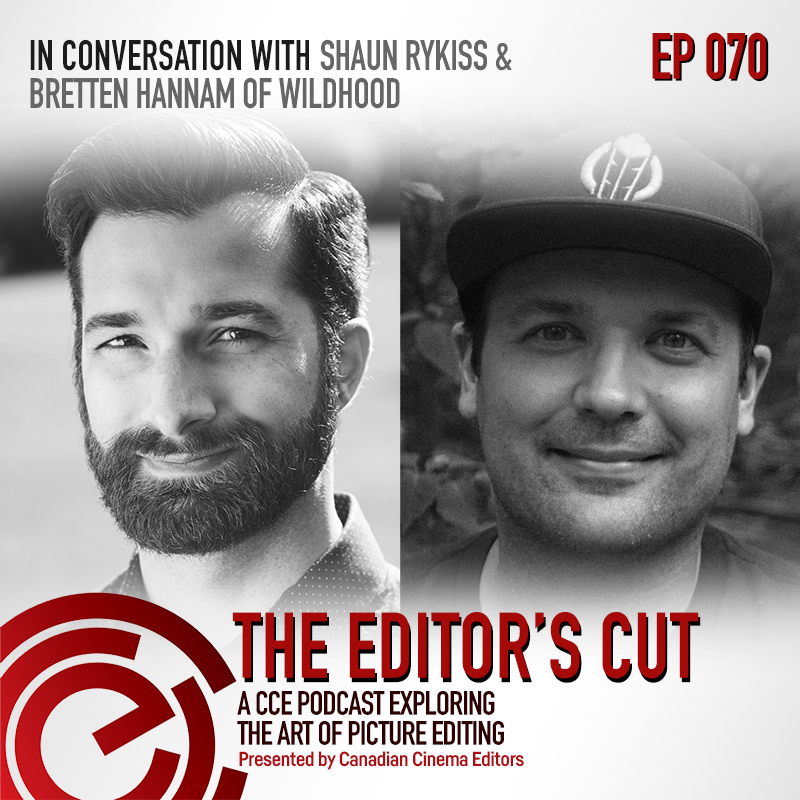
The Editor’s Cut – Episode 070 – “In Conversation with Shaun Rykiss & Bretten Hannam of Wildhood”
Sarah Taylor:
Today’s episode was sponsored by integral artists – IATSE 891 and AQTIS 514.
Shaun Rykiss:
You know you can often use temp music as a crutch to convey emotion and to set up the tone feel of the scene and as with everything else in this film, with the material, with the writing, you know it’s very organic and it’s freeform and it’s a bunch of boys wandering through the woods. And it required musically a similar feeling and was very hard to temp for, for one thing. But also I think the floaters had a natural rhythm that we wanted to abide by. So I’m glad we cut it without, because by the time we did get the composer on board it just was a natural fit.
Sarah Taylor:
Hello and welcome to The Editor’s Cut. I’m your host Sarah Taylor. We would like to point out that the lands on which we have created this podcast and that many of you may be listening to us from are part of ancestral territory. It is important for all of us to deeply acknowledge that we are on ancestral territory that has long served as a place where indigenous peoples have lived, met, and interacted. We honor, respect, and recognize these nations that have never relinquished their rights or sovereign authority over the lands and waters on which we stand today. We encourage you to reflect on the history of the land, the rich culture, the many contributions and the concerns that impact indigenous individuals and communities. Land acknowledgements are the start to a deeper action.
Today’s episode is the panel that took place virtually on April 11th, 2022. In conversation with Shaun Rykiss and Bretten Hannam on the film Wildhood. Shaun and director Bretten discuss their approach to bring one of this year’s most acclaimed films, Wildhood, to the big screen. Wildhood is about two brothers who embark on a journey to find their birth mother after their abusive father had lied for years about their whereabouts. Along the way they reconnect with their indigenous heritage and make a new friend. This panel was moderated by Kimberlee McTaggart, CCE.
Speaker 4:
And action.
Speaker 5:
This is The Editor’s Cut.
Speaker 6:
A CCE podcast.
Speaker 5:
Exploring.
Speaker 4:
Exploring.
Speaker 6:
Exploring.
Speaker 5:
The art.
Speaker 6:
Of picture editing.
Kimberlee McTaggart, CCE:
Thanks everyone for joining us, and Shaun and Brett. I’m located in Mi’gma’gi, the ancestral unseated territory of the Mi’kmaq people and we acknowledge them as the past, present, and future caregivers of our land.
So yes, I’d like to welcome Brett Hannam, who is also here in Nova Scotia, and Shaun who is in Toronto right now. Shaun Rykiss is the editor of Wildhood, directed, written, and produced by Brett Hannam. The film has been making the festival circuit including TIFF Vancouver and won, I think just about every award here at the Atlantic Film Festival. You laugh, but it’s true. It was nominated for six CSA awards and did win for best supporting actor for Joshua Odjick who plays Pasmay.
Brett, a very wise man once told me that any award for a film is an award for the writer. So there you go. And also when it’s for performance, I always think that the editor owns a little piece of that award too. So congratulations to you both.
Bretten Hannam:
Thank you.
Kimberlee McTaggart, CCE:
Shaun, before we get into the film, I just wanted to ask you, as an editor, I’m always interested in other editor’s journey, how they came to be sitting in front of their editing suite. So, what’s your journey and how did you become an editor, and why editing?
Shaun Rykiss:
The how is it starts with just you know having fun with editing software. Growing up, you know I remember it’s just…I remember, for example, taking some of my favorite clips when I was a teenager from movies, like action scenes like Lord of the Rings and stuff like that and Star Wars. And like just with Windows Movie Maker, editing my favorite rock music or that sort of thing to the scene, just to like have fun with it. That was the first memory I have of really editing anything. That and school projects, that sort of thing.
But that all came to a head when after going through university, I initially studied psychology and then transitioned out of that when I got my degree into film studies, which eventually led me to and that was in Winnipeg where I’m from originally. That led me to go to Vancouver Film School where I attended Vancouver Film School for 12 months. It was a great intensive program where we got to dip our toes into kind of every different type of discipline. Made a lot of short films while I was there and just continued to realize how much I love editing.
I love the craft of post production, of taking footage and making something of it, making something out of it that you didn’t expect and that led me to my first job as an editor, which was working for a…aside from editing short films and that sort of thing, I was working for a bit of a gorilla operation in Vancouver, editing unscripted television and docuseries, that sort of thing.
That started in that producer’s apartments and a bunch of editors in the different corners of his living room. And eventually that spawned into multiple TV series over the course of my time involved, four or five years, and we got an office. And that resulted in me getting to wear a lot of hats because as one of the earlier editors involved in the studio, as we grew, I got to take on more responsibility, got to dip my toe into post-production supervision as well as eventually series editing as well as the actual editing of the episodes.
But all things considered, I missed scripted storytelling. I had edited short films here and there, music videos, that sort of thing intermittently…but I always got into film because of script storytelling. So in trying to pursue that further, that led me to discover the Canadian Film Center, which is based in Toronto. Happened to apply back in 2016, got accepted and decided to make the move to Toronto, both to attend the program and to expand my career. And so that’s where I met a lot of my fellow filmmakers based in Toronto, one which is Gharrett Patrick Paon, who is the producer on Wildhood. And the rest, as they say, is history.
Kimberlee McTaggart, CCE:
Is that how you were led to Brett? And Brett, I know that there is this feature film lived as a short film first called Wildfire, which is a lovely little short and even though it’s quite different having to be a short, I love how there’s scenes that are moments in it that are just directly into the feature film. But I know you edited that, Shaun, so is that how you two came together?
Shaun Rykiss:
Yeah, 100%. As I recall, Gharrett had sent me an early version…early cut of Wildfire. Brett, you had edited the first rough cut, right?
Bretten Hannam:
Yeah.
Shaun Rykiss:
And Garrett had sent it to me just for some notes and I guess he liked what I had to say because then he followed up by asking if I’d be willing to take a crack at it, obviously with Brett’s permission. And that led us to building our relationship and edited Wildfire as you now see it and on we went.
Kimberlee McTaggart, CCE:
Okay. Well then on to Wildhood. First of all, well, you know I’m a huge fan of the film. I think it’s an absolutely beautiful film. I’ve watched it twice, the first time as a viewer, always the best way to view a film, just as a viewer. The second time I viewed it as an editor. And I know I was telling you I felt when I was watching it that there was probably a lot more to this film that didn’t make the film. And I say that not feeling that it was too long or that there were things…that felt things were missing, just the nature of the film felt like you probably had a lot of material. So, can you tell me about that? Kind of what you were dealing with, how much you had to work with?
Shaun Rykiss:
A lot of content. I was editing in Toronto while they were shooting in Nova Scotia, I was editing about a day or two behind. And by the time we had an assembly cut put together soon after they finished production, the initial assembly cut was three hours and 12 minutes.So…and that was pure content. Obviously there’s always room to trim and tighten things up, but overall compared to the one hour and 40-minute final film, there was a lot of extra, like I said, content and material that could have ended up in the film. So lots to work with, which was in the end such a blessing because it allowed us to make a lot of you know…play with a lot, try different things and try to tell the most focused story that we ended up with.
Kimberlee McTaggart, CCE:
So Brett, in doing that, in sculpting down the film, what was your guiding principles in deciding what stays and what goes?
Bretten Hannam:
Well, I mean, it’s always a discussion. Part of it was that there’s the macro part and the micro part, but ultimately it was, is this true to the story or the spine of the story is there and the flow and shape of the story? So when you make your assembly, it’s like a hodgepodge and you hope there’s something in there. And then as we were going along, it was like, let’s try this. We’d talk about the scenes and what was in there and what we’d include and we’d watch it. I think in the early days we weren’t doing livestream edits. It was more like Shaun would do a bunch of stuff…we’d talk, Shaun would make a bunch of cuts, he’d send them to me, I would watch them and then we’d get back together. This was really kind of a longer process, but it was just really honestly being about like, this scene doesn’t feel like it wants to be there or it feels like we want to move to this place faster, or we get into the story faster, or we want to stay with this character here or that character there.
So part of it is maybe instinct and then saying, is this the best scene or the best way the scene can be, or the best place for this scene for the story as we’re kind of finding the shape of the story again in the editing phase. So it’s a collaboration, primarily between Shaun and I, and then we’d get feedback from our producing team and other people as well and then decide what to ignore. No. But the great thing about editing is you can try out a lot of stuff. So we would try stuff and I’m like, oh no, totally, that doesn’t work okay. Or like, oh, that thing I didn’t think would work or we didn’t think would work is not a bad idea. So it was an interesting living process.
Shaun Rykiss:
Yeah, especially having had to do it remotely because again, Brett is based in Nova Scotia, I’m in Toronto and this happened, I think Wildhood was the first production that shot in the pandemic. Didn’t it? In the East Coast.
Bretten Hannam:
Yeah.
Shaun Rykiss:
So, we were all trying to kinda figure out the best possible way to do this. Initially before COVID really hit, we planned to fly Brett in to work with me at least for week at a time…weeks at a time. And then when everything happened, the outbreak got a little out of hand, then we were like, okay, let’s try pushing this remote thing and see how far it takes us. So, finding that rhythm was interesting early on, but we definitely, especially as Brett alluded to you, once we started live editing and figured out a system for that, it had a natural flow to it.
Kimberlee McTaggart, CCE:
And it’s certainly something we’re all getting used to. I know it’s probably harder with feature film to do it remotely in the notes way, but in television, wow, sometimes you can go whole season without seeing your showrunner. Now it’s kind of-
Shaun Rykiss:
Here’s the funny thing about that though is last year, including Wildhood, I cut three feature films and I did all of them remotely. I didn’t sit one day in the edit room with …
Kimberlee McTaggart, CCE:
Wow.
Shaun Rykiss:
So I don’t know how to cut film.
Kimberlee McTaggart, CCE:
And to get into a techie question, do you deal, in those three cases, for instance, mostly with notes or do you do any live over the airwaves type editing?
Shaun Rykiss:
Mostly live.
Kimberlee McTaggart, CCE:
Oh really?
Shaun Rykiss:
And that was partially a workflow that was developed through Wildhood. I like to do a combo between, I use Frame.io as a service because I just find it’s a great way for-
Kimberlee McTaggart, CCE:
It’s fabulous.
Shaun Rykiss:
It’s just a really polished experience and it’s easy for…once you get the directors and the producers acclimatized to it because they’re not all initially. Actually that’s a good point too, just to go on a tangent quickly because one of the earliest conversations Brett and I had was trying to figure out the best way to literally communicate with each other creatively. And I remember we had to do a little bit of back and forth with Frame.io to figure out what the best use of language was. And I remember the key to it, for me at least, was when we agreed like, okay, Brett, just when you’re typing notes on Frame.io, say whatever’s on your mind. Literally just, even if it’s a paragraph or an essay, just type it as it’s coming out of your brain.
And for me that’s always essential because it’s sitting in a room, you’re going to get all those kind of intangible thoughts that you then take. And as an editor especially, you try to then translate into what ends up in the timeline. I love…I’m an editor who loves information. Give me more, give me as much as possible and then I’ll filter that down and ask a lot of questions. So that philosophy kind of unlocked, at least for me, I don’t know about you, Brett, but a productive flow of communication. And then to get back to the initial question, Kim, once we got that settled up with Frame.io, and basically we would use Frame.io on earlier cuts like Brett said. And then once we decided to get into the fine-tuning, then we would hop onto a live session.
Kimberlee McTaggart, CCE:
Right
Shaun Rykiss:
And with the live sessions, the workflow I use is through a chat app called Discord, which was a gaming platform initially. So it has a streaming function. And just experimenting with it, you could stream 720 P pretty smoothly as long as you have a decent internet connection. And it took a little messing around with because we’d have to set up a separate communication call, whether it’s on a phone call or FaceTime or whatever to handle communication and then I would stream both my video and picture from my system through Discord.
So there’s a lot of muting and unmuting yourself to make sure that during playback you’re not getting too much feedback, but you find a rhythm and you get used to it and you get used to each other’s rhythms and figure it out. So that’s how I’ve been editing these films. That’s how we learned how to edit on Wildhood.
Kimberlee McTaggart, CCE:
All right, well why don’t we move to our first clip. We’re going to start at the beginning. This is the intro to the film, of course being one of the most important parts of your film is your intro to your film.
[clip plays]
Shaun Rykiss:
Again, that’s the clip as it appears in the final film. What we’re going to show next is a rough cut version of it that included additional content that you’ll see sets up the film in a little bit of a different way.
[clip plays]
Kimberlee McTaggart, CCE:
So quite a difference. That’s some important decisions to make. I mean that is your opening scene, setting your character, setting your tone, letting us know what we’re going to be seeing. So how did you come about with what you did?
Shaun Rykiss:
The first thing that I think is worth mentioning is again, what the differences do to the film. Obviously what we landed on is quite a bit more concise and moves quite a bit faster and that’s always something that you’re conscious of, it’s certainly something that came up a lot as we got into the later phases of the editing is…how can we get the ball rolling quicker?…How can we get the boys on the road quicker?…And that’s not always…it sounds like a bit of a rote note because you’re like, well what if we don’t want to get them on the road quicker? What if we just want to enjoy the long part of the journey? But there is always value in getting the first 10, 15 minutes of your film moving quickly, so that’s always something to be conscious of.
That being said, one thing, Brett probably hasn’t seen this in a long time and certainly hasn’t seen this with music, this is something I tossed in at the end in preparation for this because we cut it without music initially. And that’s some of the final music in the film that you hear in there that I added in. There’s a lot of interesting character notes in the extended version that set up some things and set up the world that we either don’t quite get to in the final film or we do in other ways.
And so that’s something else that we’re always asking ourselves is in trying to condense the start of the film, are there ways to introduce these elements elsewhere in the film? Do we have to do it here? Can we find ways to drip feed that information throughout? So those are some of the thoughts that went into the different types of things that got cut. Brett, any thoughts on specifics about some of that extra content?
Bretten Hannam:
Super weird to see it with music, that’s all.
Kimberlee McTaggart, CCE:
Well, one thing is we learn that he is gay there, or most likely gay, which I’m not sure exactly where we learn that now.
Bretten Hannam:
It depends on what you’re cued into. But yeah, so there’s that. We talked about centering things more on Link’s identity and how he sees the world and interacts with the world and that scene is kind of more a view, and oppression maybe from outside. A force from outside the world pressing in on him and setting up that he’s at odds with also his environment, which kind of became a double beat in a way because his father does all that anyway.
So it became one of those things where…are we doing this in other places?…and then do we need this…and then let’s try it without it and then oh, we don’t need this or maybe we do…no, we don’t. So that’s kind of…at least part of me remembers that conversation. And then the whole dirt bike thing, we didn’t lose too much by not having the dirt bike in, though I love the dirt bike. I love it all. All the stuff that we cut was not like, this is terrible, we have to cut it. It was more like, is this the way we want to go or is this giving us what we need at this point? Early on I think we take a little bit of time with the hair dying scene, the beginning, and then we took time with the bullies and then we took time with the dip, then we took time with the paint and it’s like we took a lot of time.
Kimberlee McTaggart, CCE:
One thing that I found interesting too is when you have so much material that you have to shake down and you’re in the middle of a pandemic is how important it is to show people and get feedback as you’re cutting and when you get really into the thick of it, you start to lose your objectivity and all of that sort of stuff. So who did you rely on? Did you have a whole group of people who you would send and save the certain cuts for some people? Or how did you deal with it?
Shaun Rykiss:
Yeah. Obviously our internal team to start, which was us plus our three producers, Gharrett, Julie, and Damon. And they were great about giving us the space to do the work and get cuts prepared to the point that we were comfortable with them and then we would have intermittent kind of checkpoint reviews with them. And then once we, I can’t remember what phase exactly, but definitely later in the rough cut is when we first started to show people. And I think it was just general colleagues within and without the industry of different focuses and disciplines. Certainly I have my gang of editors who I like to show things to and get their perspective and then Brett and the rest of the team I’m sure have their own…their different disciplines.
Kimberlee McTaggart, CCE:
Did you have any big surprises in that process?
Shaun Rykiss:
I don’t remember there being too many big surprises. The one major surprise we kept coming up against, which led to a huge change in our film, was how much people didn’t need to see as much of the dad, of Arvin and how comfortable people were with the idea of because as we’ll probably talk about at some point there was a lot more of Arvin throughout the film. And that’s definitely something that I remember coming up in multiple sessions was people being like, “I get it, he’s an asshole, he’s oppressive, he’s evoking or imposing these worldviews on Link.” People were getting that right from literally the first frame of seeing him and subsequent scenes. So that made it a lot more comfortable to make some heavy edits, heavy cut downs, which took out a lot of time, which is great.
Bretten Hannam:
We got pretty bold at one point. It was just like, let’s make these deep cuts and just see what happens, and you know, because, well, we can always undo.
Shaun Rykiss:
Yeah.
Bretten Hannam:
So I think Shaun went through…we had divided the film into reels, so went through and like made these deep cuts and then it was like, let’s watch it. And it’s like, oh, actually these deep cuts are pretty on the money.
Kimberlee McTaggart, CCE:
Most of that was with Arvin.
Bretten Hannam:
Yeah and some of its whole side adventures inside with the characters. Like entire big scenes that are just…they change maybe the perception of the characters, or it kind of feels like they’re on a journey and then they kind of went over here and they hung out for a while and then they kept going like it loses momentum.
Kimberlee McTaggart, CCE:
Right.
Bretten Hannam:
So those were kind of like we were pretty merciless. Which is hard to do, but you find a way.
Kimberlee McTaggart, CCE:
And did you feel the loss of anything in losing Arvin? I mean he was chasing them, right? And coming upon them every now and then kind of thing?
Bretten Hannam:
Well…part of it is…yeah. I mean it’s just a facet that we don’t get to experience with the way the story is now. But did we need it? I don’t think we did. Arvin has a bit more character development. Right? He’s not just a two-dimensional character. There’s more nuance. He doesn’t do like a 180 degree change at the end. He’s just kind of like maybe three degree change. He’s slightly less of an asshole, but he’s still an asshole. But there are confrontations that happened between him and Link where Link is more asserting his identity and asserting his personhood, I guess, and getting in shouting matches and running through corn fields. I mean I miss those things, but they are kind of…Shaun, we talked about it being like you know those scenes, even though they’re not there, they were instrumental to the scenes that come after them. Right? We still build…the performances build on those things, I think that’s one of the things that makes the film seem like it has a bigger life or world behind it, something like that.
Kimberlee McTaggart, CCE:
Well I was actually quite surprised when you told me he was initially all through it, which is good. I mean it felt totally organic without, so…
Bretten Hannam:
That was thanks to some little wizard tricks that Shaun did.
Shaun Rykiss:
Well, but again, it comes down to the advantage of having so much footage and so much content. You guys shot for, what, 30 days out in the hot summer in Nova Scotia. And I don’t know…I couldn’t tell you…I can’t remember exactly how much footage it was, but again, there was a three hour and 12 minute assembly. It gave us the flexibility to find creative ways to condense and lift chunks of scenes out so that we could merge others. And without all that footage, I don’t know if we could…I think we would’ve been locked into a lot more tough decisions,so…
Kimberlee McTaggart, CCE:
Right. All right, well let’s move on to another clip.
[clip plays]
Kimberlee McTaggart, CCE:
Here’s, I guess, one example of showing your audience and getting some feedback. So why don’t you tell us about this scene and how it came about.
Shaun Rykiss:
The first sequence rather when he gets out of the car and they’re walking off, that was all written, shot, and designed as a beautiful water, that works great. But then going into the next scene, which is a talk at a campfire, we felt like…in putting together the assembly and showing it to the internal team that there wasn’t quite enough tension at that point. Clearly you can tell by Link’s body language at this point, things are tense between him and Pasmay. Link’s still trying to make these tough decisions to keep him and Travis safe and going from that directly into the campfire scene, they got a little too cozy too quickly. There’s a little bit too much…the tension was lost a bit, whereas in acknowledging that, I believe it was our producer Gharrett who came up with a great idea during production while they were still shooting to get this purple sky scene, which was an example of trying to generate a little bit of extra tension in the group dynamic, create some separation between Link and Travis and Pasmay and just show that they weren’t quite connecting yet. There was room to grow there and through some great blocking and obviously a gorgeous setting, I think it accomplishes that in three or four shots, showing them collecting together. Link kind of throwing a wary glance over at Pasmay with almost no dialogue, but sometimes that’s enough to just help sell that type of tension, so, yeah.
Bretten Hannam:
Plus the hiccups.
Kimberlee McTaggart, CCE:
Yeah, this was the first time I noticed the hiccups.
Shaun Rykiss:
That’s part of the thing that makes that scene work so well too is that despite the tension, which is there, you have Travis. First of all, the relationship between Link and Travis is so clear that older/younger brother relationship where Link’s trying to help Travis in his own way and Travis is like, “No, leave me alone. I got it. I’m big enough, I can do it.” Which is already great. And then the whole time he’s hiccuping while he is trying to be this big strong man. And then that goofy little thing that he does holding the branches, trying to carry them over, it just adds that extra bit of genuineness that you can only get by having a kid actor involved. So credit to Avery for that.
Kimberlee McTaggart, CCE:
And it really shows too how beautifully shot this film is. You did a fabulous job. All right, why don’t we go to… I love this scene, the first dance.
[clip plays]
Shaun Rykiss:
You know, it’s always interesting when you get a scene that is mostly silence and body language in addition to having a little bit of action because in terms of setting up the various checkpoints that you have, the beats and the blocking that you want to hit, you have to be a little bit…usually with dialogue you have those key lines that you’re building towards and that you’re wrapping the edit around, and with this it was more about glances and it was more about gestures. So, thankfully there was some beautiful blocking that really highlighted those things.
But I do remember, one of my earlier cuts, didn’t quite have a shape that we ended up with. It was a little bit more dry, it kind of got to the dance a lot quicker. And when Brett and I finally got digging into it, they really spent a lot of time with me developing that shape. And one thing we talked about a lot was the intimacy of the moments, and intimacy not just between the two of them, but for Pasmay alone at this moment, at this time of day when everyone else is asleep. Brett, you can speak more to this, but the interesting dynamic of Link accidentally invading that. And then the reaction that they have to that moment and obviously what spurs from that.
Building up to the moment where they come together was an interesting process of slowly stretching out moments and figuring out, okay, we should cut back to Link one extra time to make sure that we’re seeing his processing of what he’s observing and give Pasmay time to take that in, digest and figure out how he wants to proceed.
Bretten Hannam:
Yeah, I mean that’s kind of how the discussion evolved. Talking about what the moment is or what the emotional moment is between the characters and what’s going on. So you have these two that have been coming along, well and Travis, he’s sleeping. But they’re slowly getting closer throughout this time. And this is a private moment for Pasmay, a prayer. You can’t quite hear it, but there’s a prayer that he says in Mi’kmaq before. As Link is waking up, he kind of hears it and then he’s practicing his dance. And it’s not just dance moves that anyone is practicing at home, dancing is a sacred thing, a special thing.
So it’s quiet, he’s with these others that aren’t really…he’s not super close, but they’re beginning to get there and he’s interrupted and then it’s a moment where you can choose to be like, okay, well I’m not going to do this right now, or I could proceed and just ignore them. But instead the choice that Pasmay makes is to invite Link into the moment, into the space. So they’ve crossed that threshold and that’s that hand extending and being pulled up and then passing on this knowledge, this tradition and reconnecting.
So they’re both getting different things out of what’s going on, and we’re very with them in the moment too. And then the Travis comment and the rebuke I think is always interesting to watch or experience with an audience because most of them are in that moment laughing because Travis is…that’s the kind of kid he is. Right? He’s kind of off the cuff, “You look like a douchebag.” And I said, oh, that’s a funny thing. Like, oh, he’s just a jerky little kid or whatever.
Shaun Rykiss:
Without fail that moment has gotten a laugh in every screening. Whether it was notes that we got where people would kind of live comments on their thoughts, they would always comment that they found that funny at first, or witnessing it with audiences like Brett’s saying. People always laugh. And then it’s always interesting seeing the tension that fills the room afterward when you hear Pasmay’s reaction.
Kimberlee McTaggart, CCE:
And also to see the look on Travis’s face is just almost heartbreaking.
Bretten Hannam:
But that’s a teachable moment too. Those are teachings as well. We teach in many different ways. And so for Travis, they’re all learning something in that scene. It’s one of the reasons it’s a great scene. And then at the end when we see his face like that, he probably also feels guilt and shame and all sorts of things. But then we go, I think in the end of that clip there’s a little bit of the next one, which is they’re walking but Link’s not quite with them and that tension and separation is something I think that you feel when you watch it because that moment is set up like that.
Shaun Rykiss:
And that took a lot of extra work because I remember we had to…that footage of them walking, we had a bunch of different footage of that same kind of sequence of events, from different angles, from different times of day and it took a while to get the right amount of it, the right shot composition, just to make sure that you lived in that moment for the right amount of time, but also didn’t get too bogged down by it. That was actually an interesting…it required an amount of extra work compared to it could have just been one shot and then you’re done. I remember we had to go back to it quite a few times to make sure that it felt right.
Kimberlee McTaggart, CCE:
And at the beginning of that scene, we saw one of the flashbacks. Can you talk a bit about that, how you decided where to put those in the film and at what moments and show how much? And were they unscripted or did that all kind of get moved and created in the editing suite?
Shaun Rykiss:
Yeah. Brett, do you remember if this one was in the script at this point? I actually don’t recall.
Bretten Hannam:
I think they’re more or less where they go in so far as where they are. But then what they are is something that’s shaped more by the shooting, how we ended up shooting and approaching the moments and then the editing of them, the shaping of them into the story. Some of them are a lot quicker than I imagined, and there’s different motivations for when we were talking about how we’re going to use them and build them. Really, there’s an arc to them in a way. At the very beginning it’s kind of more vague, not in focus, it’s not quite clear. It’s more fragments, working up to a bit of clarity, a bit more, what’s the word? Intercutting with the real world. So back and forth to a more clear memory kind of at the end. Those were shaped as we went. Did we do a pass that was only memory?
Shaun Rykiss:
We may have. Yeah, I think during the final cut, you’re right. I think we had at least had a pass as we were working through the film, we’re like, let’s make sure we’re keeping track of flashbacks specifically and see if there’s ways to shape it. Because as Brett said, there was an arc to the flashbacks. I think total there’s probably, well, there’s definitely less than 10 shots of flashback throughout the film, maybe somewhere closer to eight. But in addition to the vagueness and the more surrealist portrayal of flashbacks earlier on versus the more grounded portrayal later on.
We also talked a lot about how…because every flashback sequence, because as Brett said, they were scripted and they were shot for those moments. There was quite a bit of footage for each one, and we talked early on about how much to show. Do we develop these into a little bit more substantial two or three shot series/sequences or do we keep them more minimal and make them more moments in time?
And that’s essentially what we landed on was these are flashes of thoughts that Link is experiencing at every given point that we see…we witness them in the film. And I remember we really realized in experimenting that that was the best way to go because it felt the most real and the most tangible. It felt the most relatable because that’s how memories come to us. Right? They’re often not full-fledged sequence of events. Even dreams, they’re constantly…you’re flashing between things that are changing and ebbing and flowing. And we wanted to make sure that the flashbacks felt that way, especially because Link’s memories are…they’re deconstructed, they’re not fully formed. And so we wanted to make sure that the audience was with Link in that same feeling of disconnection.
Bretten Hannam:
I think one of my favorite uses of that is actually it’s in the house, and it just comes at…there’s a scene that’s more of a flashback and then we kind of move away from it. But then when it’s in the emotional space, where it is called for a flashback comes up for, what’s that shot of Sarah’s face completely out of focus, very quick.
Shaun Rykiss:
Her from the blurry perspective, POV perspective of young Link as an infant and her doing a peekaboo or something and it’s just for an instance and it’s right at the peak of a moment of music, but that’s how memories hit us. It’s like you see something or you smell something or taste something and suddenly you just get that flash, that flicker of, wow, where am I for a second? And we really tried to embrace that as much as we could throughout the film.
Kimberlee McTaggart, CCE:
I’m just curious, what was your schedule like? How many weeks did you have to edit this film?
Shaun Rykiss:
We took our time, it was about a seven-
Kimberlee McTaggart, CCE:
No shame in that.
Shaun Rykiss:
…seven or eight month edit.
Bretten Hannam:
Yeah.
Kimberlee McTaggart, CCE:
Oh wow. That’s fabulous.
Shaun Rykiss:
Yeah, I don’t think that was intended initially, but that speaks to the patience and the quality of our team. They really…our producers really gave us the time and the space to play and experiment. And when we sent out the cuts for feedback, we would take a little bit of time off and let it digest and we wouldn’t rush back into it. I was so grateful for that experience because again, it was my first feature film. And not having to rush it and feel rushed in getting it done really allowed us to do things like cut an hour and a half of the film.
Kimberlee McTaggart, CCE:
And breaks. I mean to have a break in the middle of a feature film edit is…that’s the best.
Shaun Rykiss:
Because I’ve had it the other way now. And yeah, you don’t want to feel rushed in the decision-making. Sometimes it’s good. Sometimes it’s good to have a sense of urgency and you know you need to get a scene done and you will focus on what’s required of that scene. But especially with a feature film, you need to give it time to breathe and tell you what it is because it’s not most of the time what you wrote. Right, Brett?
Bretten Hannam:
Yeah.
Shaun Rykiss:
And you need to be willing to listen to what the footage tells you, what production gave you, what the decisions of all of the other filmmakers who became involved, what they provided and what the performers provided. To rush a film is often the worst thing you can do.
Kimberlee McTaggart, CCE:
And speaking of that, surprises, did any of the actors give you something really surprising, Brett? Or are they pretty much as you had on the page? Or did something surprising come on the floor with your actors?
Bretten Hannam:
There was always surprises with them. We were doing two weeks of quarantine at the time, so you have no rehearsal time or you have one day of rehearsal time. I’m like, that’s terrible. And they can’t rehearse over Zoom because who could ever do that? So then they’re like, “No, we’re doing it every day. And we had an acting coach.” So every day they were rehearsing, and then I would be working with them and they would go away and do some work and they’d be like, “Here’s what we found or what we are working on.”
And so there was a good relationship there as well of, oh, okay, I can see clearer. This is the way things are going naturally and this is the way I’m dictating things. So it would make a better story if I let go of that thing and I follow what’s going on here, keeping things kind of on track, more or less. And then on the day, because they’re so in the characters and into the material, there were several scenes that were…people were, not just me I think, but very moved by or upset by or slightly traumatized by.
So there was always that willingness to be vulnerable and to go to those places, I think. And that’s what brings out those surprises. And we did some unscripted stuff too. I wish we had more time to do unscripted stuff because it’s super fun and you never know what you’re going to get. Sometimes you get half an hour of like…they’re kicking cans and nothing’s going on, and then other times there’s loon calls and great material.
So then it was looking all over all that stuff with Shaun and being like, okay, what do we have? And let’s find those real moments. I think at one point in the script, Link and Travis are going through a junkyard and Link is going to chase him with grease on his hand or something, and he trips, he falls because his pants are caught up in something. But that was just a thing that happened. And so it was like, oh, let’s find those things and put them as many as we can, if it makes sense, into the story.
Kimberlee McTaggart, CCE:
Yeah you can feel those in the montages. I mean they feel almost documentary-like, they definitely feel real, yeah like not something you would script, so that’s-
Bretten Hannam:
Yeah it was kind of looking for those magical things and then being like, let’s keep those in the edit, just to build that sense of the world and that it was happening and not scripted and away from the script, far away from the script.
Kimberlee McTaggart, CCE:
It’s nice that you could take that time on the set as well as in the edit suite to get that sort of stuff because it really did create magic in your film.
Bretten Hannam:
Yeah, it was one thing that we talked about going through the process and editing was like, from now on when I’m shooting, I’m going to do at the end, just a take that’s all silent. Just do it all in looks, do it all in motion and movement because there’s so much of that that is so powerful when you get into the editing stages about, well, Shaun, you’re stealing little kind of bits and things here and there for looks and stuff. It’s like, wow, if we did that take, it’s just a take at the end of takes. If there’s time to do that, then you have this extra little bit of icing that you can be like, oh, we want a little sweet spot here and there.
Shaun Rykiss:
Yeah, further to that point too, that was one of the earliest conversations Brett and I had. Whenever I start on a project I always like to talk to the director about just their vision. Based on the script and based on your experience shooting, tell me how feel, how this film feels to you. Tell me, obviously references and stuff are great, but describe what you think the sense of flow is and time. And one of the earliest things Brett said to me was, “If this film could be silence without dialogue, I would love that version.”
And obviously in my mind I’m like, what? What are you talking about? But it was such a wonderful guiding principle because again, it opened up for me like, okay. We never got as far as to really try it with a given scene. But my approach then, whenever I was assembling a scene and refining it was, is this dialogue necessary? Is there a way to do it without dialogue? And if not, or even if you only remove a little bit of dialogue, how much can I tell with a glance? How much can I tell of this feeling with just emotion or body language?
And I think that ended up coming through, that principal came through with the performances, especially with Link, who is always…Phillip is always doing so much. There’s a weight to Link’s character that is prominent throughout the film. And we spent the most time from the beginning of the film at that three hour stage up until the final moments of locking was making sure that every bit of Link’s nuance was coming through and that you always felt like there was more going on underneath the surface no matter what scene he was in. And I’m proud of what we ended up with.
Kimberlee McTaggart, CCE:
Absolutely. And did you end up losing a lot of dialogue in the film, in the process?
Bretten Hannam:
Not as much as I thought we would. But yeah, when I write there’s not a ton of dialogue anyway. And I remember talking to Gharrett, one of our producers, and I was like, “Yeah, but it’s fine. They can say this scene.” Or, “In this scene they can say this or that.” I was like, “This dialogue is just to get us to the place anyway. I’m going to cut it.” And he is like, “What? There’s like barely any dialogue, how can you cut?” and then as we began to work on it and Shaun is kind of retooling and approaching these scenes in these different ways with these looks and really crafting with silence, which I love, then I think it became clearer about like, oh, okay, yeah, do we need this? I was like, “No, we do need that line. We do need that.”
Shaun Rykiss:
There was a lot of taking out dialogue to see if we needed it and then putting it back in.
Kimberlee McTaggart, CCE:
Right right, see if you can get away with it.
Bretten Hannam:
Yeah.
Kimberlee McTaggart, CCE:
Yeah. Nice.
Shaun Rykiss:
Well, that’s what happens when you’re writing good scripts.
Kimberlee McTaggart, CCE:
Well, on that note, let’s talk about reshaping a scene a bit and go to the Smokey meeting.
[clip plays]
Kimberlee McTaggart, CCE:
So Shaun, why don’t you tell us about the challenges in that scene?
Shaun Rykiss:
Yeah, this, as you alluded to, was quite a challenge, actually, the most challenging. This and the scenes that follow for about the next 10 mins or so…5-10 minutes were the most challenging part of the edit because we ended up completely retooling the use of this character Smokey. In the script and what was shot, Smokey is much more of a vague character. Vague is actually the wrong word, he’s more of a red herring in that he’s presented to the boys, and through their perspective, he’s much more of a darker character. He’s a lot more…they build this…they see this kind of biker looking dude with tattoos and in the original performance that we had more of a tough portrayal, tough personality. They misconstrue Smokey as a bit more of a criminal type.
And so in the original staging of the sequence, we don’t reveal that he is a baker initially. He’s a lot more shady is the word I keep trying to look for and then when he asks them to come help him, it’s more of help him with a job. And so by the time they get to the convenience store, that whole engagement outside of the convenience store at the van is a lot more ambiguous and it’s more like Link and the boys are tense about Link going in to help Smokey pull a job.
And then the scene that follows when they get back into the van after talking to the store clerk, Desna, it’s a lot more tense. And Link thinks that Smokey robbed the place while he was swinging around back. And at one point there’s a gun involved. And we ended up cutting all of that, not cutting it out, but we cut out the gun, we cut out the tension and we brought a lot more focus to the real Smokey who inevitably in the original version would’ve discovered this sweet kindhearted baker who is just a member of the community who ends up being a gateway for Link and the boys into this inclusive community that they end up meeting.
Ultimately, we changed it for a number of reasons. This was the thing that we got the most feedback on, that people continuously in that original version were either confused by or they thought there was too much going on, or it was just…just wasn’t feeling quite right. It also was a longer sequence. So we were constantly looking for ways to get it more concise, trim it down and to clarify. And in the end it resulted in, why don’t we just try making Smokey who he is from the beginning? Which then dictated how the rest of the changes played out.
But ultimately I would say we’re happier with it because Smokey’s already a unique, interesting character without the red herring and especially in this film full of joy and community building and discovery of culture, you want that to be the driving force behind their interaction with Smokey. And the other stuff, as much as it was fun and there’s some action and whatnot, it was getting in the way of the bigger journey. So we got down to it and started cutting out guns and stuff.
Bretten Hannam:
There’s too many rocks in the river. We had to pull up some rocks and let the water keep going.
Kimberlee McTaggart, CCE:
Fair enough, fair enough. Speaking of the river, let’s go to the waterfall, also known as the sex scene.
[clip plays]
Kimberlee McTaggart, CCE:
So why don’t you tell us about that? You wanted to talk about length, we spent a lot of time with them. So tell us about your decisions in that.
Shaun Rykiss:
Yeah, the main point to discuss, as you pointed out, is the length. Because it’s a longer scene, it was always a longer scene from every point. It certainly was longer at the earlier stages and we did find ways to cut it down. But one of the most interesting things that happened with the scene was every time we cut it down more we felt resistance from the scene. We felt like we were losing too much or we often felt like there was a beat that got lost or there wasn’t enough time between beats compared to a previous version.
So, ultimately the scene didn’t change too much from what those early release rough cut scenes and the version of the scenes ended up being because every single beat, every single moment of intimacy throughout felt like it wanted to be there. It felt like it was earned. And as soon as you lost one, even in trying to make things a little bit more concise, you realized that you lost a piece of the journey, a piece of the boys becoming comfortable with one another or a piece of permission because one thing that we were incredibly careful with with the scene was making sure that both parties felt included, both parties wanted what inevitably comes. We never wanted this to be at all ever portrayed as there might be an imbalance within this moment. It was always 100% the two of them together in the moment. And they progress slowly because that’s how these things in a loving relationship do, without force and without resistance. And so that was incredibly important to us to make sure that the intimacy felt genuine.
Bretten Hannam:
It’s one of those things where it’s weird to watch it out of the context. Joshua and Phillip were incredibly vulnerable in this scene and just…I didn’t expect them to do some of the things that they did like they worked the scene on their own. And it was more kind of me talking to them and saying, “What are you comfortable with? How far are we going to go?” With these different stages of elevating the intimacy between them.
And then there’s just stuff in there kind of…Kim, you were talking about like, did they do anything that surprised me ever, and this was one of those times. In kind of close to the end, or after this interaction is finished, you hear a little bit of dialogue between them. That’s not…that just kind of comes out in the moment when Pasmay says, “Are you okay? Are you sure?” That was like…you can’t write that. It just happens. And then making sure in the edit, when we’re doing the sound edit, the edit is there and we can hear, and then we’re doing the sound edit. I think it got pushed back at some point because the-
Shaun Rykiss:
Because it was soft.
Bretten Hannam:
Yeah, it was very soft. And I was like, “No, we got to bring that back” and preserving that moment. But really the thing about the scene is when we were shaping it and some of the things that we tried was kinda getting into it quicker and then it becomes more about, oh, they’re just two teenagers hooking up.
Kimberlee McTaggart, CCE:
Yeah.
Bretten Hannam:
Right? That’s a different vibe than this is really about an emotional connection, like a deeper connection that happens. It’s not you know one then done and one-night stand type thing, they’re actually kind of building off this existing bond and that’s the first part of like, oh, they’re kind of playing around and then it’s kind of like, okay, we’re kind of doing this and then, oh, we’re doing this and then, okay, let’s do this. We’re in…like together.
So I think that, Shaun, is the thing when we kept taking parts out, we were deconstructing that ramp up or that progression and then it just felt kind of like, whoa, now we’re just pulling middle parts out of the thing and it doesn’t seem to be…you can’t collapse the middle part. And you just get a beginning and an end and it’s like, it’s fine, but it doesn’t have that weight to it. And then the consent too as well between them is, the clarity of that was important because of the scene, the day after scene that happens.
Shaun Rykiss:
To Brett’s point, in addition to those earlier moments of them being playful early on leading to the first kiss, the final moments were one that got played with a lot too, because the exit of that scene could be at various points. There was a point where we went as far as cutting out in the middle of one of their big heavy breaths while there was a thrust going on and then we cut hard into the next scene.
And again, we felt we lost…immediately Brett and I felt like we lost so much by doing that. We gave it a try. We showed it to people just to see how it felt but ultimately hearing the two. First of all, seeing them embrace lovingly in a relatively non-sexual way after their intimacy was so essential because the most important thing was that this was a loving relationship that we were building towards that.
And two was the smile that Link gives Pasmay at the end was also essential for that reason. Because even then going further, where okay we didn’t cut quite as early as I just said, but we cut before that smile because the note was to tighten up the finale. Okay, we’ve seen them do it, we see them, they’re happy…okay, let’s just get out. And again, by cutting even just that little moment of them kissing and then backing off a little bit and Link giving him a little bit of a glance, losing that you lost some intimacy, it became more vague. And especially going into the next scene where things are a lot more ambiguous, it created a lot of questions and problems in terms of where the two were in the relationship. So in the end, every one of those beats in the sex scene earned its spot and became required for the journey that we were trying to build.
Bretten Hannam:
It’s a delicate thing, the smallest little moment can change the context of everything that comes after it.
Kimberlee McTaggart, CCE:
Yeah. Okay. Well why don’t we show the scene after? And I’m really glad, I don’t know if budget-wise you tried to get talked out of it, Brett, but I’m so glad you did go underwater or you had the camera.
Bretten Hannam:
Yeah.
Kimberlee McTaggart, CCE:
It really does something for the first part of the scene when they’re just playing around or whatever. There’s something…I don’t know. There’s something really that works about that, so I’m glad you did that.
Bretten Hannam:
I wanted more, but…
[clip plays]
Shaun Rykiss:
Well obviously it’s a direct continuation off of…so that is exact following scene coming from the sex scene and just on the page, it’s already such a fascinating scene because the dynamic is so interesting. Certainly the dialogue implies that Link is in a very strange headspace. He’s not sure how he feels. He’s obviously grappling with a lot of different emotions, a lot of his history and a lot of probably his father’s in the back of his mind, his upbringing, the world of oppression that he’s been feeling. Those things stick with you.
And so in having this wonderful experience the night before, his world has been rocked a bit and he clearly has experienced something that he’s never experienced before. Be it that level of intimacy or love, be it that style of physical interaction. A lot of that is vague, which is deliberate on Brett’s part, and I think rightfully so, because it makes far more interesting scene to leave it open-ended.
But from an edited standpoint, it was one of those just fantastic scenes where you’re again, working not as much with dialogue entirely as much as you are with body language as well. One of the best notes that I got in the film was when we were editing an early version of the scene that was a little bit less deliberate with the footage and the coverage in that you could see more of Link’s face and Brett rightfully pointed out, “I want to try it where you never see Link’s face except for right at the end when he turns to camera” to help obfuscate his feelings.
So you don’t get a specific sense of how he’s feeling in the moment. Let his vocal performance and his body language dictate how people perceive Link in that moment. But let all of Pasmay’s vulnerability drive that scene more than anything and this is my favorite Pasmay scene. I think Josh brings such an interesting energy because he’s clearly full in on this relationship at this point and his reaction to how Link is feeling is…I always find it interesting because he doesn’t know what to do. He’s clearly found somebody who he thinks is his person and he doesn’t want to lose them and clearly Link is in a space where as much as he enjoys being with Pasmay, he’s not sure how to handle this. So the dynamic is just fantastic.
Kimberlee McTaggart, CCE:
And tell us about the tail end of the scene.
Shaun Rykiss:
The Mi’kmaq dialogue before Pasmay walks off and that was from another scene that we ended up losing over the course of the edit and that scene is actually in the montage that follows, which is in the laundromat. And there was a full-fledged scene there that we won’t get into because there’s a lot. It was one of our longest scenes, it was like an eight-minute scene or something. But one of the best moments of that scene was this quiet little interaction at the end when the boys are alone. And as you hear it, Link asks Pasmay to speak the language because it comforts him and in losing that scene for various reasons, we missed that dialogue.
And so you’re always looking for opportunities to reuse material because that’s the best part about editing is that nothing is final and nothing is concrete and you can move things as you wish as long as you get creative. So after refining the scene a bit, I just decided to play around with placing that dialogue elsewhere, and thank goodness we had a scene where most of the dialogue is off camera…or faces are off camera and so in finding some extra footage where they’re not talking and you can move their body language to the language, placed it in and did a little bit of an edit on the dialogue. It was a little bit longer initially. And through Brett’s translation and some ADR, we tightened that up a bit and made it work within the context. But it ended up being one of our favorite moments and whenever we hear from audiences, people often quote that line that Pasmay says when he’s talking about Link and thank goodness we kept it in because I think it defines both of them so beautifully.
Kimberlee McTaggart, CCE:
Yeah, very nice and then it was the laundromat scene that was eight minutes long, did you say?
Shaun Rykiss:
Yeah, something like that.
Kimberlee McTaggart, CCE:
Yeah. And it’s distilled down to just a couple shots now with something…I think it’s the only time you ever use it as the voiceover disconnected from the shots.
Shaun Rykiss:
We do one other time in a couple scenes that follow and another montage scene. And it is something that in discovering in one of those two scenes we were editing, that we would’ve liked to have done more of in hindsight because-
Kimberlee McTaggart, CCE:
Yeah, there was something very powerful about just that little bit in the laundromat. To have those lines spoken that way.
Shaun Rykiss:
Well, and I personally, I love when you can marry disconnected audio with image and editing. I love those shots of Pasmay in the laundromat where you can see by body language he’s uncomfortable and he’s tense. And in combination with that line of dialogue that we included, it just told the story and was able to resolve some exposition that we thought we needed, that we didn’t, just by rewriting a line a little bit and placing it with the right picture and getting a little montage going. So, we’re happy with the way that turned out.
Kimberlee McTaggart, CCE:
And the film does have…there’s several montages throughout. Were those scripted, Brett, or did those all come about in the edit suite?
Bretten Hannam:
I don’t think they were…I don’t think I wrote any montages.
Shaun Rykiss:
As I recall, most of the montages, like we talked about earlier, there was just so much great footage and you guys had just, because you were shooting in the middle of the summer and you’re often waiting for certain times a day, you just got a lot of extra stuff. If you saw a great landscape, you might as well shoot walking along it and stuff. And so we had this plethora of great, beautiful footage of the boys in various scenarios. And so we were always looking for opportunities, especially when you’re trying to pace out the film.
There was a lot of times where emotionally you’re going from big changes and there were a few moments like this one where you’re coming off of Link and Pasmay having the most emotionally draining experience and there’s a lot of tension between them. And without this montage, initially it went to another scene where they’re immediately at each other’s throat and they argue at a payphone and it just felt too rushed. As much as there was tension between them, it wasn’t quite anger and frustration yet, but we were going there immediately.
And so this was one of those opportunities where we’re like, well, aside from trying to find a scene that we could place there that we had cut and not having that available that fit, what else could we do? Well, let’s try building a montage. And then through order of operations, you’re sitting there trying to think of what can we layer onto this to add to it to make it fit within our film and the flow of things? And so you start with the visuals and then you start layering on. What if we added narration? What if we took some dialogue and helped clarify where they’re at? Or right now at this point, we need to remind audiences that they’re on a journey to get to this place, Blanket Hill. And then you kind of take all these ideas and you end up with a concise montage like this.
Kimberlee McTaggart, CCE:
And did you cut any of them to temp music, Shaun?
Shaun Rykiss:
No, none of them. That was partially because we had been looking for a composer for a while throughout the editing. Again it’s a seven, eight month edit so you’re obviously trying to lock it in a composer as early on as you can, but unfortunately we just didn’t have the right person at the time. Eventually we did find the right person, which was Neil Haverty, who did a fantastic job with what you hear.
But no, we had, as a result of not having a composer on board, made the choice to edit without music and so we edited the entire film right up until almost picture lock, or I should say fine cut. By the time we got to fine cut, we did end up temping in a few things just to make sure that we had the right tone but for the first six months or so, up to the late fine cut, there was no temp music.
And I’m so grateful for that because you can often use temp music as a crutch to both convey emotion and to set up the tone feel of a scene. And as with everything else in this film, with the material, with the writing, it’s very organic and it’s freeform and it’s a bunch of boys wandering through the woods and it required musically a similar feeling and was very hard to temp for, for one thing but also I think it just had a natural rhythm. The footage had a natural rhythm that we wanted to abide by. So, I’m glad we cut it without, because by the time we did get the composer on board, it just was a natural fit.
Kimberlee McTaggart, CCE:
I was going to say it’s brave cutting it with no music, but maybe I should say it’s confident cutting it with no music.
Shaun Rykiss:
Well, I appreciate both those statements. It was definitely a fearful experience initially because again, it’s music. You know that feeling when you put the right piece of music in, you’re like, ah, this is the one. And we all know, what do we call it now? Tempatitis or whatever it is, where you get attached to your temp. And I’ve had that experience when I’m dealing with other smaller projects and I just wanted to try to avoid it for as long as possible. Because the idea of hearing a movie with music for the first time when it’s just the music that was meant for that film, I still strive for that experience. Haven’t had it yet, but this is as close as I’ve come.
Kimberlee McTaggart, CCE:
Nice. And you do some other, I think it is kind of sound draining throughout the film where it’s almost devoid of any sound but music. Was that a sound mix thing or did you work with that, Shaun? Or? Oh no, you didn’t have music. So, that would’ve been a mix thing.
Shaun Rykiss:
By the time we got to the end of a fine cut for the last few weeks, we did start temping stuff in. So there were definitely moments where we then played with, okay, is this a moment that is entirely musically driven or not? I like moments that are entirely musically driven, whereas oftentimes people feel like everything needs to be grounded within the film and you need to hear what you’re feeling.
Yeah, I think ultimately the moments that we did end up without much diegetic and we just lived in the music, those were designed from the beginning to be that way. Sometimes it was necessary because again, with these montages, it’s like there wasn’t necessarily dialogue or production sound that was worth including. So sometimes it was out of necessity when you’re building a montage and you’re like, well, should we try to plan in the mix to build in a soundscape? And we almost always did at least include some nature stuff because it was just so important to the film as a whole. But yeah, I don’t think it’s always necessary. I think sometimes the right piece of music can absolutely carry a sequence. And I think it does in this case.
Kimberlee McTaggart, CCE:
Yeah, absolutely. So we have your scene with Becky.
[clip plays]
Kimberlee McTaggart, CCE:
I love that in the credits it says, “And introducing Becky Julian.” That’s so nice. As if she’s a young one, and she knew we’re going to be seeing lots more of, and I certainly hope we are going to be seeing more of her because she really is fantastic in this. Okay, so I’ll leave it to you guys. What do you want to tell us about this scene?
Bretten Hannam:
For all the scenes with Elder Becky Julian, she speaks Mi’kmaq, she speaks the language. I am not fluent. I’m learning. So we got the scripts, I think Gharrett gave her the pages. We talked about the story with her. She agreed to do it. She was translating pages as she wanted. I can’t tell her what to do. I would never presume to do that. It’s a bit odd because you don’t really direct elders, you treat elders with a lot of respect. So, it’s more kind of like, what can I do to facilitate what she’s just going to do and I don’t have control over that. I mean…do I have control over it with other actors? Probably not either.
So embracing that and the direction that I’m giving her is more kind of like, “Do you need a break? Do you need some tea? Do you need some water? Are you okay to do this again, or are we done?” And she would kind of dictate that as she was comfortable, or if she felt she had said what she needed to say. And she was translating on the fly too. So she would read her page or she’d read her dialogue and then speak in English as a lot of people do to teach and then that would be that.
The camera just absolutely loves her and she has such a presence. In real life, there’s so many more sides always to a person. But Becky’s just Becky. Elder Becky’s just…that’s her. And so it’s kind of like we got all this footage and we’re starting to look through it. It’s like, okay, well this will have a dialogue in it and it will have as much possible. Can we get Elder Becky’s face in there? And just having this moment, this connection.
You can see Link very actively listening and Phillip too, when he was there, the way we’re interacting with this elder, he’s actively listening and just kind of like very absorbed. And I think that kind of comes across too with the footage and how it’s shaped as well. But that is definitely one of the easier experiences for me working with non-actors because you never know who…and then, so it’s like, are we going to be covering this from 20 angles? Or 4 or 1, or are we just going to…and then Guy of course is so good. Guy finds it.
Kimberlee McTaggart, CCE:
Did you have much coverage on this, Brett?
Bretten Hannam:
I don’t think we did, Shaun?
Shaun Rykiss:
Basically what you see in the scene is what we had. I wouldn’t say that we had anything else and as Brett said, the guiding philosophy with this scene became, let’s stay on Becky as long as humanly possible because in addition to the camera just loving her visibly, she’s just so…the way that she performed, the way that she spoke the lines and added her own flare, there’s just such truth in it. You just believe every single word.
It really is fascinating watching Phillip, who’s a seasoned young actor and you know he’s a good performer is how engaged and how much he’s listening. That’s what a good performer does. They listen. And even though it’s his movie and always technically leads scene, she absolutely steals it but in a way that he offers the scene to her by just listening and reacting in a way that feels so weighted. The words hit him that she speak.
A. they’re so beautiful and genuine, and
B. as a result, they hit Phillip performing as Link so wonderfully that you feel every single word and you feel the connection that she forms between him and his mother and it is so essential because it sets up the final sequence of events. And I’m just so grateful that Becky brought so much of herself to the scene because you feel it and the wisdom of it makes it one of those just blowout scenes that you want to come back to because it has worth, it has emotional and spiritual and wise worth.
Kimberlee McTaggart, CCE:
And did she do all of her lines in English and Mi’kmaq?
Bretten Hannam:
She just had the script in English. So, she would read the script, then she would speak it in the language, and then she would give the English version of it. So, I don’t even remember…I don’t think what I wrote is exactly what she said in the English one either, but whatever.
Kimberlee McTaggart, CCE:
It works.
Bretten Hannam:
Who cares?
Kimberlee McTaggart, CCE:
It works. Yeah. Yeah.
Bretten Hannam:
It’s way better anyway.
Kimberlee McTaggart, CCE:
It’s very authentic. So, Brett, distribution of this film, what is happening with it? How will the world get to see this?
Bretten Hannam:
I think it’s finishing up a theatrical right now in like one or two spots.
Shaun Rykiss:
I think as of today it’s up on VOD.
Kimberlee McTaggart, CCE:
Oh, cool cool. And while they’re checking that out, Brett, too, Brett has also done another wonderful film that I love, North Mountain which is a thriller set in Nova Scotia, which is tons of fun with a fine acting turn by your producer of this film, Gharrett. So, folks have got to check that out. Is that available anywhere, Brett?
Bretten Hannam:
I don’t know if it is. It kind of only comes out once a year.
Kimberlee McTaggart, CCE:
Is that…
Bretten Hannam:
When the distributor pulls it out. Yeah, I’m sure there’s a copy of it somewhere online somewhere.
Kimberlee McTaggart, CCE:
Well seek it out, folks, because it’s worth a look too – North Mountain. Well, thank you both so much for being here today. It truly is a wonderful film. Congratulations on all the accolades it’s received. And congrats to Joshua too for his CSA. Well deserved. There’s some amazing performances in the film, so kudos to your actors and both of you of course, too.
Bretten Hannam:
Thank you.
Kimberlee McTaggart, CCE:
All right, thanks, Brett. Thanks, Shaun.
Shaun Rykiss:
Thank you.
Kimberlee McTaggart, CCE:
Bye, you all.
Sarah Taylor:
Thank you so much for joining us today, and a big thank you goes out to Brett, Shaun, and Kimberlee.
The main title sound design was created by Jane Tattersall, ADR recording by Andrea
Rusch. Original music by Chad Blain and Soundstripe. This episode was mixed and mastered by Tony
Bao.
The CCE has been supporting Indspire – an organization that provides funding and scholarships
for Indigenous post secondary students. We have a permanent portal on our website at
cceditors.ca or you can donate directly at indspire.ca. The CCE is taking steps to build a more
equitable ecosystem within our industry and we encourage our members to participate in any
way they can.
If you’ve enjoyed this podcast, please rate and review us on Apple Podcasts and tell your friends
to tune in. ‘Til next time I’m your host Sarah Taylor.
[Outro]
The CCE is a non-profit organization with the goal of bettering the art and science of picture
editing. If you wish to become a CCE member please visit our website www.cceditors.ca. Join
our great community of Canadian editors for more related info.













 FR
FR  EN
EN