
Événements « Offline » partout au Canada: Vancouver
22 avril 2023


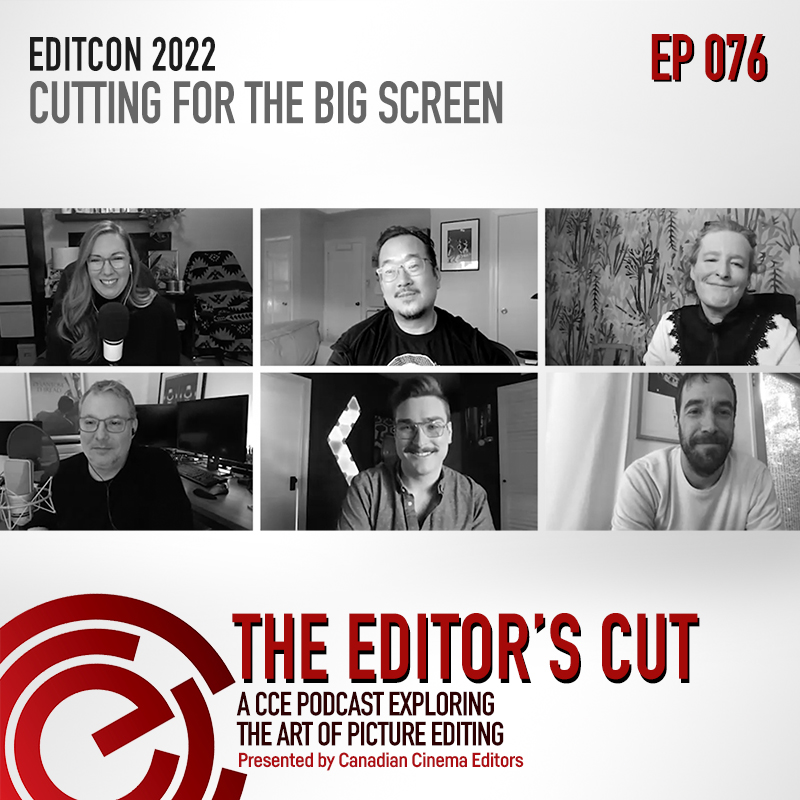
Like it or not, the landscape of cinema is changing quickly. With more films at our fingertips than ever before, it’s becoming harder and harder to draw audiences to the theatres. But people still flock to the tentpole films that we all know and love.
Join us behind the scenes as we chat with the editors of: SHANG-CHI AND THE LEGEND OF THE TEN RINGS, ETERNALS and GHOSTBUSTERS: AFTERLIFE as they take a deep dive into their workflows, share their tips on managing large teams and visual effects, and get into the nitty gritty of cutting for the big screen.
This episode is sponsored by IATSE 891.
The Editor’s Cut – Episode 076 – “EditCon 2022: Cutting for the Big Screen”
Sarah Taylor:
This episode was generously sponsored by IATSE Local 891.
Nathan Orloff:
Scripts are like a car manual for a movie. Great if they captivate you. That’s wonderful. That means they’re very successful. But you’re not looking into a human’s eyes. You’re not learning something about them silently.
Elísabet Ronaldsdóttir, ACE:
And for me, it’s a different language. A script is one language, but you have to take all of this and translate it into a movie. It’s where a monologue can become a look.
Nathan Orloff:
Totally. And that monologue might have informed the actor to do the performance that you needed in order to get rid of the monologue.
Sarah Taylor:
Yeah, yeah.
Elísabet Ronaldsdóttir, ACE:
Exactly. So it’s not the script that’s bad, it’s just you have to translate it into a movie.
Sarah Taylor:
Oh, I like that.
Nathan Orloff:
This might be why I’m a little bitter that there’s so little behind the scenes on editing. It’s a hard thing to tell people, “No, the script wasn’t bad. The assembly cut wasn’t… It’s not like these are problems. It’s that this is the process.”
Sarah Taylor:
Hello and welcome to The Editor’s Cut. I’m your host, Sarah Taylor. We would like to point out that the lands on which we have created this podcast and that many of you may be listening to us from, are part of ancestral territory. It is important for all of us to deeply acknowledge that we are on ancestral territory that has long served as a place where Indigenous peoples have lived, met, and interacted. We honor, respect and recognize these nations that have never relinquished their rights or sovereign authority over the lands and waters on which we stand today. We encourage you to reflect on the history of the land, the rich culture, the many contributions and the concerns that impact Indigenous individuals and communities. Land acknowledgements are the start to a deeper action.
Today’s episode is part four of our four-part series covering EditCon 2022: Brave New World. Today’s panel is cutting for the big screen. Like it or not, the landscape of cinema is changing quickly. With more films at our fingertips than ever before, it’s becoming harder and harder to draw audiences to the theaters, but people still flock to the tent-pole films that we all know and love. Join us behind the scenes as we chat with the editors of Shang-Chi and the Legend of the Ten Rings, Eternals, and Ghostbusters: Afterlife as they take a deep dive into their workflows, share their tips on managing large teams and visual effects, and get into the nitty-gritty of cutting for the big screen.
Speaker 4:
And action! Action. This is the Editor’s Cut. A CCE podcast. Exploring, exploring, exploring the art of picture editing.
Sarah Taylor:
Today we’re talking to the editors from Shang-Chi and the Legend of the Ten Rings, Eternals, and Ghostbusters: Afterlife. I want to give a big welcome to all of the editors here today. We’ll start with the Shang-Chi and the Legend of the Ten Rings: Elísabet Ronaldsdóttir, ACE; Harry Yoon, ACE; and Nat Sanders, ACE. Welcome. Also a big shout-out and welcome to Dylan Tichenor, ACE, from Eternals. And Nathan Orloff from Ghostbusters: Afterlife. Welcome to Editcon.
Nat Sanders, ACE:
Hello. Thank you.
Sarah Taylor:
My first question is, how did you become involved with the film and at what stage did you join? Dylan, take it away.
Dylan Tichenor, ACE:
All right. I came on well before shooting. I was called by Marvel and said, “Hey, we want to talk to you about this movie, and would you talk to our director, Chloé Zhao?” I had a great talk with Chloé and she gave me a great pitch for the idea and I was super excited to do it.
Harry Yoon, ACE:
I came on a little bit after. Well, a lot after Elísabet and Nat came on. They started with the movie and Elísabet’s schedule, because they had had to push due to COVID, it came up against another film that she was going to be starting, which was very fortunate for me because it gave me the opportunity to come on as she was leaving. I was so happy that there was a little bit of overlap so I could get a chance to work with both ER and Nat.
But it was just after their director’s cut and they had done a pretty significant restructuring, and so it was actually good for the show, I think, to also have some fresh eyes to say, “After this restructuring what’s making sense, what’s not making sense, how can we enhance it?” And so I was able to help take them to the finish line, but also to provide those fresh eyes, which was really, really fun.
Elísabet Ronaldsdóttir, ACE:
I came on, I got a call from Victoria who asked me to come and meet with Destin Daniel, the director, and we clicked. I also met with Nat and I just knew it would be a great team to work with. So yeah, that’s how I came on, and Nat, take it away.
Nat Sanders, ACE:
This was my fourth time working with Destin, the director. When we were finishing the edit on our previous film, this came up. He was working with me until 7:00, 8:00 PM on our edit, and then he was staying until midnight, 1:00 AM, 2:00 AM working on his pitch for Shang-Chi. He did his pitch for it and didn’t hear anything for a couple of weeks. He thought it hadn’t worked out and we kept editing. And then he got the call and it happened. I was very thankful that he asked me to come be a part of it. He was telling me all these crazy things that they were working up for the script. That was probably in April 2019. And then I probably didn’t actually read the script until about a week before shooting started.
Sarah Taylor:
But you were there at the beginning when the thoughts were just bubbling. That’s great.
Nat Sanders, ACE:
Yeah.
Sarah Taylor:
Yeah. That’s awesome. And Nathan?
Nathan Orloff:
Ghostbusters was my third film with Jason. On Front Runner, I had no idea that he was actually secretly working on this script. I did a independent film and then I got a call from Jason saying, “Hey, can you come to the Sony lot?” I was like, “Sure.” I went. They said which building it was, but I didn’t realize it was the Ghostbusters building on the Sony lot. I was like, “That’s weird.” And then he sat me down and he’s like, “Hey, I want you to read something.” I sat down and read something and within the second page I’m like, “Oh boy, this is insane. What are you talking about?” And that was his official ask. It was very exciting. I came on six months before production started, ended up doing a lot of storyboard work. It was really cool to be in that early to figure out these sequences with Jason and the storyboard artist.
Sarah Taylor:
I love that it almost was a little mini-proposal, take you to this special location and show you. That’s great.
Nathan Orloff:
It was because my mentor, Stefan Grube, who is a phenomenal editor I adore, he was the one who introduced me to Jason and worked with me on Tully and Front Runner. He was on the speakerphone when I walked in and sat down. Because it was a giant practical joke for the two of them.
Sarah Taylor:
That’s great. I love it. I think we should be hired like that everywhere we go. Since all of these films were part of beloved franchises, how did you prepare working on the film? For the Marvel films, did you rewatch the films? What was your process of preparing?
Dylan Tichenor, ACE:
Yeah, I was a Marvel fan, so I had seen all the movies. I did rewatch them all, to be fair. And I watched them in MCU chronology order, which I thought would be a good thing to do, especially for the film I was doing, Eternals, we have some stuff from the earliest bits of the MCU history. Technically, our movie nestles in around after the middle Spider-Man Far From Home. I think we come after that technically, but then stuff that happens before Captain America. I watched that. I did read the Jack Kirby Eternals comics, read a bunch of those. It’s funny to see the difference between the tones. The Kirby comics, they’re ’70s, but with a lot of fifties holdover vibe in it. It’s like Eternal cocktail hour in those comics sometimes. I was a big fan of Marvel from before and more and more as they went.
Sarah Taylor:
That’s a big chunk of time that you got to spend.
Dylan Tichenor, ACE:
It is. It was a good two weeks. It was good.
Sarah Taylor:
Wow.
Harry Yoon, ACE:
Yeah. Thank God we had Disney Plus at the time, because it just made the homework so much easier. It’s so funny, Dylan. I did exactly the same thing because I had seen them all, but then rewatching them in chronological order was really fun actually.
Dylan Tichenor, ACE:
It is fun.
Harry Yoon, ACE:
Yeah. Because it was hard to know with all the little crossover appearances, not having read the script or anything, what was going to happen. Trying to be prepared to see where the character tracks were. When Shang-Chi is placed in the timeline, that felt important. Also just trying to get a sense of what are the rhythms? How are they solving certain kinds of problems, particularly ones dealing with exposition, for example? That was really fun to revisit.
Also reading the original comic books for Shang-Chi was not ultimately that helpful. It was so funny because I remember reading them before my interview with Destin and thinking, how is this going to work? Because it just felt so updated in some ways because of the Fumanchu character and things like that from the original. I think it was my being politely incredulous in a way that opened the door to say, no, no, no, no. There’s this whole reimagining that Destin has done and one that is ultimately trying to update the story so it actually lives well within a time in which there is more of a sensitivity and also a respect for Asian, Asian American culture that’s happening. It was wonderful from the interview on just get a sense of what Destin’s vision was and how excited Marvel was to embrace that vision.
Sarah Taylor:
Yeah. That’s wonderful. Now, since you came on after director’s cut, did you watch previous edits that they had worked on? Or did you just watch the director’s cut?
Harry Yoon, ACE:
Ultimately, yes. From, I think, the first editor’s cut that ER and Nat had done, as well as the latest director’s cut that they were leaving Australia with and coming to LA with. That gave me insight into what is some of the material that they started with and how they restructured it. And gave me an insight into the incredible work that the two of them had done with Destin already. I had the most nerve-wracking session of writing notes and suggestions ever, because here’s filmmakers that I respected so much, and also knowing that ultimately the Marvel trio was going to read these things. I was just like, okay, how do I write it in a way where I don’t get fired on the first day, either from a respect standpoint or from a stupid idea standpoint? But thankfully, it landed okay and I didn’t get fired. That was my first task, which was very nerve wracking.
Sarah Taylor:
Oh my goodness. I can’t imagine. Elísabet, how did you prepare?
Elísabet Ronaldsdóttir, ACE:
I have four children with 20 years apart so I’ve seen every single Marvel movie. But no, I think it was very obvious from the beginning. I mean, it is an origin story. It’s the right from Marvel. They want you to experiment and do different things. They don’t want you to copy the next movie, which I think is great. They’re not copying movies. They want to evolve and try different things and they’re very good to do it.
But no, my prep was mainly meeting Nat. We sat down and talked. What people sometimes don’t understand, editing is 80% talking, just talking about the ideas. How can we do this? And then you take a day and get it all together. But it’s a lot of talking. That’s what I feel I enacted really. I think we worked really well in Australia, which was a weird period for us because we weren’t supposed to be so long. We spent a year in Australia, that was never the plan. It allowed us to dive into the movie in a different way than if COVID wouldn’t have happened. It gave us space, which we actually used very well. I think it’s benefited the movie.
Sarah Taylor:
Yeah. For sure. Yeah, that’s the silver lining of all of this is that we got time away from some stuff. More time’s always better. Well, maybe not always, but it’s often better.
Elísabet Ronaldsdóttir, ACE:
Sometimes.
Sarah Taylor:
Yeah.
Elísabet Ronaldsdóttir, ACE:
But we didn’t get away. We were lucky. We were very well taken care of and we felt very safe in Sydney. We worked every day.
Nat Sanders, ACE:
To what Harry and ER said, the comics really didn’t apply too much here. They were very outdated and full of stereotypes that the movie did not want to deal in. It is an origin story and a bit of a standalone film for them so a lot of the previous material didn’t really apply, which was great and gave us a lot of freedom. For me, I did have to dive into the Marvel world in a way that I hadn’t previously. I went in for a pretty early talk with Jonathan, our producer, Chris Russell Marvel. I don’t think Victoria was in that one. I remember getting asked about the Marvel movies. I had seen Black Panther, so I could talk about that one. I think we’ve done that pretty heavily. And then afterwards, okay, I’ve got to go watch all these.
Sarah Taylor:
You had to do your homework. Oh, this is a little pressure. Nathan, how about you?
Nathan Orloff:
Yeah, no, I watched all the three other Ghostbusters movies and took notes on structure and timing, but mainly watched the first one, I think, twice. Jason intentionally wanted this to be a love letter to the first movie and to figure out what was the magic of that and what worked and why? It was interesting because, just like ER said, that COVID was this weird… In a silver lining, like you said, having more time was a huge, huge, huge benefit in terms of us sitting back, looking at the movie, thinking about it and really experimenting, trying some things. And sitting back with fresh eyes because we had a full month off when we went into lockdown. Didn’t have any media at home, had nothing, and then go back in. It felt like you were watching a movie, like you’re saying to reference, it’s all of a sudden you have this little bit of separation. Now you can look at it in a completely different way.
Sarah Taylor:
It’s almost like when you’re in a cut and you take it and watch it on your TV or whatever, but you couldn’t even go in and do anything because you had no media. It’s just a whole other level. Right?
Nathan Orloff:
Yep.
Sarah Taylor:
Yeah. That’s awesome.
Dylan Tichenor, ACE:
It forced objectivity.
Sarah Taylor:
Yes. Yeah.
Nathan Orloff:
Yeah.
Sarah Taylor:
What was it like being on location while cutting?
Dylan Tichenor, ACE:
Yeah. Went to London for the shoot. I love London. I was happy to be there. We were shooting and based in Pinewood. Great for me. I had just a great team, cut this with Craig Wood. We had a fabulous team. We were ensconced in the Carrie Fisher building, which is a nice building. You get old parts of Pinewood, new parts of Pinewood. And then for me, a great 40 minute commute every day that I rode a bike and a motorcycle. I don’t know. I had a great time.
Sarah Taylor:
Going to another country and being on set, is it a way where you can just… Everything else disappears and you can just be in that world of working on that film?
Dylan Tichenor, ACE:
That is what happens. It’s like a traveling troupe of players, of actors, of performers. And then some of us behind the scenes. In this case it’s 500 people. It’s a great time. It’s like being with the circus.
Sarah Taylor:
That’s awesome. Well, Harry, I know that you were in LA so you missed the Australia trip.
Harry Yoon, ACE:
I did.
Sarah Taylor:
You didn’t get trapped.
Harry Yoon, ACE:
Yeah. Yeah. ER and Nat have some good stories to tell about Australia. Yeah.
Sarah Taylor:
Well, let’s dive in. Tell us about being on location.
Elísabet Ronaldsdóttir, ACE:
Can I tell them, Nat?
Nat Sanders, ACE:
Sure.
Dylan Tichenor, ACE:
Oh my God, yes.
Sarah Taylor:
Tell us. Tell us.
Elísabet Ronaldsdóttir, ACE:
You had a child.
Dylan Tichenor, ACE:
Oh yeah.
Elísabet Ronaldsdóttir, ACE:
It was not in the charts when we arrived in Australia, but he took one with him, and his wife.
Nat Sanders, ACE:
Yeah, my wife and I, we think, oh, this would be such a great four month life experience to go to Sydney. And we got there, not trying to get pregnant yet, and then we ended up coming home with a two month old baby.
Sarah Taylor:
Oh my goodness. That’s amazing.
Elísabet Ronaldsdóttir, ACE:
And what did you name her?
Nat Sanders, ACE:
Georgie. Yeah.
Elísabet Ronaldsdóttir, ACE:
Georgie.
Nat Sanders, ACE:
Yeah.
Sarah Taylor:
That’s amazing.
Nat Sanders, ACE:
Thank you. Yeah.
Elísabet Ronaldsdóttir, ACE:
Georgie has a special place in our hearts.
Sarah Taylor:
Yeah.
Nat Sanders, ACE:
We did have a very unique bond from all of us going through all this together. We had shot about a third of the film before COVID happened so we had enough to where… We did a little bit of lobbying ourselves because we wanted to say all of production was being sent back to where LA or wherever their homes were. But we felt like we had enough to keep working. It would be a waste to not use this time to be able to really refine what we had and see if that would lead to other things. Our third act was probably the least developed aspect of the script so they were using that time to also really go forward with the previs for that. ER and I also were very involved in trying to cut that down as much as we could and helping work with them.
It just kept extending. But it was in small chunks where it was a little stressful where we got extended by I think maybe six weeks at first, but there was still more to do. And just another month and another month. We kept getting some messages where there’s only one plane leaving and it’s in three days and there’s four seats left on it and you’ve got to be packed and ready to potentially get on that plane. That happened a couple times and that was stressful.
Sarah Taylor:
And the added stress of having a baby on the way, I can’t even imagine. Oh my goodness.
Nat Sanders, ACE:
That got more complicated as we went along because yeah.
Sarah Taylor:
Can’t travel. Yeah.
Nat Sanders, ACE:
Yeah.We didn’t know until about the 33rd week of pregnancy of whether we were going to give birth in the US or Australia.
Sarah Taylor:
Well, what a great story for little Georgie. That’s awesome.
Nat Sanders, ACE:
Yeah.
Sarah Taylor:
I love it. Nathan, you were up in Alberta. Tell us about your experience.
Nathan Orloff:
Yeah. I wasn’t there the whole time. The way that we initially split everything up, Dana, my co editor and I, and this is based on my previous experience on other films, was that I was tackling more of the effects, horror and any action sequences. And Dana was doing some more of the comedy and drama stuff that she had also traditionally worked with on Jason’s previous films, like Chino and Up in the Air. When it came to shooting all the stage stuff… Because the way they scheduled it is when the winter came and started snowing they went inside to the stages in Calgary. That’s when I flew up and I basically set up shop because they built two farmhouses, one on location and one on sound stage and they were identical. I set up shop in one of the rooms upstairs in the farmhouse. I just would go up to it. I’ll be like, grab my coffee, say hello to people, walk upstairs and it was a really great experience. I loved being in Calgary.
Sarah Taylor:
Do you have any good stories of being on set?
Nathan Orloff:
One time they did turn off all the lights. Well, I got distracted and didn’t know that everyone was going home and all of a sudden I’m in this house and it’s pitch black. I’m like, well, I got to figure out how to get out of here. As an editor, I’m always incredibly grateful and a little bit probably awestruck in terms of the camaraderie of production when they’re all a little grumpy and whatever and I’m like, “This is great. We can be a team.” And they’re like, “Okay. Whatever, guy. Go on your computer.” I really, really enjoy it. It’s one of my favorite things. Assembling on location and being on the mix stage are my two favorite times in post.
Sarah Taylor:
Yeah, yeah. There is something special about being on set. I’ve only gotten to do it once in my career . yeah, I was like that. I was like, oh my gosh, there’s sandwiches. Go to the craft services. It was the best thing ever.
Nathan Orloff:
And there’s a little bit of less pressure to me because I just got back from location a month ago on my new film. To me when you’re assembling you’re like, this is my first step. Let’s just make sure we have everything. Make sure I’m not throwing up any red flags. There’s not the pressure of is it perfect yet? It’s just my initial take and I have to include every single line. It’s not as to me as high pressure as everyone on set that they’re having to do their absolute best because this is their one shot to do it. It’s the complete opposite on our end.
Sarah Taylor:
So who was in your editorial team, like assistants and of course editors? How did you divide up the work?
Dylan Tichenor, ACE:
Yeah, I cut this with Craig Wood. He has done a few Marvel movies. We divided it pretty half and halfie where we got the same amount of action and dialogue. We wanted to do it that way. We both feel comfortable with it. We sorted it out ahead of time. I’m interested in this. Oh, I’m interested in that. And then divided it up as we’re shooting in such a way that we stuck to our original plan, but made sure that no one was without footage and no one had too much footage. That worked quite well. And then he and I would just bounce ideas back and forth about the other person’s sequence or whatever. But that’s how we did that. We each had our first, so two firsts, three seconds and two VFX editors and two PAs, that was basically our production crew. And then in post a crew a little bit more.
Elísabet Ronaldsdóttir, ACE:
I brought my very loyal, amazing first, Matt. I’m trying to remember his last name.
Dylan Tichenor, ACE:
Apsure.
Elísabet Ronaldsdóttir, ACE:
Apsure. Thank you. Sorry, Matt. I’d rather not make a movie without him. He’s amazing. And then we had a very big Australian crew, an amazing visual effect editor. The visual effects were a huge apartment and we had to work very closely with the visual effects. Because I’ve done big visual effects movies before, but one of the things with Marvel is you better keep it right on your timeline because you can turn around and suddenly they’ve just made the shot. You’re like, oh.
Sarah Taylor:
Whoopsy.
Elísabet Ronaldsdóttir, ACE:
You have to be very much on it, that timing, and not something you’re going to think about later. Just do it.
Sarah Taylor:
Yeah.
Elísabet Ronaldsdóttir, ACE:
Do it right on your timeline. That was the biggest lesson, because they were fast. We were talking animated creatures and all kinds of stuff.
Sarah Taylor:
Wow. Yeah.
Elísabet Ronaldsdóttir, ACE:
Even though it was a previous or a stunt fish that came in, but you just had to make it right.
Nat Sanders, ACE:
Yeah. I would say for me, the biggest lesson was in delegating sound work to our assistance team. For me, I haven’t worked on something of this scale where the sound work was just on this massive of a scope. I love working with sound and had always done it myself in the past in temping, but it became clear very early that that was just not going to be a remote possibility on this. We found ER’s assistant, Matt, did a ton. Luca, my assistant in Australia, did a ton. They did an amazing job. I have to say that their work carried through the entire process. The mix was fast on this. I would say a lot of what Matt and Luca did really was the template for what ended up in the final film sound wise.
Harry Yoon, ACE:
When the team left Australia, we left behind a couple of their amazing Australian assistants. And then we added two firsts. My first, Irene Chun, and then Leslie Webb took over as Nat’s assistant. And then we added two seconds, another VFX editor. At a certain point when our crew was largest, it was probably 11 people. And then that on top of that, there’s this whole army of VFX coordinators. It’s so funny because they are such the continuity between Marvel projects. They have all the best swag, they have great jackets and shirts and stuff like that. They’re on all the Zoom meetings. One of the things that we had to get used to, or I had to get used to, because I hadn’t worked on visual effects movies as an editor, at this scale was how long those reviews were.But it was so funny watching the VFX coordinators that they were so unruffled no matter how crazy the changes we were suggesting were that it was almost like, okay, well if they’re not freaking out then we don’t have to freak out necessarily because they’ve been here five or six times before.
But yeah, the crews are huge. What’s nice is that Marvel takes care of… Especially on their larger teams, they take such good care of their people that you have that continuity. You can sometimes get the inside track to say, how does this compare? Or how does this moment in our post process compare to what you guys have gone through before? If you’re new to that family, then I think you can get some good level setting and some good advice as far as how much should we worry about this at this point and things like that. That was fun.
Elísabet Ronaldsdóttir, ACE:
And we worked really closely with the visual effects, which was a grateful thing. All the design of the visual effects, Chris Townsend, was the mastermind behind visual effects. There was a really close-knitted cooperation, getting the visual effects right and the edit and the story and the characters. A lot of meetings. This is one of the things that has changed during the pandemic, because you used to have maybe one a week where you would meet with visual effects and stuff. Now it’s every day because everyone can just hop on whatever software you’re using. Was it Evercast we used?
Nat Sanders, ACE:
Clearview, I think, right?
Elísabet Ronaldsdóttir, ACE:
Clearview, yeah. Yeah. It’s becoming a lot of meetings.
Nat Sanders, ACE:
But rather than doing those VFX reviews in the theater next to our edit suites the way I guess it normally would’ve been done, we were doing them all over Clearview. To Harry’s point, towards the end of the process when it was Harry and I, we were already staying until 11:00 PM every night, at least as it was. During those VFX reviews, which were happening every day towards the end at least three hours, you just had to work on your own things. If they were in Harry’s scenes that he was working on, I had to be just putting the VFX review off to the side and just loosely keeping an eye on it, but working on your own things. So I can’t even imagine if we’d gone to the theater every day and you didn’t have that luxury of being able to work on the side. You’d be there until 1:00 AM every single… yeah.
Sarah Taylor:
So another silver lining. Nathan, I know that you worked with Dana Gloverman, ACE.
Nathan Orloff:
Yes.
Sarah Taylor:
Tell us how it worked.
Nathan Orloff:
It’s similar to what Dylan mentioned. Once we got to shooting, neither of us were ever without something to cut, so there’s plenty of drama scenes that I worked on. We would talk about everything. We became very, very close very, very fast. I think of her as a sister now. We would show each other everything, talk about everything. There’s not one cut in this movie that we haven’t talked about together. I learned so much from her, especially on some of these things that you pick up over because she says a lot more experience than I am, especially on specific rhythms, on comedy beats and dramatic beats and dialogue. It’s two, three frames, and one frame here. Just all that stuff. Really just kept my eyes open and the ears open. I learned a lot from her. It was a really good process. I have to say, compared to what Harry described about Marvel in terms of they’re not phased about changes. I’m like, that sounds great. Can I get a number for some of those? It’s not always like that.
There was one time very late in the process on the monster which is the thing that is closest to the boards of any of our sequences, but it was very late in the process and I was just wracking my brain. What’s bothering me about the ending? Because we had that time away on COVID and we had the time to come back. I was like, well, we need a wide shot. We need a wide shot right at the end, really establish the stakes, establish the geography. Right before the climax we need to see the ghosts and the trap and the car and then Phoebe with the gun. We need to see it all in one thing. I was like, that’s expensive. I first talked to Dana. I was like, “What do you think?” And she’s like, “Oh, you’re right.” And then we talked to Jason. Jason’s like, “All right. Let me talk to the VFX team.” It a whole big thing and it’s in the movie. It worked out well.
Sarah Taylor:
That’s awesome. You’re like, oh, that’s expensive. I love it. Well, we talked a lot about visual effects already, and I want to ask, specifically, what did your dailies look like? Were you getting just the green screen stuff or were you getting some previs already put in that your assistants put in for you? What were you actually working with when you first started assembling the film?
Dylan Tichenor, ACE:
Yeah, we had previs to start. I came early to cut previs and help with that, trying to concentrate on the bigger sequences where we needed to narrow it down and get the scope of it sorted out. I had been through the previs. When we start getting dailies, I think Chloe Chow, the director writer on this one, probably shot a little more locationing naturalistically than a typical Marvel movie. That said, every shot has effects in it so it’s just about how much green really is on the set because stuff’s going in the shot whether there’s green or not. I think we probably had less green screen from dailies because she just didn’t want to have that. It all gets wrote out anyway essentially. It’s becoming less and less of a thing.
We had viz early on and then stunt-viz when they started working on the sequences. Some of the more choreographed fights were stunted out. I would just slot stuff in as I would get it. So start with viz and then put the stunt-viz in. And then when we had a test shoot or the beginnings of second unit or whatever, start slotting plates in and you just build on the latest material you have. We have a lot of characters in this movie, so there were frankly a lot of people talking and doing stuff in the frame. We also had a lot of creatures, so there are lots of empty frames, or guys in gray suits. You just work with whatever you have and beat it out and start building.
Elísabet Ronaldsdóttir, ACE:
We did have a lot of previs. We also had how many visual? 1,750 I think visual effect shots.
Nat Sanders, ACE:
Yeah, I can’t remember now, but it’s way up in there, like 1,000.
Elísabet Ronaldsdóttir, ACE:
We had a lot of previs. We do have also imagination, so I think it worked out. But yeah, it can be weird, especially if you have to show it to someone else. I’ve been on movies where you had to test them before there are any visual effects done, but they didn’t want to have blue screens or green screens in anything we screened so it all had to be filled out.
Nat Sanders, ACE:
I think it was even the director’s, wasn’t it? The director’s cut for [inaudible 00:33:21]-
Elísabet Ronaldsdóttir, ACE:
Yeah, we had to fill it all out.
Nat Sanders, ACE:
No blue, so we had to do a whole pass. Either we would get the first early visual effects on shots, or our team would have to even gray things out just to remove all the blue. The first half of our film is very grounded in the real world and it’s not so much with blue screens and things. And then the back half, especially towards the end, it got more and more and that was the end of the shoot. We kind had built up to that. It just required a lot of communication with the VFX team of what’s happening here? We would work together on figuring out how to nail down the timing of it.
Harry Yoon, ACE:
One of the interesting things that I noticed was that you’re almost never out of dailies on this type of film, just because I think there’s so much experimentation that goes on through the post process. I think that’s one of the hallmarks that I noticed in the Marvel process, especially the trio that I mentioned, who’s Kevin Fiege, Louis D’Esposito and Victoria Alonso, they are never afraid to try things. They’re never afraid to improve or enhance a particular character arc or the understanding of a key point of exposition. We were constantly returning to previs for certain sequences to simplify things, to clarify things. You’re recutting previs again into normal dailies.
One of the benefits of shooting a lot of the action against blue, for example, is that you might be able to steal a move to shorten things, to connect things. You’re experimenting going back to those things and maybe reusing them for a different purpose. There’s always this constant inflow of trying new stuff and going back to raw material. It was fascinating to keep up with that churn, the slowly receding waves of previs and blue screen and things like that. That made it really fun.
Sarah Taylor:
I watched the Disney Plus behind the scenes of Shang-Chi. Even watching some of that, I was like, I didn’t realize how much green screen and blue screen was there. It made this question more interesting because there’s so much more that you’re like, oh yeah, I guess that’s what they do. I guess that’s how it works.
Harry Yoon, ACE:
It’s a real testament to the quality of the visual effects. As ER said, Chris and his team, what they were able to put together to make it feel so grounded and so real. Yeah.
Elísabet Ronaldsdóttir, ACE:
Also I agree. Also, as Nat pointed out, the whole first part is really grounded. Backgrounds don’t really change the story necessarily. The first part was easier that way. And then you go into dragons and weird creatures and magical animals and you have nothing.
Sarah Taylor:
Yeah.
Nat Sanders, ACE:
Our early action scenes, to her point, say the scaffolding scene that ER cut, all the action is there and it ends so it’s really just the backgrounds that are getting filled in. Yeah, like she said, that’s not really affecting your pacing or anything else.
Elísabet Ronaldsdóttir, ACE:
But then again, you still have to know certain things because it can absolutely affect the edit. Dialogue, more and more dialogue. Talk to the visual effect team. Talk to your director. Talk to everyone.
Sarah Taylor:
Like you said earlier, it’s all about talking.
Nathan Orloff:
Our dailies, it was pretty complicated sometimes in terms of here’s just an empty plate and there’s nothing there. Initially, I just took the ghost from the storyboard and I just took it in Photoshop and cut out the ghost. I was cutting with a Mario ghost where it was those… You do key framing in avid, here is a fly on this and you have to take it.
Sarah Taylor:
Spooky
Nathan Orloff:
… very seriously. And it was very funny. This actually transitions a little bit to a question I missed previously, is that very early on our brilliant VFX editor was able to use 3D models provided by VFX to at least get… He had a turntable so he could get the right angles. It was all of a sudden now in color, which was new. We had one VFX editor, eventually we had a VFX assistant. Dana and I shared a first, we had a second and then an apprentice. Everyone was just completely top-notch and wanted to make everything the best they could and stayed with us the entire process, and through COVID, too. We were a family. We really were.
Sarah Taylor:
You all touched on this a bit about having a blank plate and how long do I leave it on for? How do you determine pacing when you have these big visual elements that are missing? You have all these fight scenes and these beautiful scenery. How do you make sure that you develop your character still?
Dylan Tichenor, ACE:
Some sequences start from nothing. It’s never been boarded. Maybe it’s a new idea. This happens certainly at Marvel quite a bit where you go, well, what if there’s a beat where this happens? Or what if we add to the head of this scene and these things happen? You do cards, medium shot, she comes out of the door, and then close up monster jumps, things like that so that you beat it out to show people this is the basic idea. Then previs can go in and do shots for you. And then that’s the next level of that.
I think it depends on what you’re starting with. If you have stunt people, stunt players in gray suits, you have those movements and choreography to work with. If you don’t, you’re often doing the acting yourself. As Elísabet noted earlier, when you have 3D from scratch creatures that it’s not a human mocap or a performance capture or anything like that, it’s from scratch a creature, you’re acting it out in your head when you’re designing the shot, you’re going, okay, rawr. And let’s cut. You do all of that.And then you build the sound effects in to support your idea of the pacing. And certainly the music can help you. But usually you’re tailoring the music to what you want the sequence to do, but that also helps the flow through. It’s sculpting. You use huge chunky lumps of clay in the beginning, like rah, rah, rah. And then it gets more and more refined. You’re just constantly upgrading the quality and detail and granularity of the performance and the idea. I think that. And then what was the second part of the question?
Sarah Taylor:
Well, developing your character still when you have all these giant elements that are breathtaking that we all want to see but-
Dylan Tichenor, ACE:
Honestly, it’s a big balance in all these movies. A big challenge in Eternals was how much information do we need to keep people in the boat wanting this story, but no more and no less? And the fine tuning of that, turning that dial was a big part of the process because Chloe is an intellectual filmmaker and the script had a lot of talking in it, to be fair, the balance of that. Craig and I were always going back and forth to each other, “Do we need this line? What about that? Do you still have this beat in your scene because maybe I don’t need that same thing in my scene.” Because it was just a real focus of the storytelling.
I think that’s always a thing in movies, whether you have 2000 VFX shots or four. The balance of how much information you need to give the audience so they are emotionally tracking with you is one of the biggest jobs that we do. I think it just becomes a little bit more pointed with a VFX thing because you know there’s 25 minutes of act three that’s given over to boom, boom, bang, bang. When you do it right there’s story in the action and there’s momentum in the dialogue. You need that cross and scenes have to do multiple things. That is often down to the writing. When we would rewrite and rework things, you go, can’t we do both these things in this sequence rather than do one and then the other and the next sequence? It’s just this ongoing focus on efficient and captivating storytelling.
Sarah Taylor:
Yeah. Well, that was really good.
Elísabet Ronaldsdóttir, ACE:
I think that was very well said.
Sarah Taylor:
Yes.
Elísabet Ronaldsdóttir, ACE:
Let’s face it, you just described editing. It doesn’t matter what you are doing, if it’s a Marvel movie or something else, it’s all about story and characters. With a big movie, with a big budget, you might have a lot of visual effects, but your focus should still be story and characters.
Dylan Tichenor, ACE:
And it’s like music where you can put music on too early or too much of it, and that solves problems, like wallpaper. Papers over, bad transitions or unmotivated actions and stuff. You just go, no, no, the music will take care of that. Effects can do that, too, where you just distract people and go, well, this is fine. But whether they know it intellectually in their forebrain or not, they feel it in their stomach. Wait, I don’t understand the actions of this character, therefore I’m not behind them. And then you’ve lost.
Sarah Taylor:
So important.
Elísabet Ronaldsdóttir, ACE:
Right.
Harry Yoon, ACE:
Yeah, I think that tension that Dylan talked about where you need to know enough to not be distracted by the logic of what you don’t know and you need to know enough to invest in these characters. That’s one of the hallmarks that I found of the process that we went through was that there’s so much testing that Marvel does with its audiences that they test the film much more often than other larger features that I’ve worked on. So much of what they’re listening for with their audiences is, when are you invested in these characters? What is it that’s distracting you? Because you don’t know either a piece of exposition or how the world works? Because there’s so much world creation going on. You’re often entering a world for the first time and saying, okay, what does this tribe do? What powers do they have? How does that impact the story? And how much of that do you need to know to not throw up your hands and just tune out for a while because you don’t understand what’s happening?
If you set us an action sequence in New York, you know the gravitational properties. The hotdog vendor doesn’t necessarily can’t shoot laser beams out of his eyes or something. You don’t have to explain those things in order for somebody to be invested in the stakes. Whereas I think in this film you’re constantly living in the tension of just enough. How much do they need to know in order to invest in what’s going on? And how do we keep economizing on that and experimenting with that so that they’re engaged but not overly explained so that they’re bored?
Nat Sanders, ACE:
And to what Dylan and Harry have pointed out, in our case, we had this long prologue at the beginning of the film that on page was great and it really worked and it was basically the parents’ backstory. Everything that happened with the parents and young Shang-Chi all was in this first 20 pages of the script. And then we land on adult Shang-Chi in San Francisco and then we’re off from there and everything was linear. ER from the very beginning during all those talks she talked about would come in my office in the middle of the day and be like, “We got to do something about this effing prologue. It’s not going to work.”
Harry Yoon, ACE:
[inaudible 00:45:24]. This effing prologue.
Nat Sanders, ACE:
We were talking about it. We obviously tried to make it work linearly the way it was up. If it had been 10 or 12 minutes and maybe 15 minutes at the absolute most, then maybe there was a way to make it work. It was never going to get down to that length. You were finding out things that you just didn’t really as an audience member want to find out yet. ER really led the charge on it and it led to discussions between me and her and then eventually with Destin about how do we tell this story in the most satisfying way?
When we first showed our assembly cut to Destin, I think it was still mostly linear. Maybe with the prologue maybe you had messed around some, but it was for the most part still plain linear. And there were great elements all throughout the watch, but there was something not unsatisfying about the watch and something wasn’t right. Pretty much the next day the three of us got together and said, “What about if we restructure and just use this prologue as flashbacks throughout the film and you find out those things when you emotionally want to find out about them?” We would create a lot more mystery than we had had when it was all playing in linear fashion. There was no doubt about it. As soon as the idea got broached, all three of us were on board. We just started-
Elísabet Ronaldsdóttir, ACE:
And we did our first pass on the wall, because what’s so good when you have to do such a huge reconstructions, what’s good is just print out your sim cards. And then we were just moving them around on the wall. What if this is there? Then we’re talking again, talking our way through it. What if this happens here? I feel that’s a really good tool to have, sim cards and a good wall.
Nathan Orloff:
I agree with everything you guys have said. It’s fascinating. It’s hard to convey on a page is that if you trust your characters, if you trust the performance, you don’t need this line. You don’t need that beat even though it was written. If you lean in, if you make the audience lean in, if you make them care, that’s more important than anything else. You can explain stuff later on, you can explain the backstory. Maybe in the weird way it was good that it was written linearly as a prologue so you could chop it up and do whatever you want with it in post. But if it was written that way, you’d be trapped into certain versions.
It’s fascinating to me, because to me scripts are like a car manual for a movie. Great if they captivate you, that’s wonderful. That means they’re very successful, but you’re not looking into a human’s eyes, you’re not learning something about them silently. Ghostbusters went through more reconstructions in the third act figuring out what people need to know when and that was fascinating. But yeah, in terms of when to lean on characters and how to cut around empty plates, music is very, very useful. I ended up memorizing the Ghostbusters soundtrack and the music stems from the original because it’s different than the soundtrack in terms of, all right, what kind of beat here? What kind of rise do I want? I would make a silent beat where reverb a sound out and then do a slow old martino rise. I’m like, all right. That’s how I’m finding my taste with these empty slots. But as Dylan said, all these cuts need to work without music. You can lean on music, you can lean on sound too much, but I find it very useful, especially with empty plates, how to time them out.
My issue initially, especially since this is my first time in the editor’s chair on this level of visual effects film, was I left everything very long initially because a lot of this stuff was title cards and you needed time to read them. This to me would be the benefit to having actual previs of actual 3D models doing a turn, doing a thing, was that you’d be able to time the movements, but in order to understand everything at all my plates were all initially long and everything just got faster. But that’s a normal movie anyway. The mother character, Callie, in our movie, we ended up losing a lot of exposition, a lot of exposition, especially with the relationship with her father because we ended up, if you care, you don’t need to know. More ambiguity. Ambiguity in that regard was better. There was a great saying that both Dana and I learned on this movie and it was, it’s better to have your audience confused for 10 minutes than bored for 10 seconds.
Dylan Tichenor, ACE:
Oh my, yeah.
Elísabet Ronaldsdóttir, ACE:
Can I add to this? Because I love this, Nathan. I absolutely love the whole discussion about script versus film. For me it’s a different language. A script is one language. Well, you have a costume designer translating it into costumes and et cetera, et cetera, but you have to take all of this and translate it into a movie and it’s not the same language. It’s where a monologue can become a look. I find it so fascinating. It’s a different language. The script isn’t bad. Even if you have to reconstruct the whole movie, it’s not because the script is bad, it’s because it’s a different language. It just takes different letters to make it work.
Nathan Orloff:
Totally. And that monologue might have informed the actor to do the performance that you needed so in order to get rid of the monologue,
Elísabet Ronaldsdóttir, ACE:
Exactly. It’s not the script that’s bad, it’s just you have to translate it into a movie.
Sarah Taylor:
Yeah.
Nathan Orloff:
This might be why I’m a little bitter that there’s so little behind the scenes on editing. It’s a hard thing to tell people, “No, the script wasn’t bad. The assembly cut wasn’t… It’s not like these are problems. It’s that this is the process.”
Sarah Taylor:
I wanted to quickly touch on sound because you’ve all talked about it in different moments. Are there any specific sound effects that travel the Marvel universe that you used in your edits? And then same with Ghostbusters, did you get to get sounds that were from the original movies that you threw in? I’m just curious how that comes within the edit suite before it gets sent off to the magic sound world.
Dylan Tichenor, ACE:
If you’re working on an Avengers movie, yeah, there’s going to be sound effects that were established and sounds of things, Thor stuff and all of that. For Eternals, all new characters, all new people, related, but really no crossover characters in there. We did use as temp a lot of stuff. Ego ship, I used backgrounds for that. Thor’s hammer and swords and Valkyrie’s this and that. Yeah, used a bunch from the Marvel toolbox. Craig brought his stuff, I brought my stuff. We just used whatever we had to hand to build the idea out. And then as we went forward, we got a specific toolbox from Skywalker. Addison was our sound supervisor. As we started to talk about sound and we did a bunch of meetings where he would present some stuff, then we would give him notes with Chloe and just talk about the sound design of the movie in general, the creatures, the powers. Mainly how to differentiate those because we had so many of each and trying to keep things helping with the storytelling through sound.
I think we used what we had until we could replace it with our movie specific stuff as Addison got farther and farther along. Craig and I both love sound a lot and we did a lot of work and built it pretty full tracks as we were building the sequences. A lot of that informed the discussion and became the template for what ended up being. But it’s a very iterative process where you go back and forth and go, do we use Thena’s new sword sound for this? Or is this more like the version C? That kind of thing where it’s just so granular.
Sarah Taylor:
Amazing.
Dylan Tichenor, ACE:
Yeah.
Elísabet Ronaldsdóttir, ACE:
We had no sound library because we didn’t know, right? We didn’t know how his rings would sound or all those magical animals. We didn’t have a roadmap. Katie Woods helped us. She did some pre-designing while we were still in Australia.
Harry Yoon, ACE:
That library did start to grow as we continued to work with the team at Skywalker. We had the benefit that they’d worked on a lot of shows before. A huge benefit that there was continuity in terms of our mixers that had continued to work before. Both the sound design team. Since they have those libraries available, they could start winnowing those sounds into our cut. I just have a funny story where early on, spoiler alert, when there were some Dr. Strange sounds entering into our cut, for some reason we didn’t have the sound of the portal opening and staying open for a very long time so we literally had to rip it from a Dr. Strange movie. Anytime we did a trim, we would roll the trim and then you’d start hearing Dr. Strange dialogue underneath our cut. I’d be like, who’s talking during this time?
Sarah Taylor:
I love it.
Harry Yoon, ACE:
So there’s a little bit of challenges in terms of temping from existing Marvel movies. But yeah.
Sarah Taylor:
That’s great.
Nat Sanders, ACE:
Another interesting aspect of it too is when we would do our previews, often when you go do a preview you’ll stop at a certain point before the preview and you go into a temp mix for a couple days with the sound mixers. Marvel is just so much about story and about the edit that I think, maybe I’m guessing, but I don’t think they want to give up that time to continue working the cut. We were always using our Avid mixes during those previews, which just put an extra, not pressure, but I guess responsibility to make sure that you were representing all of your creatures well. Everything had to be on point because we were screening these for audiences and they had to play real.
Dylan Tichenor, ACE:
And that mixes with Marvel.
Nathan Orloff:
That’s great to know because I’m a huge fan of not doing temp mixes and just doing it on the Avid. We did that on Star Trek Into Darkness when Avid first introduced 5.1 audio. And then we were like, what if we just didn’t do a temp mix? It was grand experiment, but I’m glad that’s… We did 10 mixes on Ghostbusters and they were very intense and stressful.
Dylan Tichenor, ACE:
I mean, it’s great for the mixers to be able to go through it.
Elísabet Ronaldsdóttir, ACE:
I want temp mixes.
Sarah Taylor:
You want them?
Nathan Orloff:
I’d rather save the days for later. Take the same amount of money, just put it for final.
Elísabet Ronaldsdóttir, ACE:
Well, I don’t think that’s a money problem with Marvel.
Nathan Orloff:
That’s true. That’s true.
Elísabet Ronaldsdóttir, ACE:
Or anyone. I just feel, especially dialogue, is so important and dialogue is sometimes recorded under very difficult circumstances, whereas pre-sound mix really can save your ass for clarity so people understand what’s being said. That’s why I feel very strongly about getting a temp mix. Also, because I am not a sound person. I do appreciate sound and it’s extremely important to my edit, but I’m not going to do it. I could just as well go and do a heart surgery or something. It’s not my talent.
Sarah Taylor:
I love it.
Elísabet Ronaldsdóttir, ACE:
I edit movies. I don’t do sound. I feel it’s important that people have their expertise. The same way I wouldn’t do graphics. I’m not doing it. Hire a person, a graphic designer.
Sarah Taylor:
For sure.
Nathan Orloff:
That’s how Dana worked as well. I don’t know. Sound and music for me is a place I’ll go to if I’m stuck on an edit and I need to refresh. I like doing sound. And then like I mentioned for the storyboards, we’re very lucky, especially Jason has such a specific vision for this movie to be a lot like the original [inaudible 00:57:34] movies. Having the stems from the original was a huge, huge help. And having what he described as almost steampunk. Yes, someone just created this device, but they made it with duct tape and glue. It barely works. It’s not like a Star Trek shiny thing. It’s supposed to rattle when it turns on. There’s a specific vibe that was very useful to get. Having all the stems, especially for the boards sold you on the world and the tone.
Dylan Tichenor, ACE:
Totally.
Nathan Orloff:
And that stayed on. The most difficult sound, like the story of the Dr. Strange, the trap sounds specifically, when the trap opens, there was no archive of what their original one was. So Will Files, one of the sound supervisors, he had to take the stem and subtract Slimer from the frequency spectrum in order to… It was like sound archeology-
Sarah Taylor:
That’s amazing.
Nathan Orloff:
… in order to get that trap sound.
Dylan Tichenor, ACE:
That’s just the Slimer notch. It’s in the [inaudible 00:58:37].
Nathan Orloff:
Yeah, exactly.
Elísabet Ronaldsdóttir, ACE:
There is a funny Marvel music story from Shang-Chi. Someone pulled a number on me and Nat because we were both first timers. We were doing the third act and we needed to temp it with music. It was more or less all postvis. Someone said, “Oh, they want you to take from the other Marvel movies.” I remember we went through the whole music library and temp them to pieces. And then they hated it. We can’t concentrate on this, getting music from another movie.
Dylan Tichenor, ACE:
Kevin saw it and said, “All I can think of is Spider-Man.
Elísabet Ronaldsdóttir, ACE:
So we had to clear it all out and get something else in, but it was funny.
Sarah Taylor:
Oh my goodness.
Dylan Tichenor, ACE:
Oh, lots of stories.
Elísabet Ronaldsdóttir, ACE:
Someone wanted us to sweat.
Sarah Taylor:
Yeah, I’ll get you to sweat. My next question is, how did you all approach representation in your edit? Because in Shang-Chi we have an almost entirely Asian cast. Ghostbusters, we have a neurodivergent main character. In Eternals were introduced to one of the first South Asian superheroes and a deaf superhero. What were your thoughts and approaches to making sure this was tackled in the best way possible?
Dylan Tichenor, ACE:
It’s certainly something that Marvel has been concentrating on more and more. I really applaud and appreciate their efforts and the earnestness and genuineness with which they have approached inclusivity and representation in their movies because it has typically been a English speaking white guy kind of thing. I think they’ve done fantastic work. Eternals from the get-go, from its conception, was meant to be representative of other less-represented peoples. Chloe cast a, not American, but Asian English person as the lead. We have a gay black character and we have a deaf character, all of that.
I got to say, Craig and I both and Chloe came at this from the point of view of, we’re very proud and are behind all the representation, but that is not the point of the movie. We never wanted to bang that drum or put a spotlight on it. These are just the characters. Marvel went to great lengths to check things with people to show Lauren Ridloff, our deaf performer, the cuts and the ideas. Does this work? Is it okay if we change this one word to make it seem better? Because we don’t want anyone to feel like they’ve been duped or anything like that. Brian Tyre Henry, who plays Phastos, he had an onscreen gay kiss that was a big deal.
Craig cut that sequence, the Phastos house. I said, “I think the kiss in the dailies is fantastic, just as long as we don’t highlight it and push in on it and do music on it as if, look at this, guys.” And he said, “Oh no, we’re not going to do that.” I think we all had the same opinion. This is who the characters are. We support them and we are proud of it, but it’s not what the story’s about. So it gets its place. I think we’re proud of how we did it. In fact, when we would do the early screenings and we would ask, “What do you like about the movie?” And the audience would go. “Love the representation.” We’d all just look at each other and go, great, whatever. Yeah, we love it, too. What about the story? What about the characters? So yeah, I’m proud of how we did that. I’m proud of Marvel in general. I’m pleased to have been part of it. It’ll be great when humanity has passed this bump.
Harry Yoon, ACE:
Yeah, I think that was really well put, Dylan. I’m very proud that Marvel makes this a priority. I think it’s in having all the filmmakers involved care about the details and to know what questions to ask so that those details feel correct. Because it’s all about nuances. I think people who are watching for this kind of thing know when it’s surface versus authentic or feels grounded. Everything from what kind of TV program is Katie’s family watching in the background as they’re eating breakfast? How do you pronounce in their dialect the rice porridge that they’re eating in the morning?
Or just being concerned about, there’s been this whole history of a lack of Asian males as desirable characters, as romantic leads in the history of Hollywood. How do we take that into consideration when thinking, should Shang-Chi have a love interest? What is his relationship with Katie like? How do we maintain what their chemistry is like, but still acknowledge that he is potentially a desirable person? There was all of this talk, to ER’s point, a lot of this discussion and it informed the small choices that we made. But those small changes, those small details, I think are the things that audiences really loved and appreciated. When they saw Shang-Chi taking off his shoes before he went into the apartment, there were these little explosions of meaningful details that allowed people to feel seen, that allowed people to say, “Oh, this feels very real. It doesn’t feel like just a surface nod to something. It feels like somebody that I know.”
Nat Sanders, ACE:
I have to say, with that scene the Harry’s alluding to with Katie’s family, that was one from the very beginning that there was always a discussion, is this scene going to stay or not? Because we’d had a scene with their friends at the bar, and then we have another expositional scene with Katie’s family. We come back at the end of the film to the friends at the bar, but we don’t see Katie’s family again. There was always a discussion, is this going to stay? I have to say, Harry really advocated for it. We did a couple previews with it in and we still were on the fence. I think for the third preview, we were going to try it. I think we were leaning towards trying it without it. I think Harry, to his point, I said, “If we take it out, it’s probably not coming back in because it doesn’t move the plot forward. We’re not going to probably in that way we won’t miss it.”
I think at those first couple previews we’d requested that they try to recruit a certain percentage at least of Asian American audience members and I think it hadn’t quite happened. This third one, we were going to have a little bit more of an Asian American audience so we tried it one more time and it was just exactly what Harry said in the talk back afterwards. We just kept hearing, “I felt seen in that scene in Katie’s family,” and pointing out all the details. It was just so obvious how Harry had been to advocate for it. Yeah.
Elísabet Ronaldsdóttir, ACE:
I think it’s to a big credit, both to Marvel but also Destin, who was extremely keen on bringing forth a contemporary feel of the Asian community and not just the magical one.
Nat Sanders, ACE:
On a more smaller scale, too. Both ER and myself and then Harry when we were back in LA, we always made it a priority that bare minimum have one Mandarin speaker on our edit team. We would always have, I guess, it ended up being a second in each case. It was Lisa in Australia and Ujang back in LA. Especially towards the end with Ujang, she was incredibly informative about the details of phrasing, especially we were rewriting a lot of voiceover that was in Mandarin and she was a really integral part of a lot of creative decisions.
Harry Yoon, ACE:
Just real quickly. There was a joke towards the end that played so well with English speaking audiences. The thing that Tony Lang’s character was saying was so funny when it was in subtitle, but one of the things that Ujang and Novar, our other onset Mandarin speaker, said was that, “It’s funny, but it’s totally absurd. It’s too childish a thing for him to say, and therefore it doesn’t fit his character.” But those were the determiners for Destin. He would make the decision, even though it might play for the vast majority of people who don’t speak Chinese, for the people that speak Mandarin it will feel fake. It will feel untrue, and therefore we’re going to take it out even though it’s a huge laugh. I think it’s that adherence to making sure we get those kinds of nuances right that I think really came through and it’s because Destin had that dedication to it.
Sarah Taylor:
Yeah That’s wonderful.
Elísabet Ronaldsdóttir, ACE:
At the same time, I agree with what you are saying, especially regarding strong Asian lead male, but let’s not forget we had extremely strong Asian women support. I think they’re all so amazing.
Harry Yoon, ACE:
Yeah.
Elísabet Ronaldsdóttir, ACE:
I just think it’s just as much of a showcase of Asian females as the male because there are some really strong women in there.
Sarah Taylor:
Mm-hmm.
Nathan Orloff:
I don’t have a ton to add to what you guys said. All incredible. I completely agree. To echo also with what Dylan said is that, once you get into the edit and it’s there, our approach was a little bit just neutral. Just everything else, just like a VFX shot, you have to earn it. You can’t just wallow and highlight it. You just have to just let it breathe and have to let the character exist authentically. There’s cultural biases that I want to make sure I’m self aware of, that I’m not bulldozing a beat because of my prejudices unknowingly or something like that. But that’s mainly the only thing that I changed about my approach, just making sure every character has what they care about and their stakes and what they want clear. It’s just as important in making these people pop off the screen as real people so that people can identify with them and make them not caricatures of cinema past.
The only interesting example is that, in the storyboard sequence there’s the cut to of Callie and Grooberson in the Chinese restaurant. In the storyboard and the script, a Chinese restaurant. So what did I do? The first thing I did when I did the storyboard, I downloaded Chinese restaurant music and I cut it in. Great. It’s a gag. Wonderful. Blah, blah, blah. You get into the edit and there’s a whole scene before that of Callie on a date with Paul Rudd’s character. I kept trying to put Chinese music in and it’s just like, this is weird, so off. This just feels like-
Dylan Tichenor, ACE:
How vaguely racist.
Nathan Orloff:
Exactly. We were like, what are we doing?
Dylan Tichenor, ACE:
How did I get there?
Nathan Orloff:
[inaudible 01:09:48]. It was just make sure we check that we’re not doing something that’s super stereotypical and not realistic because this is a restaurant that’s in the middle of Oklahoma they’d listen to.
Dylan Tichenor, ACE:
Some modern country.
Sarah Taylor:
There’s a lot of comedy in these films. I just want to know, what’s one joke or one bit that kept you through, that was something that you took away from the film? I have a few of my own, but I want to know yours.
Dylan Tichenor, ACE:
Oh, goodness. Well, I can say we tried hard to keep all the comedy in Eternals, because it’s actually for a Marvel movie pretty heavy drama. Chloe’s bent is, she’s dramatic. She likes funny, but she’s more dramatic. Craig and I are both into funny, so we tried a lot. It’s got to be something with Kumail because he does the lion share of the comedy lifting and he’s really great in the movie. I don’t know. The spit takes of the beer that Gilgamesh ferments in his mouth from corn always got to laugh.
Sarah Taylor:
That was good.
Dylan Tichenor, ACE:
That’s probably one.
Sarah Taylor:
I love it. Harry, do you have a favorite?
Harry Yoon, ACE:
I think Unfailingly was the story that Ben Kingsley tells before entering the bamboo forest about Planet of the Apes and how the apes are the thing… Convinced him that acting was important. I have a funny story to tell. One of our test screenings during the talk back, there was a huge Marvel fan that was like, “That was the best joke ever told in the Marvel universe.” You’re able to relate that to our writers and [inaudible 01:11:30].
Sarah Taylor:
Oh my gosh.
Dylan Tichenor, ACE:
It really landed.
Harry Yoon, ACE:
Yeah.
Elísabet Ronaldsdóttir, ACE:
Aquafina, every single scene. She’s my girl.
Sarah Taylor:
Hotel California, that was my favorite.
Elísabet Ronaldsdóttir, ACE:
So good.
Dylan Tichenor, ACE:
This is an example of a perfect joke for me, which was, if I remember correctly, once Aquafina finds out the truth about Shang, she goes, “Wait, so you’ve been hiding and you changed your name to Sean?” I think that’s a trailer moment, too. The reason it’s so good is because it’s exactly what the audience is thinking. It’s going, wait, I hardly hear a difference. And then our character says exactly that, and you go, okay, perfect.
Elísabet Ronaldsdóttir, ACE:
Yeah. When I cut that scene I just laughed so much every single time he said that to me.
Sarah Taylor:
It was such a good scene.
Elísabet Ronaldsdóttir, ACE:
It was so hilarious.
Nat Sanders, ACE:
That one was fun. That was mostly improvised, probably the most improvised in the movie.
Elísabet Ronaldsdóttir, ACE:
Yeah.
Nat Sanders, ACE:
It just happens. I came up working with directors like Len Shelton and the Duplass Brothers who would shoot mostly improvised movies really based on an outline, so that was my background. That scene was really fun to backpack in for that.
Sarah Taylor:
Yeah. I love it.
Elísabet Ronaldsdóttir, ACE:
But I mean, let’s face it, she says magina in the Marvel movie.
Sarah Taylor:
Winning.
Dylan Tichenor, ACE:
Milestone.
Elísabet Ronaldsdóttir, ACE:
Winning.
Nathan Orloff:
I really love when Podcast… After the serious discovery of what Egon has been doing out there and says he sacrificed everything, et cetera, et cetera, and there’s his long beat and then podcast just goes, “Bummer.” That was my favorite. It kills me every time.
Sarah Taylor:
What was something that you learned from this film you’re going to take with you to other films?
Dylan Tichenor, ACE:
This is my first time working at Marvel and I really fell in love with the way the trio works, Kevin, Lou, Victoria. The review process, I really just got into that. Elísabet said it before, there’s a lot of talking. I love talking and exchanging ideas. When you do it with Marvel, there are three really smart people who love movies. I’ve made a million, not a million, a lot of movies where the execs are not as involved at all, A. Also, when they are, they don’t have much really substantive to contribute. I don’t know if this is a lesson, but it’s a feeling that I’m taking forward from working with them that I just appreciate. Kevin is all about plusing. How can we make this better? No stone is left unturned. You keep working to the last minute. It’s tiring, but it makes the best movie. Great ideas can come from anywhere, which is something that I know and that I’ve practiced forever, but it was just a really great experience. I take that forward. I guess what I’m saying is, I’ll try to push to integrate that style into other places I work.
Sarah Taylor:
Amazing. I love it.
Harry Yoon, ACE:
Yeah, I totally concur with what Dylan’s saying. That’s really something that really stood out, was having the attitude that always be 5% better, like a character arc or identification or clarity or something like that. Not giving up just because of whatever stage in the process that you’re at. Marvel really had that attitude. It was wonderful to see all of those resources being put to bear for story. Story, story, story. And making it make slightly better. On a more technical note, I loved digging into ER’s action edits and seeing the importance of micro speed changes. So really seeing how even a 12% speed up could really make the difference.
Dylan Tichenor, ACE:
Don’t need that frame. Don’t need that frame.
Harry Yoon, ACE:
Yeah. And just these tiny little frame differences and stuff like that. Just worrying everything. Because I guess that’s part of the it can be 5% better. In that case, a kick can be 12% better if you speed it up by 12%. So yeah, those micro speed changes were something that I’ll definitely be playing with.
Sarah Taylor:
Those are the little tricks we want to hear about.
Harry Yoon, ACE:
Yeah.
Sarah Taylor:
Yeah.
Elísabet Ronaldsdóttir, ACE:
Yeah. I think we learned a lot. I also learned one thing that I feel is very important, especially when you start working with people you don’t know very well. The importance of going it together. You can’t just go off in one direction. You all have to go together the same direction. There was something beautiful about that and very rewarding I find to have gone that with this group of people. It was actually quite amazing because everything else was happening. I mean, we were being in a country we didn’t know. So yeah, you got a family way from the people that were stuck there with you.
Sarah Taylor:
Yeah, no kidding.
Elísabet Ronaldsdóttir, ACE:
But I’m not talking about that. I’m also just talking about the process of making the movie. Bill Pope shot it, amazing cinema photographer. The thing is, we can’t edit what we don’t get, except if it’s previs and you can have them changed, but you know what I mean. You are governed by what they shoot and what they give you. I just think it was an amazing team.
Nat Sanders, ACE:
I probably learned more on this movie than I had in the previous five movies before. To what Dylan said, you always learn something on every project, but this one for me personally, was just at different levels. I’d never done fight scenes before, hadn’t worked with VFX on this scale and all those things. Actually I really early on leaned on ER and really just tried to soak in everything I could. To what Harry said, yeah, I would go in and look, especially really early in the process, would go and look at her fight scenes, look at her timelines and be like, okay, she sped this up in this moment. And then how did she do the ramp? And then I would just go and analyze all that.
It reminded me of when I was coming up as an assistant editor 15 years ago. When I would stay late at night and work on scenes on myself, I would look at what the editors had done and break down the timelines and analyze how they cut music, analyze how they did this, how they did that, and learn to cut that way. I hadn’t done that in a while, but on this I was doing some things that I had never done before. I really leaned on ER’s experience with all that, asked her questions, was soaking all that in. it was hugely helpful.
Elísabet Ronaldsdóttir, ACE:
He doesn’t know, I don’t know anything. Every project, you’re just amicably going in because that’s the beauty of it. Every project is different. It has different challenges and different…
Nat Sanders, ACE:
Yeah, so much that we learned. By the end, I guess you become a Marvel… Especially in this case, it was 18 months for me from start to end. You know the lay of the land by the end, but early on you are getting thrown into the deep end.
Nathan Orloff:
Always feels a little unfair because you’re the best editor to cut the project when you’re done with it. On this one, the scale of things, something the third act, was something that… Like I said, it scaled up a lesson and it’s sometimes hard to learn is that just because you put a puzzle together doesn’t mean it’s the right picture. I got it from Calgary, the third act, I think it was 20 minutes long, and I was just exhausted and I’m just so happy that it existed, that it worked, that it tracked, that you followed it. And Dana, to her credit, she’s like, “Eventually this will be like 12 minutes, 15 minutes.” And I was like, “What? No way.” I just couldn’t conceive of it. What I’ve been trying, especially recently since I got back from location a month ago, was that I’ve been like, all right, the editor that was on location that cut the assembly did a great job. Great.
Dylan Tichenor, ACE:
Whoever that was.
Nathan Orloff:
Different person.
Sarah Taylor:
Yeah.
Nathan Orloff:
This much is totally fine and let’s just rip it apart. Let’s figure it out. Let’s find a better picture to make with these puzzle pieces and figure out what we don’t need. And to really let go, which is an easy thing to say, but it’s really more about opening your heart and letting go of your ego and really just trying to focus on telling the best story possible. I’m also glad I had Dana as a partner on this. We were really in it together. I learned also a lot of little tricks from here, like I mentioned earlier. You can cut to a shot when someone’s opening their eye halfway if you need that extra frame. You won’t notice that they were blinking. Stuff like that.
Sarah Taylor:
Love it.
Dylan Tichenor, ACE:
It makes them seem like they’re really paying attention.
Nathan Orloff:
Exactly.
Dylan Tichenor, ACE:
I mean, it’s one of the great things about having multiple editors is that level of objectivity that your editing partner can give to you, to your sequences, back and forth. You can be brutal and have a screening and come out of it, as you were saying, and they go, “Yeah, that’s still four minutes too long.” And your stomach clenches up. What? But you feel the same way about their work. And it’s because you’re in the trenches dealing with all the minutiae and someone standing 20 feet behind you is going, “I’m done with that shot. Actually, I don’t need that beat because I already guessed that was going to happen.” You’ve been just trying to solve the problem so your perspective is totally different. It’s really helpful. Likewise, that’s what directors can be for, but I think having multiple editors, it can be a great collaboration. I had a great time with Craig.
Nathan Orloff:
And Ivan on Arm Project was a huge help on pushing for pace. Jason was in the same boat. He is never done a movie of this scale, but by the end he was totally singing what Ivan was going for and on just really… Just because it’s fast doesn’t make it… Just sing with the script. It’s not like you screwed up. It’s not like something’s bad, you need to speed through it. It just makes it more exciting. It just makes it more engaging if it’s appropriate.
Sarah Taylor:
What’s coming up next? Is there any shows or films that you want to share with us that you’re proud of or excited about?
Dylan Tichenor, ACE:
I’m doing a movie with Scott Cooper now starring Christian Bale.
Sarah Taylor:
Oh.
Dylan Tichenor, ACE:
We’re filming.
Sarah Taylor:
Excellent.
Harry Yoon, ACE:
I’m doing a dark comedy series for Netflix called Beef starring Stephen Young and Allie Wong, which is going to be a lot of fun.
Sarah Taylor:
That’ll be fun.
Elísabet Ronaldsdóttir, ACE:
I’m locking edit on Bullet Train for Sony.
Nat Sanders, ACE:
I’ve come on to help on a project. It’s a comedy that Taika Waititi shot before the pandemic, and then he’s in with Thor as well called Next Goal Wins. It’s going to be coming out later this year. I have to say, working on the comedy in Shang-Chi reminded me how much I love working with comedy and I hadn’t had a chance to do it in a while so I was seeking that out a little bit for what I…
Nathan Orloff:
I’m cutting John Wick 4 right now.
Sarah Taylor:
Oh.
Nathan Orloff:
I was on location before, so we got back and I’ll be on this until about August. It’s a very exciting project. I am looking forward to hopefully doing a comedy next because the last time I did Plan B was a comedy, and I don’t think I’ve ever been professionally just laughing all day long in my Avid. It’s a very pleasurable experience to cut comedy.
Sarah Taylor:
I’m cutting a comedy right now. Yeah, my cheeks always hurt at the end of my edit, which is great.
Elísabet Ronaldsdóttir, ACE:
I just want to let you know, Bullet Train is comedy. Just wanted to let you know.
Sarah Taylor:
Okay. Good.
Dylan Tichenor, ACE:
My movie has no comedy whatsoever. Cat Cooper, not super comedic cat.
Sarah Taylor:
Awesome. Well, thank you all for joining us today. This was a great conversation. I’m so glad to hear the inner workings of how these giant films get made. Thank you for spending the time with us today.
Dylan Tichenor, ACE:
Thank you, Sarah.
Nathan Orloff:
Thanks for having us. Yeah.
Elísabet Ronaldsdóttir, ACE:
So nice meeting you all.
Sarah Taylor:
Thanks so much for joining us today, and a big thanks goes out to our panelists. A special thanks goes to the 2022 EditCon planning committee, Alison Dowler and Kim McTaggart, CCE. The main title sound design was created by Jane Tattersall. Additional ADR recording by Andrea Rush. Original music created by Chad Blain and Soundstripe. This episode was mixed and mastered by Tony Bao. The CCE is proud to support Hire BIPOC. Hire BIPOC is the definitive and ubiquitous industry-wide roster of Canadian BIPOC creatives and crew working in screen-based industries. Check out hirebipoc.ca to hire your next group or create a profile and get hired.
Speaker 8:
The CCE is a nonprofit organization with the goal of bettering the art and science of picture editing. If you wish to become a CCE member, please visit our website, www.cceditors.ca. Join our great community of Canadian editors for more related info.
Veuillez nous envoyer un courriel en mentionnant les sujets que vous aimeriez que nous abordions, ou les monteurs.euses dont vous aimeriez entendre parler, à :
Un grand Merci à
Hosted and Produced by
Design sonore du générique d'ouverture
ADR Recording by
Mixé et masterisé par
Musique originale par
Sponsor Narration by
Commandité par
Presented in English / Atelier en anglais
Join the CCE for a unique mentorship event centered around one-on-one conversations with documentary & unscripted picture editors from across the country. From feature documentaries to reality television and unscripted series, you’ll get twelve uninterrupted minutes to chat with each of our participating mentors – any and all editing topics are on the table. This is your time to gain the specific insights you’ve been looking for. Stick around after the allotted time for virtual networking with all in attendance.
 Peter Denes is a Toronto-based Picture Editor with twenty years of experience cutting both documentary and scripted projects. His work has premiered at SXSW and Hot Docs, streamed on Amazon, Hulu, and Showtime, and aired on PBS, Vice, A&E, BBC, Nat Geo, History, Bravo and more. When not editing, he can be spotted on his bike, snacking on French pastries, and consuming all things Larry David and Daniel Johnston.
 Jonathan has been in the industry since 2001, both in Australia and Canada. He has cut everything from documentaries, animation, sports news, but his extensive experience has been in cutting reality TV. He has worked on many of the large format shows such as BIG BROTHER, DRAG RACE CANADA, MASTERCHEF, THE AMAZING RACE CANADA and LOVE ISLAND He is a 17 time CSA and 16 time CCE nominated editor and has won five consecutive CSA’s and four CCE Awards.
 Xi Feng is a Chinese-Canadian film editor based in Montreal. Having lived in China, Canada and France, she has cultivated a unique blend of cultural and artistic sensitivity. Feng has worked as an assistant editor and editor on several award winning documentaries, including CHINA HEAVYWEIGHT, which premiered at the 2012 Sundance Film Festival; and the CRYSTAL BEAR winning short film CLEBS, premiered at the 2020 Berlinale Generation 14 plus section. She’s also an editor alumna of CFC 2019 and Berlinale Talents 2020.
 Through hard work and determination, Editor Jenypher Fisher has developed a unique style, rivalled only by a keen sense of story and humour. Born and raised in Vancouver, British Columbia, for the past 20 years Jenypher has been responsible for crafting a wide assortment of Canada’s unscripted series. Projects include PAMELA’S GARDEN OF EDEN, THE NATURE OF THINGS, RUST VALLEY RESTORERS, ICE PILOTS, THE BACHELOR CANADA, ER: LIFE & DEATH AT VGH, PARAMEDICS: LIFE ON THE LINE, JADE FEVER, WILD BEAR RESCUE, THIS IS HIGH SCHOOL, QUEEN OF THE OIL PATCH, YUKON GOLD & EXPECTING!
 Carole Larsen is an award-winning documentary editor based in Toronto. Her work has a focus on our relationship with animals and the environment, from intimate portraits to broad-ranging discussions of our impact on the planet. Carole’s film and television work has been featured across Canada and around the world.
Mike has edited several award-winning feature documentaries, including STORIES WE TELL, for director Sarah Polley and THIS IS NOT A MOVIE for director Yung Chang. Most recently he completed TO KILL A TIGER for Nisha Pahuja, winner of the TIFF 2022 best Canadian feature award. Films that he has edited have played at Cannes, Berlin, Venice, Telluride and Sundance, among other festivals, with 13 features accepted into TIFF. Sarah Polley’s STORIES WE TELL was short listed for the documentary Oscar as well as being voted in a TIFF poll as one of the 10 best Canadian films of all time.
 Lindsay Ragone is a Toronto-based editor with over 20 years of experience. She’s been nominated twice at the Canadian Screen Awards for her work on CANADA’S DRAG RACE and was an Emmy-nominee for the Scripted/Reality hybrid series THE QUEST on Disney Plus. Other recent credits include BLOWN AWAY for Netflix and ALL-ROUND CHAMPION for BYU.
 Eui Yong Zong is a Toronto-based editor whose credits include: OVER TIME, HACK YOUR AGE, I HOLD THE DECHO IN MY HEART, PROMISE ME, MERB’YS, SPIRIT TO SOAR, LIDO TV, and ONE OF OURS which won a Jury Prize for Best Canadian Feature at Hotdocs Film Festival in 2021 and a Canadian Cinema Editor Award (CCE) for Best Editing in a Feature Documentary. He’s recently completed a feature documentary CHOSEN, which premiered in JeonJu Intl Film Festival in South Korea. Yong holds a BA in Middle Eastern Studies from University of Toronto, and a MFA in Film Production at York University.

Les Monteurs et Monteuses de cinéma canadien (CCE) sont heureux⋅euses d’annoncer que David B. Thompson, CCE (1949-2023) recevra le Prix d’excellence soulignant l’œuvre d’une vie pour l’année 2023. Le CCE décernera ce prix à la 13e cérémonie des prix CCE qui se tiendra le 25 mai 2023 à l’hôtel Delta de Toronto.
La liste complète des nominations aux prix CCE sera dévoilée le 17 avril! Rendez-vous sur Rendez-vous sur notre site internet pour plus d’informations.
À propos du Prix d’excellence soulignant l’œuvre d’une vie
Cet honneur est remis à un·e monteur·euse·s qui a su élever l’art du montage, qui a apporté une solide contribution à la communauté du montage et fait preuve d’une réelle passion pour son métier.
David B. Thompson, CCE, a débuté sa carrière dans les années 1980 en tant que monteur sur des classiques de la télévision canadienne comme LE VAGABOND et BRIGADE DE NUIT. Au fil des années, il a touché à tous les genres, depuis les comédies et les séries d’action (UN TANDEM DE CHOC) à la science-fiction (LEXX, DARK MATTER), en passant par les drames historiques (LES KENNEDYS). David a assuré une présence indéfectible dans l’industrie pendant plus de 50 ans et il laisse derrière lui une œuvre presque aussi grande que son cœur.
A fantastic editor, mentor, storyteller, jokester, and a great friend to so many, David was part of the first group of inductees to receive the CCE initials in 2008. He won an award at the inaugural CCE Awards in 2011, and over the course of his career garnered 5 Gemini nominations, two 2 DGC and CCE Award nominations, as well as an Emmy nomination for the pilot episode of “24”.
David always said “Cut with your gut, use your feelings to tell the story.”
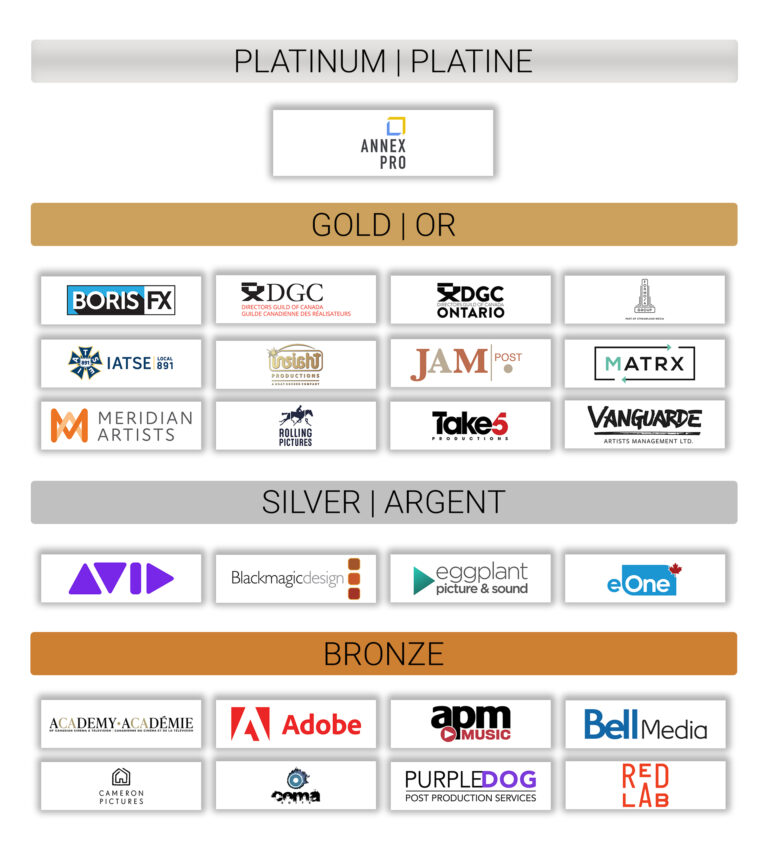
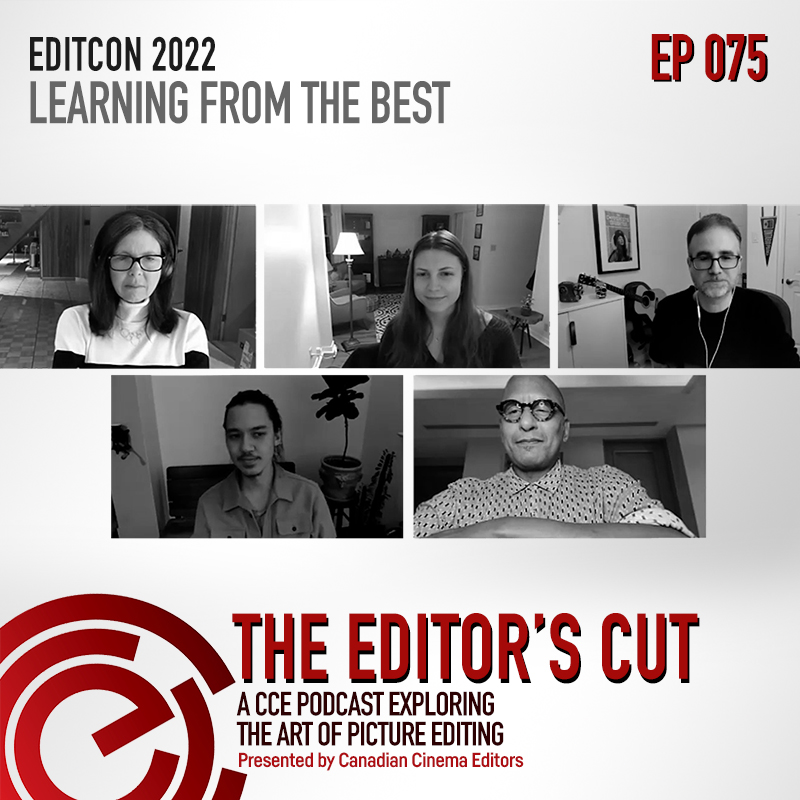
Today’s panel is Learning from the Best – Documentary editing is a craft of perpetual learning. Not only do our tools change constantly, but so do approaches to storytelling. Mentorship has long been at the heart of developing the next generation of talent in all mediums, and documentary is no exception. It can be difficult for new and aspiring editors to gain access to the suite to sit, watch, listen, and learn the intangible skill of editing. Pull up a seat as two apprentices interview their mentors on their approach to storytelling, and the importance of passing the torch to the next generation.
This episode is generously sponsored by Adobe.
The Editor’s Cut – Episode 075 – EditCon 2022: Learning from the Best
Sarah Taylor:
This episode was generously sponsored by Adobe.
Chris Mutton, CCE:
The mentee has a lot to offer the mentor. I think that’s maybe a misconception about mentorship is that it’s a top-down approach. And it’s somebody who’s, I’m going to show you, you know, I’m going to teach you X, Y, and Z. But, I think one thing that’s come across really obviously in all of the conversations we’ve had here is that openness and honesty, and it has to be a two-way conversation.
Brina Romanek:
Feeling like you have a safe space to make mistakes and to play. You know? Because I think, end of the day, one of the most fun things about editing is that you get to play.
Ricardo Acosta, CCE:
I would use one word, is empathy and respect. And also, knowing that you are working with a very particular part of our being, which is our fragility, our insecurity, our gift as artists. The fact that none of those things are absolute, but they’re all part of our humanity.
Sarah Taylor:
Hello and welcome to The Editor’s Cut. I’m your host Sarah Taylor. We would like to point out that the lands on which we have created this podcast and that many of you may be listening to us from are part of ancestral territory. It is important for all of us to deeply acknowledge that we are on ancestral territory that has long served as a place where indigenous peoples have lived, met, and interacted. We honour, respect, and recognize these nations that have never relinquished their rights or sovereign authority over the lands and waters on which we stand today. We encourage you to reflect on the history of the land, the rich culture, the many contributions, and the concerns that impact indigenous individuals and communities. Land acknowledgements are the start to a deeper action.
Today’s episode is part three of our four-part series covering EditCon 2022, Brave New World. Documentary editing is a craft of perpetual learning. Not only do our tools change constantly, but so do approaches to storytelling. Mentorship has long been at the heart of developing the next generation of talent in all mediums, and documentary is no exception. It can be difficult for new and aspiring editors to gain access to the suite, to sit, watch, listen, and learn the intangible skill of editing. Pull up a seat as two apprentices interview their mentors on their approach to storytelling and the importance of passing the torch to the next generation.
[show open]
And action.
This is The Editor’s Cut.
A CCE podcast.
Exploring, exploring, exploring the art
of picture editing.
Chris Mutton, CCE:
Welcome to Learning from the Best. My name is Chris Mutton. I’ll be your moderator for our panel today. We have an exciting discussion lined up that will hopefully bring out a better understanding of mentorship. Mentorship can be kind of hard to define, comes in many forms, from mentors who follow a lecture format in a large group all the way down to one-on-one mentor pairs. So today we’ll be hearing from two such pairs. We’ll start off with our first group, hear about their experience. Then we’ll move on to our second group. And lastly, sort of bring everybody together for an informal round table discussion. And I’ll be taking a backseat for the most part.
We’re going to try something a little new and have our conversations led by our mentees. In our first group, we have multiple award-winning documentary filmmaker and editor Michèle Hozer. With over 40 documentary editing credits, including the critically acclaimed Shake Hands with The Devil and her directorial debut, Sugar Coated, she is a mainstay of the Canadian doc world in Canada. Michèle is joined by her mentee, Brina Romanek, a documentary filmmaker and editor of the Lifestyle documentary Radical Retirees and editor of the doc feature a Cure for the Common Classroom, which she edited with Michèle’s guidance. Welcome Michèle and Brina.
Michèle Hozer, CCE:
Hi, thank you.
Chris Mutton, CCE:
In our second mentorship pair, we are joined by Ricardo Acosta, CCE. Also a household name in documentary editing in Canada. Ricardo won the CCE award for best editing in documentary for Marmato in 2014, and is the editor of acclaimed films 15 to Life, The Silence of Others, and Herman’s House. He’s joined by mentee and documentary editor Jordan Kawai. Jordan holds his master’s degree in media studies from Ryerson and has assisted and edited documentaries including Bangla Surf Girls, in which Ricardo served as mentor and story editor. Welcome Ricardo and Jordan. And just to start things off, Jordan, how did you meet Ricardo and how did this mentorship begin with you guys?
Jordan Kawai:
I first met Ricardo when I was in graduate school at Ryerson, the documentary media MFA. And Ricardo was brought in for a class critique and I shared a piece of my film and had Ricardo give me some criticism about it, which was the very first time I met him. And then fast-forward two years later, I met Ricardo again in a job opportunity where I would be assisting Ricardo in a film that was produced by the NFB. And at that time it was called Hispaniola. The name later changed to Stateless.
Chris Mutton, CCE:
Awesome. How was it like to have Ricardo look at your work?
Jordan Kawai:
I mean, it was one of those interesting things where I– it was kind of like, foreshadowing a lot of the conversations that were to come. A lot of things surrounding, yeah, simplicity and minimalism and that, and one of the mantras that I kind of, like I always tell Ricardo, at the beginning of every project, I write at the top of my notebook which is “Surrender yourself to your footage.” And that was one of the first things that he had said to me, and that was something that I kind of brought forward later in all my projects.
Chris Mutton, CCE:
Excellent. All right. I’ll let you take it away. Go for it.
Jordan Kawai:
Yeah, So Ricardo, when we first met, we had– it was an interview for the project Hispaniola. And at that point in time I was assist editing on a few projects and a lot of them—a lot of my role at that point was moreso coming in and making sure, as assistant editor, that the project was—you know, the wheels were all oiled and it was all afloat. And one of the first things that you said, was kind of like, music to my ears, I was pining for an opportunity to work collaboratively and kind of, shadow an editor and director. And, I don’t know if you remember saying this to me, but you said you didn’t want, an assistant editor who was just going to be a ghost in the room, and you wanted someone who was kind of there for the process. And, I was wondering how that kind of came to be and why that’s what you wanted at that point in time for that project.
Ricardo Acosta, CCE:
You know Jordan, for me, as I had said to you before, I was a wonderful slave slash assistant editor for a while before I started editing my films. But I also was a very privileged assistant editor because I was able to observe and participate of the creative process– on the creative process of the filmmaking. And the storytelling, in the editing suite, and being able to– to be there, in situ, when the director and the editor and the producer were discussing the story. And I have realized that, in the times of digitizing footage, the role of an assistant editor has been diminished to someone who come, in a very impersonal way, when you are not around, to prepare the material for you.
It was becoming more and more a lonely job of an editor with a footage and a director, but where is the assistant on that? And also, where is the assistant that is also a wonderful filmmaker who I can perceive as a great editor, you know– in progress and where that editor will find the role models, the place where that young assistant can learn how to conduct and how to be, and how to– what is the role of an editor in the editing suite. That’s not something you learn in a school, at Ryerson. That’s something that you have to learn also, assisting other editors. I think.
And you know, I saw on you, from the beginning, that the light of a filmmaker, of someone who took his job and his dream of telling stories very seriously. And the way you talk about editing, I went like, “Okay, this is a fantastic opportunity.” Because a lot of people do not have that drive. And for me it was very, very special at that moment to say, “Okay, here is someone who can also be my buddy in the editing suite.”
Jordan Kawai:
What I really appreciated early on when I was working with you, Ricardo was watching rushes together. And I think as someone who was kind of new to that realm and new to that industry of just… Well, I kind of– What I learned from screening live with you and you would start watching rushes and you’d hit that space bar, pause it, and then you would ask me, “What is the heart of this scene for you?” And I think throwing that question and always having that ability to stop and pause and really be on the ball of figuring out if you shake this down, what it is at the heart of something or the spirit of something.
Ricardo Acosta, CCE:
At the end of the day we have to deal with tools of dramaturgia to put together a story and it’s a four-minute story. What is the heart of that? What we are doing, we might be wrong, we might be having challenge in finding what is the best. But we have to really be brave and go for it. And based on that thing that we find that is the heart and the most meaningful, build around that. Which is what we did in that scene, also, no? Start embroidering around that idea. How do we present that? Because for me, ultimately, it’s a choreography that is not dictated by the brain only, but also by the emotion of the moment of the story that we are trying to tell. And also of the character. What the character needs and not so much about what I want the character to do, sometimes.
Jordan Kawai:
This was part of a film where that character’s arc didn’t actually make it into the feature film. It was actually– That whole character was then used for a short film that I edited later, which ended up being the opening scene in a different variation way for that film. But it was interesting because there was a lot of elements and a lot of devices that were also part of the feature. And one of them being the use of radio. And I remember Ricardo, early on, one of the obstacles was how to give a lot of the backstory and context of what was happening, between Dominican Republic and Haiti, and this idea of using radio not just for context piece, but to show some of that temperature of what some of the antagonism between those two countries were. So this idea that radio is something that is pepper corned and interwoven throughout the entire piece. For this particular scene, I remember it being more of an exercise about visual storytelling and that’s one of the things that I was really excited about when Ricardo and I worked on this was to not use any voice at the beginning. The radio wasn’t used at the beginning and just try to create a story of one of the protagonists’ father living in Dominican Republic and he was born in Haiti and just showing his daily routine of going to work in the sugar cane fields.
Ricardo Acosta, CCE:
One thing that we do is spend a lot of time also talking, and for me, it’s very important that my assistant editor or the associate editor is part of those conversations when we are looking at rushes of footage and then sharing with the director what I saw. What I saw sometimes could be a little bit different to what the director saw and he compliments that, but also to what I can foreshadow in the scenes that we find very powerful and how the story we want to tell can be enhanced with the elements, the jewels of this—you know– that are hidden within the footage. And one thing for me that was very important always was there is a subliminal character of hate here, which is on the way in the radio wave. And that it was a thermometer, as you said, of the temperature of the hate speech and the hostility against Haitians in the country.
I always remember we spent a lot of time also talking and sharing with you with what I call the rituals of the footage of the character, of the subject, of the story. And what is the impression that we are painting with a scene that will then become part of a bigger impression that we are painting with the whole story and the whole film. And one thing that I find with you, that we are very much enjoying in our collaboration, is how you understand that and how you incorporate that. We also have these conversations about… It’s complex because sometimes young editors have a hard time having something emotionally because they come from a brain is sometimes perception of everything is about the intellect and not about the emotion. And I come from a different kind of experience with you where I always said to you, it’s more about what you don’t see and what you feel, the way you are trying to compose.
And it’s also always for us not about the trend, but about the essence. And those are things that we, Jordan and me, spend a lot of time talking about when we’re editing and sharing. Sometimes, I also like to do something like, when I’m cutting something and I think I’m excited about it, I will ask him, look what I did. And this idea of sharing like a tutorial, and a discovery with a friend and it’s also about sharing with him why I made the choices that I made. Why? Because I think that all I can share in my mentoring of someone who I think is a great editor on his own and it’s a little bit of my own creative process and my fears and my accomplishments, but there is no book about that.
Jordan Kawai:
One thing I think I’ve gleaned from you, mainly from your relationships with directors, but also I feel that towards you as well is this, is how trust plays in that relationship and how you build that and how that can really obviously really shape a film because it’s a process to begin with.
Chris Mutton, CCE:
I think that’s really a hard thing to teach. Right? And it’s interesting because there’s so many hard skills to editing, but one of the soft skills is all the people stuff in the edit suite and how you deal with a director in the edit suite and how you deal with their emotions as they look at their film coming together and maybe what their expectations were against what’s happening can be very emotional for them. And that kind of skill is so different from Codex and hard drives and all that other stuff that’s in the background. So it’s interesting. I think that is a really important part of mentorship is those people skills.
Ricardo Acosta, CCE:
So we are collaborating in a film called Betrayal right now and there’s a scene where the director is on the scene. The first time she met the subject, the subject used to be in Canada. He got evicted from Canada and now he’s living in a country in Africa. And the first time that she met the subject is there, in Africa in a refugee camp. And when I was looking at the footage I see that moment, which was filmed in a very informal way because no one ever thought that this going to be part of the story, where she said to him, “Oh nice to meet you.” And then he said, “Finally. Nice to meet you.” And has been talking to each other for so long. But that is on camera, in the center of camera. And then what I have for the next 40 minutes, it’s a very raw but honest and warm situation where this man, our main subject is showing to her the refugee camp and talking about, since they have happened to him, that we may know more or not prior to that scene.
So it was very interesting because it was like, okay, this is going to be a very difficult conversation to have with the director to say, okay, we can make a very evasive scene where he’s talking to a ghost and using shots that are not our best. Or we can try to make a scene that is very warm and authentic where you are on it. I knew that was going to be a conversation that was going to be very difficult. But before that, I also shared this with Jordan and asked his opinion. And we both said, okay, let’s prepare each other. And I said to Jordan, “Okay, please support me on presenting this case to the director.”
Chris Mutton, CCE:
Backup.
Jordan Kawai:
Yeah.
Chris Mutton, CCE:
What was the reaction? How’d it go?
Jordan Kawai:
I think it’s ongoing, I would say. Ricardo?
Chris Mutton, CCE:
Oh, okay, all right. Yeah, it’s not quite there yet, eh?
Ricardo Acosta, CCE:
I think that everybody felt the strain of it and the authenticity and Jordan did a great job on putting together a scene that we have choreographed and discussed. And I think it opened a whole new avenue for us also to feel more empowered about how we are going to deal with similar situations through the whole story.
Jordan Kawai:
Yeah, and it’s interesting, Ricardo, that is an example. Because we talked about the idea of surrender yourself to the footage. And I’m thinking about it more and another thing in that example, but in previous films too, where I’ve watched you challenge the footage and I think that means also challenging the director on some of the expectations of what a scene may or may not be. And I find that kind of interesting. What is that dialogue and having that confidence to A, try something but B, to challenge what that scene can possibly be. And I think the one you’re bringing up as an example of that, for sure.
Chris Mutton, CCE:
Thank you very much for the discussion. Hang tight for a bit. We’re going to bring you back in just at the end for a sort of round table chat about mentorship. Now we’ll bring in Michèle and Brina.
Hey, how are you guys doing?
Brina Romanek:
Good, how are you?
Chris Mutton, CCE:
Excellent. Welcome back. Now something that not everybody listening today probably knows is that you guys met through the CCE mentorship pilot program, which started in 2019. So maybe Brina, tell us a little bit about that experience and how you were paired with Michèle.
Brina Romanek:
I was working as an assistant editor at the time and I was already a member of CCE when I got the email. And I really felt similar to what Ricardo was mentioning in terms of this idea of that sometimes the assistant editor is the ghost. I felt like the ghost. And I had made a couple of my own films and I felt like I needed to learn, but I needed someone to help me push my own boundaries. So I applied, and I got accepted, and I found out that I was paired with Michèle, who I then very quickly went and googled.
Chris Mutton, CCE:
I’m sure you were pretty happy when you googled her.
Brina Romanek:
Pretty pleased. Pretty pleased. And very intimidated.
Michèle Hozer, CCE:
Nah.
Brina Romanek:
Starting off, Michèle, I’m kind of curious. I know we’ve talked a little bit about your beginnings, when you started editing and learning from other editors, but I’m curious to know what your experience had been with your own mentors and what made you want to be a part of the program?
Michèle Hozer, CCE:
Well, like Ricardo, I always thought it was important to have an assistant editor in the room while we cut because it could be a lonely job. And I think it’s our obligation to… I mean someone taught me, so I think we should keep that going. And so I always kept editors or assistant editors for most of my work. Many producers and director thought, “Are you crazy? It costs too much to have a full-time assistant editor.” And by the end of the project they always loved the assistants way better than they loved me. And they realized, certainly in a documentary setting, how important the assistant editor is because they know everything about the film very intimately. The assistant editor knows the timeline, knows all the problem shots, knows the music. And when it comes to posting and putting all that together, the assistant editor is key.
And the assistant editor, if they’re a good assistant, helps smooth the waters, calm things down when the editor and the director are fighting or there’s tension in the room, the assistant editor can always come and help keep those things afloat. But in terms of our CCE, I don’t know, I got an email that said, “Would you, you be interested in mentoring?” And I thought, “Okay, why not?” I didn’t know what it would entail. I had no clue that you and I would still be working together on the Buffy film.
And I remember meeting you, do you remember that meeting? We were at Insomnia, I don’t know, three days before the first lockdown.
Brina Romanek:
Yes.
Michèle Hozer, CCE:
And I remember reading your CV and I thought, “Oh wow, she’s 27. She’s directed a few shorts already.” And I thought to myself, “Oh my God, here she is, someone to replace me. Here we go.” And I remember that was my first impression in meeting you. I don’t know, what was your first impression?
Brina Romanek:
As I mentioned to you before, I definitely sweat right through my blouse. I was very nervous. And you were asking me questions that I don’t think I had been asked in a while. Very direct questions about what I wanted to do and where I wanted to go. And I wasn’t even sure whether or not those are maybe things that I kept inside, but I wasn’t sure that I had the confidence to just blurt out. And so I felt a bit like I was in the hot seat, but in a good way. And I left the meeting feeling excited. But also I had been given the opportunity to think more specifically about how I wanted to grow. I think that that was a good start to our relationship.
Michèle Hozer, CCE:
Yeah. And I think you were interested in documentary and I think that’s important. I get a lot of people who come and they want to be fiction writers or dramatic editors or even directors and it’s like, “Why are you coming to me?” But you were very persistent and I think, what did we meet every month or something like that?
Brina Romanek:
Yeah, I think at the beginning it was, we’d have at least a phone call a month. And at first, you watched the films that I had made and gave your thoughts and feedback. And I remember very clearly, you watched my film, A Portrait of Pockets. And afterwards you gave me this note, which I still think about all the time when I’m cutting.
Michèle Hozer, CCE:
I hope it’s a good note.
Brina Romanek:
You said really think about when you are giving breath in between the phrases of what your character is saying and when you are making it a full cohesive run-on sentence, let’s say. And you were saying there were some moments in that film where I had split up and given too much breath in between phrases from the main character of Charmaine and so we lost some of the meaning of the scene. I think it was a very good note. I think about that a lot when we’re cutting now. I’m often thinking about, “Okay, is this an idea that is more clearly comes across when we hear the whole thing? Or is this one of those ideas that we need a moment to pause and breathe in part of what’s being said before we can hear the rest of it?”
Michèle Hozer, CCE:
Yeah. Yeah, you’re right. We did that yesterday on a scene. When do we let Buffy Sainte-Marie say everything she says, and when do you give the pause, right?
Brina Romanek:
Yes.
Michèle Hozer, CCE:
That takes time to figure out and you just re-listen to your scenes over and over again. We’ve been working together for what, two years now? Almost two years. Right now we’re cutting Buffy and now Brina’s taken my place. She’s the editor or co-editor with the director Madison Thompson. Yeah. And I’m story editing with her and maybe giving you too much of a hard time, Brina.
Chris Mutton, CCE:
That’s great. I mean just like Ricardo and Jordan, you guys are now colleagues, which I find is fascinating. It’s great.
Michèle Hozer, CCE:
Yeah, working that scene. Today, you were pretty tired, was it two days? Two days, we’ve been working on the same scene?
Brina Romanek:
Two and a half. And today it was down to the really minute, minute. And there’s a moment where I was like, “Oh my gosh.” But then-
Michèle Hozer, CCE:
I was a moment there when I gave you a note and you were going, “Oh, for fuck sakes. Really? She’s not happy?”
Brina Romanek:
But when I went for a walk and came back and watched it was like, “Yep, it made a big difference.” As stubborn as I was feeling in the moment.
Michèle Hozer, CCE:
I think what was great about this mentorship program… We did a movie club at one point, watched movies and talked, and then I got a call from these producers that I knew and the filmmaker was stuck. They had an assembly, they just couldn’t do the story that they really wanted to do. The film was in trouble, would I cut it? And I’m at a stage in my career where I want to do other things. I don’t want to necessarily work seven days a week or five days a week on a project. And I said, “Look, I’ll story edit. I’ve got this young mentee, she’ll cut it and I’ll story edit it. And I promise you’ll love it.” And I gave you a call, Brina.
I wasn’t sure you were completely on board. I mean, I don’t know, you were very quiet.
Brina Romanek:
Well, I had another project that I was doing currently, but I really wanted to do it. And so I expressed that to you, there’s a bit of a scheduling conflict. And you said, “Well go talk to your parents.” So I got on the phone and I went upstairs because I was quarantining with my parents. And I told them about it and my mom goes, “Well you’re certainly going to work really hard, but it’ll be worth it.” So then I called you back and I said, “Okay.” And away we went. And I’m sure Michèle, you’ll probably attest to this too, but I’m curious to know, because the beginning was a little bumpy. We had to figure out how we were going to work together. And I’m curious to know from your perspective what your expectations were going in. Because I know that I had specific expectations, and it wasn’t necessarily quite like I thought it was going to be, in some ways. And so I’m curious to know if you had any expectations going in?
Michèle Hozer, CCE:
Oh no, tell me yours first. What did you expect?
Brina Romanek:
Well, I think that when we started, I had in my brain that we were going to look at the material and we were going to talk about it and then I was going to go away and have to cut something and sort of prove to you that I could cut. And then we would look at it and discuss and go from there.
And instead, which I am so appreciative of, is you really took the time to first of all, say “When we start cutting, because I am teaching you a certain method of how I organize the project and how I cut. And I’m going to ask you to also follow that method so that I can show you the way that I work.” And it was very specific. Right from the beginning I went, “Okay, this is going to be a very detailed approach.” Which I’m very appreciative of.
Michèle Hozer, CCE:
Yeah, I’m not sure if I had a clear idea of what we were going to do, but I knew I was going to be very hands-on at the beginning. Because I had sold this to these producers and I thought, “Fuck, I hope this is going to work out. I hope I don’t end up working more than I have to.” Or who knows. I thought I knew you and I knew you were very talented and stuff, but I wasn’t completely convinced that I had done the right thing.
Well, you know, it’s that, as I said, you promised the moon in the beginning and hopefully you can deliver. But it worked out. Brina, I think you have enough confidence in who you are and you’re very open to trying things. It was bumpy in the beginning. Just for the audience to know, it was in the middle of Covid still, we shared a screen, we both had clones of material. You had your drive, I had my drive. Whatever we added in the day we would share, so we were always having the same timeline. And then the first thing you cut, I think I took it over right away, which was really bad. But I didn’t know how to explain. It’s like, “Oh shit, let me just show her and she’ll get it.”
And then because also I live in Prince Edward County and the internet is so slow, the lagging thing really was problematic. But we worked it out. We started sending quick times and I think at one point you even said to me, “Is this what’s going to happen all the time? Are you going to just take away my edits? Is this…” So I learned to back off. But also, you picked up very quickly. And after we worked really hard for the first act or so, for the first 20 minutes, then I was really hands-off. And then what we would do is we would talk about the scene in the morning, you would pull the selects, you would cut, call me at lunch if you were in trouble. I was out in the field doing, planting my flowers. And then by the last act I was really hands-off, right?
Brina Romanek:
Yeah. And I will say that, thinking about that, in terms of Buffy, one of the things that you’ve been talking about right now to me is that we’re taking the time right now to find the rhythm and to figure out what the rhythm is. And because we did the last film together and I experienced how it’s that slow turtle start and then you just get on going and you just go, and I don’t know if it comes across this way to you, but I feel like I have a more patience and understanding and “Okay, we have to be slow and deliberate right now and not to stress about the time and just to make sure that we’re finding it.”
Michèle Hozer, CCE:
Right. Yeah, it’s always slower in the beginning. Always much slower in the beginning. And I think, for me as an editor, there’s a couple of things that’s exciting us about being a mentor. One, you are not just teaching the technical, but you have real-time experience of saying, “This is how you do it” because we’re working with the material together. And sharing that experience is completely different than just editing. For me, there was an excitement that all of a sudden, I’m doing something different with the work. I’m not just cutting.
And also, working with someone from the younger generation, you have a different sensibility than what I have. And as an older editor, you can easily get used to mining from the same pot that you’ve always, “Ooh yeah, I did this trick on this film. Let’s go back to this. Let’s go back to this.” With you, you challenge and you give me a different perspective. Because the language of film changes over time. There’s new shortcuts, there’s new ways of expressing things, there is new styles. And working with you has allowed me to be on my toes and not sit back and say, “Oh yeah, I did it all.” No, you challenge that. And I think that that’s great. And by the end, the director and producer stopped talking to me, right? After the wrap cut, that was it. I was out of the picture.
Brina Romanek:
With your flowers.
Michèle Hozer, CCE:
With my flowers, yeah.
Brina Romanek:
That’s another thing which I think I’d love to have you chime in with me on, is my growth, in terms of learning from you about transitions, because that was probably my biggest learning curve. And one of the things that I’m still really focused on working on and getting better at is transitioning between scenes and sometimes even moments.
Michèle Hozer, CCE:
And I think that with time you’ll feel more comfortable with that. But I think that, as an editor, and you’ve got a feature film, there is this feeling of wanting to reach the end. You want to get to the end, you’ve got the weight of the film on your shoulders, and transitions take time. You have to let it breathe. But there is this constant momentum to move forward because of “Oh my god, I’ve only cut two minutes in the last three days. Are you kidding me?” And I think that transitions, as I said, are separate. They’re like putting peaches together. You just sometimes have to undo things and let it sit. Let words reverberate onto other scenes.
So yeah, we talked a lot about that, using sound in transition. There was an important one in the film, just for the audience. It was a character-based film on alternative education. And we had three or four characters. And midway through filming, they too got caught into Covid like everyone else. And that transition was the hardest for you, right?
Brina Romanek:
Yeah, it was really hard. And I remember when I first started cutting it, I did this weird kind of fade out thing and I showed it to you. And you said, “You don’t have to stick to what the footage is giving you. You can throw something in there and kind of turn it on its head.” And you made these suggestions of sound effects that, if you were in this scene, you wouldn’t think that belonged. And I remember you first mentioned that I thought, “She’s crazy. What’s she talking about?” And it was this… What’s that book called? The Art of the Cut. And they talk about the fact that you’re kind of a dream state, so it’s almost real, but then you have the power to bring things into play that wouldn’t actually happen in real life. And that was for me the aha! moment of, “Oh, this is what that book means.”
Michèle Hozer, CCE:
That’s right. And so I think we deliberately build up one of the characters. Again, the film is about alternative education. And each of the characters, each of the kids from the school, had their challenges to overcome. And we deliberately– we decided to have one of the kids overcome their challenge, just meet their goal and just get to the point of transforming into the character he wanted to be. And for us, if you bring that up high and then when Covid hits, the whole world falls apart. And you needed to find a transition to help you do that, right?
Brina Romanek:
Yes.
Chris Mutton, CCE:
I watched the film over the break and one of the things popped into my head was just how appropriate of a film this is to tie into mentorship, because they talk so much about how everybody learns differently and you need to have a catered approach to each person. We all have different ways we learn and understand things. So in these mentor/mentee pairs, you’ve got a unique teaching situation or learning situation where you guys get to know each other as people and your communication styles and how you best learn. And from there, you can really see how it’s an enriching process.
Brina Romanek:
Yeah, and I would also say, to jump off that point you said Chris, about learning about each other. It was a nice way to learn about each other because there were so many discussions that came about up about “What were you like as a kid? What were things that affected you in school or things that impacted you in how you learned?” And it was a really great way to not only get to know Michèle as a teacher, but also to get to know her as a person.
Chris Mutton, CCE:
Amazing. Well, it seems like a great time to maybe bring everybody back in. So we’ll have Jordan and Ricardo join us again. So to start this off with everybody, I just wanted to ask one question to each of you. And that question is, what does an effective mentorship mean to you? And Jordan, let’s start with you. What does an effective mentorship mean to you personally?
Jordan Kawai:
Well, I found it really interesting when Brina and Michèle were talking about part of their mentorship program, watching films together and dialoguing with that. And I think mentorship for me is being in dialogue with what moves you. And I find when you watch a film together, not when you’re just cutting, but when you’re– as an audience and editors as viewers as well, of what gets you excited. And I think so much of it as the process of watching a director and editor’s relationship. But when I was watching with Ricardo is just seeing that passion come out and then really focusing on that and making sure that that’s the center of everything you do, when you’re editing at every scene. So being in dialogue with what moves you, I would say is what mentorship means to me.
Chris Mutton, CCE:
And Michèle, how about for you?
Michèle Hozer, CCE:
Wow…
Chris Mutton, CCE:
It’s an open-ended question, but…
Michèle Hozer, CCE:
It’s a hard one. First of all, the two people need to have a good relationship. I think that’s really important. It takes a lot from… You’re giving and taking on both sides, it’s not just a one-way street. You’re not just talking about yourself and saying, “Oh yeah, I did this, I did this.” No. I mean the idea is, Brina came in, what can I do to advance and help her in her career? And in bringing what I have learned and what people had given me, how do I give back?
And I think that that’s really, really important. And you have to be honest. You have to be honest with yourself. You have to be honest with your mentee. There are times when Brina was very frustrated and was having difficulty. And so you share your own fears, you share your own struggles. Because even today, you still have them. I mean, how many times do you get a new film and you go, “Okay, that’s it. They’re going to find out that I can’t do this anymore.” And to be able to listen. To listen to her, to her ideas, what she brings to the table. And not always try and lead and control the situation. I think that that’s really important because they’re there. They have a lot to offer as well. So I think it’s very much a two-way street.
Chris Mutton, CCE:
Yeah. Excellent. Yeah, I like how you touched upon earlier, too, about learning from Brina and that the mentee has a lot to offer the mentor. And that’s maybe a common misconception about mentorship is that it’s a top-down approach and it’s somebody who’s, “I’m going to teach you X, Y, and Z.” But I think one thing that’s come across really obviously, in all the conversations we’ve had here, is that openness and honesty and it has to be a two-way conversation to make it work well. Brina, what does an effective mentorship mean to you?
Brina Romanek:
Well, first of all, I think both those answers are so great that it’s hard to keep coming up with things. Two things stick out for me. One is a safe space. Feeling like you have a safe space to make mistakes and to play. Because, end of the day, one of the most fun things about editing is that you get to play. And so if you have the space to do that, then it makes the whole experience better. And it probably makes your film better.
And the other thing that I would say is that having a mentor who can see what you’re capable of, even when you can’t, and so will sometimes push you to places that you don’t think you can go to is a very lucky thing to come across and I think makes the growth that much better. I know Michèle has certainly pushed me sometimes and I don’t think there’s any more pushing that can happen and then suddenly it’s like, wow. And we go somewhere completely different.
Chris Mutton, CCE:
That’s true.
Michèle Hozer, CCE:
So I wasn’t too mean?
Brina Romanek:
No.
Chris Mutton, CCE:
Amazing. And Ricardo, what does an effective mentorship mean to you?
Ricardo Acosta, CCE:
I think everybody has said something very meaningful. For me, really, it’s a collaboration. Also, I would use one word is empathy and respect. And also knowing that you are working with a very particular part of our being, which is our fragility, our insecurity, our gift as artists. The fact that none of the scenes are absolute, but they’re all part of our humanity. I cannot be the mentor of someone who is competing with me, or I cannot be the collaborator as an editor, as a story editor, or as writer of a director that is competing.
It’s about complimenting. And I always said, “Doesn’t matter who had the idea. If the idea works, that’s what the story needs and we are happy about it.” And that’s one thing that I always share with Jordan, for example, and with other editors and directors that I am mentoring about, it has to be always a pleasurable and in collaboration. It cannot be about a clash of egos or a clash of my idea is better than your idea. There’s no such a thing. At the end of the day, the movie works or it doesn’t. And everybody else ego will banish it out of the screen. And that’s something that I love to be able to understand that the mentee really see in me someone that see this… We have to have the same kind of empathy and excitement about finding each other interesting, I would say.
Chris Mutton, CCE:
Yeah, for sure. Do you guys have any questions for each other?
Michèle Hozer, CCE:
I have a question for Ricardo and Jordan. Jordan, I know you just– was the Surf Girl film the first feature or second feature that you cut? And if so, was Ricardo a mentor on it, a story editor for you? And how did that work?
Jordan Kawai:
Bangla Surf Girls was the second film that Ricardo mentored and story supervised for. The first one was a CBC doc channel piece called Stage: The Culinary Internship. And both instances were actually interesting because Ricardo brought me in for both. And both films were in a spot where they had edited a full rough cut and then they reached a point where they wanted to open it up and to reconstruct and reimagine the film.
So I was brought in for both those pieces and in that situation. The relationship with Ricardo is very much so, again, what I was talking about before, this idea of watching something as a viewer and then having a conversation about it. It was interesting because both those films, you’re able to watch a full rough cut and then have a conversation about what you got excited about and what just wasn’t holding tension. So that relationship, for that film, really was about reacting to something that was already present. And it was interesting because it kind of gave me a bit of a road map to stand on. And for a first feature to cut, it was also a blessing and curse because you were also trying to completely reimagine something, but at the same time, you also were reacting to something that was already done. And yeah. Ricardo, you have anything? What was it like for you in terms of that?
Ricardo Acosta, CCE:
No. For me, Stage was a very interesting [inaudible 00:48:14] because I was approached by the directors and producer to edit the film and I said, “I’m busy, but I have the magic team for you.” Because for me, it was very important to– I knew that Jordan was ready to do a feature length documentary. But I also knew that not everybody was seeing Jordan as being ready, because that also happens. Sometimes you have an editor in waiting that is still a ghost because the producers that he’s working with don’t see him as someone that they want to give the chance.
And one thing that we can do, Michèle, me, and editors who are more established and they have done it, is that we can become that signature behind that opportunity. And I saw it as well, okay. And I remember saying, “Jordan, you have to tell me yes about this because this is something nice for you. And these directors will never hire you on your own because there is this layer of insecurity about who are– what have you done?” But the deal I have made is that you get me if you get him.
And that was an opportunity that for me was super important to do in that case, because I know Jordan will be able to do it. But I also knew that directors and producer will not be able to hire him. So I have to pitch Jordan to the producer, director. And that was a very powerful pitch and a very important pitch. I was also mentoring the director and the producer because for them was also, in some cases, first time experience of feature length business. And that way there were so many classic mistakes that were made on the first incarnation of the film. And what we were trying to do here also was we are not coming in to follow something that’s not working, but we are coming in to reimagine that story with the same footage. And that alone is a very powerful and complicated intervention that when we do it, we have to be able to have the room and the freedom to do that.
And that was a great collaboration because constantly, Jordan and me were talking about, “Okay, first is identifying what are those things that absolutely work from what is there before us and what is not working? What is problematic? What is actually a liability to their story?” And start doing this kind of casting the scenes that are in and the scenes they’re out. And then out of that, being left with the bones that we thought, “Okay, this could be the first element to build that story.” That alone will have been very difficult for a young editor to do, on his own or on her own, without having someone like Michèle or me or many other editors who can say, “Okay, let’s resurrect or reinvent this film together.” And how we are going to talk to the director and the producer about this, which are people who had spent perhaps two years working on the same, no working, failing story.
And they has been rejected by everything film festival. And the people are actually very tired about hearing about their story. But then you are coming and saying, “No, there is always a mañana.” That that’s what we did. And I feel very proud because ultimately, that was a dream for me, to be able to help Jordan to get there with a film that, by the time that we got into the other film, it was different. Because he has so much… He have learned to find his own strength much more than at that time, I think. Right, Jordan?
Jordan Kawai:
Well, the time, yeah. The timing was really interesting for me because as an assistant editor who, as you were saying before, I was getting really comfortable with doing the assist edit role. And a lot of that is some of the IT support. So I do get that. I was having that feeling that I was so hungry to work on something in a full creative capacity, but then it’s a dog chasing its tail. When you called me and said, “Oh, there’s an opportunity,” it’s just all of a sudden just trying to find that confidence. Am I actually ready to do that? And I think just by hearing your confidence in me, that definitely was the push. It’s interesting, when you get that opportunity, and I’m curious for you, Brina, is that something that “Hands down, for sure, a hundred percent I’m going to take,” or do you have that moment of consideration of, “Am I actually ready to take this on and will I deliver?” And I struggle with that. But Ricardo, you definitely helped me find that confidence.
Brina Romanek:
It’s very nice to hear someone else… It’s a kind of up here feeling that way because I think, I don’t know about you, Jordan, but I have had minimal contact with other people in my experience and age group who are assistant editing and moving into editing. Because usually I’m working with a team of a lot of people who are very experienced. Sometimes that second guessing is in the back of my brain. I’m going, “Okay, is this normal? Is this okay? Does everybody feel this way at one point or another?”
So in some ways it’s kind of nice to be confirmed that I’m not alone in that feeling. But to echo or answer your sentiments, both times that Michèle has come to me and said, “Okay, here’s what I’m thinking,” there has been that large inhale and going, “Okay, I think I can do it. I think I’m ready.” And I’m curious to know, in your process of working with Ricardo, and I know that Michèle knows this, that I have many days of feeling overwhelmed or I’m not quite sure if I have the chops. And so I’m curious to know if you have had those moments as well when working on both of your films.
Jordan Kawai:
Yeah, definitely. Imposter syndrome is real. I definitely feel that on all the projects at a certain point. But I also find that, in some ways, it’s because there’s this skill of editing, but there’s also just understanding the world that you’re entering. And I think that’s such a gift about editing is just every project is a whole new realm and world that you’re coming into. All this new research, all this new information, all these new contexts. And I think that I convinced myself that fish-out-of-water feeling is normal for every project. And I’ve started to really just embrace that.
Chris Mutton, CCE:
And who better to learn that from than your mentors, who have that feeling too, I’m sure. And to have that confidence check, the ability to check in with somebody, rather than being on your own and left to just to wonder and have some maybe fear come through your mind. But you guys both have someone very experienced to check in on you, which is fantastic.
Ricardo Acosta, CCE:
I have a question for Michèle and for Brina also about, in this relationship that you have as mentor, mentee and collaborators, Michèle also, how has been the experience of learning? Because sometime, a lot of what I do is also being there for the director as much as for the editor that I am mentoring. And sometime even for the director, the producer, and the editor in different capacities, sometime. But how have you been sharing with Brina that whole idea about how do we deal with this director or this situation or this other? What is your role as a editor? How much active or forceful you are? Or how do you stand as an editor? Because I mean, those things are not written on the wall.
Michèle Hozer, CCE:
No, no. And those are very good questions, Ricardo. And I think, Brina, we’re learning this now with Buffy. We’re working on Buffy Sainte-Marie. It’s a big team. There’s way too many executive producers. There’s way too much pressure that this film is supposed to be fabulous. And so I want to make sure the scenes that Brina’s culling out right now are perfect. Are beyond perfect. Because the team is waiting, they’re waiting, and they’re just too nervous.
And so, I don’t know about you Ricardo, a lot of time, it’s just getting that team to calm down. And to say, “We know what we’re doing, we’ll get it done.” Brina, I don’t know, but is the amount of pressure I’ve been putting on you to make sure that, to keep cutting that scene, to make it that there’s no structural problems, there’s no pacing problems. As you know Ricardo, it’s a matter of trust. Can your team trust you because they’re going in blindly with you. You don’t have all the answers right now. And Brina doesn’t have. We’ll work it out. And I think on the first film, Brina, it was that first act had to be great, right? We’d show them scenes, but once that first act and they were like, ‘Oh, thank God. This is so good.” And they relaxed. You know that feeling.
Sometimes I work with directors and they’re new directors. I worked on one and we had barely 12 weeks to cut a feature. I’ll never do that again. No. It’s ridiculous. And you could do it on your own. I’m not following that kind of schedule. But I never worked with a director before and I said, “Well, we don’t have time to make a mistake and go, I’m going on the wrong path. You don’t have time.”
So I cut a scene, like a sizzle reel. I hate that term, but I cut one anyways, just to make sure we’re on the same page. But the director took over 10 days to look at it. You know, you give a Vimeo and you see, how come he hasn’t looked at it yet? What’s going on? And he actually admitted to me that he was afraid to look at it because he thought, “What if I didn’t like it?” Thank God he liked it because he would’ve been in trouble and I would’ve been in trouble. Because it’s, as you know, Ricardo, it’s a relationship with between the filmmaker and the editor. It’s like you’re married for a while and gaining that trust. And I think, Brina, we do a lot of that, how to gain the trust of the filmmaker. And it’s an important skill to learn.
Ricardo Acosta, CCE:
And it’s very delicate because sometime, at one scene I really feel that I always said we all have to embrace our insecurities, our creative panic, as an asset, not as an obstacle. Because we are human. And nobody has the formula of how to make the movie work. And you probably will agree with me, I cannot work with someone’s expectation because that does not give me any tools to make the movie better or worse. I can only work one step at a time with what feels right in front of us at the editing suite. So this idea that somebody is building a film outside the editing suite based on their own pretension, and then projecting that inside then editing suite, can create a lot of demoralizing around the creative process. And for us, it’s super important to protect that. It’s like, yeah, if you want to go to Sundance, that’s your own dream. Please leave it outside the door. I mean, come on.
But I love the idea of be able to share that with my mentees and say, “Yeah, you have the right to push and to exercise those things outside the creative…” That you create the space. Also, this idea that you created space, it’s not the office of the film, where people go to do production stuff. It’s your sanctuary. You are the boss. Yes. That is important because sometimes people don’t see it that way. And then you become an asset to their own world and it’s like, “No, no, no. This is my kingdom.”
Chris Mutton, CCE:
Yeah. I like that idea of how you have to protect that.
Ricardo Acosta, CCE:
I was one working in a production that was few very brilliant editors. And I came in and when I was the last one who came in and everybody was basically working with the window or with the door open, because the control freak executive producer liked to be going around looking at all and I went, “oh no, that’s not me.” It was like a fish tank. I closed my door and it was such a shock in the work environment, because it was, “My God-
Chris Mutton, CCE:
How dare he?
Ricardo Acosta, CCE:
And he was like, “Hey, he closed his door.” It’s like, “Yeah, I closed my door because this is my territory. You’re welcome to my editing suite. This is not a chorizo factory, it’s my creative space.” But it’s very interesting because I realize, okay, I am in a situation where there is a bully, but I was not hired to deal with that. I was hired to try to work on a story. And it was interesting because then I created a trend. All the editors said, “Okay, let’s cross the door.”
Chris Mutton, CCE:
I’m going to close the… You started it.
Ricardo Acosta, CCE:
And those are things that you have to share. And it’s also this idea of that I’m mentoring someone who said, “No, I’m preparing my demo reel and you know what I think about that.” And I’m going like, “You don’t have a demo reel as an editor.”
Chris Mutton, CCE:
Your films.
Ricardo Acosta, CCE:
Whole conversations about what are the trend that you are getting in that’s disrespecting our craft. And that’s important because when a producer asks you for something like that, you are not obligated to bend to that requirement. And people are still asking for demo reels.
Chris Mutton, CCE:
Yeah. Amazing. And in that case you just send them, “Nope, you want want to hire me, watch my film.”
Ricardo Acosta, CCE:
And one day I said, “So you have not that many films on your back, but you also know how to talk. You are entitled to say, let’s talk about a story. Because that’s what I can offer you.”
Chris Mutton, CCE:
I’m afraid we’re going to have to wrap it up. This could go on forever. You guys are having an amazing conversation and I think everybody could agree that both of your mentor/mentee pairs are really excellent examples. I love all the conversation around the intangible skills that mentors can pass on to their mentees. Because there’s so much more to editing than just what’s on the timeline. So thank you to Jordan, Ricardo, Michèle, and Brina.
Michèle Hozer, CCE:
Thank you, Chris.
Brina Romanek:
Thank you.
Ricardo Acosta, CCE:
Thank you, Chris.
Chris Mutton, CCE:
You bet.
Jordan Kawai:
Thank you.
Sarah Taylor:
Thanks so much for joining us today. And a big thanks goes out to our panelists and moderator. A special thanks goes to the 2022 EditCon planning committee, Alison Dowler and Kim McTaggart, CCE. The main title sound design was created by Jane Tattersall. Additional ADR recording by Andrea Rusch. Original music created by Chad Blain and Soundstripe. This episode was mixed and mastered by Tony Bao. The CCE is proud to support Hire BIPOC. Hire BIPOC is the definitive and ubiquitous industry-wide roster of Canadian BIPOC creatives and crew working in screen-based industries. Check out HireBIPOC.ca to hire your next crew or create a profile and get hired.
Speaker 9:
The CCE is a non-profit organization with the goal of bettering the art and science of picture editing. If you wish to become a CCE member, please visit our website, www.cceditors.ca. Join our great community of Canadian editors for more related info.
Veuillez nous envoyer un courriel en mentionnant les sujets que vous aimeriez que nous abordions, ou les monteurs.euses dont vous aimeriez entendre parler, à :
Un grand Merci à
Hosted and Produced by
Design sonore du générique d'ouverture
ADR Recording by
Mixé et masterisé par
Musique originale par
Sponsor Narration by
Commandité par

Cet épisode est commandité par MELS STUDIOS
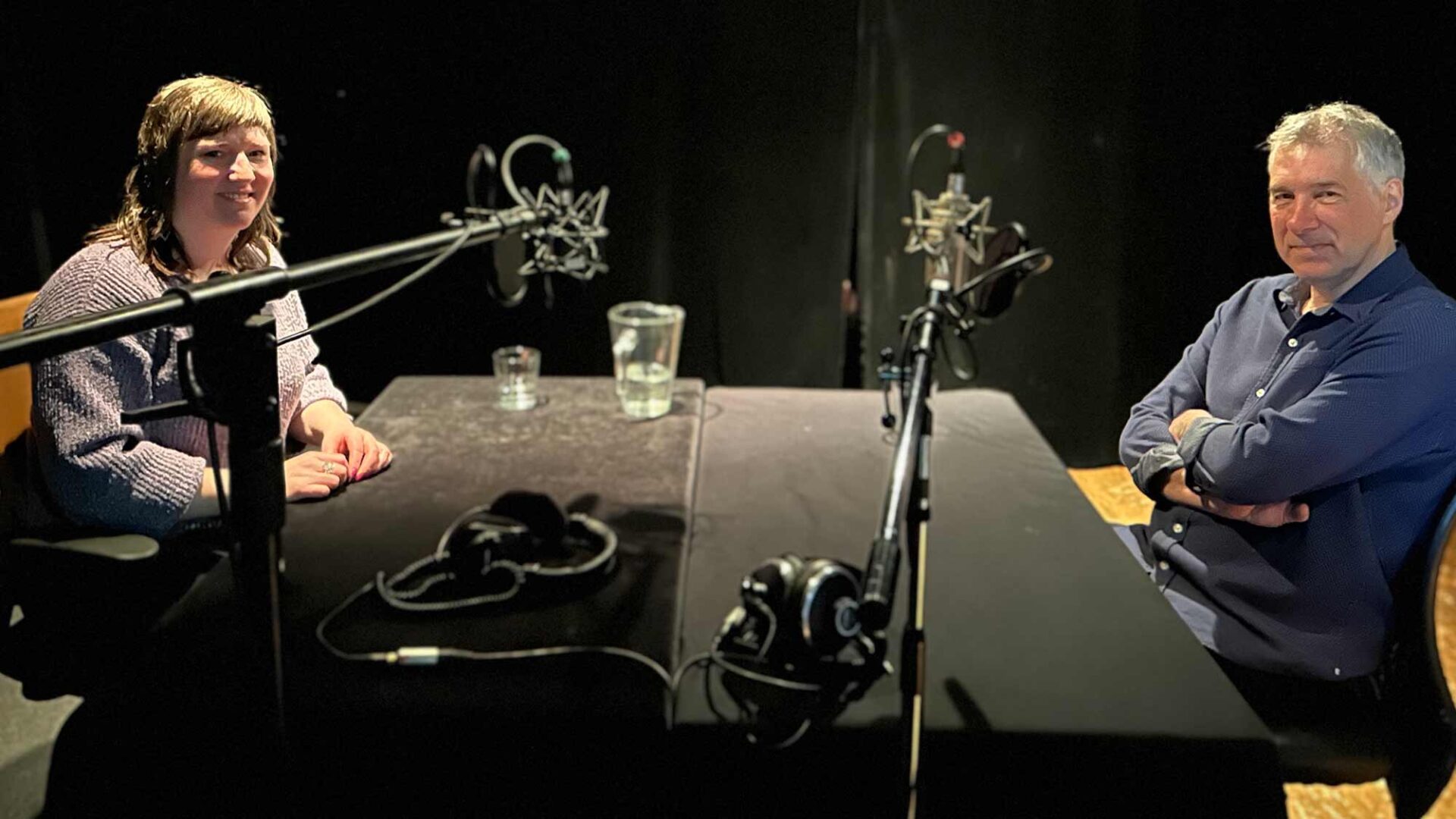
In fact, René Roberge was nominated this year for Best Editing in a Feature Documentary at the Canadian Screen Awards for the film JOUVENCELLES. Catherine Legault nous guide à travers son parcours professionnel et son approche très singulière du documentaire.
Bonne écoute!
Veuillez nous envoyer un courriel en mentionnant les sujets que vous aimeriez que nous abordions, ou les monteurs.euses dont vous aimeriez entendre parler, à :
Un grand Merci à
Animatrice
Montage
Design sonore du générique d'ouverture
Mixé et masterisé par
Musique offerte par
Commandité par

Presented in English / Atelier en anglais
Ce cours d’une durée de deux jours abordera non seulement les aspects procéduraux et logistiques de la fonction de l’assistant.e-monteur.euse, mais inclura également un survol global des enjeux politiques et psychologiques du montage et la façon dont ils affectent tout le monde impliqué dans le processus. Avec vingt ans d’expérience en tant qu’assistant-monteur, Paul Whitehead saura vous livrer généreusement ses conseils et ses anecdotes pour illustrer des leçons apprises à la dure. Les personnes débutantes comme les plus expérimentées pourront tirer profit de ce cours. À noter : ce cours n’enseigne pas l’utilisation d’Avid, de Premiere ni d’aucun autre logiciel.
La biographie suivante est uniquement rédigée dans la langue de présentation.

Paul Whitehead has been a fixture in the Toronto Post Production community for over 30 years. He has worked as First Assistant Editor on over 50 film and television productions, and now edits episodic television and feature films. His career began at the dawn of non-linear editing technology, which allowed him to witness and contribute to its development over the years. Paul has taught others the art of assisting throughout his career both one on one and at the college level, and believes strongly that experience must be passed on to maintain the high standards that Canadian crews are known for.

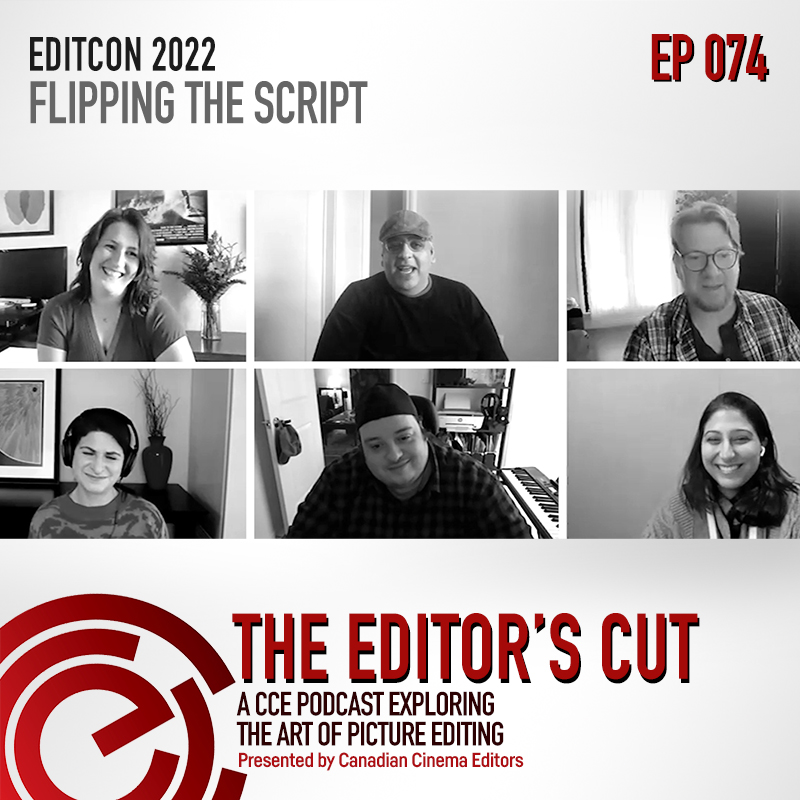
Today’s panel is Flipping the Script – The age of streaming has fully arrived. We’ve experienced a boom of topnotch shows, but how do you set yourself apart in such a crowd? Whether it’s bucking the trend of antagonistic conflict to create the arc of TED LASSO; using comedy to punctuate the lives of non-binary characters in SORT OF, exploring familiar characters in new ways with WANDAVISION or reinvigorating period drama with the diverse world of BRIDGERTON, these shows prove that discarding past norms leads to success. Sit with the editors behind these phenomenal series as they discuss the ins and outs of their groundbreaking approaches to storytelling.
This episode is generously sponsored by JAM Post.

The Editor’s Cut – Episode 074 – EditCon 2022: Flipping the Script
Sarah Taylor:
This episode was generously sponsored by Jam Post.
Omar Majeed:
Some of these words we use in television are so outdated in a weird way you know. It’s like a comedy-drama, but it’s like we think of comedy, our association is mainly the high comedy. We think of drama, you think of high stakes drama, right? Life is so often lived in the middle zones of those extremes. And then, you know, you add something high concept like WandaVision in there, and it feels like, oh, we got to have huge, big action, not scale things down to emotions of grief, right? So similarly for a character like Sabi, they’re queer, they’re marginalized, they’re racialized. These are labels that we tend to think of as having high stakes drama or outrageous comedy. And I think we were trying to kind of find what was more just the authentic truth.
Sarah Taylor:
Hello and welcome to the Editor’s Cut. I’m your host, Sarah Taylor. We would like to point out that the lands on which we have created this podcast, and that many of you may be listening to us from, are part of ancestral territory. It is important for all of us to deeply acknowledge that we are on ancestral territory that has long served as a place where Indigenous Peoples have lived, met, and interacted. We honor, respect and recognize these Nations that have never relinquished their rights or sovereign authority over the lands and waters on which we stand today. We encourage you to reflect on the history of the land, the rich culture, the many contributions and the concerns that impact Indigenous individuals and communities. Land acknowledgements are the start to a deeper action.
Today’s episode is part two of our four part series covering EditCon 2022 Brave New World. Today’s panel is flipping the script. The age of streaming has fully arrived. We’ve experienced a boom of top-notch shows. But how do you set yourself apart in such a crowd? Whether it’s bucking the trend of antagonistic conflict to create an arc of Ted Lasso, using comedy to punctuate the lives of non-binary characters in Sort Of, exploring familiar characters in new ways with WandaVision, or reinvigorating period drama with the diverse world of Bridgerton. These shows prove that discarding past norms leads to success. Sit with the editors behind these phenomenal series as they discuss the ins and outs of their groundbreaking approaches to storytelling.
Speaker 1:
And action. Action today, this is the editor’s cut, CCE podcast, exploring, exploring, exploring the art of picture editing.
Gillian Truster:
Hello everyone, I’m Gillian Truster. I’m your moderator for this panel Flipping the Script, and I am very excited to have the opportunity to chat with editors of some of the most critically acclaimed and popular shows on the planet. I would love to introduce our panelists today in the order in which you appear on my screen. We have Melissa McCoy who’s here to talk about Ted Lasso. We have Omar Majeed and Sam Thompson who are here to talk about Sort Of. We have Jim Flynn who’s going to be discussing Bridgerton. And we have Nona Khodai who’s here to talk about WandaVision. Welcome everyone.
Nona Khodai, ACE:
Thanks for having us.
Gillian Truster:
Yay, I’m very excited. So all of you have shows that there’s something very unique about them and we could fill a panel on each of your individual shows. So with our limited time, I’m going to focus my questions on what makes your shows unique and innovative, creative challenges and what you feel resonated with audiences. And then I’m going to leave time for a less structured section where all of you can ask each other questions and share your experiences. So with that, let’s get started. So Nona, let’s start with you on Wanda Vision. So you were nominated for two Emmys for this show. That is very exciting, congratulations.
Nona Khodai, ACE:
Thanks, in the same category, but yes.
Gillian Truster:
That is amazing. That is amazing. So before we dive into it, can you tell us what the premise of the show is for those watching who may not have had a chance to see it yet?
Nona Khodai, ACE:
It’s basically, well it’s an exploration on grief, actually. The show in the short term, basically. The reason the show is kind of unique is that it’s structured in a way that you think it’s about happy sitcoms, and then you reveal, as we reveal episode by episode, little things are a little odd. The character goes from decade to decade in sitcoms, and it’s her way of dealing with her grief over the years. And so instead of showing it in this traditional way of how we see grief, we see it in her love of sitcoms and how those sitcoms have helped her get through the grief as each person in her life has passed, basically.
So we start in the fifties with an episode that’s similar to Dick Van Dyke, and we go decade by decade until we get into the present day. And then we reveal in a way, in the clip I’ll be showing, how she changes the world from present to the past into the sitcom world that she’s created to protect herself from grief. And then it’s based on the characters, Wanda Maximoff, who has powers being able to mind control people and move things with her mind and Vision, who is, who’s the lover of her life and is a Synthozoid, a robot essentially, but has human emotions. And she’s lost him in the last Avengers movie. He has passed away and this is her dealing with his death basically is the show. That’s the exploration of her grief over his death and all the deaths that she’s had to deal with. So that’s basically what the show is about.
Gillian Truster:
So exactly, your show, it’s the way that it’s told. That’s super, super innovative. So with that, let’s show your clip because I think, well why don’t you set up, the clip?
Nona Khodai, ACE:
Basically goes through her life and it flashes back through what’s happened to her and where she has ended up today in the present, in her present day in the show. This witch, Agatha Harkness, basically is trying to open her up because she has this power within her that she doesn’t know why she has all this power. And so she’s basically Wanda’s walking her through her memories. It’s kind of like a Christmas Carol episode basically. So she’s walking her through all her memories and the clip is she’s found this letter, that vision has gone to this one location and we reveal why in a clip, basically why she’s gone because she basically… Well, I don’t want to give it away, but basically there’s a deed to a house that he’s bought in her name and their name and because it would’ve been this life that they would’ve lived together and yet they don’t get to live it. And so it’s the catalyst to what happens next, which is she creates this world to protect herself.
Gillian Truster:
So let’s roll that clip.
[clip plays]
Gillian Truster:
Thank you very much. That’s a great clip.
Nona Khodai, ACE:
Thank you.
Gillian Truster:
And I love how there’s so much information that’s conveyed nonverbally and I think that clip also is great that it gives people who haven’t seen the show a really good sense of actually what the show is. If somebody asked you what genre do you consider WandaVision? I legitimately think you could say all of them. I mean, it has drama, it has comedy, it has mystery, it has action, adventure, superhero. It has sci-fi, it has fantasy. But what do you consider it?
Nona Khodai, ACE:
I mean, it’s whatever, whoever’s watching it considers it. I think it’s such a show for everyone, hopefully. And you can’t put it in a… I mean it’s a limited series, so it’s its own thing. So there is no genre, I guess you would say in it. I think essentially it is like a drama and comedy, a dramedy. We have both elements. It could also be a multi-cam sitcom at times because we have laugh track and whatnot. I don’t know. I can’t… I don’t know what it is.
Gillian Truster:
Right, it’s it. It’s a bit of everything. It’s a bit of everything. So actually speaking of sitcoms, so the first few episodes starts in this sitcom world. Did you watch old sitcoms in order to emulate the style?
Nona Khodai, ACE:
Yeah, I mean we knew from the start of signing on that we would have to emulate older sitcoms. So I was a big fan of I Love Lucy, so I know all of those episodes. So I just went and rewatched a lot of that. I was a big fan of Dick Van Dyke, so I went and started watching some of those. And it’s amazing how crisp that timing is and the pacing and how much they rehearsed, it looked like they rehearsed, to get that because it was all so fast-paced. And they would just stay in those wide shots and they would just banter back and forth. It’s pretty incredible. Bewitched, I watched a lot of Bewitched and Brady Bunch and Family Ties for the ’80s episode, Full House, and then Modern Family and The Office were our ’90s, 2000s episodes. So all of those decades, and I grew up with all those.
Gillian Truster:
So you’re familiar?
Nona Khodai, ACE:
I was familiar. I knew the timing, but it was good to refresh and go back, even Laverne and Shirley and Mary Tyler Moore for the main title sequences. I had to go, because we had to create those main title sequences too. And so it was a good way to look at all of those different sitcoms and what they did and how it evolved from the ’50s to the ’60s to the ’70s, especially style and music. Music was really hard to temp because if you go back and watch, they don’t really have scores right now. We can’t go and buy those scores and put them in. So it was a lot of library music that we found to sprinkle it in for temp until we had the composer come in and write to the show.
Gillian Truster:
So even though you were emulating those sitcoms, did you end up taking any liberties with that in order for them to work for a modern audience?
Nona Khodai, ACE:
Absolutely. I mean I think at some point I had a little bit more pauses and whatnot and I tended to kind of squeeze in places just because we needed it to be paced-up for modern times and even cutting it a little cuttier than say the older sitcoms because they would just stay in those mediums for most of it. And I did do that, but sometimes you do have to just pace it up for time and so people won’t get bored, especially those early sitcoms because no one knew what was happening. And I think we were worried that no one would like the show because you’re like, what is the show? Why would people stick around and watch it? But I’m glad they did.
Gillian Truster:
Well actually, I mean that does bring up a couple of questions I have. When the show starts, the narrative is not immediately clear. So did you end up doing anything in editing to parcel out the information differently than maybe perhaps as scripted?
Nona Khodai, ACE:
I mean, a lot of it was scripted, I’ll say that. But yes, we did the end of 101, that was scripted, but we come out of frame and you see that someone’s watching the show and you’re like, what’s that? And then at the end of 102 and mainly the first two, mostly because we aired those together and they were originally going to air all three, but we needed time on the back end for VFX for the finale. So we needed that extra week to get all those VFX approved. And so instead of having all three air, and the end of two they added a bit of sound and Randall Park has a line at the end that you don’t know it’s Randall Park, but it’s him saying, “Wanda, Wanda, do you hear me?” And we added that at the very end of 102 so that it would entice audiences to come back for the next episode because we just didn’t have anything to come back to this mystery of what’s really going on.
You did a little bit with the Beekeeper coming up and staring at Wanda at the end of 102. You see all that bit. That was all done intentionally, but you just needed something extra there, I think, just to get the audience to come back for the next episode. And I think it worked. And then after the end of 103 with Monica Rambo getting thrown out of the Hex, definitely people came back for episode four, which is where we really get ya, I feel like. Four is the episode where people want to come back and watch and they’re like, okay, I get it. I get the show. But up until that point, I think it’s a bit of a mystery and it was, I think, a lot of audiences probably left because they were like, what is this? What am I watching?
Gillian Truster:
You wanted people to know that, oh not every episode is going to be a sitcom. That just wait, there is something that is going to come. And you just giving them those little tidbits just to let them know, just wait, patience.
Nona Khodai, ACE:
Just wait a second.
Gillian Truster:
Patience people patience and then it will, the mystery will unfold.
Nona Khodai, ACE:
It’ll pay off eventually. Exactly, yeah.
Gillian Truster:
Working on this show, how much did you need to know about the Marvel Universe?
Nona Khodai, ACE:
I mean, I went back and watched all the movies. I think most of what I needed to know is Wanda and Vision’s backstory. I needed to know that, how they met and what happened to her and her brother in Age of Ultron, Avengers Age of Ultron, that he had died. And just knowing her and his backstory, I think, was probably what I needed to know. But I did, I went and watched all of them and it was fun to go back and watch the whole catalog because I don’t think I had actually done that before I started the show. So it was just fun to just learn about the world and all the various different characters. And you just go everywhere. You go to a space, you go… It’s a universe of its own. It’s pretty fun.
Gillian Truster:
Now I’ve heard you say that this show was treated as if you were making a movie, not a TV series. So can you elaborate on what you mean by that?
Nona Khodai, ACE:
Well, the way that the shows are structured at Marvel, we have a director who’s the showrunner essentially. There is a writer, but we never dealt with the writer really. We would get notes through the director from the writer, but essentially the director was our leader and we took the show from production all the way to delivery. And usually on TV shows, you lock your show, you say goodbye, they do all the VFX, and then they deliver after. Like on The Boys I would lock shows and then they would spend another six to eight months working on VFX and then they would deliver the show. And I would never see them until the final mixed playback, which would be six to eight months later. And then I’d be like, whoa, look at all this, all these VFX that I had never seen before.
That’s not the way it works at Marvel. You’re there, you’re working with the VFX team, you’re working with the Sound Department, the Music Department, you’re giving your insight in all of it. You’re giving notes on all of it. You’re changing timing on shots based on VFX to the very end. And a lot of TV shows do that, but for the most part, being on very high genre shows, I haven’t had the privilege of doing that. And I don’t know about the other panelists here, but I had never experienced that in TV before. So it was refreshing to just be able to finish the show properly. And that’s what I mean by it feels like a feature.
Gillian Truster:
Right, it sounds like you’re until the end collaborating with a lot of different departments, right through the-
Nona Khodai, ACE:
Taking it right through to the end. Yeah, I mean we delivered the finale, I think, 15 days before it aired. And that was 15 because we just had no time, so. We were there to the very end. And I know working at Shonda and other places, they’ve done that or I’ve heard that too, that they take it to the very end too sometimes with shows, and I’m sure Jim could speak to that.
Gillian Truster:
That’s great. No, that sounds like a fantastic process, a fantastic way to work.
Nona Khodai, ACE:
It was a pleasure.
Gillian Truster:
So Melissa, let’s get into Ted Lasso.
Melissa McCoy, ACE:
Okay.
Gillian Truster:
So you won an ACE award and earned an Emmy nomination for Ted Lasso. Yes, congratulations, that’s incredible.
Melissa McCoy, ACE:
Thank you , yeah.
Gillian Truster:
So before we get into it, could you please give us the premise of the show for those who may not have a chance to see it?
Melissa McCoy, ACE:
Well, it’s about an American football coach who goes over to England to coach soccer or football over in the UK. And he’s brought over by the team owner who’s acquired the team in a nasty divorce. And the reason she brings him over is not to take the team, basically. And so that’s kind of the setup. It’s very Major League, but from there it basically turns into a workplace comedy that also deals with the human condition and loss. Much like WandaVision, where it’s kind of hard to put in a box because I remember going through season one and getting things and thinking, okay, I’m getting a lot of sad episodes. Him and his wife go through a divorce, and Rebecca’s dealing with a lot of pain and shame. And Roy Kent is dealing with the end of his career and who is he going to be?
It’s all about the human condition really. And it wrapped in a workplace comedy with a little bit of sports mixed in. Yeah. So it’s more of a dramedy in that way. But for me at least, you just fall in love with this cast of characters that revolve around this world. And it’s not all, you know you have your team, you have your soccer players, you have the coaching staff who have their own world. You have the behind the scenes with Rebecca, and then she brings in Keeley who starts out as a… She’s a kind of model-star dating one of the soccer players. And then, or football players, I’ll say football, that’s what we kind of try to stay with the right vernacular, even though Americanized.
Anyways, it’s complicated. I feel like I’ll say soccer and I’m pissing off some people over here and I’ll say football and people are like, wait, what are you talking anyways, football. She was dating one of the football players and that turned into a love triangle. And so there’s just a lot of world blendings of this ragtag team of characters that are all going through some pretty big life stuff. But you still find the comedy in those moments.
Gillian Truster:
No, it is actually said that I was going to ask you about, because for awards you have to choose the category, but it’s not, and so it’s won all these awards in the comedy category, but it’s really, really not a straightforward comedy. So when you signed onto the show, did you have an idea of, oh, I’m on a comedy and this is how I’m going to cut it. Did your perception of it change over time when you got the footage?
Melissa McCoy, ACE:
Yes. Yeah, so I signed on because I was working with Bill Lawrence, who’s the executive producer. So I just basically saw him developing with Jason, didn’t know the script or anything. I didn’t really even know the skit. It’s based on a skit, like an NBC promotional thing for when they brought football to America. The Olympics were coming up and it was done back in the day and it was just like a snappy, ridiculous comedy. But I knew that he was developing the script and I just basically was like, I want in on that because I love Jason from SNL. I’m a big SNL fan, and I just.
Melissa McCoy, ACE:
I love Jason from SNL. I’m a big SNL fan, and I just thought he was charming and a wonderful performer. I don’t know, just something in me, script unseen, I didn’t know anything about it. I was like, please, please, please, can I be on that? They let me do it. I got to do the pilot. I had signed on before even reading the pilot. And then when I got sent the pilot, I was reading it and I was like, okay, comedy, comedy, comedy. Then you get to the end and in the script, I remember they were like, this song plays, please play this song as you read this scene. I was like, okay. I remember I was in a coffee shop and I was like, okay, I brought up the song and I’m listening to it and reading the scene and I’m like, this feels really heavy.
It’s this conversation with his wife and you don’t hear the other side of it where you basically, oh, he’s come here for a different reason than Rebecca bringing him over. He’s got a reason to want to get away as well, which I really loved. Then when the footage started coming in, I was kind of by myself. Everybody was in London, I was in LA and we never had a tone meeting about it or anything like that. When it was coming in, I was like, “I am not cutting this 30 Rock.” It just didn’t feel like that. The performances didn’t feel like that. It felt like I want to land this moment. I definitely took my time in some places to build the relationships. Then of course did some snappy stuff. We like some more stylized stuff. There was a press conference which was kind of a nod to the original skit, so that was a little more frenetic and fast paced.
But as we were trying to figure out what the show was when we started cutting it, first Apple was like, “This needs to be 28 minutes.” and we were at 36 minutes or something. I think we got it down to 30 minutes in and around there, but everyone was like, it’s a comedy, it’s got to be fast. it just didn’t feel right. Talking to Jason, we had cut a scene that he was like, looking back now, he was like, nobody ever said, I wish these were shorter. He was like, I wish we would’ve kept that scene in it. So it was just little things. We made some concessions early on that we didn’t do in season two. As our times kind of grew, we didn’t ever get close to 30. I think our longest episode in season one was 34 minutes, and that was our shortest episode in season two.
It’s interesting to see how the world has evolved and Jason really leaning into his beliefs in the show and what he wants to say and what he wants the characters to be feeling and going through and giving them the space to do that has been a really enjoyable process to find it along the way and be like, this is what it is. And I think we all just fell in love with the people and wanted to spend some time with them and gave ourselves, luckily we’re on a platform that you don’t have to fill to the tee of a running time.
Gillian Truster:
So then in terms of like you said originally it sounds like Apple was like, oh, this is a comedy. It’s a sitcom, it’s supposed to be this many minutes. You have to get it to be shorter. Then is it with season two that they allowed more leeway because they saw how successful it was? Is it that they really had to wait to see what the audience reaction was before they were like, “Oh, right, it is this, we could let it breathe.”
Melissa McCoy, ACE:
Yeah, I think they found that over season one, it was just how much pilot, because we were a straight to series pickup, so it was like they didn’t work out anything with the pilot. They just got that and we were already moving along. I was working on episode three because I did every other episode, and so it was just like we were still going and finding it. Luckily season one, everything was open until the very end. We didn’t have to lock anything, so we didn’t have air dates. It was lovely. We were finding things later and being like, let’s go back and plant, oh, I see why the writers did this. We were letting moments land early that had we had to lock and move on and not have found what it was later. I think over the course of season one, Apple was like, “Oh, okay.”
It was only in that opening, what is this? It’s all that, trying to find the music and the tone. It was really tough. I was burning through all my soundtracks, just trying to find the right musical tone for this, because it’s just like, is it a comedy? But we have these kind of interpersonal moments that we’re trying to let land, and it feels more real in that moment and less slap sticky, which if you watch the original skits, it was all just like joke, joke, joke, joke and kind of outlandish. Even though there’s some of that, Ted Lasso you could send him off and he could be a complete caricature, but Jason grounds it in so much reality that that’s one of the things I love is he’s being silly, but then he gives a little wink to the audience of there’s something deeper of reason why I’m deflecting with the joke or trying to make you comfortable with the joke or open you up with this joke, especially with him and Rebecca and how he just keeps working at her and then they kind of reach a deeper relationship.
Well, everybody in that way, Keeley and Rebecca and Roy and Keeley and Jamie and Roy, they all kind of have this friction that then breaks down into a real relationship, which has been really enjoyable to kind of, I guess create in the editing room.
Gillian Truster:
You also brought a clip with you. Do you want to set that clip up?
Melissa McCoy, ACE:
Sure. This is from season two, episode 205 called Rainbow. It’s basically, it’s basically the rom communism episode where it’s a romantic comedy, but it’s not about love interest, it’s about the love of football and Roy Kent’s return to the pitch. It’s basically the romantic comedy of Roy and football and actually between him and Jason really, or Ted. Yes, and he’s retired after season one and he’s become a sports announcer and he thinks this is where he needs to be. He needs to be away from the pitch but our team captain Isaac is having a bad start of the season and Ted wants a big dog Roy to come in and kind of set him straight and get him on the right path to get out of his head. So Ted has kind of asked Roy to do this, and he has helped him.
One night he comes and he takes Isaac to his hometown football field and plays a scrappy pickup game with some of the guys there that are really, really good pickup game. He gets his love of the game back and Roy has kind of done that for him. Now it’s game day. Roy is on the show for the, it’s soccer Saturday I think it’s called. Yeah, starts there.
Gillian Truster:
Let’s roll the clip.
[clip plays]
Gillian Truster:
Thank you very much. That’s a great clip. Why did you select this clip?
Melissa McCoy, ACE:
For me, it was, when I think about Ted Lasso, it’s like, again, it’s not really about the football, it’s about what’s going on in these people’s lives. And that was such a turning point for him. There was a bunch of different ways you could cut that, but I chose to stay on him for longer and not cut around to all the things that were happening because he’s going through this decision moment. That’s basically what Ted Lasso is about, is these people going through these really real things and we have to cut it in a way that you are on that journey with him. When it starts out, it’s ratatat back and forth with the commentators. Then as you’re going and he’s seeing what’s happening, his change that he imparted onto Isaac and the team, when you come back out, you just stay with him and you see it on his face and you hear the announcers having the conversation in the background, but it’s not about that for him anymore.
He’s making his decision to not do this anymore. I remember I cut the scene basically how it is, and then when the director came in, she was like, “I think maybe we need to see the guys that they’re saying it’s lovely weather back there and all that stuff.” I was like, “Sure, I could cut it that way, but I did it this way because who cares about that at this point? Roy doesn’t care about that. Why would we go there?” She was like, “Yeah, I get that, I get that, but let’s see it that way.” I cut a version of it and then she was like, “Oh no, you’re right. Go back to how that was.” It was important to go through that process because that’s traditionally how you do it. Somebody’s talking, go to them. You should see it that way, sort of thing. Ultimately it was about his character and what he is going through.
Gillian Truster:
Thank you Melissa. Omar and Sam let’s get into it, because I think that your show does share some of the same challenges that Melissa experienced in terms of tone and finding the right tone and music for your show. You brought a trailer with you. Why don’t we roll that clip to set that up for the audience.
[clip plays]
Gillian Truster:
Thank you for showing that. That’s a great trailer. Sort Of has been on a lot of top 10 lists for 2021. It premiered at Tiff. It’s gotten a lot of acclaim. It’s a show that similarly to your main character or a lot of the characters actually don’t fit into any typical boxes. It doesn’t fit into boxes. Was it difficult for you to find the tone of this show? How did you find the tone of this show? What do you think the tone of this show is?
Omar Majeed:
We had to really discover the tone of the show and it was a process. I think it’s very fitting that actually Sam and I are both here on the panel. Because even though we had our individual episodes, especially in the beginning, there was a lot of back and forth on episodes that I was working on and that Sam was working on. We would share a lot and just sort of trade off ideas with Fab and Bilal who were the creators of the show to really define what wasn’t even, I think clear to all of us at first in terms of we kind of knew what the show wasn’t more than maybe what the show was, and we had to figure out a lot of things along the way. The character of Sabi is not a very usual character and that’s obviously something to be celebrated.
I think that presented unique challenges tonally. Melissa, like what you were saying, and I’m sure for you as well similar feelings about in this genre is supposed to be funny. I tend to feel like some of these words we use in television are so outdated in a weird way. It’s like it’s a comedy drama, but it’s like we think of comedy, our association is mainly the high comedy, the broad comedy. We think of drama, you think of high stakes drama and life is so often lived in the middle zones of those extremes. Then you play something high concept like WandaVision in there and it feels like, oh, we got to have huge big action, not scale things down to emotions of grief. Similarly for a character like Sabi, they’re queer, they’re marginalized, they’re racialized. These are labels that we tend to think of as having high stakes drama or outrageous comedy. I think we were trying to find what was more just the authentic truth of the character and that situation and also the characters around Sabi because they mattered just as much as Sabi did. What are your thoughts there, Sam?
Sam Thomson:
No, absolutely. I mean I totally agree with that. I think from the get go, it was really important from for Bilal and Fab to have this be a show that was about a non-binary or trans character that wasn’t about their body or about some of the other frequent sort of storylines that end up popping up about these types of characters on television and have it just be just more universal and about their humanity. There’s a line in the show that I think we come back through often, which is we’re all in transition and we’re all sort of constantly experience transition in our life and not every transition is the same or is it seen the same way in society. I think that was the core of the show is that we’re all in transition. I think for Sabi, that character, the show is about identity and just defining who you are and feeling comfortable in who you are.
It’s a journey that I think everybody can relate to. Then in terms of the process around that, I’ll echo, what Omar is saying about, repeating what Melissa was saying, I think it was hard to define how funny the show is going to be or how broad it’s going to be. I mean a lot of it was already on the page, but I think that was a huge part of the editing process was testing different directions and then seeing where we could come back to. Sometimes it feels like sometimes it feels like a little bit of a circle and sometimes you’re discovering new things along the way. I think just the fact that we could be experimental and that we had kind of the support to do that and the time to do that, but also be really collaborative like Omar was saying, just to lean on each other for new ideas. I think that was the biggest, I don’t know, the biggest takeaway I guess from the process in general.
Gillian Truster:
Yeah, I really want to get into the collaborative process on your show because I feel like, so you could say this show is about a queer, trans-feminine, non-binary, Pakistani Canadian Muslim, but it’s really not reducible to those descriptors. I think your show has really gone out of its way, just as you said, to do that. I had seen an interview between Bilal Baig and who plays Sabi and Amanda Cordner, who plays their best friend 7ven. Bilal said something like, they’re straddling all these identities, but it’s not the identity stuff that keeps them up at night. It’s like, are the kids okay? Am I letting my best friend down? Am I letting my mother down? Is the bar going to close? It’s just all this human stuff. It’s just about how people navigate the world. The show really is, it’s really trying, I mean there’s so many different people in the show and it’s really trying to find the authenticity. Everybody has depth down to the most minor characters. What was the collaboration process on your show to achieve that?
Sam Thomson:
Wow. I mean I think initially, Omar and I both knew Fab through different sort of origins. I think for us to get to know each other, a lot of it was maybe about sharing musical ideas or film ideas and things like that early on just to talk about tone because it’s like Omar brings his lived experience to the editing process and I have my own experience. And it’s like, I think again, to go back to the collaborative nature was just us having the freedom to be open-minded, to ask questions of each other and not assume that we know the answers and be comfortable with that. It was such a strange experience I think in so many ways.
I mean know, we don’t really want to get into the technical stuff too much, but we’re all sort of remote on this. It was sort of during the height of Covid and we’re just sort of trying to feel out what the show is and that’s a process and feel out each other. We were cutting while they were shooting and it was just a lot happening sort of all at once. We can speak to other sort of specifics like music and a few other things were very important in terms of that part of the process. I don’t know Omar if you wanted to say anything else just about the initial collaboration.
Omar Majeed:
I think that’s sort of the thing I would say the show’s, I really feel the show’s success owes a lot to the spirit of collaboration because I think this is a bit of a double-edged sword for me being somebody who kind of occasionally benefits from these diversity kind of initiatives. But the show did have real diversity in its, it worked weaved into its actual collaboration. The writer’s room was diverse. They were well represented in the edit suite in the sense that both Fab and Bilal were very actively involved in the edit. Then at the same time.
Omar Majeed:
Actively involved in the edit, and then at the same time, Sam and I are collaborating back and forth. And then there was other editors on the show. There’s Craig, who I didn’t get a chance to work with directly, but he as well, and we’re all sharing ideas and bringing our own experiences into things and discussing stuff. Even just to be able to raise a point, if I thought maybe there was something let’s say from a Pakistani angle that maybe let’s say rubbed me the wrong way, well, I wasn’t the only person speaking to that point. Bilal, they would put their opinion in. The writers had obviously, they had enough sort of lived experience there to speak to those points as well. The cast… It was all reflected in such a way that no one had to be the one person speaking to one specific experience, whether it was racialized, gender-fluid perspectives or even just the specifics of how you put a show together.
I mean, all of us had varying levels of experience coming into it, but I think there was a sense of like, okay, we’re trying to go for something tonally… I mean, I’ve heard the show described in some reviews as having a certain sort of gentleness, and we didn’t think of it that way, but it sort of hits as like, yeah, that sort of makes sense. We were I think consciously not trying to go for… Even though one of the characters in the show is in a coma in the hospital, it’s not like, “Oh my god,” or it’s not like laugh out loud pratfalls kind of comedy. I mean, we did have those experimentations here and there, mostly towards trying to make it more comedic, but I think it was always clear that, no, it sort of occupied a sort of middle zone here where the comedy isn’t like I-got-you-in-stitches, MacGruber kind of style comedy.
I’m speaking to my own sense of humor here. It’s more of the comedy grounded in the characters and the absurdity of certain situations. And I think we had to figure that out through a lot of real discussion where no one, I think, had to feel the burden of having to speak for one specific thing. It was real, genuine discussion on an artistic level, not just on the level of identity. So inside the show and outside the show, we touched on those issues, but it wasn’t those kinds of discussions, if that makes sense.
Gillian Truster:
Mm-hmm, fantastic, thank you. No, because I read an interview or an article about Bilal, and they were talking about the same thing that you’re mentioning, which is that it would have been very stressful for them to be the only non-binary person on the show, but what you had is real diversity, where you’re not relying on a single person to speak for an entire group of people, where there’s a spectrum within every group. There’s diversity within groups. And so I think part of the reason why you achieve such authenticity in the depth of your characters is, it sounds like, because of this collaborative process. That collaborative process is really the heart of your show.
Omar Majeed:
Yeah, absolutely, absolutely. I mean, even just one example comes to mind where I think one time, and I don’t know, I think in the end this didn’t even happen in the show, but just as an example of the kinds of things we would have, I was just talking with Fab about how to structure a scene, and then I was thinking about the music that’d be playing in the background in the scene between Sabi and their mother, and they’re playing music that their mother would enjoy. So I was trying to think, okay, what’s a Pakistani kind of piece that would work? And so I put a couple things in there, and Fabri liked it, but then I went and had a discussion with Bilal about it too, and then we got into this whole thread about what would Raffo have liked? How would she have grown up? And you know what I mean?
So it was an interesting… It’s one of those type of sidebar conversations you have that are very deep, that you go, okay, maybe it doesn’t even come into the final edit, but it was informative because we were sharing our own references. But it was like Bilal and I were sort of frequently trying to figure out what would be a good… And this was just for temp purposes, but we were trying to figure out what is the right tone. So tone was everything, I think, for us and trying to figure that out. And in terms of pacing, in terms of how to work with music, how to work with each other, and even how to fight back against certain boxes that maybe we were feeling pressured to conform to kind of echo some of what Melissa was talking about.
Gillian Truster:
Thank you. Thank you. So speaking of smaller moments and a warm, gentle show, so Bridgerton is not. So Jim, let’s get into Bridgerton a bit. So this series reached number one in 76 countries on Netflix, and it became the most watched series on Netflix ever at the time of its premier. So it is a monster hit, just a monster hit.
Jim Flynn, ACE:
A lot of people saw it, and it’s great.
Gillian Truster:
That must feel quite good, to have worked on something that just blows up like that. So a question I have before we get into sort of creative challenges is this. So Bridgeton is a Shondaland production. Shonda Rhimes is known for being a hitmaker. I mean, she really knows how to read the tea leaves. When you’re working on a Shondaland production, is working with Shonda Rhimes different than working with other producers? When you go into the show, does she say to everybody, “Okay, everyone, we are making a hit show, and this is what we need to do?” Or is she just like any other producer just trying to make the best show they can?
Jim Flynn, ACE:
Well, I mean I think all producers are different, but Shonda is different still. I’d never worked with Shonda before, but if she said at any point, “We’re going to go and make a hit, and here we go,” it wasn’t in my presence. But she does know how to do that, and her instincts are so attuned to how to construct a series for television better than anyone I’ve ever worked with by a lot. And she doesn’t even seem to spend any time sort of contemplating any ideas. She’s so direct, she’s so frank. She seems to know exactly what she wants all the time, and she makes sure that she gets it.
It’s a treat working with her. She’s a force of nature. She’s a little intimidating, and she’s very, very brief when she speaks to you or when she sends you notes, which at first blush you’re kind of like, whoa, she didn’t really like what I sent. But then over time you realize actually this is a great way to deal with her notes. She just tells you “This sucks. Take it out. Don’t use that. I don’t know why you used this take. We should do this.” And it’s really refreshing. It’s not couched in any sort of pleasantries. She doesn’t have the time.
Gillian Truster:
Right, she just gets right to the point, right to the heart of the matter.
Jim Flynn, ACE:
For sure.
Gillian Truster:
I actually forgot to ask, for those who haven’t had a chance to see the show, what is Bridgerton about?
Jim Flynn, ACE:
Bridgerton is a Regency-era period piece, but it’s kind of put through a bit of a Shondaland prism, I guess. It’s very modern. The cast is much more diverse than a Merchant Ivory type film. The moments and the beats feel very modern, and it’s really trying to appeal and presumably has appealed to a much younger audience than normally you would get with a period piece romance.
Gillian Truster:
So you also brought a clip with you. I think that clip does give a good idea of what the show is about. Do you want to set that clip up for us?
Jim Flynn, ACE:
No, go ahead and watch it. I think it speaks for itself, and then I can talk to about it when we wrap.
Gillian Truster:
Perfect. Let’s roll the clip.
[clip plays]
Gillian Truster:
Tell us about it.
Jim Flynn, ACE:
Well, I know I was originally going to bring something from the pilot, a much bigger event, but when I sort of went through the show again, thinking about this panel, I thought, well, this would also be a nice one to do, because I think what that moment does in the series, it happens in the third episode, and the premise of the show is basically the… The show is about this Bridgerton family, and Daphne Bridgeton, who is the oldest daughter, is being sort of shopped out to find her husband and seek her fortune and the sort of complexity that goes with that. And so her and this Duke Simon, who sort of become these friends, they come up with the dumbest ruse of all time, which is they’ll pretend that they’re going together so that they can get other people to be more interested in them.
So to that point in the series, they had sort of put on a show that, yes, we’re together, we’re walking through the park, we’re dancing at this ball, we’re doing all these things, and then suddenly in this episode, the two find themselves by themselves, and they realize that there is a real energy between the two of them. There’s a real chemistry. And I think the scene itself is just very well crafted and not just from my perspective. Tom Verica, who directed it, did a fantastic job with his episodes. I’m sure some of you know Tom.
But just the costuming, she’s in white, he’s in black, the way they staged it, where they were facing away from each other, then she turns around, you can see the whole scene, the distance between them getting smaller and smaller in the frames. And then I went to these closeups one after the other as she’s describing this painting and he is realizing that this person is special to him, and then the hands start to come together, and I think it’s sexy, and I think it’s really cool, and I think it represented a big change in their relationship, and that became what their relationship was from that point going forward, this sort of just barely reaching out, I’m doing this very slowly, I’m doing this very gently, and I just thought it was very, very well executed.
Gillian Truster:
It’s definitely a very memorable moment in the series. It’s like one of the iconic moments in the series, absolutely.
Jim Flynn, ACE:
I’m glad, because it’s such a small little moment. There’s so many big moments in the show, and that moment, that the fans reacted the way that they did to that moment, and that I’m so proud of it I brought it to a panel, I’m really happy that it had that big an impact, because I remember working on that scene and just being over the moon about how cool it was.
Gillian Truster:
Mm-hmm, amazing. So Bridgerton is a very modern take on a period piece. There’s been discussion… I’ve read about the multiracial casting, and also, like you said, typically you would think of a period piece as very conservative. This is not. I would not feel comfortable watching this series with my parents, I can tell you that.
Jim Flynn, ACE:
It’s funny. Actually, I’m working on it in my house, and this was at the beginning of the pandemic. This was when? This was April, maybe, and I’m working on Episode Six, which… Episode Six has a little sex in it, and I’m working in my living room. My children are all at home. I have a 16-year-old daughter and a 13-year-old son, and they’re working in their rooms on their schoolwork. And my wife’s a school teacher. She’s in the kitchen, and she’s working on her work, and I’m just working on the sex scene like I would normally work on a sex scene, and my wife came in the room, and she’s like, “What are you doing?” And I’m like, “I’m doing my job.” But I realized I had to put headphones on to work on Episode Six at home with my family.
Gillian Truster:
Oh yeah, the joys of working from home. That is hilarious. So what do you have to consider when you’re modernizing a period piece in terms of the picture edit?
Jim Flynn, ACE:
It’s interesting. There were moments that we played and it was edited to be much more sort of period piece-y when the scenes would kind of call for that, but when we were kind of bumping up against the edges of a more modern sensibility, more the Daphne stuff, Daphne’s older sister, the smoker, stuff like that, we would play that, and it was cut much more in a modern fashion. And I think the contrast of the two cutting styles we benefited from because you could be watching it in one perspective and then suddenly it feels like you’re watching a bit of a different show, which I embraced and did as often as I could.
Gillian Truster:
So I understand you cut the pilot, and I understand that that was the last episode delivered to Netflix. So what was the reason for that decision to deliver the-?
Jim Flynn, ACE:
Well, Julie Anne Robinson directed the pilot. She’s fantastic. The pilot, it’s almost like a theme of this panel. We had to figure out exactly what is the tone of the show. And I think everyone pretty much across the board here has basically kind of come around to the same thing, which is we’ll understand the tone when we understand who these people are. And when we figured out who Daphne and Simon really were, this being the first season… The second season, which I’m not involved in, I guess is subsequent Bridgerton members. But when we figured out who these people were, and not just Daphne and Simon, also Daphne’s mom and Lady Danbury and Anthony and all of the other characters, then we were kind of like, okay, that’s what this show needs to be. And the pilot is setting the table for all of that.
And it’s a huge cast, huge locations, huge events, big balls, that a tone shift of a few degrees has ripple effects from the start to the tail pop. So we spent a lot of time refining that, and we went in a few different directions. An early pass of mine, it was very broad. We had Lady Danbury could be very broad, over the top. It was funny, but we couldn’t fit that in with the rest of the events. So it just took a long time to figure out who are all these people, what are their relationships with all of the other people, and how do they fit in this space?
Gillian Truster:
So you wanted to see the entire series first so that you could figure out exactly how to set it up properly at the outset?
Jim Flynn, ACE:
Yeah, because each of the episodes is really kind of a different story with a lot of other threads from a lot of other different characters and a lot of other different people, so there was a lot of going back and fitting things back into where they need to be because, “Well, we need to set this up for Episode Six, and Episode Four we’re going to need to know who this Penelope character is because when this happens we need to…” You know what I mean? So we spend a lot of time refining Episode One to it. And it was fun. I don’t mind. I was the first guy off and the last guy to walk off at the end. I was there the whole time, which was great, got to see all the other episodes develop and go through and make One what we wanted One to be.
Gillian Truster:
Fantastic. So I’d like to know from all of you, what is it you think resonated with audiences? So, Nona, let’s start with you. What is it about WandaVision that you really think moved people?
Nona Khodai, ACE:
I think timing was essential for WandaVision. It came out at the height of the pandemic, January, 2021. Everyone was home. There was nothing new on television, I think, at that point, and we were airing on Fridays. So every Friday people would come around, and it felt like those old sitcoms that we would watch when I was growing up, like TGIF with Family Matters and Full House. I mean, I grew up with that. I don’t know if you have that. I didn’t know if you had that in Canada or not, but in America we had the Friday every night we would watch with my family. And so I think it had that same kind of quality, the feeling, and so everyone would watch it on Friday nights with their families.
And I think because we were all going through this grief of the pandemic, it also resonated in that way. She was going through grief. We were all also grieving or what we had just gone through and still are still going through, and I think it just… Timing. It’s because of the timing. It’s a great show, but I think the timing really helped too.
Jim Flynn, ACE:
Yeah, the show felt like comfort food in the beginning.
Nona Khodai, ACE:
Yeah.
Jim Flynn, ACE:
It was like, “This feels really comfortable, and I’m really, really happy here.” And then it just gets off the rails. But it’s great. I love the show.
Nona Khodai, ACE:
Aw, thanks. Love yours too.
Gillian Truster:
Well, Jim, what do you think it is about your show?
Jim Flynn, ACE:
I mean, I have to agree with Nona a little bit because we released on Christmas Day on the first Christmas of the pandemic, and people were looking for escapism, I think. And I think we delivered that in spades, and I think it’s beautiful, and I think that the acting is fantastic, and the editing is top notch.
Nona Khodai, ACE:
It’s beautiful.
Jim Flynn, ACE:
It’s beautiful to watch, yeah.
Nona Khodai, ACE:
Personally, I’ll say, I loved it. I love that series so much, and it was a huge escape. And I love period pieces, so to have even modern day music play classically, I thought that was so cool and so different, and it was just a delight to watch.
Jim Flynn, ACE:
Thank you.
Gillian Truster:
Melissa, what do you think it is about Ted Lasso?
Melissa McCoy, ACE:
Same, really. We released in the pandemic, and I think all of us are touching on, and Jason kind of mentioned this too. Jason, we didn’t know we were going to go into a pandemic, but he was just like, “I feel like people don’t want cynicism anymore.” That was something he really was into. If we had a joke in there, he was like, “I feel that’s like a little bit too mean for Ted.” And he would mention, “I want the locker room, that’s our Cheers set.” You know what I mean? He’s really into Cheers because his uncle is Norm from Cheers, little fact, but so he has a lot of Cheers references.
Jim Flynn, ACE:
No kidding? I didn’t know that.
Melissa McCoy, ACE:
Yeah, yeah. Yeah.
Omar Majeed:
When I head that, I was like, “Oh my god.”
Nona Khodai, ACE:
Yeah.
Omar Majeed:
I was dazzled when I heard that. I was like, oh my God.
Melissa McCoy, ACE:
Yeah, There’s a lot of cheers reference…
Jim Flynn, ACE:
[inaudible 01:09:05] years old when I heard that.
Melissa McCoy, ACE:
Yeah. A lot of cheers references in Ted.
Nona Khodai, ACE:
Wait.
Melissa McCoy, ACE:
But yeah, and then we… He was saying that as we were working on it, so it was just looking back, I’m like, God, he was so… He had such a vision. He was like, I just don’t, people don’t want cynicism anymore. He’s like, I get that kind of comedy, but I don’t want to do that. And so when we dropped, We weren’t some big… I think people came to it and were like, this show is Major League. This show is going to just be goofy American. And then word spread of people that stuck with it and was like, oh no, they go deeper. And all of us have kind of touched on the human condition of our shows. And I think at that time, people, it was a scary time and a traumatic time.
But there’s still comedy, there’s still life happening. And like Omar said, it’s, there’s a lot of, even though you are going through something that’s not traditionally funny, there’s a lot of comedy in that, sometimes unintentional comedy. You still find time to laugh even in the hardest times I think sometimes. And so our show touched on that. These people are divorced and hurt and shame and not feeling good enough or father issues. We touched on a lot of that in season two. It’s just all these things that are universal to a lot of people. And when people were seeking connection, I think we’re all home and by ourselves. You want to be with some friends and people that make you feel good. And I think that’s what Ted Lasso did for people and then…
Jim Flynn, ACE:
It’s also, it’s so full of optimism and gratitude. It’s just a really, it’s a great show.
Melissa McCoy, ACE:
Yeah.
Nona Khodai, ACE:
Yeah. Believe, it’s so silly, but I heard a lot of sports teams use that motto now. And it’s so great to see. It’s so positive, which we all need.
Gillian Truster:
It’s a celebration of kindness, really. It is. And so Omar and Sam, what are your thoughts on?
Sam Thomson:
Well, I think for me, well first of all, our release was actually a little bit different in the sense that it was almost like a show that I think people were discovering. We had a more of a media push maybe here locally, but we initially released on streaming, on CBC Gem, and then it went to CBC broadcast, and then about a month later was when it premiered on HBO Max. So it’s been this slow rollout. But I think Melissa really brings up a point that I hadn’t really thought about in a while, but it really connects with our show, which is, I think The Fab, I think had said this at our TIFF screening about the comedy and being, comedy that isn’t really mean towards anyone else. It’s not cynical. It’s not tearing down other people, to have that humor shine.
And I think that was something that was refreshing and fun about working on this show is that it lacked that cynicism that I think you all have said we needed, especially during the pandemic. We needed that positivity or escapism or whatever. But yeah, I think in general the comedy was something maybe I was a little surprised that connected with the audiences because as an editor you watch it so much and the jokes start to… You’re fine-tuning things within frames and trying to figure out, is this funny or not? I can’t tell anymore. But even being at that first TIFF screening and hearing an audience laughing and howling with laughter and all these little moments that you’d forgotten about, it was really refreshing. And I think just the comedy and also having these characters that I feel like traditionally you feel like people traditionally, maybe a lot of people would feel like they can’t relate to them in a direct way because of who they are or whatever.
I think that’s been a really fun, surprising things as I talk to people, is how people can really relate to these characters, even if they have a completely different lived experience. They can relate to just the human condition, I guess, or this idea of transition or whatever. It’s a relatable show I guess, which was a bit surprising for me but… What about you Omar?
Omar Majeed:
Yeah, I echo all of that. But I would say as well, it really strikes me being on this panel having… I had binge-watched all of these shows during the pandemic. Big panel of all of every them. But what’s remarkable to me thinking about them as a group as well, is that they hit a comfort zone like Ted Lasso and the sitcom’s dynamics. And Bridgerton with its period peace elements and Wanda Vision and the Marvel universe thing. But they’re also really smart evolutions on that they’re variations, and I think is similar in the sense that we’ve had shows that have tackled representation head on in terms of Queer As Folk or Master Of None or shows like this that really kind of what are trying to set a certain record straight or adjust the bar. And I think Sort Of is coming into a new space in that way where it’s not simply about representation. It’s about, okay, now let’s just put this… That’s the situation the character finds themselves into, but we’re going to rely on certain dynamics.
So there’s a comforting aspect that all of the shows that we’ve worked on and it’s enough that kind of is, that brings it in. But it’s not just a kind of throwback or nostalgic exercise. I think that’s really amazing. It’s an evolution, a turn of the dial. So I think that was also what audiences tended to gravitate towards.
Gillian Truster:
So I could ask a million questions, but I want to leave all of you time to ask each other questions. So let’s open it up, let’s open it up and let’s see what happens. I’m excited to see what this discussion is.
Nona Khodai, ACE:
I actually have a couple questions for Omar and Sam. So I love the fact, I love the show. I watched all episodes. I wish that it was a little longer, to be quite honest because I really wanted to watch them all. I was wondering, I like that the whole Pakistani, non-binary, Muslim element to it. I grew up Muslim, so having that as a show is really great. And to see that and did you guys have a lot of conversations about how to incorporate it? And I love how it’s not forced down your throat. There’s no talk about it really. And was there more of that that you took out or was it just the way it was written and that’s just the way it was? But I was wondering how you approached that in the show.
Omar Majeed:
Yeah, I think from my perspective, it seemed like, obviously being someone who’s… I’m also Pakistani background, grew up Muslim. I tended to ask a lot of questions and bring up those kinds of discussion points. And like I said, because everyone was in sort of involved with everyone else’s edits, we comment and watch and discuss and figure things out. It wasn’t so segmented. There was a lot of discussion that would go into, does this make sense? But I think that was, like I said, it was there all the way from the beginning through the end. So I know those discussions had been ongoing. So a lot of it was as it wasn’t in the script and there wasn’t a lot of room to play around with, I felt for the most part. It was mostly, again, these tonal sort of things.
But I know, I think early on, one of the things I came to understand about it was, Sabi as a character has these elements in them, but not, any of those things defines them. So you only bring up these things as it applies to the story. So we’re going to get into being Muslim or being Pakistani or how their gender fluidity or queerness unless it made sense to the specific scene. And in some senses it’s similar to Wanda vision in a way where it’s like you’ve just dropped into a reality. You have to figure some stuff out for yourself. And personally I like not having to explain because then you feel like you’re…
Nona Khodai, ACE:
Preaching.
Omar Majeed:
Yeah. You’re kind of like, yeah, you’re putting it through a, quote unquote, like a white lens so to speak, where you’re like, okay, this is what we are. But here it’s just like, no, this is the circumstances. So you never really know. You still don’t know by the end of the season certain things about Sabi, like what are their views on being Muslim or how do dynamics work in the family exactly? You understand certain things, but other things are left mysterious. And somebody who’s grown up in a Pakistani family and is nearing 50, I still find certain things mysterious. So it seems accurate. I don’t understand [inaudible 01:18:21] out for you, but I think… It was a lot about, really about what, you only bring these things up as they need to come into play. You find that, did you find that for you as well, Sam?
Sam Thomson:
Yeah, absolutely. And I think we wanted to have it be representative of what Toronto feels like to live in too. It’s a very sort of Toronto show where it’s just part of the texture of the city, and is a very diverse sort of culture. And one specific thing I just remember from Post that kind of relates to this was for a while we were actually debating whether we would subtitle any of the sort of non-English languages that were used throughout the show. And I feel like that was kind of an indicator, even just the fact that that was a debate, that this is the world, this is how it exists, and people can… We don’t need to explain everything in a really sort of prescriptive way. This is just sort of the texture of the world of who all these people are. And we did end up subtitling in the end. We had to, but still.
Nona Khodai, ACE:
Oh, great.
Omar Majeed:
I think my proudest moment of influence on the show was getting them to change a reference to, they were talking about some dish that was being made, and I think initially it might have been Buttered Chicken, and I was like, change it to korai. That was my one thing. Yay for me.
Nona Khodai, ACE:
That’s awesome.
Sam Thomson:
I actually had a question, kind of a general question for Nona. we sort of hit this in our little pre-talk, but I legitimately was very curious to know what was it like just working? How do you even do it? How do you make a show like Wanda Vision with all of the VFX heavy? And I mean obviously I’m sure this applies to Melissa and Jim too, but I just don’t have that experience. I’ve worked in animation a little bit, so I’m used to doing animatics and things like that. But just, what is that process like? Are you dealing with green screen footage? Are you dealing with building things? I’m very curious.
Nona Khodai, ACE:
Yeah. So we’re really lucky at Marvel to be able to have a lot of tools at our disposal, especially companies to help us pre-vis and post-vis, VFX heavy moments in the show, to tell the story for timing purposes. So say we’ll have like, so that clip that I showed, the moment she goes, she explodes back into whatever into her world. That was all done on green screen, outside. The backgrounds actually were all, it was on a back lot in Los Angeles, but we had to make it look like New Jersey. So all of that was filmed, part of it was filmed in Atlanta, and part of it was filmed in LA so we had to merge the background and the foreground together even as she was walking out. So just a normal shot you would think. But those were all the effect shots too. And we have this post-vis previous company called the Third Floor that helps us basically put in all the backgrounds and all the elements so we can time the shots properly.
And so we’ll time it out and then we’ll send those shots to the vendors with the post-vis on them to show basically what we’re doing. That whole sequence, I had to get post-vis, they pre-vised it and then they shot it, but they always shoot differently than the pre-vis always. So I had to recut it to make it work. And then we added post-vis to it. So all the wipes of from day present to past all those wipes, we had to add in post-vis. And then they shot that way later too. So I really had to cut those quickly in. I had timed it all out. We had pre-vis in places where I knew what the transitions were, but they also did shoot them differently too. So we did all those and then we sent it out to the vendors and then they gave us the shots back and then we would rework them in the cut until we finished. But yeah, it’s a lot of other people helping us kind of build and build until we get it right.
It feels daunting at first, but I always feel like it’s just normal editing, if you’re just getting the emotion out of the actors and the rest is easy because you have other people helping you. And Melissa, you have a lot in Ted Lasso too. You could talk about all those soccer games, all of that. That’s all visual effects. So, how about you?
Melissa McCoy, ACE:
Yeah, we do the pre-vis with to map out the games, the game play. And our season one, even before that, we just, because they shot all of the football scenes over a couple of nights for all the episodes, and so they had a specific amount of time. So we got the scripts and AJ the other editor and I, we each for episode, I was pulling YouTube clips and stock footage and just to get the beats and putting it together with title cards, like roy kicks and get the beats down. And then our VFX house was sending us the animatics and then we would replace that, and then we sent those packages over to London and the directors were like, this is wonderful because now I know what I need to check off. And then they were able to send us back even more. I feel like we gave them the building blocks for if you can get this, we can tell the story and then open them up with more time to get us some really cool things that I was like, oh, I didn’t have this in there and this is wonderful.
They had some really beautiful tracking shots and things like that. So yeah, we did a lot of that. But even in the scene I showed, just thinking we had to go going from the studio to the field. I was like, this isn’t, just cutting there, didn’t feel right. And I went and, because soccer Saturday is an actual show, so I was like, they have to have cut to a clip and have some sort of transition piece. And so I was scrubbing through YouTube to try to find an example, and then luckily, there’s so many wonderful people that work on the show that can help. So we had a VFX editor and I was like, can you match something like this that can get us there? That’s what opens up into the field is what their transition would be for the show. And he did it and it was so beautiful.
I was like, oh my God, thank you so much. And then they would shoot those with the actual cameras that they used for the show. So we got that footage and then they would do the actual Ted lasso camera, which is more handheld. And so they had run the show and Roy had done all the speech and all that stuff, and then they got in there with the handheld and they kept the cameras running, but the handheld camera. So the camera was in the scene sometimes, and then our director, Erica, who was phenomenal and did such a wonderful job in this show, and she was in there and I think maybe one of the writers was in there and you saw their shoulders in the studio cameras, but that was his best performance that met, I could go between Roy on the camera and Roy in real life, and I was just like, I don’t want to go to the earlier takes where it was clean because he’s… It’s just not, even though the performances are like, I’m so blessed with the performances, they’re so wonderful, but that was the performance that I needed.
And so I said, I tempted in, and I was like, look, his shoulder from this, we could. So it luckily never went in front of his face so that his actual shoulders are vfx. So there’s things like that that you don’t even see because we’re trying to get the character moments just right. And I was like, luckily you’re in a space where people are like, I see what you’re trying to do and not being like, just use an earlier take where they’re not in the camera. And I’m like, but you see there’s just a subtle, it’s wonderful. That’s beautiful, but this is the performance.
But I was thinking of what Jim said where he was saying, I could have gone with one of the bigger scenes, but this moment I feel like these little moments set up the bigger… If you don’t get those right, it doesn’t set up those big amazing scenes. And so there’s almost, you have that pride of I got this interpersonal moment right and that allows us to luxuriate. And I felt that in your clip too, where you really have that patience and finding that timing where you’re like, let’s sit in this moment and build this moment, and then we can bust into the big… When her heart explodes.
All the effects, but setting it up. And I really love that in both of those scenes, the patience and the build to them. And I’m just wondering, how often do you go back and watch and say, oh, I could give this more frames, or maybe I rush this moment and I could really luxuriate here and take some time there. Is it a process where you go back? Or are you like… Yeah, what’s your process of refining those moments to get them just right, so then you can go big?
Nona Khodai, ACE:
For me or for Jim? Jim, why don’t you answer that one?
Jim Flynn, ACE:
I work with a director who, his expression is, you don’t ever finish a scene, you abandon it. And so when I, because I was watching those scenes from Bridgerton, and I was like, God damn, why don’t I have eight more frame in the tail of that shot? Or I could have done this or I’m never done editing, so it’s never perfect to me, but it’s good enough. I guess
Melissa McCoy, ACE:
That feels comforting because I feel that too. I’m always watching it and being like, oh, and my husband hates watching my stuff with me, and he’s just like, nut it’s fine. And I’m like… I’m just so hard on myself. So that’s good to hear. I’m not alone.
Nona Khodai, ACE:
I feel the same way. I feel I can’t watch my cuts. It’s really hard. That’s why it took me so long to figure out what scene to show. I didn’t know, I was going to do the bedroom scene with Vision and Wanda on the bed. I was thinking about that and I asked my assistant, should I show this? And they’re like, no, it’s a edit panel. You got to show editing. And I was like, but it’s editing. It was good. He was like, No, you got to show like a big moment. I was like, okay. But I was going to pick a very quiet moment too, like Jim. It’s so funny, but because it’s so hard to know.
Omar Majeed:
Because yeah, I honestly was very touched by the ending of WandaVision. Who am I kidding? I was just weeping. Anyways, so…
Nona Khodai, ACE:
Oh, Thank you.
Omar Majeed:
So I wasn’t expecting that, but what was great about that, that scene is everything that came before it too. And I think as editors, we appreciate those kinds of things too, where it’s the slow build up. Those little moments that really earn you those bigger ones. Just like this, that’s a deeply satisfying feeling you get when their hands start moving towards each other. You’re just like, oh, I’m so glad it took its time and went there, did this, and now it’s happening and I feel warm inside.
Jim Flynn, ACE:
It’s character. If you buy the characters and you like the characters, if their chest explodes and their house builds around and you’re like, Go house! If you didn’t care about them then it wouldn’t really matter that much. So if you can make your absolutely audience care about your characters, you can do all sorts of great stuff.
Gillian Truster:
I think that is the perfect way to end this panel because unfortunately we are out of time and I’m just enjoying so much listening to all of you. You’re also articulate and talented and charming, and this time has flown by, flown by. But thank you so much for taking the time for this chat. It’s been so much fun. Thank you.
Sam Thomson:
Thank you.
Jim Flynn, ACE:
Thank you all.
Melissa McCoy, ACE:
Thank you for having me. Nice to meet you all.
Omar Majeed:
Nice to meet you all too.
Jim Flynn, ACE:
Bye-bye.
Gillian Truster:
Pleasure, you guys.
Sarah Taylor:
Thanks so much for joining us today. And a big thanks goes out to our panelists and moderator. A special thanks goes to the 2022 Editcon Planning committee, Alison Dowler and Kim Mctaggart, CCE. The main title Sound Design was created by Jane Tattersall, additional ADR recording by Andrea Rush. Original music created by Chad Blain and Soundstripe. This episode was mixed and mastered by Tony Bao. The CCE is proud to support HireBIPOC. HireBIPOC is the definitive and ubiquitous industry-wide roster of Canadian BIPOC, creatives and crew working in screen-based industries. Check out hirebipoc.ca to hire your next crew or create a profile and get hired.
Speaker 20:
The CCE is a non-profit organization with the goal of bettering the art and science of picture editing. If you wish to become a CCE member, please visit our website, www.cceditors.ca. Join our great community of Canadian editors for more related info.
Veuillez nous envoyer un courriel en mentionnant les sujets que vous aimeriez que nous abordions, ou les monteurs.euses dont vous aimeriez entendre parler, à :
Un grand Merci à
Hosted and Produced by
Design sonore du générique d'ouverture
ADR Recording by
Mixé et masterisé par
Musique originale par
Sponsor Narration by
Commandité par

 FR
FR  EN
EN 


