Categories
The Editors Cut

Episode 59: EditCon 2021: In Conversation with D. Gillian Truster, CCE

Episode 59: EditCon 2021: In Conversation with D. Gillian Truster, CCE

Sponsored by IATSE 891
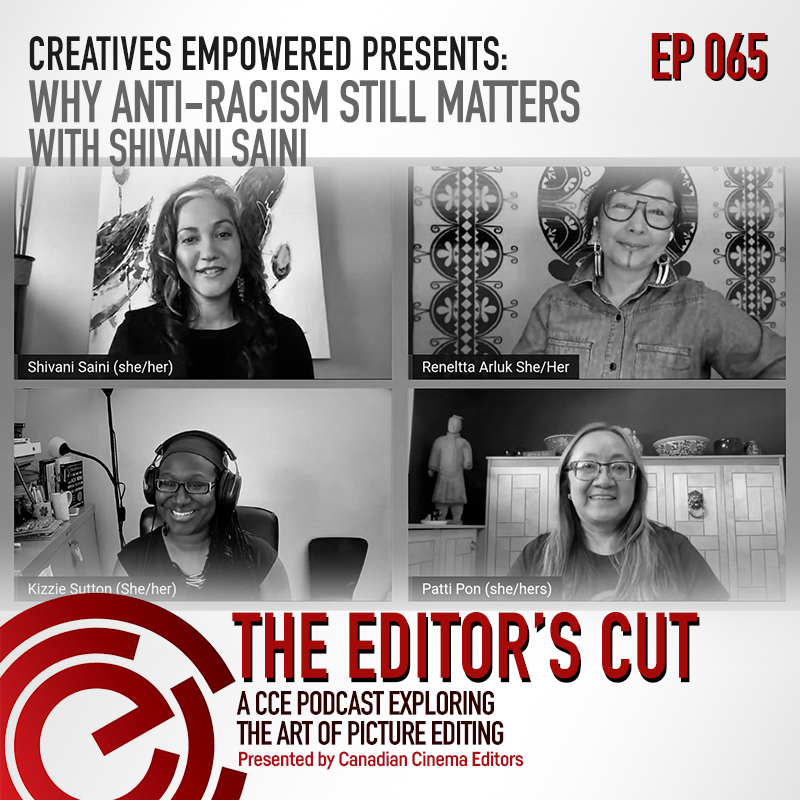
Today’s episode is part 1 of a 6 part series covering EditCon 2021 that took place virtually in February 2021.

Working from home: has COVID-19 changed the collaboration dynamic forever, or are we just waiting to head back into the office? Stephen Philipson, CCE, and D. Gillian Truster, CCE, kick things off by sharing stories of rolling with the punches in 2020, and reflecting on how the job of editing may or may not change when the pandemic finally ends.

GILLIAN TRUSTER, CCE

Hailing from Toronto, Gillian began her career as an assistant editor. She has since had a diverse career editing drama series, feature films, and MOWs in a variety of genres, and the good fortune to work with many prominent and celebrated producers, directors, and screenwriters. Gillian is best known for her work on Orphan Black, Anne with an  E, and The Expanse. She has won two CSA awards, a DGC award, and has earned eleven award Nominations.

STEPHEN PHILIPSON, CCE 

Stephen is an award-winning editor of TV series such as Altered Carbon (Netflix), American Gods (Starz), Anne with an E (CBC/ Netflix), and Hannibal (NBC), and films such as The Wild Hunt (by Alexandre Franchi), Grown Up Movie Star (by Adriana Maggs) and documentary Prom Night in Mississippi (starring Morgan Freeman), which premiered at Sundance, broadcast on HBO, and screened at The White House. Stephen is honoured to serve as CCE President and help the CCE advocate for editors across Canada.

This episode was generously sponsored by

IATSE 2018 Sponsor Event logo

Listen Here

The Editor’s Cut – Episode 059 – EditCon 2021: In Conversation with D. Gillian Truster, CCE

Sarah Taylor:

This episode was generously sponsored by IATSE 891. 

D. Gillian Truster, CCE:

I feel like when I have somebody in the room with me, there’s some kind of exchange of energy that’s happening. I think partly it has to do with being able to read body language. But also, it’s not just that. I think you actually get to know a person better when they’re in person.

Sarah Taylor:

Hello, and welcome to The Editor’s Cut. I’m your host, Sarah Taylor. We would like to point out that the lands on which we have created this podcast, and that many of you may be listening to us from, are part of ancestral territory. It is important for all of us to deeply acknowledge that we are on ancestral territory, that has long served as a place where indigenous peoples have lived, met, and interacted.

We honor, respect, and recognize these nations that have never relinquished their rights or sovereign authority over the lands and waters on which we stand today. We encourage you to reflect on the history of the land, the rich culture, the many contributions, and the concerns that impact indigenous individuals and communities. Land acknowledgments are the start to a deeper action.

Today’s episode is part one of a six part series covering EditCon 2021, that took place virtually in February, 2021. In conversation with D. Gillian Truster, CCE. Working from home. Has COVID-19 changed the collaboration dynamic forever, or are we just waiting to head back into the office? Stephen Philipson, CCE, and D. Gillian Truster, CCE, kick things off by sharing stories of rolling through the punches in 2020, and reflecting on how the job of editing may or may not change when the pandemic finally ends.

Hailing from Toronto, Gillian began her career as an assistant editor. She has since had a diverse career editing drama series, feature films, and movie of the weeks. Gillian is best known for her work in Orphan Black, Anne with an E, and The Expanse. She has won two CSA awards, a DGC award, and has earned 11 award nominations. Stephen is an award-winning editor of TV series, such as Altered Carbon, American Gods, Anne with an E, and Hannibal, and films such as The Wild Hunt, Grown-up Movie Star, and the documentary Prom Night in Mississippi, starring Morgan Freeman, and premiering at Sundance. Stephen is honored to serve as the CCE president, and helps the CCE advocate for editors across Canada.

Speaker 2:

And, action.

Sarah Taylor:

This is the Editor’s Cut.

Speaker 3:

A CCE podcast.

Speaker 4:

Exploring the art-

Speaker 5:

Of picture editing.

Stephen Philipson, CCE:

My name is Stephen Philipson, and I’m the current president of the Canadian Cinema Editors, coming to you live from my house. Our theme this year is shifting world, shifting industry. The events of the past year have brought unprecedented changes in the way we make and consume media, the way we understand the world, and even the way we relate to each other. We don’t know exactly what our industry will look like when this outbreak finally ends, but we do know people will need stories more than ever. 

Let’s introduce our first guest. Gillian Truster is the multi-award-winning editor of some of the most well-known shows cut in Canada, including Orphan Black, Anne with an E, The Expanse, and Snowpiercer, amongst many others. Since her talent is in such high demand, she’s always working, even during a global pandemic. So, we thought we’d talk to her about how the pandemic has affected the job, and how it might or might not change in the years ahead. Ladies and gentlemen, please welcome Gillian Truster.

  1. Gillian Truster, CCE:

Hi, Stephen.

Stephen Philipson, CCE:

Good morning.

  1. Gillian Truster, CCE:

Good morning.

Stephen Philipson, CCE:

Gillian, let me start by asking, what were you working on when the pandemic struck?

  1. Gillian Truster, CCE:

I was working on Snowpiercer at the time. I was actually in Vancouver. Then when all this went down, I had to fly home with a drive, and set up here in Toronto. It was crazy, because the way that it worked on Snowpiercer, the idea would be that I would assemble in Toronto, and then go to Vancouver to work directly with the director, the producers. I flew to Vancouver on March 1st, and almost as soon as I arrived we were already hearing… you know, you hear about social distancing, etc. And by the 13th, everything was shut down. So, I honestly didn’t even get to see Vancouver at all while I was there. So, I’ll have to get back there at some point again. So, Stephen, what were you working on when all this happened?

Stephen Philipson, CCE:

Well, I was actually in Los Angeles. I was working on a show called The Bold Type for Freeform on the Sunset [inaudible 00:04:20] in LA. My family was still here in Toronto. And like you, we started hearing about everything that was going on. And I think it was Saturday, March 14th I called my wife and we just realize I had to be back here in Toronto as soon as possible. 

So, I called up the producers, and they were actually very gracious, very great. They just said, “You know what, finish the show from Toronto.” So what I did, I basically put all the dailies that I had on a hard drive, on the Monday morning, the 16th, went into the office, got everything together, got on a plane at about 3:00 pm that afternoon. I was back in Toronto that evening, and then Tuesday morning I was up and running up in Toronto. And very seamlessly, we barely missed a beat. I was just very lucky that my producers were okay with me finishing remotely.

  1. Gillian Truster, CCE:

Same here.

Stephen Philipson, CCE:

Yeah, then I had to isolate in Toronto for 14 days. What else have you been working on during the pandemic?

  1. Gillian Truster, CCE:

After Snowpiercer, I worked on a new series, called Pretty Hard Cases and that show was initially, I was initially supposed to start on that immediately following Snowpiercer, but it got delayed because of COVID. So, I ended up starting working on it in September. Then, I’ve recently finished that. I am now working on season six of The Expanse. How about you, what else have you worked on during this pandemic?

Stephen Philipson, CCE:

Yeah. Well, I’ve worked on a movie that we called Faith Heist, here in my home office. That was in the fall. I was out of work for a little while during the summer, which worked out okay, because obviously I have three children, so there was a lot of just stuff we needed to do organizing, and starting online schooling in the fall, and everything. So, that worked out well. And currently working on Bold Type season five. Which we’re also doing from here, but it’s a little bit different. Rather than working on my home office here, I’m logging into an Avid which is actually in LA, working over a jump desktop over a virtual private network.

  1. Gillian Truster, CCE:

Right.

Stephen Philipson, CCE:

My LA desktop can appear here in Toronto on my computer, and I’ve been working that way. Which is, it’s working fairly well. What has your work situation been for the past few months?

  1. Gillian Truster, CCE:

Yes. With Snowpiercer, what we did was I took the drive, I worked from home, and then I worked with the producer. We would just talk on the phone for notes, and then just send cuts to him. The assistant editors were in Vancouver, so we transferred files via Media Shuttle. And then, when I worked on Pretty Hard Cases, we were given the option of working from home, but the entire team wanted to come to the office. What we did was, we all had our own offices, and we all had to wear masks. The only time we could take off the masks was when we were in our own rooms by ourselves.

And then, we Zoomed with all of the directors. But what we did was we had to show runners on that show. One of those show runners was the onset show runner. The other showrunner was part of sort of what we call our post production bubble. And so, she would come into our edit suites and sit with us, and we worked directly with her. And then for The Expanse, again, the whole team was given the option, if we wanted to work from home, we could. But, everybody wanted to work out of an office. We were all set up in our own rooms. For that, we’re going to be using Clear View to work with the directors and the show runner remotely. How has it been setting up a suite in your home? How’s that been going for you?

Stephen Philipson, CCE:

You know, it’s been okay. It has its ups and downs. I think overall I’m very lucky, because I have a nice space in my home here. I’m in downtown Toronto, so in terms of Internet, we have good strong Internet. Knock wood, I haven’t had any Internet issues, do to just the time. It’s good, the flexibility has been nice. My kids are at home. It’s a very emotional time with online schooling, so every now and again it gets tense. But, the good news is I have a really good pair of noise canceling headphones that I use. So, that’s been essential equipment.

You know, one thing that came up on Faith Heist, because we had originally, we were talking about going into the producer’s office. But it wasn’t ready in time, and I’d set up a good suite here. Now the issue was, in terms of working together, we actually decided to work together in my home space. Which, it worked very well in this case, because I had a prior working relationship with the producers. We knew each other, we’ve worked together in the past, we had a comfort level. 

I didn’t mind having him in my home office space. He could turn a little bit of a blind eye to all the chaos with our three children, home schooling, just in the sense that he has kids as well. So, it wasn’t an ideal situation, but I think it worked well. We wore masks and maintain six feet of separation in the suite, and can open the window here for ventilation.

But, I think if I was working on a show with producers that I hadn’t worked with before, or if it was a more formal working relationship, or a more, kind of you know,  intense show, I don’t know that that situation would’ve worked very well, and I would’ve wanted to have people in my house. But, in this case it worked very well. And in terms of The Bold Type, I haven’t worked with anybody yet. But it’s okay. Again, because I know the people from The Bold Type, I’ve worked with them for almost three years now, talking on the phone or over Zoom, we already have a prior working relationship. So, any of the challenges in terms of working over technology are a little bit minimized, just because I feel like I know them and have a comfort level with them.

We use a system called Millicast, where basically I can set up my Avid  in LA to output to a website with a URL that’s very unique and distinct, and then whoever has that URL can just watch the show. And it actually works fairly well. We’ve tried it a few times, and the show has broadcasted fairly high resolution, high quality. There’s no stuttering or anything. It’s been okay so far. It’s obviously challenging to work with a new producer or director in that way.

  1. Gillian Truster, CCE:

Right.

Stephen Philipson, CCE:

But again, because I have a private working relationship with these people, so far so good.

  1. Gillian Truster, CCE:

Right. You don’t feel the impact as much. Yeah. You bring up some good points. It sounds like that the benefits are having flexibility. Technology provides flexibility. And I think flexibility in work arrangements are really, really good. Especially if you have to do any sort of caregiving. Especially during the pandemic, when kids haven’t been able to go to school for large stretches of the pandemic, and daycare isn’t available. Other people who could babysit your children, you can’t do that anymore. So, I think certainly flexibility is a very, very positive development. You know, and also things like the fact that there’s no commute, people have more time to do other things.

Stephen Philipson, CCE:

That’s a good one.

  1. Gillian Truster, CCE:

That’s a really, really good thing. The fact is, one thing you mentioned about having a good space at home, that you’re lucky. One of the things I think about is, when people are wondering, will people in the future just work from home, and not go into the office? And when I think about it, I try to think of it from several different angles. 

So, the first angle I try to think about it is from the practicality of that. And so, one of the things I’m having trouble wrapping my head around is this idea that everybody has a good space that they can work from at home. When you hear about a lot of people working from home, a lot of those people have office jobs, and all they need for their office jobs is a laptop. And it’s very portable, and it’s small, and they can move anywhere. Whereas with us, you could work from a laptop, but it’s not ideal. 

So most people, they have a couple of reasonable sized monitors, they might have a TV, a couple of decent sized speakers. I mean, if you really want to have all the [French 00:12:00] of editing, you need a decent amount of space. If you live in a place like Toronto, where it’s very expensive, real estate is at a premium, you may not have the space to do that. 

I mean, I know lots of people who, during the pandemic, what they’re doing is they’re shoving their furniture out of the way, and they’re setting up at their kitchen tables. I think that’s fine. I think people can accept that, because they’re like, “Well, this is what we have to do. It’s a pandemic.”

Stephen Philipson, CCE:

Yeah.

  1. Gillian Truster, CCE:

But at some point, people might want to use their kitchen tables for eating again. It’s the same thing, does everybody have an environment that’s conducive to working from home? So, I think it depends on what your living situation is. And then, also you need a fairly robust Internet. Because we’re uploading/downloading fairly large files. From the practical point of view, I have a bit of trouble thinking that it’s just all of a sudden everybody is going to be working from home, and that’s just going to work out well. How do you feel about that?

Stephen Philipson, CCE:

Yeah, no, I agree. Again, I do often think how lucky I am really just to have this space that I’m in right now. I’ve been able to make it work. But like you said, it’s sort of in the context of hopefully going back into the office soon. There are a lot of distractions. Again, there’s ups and downs. Without the commute in the morning, means I gain a little bit of time in the day. 

I know especially for our guests joining us from Los Angeles, that’s a huge plus. That’s good. I mean, I like the ability to just go make lunch in my own kitchen, rather than eating set food and catering, which is, I think I’ve actually lost weight during the pandemic for that reason. Yeah, I can’t help thinking I do have a bit of a unique situation, and I’ve been able to offer flexibility to The Bold Type through this, which has been great.

  1. Gillian Truster, CCE:

Right.

Stephen Philipson, CCE:

But yeah, not everyone is in that situation, for sure.

  1. Gillian Truster, CCE:

And maybe not every, but also your point about having your producer come to your home. Definitely there’s lots of reasons why you might not want your boss in your home, working. So, it’s sort of like there could be projects that if you decide to work from home, what happens if the person does want to work with you in person, and what do you do in those situations?

Stephen Philipson, CCE:

I mean, social distancing is an issue. We were just able to fit two producers in here from Faith Heist, and I had to kind of scrunch way in the corner, and set up the TV way at the other side of my office. So, it wasn’t an ideal working environment. Like you said earlier, it worked well because we know that it’s temporary and it’s a situation beyond our control, and that hopefully one day we’ll be back in a more traditional office environment.

  1. Gillian Truster, CCE:

One other thing I find with working from home, I think that you have to be more disciplined about your work hours.

Stephen Philipson, CCE:

Absolutely.

  1. Gillian Truster, CCE:

And also, the producers also have to be more disciplined about… I think what happens is, you have your space and because it’s there, it potentially you could work whenever. I read an article recently that said that people were working longer hours when they were working from home, for that very reason. And then also, I think it does open the possibility too, that producers could ask you to do things at times that they wouldn’t ordinarily ask you to do, because they also know you can’t just say, “I’ve left the office.”

So, I think if you’re going to work from home, I think it’s really important to be disciplined about that. So, that’s something to think about as well.

Stephen Philipson, CCE:

Yeah, no. You know it’s funny, in my situations, I sometimes have the opposite problem, where there is a lot of distractions here. If I have to take the kids to school, or have to pick them up, I find I work in little chunks at odd hours sometimes as well too.

  1. Gillian Truster, CCE:

Right.

Stephen Philipson, CCE:

Just because I have to make dinner, because my wife is, she works full-time as well. So flexibility, it’s like a double-edged sword. So, I have to be more disciplined sometimes about setting my own hours too, to make sure that I get enough time in the day.

  1. Gillian Truster, CCE:

Right.

Stephen Philipson, CCE:

And sometimes I end up making up time on the weekend.

  1. Gillian Truster, CCE:

Right. It’s true. It’s interesting.

Stephen Philipson, CCE:

Sorry, I was just going to say, another issue too that comes up, and that I wanted to ask you about actually, Gillian, how do you feel this working remotely affects the job creatively too? Because obviously when you’re working with producers, if you’re not in the same space, it’s a different dynamic.

  1. Gillian Truster, CCE:

Right.

Stephen Philipson, CCE:

So, what’s your sense on how that affects the creative relationship, or the creative process between working producers and directors?

  1. Gillian Truster, CCE:

It is interesting. I think for me, with my process, I think for years we’ve been used to working remotely with producers and directors. There’s been lots of times where they either can’t come into the edit suite at a particular time, or they’re actually directing a series, and then they’ve flown back home, they might not live in your city, while they’re doing the director’s cut, and then so you’re working remotely. 

So, I am used to working remotely. But what I’m not used to is also not having the team around. So, not only working remotely with the showrunner and the director, but also with your post team. And for me, I would say that is a really, really big loss. 

So, the way I typically like to work is, when I’m assembling, what I like to do, once I’ve done an assembly of the show, before I submit it to the director, I like to have the assistant editors come in, and we screen it together, and we talk about it in great detail. I want to hear all the things they have, all their thoughts. All things they like, things they don’t like. And some of those things that we talk about, I’ll implement at the assembly stage. And some of those things I will have in my head, of ideas that I’d like to implement later after I’ve spoken with the director. 

So, that is a big thing for me. It helps me in my… Because also, I really do want to hear what people have to say. And I don’t think it’s the same when you screen something… When people are in my room and we screen it, I can read their body language, I get… Even if they say nothing, I’m getting a sense of how engaged they are. Are they laughing at the right moments? Are they emotionally reacting when I think they should be, when I’d like them to? So, that’s something for me that’s a big loss.

But also, I think from their perspective it’s a bit of a loss too. Because for many assistant editors, not everybody, but for many, they would like to eventually be editors. And so, what I think one of the other reasons I like doing it is because I feel like editing is, the creative part about editing happens in your brain. It doesn’t happen when you’re sitting at a computer. It’s not about where you make the cuts. 

It’s about thinking about why you want to cut, and how you want to cut. And so, it’s about learning how to articulate what you’re thinking and why. And so, it’s like a muscle memory. So, it’s one of those things where it’s actually really, really a good learning experience. And, I’d like to also add, it’s a good learning experience for me too. Because I feel like even though I have the title of editor, and they have the title of assistant editor, that doesn’t mean I have nothing to learn. And actually, I find that when I am sitting with the assistant editors and they have great ideas, I’m also learning from them.

So, listen, not everybody works this way. And there’s also lots of projects that people edit that don’t require this kind of collaboration. But for me, it’s a big loss. I’m on The Expanse now, and right now me and another editor have started, and we show each other stuff. We’ll knock on each other’s doors and be like, “Can you look at this? What do you think?” And so for me, that’s a really, really valuable part of the experience.

In terms of working with the show runners, or the directors, or the producers, like I said, I am used to working remotely. But it’s a really interesting thing I’ve found, having this break, and then coming back to work on Pretty Hard Cases, and just being able to compare, really compare what it’s like when you really are working with somebody completely remotely, that you’ve never worked with before, versus having somebody that you’ve never worked with before, but also have them be able to come into your suite. Sometimes.

Sometimes I would also Zoom with the showrunner when she wasn’t able to come into the suite. But, I think there’s a real difference between those two things. I feel like when I have somebody in the room with me, there’s some kind of exchange of energy that’s happening, where I just feel like it’s hard to articulate exactly what the difference is. But, I feel like you can get a little bit more… There’s something about the creative process that I think is really, really valuable. And, again, I think partly it has to do with being able to read body language.

But also, it’s not just that. I think you actually get to know a person better where they’re in person, versus only getting to know them through a screen. Because what happens is… You know I think it is? I think it’s when you’re working with somebody in person, you’re having conversations with them that are not only about the work. You get to know them as a person outside of… You’ll joke around, and you’ll laugh at stuff. And I think what happens is, that affects how you relate to each other too.

Because for me, the ideal way of working, with collaborating with somebody, is that you’re comfortable with each other, and so there’s a free exchange of ideas. That they feel totally comfortable telling me what they think about the cut, and I feel totally comfortable telling them what I think. And that it’s in this free exchange that you’re able to truly collaborate, have a really close collaboration, and get to what you two of you really think is the best.

And I think being able to work in person, you get to know each other in a way that is conducive to creating that comfort level that gives you that collaboration that I like. I mean, what is your feeling about that sort of thing?

Stephen Philipson, CCE:

Yeah, no, I agree with everything you’re saying. I think for me, since I’ve been working in series television for the past few years, what I keep thinking about is typically shows have two, three, four different editors. And after a while, shows kind of developed their own zeitgeist, is the word I like to use, where everyone sort of feels like they’re making the same show. 

Subtly, you’re making similar decisions, because you’ve had this experience of, I guess communal experience, of working together in the same space. That everyone kind of sinks up, for lack of a better word. And currently on The Bold Type, I feel like because I’m already, quote unquote, in sync with the other editors, and the producers, I still feel like I’m making The Bold Type when I’m here, and I know what it is, and I understand it. My assistant is in Los Angeles, but we’re texting to each other constantly. I call her up if we want to have a little discussion. I try to let her edit stuff, and we can talk about it to help her career.

And all that has been quite easy, but because we have this pre-existing relationship. I’m a little worried, my next show I’m doing season two of a show that I wasn’t on season one for, and I’m worried there’s going to be a bit of a learning curve in that I don’t even know if I’m ever going to meet the people I’m working with. We’ll see, it really depends on what happens in the pandemic. I may go to LA for the second half of the show, or I might not. I guess what I’m worried about is finding the look and tone of the show, and getting into that zeitgeist without being in person.

I was on a show recently, our producers were in LA for the entire process. And we used a platform called Sohonet to work with them. And in that case, it was interesting, because Sohonet is very robust. It’s like a very high-end version of Skype or Zoom, where the person appears on a normal TV sized monitor with a high-resolution camera, so you can read body language a lot better through Sohonet. It’s seamless, there’s no pause, there’s no delay in communication. 

So, I worked with producers for six months through Sohonet. What was interesting, I think it went quite well, and it was interesting, we actually met in person later after I was done the show. For the first time ever I actually went to the room they were broadcasting from the whole time, which was very bizarre. But what I found is we had a reporter when we met in person, because we developed it over six months.

  1. Gillian Truster, CCE:

Right.

Stephen Philipson, CCE:

So, I think because that particular technology was very robust, very dependable, and high resolution and all those things, I mean, it wasn’t ideal, but we were able to make up for it. I think what we lost is, again, it’s like you said, when you’re working in the same space, there’s opportunities for casual encounters, whether at lunch, or people just popping into the suite. Whenever you go on Sohonet, it’s a very formal arrangement. 

  1. Gillian Truster, CCE:

Right.

Stephen Philipson, CCE:

We’re going to talk at this time, we’re going to talk about this, for this amount of time. So, maybe you lose a little bit of that chance to just see them in the hallway, or get their quick thoughts on something. I mean, that was a bit of a loss.

  1. Gillian Truster, CCE:

No, it’s true. So it sounds like, to work, stream live, where there’s no lag with what you’re streaming, so the technology itself is not a barrier to working with somebody. And also in the case of Sohonet, where you saw the person, and it was sharp, and they were big.

Stephen Philipson, CCE:

Yeah.

  1. Gillian Truster, CCE:

So, it was trying to replicate that in person experience as much as possible. Because often what happens, Zoom has a share screen, you can’t use it for sharing high-res sequences. It’s not robust enough for that. There’s just too much lag. But what happens is also when you share your screen, the people become really, really small. And so, your screen- So, that’s a big difference actually with Sohonet. It maintained, so that you at least really get a sense of looking at their face, reading their face. And that seems to be a really important part of collaboration, being able to read the person.

Stephen Philipson, CCE:

The nonverbal communication.

  1. Gillian Truster, CCE:

Exactly. All that nonverbal communication. But also, your point about when you’re working with somebody remotely, what happens is you have a screening time, and you talk about… You have a mandate for that call, and you just talk about that thing. But when you’re in person, it’s all those little interactions that you can have, where you can just grab a person and ask them a question. You don’t have to set up a call, or a specific time.

And then also, like you said, those interactions lead to other interactions where you get to know a person on a personal level. Which I think is actually really important for this industry. When I think about people entering the industry, you know how they say it’s all about who you know, right? When somebody’s looking for somebody, they might remember you from meeting you at some point, and then they’ll hire you on something. 

And so, if you’re just entering the industry, if you’re working from home all the time, I wonder actually how you make those connections that you wouldn’t ordinarily be able to make if you are working out of an office. So, that’s a question I have, those little-

Stephen Philipson, CCE:

Yeah. The social aspect of the industry, how important that is to career growth. Particularly when you’re just starting out as casual encounters and everything. It makes it a lot harder. Even today in EditCon, a big loss that we were dealing with, trying to figure out how to make it a social gathering. Because we’ve always seen this event as something that builds community. So, how to build community online. It’s not quite the same. Still figuring it out. So, sounds like working remotely [crosstalk 00:27:17] has pros and cons. I’m sorry, go ahead.

  1. Gillian Truster, CCE:

It sounds like EditCon’s a really great example. Where with the technology, now there’s these amazing editors from all over the world that are part of EditCon. And I’m super excited to see some of these panels. They’re editors of some of my favorite shows and movies. And that’s not something we would be able to do without the technology. The downside, of course, is that for the people who would’ve in previous years been able to come to EditCon and go to the TIFF Lightbox, you lose that in person interaction, where I think you do get to know people. 

So, it’s interesting. It’s interesting to think that when I was working on Pretty Hard Cases, and The Expanse, everybody’s given the option of working from home, everybody wanted to come to the office. Because I think, if the pandemic has taught us something, I think one of the things is the value of human interaction. It’s kind of like during this pandemic we’re zooming with our friends and families to keep up with them. 

But, I don’t think anybody’s saying to themselves, “Well, because I’m Zooming, I don’t need to see them in person anymore.” They’re two different experiences. Technology’s amazing. You want the technology. It’s essential. It has been essential for us through this pandemic. But, I don’t feel like it entirely replaces the human interaction, seeing people in person.

And it’s the same thing I feel like about film versus theater. Film doesn’t replace theater, and vice versa. They’re just two very different experiences. Both have value, yeah. So I guess, I think the social interaction… And also, when I think about my career, when I really think about what have I really enjoyed, what are my memories about? When I look back at my career, what have I really enjoyed working on? 

And for me, what I’m working on is essential. I really want to be challenged by the work I do, I want it to be about things that are important to me. But when I have the memories of those things, it’s actually the people I’ve worked with, the laughs we’ve had. So, I feel like it’s the camaraderie.

So, if I was to always work from home, I would still love editing. But, it would lose a part of it that I really value, that I find is very enriching. And just the friendships that you make because you’ve worked with people. It sounds like you feel sort of the same way about that aspect of it.

Stephen Philipson, CCE:

Absolutely. I mean, editing anything in the film industry, compared to other occupations is… A friend of mine always says, “A lot of people live to work…” Or sorry, I’ve got it backwards. In an ordinary job, you might live to work. But in editing or in the film industry, because it demands so much of you creatively, just in terms of passion, that we live to work. And for us, a career in film, or in editing is creative, and it’s something that’s very much a vocation rather than just the job that we do. So, yeah, if we lose some of those things, the work/life balance, the community side of things, those are things that I think we have to work to protect.

And I guess the question that comes up out of all this is, where do we go from here? How do we move forward using some of this technology that we’ve been talking about, which has improved the situation, but without losing the important aspects of our job that come from working in person? So, I’d love to get your thoughts on that, on what you think is next in terms of where we’re going.

  1. Gillian Truster, CCE:

I think that it’s clear that the pandemic has accelerated the development and use of technology that allows us to work remotely. And I feel like the technology does provide some extremely valuable things. Like you mentioned, flexible work arrangements. That is a really important thing. And it allows us to work remotely with people, not only in other cities, but other countries. That’s amazing. We’re definitely going to be using this technology more and more. 

But I feel like what’s going to happen is it will be a hybrid. That people will still work in person together, because they’ll want to. Maybe not on every project, maybe not every project requires in person collaboration. And also, there’s a lot of factors involved as to why it might be better for a particular project for you to work from home, versus coming to an office. Is it valuable for you to work in person with somebody, or does it matter for that particular project? 

But, I feel like that it’ll be a hybrid. That there’ll be some projects you work from home, but others it will be a combination of those two things. Because why choose, when both have value? Why not use the best of both worlds? Use the best of them and that’s what I would advocate for. What do you think?

Stephen Philipson, CCE:

Yeah, I agree. I mean, there’s a lot of, I guess, issues that come up around, is every editor, kind of, responsible for having their own suite in their own gear, as we discussed earlier? I know we have a lot of people joining us from the US. I find when I work in the US, I tend to go into an office on the lot and use studio gear. Whereas here in Canada, a lot of people have their own equipment, and do rent it out. There’s always issues that come up, like do you need to have your own gear? If so, what’s a fair rate to rent it if you’re not using it all the time? I mean, those are things that I think we’ll have to work out definitely.

I keep hearing about hot desking in the corporate world, where people don’t come in as often, so there aren’t as many offices, and people share offices. Maybe we’ll be sharing suites more than we used to. Yeah, no, I agree with you. I do think it’s important as editors that we advocate for time to work in person in a more traditional way, so that these technological tools sort of enhance, or allow us to do new things, don’t make the creative process entirely isolated.

  1. Gillian Truster, CCE:

And so the question that becomes is, well, one question I have is, how do you think this is going to affect EditCon in the future? Because what’s amazing, like we talked about, is that here you have, it’s all virtual. But there’s some real upsides. Because again, you can have panelists that are from all over the world, and also participants from all over the world. Which before, when you had it in Toronto, it’s mostly people who live here. And then, some people would fly from across the country to attend. But now, far more people can come. I mean, do you think that in the future EditCon will also be hybrid? What are your predictions for that?

Stephen Philipson, CCE:

I hope so. I really hope so. It’s an organizational challenge. But, I think the two biggest goals of EditCon, one, provide educational opportunities for all our members, and two building editing community through networking. Education, the online aspect is better, because we can reach more people across Canada, we can reach people who can’t travel to Toronto, and in regions of Canada where it might be prohibitive. Which is great. 

But, networking is better in person, because of these interpersonal relationships and stuff, and what we’ve been talking about. So, we are definitely looking at ways we can offer in person events that are also available online, or connected to other simultaneous events across the country. But, it’s a volunteer run event, so it’s a challenge.

  1. Gillian Truster, CCE:

Correct.

Stephen Philipson, CCE:

But anyways, I want to thank you very much, Gillian, for joining us today, and sharing your thoughts where we’re headed.

  1. Gillian Truster, CCE:

Thank you for having me.

Stephen Philipson, CCE:

Oh, it’s been a pleasure.

Sarah Taylor:

Thank you so much for joining us. And a big thank you goes to Jane MacRae  and Alison Dowler. This episode was edited by Malcolm Taylor. The main title sound design was created by Jane Tattersall. Additional AVR recording by Andrea Rush. Original music created by Chad Blain and Soundstripe. This episode was mixed and mastered by Tony Bao.

The CCE has been supporting Indspire, an organization that provides funding and scholarships for indigenous post secondary students. We have a permanent portal on our website at CCEditors.ca, or you can donate directly to Indspire.ca. I-N-D-S-P-I-R-E dot CA. The CCE is taking steps to build a more equitable ecosystem within our industry, and we encourage our members to participate in any way they can. If you have enjoyed this podcast, please rate and review us on Apple Podcasts, and tell your friends to tune in. Until next time, I’m your host, Sarah Taylor.

Stephen Philipson, CCE:

The CCE is a nonprofit organization, with the goal of bettering the art and science of picture editing. If you wish to become a CCE member, please visit our website, www.CCEditors.ca. Join our great community of Canadian editors for more related info.

Subscribe Wherever You Get Your Podcasts

What do you want to hear on The Editors Cut?

Please send along any topics you would like us to cover or editors you would love to hear from:

Credits

A special thanks goes to

Jane MacRae

Alison Dowler

Leo Woolley

Hosted and Produced by

Sarah Taylor

Edited by

Malcolm Taylor

Main Title Sound Design by

Jane Tattersall

ADR Recording by

Andrea Rusch

Mixed and Mastered by

Tony Bao

Original Music by

Chad Blaine

Soundstripe

Sponsor Narration by

Paul Winestock

Sponsored by

IATSE 891

Categories
The Editors Cut

Episode 058 – Editing Seduced: Inside the NXIVM Cult with Inbal B. Lessner, ACE and Gillian McCarthy

Episode 058: Editing Seduced: Inside the NXIVM Cult with Inbal B. Lessner, ACE and Gillian McCarthy

Today’s episode is the master series that took place on January 12th, 2021, Editing Seduced: Inside the NXIVM Cult with Inbal B. Lessner, ACE and Gillian McCarthy.

Seduced: Inside the NXIVM Cult is about women by women. It had women in all key positions, and they took great care in creating an environment for the cult survivors who shared their stories, in which they felt supported before, during and after filming. We discussed the ins and outs of shaping such a complex and sensitive story and the challenges that Inbal and Gillian came across in the edit suite.

Inbal B. Lessner, ACE is an Emmy® and Eddie-nominated editor and producer. On her latest project, “SEDUCED: Inside the NXIVM Cult,”  which she co-created with her filmmaking partner, Director Cecilia Peck, she takes on the roles of Lead Editor, Writer and Executive Producer. This four-part documentary series, premiering on STARZ, follows one young woman’s perilous journey through the dark and criminal world of NXIVM, the notorious self-help-group-turned-sex-slave-cult. 

Inbal and Cecilia Peck’s last collaboration was the Emmy-nominated feature documentary Brave Miss World, which debuted on Netflix in 2014. It is the story of an Israeli beauty queen, who was raped seven weeks prior to her winning the Miss World pageant, and her crusade to reach out to fellow survivors while trying to keep her own rapist behind bars. 

In 2019, Inbal edited and co-produced “The Movies: The Golden Age,” executive produced by Tom Hanks, Gary Goetzman and Mark Herzog. This was the latest in her 4-year-long collaboration with the team that produced CNN’s Emmy-nominated “Decades” series. Inbal has edited seven episodes in the series and was nominated for an ACE Editing Award for “The Nineties: Can We All Get Along.”

Inbal’s editing credits include ReMastered: The Two Killings of Sam Cooke (Netflix Original, Dir. Kelly Duane), nominated for an Outstanding Documentary NAACP Image Award, and Autism: The Sequel, (HBO, Dir. Tricia Regan), a follow-up to the Emmy-winning Autism: The Musical (2007). She edited and co-produced the internationally acclaimed, award-winning, I Have Never Forgotten You, about Nazi hunter Simon Wiesenthal.  Inbal also directed the docudrama Night Bites and was second-unit producer on the HBO/ARTE documentary Watermarks.

Over the course of her career, Inbal has worked in the cutting rooms of directors such as Davis Guggenheim (Teach), R.J. Cutler (“American Candidate”), Kief Davidson and Daniel Junge (A Lego Brickumentary), Jeremy Simmons (“Transgeneration”), Tracy Droz Tragos (Be Good, Smile Pretty) as well as Natalie Portman’s feature directorial debut (A Tale of Love and Darkness). 

Inbal began making films when she was in high school and later produced training films for the Israeli Defense Forces.  At NYU, she was the recipient of the prestigious, merit-based, WTC Johnson Fellowship, awarded to one student filmmaker a year.  Since moving to Los Angeles, Inbal has edited hundreds of hours of non-scripted network and cable television shows. She was also a Visiting Professor at UNCSA Film School, and a mentor in the Karen Schmeer Diversity in the Edit Room Program.

Gillian McCarthy is an accomplished editor whose creative style combines compelling storytelling with a cinematic sensibility.  Her feature documentary credits include the Oscar-nominated Operation Homecoming: Writing the Wartime Experience, Girl Rising, and Above and Beyond: 60 Years of NASA. Her television credits include work for ABC, PBS, Showtime, STARZ, Discovery and OWN.  She learned her craft working in the most precise form of visual storytelling, the television commercial, editing countless national campaigns in New York and Toronto.  A dual American and Canadian citizen, she lives in Los Angeles.

Listen Here

The Editor’s Cut – Episode 058 – Editing SEDUCED: INSIDE THE NXIVM CULT with Inbal B. Lessner, ACE and Gillian McCarthy

Sarah Taylor:

This episode was generously sponsored by IATSE Local 891, Integral Arts, and the Vancouver Post Alliance.

Inbal B. Lessner, ACE:

We were contracted to do a four hour series, and that was a really big creative challenge of how to distill this very complex world. How much you explain, what you don’t need to explain, what you need to stay the hell away from because it’s- we would take two hours to explain.

Sarah Taylor:

Hello and welcome to The Editor’s Cut. I’m your host, Sarah Taylor. We would like to point out that the lands on which we have created this podcast, and that many of you may be listening to us from, are part of ancestral territory. It is important for all of us to deeply acknowledge that we are on ancestral territory, that is long served as a place where indigenous peoples have lived, met and interacted. We honor, respect and recognize these nations that have never relinquished their rights or solve an authority over the lands and waters on which we stand today. We encourage you to reflect on the history of the land, the rich culture, the many contributions and the concerns that packed indigenous individuals and communities. Land acknowledgements are the start to a deeper action.

Today’s episode is the master series that took place on January 12th, 2021. Editing Seduced: Inside the NXIVM Cult with Inbal B. Lessner ACE and Gillian McCarthy. Seduced: Inside the NXIVM Cult is a series about women by women. It had women in all key positions and they took great care in creating an environment for the cult survivors who shared their stories in which they felt supported before and after filming. We discussed the ins and outs of shaping such a complex and sensitive story, and the challenges that Inbal and Gillian came across in the edit suite. Seduced: Inside the NXIVM Cult is available on Crave in Canada and on the Starz app almost everywhere else. I hope you enjoy.


[Show Open]

Sarah Taylor:

Welcome, welcome, welcome, thank you both for joining me today, us today, I’m very excited to talk all things Seduced. I kind of got hooked, by kind of, I really got hooked and I’m very excited to discuss this show and the making of this show. So I want to start off a little bit by just finding out a little bit of about you and where you come from and how you got into the world of editing. So whoever wants to start first dive, right-in!

Inbal B. Lessner, ACE:

I’m Israeli. Started studying filmmaking and especially falling in love with editing in high school. And then in my military service in Israeli army and then went to film school in New York. And that’s kind of like how my American journey started. My most influential teacher in high school was a documentary editor, probably one of the leading documentary editors in Israel, and it just always fascinates me, fascinated me how to mold random footage into a story. And so while I’ve done, you know,  any kind of genre and anything from wedding videos to narratives and instructional films about explosive in the army to you name it, documentaries have been my focus of my career.

Sarah Taylor:

Awesome. And Gillian?

Gillian McCarthy:

I’m Canadian, I grew up in London, Ontario, and I also went to a high school that had a broadcasting television program and did editing in high school. And then I went to Fanshawe College in London, taking television broadcasting, and I worked at the local television station in the news department while I was there. Then after college, I moved to Toronto to assist an editor in a small commercial editing company that did, for television commercials. That was kind of my post-graduate, experience with the budgets and 35 mil filmmaking and technology that commercials did. I assisted for a while, and then I was lucky enough to help a creative team for an advertising agency, do a pitch, which turned out to be the original Molson Canadian “I am Canadian” beer campaign.


Sarah Taylor:

Awesome!


Gillian McCarthy:

Then I was 25 sitting doing that and did the sort of beer, cars and communications commercial work. Then I was recruited to a company in New York, and that started my American experience. I did commercials in New York and then just as I was about to get married and move to Los Angeles, I was lucky enough to be introduced to Richard Robbins, who was a producer and writer working mostly through ABC news. We happened, I happened to be moving to his neighborhood in Los Angeles, so we became friends and he hired me to work on a television doc about Bill Bratton’s first year as the LAPD chief of police. We did a few more docs over the years. Then we did Operation Homecoming, which got nominated for an academy award. Ever since then, I’ve been doing nonfiction television and documentary features.

Sarah Taylor:

Fantastic, that’s exciting! I love that both of your stories began with a high school teacher who really had an influence in the editing world. That’s really exciting to hear. Nowadays I think kids are learning younger and younger because the technology is just, we have the capabilities, so that’s really exciting to hear. Now, let’s get onto Seduced. What led you both to this project? I know Inbal you’re the executive producer. Your story probably started much earlier than Gillian’s, but tell us how you, how this project started and how you got involved.

Inbal B. Lessner, ACE:

My producing partner, Cecilia Peck, we’ve done a feature doc together called Brave Miss World, released in 2014 and was nominated for an Emmy. We were looking for another project to work together. In the meantime, I just work as an editor, and she called and said, she has a few ideas and a few things she was working on. One of them was NXIVM. She was actually an intern who worked on Brave Miss World, attempted to recruit her.

She sent her a lot of emails about this woman’s group, and Alison Mack, all these amazing women she must meet and come to an intro and come, there’s mentorship, and networking and women empowerment. Cecilia wasn’t interested at the time and finally said, I’m happy this is working for you, but please stop emailing me. It’s getting too much. About a year later after the emails stopped, she called her up and said, I’m sorry, I just realized I was in a cult and I was under pressure to recruit. They met and she told her her story. Then Cecilia brought that to me and said, I think we have an in. She had already, she had just shot a little reel with this former member.

This one intern introduced her to through three or four other former members. She shot a little footage for a couple hours just to get them on camera. She asked me actually to join her and cut a sizzle reel, like a little presentation. And so we- I downloaded a few things I found online. I had no idea what NXIVM was. I was not following the story in the news. It really took me I have must say months to wrap my brain around what it was and what was wrong with it. I downloaded what I could. Cut that with the footage that Cecilia shot. We were able to go into Starz and pitch it together. I helped with the pitch and in of command there, and eventually got greenlit to do a series. That’s how, kind of, how I got started.

Sarah Taylor:

What was the timeframe from the, you doing the sizzler stuff to getting to greenlit to actually start the series?

Inbal B. Lessner, ACE:

So I think we, trying to remember, we started working on the pitch and had the first few meetings end of 2018.

Sarah Taylor:

Okay.

Inbal B. Lessner, ACE:

Then we got greenlit. We started developing, got greenlit officially April of 2019. The trial I believe started in May that year, the Keith Raniere trial, and then Starz thought and pushed us to make this plan that we would film and edit and be completely done and delivered in about six months. That was not, [crosstalk 00:09:02] a reasonable expectation. We ended up working almost two years and we locked the show in this, this past summer.

Sarah Taylor:

Then did you, you did have to open the lock when you find out the results of what his conviction and stuff, right? You were kind of waiting for, were you waiting for that?

Inbal B. Lessner, ACE:

Well, we were just putting the last finishing touches on episode four.

Sarah Taylor:

Yeah.

Inbal B. Lessner, ACE:

It was locked, but we put it in to the end credit.

Sarah Taylor:

Yeah.

Inbal B. Lessner, ACE:

We added that information. With couple of the cards, I think we updated them after the most up to date information.

Sarah Taylor:

We’ll get Gillian to tell us your story of being approached to do the show and what your thoughts were when you got to get into the edit suite.

Gillian McCarthy:

I had talked on, to, Cecilia Peck on the phone a bit around the time that they were doing Brave Miss World. I think you might have been making it from a feature to a series or something, but it didn’t really work out. Then she contacted me to come in to talk about this series. And so I came in and met with Inbal and Cecilia in at little edit room. They said, do you know anything about cults? I had just, I worked on the Bikram film earlier that year. I knew a bit about cults and they showed me the reel. I don’t know if reel is the same one they pitched to Starz, but they showed me the sizzle, which, and then I was wow, that’s a crazy story. Then I started in October of 2019 originally scheduled to work through the end of January 2020, but ended up going through April or May? Of 2020.

Sarah Taylor:

I noticed that you had a big importance of the team of the series is to be female led. Why was that important from the creative standpoint, and to keep this series female led. I kind of want to know the thought process behind that and how it worked out for you.

Inbal B. Lessner, ACE:

We had experience from Brave Miss World, which is a film about rape and sexual assault. Of interviewing and working with working to tell the stories of sexual assault victims. We learned what needs to be done to create a safe environment on set, and then to tell the stories in the most respectful way honoring the trauma and not exploiting it, or sexualizing it. Cecilia, and I are both women. It happened that both our network executives were women and, definitely on set, we felt that a female, either a complete female crew or a female heavy leaning crew, was going to help these women and former members open up and feel safe to share. What we didn’t expect is that, and that’s a little anecdote, that a lot, our crew members, it was their first time working on an exclusively female crew.

It was like an unusual experience for them too. They started sharing things and they were like the vibe was just so different for them. Nobody was mansplaining. Nobody was kind of taking over. The egos were all a check. I think it was just very special environment that we created on set. Even on days that we had male crew members, we, they were carefully chosen. Everybody, male and female were carefully chosen and trained for sensitivity. We had a protocol of how to approach our subjects. What to tell them when they finish telling their story, not just like, okay, next setup, but, thank you for sharing. This is really meaningful. There’s just a way that we established to interact with these people, so they don’t shut down or they don’t, just to feel supported and comfortable. Then with, as we were hiring the production end post and post team, we certainly made sure people were, had in their heart, a place for this story. Whether they were male or female, they understood it, understood what we were trying to do with it and had the proper sensitivity to tell it.

Sarah Taylor:

You can see that in the final outcome, I feel anyway. Gillian, did you have any sort of take on seeing the footage in the end, edit suite and how that, did that come into a play, that there was a female? Could you, tell, could you feel a difference? What was your take on it?

Gillian McCarthy:

Especially in the interview dailies, you can tell it’s so hard. I can only imagine to be telling those stories in front of a bunch of people. There was, you can tell in the interviews where there’s breaks and there’s, we come back and a reset and think that it was a very respectful and gentle perspective in that way.

Sarah Taylor:

I feel like it would easily reflect into your edit when you see that care being taken in the footage and with the people that’s gonna happen in the edit as well. Now with the actual series, it’s such a complicated story with so many layers, so many things going on, and you had footage from the insider footage from NXIVM itself, you had their promotional videos, you had news clips, you were sourcing from everywhere. How could, how did you wrap your mind around how you’re going to tell this story? It’s going to be led with India’s, her story. You still need to explain what NXIVM is. You have your experts, which I love that you had experts in there explaining what cults were and what, how they were manipulating people and all that information. How did you go about, setting out to make it so concise? So we could all understand, wow, this is how it happens and how it can happen to anybody and understanding all of the ins and outs of a cult.

Inbal B. Lessner, ACE:

Well, I kept saying this story could be, if they gave me 10 hours or 20 hours, or 30 hours, I could fill those, no problem. We were, we were contracted to do a four hour series. That was a really big creative challenge of how to distill this very, as you said, complex world, very intricate web of different companies, and sub companies, and courses, and seminars and the lingo, the vocabulary and how much you explain, what you don’t need to explain, what you need to stay the hell away from. Because it’s, it would take two hours to explain. There were a lot of difficult choices in constructing it. The basic structure was there from the pitch, from the beginning, even before we had India involved. So India joined actually pretty far. India is through the process of being in a high control group like this.

Episode one was always about seduction, and getting hooked and what it feels like to join a group like this. Episode two was about, as it turned out to be about indoctrination. What happens with thought reform and what does your brain go through when you’re fed up this information over and over again? And how does it really changes your thinking? The later episode were always about, the heart of darkness kind of like, what does it mean to be in the center, of gravity of this organization? What are the worst kind of crimes and start unpeeling what the worst crimes and experiences of abuse that happen in the inner circle of the cult. Then we initially imagined it as a five episode with the last one being about recovery and healing.And so that was a lot of back and forth, but eventually when Starz insisted on keeping it down to four, which is a really brave choice and also means a lot more people actually going to commit to watching the whole thing, possibly binge it in one night or two.

Sarah Taylor:

Guilty.

Inbal B. Lessner, ACE:

That really constricted us in telling the story a lot more economically and make more choices, but we did come to a compromise with them and had episode four, as some of you’ve seen, as a supersized episode with the kind of healing and-and what these women go through to overcome what happened to them and find their voice again, as the kind of last chapter of this saga.

Sarah Taylor:

That is a lot to put into four hours of content. There’s just a couple questions that I’ll get you to, from the audience. For Inbal. What was your experience writing and editing at the same time?

Inbal B. Lessner, ACE:

Well, if you’re a doc editor, you’re a writer always.

Sarah Taylor:

Yes.

Inbal B. Lessner, ACE:

Whether or not you’re credited for it, I’m sure Gillian, anybody will tell you, they always write. I think every single editor we had on the team, as well as any film, any documentary film I ever cut, I probably should have gotten an edit, a writer credit and part of an organization who that advocates for editors to get writer credits. Ultimately there was a lot of writing done in order to really help the audience go through the experience and understand what they needed to understand, but also not think about the thousands of questions they might have. That they shouldn’t be thinking about when they’re watching. There was a lot of choices and careful writing throughout, and I’m glad that Starz agreed to give that credit to myself and Cecilia, but it’s really, I mean, as a doc editor, you’re always writing. You’re just writing from existing warrants. Opposed to making stuff up on a clean piece of paper.

Sarah Taylor:

Totally.

Inbal B. Lessner, ACE:

But what was, what was your experience, Gillian, writing?

Gillian McCarthy:

I think that you might be forgetting how hard you worked. You would spend the day producing, executive producing, directly, setting up doing all that. Then, you would spend the all night editing. It was 24/7 for you [crosstalk 00:19:49]. You did a lot in that way, but I think also for me the, helping the structure, was the story editors. This is the first thing- time I’d ever worked with story editors, because I’d only done single feature docs. Where you’re the writer with the director and some series that were more discreet episodes, so they didn’t have somebody who needed to have that overall awareness of the story arc over multiple episodes. I found that Sarah and Tara were really helpful in structuring that keeping the awareness because you don’t- you dont know where you are sometimes, and everything was cut so wide. The first version of Genessee was probably 15 minutes in itself with everybody’s story. Then you’d start to distill it down. I think if for you, my perspective of Inbal’s work was that she had two jobs and worked twice as much.

Sarah Taylor:

Wow, you were two people. A question that also came for Gillian was there a piece of footage that you really loved, or part of the footage that you really loved that you had to let go? Which you mentioned the Genessee was 15 minutes long, so you did obviously have to pair back a lot of stuff to get to what we have now. Was there something that you were really upset or kind of sad that had to leave?

Gillian McCarthy:

The one thing that I was sad that had to leave was when they took India back to Silver Bay and they shot her in the winter, and she went into the auditorium and did a lot of talking when she was on the stage and talking about her experience in her promotion ceremony. We’d done some inter cutting with what we had of clips of the promotions. It didn’t really survive, but I thought that stuff was really good and she was really good in it.

Sarah Taylor:

Got to let them go. Should we look at some clips?

Inbal B. Lessner, ACE:

Cause I don’t know how many people watch the entire series, but it’s towards the end of the first episode you see in India take, the annual retreat, the annual summer camp of NXIVM and it’s in upstate New York. She really makes a decision to confront what happened to her emotionally and physically, and actually go to that place. You’ll see the beginning kind of part of it.

Sarah Taylor:

Just a warning for all of the clips, just a content warning, we are talking about assault and there’s, it’s sensitive subject, so just be warned


[Clip Plays]

Sarah Taylor:

Where do we start? I love how you really worked with the mood in that sequence and how it went from, “Yeah, I want to go to V week. Totally. I want to do that.” And then you’re like, “Woomph, nope.” You did a really great job of taking us on the journey, the emotional journey. So would you like to share your thoughts on that clip and why you chose it?

Inbal B. Lessner, ACE:

It’s definitely my favorite in episode one and one of the favorite overall. I mean, this magic that happens when we start intercutting from her in present day to fragments of archival footage, inside a footage that was shot in that same space, and how that’s such an emotional manifestation of what’s happening inside her head. And it’s one of the first sequences we cut in episode one. And once you saw it, you just knew there was something there that was so special. I think the decision we made behind the scenes, in production, to go there and the fact that we couldn’t get there, that it was the dead of winter and we got a call that it was going to be snowing when we got there. And we’re like, oh, all the curse words you can think of. But then I was like, “No, this will be great.”

Sarah Taylor:

Yeah, it was perfect.

Inbal B. Lessner, ACE:

Initially we were like, “Oh, it has to look the same.” But the fact that the difference between the beautiful summer images of V week in August versus what’s happening as she’s going back and it’s cold and snowy, and snow is on the ground. And it was freezing to shoot it, but it was really great that we were able to capture this dissonance that’s happening inside her brain and also visually. And then, later in the clip she goes into that auditorium where all the events and promotions and performances and speeches used to happen, and you really feel like she’s sitting there remembering what was going on on-stage while she’s in the audience. And so that was obviously, well thought out, but then it just became even better than what we could imagine in the edit.

Sarah Taylor:

Yeah. It was very powerful. And you could really feel her emotion that you… Yeah, some of the people are saying like they felt every minute of it. It is so powerful. Gillian, did you have anything with this clip?

Gillian McCarthy:

No. I did not work on episode one at all. I was originally, came in to work on episode two only and then ended up working on two, three and four.

Sarah Taylor:

Oh, excellent. Okay.

Gillian McCarthy:

And never got to one, although there’s maybe a little bit of Jness that when they rebalance the episodes that got pulled on up from two to one. And I kind of feel good about not having to work on one because openings are the hardest thing, like you could just cut forever, forever on getting that, the first 10 minutes in the first episode. There was a lot of heavy lifting in that episode to set up everything, so people could understand it, get to know all the people, not just India, all the other amazing women, understand the cults and the cult experts and that, so.

Sarah Taylor:

Yeah. Yeah. There’s a lot. And effective, how it all came together. But yeah, so much that, Inbal, you mentioned earlier like even the terminology and the lingo. And here you hear one of the women saying like, “Oh, they called them objectives.” So, I liked how you incorporated in your interviews that they were explaining what it was and it just was so organic that you just kind of got it, you just understood, which is really great. So, kudos to you. Good job.

Inbal B. Lessner, ACE:

Thank you. I just wanted to quickly say, again, plans and reality collapse, but originally I was planned to cut episode one myself and have three editors hired to help with two, three and four, but it was budgeted and scheduled that I would cut episode one myself. Well, that did not happen. I was needed on set a lot. When we were supposed to be full time in editing, we had just started filming with India. It was quickly apparent that that was not going to be the case. And we hired the marvelous Caitlin Dixon to work on episode one. And then Matthew Moul. When Caitlin had to leave, Matthew Moul joined us later and really helped shape this episode.

But yes, so much to accomplish in setting up India’s story, the other women, the whole spine of this mother-daughter story, that’s in the heart of the series, and how Catherine took India to the first seminar, and how the guilt that she feels about India going deeper in. This story that wasn’t told even in Catherine’s book, that she actually went on much farther, and then that India ever planned to, and even hosted events in her home and then India followed somewhat reluctantly and then ended up really getting chosen, selected, hooked, but hooked meaning-

Sarah Taylor:

They picked her, right?

Inbal B. Lessner, ACE:

Yeah, exactly. She was targeted.

Sarah Taylor:

She was targeted, yeah.

Inbal B. Lessner, ACE:

Yeah. She was targeted to go further in. And Sarah Edmondson actually asked her if she wanted to be a coach, she thought she would be a really good coach. So, once India goes on this coaching path is when things really start getting dangerous. And we needed to do all that and then get India out there as she starts exploring in real time, in veritae scenes, take us on this journey of unpacking and understanding what happened to her.

And Gillian and I talked earlier today and we were saying, the India we met, who we started filming with around October of 2019 is not the same India you see today in press or even the same India that was four months later. She was really going through a real time process while we were filming of understanding, as she said, the difference between what really happened and what she was made to believe happened. And that tension drives the entire narrative. And that took us a while to understand, that the whole series is about the difference between how- what the members experienced and what is really at play, the coercion tactics. And that’s why all these experts are really critical to give you that outside perspective, as the members are trying to explain you their firsthand experience.

Sarah Taylor:

Because I feel like often we’ll just, people will jump to like, oh, well they must be- something must be wrong with that person to get hooked into that. So, to hear the experts explaining it and clearly explaining like, no, no, no, this is how it works, this is how manipulation works. Because there’s other shows that have been things, other things that have been done about NXIVM, but we didn’t get that key, the expert element, to understand what’s happening in people’s minds and how they’re using the language and manipulating the people that are in the cult. Somebody asks or mentions, since India did join the project later, how did she become involved? And then, how did you make it safe for her, so she felt empowered that she could be vulnerable and do this journey on camera of healing and working through all this incredible- incredibly hard stuff?

Inbal B. Lessner, ACE:

We always wanted to get to a story obviously as producers, investigative journalists, we wanted to get at least one member that was at the core of this cult within a cult really, of DOS. And it became apparent that nobody was going to talk to us before the trial is over. So, our goal was to get women that were in, that would feel empowered enough to, after all that power was taken from them, would feel empowered enough to share their story.

And in the meantime, we were just really working hard at getting other aspects of the story. And we realized that Catherine Oxenberg played a major role in that story. And we had planned to interview her. We did interview her just to get her perspective and kind of her perspective as a former member, as somebody who had a daughter that went really far into it. And what did she do publicly to expose and bring the cult NXIVM to an end, really. And I think once we talked to her, she saw what our team was about, what was our perspective, and she appreciated our point of view.

And India at the time was still working on her own healing and deprogramming. And I think, she was just getting ready to share her story and she wasn’t sure whether that’s going to be a book, which she also did, or a TV show or a documentary, or. I think because of our relationship, the relationship we built with her mother, she felt comfortable meeting with us. And then once she saw what we had put together up until then, she really decided to join us. She felt we would do justice for her story and treat it the way she wanted it to be told, tell it the way she wanted to be told. So, we worked with her, but we let her take it as far as she could at any given moment, meaning, the first time we flew to Belgrade and filmed with her, I personally didn’t even know that she was sexually abused, nor did I ask. So, that had to come from her and she initiated how much she wanted to share.

And then she’s the one who said to Cecilia like, “I want to show that healing and deprogramming.” And therapy is complicated. And talk therapy for example, talk therapy was very triggering for her because NXIVM was a lot about the DCMs and talk therapy. So, she invited Cecilia to film that buddy therapy session that you see in episode four. So, it was really letting her lead the way and take us on this real journey of what she was willing to share and show. But she was an open book. And she started remembering more things. I know Gillian has a story about can we learn more things from her as we were going through it.

Gillian McCarthy:

Where I was just recalling that, I think episode two or three had gone into the network, maybe, at least once and Inbal, you stopped by the edit room and said, “Well, India just told us about the situation where Keith would make her pull over and take more vulnerable picture, more vulnerable picture. And we didn’t know this and you’re not going to ask like, “Oh, how bad did he get?” She just offered that up. And it was like, okay, so we’re going to go. I mean, obviously they did multiple interviews with her to talk about things and that just opened up other paths and other memories and talking about more stuff. So I think, the first day I started involving, Cecilia weren’t even there because they were on a plane to Belgrade to go shoot with India, and that was the first time they had done that interview. And then-

Inbal B. Lessner, ACE:

That trip was confirmed the night before. It all happened very fast.

Sarah Taylor:

Wow. And so how much editing did you do before you made that shift where you had to change the structure of the series to really be driven by India’s story?

Inbal B. Lessner, ACE:

I started working and laying out some sequences for episode one and actually laid down sequences for the entire series, sort of things that we didn’t know where they would go yet. And you know, we had amazing scenes that we shot during the trial. We initially thought that the trial was going to be the spine, the narrative spine of the series, and that you would learn more and more about what happened inside NXIVM as the trial unfolded. And we had these other really brave former members who sat inside the courtroom and then had interesting reactions outside about what they experienced inside the courtroom, where we were obviously not allowed to film or record anything. So, we had started cutting all these scenes and started imagining what it would be like animating some of what happened inside the courtroom in order to kind of utilize it.

And then when we got India, we just thought, oh, it’s just another voice added to this chorus and we’ll just figure out how to weave her hand in. But it quickly became apparent that she had to be the narrative spine that would get you from beginning, middle and end, from the moment she joined till the time it all went down, that she was one of the last people standing, she stayed there really until the bitter end. Maybe not as far as dancing outside his bell-

Sarah Taylor:

That scene. Oh, my word. Like, what are you doing?

Inbal B. Lessner, ACE:

Not that far, but almost, very close to that. So, once we realized she had to be this spine, we had to completely take down the board, take down the storyboard, put new cards and reimagine it around her story. But there was a lot of stuff already in place and done that we just kind of started weaving around.

Gillian McCarthy:

You feel like the other women like Naomi and Tabby and Ashley, although their stories are part of it and we had that to work with too and a lot of that stayed in. But their experiences really, I think, help and support India’s. Like, how do you get into that? One of the most affecting things for me is when Naomi is talking about how if you are in a room and everybody’s saying something and you don’t feel the same way, how do you stand up to that? And are they wrong? Are you right? And that filled it out too, a lot.

Sarah Taylor:

One question here, did you have any concerns or worry about knowing other documentaries were being made about NXIVM while you were crafting this one? Did you think about that or did you just do what you needed to do?

Gillian McCarthy:

I think it was six or eight weeks after I’d started that somebody was like, “Oh, HBO’s doing a 10 part doc.” I was like, “Well, what are you going to do?” It’s a different perspective too.

Inbal B. Lessner, ACE:

I mean the most fascinating thing, we locked the show before they started airing. So, at that point we were done with the hard work and just sat down and enjoyed the show. But it’s fascinating how the approaches and the end result is so different. I mean, I was worried that it would be the same or redundant, but. We didn’t know anything, obviously with documentary, but most film productions, you sign all these you confidentiality agreements, and you’re supposed to be really tightlipped about what you’re doing. So, we didn’t share anything about what we’re doing, neither did they. So, until they dropped their trailer, we found out about their air date like everybody else. We didn’t know that they were not even going to go into the trial in season one. We really had to stick to our own lane and do our thing.

We had- we respect them as filmmakers. We were working side by side, outside the courthouse. We had an understanding that we would share some experts. Like if somebody’s an expert on a call, it’s fair game that both projects would interview them. But with former members and main characters, we try to stay away and not approach the same people that we knew were already working with them, if that makes sense. So yeah, I think, at the end of the day, there were something like 17,000 members that went through NXIVM. So, that’s 17,000 stories. And there was coercion and trauma, I think, on almost every level, even those who were involved for a short time. And I just think there’s a lot of stories to tell, and the more are told the better it is, because it just helps people understand coercion, coercive control and unpack this unbelievable story.

Sarah Taylor:

Totally, yeah. Wow. Another question here, which I think will take us into maybe the next clip. Did you have to go through all the modules to understand how NXIVM worked? Did you take the time to watch all their videos to really understand how it worked?

Gillian McCarthy:

I don’t think it would be possible.

Sarah Taylor:

There’s a lot, right?

Gillian McCarthy:

I mean, we only had what we had and we didn’t have much material. I guess people got stuff in their classes, like papers and stuff. Like Keith says in one of those interviews, he’s like,”We have thousands of modules.” But to me, the gist of it was what it was actually teaching didn’t really matter. I mean, to me it was like, it was an MLM. So it wasnt-, you weren’t ever designed to get fixed or win or develop. You might feel like you were, but they were always going to be moving the bar, so. Other than the idea that your life issue,  that you were inherently broken, that they would instill into you. What they would do to fix it, didn’t really matter to telling the story.

Inbal B. Lessner, ACE:

I remember we did take a lot of time talking to the former members. I personally, I made Tabby perform [miniem 00:45:03]. Not personally on me, but on our co-producer Morgan Poferl. And I filmed it with my phone. I was trying to figure out how that would play. I wanted to understand the hook, the draw. Because you see so many people that went so far and so you were like, wait, but what did they say? What’s the secret? What was so positive? What was the one thing that got you hooked? So yeah, there wasn’t a lot available in terms of material. NXIVM team was very protective of their copyrighted, patent pending materials. Everything was locked up. It wasn’t like people took copies of the curriculum home. Even the coaches, you were not allowed to take it out of the center, it was always locked. It’s not like there’s a ton of material available online. And frankly, we didn’t have videos of all the modules. We have very little and we did the best with the most of it.

But Cecilia and I did have, and Morgan had long conversation with the former members to understand the teachings and what the structure of the classes were and what exactly they learned or remembered, or. It’s like a word salad. It’s just that an attack and that’s part of the tactic. You get numb because all these words are just, it’s an over saturation to your brain. But I think our job as editors and that’s what Gillian is brilliant at, is to find the one line, the one moment where you’re like, okay, in that ocean of words, that’s the one thing where they hook you or where the implant is starred into your head, that will later pay off or later build into self-hatred, or this misogyny. It wasn’t as clear as it is in Seduced, right? It was veiled in a lot of other bullshit. So that was our job, to find those moments, that in five seconds you could understand what was really happening as opposed to what they thought was happening.

Gillian McCarthy:

It was also, I think, where the people involved because such a slow build. They didn’t start out saying you’re going to go to this SOP thing and have to wear a jockstrap on your head. That build. You started with the introductory courses and then they could see who would accept, how far you could go. You’d fill out the form and they’d be able to see who they could push. And just working on it for five or six months, you’re not getting that slow build, so you look at something and go, this is nuts, because you’re coming in with a perspective. And then their point is to have you have no perspective. Anything outside is not valid. It’s only what we’re telling you in here is the valid thing.

Sarah Taylor:

They get you to trust the process and trust the people. And then, yeah, totally.

Gillian McCarthy:

That said, the production did say there was people available for us to talk to if we felt like we were getting… There’s a lot of traumatic stories and to listen to that all day is difficult.

Sarah Taylor:

Yeah, that was one of the questions is like, did you have to take a step back? And I know Inbal mentioned when we talked before this, that you had put together supports for your team for that case. If you’re feeling triggered or you need to talk something out, here’s something to help you. So, why did you feel like that was important? I think a lot of series and documentaries probably need to have that in place.

Inbal B. Lessner, ACE:

I do think it’s an important conversation that needs to be had. And I’ll just mention quickly that I’m on a brand new mental health committee that we started at the Alliance of Documentary Editors, the ADE, which is an organization for doc editors. And we realized early on that we needed to provide a professional support for the people on camera. I mean, that was a no brainer. I can’t… I can be nice and supportive and as kind as I can be, but I’m not a mental health professional. And when somebody’s triggered or having really scary, suicidal thoughts, or really severe PTSD because of what they’re decided to share on camera, I need to make sure they have a professional standing by to help them before, during and after filming. So, that was a no brainer. The network didn’t completely understand it. So, we actually had to raise the funds ourselves to make that happen.

And then when we started editing, I just remember this one day, Roxy who used to be my film student and then was a post BA and eventually was promoted to assistant editor, but she did a lot of logging. And I remember walking the hallway and behind the closed door, I hear her yelling at her screen, like “What the hell!” And…

PART 2 OF 4 ENDS [00:50:04]

Inbal B. Lessner, ACE:

Screamed, like what hell? And I was like, “Roxy, what happened?” She’s like, “Why are they staying? How they’re not getting up and leaving, like what is happening?” And so in our weekly post meetings, we would try to discuss those things.

And then Cecilia and I decided to make the same services that were … mental health services that were available for the subjects, also to the crew. So if somebody felt like … Tracy Layman, who also helped with watching some of this stuff, and she said, “Sometimes I feel like I need to take a walk, because my brain is scrambled. I’m starting to not know what’s real or not.” And I was like, “Okay, we need to provide that same help to people on the editing team who are getting … ” I don’t want them to be brainwashed by Keith from watching this footage.

Sarah Taylor:

Yeah. No kidding. And so Gillian, did you take breaks and did you think about that? Were you mindful of that you had that option to seek assistance if you needed it or?

Gillian McCarthy:

Well, they told me. I mean, I didn’t take advantage of it, but you can’t just drive a highway all day. So you’ve got to do something else. It’s like, maybe I’m just going to take a look at somebody else’s interview you or go look at the news archive for a bit or go read the trial transcript. There’s not really a break, but it’s … Or just go to the lunchroom and get a donut.

Sarah Taylor:

Sugar always helps.

Gillian McCarthy:

Always. You can’t go wrong with a donut.

Sarah Taylor:

You also mentioned at one point an organization FACT, I think you said?

Inbal B. Lessner, ACE:

Families Against Cult Teachings. That’s the organization, the 501c3 organization we partnered with that would accept the donations. And they managed the fund of therapy for the NXIVM survivors. And Starz made a very generous donation to it, to keep supporting them through the release. Because the release became another trigger. Now they didn’t just share with our a crew, but also shared with the world.

And sometimes you have to bend the rules for when you do these difficult projects. And I remember we invited … And Gillian met them several times. We invited some of the former members and then the others to the edit room. And we would share sequences with them. We want them to feel like we really embrace them. We care about how they feel about sharing their story. We care about making sure that their perspective is represented truthfully.

It was very complicated. I think I underestimated how much of my work was caring for our subjects. Interacting with them, caring for them, considering them. All those things was quite consuming.

Sarah Taylor:

Yeah. It’s so important. I think sometimes we lose sight of that in the doc world, that these people are sharing them. And we need to be very, very delicate with that. And so I hope more and more productions do things like this. And for the post crew for everybody. Because it’s heavy. Even watching it like, oh, take a break. I’m going to drink some water or whatever. Right? So I think, yeah, thank you for doing that.

Gillian McCarthy:

There was not a lot of potential to be … I mean, not exploitative, but as you could see, it really was a TMZ moment. Especially when Catherine did her- went public with it. And India had been through the ringer with that. And it was sensationalized and it needed to be looked at. Because this happened to a lot of people. Was there 150 people in DOS?

Inbal B. Lessner, ACE:

Yeah.

Gillian McCarthy:

All smart.

Sarah Taylor:

Mm-hmm (affirmative).

Gillian McCarthy:

All of those people were super smart and driven and focused. And that’s why they were chosen.

Sarah Taylor:

Yeah.

Gillian McCarthy:

And deceived.

Sarah Taylor:

Mm-hmm (affirmative). Well, shall we watch another clip? We have a clip from episode two, the JNESS tracks.

Inbal B. Lessner, ACE:

This is really the heart of the indoctrination. There was a lot of stuff in NXIVM teachings that looked legit. And when we really dug into it, we decided, Cecilia and I, that the gender-based programs were really the core cause for what ended up happening in DOS. And how they changed people, perception about gender and really made the women hate themselves. This is just a little snippet of how we had to distill that down to a little tiny clip.


[Clip Plays]

Sarah Taylor:

In a distilled three and a half minutes, hearing them say like, “Oh, yeah, monogamy is not … ” Just all those lines that you’ve picked to explain. Yeah. Like somebody just put, it makes your blood boil. It does. And like, ugh, there’s so many elements to it that you’re like, how is this- how is this happening? Especially right now, how did this happen? Give us some insight on what you chose and how you chose to shape this.

Inbal B. Lessner, ACE:

So we needed India by the end of episode two, to accept a membership in a slave master sorority. Now we have 90 minutes from beginning to that point. In about an episode and a half to get her there. And so we had to distill five years of her in NXIVM with all the indoctrination and many programs that we don’t even mention. With her being on the coaching path and trying to advance on the coaching path. And maybe figure out how to make it a sustainable career.

And what she’s hearing along the way. We really realized that, as I said before, the gender-based programs were the most harmful in terms of how it changed her thinking. And JNESS was in existence for years. And Naomi took JNESS classes here in LA. So they had- The curriculum was coming down from Keith and then distributed confidentially. Or like with secret kind of … Like never just emailed. But then read on conference calls or in different forums around the country. And in some places in other countries, as well.

What came from him and eventually at the end of the clip, you see where he gets to. Is like, okay, rape is not really a rape. And the victim is really the abuser. And you want to make sure that by the time you hear that, you can understand how somebody can be susceptible to accepting it.

And it’s still like, as somebody commented on the thread here, makes your blood boil. And it’s like, there’s no way. But hopefully we gave you enough clues where you could see there might be a way. Because anything that makes you jolt or want to run away, they told them that’s exactly how you need to feel. If you have the urge to bolt out of your seat, you’re doing the work. You’re doing the hard work. You are opening your mind. You’re not accepting anything as a given. You’re really fighting what they call indoctrination, which is the way you were raised, the way you were indoctrinated as a child. You challenging your perception of the world to accept this other things.

And so they kind of used their instincts against them. And that eroding of instinct is what eventually leads India to accept this membership in DOS. And so that was really important to lay it out gradually. But also very concisely.

Gillian McCarthy:

It makes you wonder if there was a huge game plan from the beginning that they … I don’t know that they were all that clever. But to start with JNESS and roll it into the tracks. Which they were called intensives for a reason. That they would take people, make you go to Albany, usually. I think most of them were in Albany. And spend 12, 15 hours a day in these rooms, listening to this stuff with minimal food.

And I know from some of those testimonials we had, in the B roll, people were talking like it’s 11:30 at night, it’s midnight. After they spent this day, they were required to go and record their thoughts on it. And be coached into what to say, as well.So It’s a physical breakdown, as well as a mental breakdown. But JNESS was a gateway, for sure.

And the last clip of Keith is government evidence, right? That was in- came from the FBI. That one I watched. And that’s hard to take from top to bottom. Nancy Salzman is there hitting record and setting it up. And they’re all sort of … The first line DOS women are, can’t really tell, are sitting around the table, nodding and agreeing.

If they did even say, like, I don’t understand, it would just be dismissed. And Kelly said that about JNESS, the tracks that she took. Where she was like, if you had anything to say, they’d be like, “No, you’re wrong.” You were supposed to discuss the curriculum, but there was no real discussion. You were told what to think.

Sarah Taylor:

Was there any challenges in putting this together, the edit of making this concise? Giving us that information on how- what they’re telling the people to believe to get to that point where we hear Keith say the victim’s the abuser? Did you find that clip and think, “Okay, this is how I’m going to … ” And this is like … How did you get to that stage of piecing it together?

Inbal B. Lessner, ACE:

I think the biggest challenge was letting go of anything that wasn’t directly informing India’s through line. There was a lot more things and stuff. And seeing a lot of the other key players kind of in moments where they’re overwhelmed or kind of this gazed look on their faces as they’re like totally brainwashed, as Gillian said. They would make them sit at the end of a really long day and be a PR machine for spelling out, again, everything they learned that day. And which I think is a really dangerous part of this, how they make all these members be PR machines for the organizations.

So I think we just had to be really thoughtful about what India’s experience was and only use the pieces that informed her story and her experience and just kind of bravely let go of everything else.

Gillian McCarthy:

It was, I think originally the concept of the JNESS groups, which as Inbal said, were held. You had your friendships where you had your group of women that you would hang out with once a month, rolled straight into the tracks. And that was a longer sequence. There was this process of splitting that up and moving part of it to episode one and seeing what made sense with episode two. It went through a lot of iterations.

And then I think we watched it once and then we rolled straight into the SOP, which was the men’s group like JNESS. But at a certain point, it all just … you just become numb to it. Because it’s hard to differentiate on just if you’re just going to watch it once.

Sarah Taylor:

Well, another component that you used a lot in the series was animation of the reenactments of moments in India’s story. The next clip that we have is from episode three, and it’s the branding sequence. Which again, I’m going to give a content warning, because it is intense.

Inbal B. Lessner, ACE:

Obviously, there was no footage that we could use. It was such a tentpole- important part of the story. And to really understand how they willingly and knowingly went into that room to be branded. We wanted to make sure people understood the context, how they made that choice under coercion, but still a choice. And what actually transpired in that room.


[Clip Plays]

Sarah Taylor:

How was that to put together?

Gillian McCarthy:

I think that the tone and the texture that Elyse and the people at the animation brought to it, transformed it. I’d like to just recognize that.

Inbal B. Lessner, ACE:

There’s a good story behind it. When India joined as an executive producer, she was really … her first film. And she kind of fell in love with the process and started watching and binging a lot of documentaries. And so she would say, “Oh, watch this. And what do you think about that?” And so Cecilia and India and I would start binging on the same docs over the weekends.

And she watched … One weekend, I got a text. She watched Miss Americana, the Taylor Swift documentary. And so then Cecilia watched it. So I had to watch it. And so I watched it. And it’s a beautiful doc. And there’s a little sequence in it about a court case that Taylor was involved in when she was suing for a dollar somebody who sexually harassed or assaulted her. In any case, they couldn’t shoot in that. They didn’t have footage from that court case of that courtroom. And they just used this amazing, beautiful, very subjective illustrations that looked like nothing I’ve really seen before.

And so I contacted the producer of Miss Americana, whom I worked with before. And I said, “You have to give me the contact. We need to illustrate all these court room moments.”

Sarah Taylor:

Mm-hmm (affirmative).

Inbal B. Lessner, ACE:

That’s back when we thought that was going to be the through line. And she connected me with Elyse Kelly. She’s a DC-based animator. She’s just a wonderful, beautiful person and an artist. And it just became better than what we could have imagined ourselves. Every frame was very well thought out. Again, from the texture to the choice of colors, to the composition. There were key moments in the story that we didn’t have any footage or photos. Well we’re not going to do re-creations. We were really stuck with trying to figure out how to visualize that and still tell this important story.

And it wasn’t something we had budgeted for or really planned going into this project. And animation is expensive. Luckily, Starz supported once they saw what Elyse can do and they understood our vision for it and understood the necessity for it. We really had to fight almost like scene by scene. Like, we really need this illustration and this animation. They’re like, “Okay.”

The branding was number one on the list. We knew that we had to tell that story and we knew we are going to have to come up with the money to do that. But I think that the challenge was how do you show these moments that are so revealing, traumatic and not make it look like porn? Tell it really from the perspective, from the point of view of the victims and their trauma.

And the goal was we worked with Elyse to make it like a visual manifestation of India’s memories.

Sarah Taylor:

Mm-hmm (affirmative).

Inbal B. Lessner, ACE:

And kind of like you saw in V Week, as she’s going through the reception area and seeing those people still there. That should have give you the same feeling like she’s remembering these shreds of images and voices.

And we had one visual reference of what that whole branding could have looked like. But we mostly flying blind. We had to just come up with this world, but from the details that India gave us. So place, it was important to place the phones recording it. Because you see later that Keith said you have to videotape it from different angles to create more collateral. We wanted to make sure that was clear. That they knew they were being filmed with multiple devices. And some of the pod mates had to hold the phones and tape and record them. And then get on the table themselves and let their friends tape them.

It’s really so wild to think somebody would willingly go through that. I don’t know. It’s kind of hard to put into words, but when it all-

PART 3 OF 4 ENDS [01:15:04]

Inbal B. Lessner, ACE:

I know it’s hard to put into words, but when it all came together and as I’m sure people on this seminar know, you don’t get this final animation day one, right? You get a sketch and so to see the process evolving to finally both, the amazing sound design work, that was done by Snap sound, the team from Sweat Snap sound and the animation work with India’s voice on camera. So with really all the elements kind of pulling together.

The reaction on her face as she’s watching that YouTube video that they showed them, it really builds a certain feeling that we wanted to make sure you get the horror of it and relate to her and the other victim who’s anonymous. Who’s telling you, “well, they told us one thing, but then it was something else.”

So this is the whole tension between what they thought it was going to be and what it actually turned out to be, which is so horrific and I think for me personally, the fright experiment that appears in episode two, we didn’t show you that clip, but they set women in front of a screen and showed them both clips from movies and real videos of cartel beheading women, and recorded their brain reaction and, put a video camera in front of their faces to record their facial expressions as they’re watching it.

It’s like a crazy Clock Orange moment, and for me, that is the most horrible thing for various reason that I ever seen and I saw the clip of the beheading and we used it in a way, but, it took the branding to move the justice system. So that’s why this is so important. Without the branding, there could have still been NXIVM today. So that’s the line he had crossed. I feel like he crossed it a million times before, but in terms of law enforcement, that had to happen for people to pay attention. For it, to be, a front page photo on the New York Times and for people to finally take them down. The branding wasn’t a prosecutable crime, but it took that to bring down NXIVM.

Gillian McCarthy:

I mean Danielle Roberts still has her medical license, right?


Sarah Taylor:

What?

Inbal B. Lessner, ACE:

There’s hearings now that have been delayed because of COVID, but she’s about to lose it. It’s under hearing now.

Gillian McCarthy:

But the branding in itself wouldn’t have brought NXIVM down if it didn’t turn out to be his initials. And at that point when they were getting branded, and from the series India, 100% believed it was even when she was told straight to her face, what it was. She simply did not believe it until she heard it from his own mouth and I think from the interviews from other people, they had no idea.

Inbal B. Lessner, ACE:

When we did research into other sex trafficking organizations, that’s not like an unusual thing to do marking your slaves, marking the women with tattoos, with brands. That’s actually something other sexual offenders and sex trafficking organizations or men sex traffic women, they do that. They mark their women in some way and it’s incredibly shocking when it happens.

Sarah Taylor:

Wow. Somebody was asking about security. Did you have to do any special security about potential, dangerous things happening by telling the story of NXIVM? Because they are- they had been so powerful over the course of the time they were on.

Inbal B. Lessner, ACE:

Yes, it’s hard to think about it now because now Keith is in prison for a life sentence-  more than a life sentence and Clare Bronfman is finally in prison, but that was not the case when we started filming. And most people we talked to actually decided to not go on camera cause they were so afraid of retaliation. Not just what their families would say, but could they be sued by Clare Bronfman? What was going to happen?

They were in an organization that vilified anybody who tried to speak against it. So they knew firsthand or secondhand what happens to those who speak against it. So, it was complicated to get people to tell the story. And once we did, I think the security is probably typical studio security because you get that on other shows where they’re really concerned about their footage for any sitcom too, leaking out. But it was especially important on our project where, nothing was coming out and so when COVID hit in March and we had to move to editing from home, we really had to figure out how we going to translate the tight security and the editing office to everybody taking those drives home. So, it was tricky, it was complicated.

Sarah Taylor:

Another question came up of, how did you get permission to use audio from the jump drives that were taken from Allison’s house and some of the other insider footage, even any of that stuff. How did you get permission to use that?

Gillian McCarthy:

I think a lot of it was exhibits in the trial. It was released by the DEA.

Sarah Taylor:

So if it’s in the trial then that says- I don’t know the rules.

Gillian McCarthy:

Then it’s public.

Sarah Taylor:

That makes sense then, yeah.

Inbal B. Lessner, ACE:

Anything that the prosecution releases as exhibit becomes public information cause the U.S. courthouses are like the court of the people.

Sarah Taylor:

Yeah, yeah.

Inbal B. Lessner, ACE:

So those were in the public domain in a way and then other material was carefully reviewed by a team of lawyers to make sure we have the right to use it and that we’re not violating anybody’s rights, but still with commitment to telling the best story we can. So not everything passed legal review, but a lot of it that I didn’t think would, did. So I felt very, I mean, I remember my first ugly cry was the day that the fair use lawyer called us and told us that he thought everything we used in episode one or one and two was like clear. And I just couldn’t I was like, mind blown could not believe it.

Sarah Taylor:

That’s amazing, yeah.

Inbal B. Lessner, ACE:

Was actually crying.

Sarah Taylor:

Yeah.

Gillian McCarthy:

I think that also informed who was obscured in the footage and who was left clear. I mean, definitely if they have the trial exhibit with the sort of circle of Keith in the middle with all the people. So if they were in there, that’s, they’re in the public, identified already. So we’re not going to secure them.

Sarah Taylor:

One more quick question here, and then we’ll show one more clip before we run out of time. Did you, either of you do any research on understanding like cult practices and learning how the coursing works and stuff like that, did you investigate, or did you just go with what the footage was or your expert said?

Gillian McCarthy:

The Canadians will know Ticket to Heaven, which is a fantastic film that you should watch and then talks a lot about how cults work. And again, I’ve done a bit of work on the Bikram, so I need about it from that. But, I think the interviews with the experts really did illuminate specifically with this cult where you could say this intake sheet means this, when they say this, if you question, it just shows how much more work you have to do. So-

Inbal B. Lessner, ACE:

Normally I like to not educate myself or read things outside. It sounds like stupid and lazy, but I like to learn from what’s on the screen. So, I don’t want to assume things that are not actually there just because I knew them on other documentaries I’ve worked on, I usually avoid reading things and just try to learn from the material.

And so if something doesn’t make sense, I’ll maybe like go specifically to one area or look for a book or expert, or pick up the phone and ask India or an expert. But for the most part, I try to let the footage inform me as much as possible. So I don’t bring assumptions into it and I try to maintain sort of virgin clean slate perspective. So I’m as close as I can be to my audience, as opposed to like patronizing them, telling them how much I know.

I think it was really important with this series to make it feel accessible, to as many people as possible. The Def stars definitely drove us to make something that felt commercially accessible, viable, palatable to a large audience. And sometimes our instinct were not… Our storytelling style was different. We wanted to reveal things more elegantly or more slowly.

I remember the first cut we screened of episode one at the end of it. Somebody from Deborah told us, “I felt like I could join.” And I said,”yes, mission accomplished. This is exactly what we wanted you to do.” But they said, “no! We want to know that it is evil from moment one. We want to make sure we know who’s the protagonist and antagonist and set that up really clear clearly and tell you along the way.” And so that was really tough to like change our perspective and understand the value in that way of revealing it and really letting the tension between what you learn from the experts as you go along and what you don’t learn yet, to the moment they going to say that’s makes the job of the interview is the subject a lot harder.

You put a lot of responsibility on their shoulders to explain to you their perspective, despite like I’m telling you, there’s all these red flags I’m telling you that this is evil, and I still need to believe this woman that she didn’t see any of that. That She thought it was good and so that I think was super challenging.

Sarah Taylor:

Yeah. That’s a really hard balance because you don’t want your subjects to look like a fool where if the audience is smarter, but I could see how you could watch a cut and be like, yeah, I want to be a better human. I want to do that too. Yeah, yeah, yeah. Such a fine balance.

Inbal B. Lessner, ACE:

Yes, it was.

Sarah Taylor:

That’s tough.

Inbal B. Lessner, ACE:

Should we quickly watch the other-

Sarah Taylor:

Yeah, so we have the… this is a really great sequence that Gillian is famous for I’d say. Is going to be extra famous for.


[Clip Plays]

Sarah Taylor:

The music. How did you decide that piano playing was going to be like, that is just, yeah.

Gillian McCarthy:

We had this footage of him playing and they recovered it and he stopped and started again. So I kind had it twice, which made it convenient. And I came across it and knew that it existed. And then when I ended up on 104 and we had this had been structured because of Tara, one of the story editors had, and they had structured it with the people gushing about him on stage with the arrests. But it… the gushing on stage had already been seen in episode one. So it was reiteration of that, and I remember talking to Inbal, cause I had this idea because I felt like the presence of Keith within that section, wasn’t there because it was the news footage and the archive clips. We hadn’t really seen him for a while too, because by this time he had been put in jail.

So I remember proposing this to Inball because it took some doing and it’s not something that I could just go and spend a couple days and doing and then be like, “no one likes it or it wasn’t a good idea.” So we talked about it. Should we use it in that sequence or somewhere else? So, and then it did take some doing because I wanted to get the reveal, that it was him playing. So I had to like back time and maybe do a little bit of music editing to get that reveal up from the piano that it wasn’t score, that it was him playing that and then to- we even and out in the right points because the person was just shooting and there was only like so many really good shots of him to use. So it took a bit and I did it and you know, it was the typical, everyone was like, “I love it.” Here are notes. That’s not okay. Its great but-

Inbal B. Lessner, ACE:

But we knew it was genius from the first moment. I mean, people watched a very early version of this episode after Gillian had put this together and said, “this is like the godfather, this is like, just so amazingly put together.” And I felt also like for me, how magic can happen working in a team like a store, the senior store producer had this idea of like Gillian said, inter-cutting, the professing their love as they are led to court. And then Gillian had the idea to add Keith playing the piano.

It had to take that time and all these people involved in that particular team to come at that final result. And then it had to have that, extra sound design to really make it sing and it’s most people who comment like on Twitter or friends, family, people we heard from it’s their favorite sequence of the entire series and it’s just so really beautiful, beautifully, beautifully kind.

It was one of the things they told him that he was a genius. He had the highest IQ ever and he was a Judo Champion and the concert pianist. I know piano, I’m married to a concert pianist who’s also the composer of the series like, Moonlight Sonata is something you learn in your first year of piano, but somehow like that is still impressive enough that he could like fumble through that and still impress everybody. Yeah. It’s not even a great performance of the Moonlight Sonata, but I guess it was enough for them to think it all that.


Sarah Taylor:

Yes.

Gillian McCarthy:

I love the fumble at end. He just doesn’t care about these people.

Sarah Taylor:

Biggest challenge that you faced working on this project?

Inbal B. Lessner, ACE:

For me personally, was my first time as an executive producer showrunner so to balance being used to being the editor and touching everything, to trusting the amazing team we assembled to do their thing and still get the show done under very, a lot of pressure from budget, schedules, network. We had to have every single shoot pre-approved and then record it too, we had to have every week kind of accounted for. There was a lot of show running, heavy lifting that had to be done on a daily basis. And so at the very end, after COVID hit, we all disassembled and became harder to really do the kind of one-on-one interfacing communicating, and I ended up locking the show by myself.

So like, and Gillian helped me towards the end. We brought her back, after she was already wrapped to kind of help us a little, but it was a lot, it was like a lot of as Gillian said producing and managing and helping, watching cuts and giving notes and then at night I would be cutting all night. So it was… I don’t think I want to do that again. Like if I’m a showrunner, then I’m just a showrunner and like, I’m not going to commit to being an editor, full-time editor as well. Like that’s just too much to chew.

Sarah Taylor:

Yeah. Rightly so.

Gillian McCarthy:

The challenge of wrangling this huge story over the multi episode arc, that’s always challenging. It’s much easier to do like discreet, where things stop and start. COVID was a big challenge too and I just felt like… and it happened at a time where we were getting into the point where you would be working in the room with Cecilia and Inbal in a more direct, because there was a lot of… as they were shooting, we were just cutting and not so that I missed that part of it, that we were separate. I wanted to say this though, for everybody that they interviewed, no matter what happened, So many people said, ultimately that they got something out of NXIVM and that to me was the challenge of… I found that striking. Pretty well all of them said, “it ended like in a mess and it was terrible what happened, but there was something in that that helps them, and they might do it again.”

Sarah Taylor:

Interesting. Was there anything from working on this series that you’ll take to other shows that you do? I guess we know Inbal will not do editing and executive producing at the same time, but what’s something that you’ll take with you from doing this project.

Inbal B. Lessner, ACE:

I mean, we’ve certainly learned a lot in developing this relationship with our subjects and what, what are ethical guidelines that we will continue to follow and develop further? You know what we talked about caring for editors as they’re handling tough subject matter, kind of a long, secondhand exposure to trauma through the footage, I think is really something that we should look at very seriously across the industry. I think the response to this series has just been so positive and amazing. I was addicted to Twitter for the first few weeks to just like, see how people respond and that they really got it all and they were drawing parallels to their own lives and they understand that coercion doesn’t just happen in a crazy sex cult.

It happens everywhere. And they were able to see parallels to their romantic relationships or workplace abusive bosses or our political situation. I mean, there are people this week- last week that were tweeting about, oh, you want to understand people in Mega, you know, mega people watch seduced. I mean, people were tweeting that, making something that’s, that’s palatable to a large audience and make it educational and impactful at the same time. I think that was the biggest challenge and I really feel that we scored pretty high on that front. So I think that will continue to learn in that direction.

Sarah Taylor:

Yeah. Thank you for taking the time to let us ask questions and explain the process and thank you both so much for taking the time today. It sounds like everybody in the chat is saying, thank you and they’ve enjoyed it and so, yes, thank you again for sharing with us and we’ll look forward to seeing more of you in the future.

Inbal B. Lessner, ACE:

Thank you, Sarah. Thank you so much everybody.

Sarah Taylor:

Thank you so much for joining us today and a big, thank you  Goes out to Inbal and Gillian for taking time to sit with us. A special, thanks goes to Jane MacRae and Alison Dowler. The main title sound design was created by Jane Tattersall, additional ADR recording by Andrea Rusch. Original music created by Chad Blain and Soundstream this episode was mixed and mastered by Tony Bao. The CCE has been supporting Indspire, an organization that provides funding and scholarships for Indigenous post-secondary students.

We have a permanent portal on our website @cceditors.ca, or you can donate directly to indspire.ca, I-N-D-S-P-I-R-E.ca. The CCE is taking steps to build a more equitable ecosystem within our industry and we encourage our members to participate in any way they can. If you’ve enjoyed this podcast, please rate and review us on Apple Podcasts and tell your friends to tune in. Till next time, I’m your host, Sarah Taylor,

Speaker 41:

The CCE is a nonprofit organization with the goal of bettering the art and science of picture editing. If you wish to become a CCE member, please visit our website www.cceditors.ca. Join our great community of Canadian editors for more related info.

Subscribe Wherever You Get Your Podcasts

What do you want to hear on The Editors Cut?

Please send along any topics you would like us to cover or editors you would love to hear from:

Credits

A special thanks goes to

Jane MacRae

Alison Dowler

Ryan Watson

Hosted and Produced by

Sarah Taylor

Edited by

Sarah Taylor

Main Title Sound Design by

Jane Tattersall

ADR Recording by

Andrea Rusch

Mixed and Mastered by

Tony Bao

Original Music by

Chad Blaine

Soundstripe

Sponsor Narration by

Paul Winestock

Sponsored by

IATSE 891, Integral Artists, VPA

Categories
The Editors Cut

Episode 057: The Business of Freelance with Accountant Brian James Taylor

Episode 057: The Business of Freelance with Accountant Brian James Taylor

In today’s episode Sarah Taylor chats with Brian James Taylor. Brian is a retired chartered accountant and also happens to be Sarah’s Dad. Sarah and Brian talk about all things tax. He shares the same wisdom that helped Sarah succeed in her freelance career with all of you!

Brian's future tax clients

Listen Here

The Editor’s Cut – Episode 057 – “The Business of Freelance with Accountant Brian James Taylor”

Brian Taylor:

Ultimately, you’re going to have to pay some income taxes. In the first year you start out, your taxes are all going to be due the following April 30th. And if you don’t remember that, then you’re going to come to April 30th you’re going to have spent all your money on capital equipment or just life. So, I suggested to you, I believe that you should sort of set aside 25% – 30%. You’re just a single freelancer. That probably would be sufficient to set aside enough money for taxes and you’d probably find you won’t need it all. And that will allow you to buy the new computer, the new edit suite. Obviously, you may need that stuff anyways, but if you can try and set aside those kinds of funds that should probably do you in good stead.

Sarah Taylor:

Hello and welcome to the Editors Cut. I’m your host, Sarah Taylor. We would like to point out that the lands on which we have created this podcast and that many of you may be listening to us from are part of ancestral territory. It is important for all of us to deeply acknowledge that we are on ancestral territory that has long served as a place where indigenous peoples have lived, met, and interacted. We honor, respect, and recognize these nations that have never relinquished their rights or solvent authority over the lands and waters on which we stand today. We encourage you to reflect on the history of the land, the rich culture, the many contributions, and the concerns that impact indigenous individuals and communities. Land acknowledgements are the start to a deeper action.

Sarah Taylor:

I sat down and interviewed Brian James Taylor, a retired chartered accountant, who also happens to be my Dad. When I first started freelancing, my Dad was the go-to for anything tax related or finance related, and it made a huge difference in my business. So, I thought it would be great to share that wisdom that he shared with me with all of you. I hope you enjoy.

Speaker 3:

And action. This is the Editors Cut.

Speaker 4:

A CCE podcast.

Speaker 5:

Exploring-

Speaker 3:

Exploring-

Speaker 6:

Exploring-

Speaker 3:

The art-

Speaker 4:

Of picture editing.

Sarah Taylor:

Welcome to the Editors Cut, Brian Taylor, also known as my Dad. Thank you for joining us today.

Brian Taylor:

Not a problem. Before we get started on the questions, Sarah, I just want to mention that nothing that we discussed today should be considered to be tax advice that you can rely on. Everybody’s situation is different and unique. And if you’ve got specific questions or issues, you should be sitting down and discussing those with your tax advisor.

Sarah Taylor:

When I started freelancing, I had so many questions. And my Dad was like, so important in that process of figuring out, well, what am I supposed to do? And so I was asking him stuff all the time. So I thought that maybe I would ask Dad these questions now, because there’s probably lots of other people out there that are in similar situations that I am. One of the first questions I have is I remember you telling me at every paycheck I got, that was a freelance check, because when I first started freelancing I was like working on the side, still had a full-time job. And you had told me that there’s a certain percentage that we should always save or be mindful of, for when we are receiving this freelance money. So, what should we think about when we’re first preparing with our first amounts of money that we’re getting as a freelancer?

Brian Taylor:

Well, what I was telling you and telling anybody just starting out in business is that ultimately you’re going to have to pay some income taxes. In the first year you start out, your taxes are all going to be due the following April 30th. And if you don’t remember that, then you’re going to come to April 30th, you’re going to have spent all your money on capital additions, capital equipment or just life. And so, I suggested to you, I believe, that you should sort of set aside 25% – 30%. And I think that’s probably going to be high initially until you really become full-time and have more staff, et cetera. But you’re just a single freelancer. That probably would be sufficient to set aside enough money for taxes. And you’d probably find you won’t need it all. And that will allow you to buy the new computer, the new edit suite. Obviously, you may need that stuff anyways, but if you can try and set aside those kinds of funds that should probably do you in good stead.

Sarah Taylor:

This might be a really basic question, but can you explain what it means to write something off? What does that actually mean?

Brian Taylor:

You have your income that you earn. You had to pay for things. You had to spend money to earn that money. So, maybe you had to do some advertising so, people knew that you were out and about and available for work. Maybe you paid somebody to design a webpage for you. So, if you have spent money in an attempt to earn income those generally you can deduct as an expense. So, when I say right off the cost of the advertising really you’re deducting it. And there are a lot of different expenses you should look at. I always say that if you think it might relate to trying to earn your business income, then keep the receipt or hopefully you’ve got a system where you’re able to record your expenses as you go along and your income so you’re not… Like one client I had many, many years ago brought all his receipts, he was a farmer in a Kellogg’s Corn Flakes box.

Sarah Taylor:

It’s a system of some sort.

Brian Taylor:

Well, there was no system at all because… Anyways, it was awful. But fortunately, I didn’t have to do it.

Sarah Taylor:

Yeah, no kidding.

Brian Taylor:

But let me run through some of the expenses that maybe you wouldn’t think about. Meals and entertainment. The lunch you have today, not a deductible expense. But if you take a producer out to lunch to convince him or her that you’re the editor that should be working on the particular job and you pay for it, then you can call that a legitimate business expense. In this case, meals and entertainment are only 50% deductible. 


But you could do the same thing by taking a producer, or a potential client to some kind of a show, or you pay for them to go to a conference. But if you’re paying, then you can get that as a deduction. You might have to buy some insurance for liability issues, or errors and emissions. That would be deductible. Interest on business loans. So, if you have to go to the bank because you’re just starting and you have to buy your edit suite, you might have to borrow, that interest would be deductible. I assume you pay fees to belong to the Alberta and the Canadian editor associations?

Sarah Taylor:

Yeah.

Brian Taylor:

Deductible. Office supplies, legal and accounting fees. If you don’t work in the office, rent, tenant insurance, utilities. Do you have to get your equipment repaired? That would be a deductible expense, or something you could write off. If you get big enough, then you have employees, obviously salaries and benefits. Do you outsource some of the work that you do? Do you get somebody to help you out? The contract payments you make to that person would be deductible.


I know you at one time traveled. You traveled to Calgary to do some work. Your expenses to go there, your travel costs to get there, plane, train, taxi, car, hotel costs, your meals while you’re away from home would be deductible. Conferences, out town conferences you’ve gotten. I know you’ve had to go to conferences. You’ve gone to the awards ceremonies when you won your awards as Canada’s Best Ever Editor, or maybe no, maybe not quite that. Okay, it was Alberta.

Sarah Taylor:

Thanks Dad.

Brian Taylor:

When you finish a product, and you can’t drive it over yourself do you get a courier company to send it over? That cost would be deductible. Postage. Cell phone. Use your cell phone for work, maybe there’s a percentage of the cell phone that’s work related and you can claim 30% or 40 or 50, depending on how much you use the phone for.

Sarah Taylor:

Yeah. Well, some producers it’s all the time because they text you, and they email you, and they call you [crosstalk 00:08:01].

Brian Taylor:

Well, so there you go. I mean, that’s a business cost because you are using it, you know from… during the business hours, you’re using the cell phone primarily for work. And I may have missed some things, but what I’m saying is, think…whenever you spend some money, think about; Is this related to my business? And then if it’s a possibility it might then keep the receipt and make note of it and talk to your accountant if you’re using somebody to finish off your books, your accounting file and your tax return at year end and see what he, or she says. You can’t claim it if you didn’t keep it.

Sarah Taylor:

Exactly. So you need to have those receipts. That’s the key.

Brian Taylor:

Yeah. You need the receipts for at least two reasons. One, because you need to know the amount you paid and what it’s for. And secondly, if Canada Revenue Agency does decide they want to do an audit, and they do audit periodically, then you need to be able to support what your expenses are.

Sarah Taylor:

Right. Yeah. So, you can’t make up an arbitrary number, being like; “Oh, I went for lunch four times this year,” or whatever. “And it kind of cost this much money.”

Brian Taylor:

It’s not a good idea.

Sarah Taylor:

Yeah. It’s not ideal. Okay. Now what about gas and mileage? If you’re driving to somebody else’s office to do work, that sort of thing would also be something I could write off?

Brian Taylor:

Yes. So you’re driving over instead of sending the courier company over or a taxi, what the government likes you to do is keep track of all of your car expenses. And so, that’s your car insurance, your license plates, your oil and filter changes, any repairs, gas, and also keep track of your kilometers. And so, you keep track of your business trips. And so you then, so you say, “Okay, I did 10,000 kilometers this year and a thousand of it was on business trips. And so, I claim 10% of all my expenses.” Now that’s what you’re supposed to do. If you don’t use the car that often, and these days it’s probably even less and less because-

Sarah Taylor:

Never.

Brian Taylor:

… of COVID, what you could do is, if you’re taking some trips, like let’s say you went down to Calgary for a one day conference or something, you could just keep track of the gas that you spent on that trip and claim that because that was a business trip. 

Sarah Taylor:

Yeah. 

Brian Taylor:

So that’s not as good and you may not be getting as much of expenses. The other thing I forgot is you might have borrowed to buy the car. And so you’ve got interest expense you could deduct as well, and depreciation. So, but it’s a lot of work.

Sarah Taylor:

Yes.

Brian Taylor:

Well, it’s just you have to get into a system. And so, if you take an odometer reading on January 1 if you’re at December year end and you take it on December 31st, that gives the total. And then what I would suggest you do is you just write down the business trip only. If you don’t have a lot of business trips then you’d write down, “On April the 19th, I went 30 kilometers to and 30 kilometers back from my producer’s place of business,” named the producer, maybe even name the show you worked on and do it that way. But it is more work. So, it just depends on how much you’re using the vehicle, as to whether it’s worth your while.

Sarah Taylor:

Yeah, I know in the past I’ve used in the past, different apps to keep track and I’ve also heard of apps that can… they know when your car’s moving and they just keep track of it on its own. But it is something you have to remember, and I’ve been notoriously bad for remembering. But to know that, yeah, if you’ve bought a car or you have a car loan it could really add up quick I’m guessing.

Brian Taylor:

Oh, definitely.

Sarah Taylor:

If you are driving all the time for work and even if you’re not, but just that little extra, I’m sure, every little extra helps.

Brian Taylor:

Yeah. Now the one thing I should say is if you are working out of an office, and so you’ve rented an office somewhere, driving from home to that office is considered to be personal because that’s where your work is. Just bear that in mind.

Sarah Taylor:

Yeah. But then I guess for most freelancers they work from home and then they will go to somebody’s studio if they get contracted. So, that would still be considered business if they’re going to somebody else’s studio. Okay. Well, that’s good.

Brian Taylor:

Yeah. Your place of work, your main place of work is your residential address. So anything related to work when you leave the home that would be considered business use.

Sarah Taylor:

So, now coming to home offices, how do we write off the expenses of our house that are like for work?

Brian Taylor:

Okay. So, you have an office in your house that is exclusive for your work. And so, I believe what you’ve done is you’ve determined the square footage of your office and the square footage of your house. And so, let’s say that number is 8%. You can then deduct for your office, if you like, 8% of the heating costs, your home insurance, electricity, cleaning materials, which I don’t imagine is much, property taxes, mortgage interest, and the government will let you claim depreciation, or tax lingo it’s capital cost allowance. But I don’t normally recommend that because if you’re claiming capital cost allowance on a portion of your house, when you sell it then you’ll have to pay tax on a portion of the house.

Sarah Taylor:

That could get complicated.

Brian Taylor:

Normally, principal residents, you don’t have to pay tax when you sell it. You have to report it on your tax return but you don’t have to pay tax on it normally.

Sarah Taylor:

That’s good to know. When should somebody register for GST and PST as a freelancer sole proprietor person?

Brian Taylor:

The rule for GST is that when your income in the first year exceeds $30,000, you have to register. If you’re going to be full-time as a freelancer, you’re probably going to be over 30,000 anyways. So, what you probably should do is register when you start your business. That means that you will have to charge GST on your invoices, but you’ll also then be able to claim any GST you’ve paid on your expenses. You will be able to recover that GST. So, if you have a $1000 invoice that you charge 5% GST on, and so that’s $50, if you spent $10 on supplies that month, the GST was $10, then when you file your GST return, you would say; I collected $50, or I will be collecting when my producer pays me. I paid $10. So, I only have to send $40 to the government. Now it won’t be, necessarily monthly. You might even be filing annually. I’m not sure whether… or quarter quarterly depending on your revenue source. PST, provincial sales tax, I’m sure you’ve registered for PST in Alberta since you don’t have any.

Sarah Taylor:

Nope.

Brian Taylor:

So, other provinces do have provincial sales tax. So, you’d have to take a look at their rules and regulations to see if the work you’re doing is something that you have to charge PST on. Provincial sales tax was not an area I dealt with or dealt in. So, I can’t tell you which provinces require you to register for PST. But just be careful because you don’t want to get caught not complying with the laws. So, if your work is something that is taxable for the province that you live in, then you should be registering and paying the provincial sales tax as required, and charging your clients.

Sarah Taylor:

Yeah. So what happens if you don’t do that?

Brian Taylor:

Well, if you get caught, if there’s an audit done and you haven’t been collecting and charging and collecting GST then they can fine you. They can charge you interest, and penalties for the shortfall, and they can make you pay the GST that you should have paid.

Sarah Taylor:

Oh, wow. Yeah.

Brian Taylor:

So, generally not a good idea to not get involved in paying the tax, whether it’s provincial, federal, GST. You should always file your tax returns. Now I would suggest you file them on time because if you don’t there can be a late filing penalty. And why would you want to give more money to anybody because you just didn’t get around to pulling together your accounting information and getting somebody to file a tax return for you?

Sarah Taylor:

Yeah. Yeah. And then if you do owe, then you’ll pay interest on top of that as well I’m guessing, right?

Brian Taylor:

Yes. Yeah. And that actually leads to another issue. I don’t know if that was a question you’re going to ask, but your income tax. As I said before, your first year taxes are all due April 30th, because the government doesn’t know that you’re working as a freelancer. But once you’ve filed your first tax turn and if there is taxes payable, then the government’s going to want you to pay installments. If you’re an employee, your tax is taken off from your paycheck every period, every pay period. So they’re very happy. They get their tax every month or every two weeks. But as a self-employed individual, there’s nobody to take the tax off. So, they ask you to pay installments on March 15th, June 15th, September 15th, and December 15th. And if there’s any more taxes owing they want you to pay it the following April 30th.


They will send you a notice. So, if you don’t get a notice because you didn’t have to pay installments they won’t send it to you. But once you get the notice, for example, you get one in probably August for September and December. They’ll send you a notice. They’ll send you some slip you can take over to the bank if you don’t pay it online, and you should, unless you know your income is going to be way lower in the current year maybe because COVID didn’t let you work, unless you’re in that situation, if your income is consistent or maybe growing every year, you should always pay what the government tells you. And if you do, they won’t charge you interest for being late. But if you’re late and you should have paid the taxes and your tax bill is higher next April then they will probably charge you installment interest too. And that right now is… I believe it’s 5%.

Sarah Taylor:

Whew.

Brian Taylor:

So, it’s more than what you probably would pay on overdraft in your bank or loan you could get. So, way better off to try and pay the installments as required.

Sarah Taylor:

Yeah. It’s always something that I think I message you every year. I’m like, “Dad, do I have to pay this?” You’re like, “Yes. Pay the installments.”

Brian Taylor:

Yeah. Like I said, the issue is in a year when your income is expected to be down. It’s a little tougher because as a freelancer you still don’t know for sure what you’re going to earn in September and November.


Sarah Taylor:

Exactly. Yeah.

Brian Taylor:

So, you’re guessing. But you are allowed to estimate what your taxes will be in the current year and reduce your installments. But if you’re wrong then there’ll be some tax to pay… or some interest to pay.

Sarah Taylor:

And then if you pay the amount and you make less than you could get money back in the end, right?

Brian Taylor:

Well, if you’ve paid “too much”, yes. You’ll get your refund back when you file your tax return, usually in April.

Sarah Taylor:

Now I think the March 15th date is really tricky because I know for myself, I think I forget about that sometimes because I’m in the process of prepping all of my tax information that I forget to pay the March 15th tax installment. And then I think what also is kind of sometimes confusing is… So, maybe you can walk us through this again. So, I’m going to… I have to pay tax installments, March 15th, August 15th-

Brian Taylor:

March, June, September, and December. I have diarized in my calendar and diarized forever that I have installments to pay and I put it on March 13th or 14th just so I’m a day early. But I’ve got them all diarized. I don’t know the amount that I’ll pay next year, but I know that I have to pay it. So, if I don’t have that installment notice from CRA in my hands, in my case, because it’s sent to me electronically, my calendar reminds me.

Sarah Taylor:

Yeah. Okay. So, it’s good to keep on track of that stuff.

Brian Taylor:

Yeah.

Sarah Taylor:

I know there’s lots of places that we can donate our money to different charities and organizations. We can claim that in our taxes. But what if we’re donating our time for projects, for nonprofits? Is there a way of getting any sort of recuperation in our taxes from that set kind of work?

Brian Taylor:

The short answer is no. And I’ll tell you why. If you are donating your services, and let’s say it’s worth $1000. What you would normally do is you would invoice the charity a $1000 and then you’d say, “Oh, but I’m going to give that. I’m going to wipe out that invoice because I want your good cause and I want to donate my time.” Well, in the accounting world or the tax world, what you should be doing is showing income of $1000, and then a write off of $1000, or a deduction of $1000, which nets to zero. So that’s why the short answer is no. When a business person is donating his or her time that they charge people for it, it should be included income and as a deduction. So, basically it’s a wash.

Sarah Taylor:

Right, because there’s no money transferring.

Brian Taylor:

Correct.

Sarah Taylor:

Another big question that comes up often is when should somebody who’s self-employed, or a sole proprietor decide to incorporate or should that even be something we think about? What are your stance on that from the accounting side of things?

Brian Taylor:

I told my clients, and I think I told you the same thing, and this first part’s the legal part, but if you’re in a business that is really risky legal wise, that there could be somebody that could be hurt on your premises, a construction company, for example, I guess if there’s something you could do and if you really made a big mistake, it’s going to cost somebody millions of dollars and they’re going to sue you for the mistake you made, and you can’t get enough insurance to cover that error and omission, the errors and omissions insurance, or liability insurance for somebody hurting themselves on your site, then you might want to consider incorporating. But talk to your lawyer about that or insurance broker. If you are going to make more money than you will possibly need in a normal year then you might want to incorporate. And I’ll explain why in a minute.


And the other reason is if you have a lot of debt related to the business. So, you had to borrow like thousands and thousands of dollars, or tens of thousands of dollars, then you might want to incorporate. And the reason for that in Alberta, a small business, the first $500,000 is taxed at 11%.

Sarah Taylor:

Oh, that’s a lot less.

Brian Taylor:

Whereas a person who makes 100 to 150 thousand dollars would be paying 38%. So, if you earn $10,000 and you pay 38% tax you’ve got $6,200 left to pay off your bank loan. If you have $10,000 and pay 11%, you’ve got $8,900 to pay off your bank loan. So, you can pay it off quicker if you like. And if you only need $100,000 or $50,000 of your income, net income, then if you can leave the other $100,000 in the company you pay 11% versus paying say 38%. So, in that case, it’s a deferral because when you take the money out you’ll have to take it out as a dividend and then you will pay tax.


Sarah Taylor:

Right. Yeah. Okay. That makes sense.

Brian Taylor:

So, if you have a company, you pay corporate tax and then you pay dividend tax when you take it out. If you earn it personally, you just pay your one level of tax.

Sarah Taylor:

But then you also pay yourself a salary if you’re incorporated. So, then if I was incorporated and then I’d still have to do personal taxes and my corporate taxes. Correct?

Brian Taylor:

Yes, yes, yes. And you’re right. If you’re making $150,000 in your company and you only want $50,000, you could take a wage of 50,000, send in the tax and CPP, and leave the rest in to be taxed in the company. Now you’re going to have to incorporate a company. That’s probably going to cost you $1000 or so. You’re going to pay an annual… I’ll call it a registration fee to the government every year that could… and maybe $30-$400 bucks. You’re going to pay an accountant to do the corporate accounting, and the corporate tax return. And then you’ll pay probably that same accountant if you’re doing that to prepare your personal tax return. So, there might be an additional cost of $1,500 to $2,000 dollars depending on how complicated things are and how much you do versus how much you have the accountant do. So, you want to make sure it’s worthwhile.


Another thing you have to do is you have to remember this is now a separate entity. And so, you’ll need a separate bank account. And you can’t just take the money whenever you want without having to either declare a dividend, or pay a salary. Now you should probably have a separate bank account anyways. I always recommend that you keep your business separate from your personal bank. For one reason, it’s easier to remember all your expenses because you look at the bank statement say, “Oh, look, I spent that $500 and I forgot about that in my accounting record.” So, when you try and reconcile your bank, you’ll see that you’ve missed an expense. That’s a recommendation anyways.

Sarah Taylor:

The incorporation thing sounds like… For me personally, it sounds like a lot of work that I wouldn’t really need to do. So, I’m glad that I’ve chosen not to.

Brian Taylor:

But if you had developed your business where you had three or four editors working for you. You were just out and about generating new business. And you might be making enough money off the other employees that you don’t need it all.

Sarah Taylor:

That’s true. Yeah. Yeah.

Brian Taylor:

So, everybody’s situation is different.

Sarah Taylor:

For sure. Yeah.

Brian Taylor:

For a single freelance editor probably it may not be worthwhile.

Sarah Taylor:

Would you recommend that you do, like go to an actual accountant to do your taxes, or are these online tax software sites good?

Brian Taylor:

Well, it depends on how comfortable you are in doing financial work, how comfortable are you in keeping track of all your expenses and doing your own accounting. Once you’ve got the accounting done the tax return isn’t all that complicated. It just shows up as net business income. But do you know what depreciation rate to claim on a computer, on… Yeah. No. So you may need… yes, you could do some research and you could look it up. It’s easy to find things online these days. But what’s your comfort level and frustration, anxiety? You may be able to find it eventually. It might take you 10 or 20 hours to do something that might take me an hour.

Sarah Taylor:

Exactly. Yeah.

Brian Taylor:

Or where would you rather spend your time? So, is it, can you make more money by spending that extra five hours or so working, or the anxiety and the extra hours to work on the accounting side?

Sarah Taylor:

For sure.

Brian Taylor:

So, a lot of people, that if it’s not there bailiwick then they get somebody else to do that. That’s why we have plumbers, because I don’t know how to deal with plumbing.

Sarah Taylor:

I hear you. What do you think are the best practices that we should do throughout the year to ensure that the process is smooth when it comes to the tax time?


Brian Taylor:

Biggest thing, a couple things I guess, is keep track of your expenses. I mean, you can keep track of expenses yourself. You can do an Excel spreadsheet. There’s probably software out there you can keep track of it as well. But if you are not so inclined, then set up a system with your accountant as to how that information gets to him or her and might be better to do it monthly, quarterly than waiting until you year end because then you’ve got that Kelloggs box of Kellogg’s cereal box of receipts. We don’t want to do that. Or a shoebox we used to call it.


The other thing is try and make sure you invoice on a regular basis. Well, first of all, you need the cash. So, that’s one reason why you want to invoice as often as possible. But set up a system with your clients and whether it’s monthly, bimonthly, maybe if it’s a small enough job it’s just when job’s finished, but you need the cash. So ,you’ve got to pay expenses. So, try and keep that done on a regular basis too.

Sarah Taylor:

I know with my accountant I was able to… They did bookkeeping and accounting in one. I don’t make my dad do my taxes anymore. He used to do them when I was young, but I’ve grown up and I have my own accountant. I’m sure he still would though if I asked him. But yes, so there are systems out there where you can find accountants that can offer that, and mine’s just all online. And I’m sure there’s other online programs that people use. So, it’s definitely something that can be… not easy but for sure.

Brian Taylor:

Correct.

Sarah Taylor:

But still it’s something you have to keep up on. And I still have trouble with that. One of my other questions is should we consider getting EI, or contributing to EI? So, that if anything goes wrong, we have some sort of help, I guess?

Brian Taylor:

Well, that is now an option. It wasn’t always an option. Generally, self-employed individuals do not have to pay EI. But that means they don’t get any of the EI benefits. So you don’t get maternity leave and you don’t get any kind of benefit if all of a sudden your income is gone. I think each person has to look at it separately and say what are the benefits? If you are a 45 year old, just starting in business and you are not going to have any more children, that means you haven’t got a chance to get the maternity benefit. Then look ahead and say, “What are the chances that I might need to qualify to get some support if I work real well for four or five years and all of a sudden everything dries up?”


It’s a call you have to make. I mean, the cost is right now, it’s 1.58% on $54,200 maximum. So, the maximum this year is $856. So, that’s your cost. So, look at what the benefit might be. And I don’t have that information handy, but I don’t know what the… For maternity leave it’s a year, I believe.


Sarah Taylor:

Yeah. It’s a year’s money, cash wise, but you can spread it out to 18 months. But yeah, it’s a-

Brian Taylor:

Yeah, but it’s only a year of money.

Sarah Taylor:

Only a year. Yeah.

Brian Taylor:

Yeah. So, if you’re younger and you might have two or three kids, you might look at it. But remember, once you’ve signed the form, or signed on to be part of EI, my understanding is you have to be pay EI for the rest of your business career. So, if you’re 25 years old and you’re going to work for another 30 years, that’s 30 years times $850. And it changes. So, that’s $24,00 or $25,000 so, over time. The benefit, if you need it, it might be worthwhile because when you need it that means things are tough.

Sarah Taylor:

Exactly. Yeah. This year shows us, right? It was a tough year. So, yeah. These are the moments when we’re like, “Ooh.” Yeah. So, it’s good to think about that stuff. Now RSPs are something that I always invest in. So, that’s a way to save us money on our taxes.

Brian Taylor:

Correct.

Sarah Taylor:

So, tell us a little bit about RSPs, why that’s something that we should consider doing for our taxes. And then maybe after that, tell us if there’s any other things that we should be considering investing in that maybe we don’t know about.

Brian Taylor:

Well, the RSP was sort of first introduced to help people who wouldn’t otherwise have a pension. So, if you’re self-employed and you are your pension plan, this was a way to put money into an investment vehicle called an RRSP, a registered retirement savings plan. And while the money is sitting in that RRSP, it grows tax free. So, it grows quicker. When you take it out, then you pay tax. So, the concept was, let people do this every year, those they can set aside. Current rules are 18% of your earned income to a maximum… Sorry, I forgot to look that up. It’s around 20… 25, $28,000, something like that. So, you can put that money into RRSP. You can do it through your bank. You can do it through a stock broker. You can do it through an online investment account. And as long as you invest in qualified investments, then that money just grows, and grows, and grows hopefully.


So, you get to deduct it at your marginal tax rate. So if you’re at a 38% tax rate, then you save 38% of whatever you put in. So, if you put in $10,000, you save $3,800. When you take the money out when you retire, then you pay tax at whatever your marginal rate is. So, the ideal situation is you contribute when you’re at a high tax bracket. And then when you retire, you have less income and you also have less financial needs. You don’t need to spend as much money. Surprisingly, that does happen. Then maybe you’re in a lower tax bracket. So, you’ve saved at 38 and maybe you only pay at 26. And also, you’re not paying until 30 years from now. So, you’re deferring the tax as well. So, it’s generally a good idea.


The other option is a tax free savings account. And that is limited at the moment to $1600 dollars that you can put in annually, and it grows tax free as well, but you don’t pay tax when you take it out. So, it’s really tax free. But there are obviously lower limits as to what you can put in. So, if you’re in a low to mid tax bracket and you have to look at which one do I do, probably suggest a tax free savings account, because you never have to pay tax on it. And the other reason is if you buy an RRSP possibility is, you might end up in a higher tax bracket when you cash in, and now you’ve deducted low and you’ve paid tax high. So, that’s not as good an idea.


Now that’s a general concept. Talk to your financial advisor about that. Nice thing about a tax free savings account, if you have an emergency and you need some money and let’s say you’ve got $10,000 sitting in your tax free savings account, you can take that out. Don’t pay any tax. Next year you can put it back in. So even though the limit for next year might be $1600 dollars, you can put in the $10,000 you took out in 2021. You can’t do that with an RSP.

Sarah Taylor:

With an RSP you can take some money out if you buy your first house, but then you have to pay that back. Right?

Brian Taylor:

Correct.

Sarah Taylor:

But with a tax free savings account, you can just take it out. And if you don’t end up putting that money back in you’re not going to get penalized.

Brian Taylor:

No. Yeah. You don’t ever have to put it back in. But if you’ve got investments or you have enough income that you can have investments, you are better to put it back in.

Sarah Taylor:

Yeah, for sure.

Brian Taylor:

The other thing for people who have younger children is a registered education savings plan. Those funds grow tax free and the government helps… they kick in cash as well. So, there’s limits. You can put in up to $2,500 in a year and the government will match 20%. So, they’ll top it up with $500. You can put $3000 in, but they’ll only match the first $2,500. That money grows tax free. And when it comes out, as long as it’s being used for education for your child, or children then the principal you put in, is returned tax free. But the earnings that come out are taxed in your child’s hands. Traditionally they don’t have much other income. So, they generally don’t pay tax, but they do have to report it. And the financial institution that you dealt with for the registered education savings plan will give you a tax slip to show how much is taxable.

Sarah Taylor:

Are there any other tips that you would have that we haven’t covered for making things easier on the minds of a freelancer?

Brian Taylor:

It can seem to be like a daunting experience, but if you ever in doubt ask somebody. Well, first I guess these days go online and see if you can find something on a government website or whatever that is a little more authoritarian than perhaps somebody, Joe’s website, not picking on Joe. But yeah. I mean, most accounting tax financial advisors, they’re willing to sit down and talk to you and might even sit down for 10, 15 minutes if it’s a real quick thing and say; “no charge”. We’re all in business to make money. So, don’t expect it to be no charge, but sometimes I was willing to help people out because it didn’t take much of my time, and I could see that it was important to them.

Sarah Taylor:

Yeah, yeah. Well, and you have that knowledge. It’s just in your brain. So, if you have a dad that’s an accountant, that’s really helpful. He doesn’t charge you.

Brian Taylor:

True.

Sarah Taylor:

Or does he? Anyway, thank you, Dad. This has been really helpful. And by the way, this is Brian James Taylor. He’s a retired C.A. He’s also my Dad, and it’s been really great that he always shares his knowledge with me and that he was willing to share his knowledge with all of you. And I hope that it’s been helpful.

Brian Taylor:

Thanks, Sarah.

Sarah Taylor:

Thank you so much for joining us.

Brian Taylor:

Bye.

Sarah Taylor:

Thank you so much for joining us today and a big thank you goes to my Dad, Brian James Taylor, for taking the time to chat with me and for being so supportive over my career. And a special thanks goes to Jane McCrae and Alison Dowler.. The main title sound design was created by Jane Tattersall. Additional ADR recording by Andrea Rush. Original music created by Chad Blain and Soundstray. This episode was mixed and mastered by Tony Bao.

Sarah Taylor:

The CCE has been supporting Indspire, an organization that provides funding and scholarships for indigenous post-secondary students. We have a permanent portal on our website at cceditors.ca, or you can donate directly to indspire.ca, I-N-D-S-P-I-R-E.ca. The CCE is taking steps to build a more equitable ecosystem within our industry. And we encourage our members to participate in any way they can. If you’ve enjoyed this podcast, please rate and review us on Apple podcasts and tell your friends to tune in. Till next time I’m your host, Sarah Taylor,

Speaker 4:

The CCE is a nonprofit organization with the goal of bettering the art and science of picture editing. If you wish to become a CCE member, please visit our website, www.cceditors.ca. Join our great community of Canadian editors for more related info.

Subscribe Wherever You Get Your Podcasts

What do you want to hear on The Editors Cut?

Please send along any topics you would like us to cover or editors you would love to hear from:

Credits

A special thanks goes to

Jane MacRae

Brian Taylor

Jana Spinola

Hosted and Produced by

Sarah Taylor

Main Title Sound Design by

Jane Tattersall

ADR Recording by

Andrea Rusch

Mixed and Mastered by

Tony Bao

Original Music by

Chad Blain
Soundstripe

Sponsor Narration by

Paul Winestock

Categories
The Editors Cut

Episode 056: Editing Unorthodox with Gesa Jäger and Hansjörg Weißbrich

The Editors Cut - Episode 056

Episode 056: Editing Unorthodox with Gesa Jäger and Hansjörg Weißbrich

This episode is the master series that took place on October 18, 2020 with the editors from the Netflix mini-series UNORTHODOX - Gesa Jäger and Hansjörg Weißbrich.

Unorthodox Poster

Released in spring 2020, Unorthodox became one of the most popular titles on Netflix immediately after its premiere. With millions of views around the globe, this mini-series received rave reviews and eight Primetime Emmy Award nominations, culminating in a win for director Maria Schrader (Outstanding Directing for a Limited Series). This talk focused on the collaboration between the series’ two editors, and their journey in making the project a success.


Hansjörg Weißbrich photo

Hansjörg Weißbrich is an award-winning German film editor. After 25 years in the industry, he has worked with numerous German and international directors on more than 50 feature films so far. In addition to his close collaboration with highly acclaimed German director Hans-Christian Schmid (“Requiem“, “Storm“), he also worked with Danish director Bille August (“Night Train to Lisbon“ with Jeremy Irons and “55 Steps“ with Helena Bonham-Carter and Hilary Swank), Russian director Aleksandr Sokurov “Francofonia“, Academy Award-winner Florian Gallenberger (“Quiero Ser“, “Colonia“ with Emma Watson and Daniel Brühl), and Marco Kreuzpaintner (“Trade“ with Kevin Kline, produced by Roland Emmerich). 

His latest works include “Stefan Zweig: Farewell to Europe” by Maria Schrader (Austrian Oscar submission 2017), “The Divine Order” by Petra Volpe (Swiss Oscar submission 2018 and Tribeca winner 2017), “3 Days In Quiberon” by Emily Atef (Berlinale 2018 Competition), “The Aspern Papers” by young French director Julien Landais, starring Vanessa Redgrave, Joely Richardson and Jonathan Rhys Meyers, and co-produced by Academy Award winner James Ivory, and Diane Kruger-starrer “The Operative” by Yuval Adler. 

Weißbrich’s documentary work includes “Master Of The Universe” (European Film Award 2014) and social media doc “The Cleaners”, which premiered in Sundance 2018. 

For his work, Weissbrich has received numerous awards, most recently the German Film Award in 2014 for “Two Lives” by Georg Maas, that made the Oscar shortlist for Best Foreign Film in 2014

Weißbrich is a member of the Academy of Motion Picture Arts and Sciences, the European Film Academy and the German Film Academy.

Gesa Jäger Photo

While studying history, Gesa Jäger went through various internship programs, where she discovered her passion for editing and subsequently completed an apprenticeship for film and news editing at the Norddeutscher Rundfunk (NDR) in Hamburg. Following a brief period of employment at NDR, she enrolled at the Filmuniversity Babelsberg Konrad Wolf, studying Film Editing and editing several shorts and a feature film. Gesa Jäger graduated with a Master of Fine Arts degree in September 2013 with the feature film “Love Steaks”, which was not only nominated for the German Film Awards, but also won her the “NRW Schnitt Preis Spielfilm” at film+ festival in Cologne 2014 and the “Award for outstanding achievement in Editing” at New York First Time Fest 2014. 

In 2019, she was awarded the “Filmkunstpreis Sachsen-Anhalt/Special Schnitt” by the Filmkunsttage Sachsen-Anhalt, which also presented an exhibition of her other work. That same year she was awarded the “Bild Kunst Schnitt Preis Dokumentarfilm” at the film+ Festival for her editing of “Dreamaway”, an Egyptian-German co-production. “Unorthodox”, which she edited alongside Hansjörg Weißbrich in the fall 2019, has just won director Maria Schrader a “Primetime Emmy Award” for outstanding directing of a limited series.

This master class was moderated by Sandy Pereira

Listen Here

The Editor’s Cut – Episode 056 – “Editing Unorthodox with Gesa Jäger and Weißbrich Hansjörg”

Sarah Taylor:

This episode was generously sponsored by Jack’s, a creative house, Annex Pro and Avid.
Weißbrich Hansjörg:

In the beginning when I first started editing, I dreamt in loops. So I am very happy that this was only in the beginning because otherwise he would get a little, I don’t know.

Gesa Jäger:

How short were the loops? Like three seconds or three minutes?

Weißbrich Hansjörg:

Three seconds. [inaudible 00:00:26]

Gesa Jäger:

Oh my God!

Sandy Pereira:

That’s very stressful. So good on you. 

Sarah Taylor:

Hello and welcome to the Editor’s Cut. I’m your host, Sarah Taylor. We would like to point out that the lands on which we have created this podcast and that many of you who may be listening to us from are part of ancestral territory. It is important for all of us to deeply acknowledge that we are on ancestral territory that has long served as a place where indigenous peoples have lived, met and interacted. We honor, respect and recognize these nations that have never relinquished their rights or sovereign authority over the lands and waters on which we stand today. We encourage you to reflect on the history of the land, the rich culture, the many contributions and the concerns that impact indigenous individuals and communities. Land acknowledgements are the start to a deeper action.

Today I bring to you the master series that took place on October 18th, 2020, editing Unorthodox with Gesa Jager and Hansjörg Weißbrich. Released in spring 2020, Unorthodox became one of the most popular titles on Netflix immediately after the premier. With millions of views around the globe, this mini-series received rave reviews and eight primetime Emmy Award nominations, and a win for director Maria Shrader for outstanding director for a limited series. This talk focused on the collaboration between the series’ two highly successful German editors and their journey in making the project a success. This panel was moderated by editor, Sandy Pereira.

[Show Open]

And action!

This is the Editor’s Cut.

A CCE podcast.

Exploring the art- 

Of picture editing.

Sandy Pereira:

Thank you everyone for joining us today for this discussion and welcome, Gesa and Hansjorg.

Weißbrich Hansjörg:

Hello. 

Gesa Jäger:

Hi.

Sandy Pereira:

Hello. So I guess first, question, how did you come to work on this project? How did you become involved?

Weißbrich Hansjörg:

Actually, I worked with director Maria Shrader before, especially on Stefan Zweig: Farewell to Europe, which was the Austrian entry for the Oscars that year. And Maria asked me if I would like to do the show with her and was clear from the beginning that we would have more than one editor. So Gesa came on board as a suggestion from the production. I knew Gesa a little bit, but we never worked together. And I’m very happy that we took Gesa on board because it has been a fantastic team.

Sandy Pereira:

And Gesa, so how did you get involved? Did you get the script? Did you know anyone on the production or how did that happen?

Gesa Jäger: 

I didn’t know anyone. I just got call from the production and they told me what the story was about. And I thought, okay, well it’s a strong female character. I could connect to that right away. And then at that point it was not yet official that Maria was going to direct it, but I asked who’s going to direct it. And they said, “It’s not really official yet, but it’s Maria Shrader.” And then I was like, okay, because I loved her. And then I asked, “Okay, this sounds like there’s more than one person editing, who’s going to edit it?” And then she said, Hansjörg Weißbrich. That was kind of my moment when I was like yeah, I know him because Hansjorg has edited most of the German films from the early 2000s that I love. And at some point when I got into editing, I realized that all of the films from that time span that I like are edited by him. So that was my connection and that was one of the reasons why I wanted to work on this project.

Sandy Pereira:

That’s definitely exciting. Yeah. I know having worked with somebody I admired and who hired me as an assistant and being able to mentor under them, it’s like, you have that moment where you’re like, this is life, is this real life, is this is happening. So that’s amazing that you two got to work together. What drew you to the series? You mentioned, Gesa, that it was a strong female character. Did you get to read the script or any of the script ahead of time, an outline, how much information did you get before you actually got to work?

Weißbrich Hansjörg:

When Maria asked me at that moment, there were no scripts at all. I think that there was not even a summary or something, but of course there was the book by Deborah Feldman. And I met with Anna Winger, the producer and the showrunner. She gave me the book by Deborah, so I knew basically what it was about. And as Gesa already pointed out, a strong female character, but also the cultural background was something that I was very interested in. When Maria asked me, and we are good friends. I was sure that it was something relevant, emotional, and a story worth telling. So it was a little bit blind date with a script to come, but it– worked out

Sandy Pereira:

It worked out.

Weißbrich Hansjörg:

It was interesting because I rarely am in a situation where you don’t have a script and you have to make a decision, but if you can rely on the people involved, you can be pretty sure that something good is coming out of it.

Sandy Pereira:

And did you get a chance to read the book then before you started?

Weißbrich Hansjörg:

I was in the middle of another project and I was waiting for the script for the screenplay to come. Then I got episode one and couple of weeks later, episode two and so on.

Sandy Pereira:

And Gesa, did you get a chance to read a script before you started?

Gesa Jäger:

The script, yeah. Also the novel, I think I ordered it the same day they called me because I wanted to know right away what it was about. I still haven’t read it through yet because shortly after, that the scripts came and then I thought, okay, now I’m going to confuse the novel and the scripts. So I stopped reading, but I liked it as far as I got. But knowing what it was about was enough and knowing the people involved was enough. So I didn’t need the script to make my decision. Also, I edited a documentary about a guy leaving this kind of community three or four years ago, so I could connect to the whole theme very, very fast. I wanted to do it right away.

Sandy Pereira:

Yeah, so a leap of faith from both of you to work on this, which is pretty cool actually. A testament to the people involved, that’s for sure. So when you did start working, how did you collaborate? How did you split up the work and how long did you work on the project? How long did this take?

Weißbrich Hansjörg:

I started editing during shooting and I did a rough cut for all the four episodes. And then Gesa came on board and took over episode two and three. We discussed how to split the work best. And there were several options in the beginning. I think that there was a plan to even get a third editor on board for just three weeks. And we constantly had to switch episodes, Gesa and I preferred to not to switch so much and make it more a plan that splitting episodes as a whole would be better. And finally, we found a solution not to get a third person on board, and I think it was a very good decision.

Gesa Jäger:

You have this kind of Netflix post-production schedule. I don’t know if you’ve ever worked for Netflix, they have a very… quite a strict plan what happens at point to what episode. And that was why we had to switch so much. You have one week for your editor s cut, one week for director’s cut, one week for the show runner’s cut. And then there’s three Netflix cuts. At the end of the week you give the episode to Netflix, then they have one week to send their notes and then you rework the episodes. So I think after the rough cut, every one of us had six to seven weeks per episode.

Sandy Pereira:

Okay. That doesn’t seem like a lot of time.

Gesa Jäger:

It’s not.

Sandy Pereira:

Yeah.

Weißbrich Hansjörg:

I think it was about 12 weeks during shooting and then 12 weeks for each of us after shooting, 36 weeks. Yeah, editing, which I think is better.

Sandy Pereira:

It’s just, when you have so many people involved, sometimes that just doesn’t feel like enough time, but you did it.  

Weißbrich Hansjörg:

The plan was, when you give one episode to Netflix and wait for their feedback, you continue working on the other episode. So we too also switched between our respective episodes, but that was the basic plan. And we somehow stick to that plan. But of course, there were episodes or scenes that took a little more time or more attention, of course. And somehow we did our own schedule, except for of course, that there were the dates you had.

Sandy Pereira:

You had to hit certain dates, but you could kind of massage what you needed in between.

Weißbrich Hansjörg:

There was not so many remarks on one episode, you could steal one or two days for the other one.

Sandy Pereira:

Right, exactly. Do what you have to do. Four episodes, two editors, several timelines, well, two different timelines, more than two different timelines. And then there’s also the story of Moishe and Yanky and her aunt and Bobby back in Brooklyn. There are so many stories and layers at play. How do you manage it all, splitting the work, making sure it’s a cohesive whole? You had assistants who I imagine would’ve helped in sort of trying to manage this. How did you see the bigger picture while you were trying to put this all together?

Gesa Jäger:

Since I started editing, I’ve been using magnetic boards. I don’t know how you work, but we had this great apartment in which we were editing in, which was like a whole space just for us. Hansjorg had his room, I had mine. We had two great assistants, Daniela Schramm Moura and Sandra Böhme. They both had their own rooms. And then we had a big kitchen. And between that, there was a hallway. And in this hallway, there was a big magnetic board. So we chose still frames from every scene. We had printed them and put them on this magnetic board. And so we could take a step away from the puzzle and then get back to the Avid, which always helps me a lot. And in the beginning, I think Hansjorg said he doesn’t need it, but then he was quite happy that it was there.

Sandy Pereira:

You were a convert.

Weißbrich Hansjörg:

In fact, I’m used to edit feature films and not series. And I somehow prefer to do it on the Avid and watch it and see if it turns out or not. But of course in this specific case, the stretch was a little longer and it was far more complicated with, as you said, the two different timelines and the three different storylines. It was in fact, most of the time that we spent a lot of time on structuring the show. And we did change a lot in fact and with a help, by the way, of Anna Winger, who was the writer, producer and show runner on film. And she was very open to, sometimes she was the first to say, “This doesn’t work, let’s change it. Or what can we do?” And the magnetic board was very, very helpful because we tried a lot, different orders…

Sandy Pereira:

Yeah. Were Maria and Anna in there changing things around as well? Or was it mostly the two of you?

Gesa Jäger:

Sometimes it was Maria and Hansjorg and I was standing behind them being amazed how fast they can think.

Weißbrich Hansjörg:

Sometimes we had a coffee in the morning, Gesa and I, and we thought, well, how can we solve a specific question? And it was a very open atmosphere.

Sandy Pereira:

It sounds like it. It sounds really ideal, like it was just sort of this hub where you guys could stand around and really look at the big picture. You can’t really do that in the Avid. You could watch it and talk about it, but to actually see it all in one, it’s a handy tool that’s for sure.

Gesa Jäger:

Yeah. It makes it easier to put a scene from one episode to another, which didn’t happen very often. I think just once or twice maybe, but that’s easier, just to take it and put it there, seeing at all.

Sandy Pereira:

And even placing flashbacks. If they come in at the wrong time, you really notice it so having something visual sometimes to just play before you actually get in there and do the work was probably really handy with something like this, because it really is layered and complicated. There is one moment, I think it’s in episode one where we’re in a flashback and then that flashback goes to a flashback. So you’ve got these and you would think something like that might not work, but it does. But I know a lot of this sometimes is trial and error. I’m not sure how much was written, but we’ll get to that later. I don’t want to jump ahead of myself. I guess we should start talking about the first episode, which Hansjorg would have been your episode. You cut episode one.

Weißbrich Hansjörg:

The moment when Esther finally decides to liberate herself by putting off the wig. She doesn’t undress to take a bath, so she takes that bath fully dressed, which somehow explains the difficulties of course, she will face in the new environment. And then the whole moment is loaded with, of course, with the ritual of the Mikvah that we will see later on in episode two. And the past, you mentioned it, an artsy past of Berlin, especially of course, the capital of Germany. It’s of course a difficult decision to go specifically to Berlin for her. Why would she do that? But of course, she follows her mother. And I specifically like the moment when we see the photo of the grandmother being taken out of the envelope, she lived through that past and she is wearing the wig. And it all reflects the now and the past, and the really complicated decision Estee is taking for herself.

Sandy Pereira:

It’s almost like, this is my religious background, it’s almost like a baptism. She walks in, she takes off the wig. It is like the Mikvah as well, but this sort of baptism and she’s faced with the past and she’s faced with her future. And it’s just this layered moment. Her friend, Dasia, is sitting on the beach watching her. You don’t even really know this character yet, but you really feel. And that’s something that I have to say, and I’m wondering how you arrived there, we start with Estee escaping, the whole series, we start with her escaping essentially, without knowing her, without knowing why she’s escaping, why she’s leaving, why she’s so desperate.

We get a sense, but we don’t really know her yet. And even in this moment, still don’t really know why she needs this escape, because like you said, she’s in Berlin. On the car ride over, she talks about how this is a horrible place for her, this is a place of historical horrors. And yet here she is basically being welcomed in this lake. How in the cutting room were you able to make that moment have such an impact when we’ve only really just begun this series? We’ve only really gotten to know these characters. Was there a lot of discussion? Was this scripted this way, or did you rework the script and the opening to make that work? How did that all land?

Weißbrich Hansjörg:

Well, I think it has to do with the way the scene builds up. And of course we worked a lot, especially on the beginning of the show, with the escape and how much information do we give the audience and how much do we stick to the lead character? Because originally in the script, it was a little bit more intercut with the action in New York, with Estee missing in New York, with people wondering where she is. We cut that a little down to stick to her and to have her arrive in Berlin a little earlier. And then there’s a funny thing in the script. 

There was a scene in the music academy when she first meets her future friends, they invite her to join her for the lake. And she sneaks into the bathroom and takes her wig off for the first time, like to find out if she would be able to do in public. So she did it for herself, but it felt like giving away the moment. So I suggested to cut that scene out to have the full impact when we see her first without the wig and with the short hair, which is a revelation as well at that moment of the show. So I think these are the questions that build up the emotional impact of the scene as well.

Sandy Pereira:

Yeah, definitely. And removing that scene was a wise, I think, very wise choice, because seeing that reveal in the lake really hits you. And if you had teased it beforehand, it definitely wouldn’t have hit the same way. So yeah, great suggestion. One of the things that I noticed the most in the series is this feeling of authenticity. There’s so much detail and so much specificity to this culture and way of life that sometimes it almost feels like a documentary. There are moments that feel so objective, but yet you never feel like you’re not with the characters.

But there are these moments, and the wedding is one of the ones that, the whole ritual leading up to the actual marriage, there’s just this feeling that you’re watching a documentary. I think it’s a combination of the sound, of the way it’s shot, of the location. There’s just so much there that’s going on. And then you have these like ultra tight closeups of her face and her eyes and the back of her head, which just kind of break that up. How did you balance that? Balance the objectivity and the subjectivity so that yes, you’re feeling like you’re watching something very authentic and you’re immersed in it, but to remind everyone this is really Estee’s point of view. How did that play out?

Weißbrich Hansjörg:

Generally, I think the overall topic for Anna Winger and Maria was to be as authentic as possible. They didn’t want to characterize the cultural environment as bad or something like that. It was clear from the beginning that they are telling Estee’s and how Estee experienced that environment and what brought her to flee the community. They had an advisor on board throughout the whole process, Ellie Rosen, who grew up in an ultra Orthodox community. And he advised the whole shooting, the preparation, the whole shooting and the editing process also in terms of language. He came once or twice to the editing and approved the final editing. So that was very, very important to the producers and to the director.

Sandy Pereira:

Let’s talk about the wedding. And A, how complicated was this wedding to put together and I imagine shoot, but put together in our case? And how were you able to keep it as authentic as possible, but within Estee’s POV? I imagine it got restructured and how you managed to sort of weave that into that second episode.

Gesa Jäger:

Okay. So that’s a lot of questions.

Sandy Pereira:

A lot questions, I’m sorry.

Gesa Jäger:

A lot of things to say. First, there was an immense amount of material. It’s five scenes, five wedding scenes, and they’ve shot at least three of them, I think with two cameras. Hansjorg, do you know? The first two parts and the dancing, at least one of the two dances I shot with two cameras. So there was a lot of material. And I took over Hansjorg’s rough cut, which for these four scenes, I think, or five scenes, was about 40 to 45 minute long. And every episode is 55 minutes long so it had to be shortened a lot, and with  authenticity. Because all of these rituals, which each of them is really important for this kind of ceremony and deciding what part of the ritual you can take away without taking away the essence was hard, but we had Ellie Rosen guiding us through this.

And there’s also this music that’s being sung live by the men in the takes. Like for the first scene, we had to loop it a lot and try to de-synchronize it a little so it sounds like they’re starting and we had to make it a lot longer to have the whole procession a lot longer. So that’s a part that we had to, not to tighten, but to make longer.

And then it was written as one block in the script. We looked it up earlier. Episode two is one of the episodes that got restructured all the way. I think the Mikvah was in the beginning of act two, and the wedding was the whole act three. It was a five act structure. And the wedding was one block. And we very early had the feeling that we couldn’t show it in one because it’s so intense. It’s so emotional. And you get so close to Estee and to Yanky. You have all of these moments where they get really, really close to each other. And if you use that and weave it into the present tense, the present gained so much from this intensity they have in the past. 

So we tried to put it in groups of two. The first one, we just watched where in the end, all this tension and this pressure comes off for a moment, which is a great moment to get back to the present. Most of the time we were just under Estee’s veil. I kind of fell in love with that in the script because we were supposed to only see feet for minutes, only feet and hear the rituals. I kind of liked that, but I still connect to that being under the veil a lot. And I think that you see that wedding kind of being shot with a, is the English word, hand camera.

Sandy Pereira:

A handheld camera?

Gesa Jäger:

Yeah. The camera was moving all the time so it felt a little more documentary. And then we have these very strong closeups seeing Estee under the veil. And I remember that we tried to show her a lot just being under the veil and moving, being close to her even if we can’t see her. And the moment of the revelation of the face gets even stronger. The authenticity part, I feel like I’m a little lost with the authenticity.

Weißbrich Hansjörg:

Basically, I think it’s a decision taken earlier on costumes, research, shooting. The way that the scenes are shot are really shot in a documentary style. And I think everyone involved knew that the scene wouldn’t be 40 minutes in the end. And that was the funny thing. I remember in the first script I wrote, there was just scenes from a Yiddish wedding to be researched, something like that. And I think that indicates the process. It was very much about research, documentary style for this specific wedding scene. And yeah, they shot it, I think in two days.

Sandy Pereira:

Over two days, wow. Yeah. 

Gesa Jäger:

With immensely long takes. They’ve been dancing and dancing and dancing and they were sweating. It felt very real. 

Sandy Pereira:

Yeah, I could see why. It really comes off like there was a wedding and somebody shot it.

Weißbrich Hansjörg:

Our DOP is a very famous for his handheld documentary style camera. So I think there’s also an artistic influence in it.

Sandy Pereira:

Yeah, it’s beautifully done. And to go back to the subjectivity of it, sometimes it’s the opposite. We see lots of subjective tension happening, and then we break to something wide or objective, and then we get that relief. And I think this is the opposite. We have this long ritual, very real, very authentic, very naturalistic and then we smash to this like ultra closeup, or the veil or something that is very subjective. And so it’s doing the opposite of what our expectations are, which I find really striking in this, because I think that also reflects a lot of what’s going on in Estee’s world. We’re in her community and then we’re outside and we’re in just her sort of her point of view. And anyway, this scene, when I first watched it, I thought, oh my God, that would be the scene that would come in that you would keep saying, I’m going to cut that later. Because that’s what, five, six bins, multi camera. Okay, I’ll get to it. Let me cut all these small scenes first. Was that a little accurate?

Weißbrich Hansjörg:

Yes. So Gesa said she took over my rough cut. I think it was more like an assembly, because that’s exactly what [inaudible 00:29:42] when I got the material. And there were some more urgent topics or scenes to work with. And as I knew that Gesa would work on the scene or on that episode anyway, it was somehow a little bit like you described

Sandy Pereira:

Procrastinate a little bit on that one because it’s overwhelming, two days. Anything that is that intensive footage wise, you really have to steel yourself for it. And then to rework it over and over again, it’s a lot of work, but it truly pays off because I think that whole arc of the wedding and the relationship with Yanky, it all pays off in the end. So it’s a Testament to a lot of hard work on both your parts. Bravo.

Weißbrich Hansjörg:

I like the cut how the wedding ends. I just re-watched it with the shaving, it cuts straight into the shaving and that is a very, very powerful cut I think. And that’s something that Gesa and Maria found out in the editing because originally, episode two would’ve ended with a shaving. So they replaced it earlier.

Gesa Jäger:

Yeah, because the shaving of the head is something, we’ve already seen her with a shaved head multiple times. She had a big reveal she had in episode one. So closing the episode with something we’ve already seen multiple times wasn’t that strong, but putting it at the very point where they start getting close to each other and then showing the other side of the coin, was so much stronger. And also ending the episode with being let down by the very person you love in the world, and she hangs up on her is so much stronger as a.

Sandy Pereira:

As an ending, yeah. That image of her getting her head shaved, it’s funny, you would think it would be horrific, but the way she played it. I know you didn’t have a lot of options to cut there, it looks like there’s only a few shots, but you don’t want to cut. You don’t want to cut away from her face because it’s a mixture of letting go, of grief for her hair, but it’s also there’s joy in her face and not what you’re expecting in that moment. And so it’s incredibly powerful.

Gesa Jäger:

It was a shot on the first day of shooting.

Weißbrich Hansjörg:

[inaudible 00:32:26] a good wife and have children. Yeah, it’s multi-layered.

Sandy Pereira:

Very multi-layered, yeah. So her hair that she has is a wig normally.

Gesa Jäger:

It’s her real hair that gets shaven off it’s on the first day of shooting.

Sandy Pereira:

Wow. 

Gesa Jäger:

The Mikvah scene is her real hair and then this one is her real hair that gets shaven off. And after that, she always wears a wig when we go to the past.

Sandy Pereira:

Okay. So that’s another wig.

Gesa Jäger:

Yeah.

Sandy Pereira:

I didn’t know that. That’s amazing. So she’s started it off with a bang. Good for her. That’s a tough one.

Gesa Jäger:

So everything we see is real, the whole range of emotion is kind of real. And that’s just one shot, shot with two cameras, one from the side and one from the front.

Sandy Pereira:

And then some reactions. And even the reactions, those kids, they’re just fascinated, it’s just so great. I could watch that scene over and over. So we have a question, actually, Travis [inaudible 00:33:28].

Audience Question:

As an editor in Quebec who is somewhat bilingual, I find it difficult to work in my second language, French, when cutting dialogue. How do you overcome the barriers to work considering you are German working in the English language? 

Sandy Pereira:

And also Yiddish in this case, there’s three languages really.

Gesa Jäger:

We have English in school very early on and almost everything I watch, I watch in English. Most of the German TV is dubbed so you hear it in German. But at one point I stopped watching TV and started watching things in the original languages. So I’m very, very used to the rhythm of the English language. So that didn’t feel like a bigger problem to me. Yiddish was another thing, but we had subtitles from a very early point on. And after some time you could even turn that off because you knew what they were saying. And the rhythm is quite close to German. There are even words that are very close to German. So that wasn’t that problematic as I thought. I’ve also edited in Arabic once. That was another thing. So if you are really lost with rhythm, then it’s really hard to edit something, then you need someone by your side who can help you. But in this case, I didn’t feel like it was such a big problem. I don’t know. What do you think Hansjorg?

Weißbrich Hansjörg:

Same to me I think. English is somehow not the problem. And the Yiddish is very close to a German in fact. As Gesa pointed out, the whole rhythm is similar. So I did films in other languages that were more complicated for me than Yiddish in this case. But of course you have to double check in the end with a native speaker. And in that case, we had Ellie Rosen on our side, went through the whole film with him and that there were tiny little adjustments. In our case, the actors didn’t speak Yiddish either. So I think it’s far more complicated to deliver such a performance in a language they don’t speak.

Sandy Pereira:

 I would’ve thought that they spoke Yiddish. They were very convincing. 

Weißbrich Hansjörg:

They learned it with the help of Ellie. I guess they were somehow familiar, Shira with some Yiddish of course, but they didn’t speak it, they had to learn it.

Sandy Pereira:

Okay. And then I guess you have tools too as editors, you have a translation that you can work with, right? And your assistants, I imagine. Was it your assistants who subtitled the clips for you so you knew what you were? It gets complicated when you’re cutting dialogue. You’re cutting stuff out to make sure that it still makes sense and stuff.

Weißbrich Hansjörg:

Yeah. In fact, I did the rough cut without subtitles, with the script and the translation, and it helped that Yiddish was so close or familiar to German. Then we had the rough cut subtitled for the first time by my assistant. We also needed to subtitle every delivery, of course, to Netflix. So even if we spoke Yiddish, we would have to subtitle it. That of course is an enormous work for the assistants. All the delivery process for Netflix is quite a bit of work because they have certain specifics. Though both of our assistants [inaudible 00:37:16]

Sandy Pereira:

They had their work cut out for them with this one. But it’s always fun. I’ve cut some stuff as well in other languages and we get sometimes a transliteration if it’s in an alphabet that is not English in my case. And it’s the cutting out dialogue that gets you nervous because you’re like, is it going to make sense after if I cut out these words? If I reverse the conversation and start it here, and it’s always handy to have, like you guys had a consultant who could do that. And so you always have to find someone.

Weißbrich Hansjörg:

Pretty well. I think during the editing, without a consultant, combining two takes also was not that complicated. But I did do films in Arabic, for example, or in Chinese or Japanese, that really is a problem.

Sandy Pereira:

Yeah. It gets complicated. Because obviously your English, you’re fluent both of you, but you get into languages you really are not familiar with, it gets really hard. My next question would be, and we’ve talked a bit about this, about how much the script changed. And you talked about how the wedding episode changed a lot, the first episode changed a lot. How different was the final four episodes compared to the first four scripts? How much did it evolve in the edit? Was it like night and day or?

Weißbrich Hansjörg:

Basically we didn’t cut out so much. The scene I mentioned earlier on was one of two or three scenes, I think, that have been cut out completely.

Sandy Pereira:

Just gone. Wow, that’s it.

Weißbrich Hansjörg:

Yeah. Other than that, it was more like tightening and shortening and of course restructuring. I never compared the scripts to the final editing, but it changed a lot. But it was like the whole script writing, I think was kind of a process because the whole production took place within one year, from starting the scripts to the final deliveries of the show. You can imagine that there was not so much time [crosstalk 00:39:28] the script before shooting started. So it was a fluid process. And as I mentioned, Anna, the writer and showrunner, was so open and she considered it; I think that kind of process that there is not a script you have to stick to literally, but you have to work with the scenes you shot and put it together. And she also was in the editing of course and we worked together on the restructuring.

Sandy Pereira:

So this really was truly a series that was found in the cutting room in that sense, the way it’s told. And so Gesa, was this somewhere where your board came in handy? Really, if it was this fluid, almost like a documentary in that sense where you’re getting scenes and there was more of a script in the sense, but really there was this freedom to play around. Was it mostly because of the flashback structure or was it just because of all of the storylines and they just all needed to make sense?

Gesa Jäger:

I think it’s all of the storylines, but primarily the flashbacks. Because sometimes I felt like there’s a German expression, [00:40:42]. Hansjorg, do you know the English translation maybe?

Weißbrich Hansjörg:

You have plenty of options.

Gesa Jäger:

Yeah. That doesn’t sound as beautiful.

Sandy Pereira:

Too many options?

Weißbrich Hansjörg:

An abundance of options.

Sandy Pereira:

An abundance of options.

Gesa Jäger:

And you feel like everything is there, it’s just not yet in the right place. And then I felt like Hansjorg was pretty good at making these kinds of connections. Like my episodes, he remembered lines from scenes. I feel like this one picture you have, of course, has to reflect the whole scene when you’re puzzling. And he sometimes remembered like that one sentence and said, okay, but if we stop at this sentence and then go to the past and not have these three more sentences, then the past would be like a magnet connected to the present or so. So the board kind of helped making those connections easier. For me, it’s standing up, going somewhere else, leaving something behind, getting my head free, puzzling, going back and then trying out. It helps me a lot.

Sandy Pereira:

Yeah. A lot of trial and error with that. And a lot of moving things around.

Gesa Jäger:

Yeah.

Sandy Pereira:

Yeah. Getting up and getting a coffee and just leaving for 10 minutes, coming back, it’s amazing how it’ll just sort of reboot your brain a little bit. Sometimes I find, I don’t know if you guys find this, if I go to sleep, I will dream. Do you ever do this? You dream about the scene because that’s all you can think about. You don’t do it?

Gesa Jäger:

No.

Sandy Pereira:

I do.

Weißbrich Hansjörg:

In the very beginning, but somehow I think I decided I stopped that.

Sandy Pereira:

Get out of my head. 

Gesa Jäger:

Good for you.

Sandy Pereira:

Yeah, good for you. But the one good thing is sometimes I’ll wake up and I’ll think, I got it. Sometimes it’s good and sometimes it’s not, but it’s the ultimate break, that sleep state.

Gesa Jäger:

For me it’s the shower. I don’t know why, but it’s like almost every time I go under the shower that I have an idea. I have never tried that, doing it on purpose.

Sandy Pereira:

But it’s probably the sound of the water, puts you in a meditative state.

Gesa Jäger:

Maybe, I don’t know. It’s the shower and the early hours of sleeping or going to sleep, lying down, not wanting to think, but coming back to something and then having that idea. Happened to me two nights ago, I wrote something down that I needed.

Sandy Pereira:

Yeah. Hansjörg, you must sleep peacefully. You don’t think about work, you just tune it out, shut it off.

Gesa Jäger:

Hansjorg doesn’t sleep that much.

Weißbrich Hansjörg:

It’s right. It’s not related now, but in the beginning when I first started editing, I dreamt in loops. So I am very happy that this was only in the beginning because otherwise you would get a little, I don’t know.

Gesa Jäger:

How short were the loops, like three seconds or three minutes?

Weißbrich Hansjörg:

No, no, no, three seconds.

Sandy Pereira:

That’s very stressful. So good on you.

Weißbrich Hansjörg:

Restructuring the show, sometimes two options were not, which one would be the best. And I think trial and error, or with thinking about what could be best. Sometimes you don’t find the solution which is best for all parts of it, because it’s like a puzzle. And if you take something out here, maybe something is missing, but the part you take out is better at another place. So I think you also have to have the ability to decide in the end which options are the best. And there are always, I think, more than one option and it’s especially difficult if you don’t have an option which is totally the best or everyone agrees that it’s the best. This is another topic in the editing, of course. There are lots of opinions and you have to deal with moderating, not specifically on this show, but in general.

Sandy Pereira:

And in this case, you don’t just have your producer and your director, you also have your broadcaster. So they will have an opinion as well. And sometimes you have to figure out not just make everyone happy, but how to make sure that if they have a valid point, that it gets really addressed in the cut. And that can be difficult. So I have another question. So this is from Alex Shade. 

Audience Question:

Hi everyone. And thank you for hosting this panel. My question is about the choosing of the assistant editors and on top of the language, what other requirements or skills were you looking for? Did they have anything to do with delivering to Netflix and their delivery requirements? So choosing your assistants, were these, I guess people you’d worked before, or how did you come to put your crew together, I guess?

Weißbrich Hansjörg:

In my case, I haven’t worked with Sandra before, and it was very short notice to find someone. And Sandra worked for a Netflix project before, and that was something I was looking for because I wanted to rely on someone for all the requirements, because I didn’t really want to get into that. Sandra was a very good choice.

Gesa Jäger:

Yeah. I’ve worked with Daniela before on an Amazon Prime series or show. There she was the third assistant and she came later on the project when the workload was getting too big. And she kind of saved our asses a little. And she was really good like making sound design and also has a personality that kind of soothes me in a way. So when I get stressed and I talk to Daniela I always feel better afterwards. So I knew she would be the perfect person for this.

Sandy Pereira:

Very important in the cutting room, to have that calm voice to kind of bring you down. I really would love to talk about the use of ritual in the series and how that was intercut and balanced out through the whole show. But episode three, it’s throughout, but for some reason, episode three just always stands out to me as having all these sort of rituals and counter rituals. It’s not final, but she’s starting to shed a lot of these repressions and a lot of these inhibitions that she’s been taught her whole life. And she has these moments where she feels like nothing bad is happening. I’m doing all these bad things, but nothing bad is happening. 

And this scene, it’s so beautiful especially because it is juxtaposed so starkly with that opening scene and with Yanky. Was that always scripted to be that way? Did this come organically? How did you make that all work? And also that scene in itself with music and everything, if you could talk a little bit about your work there, that would be great.

Gesa Jäger:

So these two scenes are in the place that were written that way. The episode was supposed to start with the ritual and end with the love scene. This is the first time Estee gets touched, like really touched by someone. We tried to reflect that, of course, in the way we edit that scene. I remember that Maria very early on had the idea to weave the club and the sex scene together. And I remember that at first she was not in the editing and I tried that and I worked into the wrong direction. I started the love scene in the club. I kind of let that glide into each other, not having them come home, but people dancing and they start touching. 

And with that, taking away the whole essence of the scene. This moment when she doesn’t know what to do and kind of jumps in his face and then realizes, okay, this is not the way this is supposed to be. And then him showing her in a very subtle way how to get close to someone. And when they were shooting the club scene, there was this real party crowd and Catnapp, she made the music life, the artist, Catnapp. And in one take, there was another version of the same song that Yansis playing the violin to. And it was this very slow version of that song.

And everyone started moving in some kind of wave, there were all these bodies. And the camera captured some of those moments very beautifully. And that was Maria’s idea in the beginning to get Estee and Catnapp together. She’s this version of her in maybe 10 or 15 years. She’s someone Estee could look up two. And then we started to combine these two scenes and put more and more of those women’s bodies into it. And then we had the luxury to get this track of Catnapp. She sent the stems to us. The howling of the wolf separately, it had the beat separately. It had all of those instruments.

Sandy Pereira:

Amazing to have that in the cutting room.

Gesa Jäger:

Yeah. We could decide at what point is the Wolf supposed to howl, at what point does the beat come in. And so we kind of layered that together with the touches and that works so well. I love the scene so much.

Sandy Pereira:

Yeah, it’s so sensual. I think because it is this buildup too. And I think there’s a lot about this series where there are these build ups. So they pay off later, but they’re so worth the wait. And this is one of them, especially the way the episode is framed. You couldn’t have two different sex scenes in one episode of television. It’s amazingly done that way. And this brings me to another question which is the music in this series. Music is so central. Obviously, this is Estee;s escape route, is through her music or her trying to come into this music community. But yet it’s very spare the music that you’ve used in the series. It’s a very quiet series. There aren’t any huge musical moments. That moment in the club is probably the biggest musical moment. Was this a discussion beforehand? Was this a discussion in editorial? Was the composer brought in early, late? How did the music conversation come into play? 

Gesa Jäger:

Sorry, Hansjorg, but do you feel also that it’s such a quiet because I don’t feel it’s very quiet. It’s interesting. 

Sandy Pereira:

I feel it’s so quiet.

Gesa Jäger:

I feel like we have quite a lot of music. 

Weißbrich Hansjörg:

I was about to say, we have a lot music that is part of the scene, like it’s played on screen in the scene or source music. So score somehow builds around those.

Sandy Pereira:

Maybe that’s what I’m thinking of, is that there is not a lot of score.

Weißbrich Hansjörg:

So if you have that big arch, like the wedding song she sings at the audition in the end, this somehow book ends the film. You have the classical tune by Schubert that is connected to the grandmother also reappearing in the audition at the end. You have all the orchestral work, the music academy, the club music, and that is something you wouldn’t use score, or maybe a score that takes over. But the tracks by Catnapp are so powerful by themselves that that was not really necessary, and no thought of using music there. The composer, Antonio Gambale, came in at the very beginning, even before shooting. They had a pitch with several composers and he got the job.

And we worked with those pictures, four or five tracks. We decided from the very beginning that we wouldn’t use any temp tracks from different soundtracks. Which always for me is ambivalent because somehow, you stick to the first sketches and using them somehow states effect at one point. Sometimes make that experience that when a composer comes in at the very beginning, you don’t have, like what I sometimes do with temp tracks, I take one or two days and just try completely different things. In this case, we stick to what we got from him, and it fitted perfectly. Like the scene in the [inaudible 00:54:22] we saw earlier,  this is one of his first sketches, based on one.

Sandy Pereira:

On one of his first sketches.

Weißbrich Hansjörg:

And it works perfectly. It’s very emotional, it’s very powerful. And we decided to use it as a light motif throughout the film. And then of course there are dozens of other parts he composed when he had the editing, of course. But also the main theme is based on one of his first sketches, the title theme, during the opening titles. This was somehow the process. He was involved, he would get the cut, he would adjust the composition. He would try new things and stuff like that, and it was somehow back and forth during the process.

Sandy Pereira:

Yeah. That’s great. Because sometimes you’re on a show or a feature and the composer doesn’t get hired until late. So you are trying to build tone and mood with other music and it can be really difficult. 

Weißbrich Hansjörg:

And again, gigantic temp tracks.

Sandy Pereira:

Yes. And then they all got thrown out. It can get complicated and people get attached. And so it’s great to have somebody from the beginning and to set this tone and this motif as you have described.

Weißbrich Hansjörg:

But it was never, I think, never during the process, a discussion to have more music because you mentioned it. I think it was important for Maria and for Anna that the film doesn’t have an overload of music and keeps also silent moments and pure moments that don’t need emphasis with music because they’re so emotional in itself.

Sandy Pereira:

They play on their own, they really don’t need anything. And then when you have things, like in the wedding you have the men’s chorus singing, they really stand out because it’s not replaced by this overarching sort of composition. Rather, it’s just feels more natural and organic. I guess that’s what I meant by, it just never feels like the music is imposed on the series. We’re into episode four. I was thinking we could talk about Yanky when he cuts his hair, the peyot, when he cuts his peyot. And I think we’ve talked a lot about how some of the most emotional scenes are the result of this buildup, and they just have this payoff.

And this is one because I just love Yanky. And I know Yanky is one of these characters, you just want to shake him. And especially his relationship with his mother and how it imposed on their marriage. There’s so much about Yanky you just want to shake, but he is never drawn as a villain, never portrayed that way. And I know you, like you said, you took great care to make sure that there was never any villainization or anything with this community. It’s more about choices and more about freedom. And Yanky is someone who’s very late to the game. He’s just so slow in catching on.

Weißbrich Hansjörg:

[Inaudible 00:57:47]Unfortunately he was too late.

Sandy Pereira:

Too late.

Weißbrich Hansjörg:

The two of them coming together.

Sandy Pereira:

Yeah. And I think it’s what makes the scene so tragic. 

Gesa Jäger:

I need to cry every time.

Sandy Pereira:

Every time. You’ve seen it way more times obviously. I didn’t actually watch it this time because it would’ve made me cry. It’s just so emotional. He finally acknowledges her for her and he just, like you said, Hansjorg, he’s just too late. And in a way, this is his lake scene. Not the shedding, he doesn’t want to shed his culture, his community, but he’s growing. And in a way, this is sort of his lake moment. This is taking off the wig in a way. And do you want to walk us through this and how we got it to this point?

Weißbrich Hansjörg:

Interesting because the scene in itself is very simple. It’s shot very simply with shot and reverse shot. And I think the emotional impact is really what builds up to that moment. And the scene reflects the whole show we’ve seen, and the tragic of the two of them. It’s the payoff of brilliant script writing, brilliant directing and especially brilliant acting, I think. And Shira, while she’s so amazing, but also Amit is really, really great. You want them to come together because they could come together under different, or they could have come together under different circumstances. 

And that is, I think yeah, the impact of the scene. Brings her that necklace with the musical notes, which was so sweet because it’s where it all started in episode one with their first conversation about music. She tells him that she likes music and he says yeah, different is good. But then different was not so good. This is all comes together in that scene. Of course it’s about editing. Also quite a simple scene, you have to carefully weigh the moments and the frames, of course, but you wouldn’t be able to work that out if the whole buildup would not work as brilliantly as that.

It’s one of my favorite scenes. And interestingly, we didn’t change so much from my original assembly in this scene because it just worked very well. Of course, we carefully shifted frames, but the overall build up, I think, was pretty much what it is now in the very beginning.

Sandy Pereira:

Yeah. It really is one of those scenes that without all the pieces that came together before it working, would not have paid off as well as it does. It would always be, I think, an emotional scene, but maybe not as powerful as emotional. I’ve watched it a couple of times now and it just really punches you in the gut. It just really does because it’s just so beautifully done. And again, I think one of the things that I find, all the themes that sort of you visit and the way that the show has been structured around a lot of rituals and a lot of these sacred spaces in this series, when he cuts off his peyot, it really is just this callback to everything that matters. It’s not a simple thing that he’s doing, it’s not an easy thing that he’s doing. He’s doing it in a way that is showing that he’s willing to change, but there’s just so much history and context in what he’s doing.

Weißbrich Hansjörg:

You’re right. Cutting off the peyot is somehow getting rid of the wig, of course.

Sandy Pereira:

Yeah. And one being in episode one and one being at the end of the show, it just frames the whole thing with again, choices, another overarching theme through the whole thing. I have a couple more questions for both of you. One is, how do you feel as editors, as part of telling the story, when you work on something that’s based on a true story with such a weighted historical context, do you feel extra cautious when you are cutting out dialogue, cutting out certain moments like you were saying in the wedding ritual, not cutting out anything that’s going to make it less authentic? Do you feel that there’s almost a greater responsibility when telling a story like this on your shoulders?

Gesa Jäger:

I feel like it’s a much bigger responsibility if you edit the documentary. But still of course it had a lot to do with respect for the rituals and for not cutting out something that might be respectless in a way. It’s just her past that they used for the series and the whole [inaudible 01:03:23] It’s not her personal story so all of this was a lot easier to work on and to cut out.

Weißbrich Hansjörg:

Deborah was somehow, while she was not directly involved in the process, but she was part of the process. And I think Anna showed her the cut before we locked it. So it was very important to Anna that Deborah was happy with it, and she was. So that is her very personal story. I think the responsibility, more with Anna, with the adaptation and Maria of course, with the directing, but I think the creative group was so much on the same page that there was no danger of being disrespectful to the story. And the other thing I think with the show is respect for the community. This is, of course, something which is sensible, that again was very important for everyone involved. So it was not specifically in the editing or for us as editors to prevent the show being disrespectful, because there was no danger because the show runner and the director were very sensitive.

Sandy Pereira:

Right. So it was always something that was kept in mind by the whole creative team. So my last question is, what did you learn on this series and how did working on this show contribute to your evolution as editors? And what would you take from this experience onto your next experience? What is the thing, or maybe there’s more that is helping you now on your next show?

Gesa Jäger:

I have to be careful not to be fangirling again, but of course for me, it was great to see Hansjorg work and to see the way he thinks and what I talked about earlier, the way he connects things to each other. So I think I learned a lot also from taking over his assemblies or his rough cuts for my own edit, to see why and at which point did you choose what take, for example. And then also Maria, she’s really wise concerning editing. And she always says she learns about everything from Hansjorg, so maybe that’s like fangirling again. 

But no, Maria’s also an actress, not only a director. So she knows a lot about acting and about how to edit someone or something in a way that it gets really, really better. And from her, I learned a lot about pacing, about breathing, about when to put a beat and where and why. And I learned a lot what to think about before even starting to edit the scene. I think before this series, I was just looking at the material, starting to work and figuring it out while I was working. And from both of them, Hansjorg and Maria, I think I learned to first use my head and then my gut.

Weißbrich Hansjörg:

For me, it was a great experience working with Gesa as well, in a team and parallel that there have not been so many projects for me to work in parallel with someone else. And that is a delicate and sensible situation, I think. Every editor knows that I think, because the tiny little things you can’t really explain, it matches or it doesn’t match. And with Gesa, it was really great. We have a similar approach to things I think, and never ever had the feeling I would do that completely different, and what is she doing there? I was very, very happy that it turned out to be such a great team with Gesa. And I hope we will work on further projects again. 

And the other thing for me was, for me it was the first experience working for Netflix and was the first full experience to work in a series format. Because I mostly edited feature films for cinema, but like 90 minutes or 100 minutes storytelling. Well, both the stretch of the story and working in an environment for Netflix where you really have a tight schedule, you have to deliver and cannot push very much and handle all sorts of other things probably not so much connected to the actual editing, was a great experience I didn’t have before. 

So personally for me, working with Maria again, a great experience and brought us even closer artistically and also as friends. And we are currently continuing our work on Maria’s next film. Having a continuity with the people you work with is very nice because you get to know each other better and you can start on the next film, you can start a step ahead from the last one. So yeah, that was very great. And of course, I was very close to her when she got the Emmy because we were working together.

Sandy Pereira:

That’s exciting.

Weißbrich Hansjörg:

And that was a great moment too, of course.

Sandy Pereira:

Yeah. And well deserved. And to grow together like that show to show and keep going, it’s such a great reward for all this hard work. Thank you so much Gesa and Hansjorg for joining us. This was an incredible discussion. I’m so happy that you were able to make it and to take time out of your evening to join us. And thank you to everyone who came and asked questions, and to Pauline and Ali and the CCE team for putting this together. Good evening, goodnight. Thank you everyone. 

Gesa Jäger:

Thank you for having us.

Weißbrich Hansjörg:

Thanks for having us.

Sandy Pereira:

This was lovely. Thank you so much. 

Gesa Jäger:

Thank you. 

Weißbrich Hansjörg:

Thank you.

Sarah Taylor:

Thank you so much for joining us today and a big thank you goes to Gesa, Hansjorg and Sandy. A special thanks goes to Jane MacRae and Alison Dowler. This episode was edited by Jason Konoza. The main title sound design was created by Jane Tattersall. Additional ADR recording by Andrea Rusch. Original music created by Chad Blaine and Soundstripe. This episode was mixed and mastered by Tony Bao. The CCE has been supporting Indspire: an organization that provides funding and scholarships for indigenous post-secondary students. We have a permanent portal on our website at cceditors.ca, or you can donate directly to indspire.ca, I-N-D-S-P-I-R-E. The CCE is taking steps to build a more equitable ecosystem within our industry, and we encourage our members to participate in any way they can. If you’ve enjoyed this podcast, please rate and review us on Apple podcast and tell your friends to tune in. Till next time, I’m your host, Sarah Taylor.

[Outro]

The CCE is a nonprofit organization with the goal of bettering the art and science of picture editing. If you wish to become a CCE member, please visit our website www.cceditors.ca. Join our great community of Canadian editors for more related information.

Subscribe Wherever You Get Your Podcasts

What do you want to hear on The Editors Cut?

Please send along any topics you would like us to cover or editors you would love to hear from:

Credits

A special thanks goes to

Jane MacRae

Alison Dowler

Sandy Pereira

Liam Brownrigg Bartra

Hosted and Produced by

Sarah Taylor

Edited by

Jason Konoza

Main Title Sound Design by

Jane Tattersall

ADR Recording by

Andrea Rusch

Mixed and Mastered by

Tony Bao

Original Music by

Chad Blaine

Soundstripe

Sponsor Narration by

Paul Winestock

Sponsored by
Jaxx a creative house, Annex Pro and AVID

Categories
The Editors Cut

Episode 055: Ghostbusters: Afterlife with Dana Glauberman, ACE & Nathan Orloff

Episode 055 - Ghostbusters: Afterlife with Dana Glauberman, ACE & Nathan Orloff

Episode 055 - Ghostbusters: Afterlife with Dana Glauberman, ACE & Nathan Orloff

Today’s episode is the masterclass that took place at the Calgary International Film Festival on September 26th, 2021 with the editors from GHOSTBUSTERS: AFTERLIFE - Dana Glauberman, ACE and Nathan Orloff.

Dana Glauberman, ACE

Dana E. Glauberman, ACE is an award-winning film editor known for her work on critically-acclaimed projects including JUNO, UP IN THE AIR, and THE MANDALORIAN. She has garnered recognition for her craft, receiving five ACE Eddie Award nominations, a BAFTA Award nomination, a Primetime Emmy Award nomination, and three “Editor of the Year” accolades. GHOSTBUSTERS: AFTERLIFE will be Glauberman’s seventh feature film partnership with director Jason Reitman. She is currently working on Disney+’s THE BOOK OF BOBA FETT.


Nathan Orloff

Nathan Orloff is an editor who has worked in various positions in post production before cutting for Jason Reitman on TULLY. He’s been to a galaxy far, far away… and where no one has gone before. With his latest feature, he’s busted ghosts one frame at a time with GHOSTBUSTERS: AFTERLIFE. Nathan recently finished PLAN B, a critically-acclaimed comedy for Hulu that championed diverse stories and voices, both on and off the screen.

Listen Here

The Editor’s Cut – Episode 055 – “Ghostbusters: Afterlife with Dana Glauberman, ACE & Nathan Orloff”

Dana Glauberman:
I was told long ago, “Put a comma after a scene, not a period.” So you want to just keep the movie flowing, and anything that stops the movie… Stops the story from being told, not necessarily take it out, but reevaluate it and see if it’s actually needed.


Sarah Taylor:
Hello and welcome to The Editor’s Cut. I’m your host, Sarah Taylor. We would like to point out that the lands on which we have created this podcast, and that many of you may be listening to us from, are part of ancestral territory. It is important for all of us to deeply acknowledge that we are on ancestral territory that has long served as a place where Indigenous peoples have lived, met and interacted. We honor, respect and recognize these nations that have never relinquished their rights or sovereign authority over the lands and waters on which we stand today. We encourage you to reflect on the history of the land, the rich culture, the many contributions and the concerns that impact Indigenous individuals and communities. Land acknowledgements are the start to a deeper action.


Today’s episode is the masterclass that took place at the Calgary International Film Festival on September 26th, 2021 with the editors from “Ghostbusters: Afterlife”, Dana Glauberman, ACE and Nathan Orloff. Dana Glauberman, ACE is an award-winning film editor known for her work on critically acclaimed projects, including “Juno”, “Up in the Air” and “The Mandalorian”. She has garnered recognition for her craft, receiving five ACE Emmy Award nominations, a BAFTA Award nomination, a Primetime Emmy Award nomination, and three Editor of the Year accolades. “Ghostbusters: Afterlife” will be Glauberman’s seventh feature film partnership with director, Jason Reitman. She’s currently working on Disney+ “The Book of Boba Fett”.


Nathan Orloff is an editor who has worked in various positions in post-production, before cutting with Jason Reitman on “Tully”. He’s been to a galaxy far, far away and where no one has gone before. With his latest feature, he’s busted ghosts one frame at a time with “Ghostbusters: Afterlife”. Nathan recently finished “Plan B,” a critically acclaimed comedy for Hulu, that champion diverse stories and voices, both on and off the screen.

Speaker 3:
And action. This is The Editors cut.

Speaker 4:
A CCE podcast.

Speaker 5:
Exploring

Speaker 6:
Exploring

Speaker 7:
Exploring the art

Speaker 4:
of picture editing

Sarah Taylor:
Hello, everyone. Welcome to the CCE master class with the editors from Ghostbusters: Afterlife: Dana Glauberman, ACE and Nate Orloff. Welcome to the Calgary International Film Festival.

Dana Glauberman:
Thank you so much for having us.

Sarah Taylor:
Nate is joining us from Berlin, which I think is amazing, so thank you. I don’t know the time difference, but I’m guessing that either is really late or really early. So my first question to both of you is: Tell us how you became part of working this team for Ghostbusters: Afterlife and what your relationship with the Ghostbusters franchise was prior to working on the film. We’ll start with Dana.

Dana Glauberman:
I got involved with Ghostbusters because of my longstanding relationship with not just Jason, but also Ivan. This is my seventh feature film collaboration with Jason, starting a long time ago with “Thank You For Smoking”, but prior to that, I was an assistant editor for Ivan on several of the movies that he directed and or produced, and I also edited a movie for Ivan, so that kind of brings me into the world of ghost busting just by default, I guess.

Sarah Taylor:
Do you have any memories or feelings about Ghostbusters prior to being part of the film?

Dana Glauberman:
Oh my God, so the original Ghostbusters was so long ago, I’m aging myself, but I was in high school when the original Ghostbusters came out. And I just remember going to the movies with my friends and you know, coming out of it. The Ghostbusters song was so catchy, singing the Ghostbusters song and the Halloween costumes and.. quotes and.. all of that kind of stuff. But it actually, is kind of interesting because you can still turn on the original Ghostbusters from that long ago and it still holds up today. I could turn it on any day of the week and still enjoy it, so it’s fun to see.

Sarah Taylor:
I think I watch it once year usually. And Nate, how about you?

Nathan Orloff:
So my first time working with Jason was on Tully, I actually started on that film first assistant, and so I ended up being an additional editor on that movie, working with Jason on montage. Then he brought me on to the front runner as an additional and so then Ghostbusters was a sort of big opportunity and I felt very, very, very grateful to Jason and grateful for the opportunity to work with Dana on something that is.. You know, so deeply meaningful to not just to a lot of people, but to me. Ghostbusters felt like it was just one of those films that was on the shelf, growing up, that VHS that I would just pop in. It was between Return of the Jedi, Last Crusade, Ghostbusters, I would just pop it in and that was some of my favorite movies to watch.

Sarah Taylor:
Well, speaking of working together, I’m curious, how did you two work as a team of editors on this film? Did you each tackle your own scenes? Did you, you know, do a scene and then pass it onto the next? Kind of tell me what your collaboration was like?

Dana Glauberman:
I think Nate and I worked really, really well together. The original plan was that Nate was going to tackle a lot of the visual effects scenes while I was going to sort of focus on more of the dialogue and character building scene, but part of a strong collaboration is to give the other person or the other people on your team, to look at their work and to give them input. And, you know,  I would call Nate in after I cut a scene and he would have some great ideas that I didn’t even think of and same thing going the other way around. Nate would cut a lot of these visual effects scenes and I would come in and take a look at a first pass of it or even a fifth pass of it and you know,   just constantly collaborating with each other.
But then as more scenes started to come in and as production was going on, and as we started building the project, or the movie from individual scenes to building scenes around it, just second nature, it’s just a natural progression to hand something off to Nate to do a couple of things to something that I worked on or him handing something off to me, and that’s part of the beauty of the collaboration that we had on Ghostbusters.

Sarah Taylor:
Yeah.. Nate, do you have anything to add to that?

Nathan Orloff:
Yeah, no, but Dana said it really well, because I’ve seen it done many ways, and there’s no wrong way. There are certain times where you can have a big wall and you’re like, “These are my scenes. These are your scenes.” And then it turns into “These are your reels and these are my reels.” Dana and I from early on, I would work on a scene all day and it’s 7:30 and I walk in her room like, “Ah, my God, I don’t know what to do,” and then I’d show it to her and then she’d be like, “Well what about like this and this?” And I’ll go yeah, yeah, yeah! And so we quickly bonded on being each like someone to lean on, and I think that’s a really important thing that we did early on in the relationship while Jason was in Calgary and we were in LA.
And… yeah. And totally. And as this goes on, you know, it all meshes together, and so it was really the three of us. It was Jason, Dana and I always in the room looking at, either I have his notes or notes from it. And any person he wanted to show the movie to, talking about it, brainstorming, experimenting. You know, It was a very collaborative and very genuinely open process.

Sarah Taylor:
Oh, that’s so great to hear. That leads to my next question, what was one thing that you learned from one another?

Dana Glauberman:
I’m constantly learning things on every single project, but Nate is so technical. My process is to not include sound effects and music in my first assemblies and Nate does, and you know, so he kind of encouraged me to add more stuff to build on. Even to this day, I’m trying to add more things in. He’s so smart with his storytelling and you know,  I can’t put my finger on one particular thing because he’s so good.

Nathan Orloff:
Similarly, it’s hard to put one thing, but it is funny sometimes that, oh, I don’t know why this cut’s not working. And it just feels like Dana has such great experience, like, through everything that she’s done. She’d be like, “Add three frames to this shot.” I’d go, “Oh, it worked.”

Dana Glauberman:
I love it.

Nathan Orloff:
I was thinking it was a blink or it’s one of those… Oh, you could sometimes start a cut on someone’s half eye opening and you don’t catch that they were blinking and you get an extra frame or something. It’s the tiniest trick that she’s picked up to… Like, because to me, editing, what’s so important is to not just… Like, the hardest part to me about is.. at least is “Look, I built a puzzle.” And then someone walks along and says, “Great, but it’s too big. You need to make this a smaller puzzle.” You’re like, “But it’s a puzzle. I put it together.” And you have to tear it apart again. And so you have to really force the scenes to do the things you want it to do. And she has all these tools to do that.

Dana Glauberman:
I learned the three frame thing, a lot of it came from Ivan because when I was an assistant editor for Ivan  he would be spot on with his framing. And just over the course of time, you sort of learn that pacing and what’s right. Or what feels right. Like you say, there’s no right or wrong, but it’s just an instinct on what feels right.

Sarah Taylor:
Yeah.

Dana Glauberman:
And so it always amazed me that it was like, take two frames off, add five frames here or whatever. Along the lines of the eye blink, sometimes there would be a cut that, you know, the eyes are literally just starting to blink, half-open, but just starting to blink. And that’s what throws you. So if you take off that one frame or complete the blink, it makes the cut a lot smoother.

Sarah Taylor:
Oh, that’s awesome. I love it. Before we became live on this panel, you guys both mentioned, I didn’t know, that you came to Calgary during production of “Ghostbusters: Afterlife”. And my question was originally just “What did you feel about the landscape of Alberta? And how did that affect the film?” Cause I think the landscape in Alberta is beautiful, but… And then also what were your thoughts about coming to Calgary and being here with our crews and being able to be on production for this film?

Nathan Orloff:
I loved Calgary. I loved it. And I grew up in the Pacific Northwest. I grew up in Seattle, so I love mountains. I love trees. So it was nice to be among nature and the close proximity of like, oh, I’m in downtown. Oh, I’m in the middle of nowhere. To be able do that really quickly was really cool. There’s this bigger concept in “Ghostbusters: Afterlife” that the original… Both films, actually all the previous films, were all about high rises and vertical expansion and density. And Jason intentionally wanted to pivot and do something completely differently and take all the things you love about Ghostbusters, but put it in a totally new setting and Calgary was the perfect place. They wanted to go wide. They wanted to go expansive with beautiful landscapes. And there was, I think it was in the commercials that you guys were showing, that’s something that Jason repeats. He’s like, “Calgary has some of the most awards… density for cinematography because of the landscapes.”
And it’s totally warranted. It’s not an anomaly. It’s beautiful. And it’s diverse in its beauty, which I think is important for at least filmmaking aspects. And regarding actually filming there, I was there I think about five weeks, six weeks towards the end I finished the production there because it was all pickups on the stage. And the crew really impressed me, the general attitude, the general vibe, the general… Like that kind of thing. Everyone wanted to make films. It was a passion. It wasn’t just a job.

Sarah Taylor:
There’s a love here for film that’s for sure.


Dana Glauberman:
It’s nice to see. 


Sarah Taylor:
Were there any scenes that you found really challenging and if so, how did you get through those challenges?

Dana Glauberman:
That’s a really good question, without giving anything away.

Sarah Taylor:
I know, right?

Dana Glauberman:
Because nobody’s really seen the movie. You know, film editing in itself is pretty challenging in general, crafting performances… Where like sort of… the bottleneck of where everything comes in. So we have to take the best of everything and put it together to tell a story and creating, you know, a consistency, consistent arc for characters is challenging, particularly when you shoot completely out of order. And so I think that in general, is just a challenging aspect of any kind of project that you.. You take and work on. But some of the visual effects scenes, I would say were… You know, with the ghosts and the build of all of that I think was pretty challenging.

Nathan Orloff:
Crazy on the ghosts stuff, for certain. Very challenging. And it was more challenging, I think, than anyone anticipated. Because I think it’s one of those, like, you know, you see it on so many movies, like `oh, CG characters and this and that`, and you know. it’s not going to be that challenging. Or it’s not like  going to be like climbing Mount Everest that no one’s ever done. But with… for instance, like the scene in the trailer, the one that is in the trailer you showed where they’re going through the town. This is not a spoiler because it is out there. That ghost is called Muncher. And so that’s the Muncher chase. They’re driving through and they’re trying to get Muncher. That scene was like… shot, they had the location, the back of the car and everything, they even had some… she was out there on the chair, it’s real.
And then a few months later we shot all the stuff on a stage of closeups inside. And getting all that stuff to… Sort of… Like, that’s one of the reasons I came up to Calgary, because I was on my laptop, on this laptop that I’m using right now, I was up there in the middle of the sound stages, in a shot in between two things that were shot with the other units, months prior being like, “Oh, does this work and does this fit? And what do we need?” And that was sort of the biggest wrap-your-head-around kind of puzzle, especially when it’s an invisible character. Like It’s just like…

Dana Glauberman:
Hey, you’re going to have to imagine where this ghost is and what he’s doing.

Sarah Taylor:
Yeah.

Nathan Orloff:
We have these storyboards from prior so that we just put it in the scene and cut it out, before a VFX editor could use a 3D model that was at least a rudimentary 3D model. So for a while it would look like a Mario ghost. It was very 2D.

Sarah Taylor:
I love it. So scary.

Nathan Orloff:
I was just like, “No, no, the ghost is going to be here and then it’s and we’re doing this.” And you have to take it dead serious, like “Oh, okay. Okay.” It’s just this very silly… But it’s cool to see that stuff evolve over time.

Sarah Taylor:
Well, my next question was about visual effects. So you had the 2D image that you put in. What other things did you get from visual effects that you got to work with in the edit to maybe help visualize what’s happening?

Dana Glauberman:
Well, we had an amazing visual effects editor on our crew from the very beginning. His name is Tom Cabella and we would literally give him scenes and he would, Nate in particular, would sort of sit with him and tell him where he wants things to go. And he would comp them in early on, so much so that you couldn’t even tell that it was just a temp visual effect. And so the process, for anyone who doesn’t know, the process is, we get dailies, we cut them, pass them on to the visual effects department, we talk about what we want and then they take it to their artists and they start working on it. So that’s the general, like A-B-C version of the process. But I don’t know, Nate, you probably add on a little bit more to that.

Nathan Orloff:
Yeah, no, just the D-E and the F part of the process looks a lot like A-B-C because once the stuff comes back, you’re like, “Oh no, we’re going to re-cut it.

Dana Glauberman:
Yeah.

Nathan Orloff:
And then it changes. And then you’re doing all this over again, over again. It’s very interesting because the nature of the cut drastically changes things and just like Dana said, you learn so much on every project. One of the bigger things I learned generally, was just how much it’s so hard to anticipate timing of invisible things. I’d put it in there and it’s like, “Oh, well my cut’s completely wrong. Look at this.”

Dana Glauberman:
Yeah.

Nathan Orloff:
It’s one of those that’s a little embarrassing, but it’s just not there. It’s hard to time that out. Initially, my cuts were always like … I made it longer instead of shorter. Because I thought that might be better to get more time or something. I don’t know. We have videos of Jason acting out like what Muncher would be doing. He’d be like, “No, no, no. Then he’s going to do this. And then he’s like…” And then we sent it to Vancouver.

Sarah Taylor:
I love it.

Nathan Orloff:
We did not have any pre-vis. Jason ended up not liking to do pre-vis. For his process, he loved doing storyboards. Early on, I was putting together storyboards and that’s some of the reasons we had music and sound effects early on. We didn’t have dailies and then music and sound effects were all I had to support storyboards and it was like an animated movie at one frame per second. And it was very interesting and I have not gone for the kind of big movies now. They all usually use pre-vis to the point where the pre-vis artist has chosen, “oh, this is a 50 millimeter lens.” And then that goes through the pipe. I mean they can change it on set, but certain times where it’s like, “no, no, this shot’s going to be this lens.” Obviously his storyboards are very much more free and open, which is how Jason liked it.

Sarah Taylor:
Well we got a lot of audience questions piling up here. So I think we might just start with these now. What made you want to get into editing and how did you first hear about film editing?

Dana Glauberman:
My… I went to UC Santa Barbara for undergrad. I did not go to grad school for film school. I was a film studies major and I didn’t know what I wanted to do. I was just kind of exploring things. The one film production class, UC Santa Barbara had a very small production department, but we had to take one film production class and we had to do everything from write, direct, produce, shoot, cast, edit. We had to edit our own little short film. And the only thing that I really clicked with was going into a dark room with my plastic butt splicer with my super eight millimeter film and cutting the film together.
And the reason why it resonated with me was because as a kid, I absolutely loved doing jigsaw puzzles. Still to this day, I do jigsaw puzzles. It kind of got me through the first half of the pandemic. On weekends. I would work during the week, and then on the weekends I would go and work on my puzzles. The only difference between a jigsaw puzzle and film editing and filmmaking is, there’s only two pieces that fit together in a jigsaw puzzle. But there’s thousands of ways to edit a movie, to tell a story. The outcome is the same. You’re still telling a story, whether it’s in a picture through a jigsaw puzzle or on a film or TV show, but that’s what really connected with me. And that’s how I followed that path.

Sarah Taylor:
Oh, that’s great.

Nathan Orloff:
So when I was in middle school, I was a big Star Wars fan. I made a Star Wars fan film, and then I was in iMovie playing around with and I was like, “Oh this is cool…” So I was hooked ever since. I went to film school, I went to Chatham University and I think that, like 90% of people that walk into film school, I was like, “I’m going to be a director.” And by the end of the year, I was like, “I like editing the best.” And so that’s when I ended up focusing on.

Sarah Taylor:
The questions just keep coming in. So… how would someone find experience editing outside of the independent projects? Any tips?

Nathan Orloff:
Be an assistant if you ask me.

Dana Glauberman:
I think starting at the bottom and working your way up, I think, is really, really helpful. Prove to people that you work with that this is what you want to do. Volunteer your time. And then, just on a side note I think, find if there’s editors that you admire their work, find out how to get in touch with them. Write them a fan letter and say that you’re interested in this and you would love to observe. Sometimes you won’t be able to because of confidentiality reasons, but sometimes editor you do hear back from a lot of editors, believe it or not. And that goes for any area that you want to do. It doesn’t necessarily have to be editing. Fan mail is always fun to get.

Nathan Orloff:
For nice people, we respond.

Dana Glauberman:
Yeah. It’s true.

Nathan Orloff:
It`s just..I’ve met for coffee a few people that are just out of film school who want to get edit. Who really wants to get in. But I am very thankful that I spent a lot of time being an assistant and observing and being the fly on the wall and learning the discipline of it. It’s one of those, every year you get older, you know that you don`t know less than you did previously. And that’s very, very, very true in terms of, it’s very important to understand these relationships. Editing, to me, is more about the relationship you have with the director and your crew. It`s not.. You don’t get hired off LinkedIn. Like… Even with an agent, you know, the person that you might be cold-calling or having a meeting with is going to talk to all the other people you have relationships with. And so, if you don’t have any of that… You need to build those relationships and the best way in this industry is to start a career from the bottom and seeing how it’s done. It`s like the same way. But I don’t think it’s even right to just walk in and just do it.

Sarah Taylor:
Totally. That’s great advice. I agree. How early in the process do you come on board of the film and what do you do in those, or, sorry, what are those early conversations with the director like?

Dana Glauberman:
I think every project is unique in that. A lot of directors will bring their editors on really early on during pre-prep and pre-production. For me, I’m always reading a script early and giving notes, but in terms of physically starting on the project, usually it’s day one of production is my first official day on the show. But there are times when the director will want you in on early conversations about how to do things or you know just being involved in the project and story. Being involved in the story and you know, getting ideas of everybody, you know with everybody involved.

Nathan Orloff:
I think Ghostbusters was very much an exception that proves the rule because Dana’s completely right. Most of the time, principally before you start, besides script conversations and all that. For Ghostbusters, I think it was fortunate because that we had storyboards that Jason asked me to work on. And I was grateful for that because it`s like normally you start a project and you get pre-vis, that’s been cut by a pre-vis house. And the director’s like, “Oh, this is not the final edit.” Of course is not the final edit, every time… but we can obviously do whatever. And its intense. And so you’re handed something a little bit. So this was nice to get involved early on these sequences, which I think personally is what I’d rather have happen on these big visual effects movies.

Sarah Taylor:
How far into the edit did it take before you felt like you found the rhythm and tone of the film?

Dana Glauberman:
That’s a good question.

Sarah Taylor:
Yeah.

Nathan Orloff:
A great question.

Dana Glauberman:
Kind of hard to answer. You know, we had a really, really good film when… COVID shut us down, and everything was pushed. But the tone of the film, I think Jason had a really good… Good sense of what he wanted the tone to be. And that came across in the dailies that we were getting. So.. You know, if a director like Jason Reitman knows what he wants and is so good with his actors, the tone comes across in what he’s providing us to cut together. But… You know,  like I said, we had a really good film early on and just toning in on a lot of different aspects of the film you know, just continues to get better and better and better. We started production, what, July of 2019?

Nathan Orloff:
Yeah.

Dana Glauberman:
COVID shut us down in March of 2021.

Nathan Orloff:
I think our director’s cut started end of October?

Dana Glauberman:
Yeah, I think so.

Nathan Orloff:
I think we screened the first week of November.

Dana Glauberman:
Yeah.

Nathan Orloff:
Yeah. So I think by February we had a movie that we were like, “Hey.”

Dana Glauberman:
This is really darn good. I mean, we knew we had something special pretty early on, but seeing the whole movie together, taking out things that don’t project the story at all, taking out scenes don’t really belong in the movie, even though it was scripted. There… You know, it’s just… It just slows the movie down. You want to keep that… I was told long ago, put a comma after a scene, not a period. Right? So you want to just keep the movie flowing. And you know, anything that stops the movie, stops the story from being told… You know, not necessarily take it out, but reevaluate it. And see if it’s actually needed.

Sarah Taylor:
You touched on how COVID stopped you at one point during the film, during working. So how did you find, what did you do? Did you work remotely after that? How did it get back going once you had to stop?

Dana Glauberman:
It was hard to sort of… figure out. It was hard to go from being in an office space with all 10 of our crew members, in addition to all the visual effects and being able to walk down the hall and say, “Hey, Nate, come in here and take a look at this.” Or.. You know.. Just…  Just have all that bond of.. Having lunch together or whatever the situation is.. To going go and working from home. It was really hard for me in particular because we already work in a somewhat isolating part of the business, that working from home is even more isolating, but we, you know, our assistants were fantastic. Mike Fay, Nick Ellsberg, Allie Andrus and all of the rest of the crew. Got us all up and running and figured out a system so we could all work on the same project and be working from home, which was a very hard task.
But we were able to take a little bit of a step back and reevaluate some things and the studio and Jason and Ivan all believed in not releasing the movie on any streaming device or streaming platform I should say. And I’m kind of going all over the place, but really believed in a theatrical release and thankfully was that’s the case because this movie does belong in a theater for everybody to see. So November 18th. Well, I kind of went all over the place with that answer.

Nathan Orloff:
No, that makes sense. I completely agree because it gave us more time, which is like just one of the biggest gifts you can get in post, is more time.

Dana Glauberman:
Yeah. If I could, sorry to interrupt Nate. If I could do every movie like this, not with a shutdown and working from home. But take a month break to… and then come back in and take a fresh eye look at a movie, I think it would be an incredible process for filmmaking.

Nathan Orloff:
Totally agree.

Sarah Taylor:
Did anything spooky happen while you were cutting the movie or on set? Did anything scary happen?

Nathan Orloff:
So the farmhouse in the movie… They built two. They built one on a sound stage. And so when I was in Calgary, I was in the sound station and I ended up working out of what was Trevor’s room. It was my office. And so there was a bunch of times where I’m just watching what they were doing on set and then whatever. And then there’s one time, I totally lost track of time, I’m in my headphones and I suddenly look around and everyone’s gone..

Dana Glauberman:
[giggles]

Nathan Orloff:
And my power gets unplugged and no one notified me. And I was like, “oh shit.” And so it was just very scary that all of that was in this haunted house, for the movie, having to, in the dark, navigate my way out, and it was great.

Sarah Taylor:
Oh, I love it.

Nathan Orloff:
That’s it. That’s it.

Dana Glauberman:
I forgot about that. That’s a good one.

Sarah Taylor:
Do you have a piece of advice that you wish you could go back and give yourself when you first started being an editor?

Dana Glauberman:
I got to think about that for a second…. 

Nathan Orloff:
Oh God…

Dana Glauberman:
I think one of the most important things is to take care of yourself and a work life balance is extremely important. You know, I… Nate and I both really were supportive of our crew, who had to take time off for personal reasons. You know, their job was always going to be there, but there were times when, or there have been times in my past where I’ve had to cancel plans… Because of work. And they were important plans, whether it’s going to a friend’s wedding or having to work until all hours of the night and not being able to go to a play with my family that had been planned for so long for Father’s Day. You know… There`s.. We’re constantly working towards deadlines and I think it’s really important to keep that.. Keep it in perspective. Life is really, really… Your personal life is really, really, really important. And I think that’s probably one of the most important things that, I wish, I had balanced better in my early days of being in the business.

Sarah Taylor:
Yeah…

Nathan Orloff:
I think I’d say… That it’s okay to hate the scene you cut. Tomorrow, next week or next month. It’s to not be precious about your work and that it’s okay to get to a certain place. But to always push it to be better and always push to destroy the thing that you spend that kind of time on. It’s a natural part of the process that does not come naturally.

Sarah Taylor:
Yeah, yeah.

Dana Glauberman:
You follow your instincts.


Sarah Taylor:
Yes. 


Dana Glauberman:
Nate can attest to this. And as far as cutting goes, I tend to second guess myself. I tend to overthink things. And Jason would always say to me… And Nate would come in and look at a scene and be like, “This scene’s great. What is wrong? What are you talking about?” Then I would show Jason and I would just be insecure about it. And Jason would be like, “Stop overthinking things. This scene’s great. Don’t even worry about it.” So follow your instincts.

Sarah Taylor:
That’s a great tip. I think we need to end, but I have one quick question. What is something that you need to have in your edit suite to be the best editor that you can be? It could be like the coffee that you like to drink, the special mouse. What’s one thing that is your…

Dana Glauberman:
All of the above.

Sarah Taylor:
Yeah.

Dana Glauberman:
I mean… Lunch. Don’t forget to eat. A strong crew that you trust and enjoy being with, I think, is really a good thing to have. Our crew was unbelievable. Nate and I spent a lot of time sort of matchmaking our crew in a sense.. You know, because we are in a room for 12 hours a day, five days a week, minimum, and you have to be able to like the people that you’re working with and you have to be able to trust the people that you’re working with. And… I think… You know their input as.. Is as important as the director’s input, and.. You know, it is particularly in the early stages of actually cutting things. So you know,  there were times when, at the end of our work week on a Friday night, we would all be done, and you know sometimes I like to have jigsaw puzzles on my coffee table in my cutting room, and we would all sit around the coffee table because we liked each other so much. We would sit around the coffee table, drinking scotch and doing jigsaw puzzles and just hanging out for an hour. And that’s hard to come by with your crew. Most people want to go home. You know… I think, a strong crew is really important.

Sarah Taylor:
Well, that’s really special.

Nathan Orloff:
Scotch and a very click-y keyboard.

Sarah Taylor:
Excellent.

Nathan Orloff:
Because both of those come after a great group.

Sarah Taylor:
Well, I think that’s the end of our time. It’s been so great to chat with you. Thank you for joining us. Thank you for having us, Calgary International Film Festival. And we can’t wait to see the film. So everybody go watch Ghostbusters: Afterlife. Thank you.

Dana Glauberman:
Thank you so much for having us. This was delightful.

Nathan Orloff:
Thank you very much.

Sarah Taylor:
Thank you so much for joining us today. And a big thanks goes out to Dana and Nathan for taking the time to chat with us. A special thanks goes out to the team at the Calgary International Film Festival, Andy Willam and Jane MacRae. The main title sound design was created by Jane Tattersall. Additional ADR recording by Andrea Rush. Original music created by Chad Blaine and Soundstream. This episode was mixed and mastered by Tony Bao. The CCE has been supporting Indspire, an organization that provides funding and scholarships for Indigenous post-secondary students. We have a permanent portal on our website at cceditors.ca, or you can donate directly to indspire.ca I-N-D-S-P-I-R-E dot C-A. The CCE is taking steps to build a more equitable ecosystem within our industry. And we encourage our members to participate in any way they can. If you’ve enjoyed this podcast, please rate and review us on Apple Podcasts and tell your friends to tune in. Until next time, I’m your host, Sarah Taylor.


Speaker 8:
The CCE is a nonprofit organization with the goal of bettering the art and science of picture editing. If you wish to become a CCE member, please visit our website: www.cceditors.ca. Join our great community of Canadian editors for more related info.

Subscribe Wherever You Get Your Podcasts

What do you want to hear on The Editors Cut?

Please send along any topics you would like us to cover or editors you would love to hear from:

Credits

A special thanks goes to

Calgary International Film Festival

Andy Wilhelm

Jane MacRae

Jana Spinola

Hosted, Produced and Edited by

Sarah Taylor

Mixed and Mastered by

Tony Bao

Original Music by

Chad Blain

Categories
The Editors Cut

Episode 054: The Business of Freelance with Lawyer Gregory Pang

The Editors Cut - Episode 054 - The Business of Freelance with Lawyer Gregory Pang

Episode 54: The Business of Freelance with Lawyer Gregory Pang

In today’s episode Sarah Taylor chats with Gregory Pang.

Gregory Pang

Gregory is a lawyer, registered trademark agent and notary public who has been practising since 2009 in the areas of business and intellectual property law. In 2013 he started his company RedFrame Law. Before his law career, Gregory worked in film and television for 5 years in various roles, and now counts film and television production companies among his clientele. He also co-hosts the podcast Legal Cut Pro.

Gregory and Sarah talk about all things contracts/deal memos, stock licensing protocol and what to do if we don’t get paid!


This episode was generously sponsored by IASTE 891

iatse

Listen Here

The Editor’s Cut – Episode 054 – The Business of Freelance with Lawyer Gregory Pang

Greg Pang: One thing that perhaps freelancers can get tripped up on is that the scope of the

work is not very well defined, and what do I have to deliver and when? And can

the person contracting me, can they just keep piling on work that, well, this is

not part of the deal, but it’s super vague,right? And for both parties, there

should be clarity on what is the scope of the work, what are deliverables, and

when am I getting paid? And what triggers that payment, and how am I getting

paid, and so on, so forth.

Sarah Taylor: Hello and welcome to The Editor’s Cut. I’m your host, Sarah Taylor.

We would like to point out that the lands on which we have created this podcast

and that many of you may be listening to us from are part of ancestral territory.

It is important for all of us to deeply acknowledge that we are on ancestral

territory that has long served as a place where indigenous peoples have lived,

met, and interacted. We honor, respect, and recognize these nations that have

never relinquished their rights or sovereign authority over the lands and waters

on which we stand today. We encourage you to reflect on the history of the land,

the rich culture, the many contributions, and the concerns that impact

indigenous individuals and communities. Land acknowledgements are the start

to a deeper action.

Today, I bring to you Greg Pang. Greg is a lawyer, registered trademark agent, a

notary public who has been practicing since 2009 in areas of business and

intellectual property law. In 2013, he started his company, RedFrame Law.

Before his law career, Greg worked in film and television for five years in various

roles, and now counts film and television production companies among his

clientele. He also co-hosts the podcast Legal Cut Pro. Greg and I talk all things

contracts, deal memos, stock licensing protocol, and what to do when you don’t

get paid. Enjoy.

Speaker 3: And action. This is The Editor’s Cut.

Speaker 4: A CCE podcast.

Speaker 3: Exploring the art of-

Speaker 4: Picture editing.

Sarah Taylor: Welcome Greg Pang to The Editor’s Cut. Thank you for joining us today.

Greg Pang: Glad to be here, Sarah.

Sarah Taylor: So, first, I want to know a little bit about you, so you can tell us a little about

yourself. I know that you are a co-host of a podcast, Legal Cut Pro. But, yeah, tell

us how… why you decided being a lawyer was your outcome in life, and, yeah,

why entertainment?

Greg Pang: I worked in entertainment and I worked in film and TV before going to law

school.

Sarah Taylor: Oh, I didn’t know that.

Greg Pang: Yeah. Yeah. I [00:02:30] started out… as a locations PA actually.

Sarah Taylor: Oh, cool.

Greg Pang: So I started out as a locations PA, so I started as a locations PA and then got a

CFTPA internship at a small production house here in Edmonton, and I started to

just work around the province after that, and did a stint as a work study at the

Banff Center.

Sarah Taylor: Oh, nice.

Greg Pang: Eventually then moved, Ah…chased a girl to Montreal. And it worked out

because we’re married now.

Sarah Taylor: Oh, good. Excellent.

Greg Pang: I worked at a marketing distribution company. I worked for them in Montreal for

a while as well. And then shortly after that, I decided I’m not making enough

money, and I’m not quite happy with what I’m doing, so that’s when the … went

on a whim to apply to law school. And then the rest is history, as they say.

Sarah Taylor: And when you went into law school knowing that you had the background in

film and television, when you first went, you were like, “I’m going to do

entertainment law because I know the industry?”

Greg Pang: That’s a really good question because that was the thought process, but then it

that quickly evaporated knowing that, at least in maybe at Simon Fraser

University… but at most law schools in Canada at least, there’s no specialized

stream per se in law school to say “I want to do entertainment law.” Everyone

does the same courses in first year, right? So your contracts, your torts, and

criminal and whatever ones there are, and then you have a bunch of other

courses you have to do. And then you can pick and choose other courses that

are not mandatory, like intellectual property law.

So.. I always kept it in mind in thinking that, one day, I’d like to work again in the

film industry. And it just so happened that I… still made some good friends

during my time working in the industry, and they, in those years, had graduated

from being a peon, like I was, and are producers, and eventually I started

working for them and came full circle, came back to Alberta. And here I am now.

And I’m building the practice in that area, and I’d say it’s probably my favorite

practice area at this point.

Sarah Taylor: Oh, that’s fantastic. And I actually have never met Greg, but I have seen his

name in the end credits I’ve created because Greg has been a lawyer on many of

the shows that I’ve worked on here in Edmonton. And so it’s nice to put a face to

the name that I have seen on my end credits.

Greg Pang: Likewise.

Sarah Taylor: And the contracts that I’ve signed in the past. And I’m going to guess that maybe

Eric Rebalkin was somebody that you worked with as a locations person, and

then you became a lawyer.

Greg Pang: Yes.

Sarah Taylor: That’s fantastic. Yeah.

Greg Pang: Absolutely, yeah. He was the LM on those first shows that I worked as a PA.

Sarah Taylor: That’s so fun. Oh.

You started a podcast with another lawyer, who’s actually also an actress, and

who’s somebody that I, again, have worked on shows with but I’ve never met.

And so you want to tell us a little bit about Legal Cut Pro?

Greg Pang: The Legal Cut Pro is a podcast about entertainment law. You can find it on most

major podcast catchers. And we talk about legal issues that are relevant to

independent film producers mainly. One of the series that we put a lot of work

in and we actually kind of have a followup on is about music licensing, because

there’s so many issues that come in music licensing. Just to give a bit of a flavor

for it. Is that we’re doing a little bit of a deep dive into some of those terms that

might look a little bit alien in a stock work license agreement, like the Pond5s,

the Gettys, [00:06:00] and stuff like that, right?

Sarah Taylor: Things we use all the time.

Greg Pang: Yeah, exactly. And through working on projects together, Michelle and I, because

she’s a producer as well, we’ve run into a lot of these issues, and have had to do

corrections, and ask other questions, or issues have come up because this

wasn’t right or that wasn’t right. And so we had already reviewed a bunch of

different stock licenses and thought, hey, we might as well do a podcast episode

about this because there’s just so much to talk about here.

And a lot of times, people don’t even read these license agreements.

Sarah Taylor: Guilty.

Greg Pang: Not knowing that there are actually differences between some of them, right?

And sometimes, is kinda of you get what you pay for. Some of the cheaper ones,

like, oh, okay, this is why it’s so much cheaper is because of this, right?

Another example is, okay, so what is marked as editorial use only? And that has

tripped up people before as well. It’s like, oh, no, no, no. You can’t use that

because your project is a narrative project and it’s not something appropriate for

using an “editorial use only” marked stock work.

Sarah Taylor: Yeah. Oh, okay. Well, we’ll have to listen to that episode, everybody. Go

download Legal Cut.

Greg Pang: Yes, and we hope to get that out soon.

Sarah Taylor: Okay, well, I want to get into some questions that I think pertain to freelance

editors. But I’m sure most creatives in the industry would benefit from learning

this information. We, as editors, do we need to talk to entertainment lawyers,

and can you explain maybe what the difference is between an entertainment

lawyer or somebody that deals with entertainment law versus just a corporate

lawyer?

Greg Pang: And that’s a really good question because lawyers, and it’s hard to sometimes

say that I even have the same job as someone who specializes in, say, criminal

law, right? We’re both lawyers, but I have no idea what … I have a friend in

Calgary who is in criminal defense and then another friend who is a crown

prosecutor, and I have no idea what they do. Other than taking my one criminal

law course and evidence back [00:08:00] in law school, I have no idea what they

do, and I would not have a single clue.

Like, you see on TV a lot that you have a lawyer who’s drafting a patent, and

then next day, they are walking into court defending someone for murder, right?

So that’s completely ridiculous because I would have no freaking clue, on how to

deal with something like that in court, you know? So I’d be facing down a claim

from my insurance pretty quickly if I tried to do that, right? Because I’d probably

mess up pretty badly.

SARAH: Yeah!

GREG So there are big differences between … Especially with entertainment law, and

entertainment law is not so much an area of law but rather it’s an industry in

which you apply several different areas of law. And corporate is one of those.

Strictly corporate lawyer and have not done anything in entertainment could still

work for, perhaps, together incorporating a company, a single purpose

production company, and helping with certain transactions in a corporation, but

they may not know the specifics, the peculiarities, of the entertainment

industry.

And even the term “entertainment industry” is extremely broad, right? So let’s

narrow it down even further. In our world, it’s the film and television industry,

right? So it is..You have to really know the peculiarities of the industry to practice

competently in this area. And as I mentioned, there’s several different

types,areas of law that apply in the entertainment field. One of them is

corporate. Commercial, contracts, labor, employment, intellectual property. So

it’s a mixture of a number of different areas of law, and you apply that in

servicing the client.

Sarah Taylor: Yeah. Of course that would encompass all sorts of different areas.

Well, speaking about contracts, we should be, I’m assuming, signing deal memos

or getting contracts when we start projects. Can we go over what are the basic

elements, what we should look for? Like there’s a start date, an end date. The

scope of the work we’re doing. The amount, the type. The payment, whether it’s

flat, daily, hourly, I don’t know. And then maybe what kind of options we can add

to a deal memo when we receive it. I know that’s a lot of questions all in one,

but tell us all about deal memos.

Greg Pang: Well, I think you mostly got it right there, Sarah. Like.. Let’s set something aside

first. There’s the standard deal memos that, as an editor yourself, and maybe

most relevant to your audience is the DGC, I think, schedule [eight, the standard

form. So all your basics to form a contract under the DGCIP8 is in that, right?

And you may have seen it as well, and I may have actually prepared them for you

to sign, is a rider to that containing many more actual particulars, right? Because

it’s fairly skimpy. It just gives the basics basics and say that this is contracted

under the DGCIP8, but then it’s missing anything [00:11:00] concerning rights

and any other additional details of the actual deal between yourself as an editor,

contractor, and the producer or production company.

So like some of those, I’d say beyond those basics, those very basis, one thing

that perhaps freelancers can get tripped up on is that the scope of the work is

not very well defined, and what do I have to deliver and when. And can the

person contracting me, can they just keep on piling on work that, well, this is not

part of the deal, but it’s super vague, right? I think, and for both parties, there

should be clarity on what is the scope of the work, what are deliverables, and

when am I getting paid. And what triggers that payment, and how am I getting

paid, and so on, so forth.

So those things should be not written in, quote on quote, legal language, but

they should be written in standard English so that all parties agree, or it’s clearly

agreed upon, and we know exactly what our obligations are and what triggers

what, when without having to go to a lawyer and be paying $300, $500 an hour

to interpret something that is drafted very legalese-y.

Sarah Taylor: Yeah, yeah. I’ve seen deal memos come through my office where it’s just like,

“Here’s your flat rate. This is what you’re going to get for the doc.” But then

there is nothing else, so it’s like as an editor, can I go back and be like, “Hey, let’s

put in some ahh..delivery dates or some sort of payment schedule,” and to go

back to them and do that back and forth. Is that something that is

recommended?

Greg Pang: Yeah. Oh, I forgot to say I can’t give legal advice per se during this interview, but I

can give information and tips, of course, and which I’ve been doing. So I’d say

the general answer is yes. Like in any contract negotiation, if the terms are too

vague … Like in that example you mentioned, then absolutely, you’re entitled to

go back and say, “Hey, I don’t think this is good enough. I think we need a little

bit more detail on what I’m actually doing for you and what are my deliverables

and when do I deliver them so that you’re not pissed off if I’m delivering this

part, this cut of the project at this date, which I think is reasonable,” right?

So absolutely, yeah, you’re entitled to do that. And these kind of things can be

either you’re presented that deal memo, and it doesn’t have any particulars, but

you can always request that, “Hey, let’s hammer out the particulars in detail in a

schedule perhaps, and let’s attach it to here, and then we’ll agree that this is the

schedule to the contract.” It’s a good idea to consider when you look at a

contract and say, “Hey, there’s just not enough detail here for me to know when

I’m performing the contract, and also on the other side so that… the

expectations are clear between us so that there’s less chance of friction

between us with this project.”

Sarah Taylor: Yeah. And I think often we have those conversations, but they’re not in that

format of this is the, quote on quote, legal document. And so you might have

that verbal conversation on the phone, but if it’s not written down, if something

does go wrong, it is probably always safer to have that in a document that we

can be like, “Actually, this is what we decided.”

Greg Pang: Exactly. It’s all about clarity, right? And I think this goes to your question earlier,

do you have to engage a lawyer to help? I think in some certain times, [00:14:30]

especially if there’s a lot of money involved, and if there’s a lawyer on the other

side, it’s generally a good idea. I know it’s like, okay, how much am I going to

have to pay this lawyer, $500 to review … Let’s say if it’s a tiny project, $1000

contract? Well, that doesn’t seem like it’s worth it, but it’s like, okay, no, actually

this project is $20,000, and so..and it’s massive, it’s going to take up hundreds of

hours of my time. And the contract that they’re presenting me is very vague, or

it’s just very dense. I don’t quite understand. Or I need some clarification, make

sure my interests are protected. Maybe it’s a good idea to go consult a lawyer

about that.

Sarah Taylor: Yeah, and I think that’s something I know for myself… I haven’t done that, but

I’ve signed some really giant projects, and because I think often we’re like, well,

we’re just our own person. We’re freelancing. Where’s the money coming from?

But in the long run, we could really maybe get more out of it, maybe there’s

something that we’re not thinking about, like charging for our kit or something,

right?Things that maybe a lawyer could be like, “Hey, have you thought about

this or thought about that?” If somebody is… So if a freelancer is looking for a

person that can review smaller deal memos or contracts, and smaller as in

smaller because we’re not going to be getting million dollar contracts or

something like that, what should they look for in finding somebody to do that?

Greg Pang: I’d say… The main thing is, especially in this industry, is that they have the lawyer

has at least some experience in this industry in dealing with those kinds of

contracts. Yeah, I think that’s the main thing that, if I were in your place, that I

would look for. It’s like, do you have experience in this? Maybe not this exact

picture editor services contract, but you have experience in negotiating or

preparing or reviewing contracts for film and television for service providers in

this field. Because there are a lot of little peculiarities of the industry that

someone who perhaps works in construction, like construction law, might not be

familiar with on the entertainment side. Or is likely not familiar, unless they’ve

otherwise studied it or something like that.

Sarah Taylor: Yeah. Is it common? I know in Edmonton there’s two I can think of, lawyers that

everybody uses.

Greg Pang: I think I know three or four actually, yeah.

Sarah Taylor: So I’m sure in major cities like Toronto and Vancouver, it’s probably more

common to find a lawyer that specializes in entertainment. But, yeah, in the

smaller jurisdictions, is it common to find somebody that can do that? Or, on top

of that, if, say, somebody in a smaller place doesn’t know anybody, can they

reach out to anybody in Canada to do that kind of work?

Greg Pang: I’ve heard… I don’t know I can say it as a blanket statement, but I’ve heard it is

harder to find an entertainment lawyer in Alberta who practices in Alberta, but

we’re there. I know at least two in Calgary, and three more here in Edmonton. So

we’re around. Actually, I think I might have the best SEO of all of them when

someone searches “entertainment lawyer Alberta,” so I actually pop up pretty

high.

Sarah Taylor: You win! So everybody can search Greg.

Greg Pang: Yeah. So we are around. First place you’re going to look is on the internet. Do

that Google search or whatever, right? And if nothing pops up, I’ve heard before

is that then they had to go to Toronto or Vancouver, which is fine. Which is

fine!Absolutely fine, right? It’s possible that you could be paying higher rates,

but it’s also possible that you can find a lawyer who will work for a much more

reasonable rate rather than one of those what’s called the big sister firms in

Toronto. So not that using them is bad at all, but just generally they’re more

expensive, right?

So I’d say the only downside to that, and it doesn’t really matter a whole lot in

our world of COVID right now because none of us are meeting personally

anyway, right? So… before, it’d be like, oh, yeah, you have a lawyer in the area,

and you can go in and sign documents and stuff like that. It’s like, well, most of

that is done virtually now. Not all of it, but most of it is done virtually now. And

it’s not that if you have an affidavit to execute or other document that needs

wet signatures, then you can always go another way. It does not have to be an

entertainment lawyer, right?

And just one more thing is that … And it doesn’t so much apply to freelancers,

but for producers, if you’re applying for the Alberta film and television tax

credits, or AMF funding, then having a local lawyer in Alberta, that can be

counted towards your Alberta labor, right?

Sarah Taylor: Right, yes.

Greg Pang: Yeah. So depending on the program, right?

Sarah Taylor: Which that can come into play, too, because there’s post production grants in

Alberta as well, so and there could be ones in other places in Canada. So if I, for

a certain project, had to hire a lawyer, I could potentially get some of that

money back. So, yeah, that’s a really good tip to put out there. Look at getting

money from the government.

Greg Pang: Exactly.

Sarah Taylor: So back to contracts. There are different types of employee versus self-employed

versus corporate. I’ve heard the phrase “loan out,” and I don’t really understand

all of it. If you were a freelancer, but then they hired you on as, say, an

employee, what can they expect from you legally, if they’ve brought you on as an

employee versus a self-employed person?

Greg Pang: I don’t think the expectations would be necessarily different, but sometimes

they might even ask you, “Hey, do you want to be an employee employed or do

you want to be an independent contractor?” And I’ve been asked that question

way, way long ago before. And there are some consequences if you choose

independent contractor whereas, the facts don’t lend itself to being an

independent contractor, and the CRE will deem you as employed. But, anyway,

we won’t get into that part.

But the actual expectations don’t have to be different, and there’s no line

between, oh, I’m an employee so I’m expected to do this and that. But there are

legal differences. An employee, you are under protections, you have the

protections as an employee under the employment standards code as they call it

here in Alberta, and in different provinces, they have similar types of legislation.

The difference there is that you are under the code, and that the employer, they

have a bunch of other obligations that kick in as an employer proper.

Withholdings and stuff like that. So it’s really a tax and legal difference, but in

terms of your… their expectations of you, how you do your job doesn’t need to

be different whether you choose one or the other.

Sarah Taylor: Okay.

Greg Pang: Usually, as you’ve probably experienced, like just from project to project where

you’re just switching from company to company, a lot of times it might not make

sense, especially if it’s pretty short term, to be an employee.

Sarah Taylor: Another thing, in a contract, can somebody ask you that you work exclusively for

them, or dictate how many hours you work, or where you work?

Greg Pang: Yeah. It’s possible, and that’s wording that you need to look out for. And

sometimes those kinds of contracts are presented just because they believe it’s

boilerplate language. But it might not apply, so you have to really watch that

kind of wording. Let’s say if you’re, for example, hired as a picture editor for this

great big feature film project where you have to dump hundreds of hours in a

very short amount of time to meet very demanding timelines, well, I think as the

producer, I would be justified in asking Sarah or through your loan out company

is that you work exclusively for me during this time. Because I’m going to

demand 100% of your time, and I don’t want you to be distracted by other

projects, right?

Sarah Taylor: Right.

But that is not always the case. Perhaps the majority of times you should be able

to be pursuing or working on something else on the side because it’s not going

to take up 14 hours a day every day for the next two months for you to work on

this project solely.

Sarah Taylor: Yeah, for sure. I just ran into this on the rider part of a deal memo, and I was like,

no, I can’t do that. I have other things that I’m doing, and this project won’t take

all the time. And so I said, “Hey, can we change this?” And they were fine. They

took it out. It was no big deal. But that was the first time where I almost felt like

have I been not reading things properly for awhile? It felt like the first time I’d

seen that in a rider scenario, but definitely something that was a reminder, we

really need to make sure that we read what is in these documents. And if

something doesn’t make sense, to ask the question.

Greg Pang: Yeah, exactly. And for most of the time when I would prepare contracts, and

usually on the producer side, for independent contractors, then the wording

would go something like that you can work non-exclusively, meaning that you

can take on other contracts, at the same time so long as none of that other stuff

… And this is not exact wording, of course … Doesn’t materially interfere with

your obligations under this contract. And I think that’s fair for most independent

contractor situations.

Sarah Taylor: This brings up the idea of if I’m engaged in a deal memo or a contract, that’s

Sarah Taylor the freelancer, what are the rules if I decided I wanted to

subcontract some of that work to somebody else?

Greg Pang: That depends on what your contract states, right? So, sometimes, let’s say, if I

am contracting Sarah Taylor or through your loan out company, saying that I’m

contracting with you, I’m hiring you, Sarah, or engaging you because I know your

work and I want you to work on this. I don’t want anyone else to work on this,

right? So you will personally deliver these services, and that would be the

general phrase if you’re contracting through your loan out company.

Sarah Taylor: Right.So it would be like…So in the contract, it should say the person. Now, if it

didn’t say the person, then you legally could do … Like, you wouldn’t get in

trouble, quote on quote.

Greg Pang: Well, yeah, you’d have to look at the rest of the contract. So, generally, in that

loan out situation, and if the listeners aren’t familiar, loan out, it’s just like if you

have a corporation that you’re running your services through, right? And I’m not

sure if you have one, Sarah, but let’s just say, for example, Sarah Taylor Services

Corporation or something like that. And that could be done for tax purposes or

whatever, right?

Sarah Taylor: That’s actually one of my questions coming up.

Greg Pang: Okay. Yeah, and a lot of times in those loan out deal memos or contracts, it will

say that the corporation shall loan out Sarah Taylor, in this example, to

personally render these services on behalf of the corporation. So words to that

effect. And if that’s the case, then if you subcontract, then it could be

theoretically a breach of the contract, right? But if it doesn’t specify, and this is

sometimes the case where, let’s say, in another scenario you have Taylor Editing

Enterprises Inc. or something like that, and you have three or four different staff,

and a couple of different picture editors, and other people working for your post

production services, well, in that kind of case, then they would be contracting

with the company, and I think that would be a different scenario because they

might not be saying that, yeah, Sarah Taylor has to do this all personally by

herself, but we’re contracting this company because the company has the

resources and staff to give us this full suite of post production services.

And so in that case, one of the questions I ask when I’m asked to prepare or

review these things is I say, “Okay, so producer, is there someone in particular at

this post production house that you want working on this?” And a lot of times, a

post production house might be like, “We need the flexibility to assign different

people to this because we can say that this person works on this aspect of

editing and this one works another aspect. We have to be free to swap people in

and out because we have a ton of projects going on the go, and we are

promising a standard of product at the end, but we have to have that flexibility

to be able to assign different staff to your project.”

Sarah Taylor: Yeah. So that totally makes sense, yeah.

Now, you touched on incorporation, and I’m a sole proprietor. So I know the

difference and I know the benefits of being incorporated for tax purposes and

stuff like that, but when should a freelance editor think about incorporating?

And is it necessary as a one person show?

Greg Pang: I don’t think it’s necessary but like as a general rule, but it could be a good idea.

One of the big considerations is what you already mentioned is for tax purposes,

right? If your income is above a certain amount, then your accountant will say,

“Even though incorporating has costs and maintaining incorporation, accounting

fees and legally maintaining it adds to your costs year to year, but the tax

efficiencies, the tax benefits … How I’m going to set this up and how you’re

going to pay yourself through dividends or whatever, maybe issue shares to your

spouse or whatever, then it could outweigh by far depending on your income

amount, income level, the cost of incorporating and maintaining a corporation.”

So that’s the mainfor this kind of scenario, I think that should be the main

consideration.

The other one is also … It could be liability, right? But a lot of that could be

mitigated through insurance. So if you have insurance, you’re insured anyway.

And I don’t think this kind of … At least just off the top of my head, it’s not one

of those high risk, personal services type of areas where you’d be like, “Oh, god,

I have to really protect my assets and incorporate to have that separation from

the limited liability setup that a corporation provides.” So that could be a

consideration anyway, and I’d have to evaluate it on a case by case basis with the

client and say, “Okay, so what are your concerns here,” right? It’s like, “Oh,

you’re editing this one project where the subject matter is super risky, and I am

super paranoid about this. Yes, I’m insured, and the contract provides for

indemnifications to protect me, but I’m still concerned because I have a lot of

personal assets, and I’m concerned about liability because this is a super taboo,

risky, or whatever subject matter that I don’t want to get sued for just for

participating.”

And that would be really weird to actually sue the picture editor for editing, so

that would be really strange, but stranger things have happened.

Sarah Taylor: You never know, I guess. It leads me to the next question is liability. We do do a

lot of sourcing of stock footage, music library stuff. If I purchase something

through my business account for a project that’s for a producer that a producer

has commissioned me to do the editing for … A series, say. And ultimately I am

being reimbursed for what I paid for, would I still be the person held liable if

something was to go wrong or that stock footage was used incorrectly from the

license? And how can we protect ourselves if that is the case?

Greg Pang: Oh. That’s a really good question because that brings up a lot of issues. And a

couple of those issues we discussed on our last recording for our podcast.

Sarah Taylor: So we should listen to the episode. But who knows…

Greg Pang: But one of them is that… you have to make sure that whatever license you have

allows you to assign or transfer those works in the first place to your.. to the

producer or to your employer. And some stock licenser EULAs, end user license

agreements, or standard license terms do allow that to happen. But some, they

don’t. Some, it’s like outright, no transfers. But some of them say, “So long as

they’re your employer or your client,” I think that’s the wording, I forget, it

might’ve been in Getty or maybe Pond5 that you can transfer this to that other

entity or person.

So you have to be very careful on that front there. Yeah, if you are the one who

licensed it, and then to your second question about liability, I think it’s possible

that you could be liable if you’re the one who licensed it and then flipped it over

to the producer and they used it improperly or something like that, right? Yeah,

or something like that, or they didn’t follow the rules of the licensing terms for

attribution and perhaps other terms of the license. So it’s possible. It’s definitely

possible.

I’d say, that.. the best course of action, and this might raise some questions from

the producer, is that, okay, I found all through my subscription with Getty, but,

just for example, to be safe, I’ll provide you with all the codes, but you have to

license it yourself and then I will use all these,” right? I know that sounds very

cumbersome because it’s like, okay, then they have to download it, and they

have to-

Sarah Taylor: And then often people will have a login. The producers can login to their account

provided to you. I’ve done that before, too, but sometimes there is this ease. I

subscribe to a certain music library, so I just download the things, but it’s

through me and not through the person that I’m making something for.

Another thing I thought about … So say we’re licensing some footage from

Pond5, as an example, and there’s different licensing. Maybe we’ll have to listen

to your podcast, but there’s different licensing levels where it’s like, oh, if it’s a

company of five people, then that’s fine. But if you’re creating something, say,

for a major network, is it still the company that’s creating it as the five

employees, or would that be considered the major corporation that is

broadcasting the thing you’re creating?

Greg Pang: Yeah, I think so. I think you really have to go back to who is the end user and

about the transferability, again, right? So if that level of license only allows for a..

certain use but not transferring to that entity, it doesn’t matter if a corporation

or whatnot, right? So look to the transferability. If it’s under my subscription, can

my employer or the production company that engaged me, can I flip this over to

them legally under the terms of license for my license level under my

subscription? And, unfortunately, it’ll take a little bit of reading into this. Like,

okay, can I do this?

I think the safest way again is what you mentioned before, is that just have the,

use the producer’s account or have the producer or the end user get it

themselves even though you’re the one using your subscription to pick them.

But then say, “Hey, these are the ones I’m picking. You go get them for me. Or

give me your login and I’ll grab them.”

Sarah Taylor: Okay. That’s good. That’s a very good tip. I will make sure I do that in the future.

Now, what do we do if we don’t get paid? What is our recourse as somebody

that, yeah, we had signed a deal memo, and then we didn’t get paid?

Greg Pang: So in the union context, let’s say DDC. If you’re a DDC member, then you have

recourse under the IPA, the Independent Producers Agreement or production

agreement. But outside of that, then, unfortunately, it’s like any commercial

contract dispute. Then you’re demanding them, and then maybe a lawyer letter,

and if they still don’t reply, then your options are you could sue them in

provincial court, which is our small claims court here in Alberta, and the limit is

$50,000. So if the amount owing outstanding is under that threshold, then it’s a

relatively friendly court if you wanted to just try to do it yourself as a

self-represented litigant. I don’t normally recommend, but it’s possible. It’s

possible, right?

Or it’s one of those things that, and I don’t vouch for this, but some people just

sell their debt to collections because they don’t want to deal with all the legal

proceedings or something like that. They know that they’re going to get a cut of

what they collect, but then you have this collection agency hounding whoever

owes you money. So that’s possible, too. Again, I don’t necessarily recommend

that you do that, but, yeah, like I said, unfortunately, then we fall into the realm

of a commercial contract dispute. And it could get ugly.

Sarah Taylor: Yeah. I never even thought about the idea of a lawyer draft a letter. Being like,

“Hey, pay.” Because that could scare people, I would think.

Greg Pang: It could, yeah. And especially since they know, yeah, for the reason that you’ve

lawyered up, as they say, right? “I’m not going to dick around with this. You’re

talking to my lawyer now.” And then they might either be, “Okay, fine. We’ll pay

you,” or they’ll lawyer up, and then maybe there could be some cooler heads.

Not that your head isn’t cool, but it’s one of those things that …

Sarah Taylor: Yeah. It might not be. I might be upset.

Greg Pang: Yeah, you could be extremely pissed off, right? So if you remove the emotions on

both sides from it, then sometimes the lawyers could work things out. Yeah, and

if not, then it could escalate to a claim and litigation.

Sarah Taylor: If somebody…If a producer has been through that where somebody has taken

them to court for not being paid, is that public information? Can somebody

search people’s past, I don’t know, sues? I don’t know if that’s the right term.

Greg Pang: Yeah. You can do court searches, and I order my court searches through a

corporate registry. You can also search written decisions, and written decisions

are fairly publicly accessible through a very good website, not-for-profit

organization called canlii.org, C-A-N-L-I-I dot-org. Fantastic, searching written

decisions all over Canada.

Sarah Taylor: And what’s a written decision?

Greg Pang: Oh, it’s a decision of a judge that they would, after hearing whatever the matter

is, then they would render written decision, and then it’s entered into … Well,

it’s public record anyway, but it eventually makes its way to Canlii, and then you

can see it.

But the problem is that a lot of times the parties settle. Most of the time, the

parties settle, and then there’s no written decision. So by any means, if you’re

looking for someone who has been sued, Canlii is by no means the all

encompassing search for that. It only gives you written decisions. And a lot of

decisions as well are not written, the term is “rendered from the bench.”

Rendered orally by the judge or master, and they’re not in writing.

Sarah Taylor: Wow. That’s really cool. Do you have any quick tips on types of language we

should look for, or areas of a contract or deal memo that we should watch out

for?

Greg Pang: Beyond what we talked about, the terms and the scope of your engagement,

when you get paid, and what triggers payment, and when, when I read

contracts, I read everything front to back, right? So I say concentrate on the

basics, and if you need help with, say, something that looks very legalese-y, like

representations and warranties, or some really convoluted force majeure

provision or something like that, where they can suspending your services

without paying you because of a spike in the coronavirus or something like that,

right? So those are things that might take a lawyer to help you work through the

language there and what the risk is to you.

So I’d say if there’s something that’s not clear, you don’t understand, ask for

clarification. And if they can’t even clarify it for you, then definitely consider

retaining a lawyer and saying, “Hey, I need you to have a look at this. I’m really

concerned about what is my risk here under these paragraphs.”

Sarah Taylor: Bringing up COVID, I have a question of what should we have in place if like… So

we sign a deal memo, whatever. We’re good to go, we feel great. Then

something happens and we get sick. Obviously, a lot of people have health

benefits and health insurance and all that kind of stuff, but as a contractor, if I

am now sick and I can’t finish the job, what am I liable for, I guess, in those

cases? And should I be putting something in my deal memo? Having some sort

of rule in place, or even just for ourselves, should we have a backup in place of,

okay, if something does happen to me, this is a person that maybe can take over

my services? Should we think about that stuff?

Greg Pang: Yeah. I haven’t been asked that question before, so I’m just trying to play out the

scenario in my head. Okay, so if we have … It doesn’t have to be an editor. Let’s

say whatever contractor we have in production or post production and they just

get sick. Well, if the contract is with that person as an individual, we’ll just

exercise our right of terminating that person, right? Unless they’re subject to the

collective agreements obligations and stuff like that, right? And subject to

employment legislation on terminating, and notice, and blah blah blah.

So! But, yeah, I’d probably advise exercising a right of terminating because they

can’t perform their obligations under the contract. So you can terminate them as

long as you give them the proper notice, and if it’s a pay or play, then you might

have to essentially buy out the contract, right? Again, we have to look at, okay, is

this a pay or play situation because they get sick? Probably not.

Anyway. Look at what the details are and what your entitlement is as if I’m

looking at the producer’s side of terminating this person. On the contractor side,

I don’t know. Again, I haven’t been asked that question before, and what can you

do to protect yourself in that situation? Maybe there could be something in the

contract where … And I’m not sure if I would advise the producer to agree to it,

but you can always ask is that, okay, well, I could have to go into isolation on a

runny nose or something like that, and under health autorities , health services

orders, I have to go, to self-isolate because of X, Y, Z … Let’s say a part of your job

is … Most of the time, I take it you could probably do most of your job at home,

but sometimes you can’t, right? Sometimes you have to go in. So if you can’t

perform, maybe there could be something built into the contract that says that,

hey, you have to build in some kind of accommodation if this happens because

this is just the damn world, the corona-verse, that we’re living in now, right?

Sarah Taylor: Yeah. Things that I never really thought about before this current situation, but

things that we have to now, right?

Greg Pang: Yeah, exactly.

Sarah Taylor: But also the bonus for being an editor who works from home, I can pretty much

do everything in self isolation anyway because that’s how I operate day to day.

Greg Pang: Yes, exactly. Yeah. That’s it, yeah.

Sarah Taylor: Yeah. Well, this has been really great. I’ve learned way more than I thought I

would. This is awesome. And we could probably talk for hours and hours,

because I’m sure there’s so many things I could ask you. But do you have any

final things that you want to share with us that you think we need to know?

Greg Pang: I don’t think so. I’d just like to thank you for reaching out to me. I know you by

reputation, and I know your podcast, so I’m very honored to be asked to and be

a guest on your podcast. So thank you very much for doing this. And check out

our podcast. We hope to be releasing more episodes coming up.

Sarah Taylor: Well, thank you, and thank you for helping all of us and providing this

information to the podcast and to your Legal Cut Pro podcast. I think it’s so

valuable to have that information. For us as contractors to know that we have

some information that we can feel comfortable asking the question or going and

getting a lawyer to look at it, and it’s okay to do that, and that we’re protecting

ourselves. And I think the more we know, the more empowered we are, and the

better we’ll [00:44:00] feel protected, and then we can do better work because

we don’t have to worry about stuff. So I think that’s great.

Greg Pang: Exactly. You can be sure you’re legally protected, and then just concentrate on

doing what you do best in your craft.

Sarah Taylor: Exactly, yes. So thank you for providing that for us, and thank you so much. This

has been awesome.

Greg Pang: My pleasure.

Sarah Taylor: Thank you so much for joining us today, and a big thanks goes to Greg for taking

the time to share so much with us. And a special thanks goes to Jane MacRea.

The main title sound design was created by Jane Tattersall. Additional ADR

recording by Andrea Rush. Original music created by Chad Blain and Sound

Stripe. This episode was mixed and mastered by Tony Bao.

The CCE has been supporting Indspire, an organization that provides funding and

scholarships for indigenous post secondary students. We have a permanent

portal on our website at cceditors.ca or you can donate directly to indspire.ca.

I-N-D-S-P-I-R-E dot C-A.

The CCE is taking steps to build a more equitable ecosystem within our industry,

and we encourage our members to participate in any way they can. If you’ve

enjoyed this podcast, please rate and review us on Apple Podcasts and tell your

friends to tune in.

Till next time, I’m your host, Sarah Taylor.

Speaker 5: The CCE is a nonprofit organization with a goal of bettering the art and science

of picture editing. If you wish to become a CCE member, please visit our website,

www.cceditors.ca. Join our great community of Canadian editors for more

related info.

Subscribe Wherever You Get Your Podcasts

What do you want to hear on The Editors Cut?

Please send along any topics you would like us to cover or editors you would love to hear from:

Credits

A special thanks goes to

Jane MacRae

Jana Spinola

Hosted and Produced by

Sarah Taylor

Main Title Sound Design by

Jane Tattersall

ADR Recording by

Andrea Rusch

Mixed and Mastered by

Tony Bao

Original Music by

Chad Blain

Soundstripe

Sponsor Narration by

Paul Winestock

Sponsored by

IASTE 891

Categories
The Editors Cut

Episode 053: In Conversation with Terilyn Shropshire, ACE

The Editors Cut - Episode 053 - In Conversation with Terilyn Shropshire, ACE

Episode 53: In Conversation with Terilyn Shropshire, ACE

Today’s episode is the online master series with Terilyn Shropshire, ACE that took place on October 13th, 2020.

This episode was Sponsored by Finalé Post: A Picture Company, Annex Pro/ Avid, Vancouver Post Alliance , IATSE 891 & Integral Artists

The Editors Cut - Episode 053 - In Conversation with Terilyn Shropshire, ACE

Terilyn Shropshire, ACE provides an in-depth look at her stellar career and her collaborations, which include a 20-year working relationship with director Gina Prince-Bythewood, as well as with notable directors Kasi Lemmon, Catherine Hardwicke, Vondie Curtis-Hall, and Ava DuVernay.

From feature films (THE OLD GAURD, MISS BALA, THE SECRER LIFE OF BEES, LOVE & BASKETBALL, EVE’S BAYOU) to network television (WHEN THEY SEE US, Marvel’s CLOAK & DAGGER, SHOTS FIRED, and QUANTICO) Terilyn has had a hand in crafting some of the most revered stories on screen.


This talk was moderated by filmmaker V.T. Nayani.

Listen Here

The Editor’s Cut – Episode 053 – Terilyn Shropshire, ACE

Terilyn Shropshire:

When you think about it, we all edit everyday in our lives. We’re making decisions constantly in our lives,

whether how we move, or how we dress. I know for me, when I was in high school and English was one

of my favorite classes, and writing. And writing is rewriting, and writing is editing. And so I think in some

ways once I really understood how it applied to film, it made me realize that in some ways, I’ve been

preparing for this career.

Sarah Taylor:

This episode was sponsored by Finale Post a Picture Company, Annex Pro Avid, Vancouver Postal Lines,

IATSE 891, and Integral Artist. Hello, and welcome to The Editor’s Cut. I’m your host, Sarah Taylor. We

would like to point out that the lands on which we have created this podcast, and that many of you may

be listening to us from, are part of ancestral territory. It is important for all of us to deeply acknowledge

that we are on ancestral territory that has long served as a place where indigenous peoples have lived,

met, and interacted. We honor, respect, and recognize these nations that have never relinquished their

rights, or sovereign authority over the lands and waters on which we stand today. We encourage you to

reflect on the history of the land, the rich culture, the many contributions and the concerns that impact

indigenous individuals and communities. Land acknowledgments are the start to a deeper action.

Today’s episode is the online Master Series that took place on October 13th 2020, in conversation with

Terilyn Shropshire, ACE. She provides an in depth look at her stellar career, and her collaborations which

include a 20 year working relationship with director Gina Prince-Bythewood, as well as with notable

directors Kasi Lemmons, Catherine Hardwicke, Vondie Curtis-Hall, and Ava DuVernay. From feature films,

The Old Guard, Miss Bala, The Secret Life of Bees, Love & Basketball, and Eve’s Bayou, to network

television. When They See Us, Marvel’s Cloak & Dagger, Shots Fired, and Quantico, Terilyn has had a

hand in crafting some of the most revered stories on screen. This talk was moderated by filmmaker, V.T.

Nayani.

[show open]

V.T. Nayani:

I’m V.T. Nayani, I go by Nayani, and so grateful to be here tonight for this conversation, this necessary

conversation with Teri. I’m so glad to everyone for joining us from home, from wherever you are, and

choosing to be with us tonight. We’re so grateful to have you here in this conversation. I think as Teri said

just before we started, which you guys weren’t privy to, but obviously it’s still important to gather and

celebrate each other, and to continue to dream forward and move forward. I think this is part of a larger

practice. It’s a difficult time for all, we acknowledge that, and honor that. But it is wonderful that we can

still find ways to gather. I’m thankful to be gathering with you, and to be in this conversation, and to

have people at home join that conversation a little bit later. I’ll start with asking you how you doing

tonight? I love to do a little check in before we start. I guess for you it’s 5:00 PM in LA, right?

Terilyn Shropshire:

It is, yes. And the sun is just setting. So you’ll probably see it start to go that way.

V.T. Nayani:

You have a good glow right now, we’ll see it’s set with you. I wanted to get right into it if that’s cool with

you. Last night, we had a lovely conversation. And I’m so grateful to be moderating this, or having this

conversation with you. Really, it’s a conversation. I don’t want to look at it as a moderating a panel of one

person, but really just two artists, two people who are working in film sharing and talking. I’ve watched

your film, I mentioned it the first time we talked but I’ve spent my years watching your films growing up.

Some of them having a really deep impact on my early childhood girlhood. And still going back to them,

but also seeing your more recent work which we will speak to and have a chance to watch.

Something that stuck was me last night… And for those at home, we’re going to go more into the

storytelling aspect, we can get into the technical, and we will, but as a director, I often see the editor as

an integral part of the storytelling unit, you have the writers or the writer, the director or the directors,

and then you have your editor and without any one of them, we can’t get our job done. And it’s actually

my favorite part. I’m going to interview you or ask you questions from the perspective of a director who’s

really interested in your process, but also who you are as a storyteller.

Again, last night we spoke and the conversation still sitting with me because you spoke tenderly

about women’s empowerment, and agency, and giving characters agency through your work. And I

wanted to start there tonight. In this conversation between two of us who are two women working in

film in different capacities. What does that mean to you when you approach your work, and you’re

thinking about women’s empowerment and agency and in the editing process specifically?

Terilyn Shropshire:

Yeah. I’m really fortunate that the writer directors that I’ve worked with are people who are interested in

telling, obviously, a wide spectrum of stories and bring to the world a large spectrum of characters. I

think that part of their responsibility or choice as artists is to do that and to choose projects where they

see themselves reflected back. And in part, so do I. And so it is one of those things where when I’m on

those journeys, and I can be part of creating that reflection, and through the director’s lens, it’s always a

privilege, and it’s always appreciated. I think that as movie goers, we love to just immerse ourselves in

other worlds in other people’s worlds and cultures, lives, and in many ways our way of expanding our

world is through education, and travel, and meeting other people and experiencing other stories. I feel

really fortunate when I can be part of that.

V.T. Nayani:

I want to thank you for sharing. I wanted to ask you a question. I’m not going to get into all the reasons

why you got into editing, because we’re going to focus on your work. But I did want to start with having

this one question for you, which is, for me, I know I’m a director, but I didn’t necessarily know I was going

to be a director. I loved films and TV growing up which I think all of us who work in this industry love. We

have a love for the craft, and the stories that had a lasting impression on us as we were growing up. But

there were so many different pathways to get me to this point. And I’m wondering with you, how did

editing become an interest? How did it become something that you thought, “Oh, man, I could really go

for it, I could really explore that. That’s a thing I can do.” Do you remember that that moment, or that

inception? Or if there were multiple moments that led to you becoming that storyteller in post?

Terilyn Shropshire:

No, it’s a really good question because I didn’t grow up going… I mean, I would love to meet someone

who grows up thinking, “Oh, I want to be an editor when I grow up.” I want to be that person.

V.T. Nayani:

I know.

Terilyn Shropshire:

I really didn’t think about that while I was growing up. I was a movie watcher. Spent a lot of time in dark

theaters watching films. I also had a dad who seemed to always have a camera in his hand, or have a

Super 8mm in his hand, but as far as realizing the editing aspect of it, it wasn’t something that I focused

on. I don’t think that I really, really understood what it was about until I was in college. And I was literally

editing my first film that I shot, which was part of the requirement, that you had to both… I was a double

major, I majored both in journalism and film. So we have something in common.

And even in the journalism classes, and when you switch over to broadcast journalism, you had

to do everything. You had to write, you had to shoot and get on the studio and do all of that. And I think

it was really when I started to have to bring the material back into my personal space and figure it out,

did I really appreciate and truly understand what that meant. And yet, I have been watching it all my life,

but I’ve been watching the result of effortless storytelling in a sense. And I think that when you think

about it, we all edit everyday in our lives. We’re making decisions constantly in our lives. Whether how

we move or how we dress, or how we do. And I think even when we were… I know for me when I was in

high school and English was one of my favorite classes. And writing and writing is rewriting, and writing

is editing.

And so I think in some ways, once I really understood how it applied to film, it made me realize

that in some ways, I’ve been preparing for this career, because I love to write, and I also was a person

that when I was in school, my friends would bring me their papers and say, “Read this, and tell me what

you think.” And I would read it and I would give them suggestions, “Maybe if you move this sentence

here.” And I never thought about it as how it would relate to the career that I’m doing now. But I really

started feeling an appreciation for it when I actually had to become the problem solver, and try to figure

out how to fix the things that I had not maybe done right when I was out shooting.

And then when you’re in school, you also are working with other people. So then you start to

edit their material. And I just found that was the most organic and instinctive to me. And I could spend

hours doing it, and still want to get up the next morning and do it again. And I didn’t necessarily feel that

about directing.

V.T. Nayani:

I’ve tried my hand at editing and I definitely don’t… I feel that way about directing, but I think editing is…

I started from the roots. I’m always talking about the editors I work with, because it’s so fun to work with

the editor, I think you get… everyone says it, but when you’re in the edit, when you’re in that room with

someone you know what it feels like. You get a chance to retell the story, to reimagine it really, because

you have it on the page, and it’s one thing, and whether you wrote it or not is one thing as a director.

And then you shoot it and there’s all these questions and feelings that come up, and you don’t really

know where it’s going to go, you’re tired. You’ve got long days. You know there’s footage but you don’t

know what’s going to happen with it.

And then you get to the edit room, and there’s so much trust that you put in the editor that you

collaborate with. We’ll speak to some of the relationships that you’ve had with the directors you work

with. But I almost want to shout it from the rooftop every time that people don’t ever see the editor. It’s

not somebody you necessarily see all the time. But without them we have nothing. We actually don’t

have… and it’s like with any other role, and we can say that about an ACU for the focus, we can say that

about costume, but everybody’s integral, but the editor is a storyteller.

And when you mentioned being… I think there’s something at some point, obviously, we don’t

have to do it tonight, but to say about people who end up in film who really love writing or English. They

love their creative storytelling classes in high school, or growing up, they loved reading or writing. And I

think you’re speaking to… you doing those rewrites for friends, which I was also that person, speaks

directly to the fact that you are a storyteller in this process. So, thank you for sharing that. “When They

See Us” directed by Ava DuVernay, all of us know on Netflix, and we know the story and we’ve read the

news, and we’ve heard the stories for years, and then the weight of rewatching it on set is one thing.

There was so much content, and they filmed for quite a bit of time, a couple of months and it’s a

huge cast. I can’t imagine actually how much footage there was, especially for episode one. And I think a

lot of people that I’ve spoken to have shared that they struggled getting past episode one, because it’s

the inciting moment, is when everything happens. The journey that these men have been on. My

question for you is, being on set and seeing how it was being filmed, and then you getting all that

footage, what was your first reaction? I mean one, what brought you onto this project, I can imagine

from what you’ve already shared why you decided to come on board, that as well. But what was your

first reaction when you received this footage? How much footage did you receive? And how did you not

only start to process and move through it all as an editor, but also as a person to sit with that content?

Terilyn Shropshire:

As you know, it all starts with the script. I remember when Ava called me to ask me to be a part of this.

And then she sent me all four scripts, and I read them back to back. And I just remember being… by the

time I got to the last one, I was just completely devastated. And it’s always a privilege when you can take

a journey where you’re also learning about things. I knew the story, obviously, but to the depth that the

writers have really gotten into it, it was quite extraordinary. And so when the dailies started coming in

and the way that Ava was shooting, she was shooting multiple scenes for different parts at the same

time.

I was responsible for part one, Spencer Averick, did part two and four, and Michelle Tesoro did

three. We came on a gradual even though Spencer was starting to receive his dailies for two, he wasn’t

quite official, he was actually working from home. And so I was looking at all the dailies and then getting

back to production and Ava just tried to send a message every day to let her know what I was seeing. I

feel that the first time you watch dailies is the most important, it should be the purest and hopefully, you

can allow yourself to take it in for the first time as the audience would take it in for the first time.

I really don’t like to take a lot of notes the first time I watch dailies, I like to just… If I have the

time to do so, I like to just be able to experience it because I will never have that experience again. And

all editors know that. And so I just remember first of all, being incredibly impressed by the young men

who were playing the characters and because I had the five men as boys, I have the actors that were

playing the younger version. And every day I just became more and more just stricken by how beautifully

they were portraying these characters. And yet I had to focus on the characters because that’s ultimately

the stories I have to tell. So, It was never an easy day on dailies. The dailies were pretty tough, and you

had to be able to take those in and then, again, I go back and then make notes about the things that

were particularly effective to me.

I started in a very broad sense, and then you narrow things down. And then the script itself, at

least part one, there’s a tremendous responsibility because in one, you have to set the stakes, you have

to set the conflict. As an audience, they have to get to know who these young men were, as well as their

parents, and what everybody was going through so that you’re invested in them enough to want to

continue on the story. And so the script itself for part one was a bit more on the linear side than what

the ultimate version of the cut ended up being. It was shot in such a way, and conceived in such a way

where you went into each voice story. At the beginning, you get a sense of them going back and forth

and getting to know them before they go into the park.

But once you’re in the interrogations, there was a lot of going into each young man’s room, and

hearing the detectives question them, and then you go back to the detectives room, and you hear them

talk. And as we started to build it, it became very apparent that even though these boys were going

through some incredibly horrific experiences in their individual rooms, collectively, they were sharing the

same thing. They were basically being pitted against each other. They were trying to get one to, to

implicate the other. And they were in those rooms for a very, very long time. And it became very

apparent in working with the material and working with Ava, that we needed to give everybody a sense

of how even though these young men did not really know each other, ultimately Yusef, and Korey knew

each other, but it was one of those things where they were all experiencing the same hell, so to speak.

How to build that, and how to make you feel as an audience that the viewer is trapped in that

sense, as they were, and also to be able to really show what the detectives were doing in order to build

their case. And that’s very much the scene that you watch, this happens towards the end of part one,

after the boys have been interrogated for hours, and most of them without their parents, and now they

finally let their parents in. And you’re seeing the weight and the gravity of what’s happening.

V.T. Nayani:

Thank you for sharing. Yeah, I know you had mentioned that it was very linear. And in the edit it becomes

what it does. And I just wanted to understand a bit more of that process. And I guess my other question

was, how long did you guys work on that particular episode? And you got your dailies they came in,

you’re determining how you’re going to tell the story. What did that process look like as it got to the end,

because I’m interested also how it is working with the different… you’ve worked with incredible

directors, what is like working with Ava to really lock that and decide, “Okay, this is what we’re going to

do.” What did that process look like near the end, having it come together?

And half of that, the men were on set a lot of the time you saw Korey, and Yusef, many of them

stopped by, did they get to see a cut before it ended? And it’s going to go into my next question as well

with the next clip, but it is their story, were they involved at any point, or was it just you and Ava, for the

most part?

Terilyn Shropshire:

Those are good questions. While Ava was shooting, I was cutting simultaneously. And again,

communicating with her. I don’t remember really sending a lot of things forward. I think I sent her a few

scenes forward, but because she was… the schedule is pretty, non-stop. But there was also the benefit of

having the other editors around, because we could work off each other. As far as the part one process,

part one was the first and I think part one was probably one of the last ones to finish. And I think part of

it was, it was again, the weight of what it had to do for the rest of the other parts. Because one is

introduction to the young characters, and you do see them, you do see them in two.

But again, you have to be able to understand what’s going on in one. We spent a lot of time in

one, and we spent a lot of time editing and re-editing and also getting a lot of feedback from the other

editors in terms of… because the other thing too, is it was really important for me to be able to

communicate to them because we were handing off the character batons to them, and so it was

important for them to see what we were doing in one, and then ultimately we ended up finding

ourselves swapping footage. Footage that maybe was intended for one, but it seemed as if it was going

to work better and two, or a flashback, or something.

There were there were images that I had fallen in love with, with just… you know when you…

you know stock footage of New York and that time of the movie where suddenly I have this great image

and Ava would be like, “Oh, no, let’s leave that for two.” And you’re like, “Okay.” There was a lot of that.

But Ava is just… she is so clear with her vision, and very, very specific. So what’s great about Ava is just

that… and she had to move around a lot. And so in some ways you had her for a certain amount of time,

but that time that you were with her, she was so laser focused. So you could have been working on

something for hours, and then Ava would come in and go, bam, bam, bam, bam, bam. And you’re like,

“Oh, of course. Yes. Okay, we could do that.”

That part of it was great. And figuring it out. I love the problem solving part of what I do. And

with something like this, it wasn’t as if we were running into a problem. But we were running into that

realization of as you go into each room, and you keep hearing the same young man… or a different

young man say the same thing. “I didn’t do it. Who are you talking about? I don’t know who that is.” And

so in a sense, there was a rhythm to each scene that allowed you to say, “Okay, look, if we keep going

through each room, and they keep saying the same thing, at a certain point, the audience is going to be

ahead of us.” They know that these boys are going to… they’re going to deny what’s going on, and the

police are going to press them about that. So, why not create an environment where we’re moving

where one person starting a sentence, and the other person’s answering it.

Or where we disorient you in a way that you don’t know where we’re going to take you next.

And you also needed to understand and be clear that these guys did not know each other. They lived in

the same neighborhood. And like I said, two of them, and they might’ve passed each other on the street,

but you really need to understand that they were being categorized a certain way. And this wilding, and

this mentality that they all went out together. It took time to find the right rhythms and whose room

were you going to go into next? And how to how do you build that story where you understand that even

from the standpoint of someone like Raymond, who was completely just… he was with his grandmother,

and they took her out.

And he was in that room alone with those guys. And ultimately they were forcing them to

implicate the other. To answer your question, I think one took the longest, which made complete sense

that it would, and I think that with… as far as how Ava decided to show it, at a certain point towards the

end of our process, she did screen it for the actors, the young actors to see it. And then she made a

decision to screen it for the actual men. I think she flew them in actually, to watch it because she knew it

was going to be really important for them to be able to see it a certain way, and see it privately, frankly.

She was very, very respectful because as hard as it was, for us to make it and be a part of it. We were

trying to honor what they lived and what they went through. And it was always very sensitive and strong

about the story, and protecting their right to experience it.

V.T. Nayani:

Thank you for sharing. I’m going to go to the next film, “Talk To Me” the MLK clip, I’m thinking about

both pieces, both pieces of storytelling, and they are about real people and real lives lived based on real

men’s lives and what they’ve been doing, their story and their journey, but also within the larger social

political context within bigger movements. One of the questions I had was how does that factor into

your process of preparing and editing, but I think you spoke to that earlier. And so, I would love to

discuss what we had a conversation about briefly, which is the pacing. We’re going on this journey of

emotion, feelings, and there’s so many beats in there. Was that something that was on the page, and

even if it was or it wasn’t, how did you build that? What goes into crafting something that takes us

through so much as an editor?

Terilyn Shropshire:

Thank you. Well, the thing about that clip is, it speaks to tone. And when you’re working on a particular

film, where you’re going between moments of lightness and brevity and also dealing with serious topics

within the story of somebody’s life. This was a movie about a real person, Petey Greene, who was a radio

personality at WOL at the time, and this was based on his life. And he was a character. And he was

known as such. Dewey Hughes is also a real… was a real life character, this movie is about the

relationship between these two men who actually came from the same background. And ultimately,

their lives went in different directions, and yet their lives came back together. And they became very

dear friends.

The reason why I like this clip, in a sense is it speaks to, as editors, how we have to sometimes

navigate between something that is purely slapstick, or comedy, and then be able to make that shift. And

how do you do that? How can you do it in such a way that hopefully it feels organic, and feels natural to

what really happens in life, because in one minute we can be laughing, and something tragic can happen.

And life shifts on a dime, it shifts quickly. And so within that scene, it’s not even so much, really, again,

the cutting part of it, because really, the first shot is one shot. We take you all the way in until the fight

starts to happen. But it’s really about being able to bring something so crazy happening into a place

where these people are suddenly hearing one of the most devastating pieces of news that black people

heard in their history.

And so I felt like I was helped a great deal by the music and Terence Blanchard’s score, and

Tainted Love, which is the original artist, and Gloria Jones. Yeah, actually made a note on that. And being

able to go from something like that to then have Terence be able to help bring us in to what’s really going

on, because I think even when… I remember when people first started to see this scene, when you start

to see the station manager come in played by Martin Sheen, people are still laughing in the theater. It

was one of those things where even in seeing him come in, they were still in the head space of, “What is

happening with this fight?”

And just to even feel that shift happened in the audience was palpable, really. And then

ultimately, to then go into something that’s a lot more watching these people have to work, to continue

to do their jobs amidst this horrific information. The clip is shorter because it goes into a whole… even

more of the riots and more of ultimately… it then shifts into a whole musical section. So yeah, I think

that it’s one of those things where when you’re first starting out and trying to figure out your way in

terms of storytelling, part of that muscle you try to hone in on is how to be able to make those shifts in

storytelling. And how, as an editor, can you hopefully facilitate that, the way that you juxtapose the

images and emotions and that type of thing.

V.T. Nayani:

We also have two questions that are about “The Old Guard”, usually with fight scenes, or I feel like I

especially in the pandemic where I had the opportunity to pull everything back and rewatch things

multiple times. I always feel like I’m anxious and I’m caught up, and I’m missing things. Involved action

happening so fast, the tendency to cut it that way. I’ve seen in a lot of work, and what I felt about this

was I felt I was a part of everything, I saw every part of that fight. I didn’t feel like it was rushed. I didn’t

feel like I missed anything. It’s almost like I was a pilot, I was there and playing with them. And so yeah,

what was the process of editing that? Was that intentional that way? How did you approach this

particular fight scene?

Terilyn Shropshire:

It was extremely intentional from the standpoint of how Gina, how she and the DP Tami Reiker

envisioned the fight. Her conversations with the fight coordinators and stunt coordinators, and obviously

the choreography ultimately, and the training that both actors did Kiki Layne, and Charlize Theron, did to

be able to have the scene work the way it did. Gina has always… her mantra was always that she wanted

everything to feel real, to feel authentic. And she wanted to feel these two warriors taking each other on

without a lot of bells and whistles. And they purposely even within the plane, they built the plane in such

a way that they there were no walls that you could move out. They were in the fuselage working on the

fight.

And so from my standpoint, it was just really important that I honored that. Fortunately, you had

two very committed actors who really trained hard, and worked the choreography, and really made my

ability to let them do their thing much easier. It was structured in such a way that each part of the fight…

there were different stages of the fight. And so in a sense, as they were actually shooting it, and Gina

directing the fight scenes, they were done in such a way that, “Okay, we’re going to go from here to

here.” And then ultimately work on that part until they got that particular part of the fight done. It was

very much like a dance and choreography.

And then moved on to a different part of the fight. And so it was created in such a way that at

least the actors, if you can imagine, it’s a lot for them to take on, if you were to try to do the whole thing.

It was definitely divided into sections. And then it was really about them continuing to do a particular

move. And until they felt like they had the right look of the punch being thrown or being received, or any

number of those movements. And so within a take, I would actually have a lot of resets. Ultimately was

about going through and really looking at what was working, and just picking the best of the work that

they did. But it was a fun scene to work on. And it was great because there were things that ultimately,

you get a pre-stunt piece, that’s done by two of the stunt people that shows you what the choreography

of the fight is going to be.

But it takes on a completely different life when you have two actors taking on that, because they

bring their performances and their personalities, and the characters, and what the characters are going

through. And being able to capture that. And that’s part of it too, is that the whole idea of being able to

have a fight scene is it’s got to have a purpose. There’s a reason why we’re moving through it. And when

you say yeah, it’s not just about these two women punching each other out, they both have a goal,

they’re both trying to achieve something in this fight, and not just take you down the other.

This is the beginning of this master-student relationship. Nile is a warrior, she’s a Marine. She’s

going to have a certain education, a fighting styles based on how she was trained. Andy’s lived for

millennia. She’s learned every possible fighting style, she could have taken Nile down at any point. But

that wasn’t really the point of a fight, was it? For her, she’s about to bring somebody into her family and

to her team. And she’s got to see what this person’s made of. That was a fun part, was being able to let

them both have… where you get a little bit more of a window into each person’s personality within the

scope of the fight.

V.T. Nayani:

Thank you. One of the questions that they had was how did you land that job? I know you have a

relationship with Gina, so maybe that’s… how did you get that job, how did you sign up for that job? And

what was the best, and the most negative and positive, or the best and most challenging, maybe,

takeaways from working on “The Old Guard”?

Terilyn Shropshire:

I landed the job because I’ve know I’ve worked with this director for 20 years. And as artists we have

done, I think this is our sixth project together. As artists, we’ve grown together. I’ve been fortunate

enough to have earned her trust. And so when she was going to take on this project, she asked me if I

would be her editor. And of course, it was something that I ultimately, of course wanted to be a part of.

As artists, we always love to keep moving and navigating ourselves through different stories. As people,

we love living different stories and experiencing different stories and it’s no different when you’re an

editor. I was very fortunate that Gina asked me to be a part of it. I would say that as far as, I guess, what

was it the best part of it, the journey itself and the people that I got to work with-

V.T. Nayani:

And the most challenging.

Terilyn Shropshire:

Most challenging. The most challenging was… and this is not unique to “The Old Guard”, but there was a

lot of footage. And so there was a lot of footage to get through. And for me, I watch everything. So it was

a lot of time spent in a room with a lot of footage. But I think the other thing that I would have to say,

and I’m sure there are a lot of people that can relate to this right now, was having to finish a film of this

caliber at the level that Gina and I work, and everybody else works in a pandemic. And that I found to be

the biggest gauntlet that was… we have other gauntlets, but the one that really said, “Okay, how are we

going to navigate through this and be able to continue to work and make collaborative art?” Which is

what filmmaking is, “In a place where we have… a space where we have to isolate from one another.”

And I had the most amazing crew. And my crew just rose to the occasion, every single time. Even

though we were apart, we were a connected unit, obviously, Zoom, and Evercast, and Source-Connect,

and TeamViewer all of these things that kept us moving forward. And I think the thing that was also… the

thing that was hard, just at the point when I feel like sometimes as an editor, you’re still working, but

you’re starting to enjoy the fruits of your labor. You’ve gone through the production, and all that’s… the

drama that happens with that. And then you finally you’re close to locking. And now it’s time to work

with the sound people which I love. I love working with sound, and music, and scoring and all those

things where you get to move into other people’s rooms, instead of them coming into your room.

You get to go park to the scoring session, all of that went… we had to find a way to do all of

those things in a different way. And we did it, and I’m really proud that we got through, but that part was

hard. I love scoring, I love being part of hearing the score actually being recorded. And we did, we were

on Source-Connect. They were literally scoring in Iceland, and I was getting up at… I find myself like

falling asleep and waking up at three or four o’clock in the morning just to listen to the score being done.

But that part was challenging. And then not being able to see… I got to see it in Gina, and I got to see it

on the big screen, which was amazing just before, as we were doing our final checks. But when you saw

it finally at theater, it was extraordinary. And I keep hoping that we’ll do “The Old Guard” drive-in

because I really would love more people to have seen it on the big screen.

V.T. Nayani:

Yeah, I was watching it on my laptop, but I just don’t feel like it’s the same as being on the big screen so I

hope we all get to see that sooner than later. People that watched “Eve’s Bayou” before this, then you all

know that there’s a long history of her being in stories that explores supernatural and the mystical

forces, I guess, so to say. On your approaching… we talk about things that are about real people. And

then you have a film like this that explores family secrets, the rituals, and spirituality and other kinds of

practices. I’m always interested in that kind of stuff within my own culture. And so as an editor, as an

artist, as a storyteller, coming on board, documenting and putting together something that reflects

things that are so sacred for real communities. What’s your approach in that to edit something that does

mean something and does have a history, and indigeneity, and a sacredness to so many communities?

How was that?

Terilyn Shropshire:

It’s interesting, isn’t it? Because “Eve’s Bayou” was set in a world where it’s its own ecosystem in a sense

within the film. It’s this Southern Gothic world where there’s a lot of tradition, and one of the things I

loved about the script, again, all starts with the script. And Kasi’s approach to it was the idea that if you

think about it, “Eve’s Bayou” was made, and I’m going to age myself and I look at Young Journey and I’m

watching Lovecraft now I continue to be blown away by this young lady. I was blown away the first time I

worked with her, and she carries… not carries the film, but it is her… this movie is about… it’s her story,

it’s her point of view. It’s like we journey through journey.

And so what was amazing about this was… part of this too, was just based on Kasi’s life, and

how she grew up and the people that she grew up around. And be able to reflect that back in film is

something that we’re not always able to do. And certainly was much more difficult to do it back then.

And that’s what it was so refreshing about “Eve’s Bayou”. Was that you were able to take these traditions

that our culture have grown up with, and many other cultures have grown up in different ways, but share

the same type of traditions and having parents who live at home, with grandparents who live at home

with us. And kids who were basically disciplined a certain way, and beautiful women who… and black

men who were professional doctors.

This is the way that I grew up. And these are the type of people that when I read the script, and

ultimately started to work with this movie with Kasi, we were just reflecting a part of our lives that we

were familiar with. But yet it was considered different to people who maybe had not seen this type of

family. And so the mysticism part was, what was really great about this story was is that there were

these traditions, but if you can imagine it through the eyes of a young girl who, for her, it’s all both

exciting and scary, and she doesn’t clearly quite understand what’s going on. And then ultimately, she

realizes that she has this something special that’s been passed on to her from her family.

And so it was always fun to respect the magical part of the story, and to make it feel… because it

was real to these people, it was a real thing. And to be able to do that in a non-campy way and yet to

find both humor in it, but also within Eve’s mind, it was something very serious, she feels that she killed

her father with Voodoo. Like, “How do I kill my father with Voodoo?” But yet to actually have that loss, I

don’t know what kind of therapy she went through for the rest of your life. But yeah.

V.T. Nayani:

We do have a question from someone who says “Love & Basketball” is one of their favorite film. I find

that, and I mentioned this, we always focus on the love story, which is at the height of this film, and

watching those journeys unfold together and apart. And it’s one of my favorite films growing up. And it’s

so nostalgic, it takes you back to particular moments, particular time in your life. But I often find, and I

think this also comes from Sanaa, talking about her experience, prepping for and being in this film, we

forget about the process of her getting ready for it and becoming Monica, and the journey of becoming

Monica. And her story on its own, and her journey in its own.

I picked this clip, because it focuses on her, and is not necessarily we woven together with the

story of him and them together. And he talks about giving back agency in your work, and I see it here

with this scene… even if it’s one woman in the film, it’s about her journey. It’s about her story from her

perspective. What was it like working on this scene? And how did you cut that together? It’s such a

emotional moment, there are these beats there for her, and it leads to so much. What was that like, and

how did you carve space to tell the story of the individual characters, but also focus on the lightest story

of Love & Basketball?

Terilyn Shropshire:

I know, it all starts with Monica, doesn’t it? And I think that we all have a little bit of Monica in us. It’s not

the athletic part. But it’s the part of someone who’s struggling to find her place, to prove herself, to not

be limited in a world that wants to put you in a certain box, or tell you what you can’t do. And I think

that’s why we all relate to Monica, and I think that’s why we root for her because at any given point you

can be identified if you’re strong, or if you’re overly athletic, or you move a certain way… you’re basically

pigeon-holed, or people decide who you are, when sometimes you’re still trying to figure out who you

are.

I think that that’s why people really connect, aside from the fact that it’s a love story. And

because you’re in a situation where, again, this is centered around a young person, and it’s important

that… and Sanaa, again trained so hard for this, and she wasn’t a ball player, and she encompasses

Monica. And so I think that to Gina’s credit, it was also about trying to allow us as an audience to not

necessarily have each basketball game… yeah, each basketball game had to have a purpose. It wasn’t

just about showing that Monica could play, but also showing that Monica was vulnerable, and that she

didn’t always make the right decisions. And so what I loved about creating this game and building this

game, and Gina deciding to create it as a POV was what could I do to try to balance the time that you’re

with Monica in her head, basically going through what she was going through?

Initially, I didn’t have the voice, that was something that was recorded while that ultimately it

was… So it was trying to figure out building the actual POV part of the game, and when I was going to

take you in and out of that. At what point do you choose to step out of Monica in a way that he or she

would react. She would react to a buzzer, she’d react to a whistle. You go out in those moments, and yet,

even her stepping onto the court, it’s like… I was a swimmer in high school, and I remember when you

would come out to get ready to go off the blocks, and you’re walking to the blocks. And yet, you’re

somewhat aware of who’s in the stands, if your parents are in the stands.

And so I think that we all can connect to those feelings of what is it like. The boy that she has a

crush on is in the stands. All of that, that part of it was… it was kind of it’s always like putting yourself in

the position of where do I want to be as an audience? I think that the best thing sometimes you can do

as a technician, as an editor, is to remember go back to your roots, go back to what made you want to be

part of film. What it felt like to experience things, and try to approach your work that way. It’s hard

sometimes because you have to step in, and you have to be technical, and you have to figure it out. But

you have to sometimes get out of your own head space and become a viewer again, and re-experience.

That’s why I say forget what you know and try to allow yourself to have some degree of perspective as an

audience to what you’re working on whenever you can.

V.T. Nayani:

Thank you. There’s two audience questions. Speaking of audience, there’s two audience questions, and I

want to make sure we get to them. Again, Jennifer, I’m just going to read it word for word, “Love &

Basketball is one of my favorite films, what was the process of editing that final one-on-one screen

between Monica and Quincy? There’s so many quick little moments that were captured so perfectly.

How did you bring it all together?

Terilyn Shropshire:

That’s so funny that Jennifer asks that, because that’s usually the clip I show, actually.

V.T. Nayani:

Yeah.

Terilyn Shropshire:

But I felt like I should maybe show something different to this evening. Look, that game was… it was,

gosh. There was so much riding on it. I remember reading it, and I remember literally holding the script

like, “Oh, my God, what’s going to happen…” And so you want to honor that. You want to honor the first

time you experience it. That was a scene that was scheduled to be shot over two nights. And I think it fell

somewhere. I don’t know, it was somewhere… I don’t think it was toward the end of the shoot. But I do

remember… I don’t tend to always go to set. I have feelings about that, and there are some films where

I’ve been on set more than others. And it’s usually because there’s some choreography or something

going on, or playback, or something where I feel like it’s helpful for me to be there. But usually, I like to

keep a certain degree of filter, between what’s happening on set and what’s coming in to me as an

editor.

And so this was a scene where I remember seeing the early rushes of the stuff that was coming

in. And I could definitely feel that the game between Quincy and Monica. Originally, it was supposed to

be a much longer game. And then I think in the course of them choreographing that, they realized that it

was going to need to be a short… plus they were shooting this at night, and anybody who has shot at

night knows that you only have a certain amount of hours. Anyway, it came in, and I felt like both of

them by this point they both have the physicality of the game. And clearly, it had nothing to do with the

game. It was really about what was at stake at the game.

And I did feel as I was starting to put it together that I was wanting a little bit more of what the

game meant physically from an emotional standpoint, if that makes any sense. Yes, Monica would miss a

shot here, and Quincy would get a shot here. But I really wanted to feel what they were both going

through in the game. And I think that we had about 85% of it, but there was a 15% that I was missing. I

remember talking to Gina about it and saying that… because they were going to have to go back and

finish the game. It was one of those things where I did ask her, I showed her an early cut of it. That’s the

other thing. It’s like, when you suddenly have to cut something very quickly for a director, and you may…

and it may not have been a scene that I really wanted to cut right away, but I felt like I had to because,

again, there was an instinct where there was certain things I wanted to see.

I wanted to get more of the fight, get into the game of… And so what was great was is that we

looked at it together, and we found certain areas that we felt like she could go in and pick up some

things. And so when you watch it, it’s like some of this stuff is like just when they’re grabbing each other,

or he’s pushing her hand away, or a couple… I think we have like just a couple more close ups of them in

terms of relating to one another that really had nothing to do with the actual game itself. But the

internal fight that they were both going through.

And so then we put it together, and then the challenge becomes how do you take a scene like

this, and underscore it? Do you use score? Do you use source? What do you use as far as… what is going

to be the musical language of a scene like this, because so much of it’s at stake. And I remember,

because a lot of times when I’m editing, I will start to… Gina usually has a playlist when she’s writing, she

usually passes on the playlist to me, and I start listening to what she is listening to. And then I’m always

listening to a lot of different types of music. And it happened around the time that we were cutting the

scene, Meshell Ndegeocello’s album Bitter came out.

And I remember listening to it on my way in to work one day, and the song came up, Fool of Me.

And I was like, wow, this is our movie in a sense. This is what’s going on right now. And so when I got to

the cutting room, I talked to Gina about it, and we put it in. We had a cut of the scene, and I literally

dropped it in. And it was amazing. It just fell. Those happy accidents are rare. Often you have to

maneuver the music to… but it just, it was so emotional. We got so excited. I think we were running

around that editing room. It’s like we found the voice, the vocal voice of what we wanted the scene to

be. And so that was really exciting.

And yeah, it’s the scene that where you do have the cutting style of yes, the game. But then

there are times when you want to slow it down, and you want to feel what these characters are feeling.

And I think that that’s the balance of trying to have a certain momentum. But don’t lose the emotion in

the momentum. There’s a reason why this game is going on. And if they were just playing basketball, and

you were focused on the action of the game, the scene would have never worked.

V.T. Nayani:

Yeah, I saw the story of how the track was taped because that track is… I think when anyone thinks

about that movie, they think about that particular song, I think anytime they hear that song, it takes

them back to that movie, if you watch that film. Good to know the story behind you listening to the

album and suggesting it. It’s going to be my little bit of fact history that I can share with like, “Did you

know that actually, this is where the song came from?” We have two more questions, and one of them,

I’m going to… there’s one from your cousin. Your cousin Patricia. Patricia asks, “The Old Guard was so

very different…” I’m going to read her whole message. “The Old Guard was so very different it seems

from your other movies and work. Did it feel this way to you? Are there any common threads in the

movies, do you have edited you feel?” And then it says, “This silly question is from your cousin, I am so

very proud of you.”

Terilyn Shropshire:

Thank you. Oh, my goodness. Look, “The Old Guard”, what I loved about doing “The Old Guard” was it

was a perfect example of being an editor and wanting to be considered that you’re capable if you’re

really working on your craft, and you’re working on your skill, as an editor. You have lots of tools in your

toolbox, just as a director does. There’s a lot of muscles that you want to try to just stretch when you’re

an artist. And I think that sometimes when you’re working in commercial art, people want to tend to

limit you or pigeon-hole you into, again, saying what you can’t… not that they’re not saying that you

can’t do it, but they tend to want to go with what is tried and true, or the person that’s tried and true in

a particular area.

And they may be tried and true because they’ve been given the opportunity. Ultimately, us being

able to be our best selves is when people don’t try to limit us and try don’t try to tell us what we can’t

do, or don’t allow us to showcase our work. What was great about “The Old Guard” is that everything

that I’ve done before has prepared me for The Old Guard, it’s a different type of storytelling, but it’s still

storytelling, there was no reason for me to think I couldn’t do “The Old Guard”. Whereas at the same

time, I still had to go into meetings with the studio and educate them as to why wouldn’t I be able to do

“The Old Guard”. But I had to be able to do that in a way to assure them that I was the right person, even

though this was a choice of Gina’s, but there was still the necessity for them to meet me, which happens

on most films where, of course, the people that are giving you the money to make the film, are going to

want to know who have you chosen to take this journey with?

But what I would say about in terms of things that are similar, what I love about all of these films

is that they’re either telling you… they’re bringing you into a world that maybe you’ve been aware of,

maybe you haven’t certainly when you look at something like “When They See Us”, and you look at “Talk

to Me”, these were based on true stories of people you… I mean there are a fair amount of people that

knew about Central Park Five, but there are people that didn’t really know the story. With movies like

“Love & Basketball”, and “The Old Guard”, and other films that I’ve done with directors, especially the

female directors, and not to say that male directors don’t empower women, of course they do.

But being able to tell a particular story, or show a particular character through a specific lens, the

people that I’ve been fortunate to work with, really are trying to empower and show the strength of

their characters, whether they’re male or female, and vulnerability. And that especially in terms of

working with Gina, where you have women that have agency, and they’re trying to find their place in the

world. I’m just fortunate that the directors that I’ve worked with Ava, Gina, Kasi, Bob, if I start

mentioning I’m going to miss somebody. They really have a strong voice, and they want to reflect the

world that they want to see. And it’s not necessarily the world that we always are living, But I feel like

they’re trying to give us a different perspective and a different lens, and allow us to think and feel and

maybe see the world in a different way.

V.T. Nayani:

Patricia said, “Well, you knocked it out of the park.”

Terilyn Shropshire:

Thank you.

V.T. Nayani:

One last question for tonight. I know it’s getting late on the East Coast… late depending on who you are.

I tend to stay up late, I think that’s a lot of artists. And this is about “Eve’s Bayou”, we’ll wrap with this. “Is

there a part you would have cut that remained in Eve’s Bayou because the director wanted it? I read the

book a long time ago, but it was my favorite for many years. So is there anything left in that, that you

would have cut but it stayed in the film?”

Terilyn Shropshire:

That’s funny that they asked me about that “Eve’s Bayou” and none of other movies. But no, seriously,

with “Eve’s Bayou”, there was actually something that we didn’t want to cut that we had to take out. And

so it was actually the opposite happened, because in the original “Eve’s Bayou”, which you can still find

because ultimately there was a director’s cut that was released on “Eve’s Bayou”. But the original “Eve’s

Bayou” was there was a character named uncle Tommy, who lived in the house with Eve and her brother,

her family. And he was actually based on a character and a memory from Kasi’s childhood, again where

often in cultures in the past, families lived together in the same house.

Uncle Tommy was a character who had… I don’t remember whether it was cerebral palsy or

whether he had had a stroke. He was someone who was not able to speak, and he was in a wheelchair,

and they cared for him. Kasi’s memory as a young girl was having to go upstairs. Her parents say go

upstairs and say goodnight to Uncle Tommy. And for her, that that character, the idea of young kids

having to go up and say goodnight to “something” that they didn’t necessarily understand. Was a little

bit daunting to them. But yet, within Kasi’s writing and making a film, Uncle Tommy was actually a very

integral character because he ended up being the mute witness to what had happened that night that

Cisely and her dad there was a fateful evening where something happened and it changed the course of

their lives.

And that’s part of what the movie about. And yet, in the original, what you discover is, is that

you have two versions of what happened. And as we all know, again, memory is a selection of images.

That’s how we begin the movie. And our memories are different, like you and I could have an argument

and our memory of that argument is going to skew towards… But yet, within this particular movie, there

was somebody who saw what happened. But he doesn’t have the ability to say what happened. And so it

was a very layered character. And ultimately, when we… we had finished the film, and I don’t want to go

too far into it because we don’t have a lot of time. But we finished the film, and then we were told that

we had to remove that character.

And it was a big deal for Kasi, as you can imagine, as a director, to cross the finish line, and then

somebody pulls you back from the finish line and says, “No, you’re not done.” And it was the studio

decision to remove this character. And then it became my responsibility, or our responsibility together to

remove this character, and yet deliver a story and a film where you never knew the character was there.

Yeah, it wasn’t something… I don’t remember anything where I said, “Oh, this has got to go.” But I do

remember someone telling us that some character got to go.

V.T. Nayani:

Yeah, I remember Kasi being in Toronto at a screening of “Eve’s Bayou”, I guess, was last year sometime,

but I don’t know what time is anymore. But I remember her sharing that story. And I remember being an

audience. Do you remember what that feels like to be in an audience? And we were all like, “What?” And

it was a collective… especially not a filmmaking audience, in my mind that sometimes some of the

decisions it’s hard. It’s hard because we’re artists and, especially, I think for a story that’s so personal,

and comes out of your experience in some way. Yeah, I remember the collective gasp, so thank you for

sharing that story.

Thank you for tonight, thank you for making time to chat with us. Again, I was so excited to

speak with you. And I’m so glad that I know you a little bit. And I hope we can continue the conversation.

Just for making your time and being open and willing to share because this is how we learn. And this is

how we grow. We’re a community, for those who are filmmakers here and those who aren’t, and who

are just film lovers. Film never gets done. And you said it earlier, film never gets done on our own. And

we’re all integral to the process. I’m excited to see what you work on next. But it’s been a beautiful

career to watch. And I know there’s so much more to come, so thank you again.

Terilyn Shropshire:

Well, thank you. And I’m looking forward to seeing what you do next as well. And I really want to thank

you for taking the time to get my work, and ask such great questions and steer us through this. I want to

also thank the Canadian Cinema Editors for this honor of being able to talk with your group, and we’re all

in this together. So I really do appreciate it.

V.T. Nayani:

Thank you, Teri. Have a good night everyone, take good care, and I’m just wishing health and wellness for

everybody.

Sarah Taylor:

Thanks so much for joining us today, and a big thanks goes to Terilyn, and V.T. for taking the time to sit

with us. Our special thanks goes to Jane MacRae and Nagham Osman. This episode was edited by Alex

Schead. The main title sound design was created by Jane Tattersall, additional ADR recording by Andrea

Rusch. Original music provided by Chad Blain and Soundstripe. This episode was mixed and mastered by

Tony Bao.

The CCE has been supporting Indspire – an organization that provides funding and scholarships to

Indigenous post secondary students. We have a permanent portal on our website at cceditors.ca or you

can donate directly at indspire.ca. The CCE is taking steps to build a more equitable ecosystem within our

industry and we encourage our members to participate in any way they can.

If you’ve enjoyed this podcast, please rate and review us on Apple Podcasts and tell your friends to tune

in. ‘Til next time I’m your host Sarah Taylor.

[Outtro]

The CCE is a non-profit organization with the goal of bettering the art and science of picture editing. If

you wish to become a CCE member please visit our website www.cceditors.ca. Join our great community

of Canadian editors for more related info.

Subscribe Wherever You Get Your Podcasts

What do you want to hear on The Editors Cut?

Please send along any topics you would like us to cover or editors you would love to hear from:

Credits

A special thanks goes to

Jane MacRae

Nagham Osman

Hosted and Produced by

Sarah Taylor

Edited by

Alex Schead

Main Title Sound Design by

Jane Tattersall

ADR Recording by

Andrea Rusch

Mixed and Mastered by

Tony Bao

Original Music by

Chad Blain

Sound Stripe

Sponsor Narration by

Paul Winestock

Sponsored by

Finalé Post: A Picture Company, Annex Pro/ Avid, Vancouver Post Alliance , IATSE 891 & Integral Artists

Categories
The Editors Cut

Episode 052 – Interview with Elisabet Ronaldsdóttir

The Editors Cut - Episode 0052 - Interview with Elisabet Ronaldsdóttir

Episode 52: Interview with Elisabet Ronaldsdóttir

In this episode Sarah Taylor sits down with Elisabet Ronaldsdóttir.

Elisabet has a killer film resume and has cut many much loved action films – Atomic Blond, John Wick and Deadpool 2 to name a few.

This month she has two new films coming out – Marvel’s latest SHANG-CHI AND THE LEGEND OF THE TEN RINGS and the Netflix film KATE. Elisabet shares her career journey and so much wisdom!

Listen Here

Elísabet Ronaldsdóttir (Guest):

I have women or people of color, for example, in the cast. I try to remember that I am not raised

in a just society. So, I might have ideas that go against what these people are bringing to the

table, and I have to be aware of it. I ask myself, again, “Should I cut that dialogue out? Why am I

cutting it?” Just so I have a fighting chance to work against my possible prejudices.

Sarah Taylor (Host):

Hello, and welcome to The Editor’s Cut. I’m your host, Sarah Taylor. We would like to point out

that the lands on which we have created this podcast, and that many of you may be listening to

us from, are part of ancestral territory. It is important for all of us to deeply acknowledge that we

are on ancestral territory that has long served as a place where indigenous peoples have lived,

met, and interacted. We honor, respect, and recognize these nations that have never

relinquished their rights or sovereign authority over the lands and waters on which we stand

today. We encourage you to reflect on the history of the land, the rich culture, the many

contributions, and the concerns that impact indigenous individuals and communities. Land

acknowledgements are the start to a deeper action.

Before we get into today’s episode, the CCE is excited to be involved with the Calgary

International Film Festival’s Industry Week, from Thursday September 23rd to Sunday

September 26th. No matter where you are in your career, they are inviting those in the film, TV,

and adjacent industries, to mix, mingle, celebrate, and learn. Industry Week will feature inspiring

and engaging programming, tailor-made for industry professionals. Expand your knowledge, find

your inspirational fuel, and grow your connections. Your seat is waiting at the Calgary

International Film Festival’s first ever Industry Week. And, I’ll be there, moderating a panel with

the editors from Ghostbusters: Afterlife. Join us on September 26th, online or in person. I hope

to see you there.

Today, I bring to you the lovely Elísabet Ronaldsdóttir. Elísabet has a killer film résumé.

She’s cut many much loved action films, Atomic Blonde, John Wick, and Deadpool 2, just to

name a few. This month, she has two new films coming out, Marvel’s latest, Shang-Chi and the

Legend of the Ten Rings, and the Netflix film, Kate. Elísabet shares with us her journey and so

much wisdom. I want to be like her when I grow up. Please enjoy Elísabet.

Speaker 3:

And, action.

Speaker 5:

This is The Editor’s Cut.

Speaker 4:

A CCE podcast.

Speaker 5:

Exploring, exploring, exploring, the art…

Speaker 4:

Of picture editing.

Sarah Taylor (Host):

Welcome, Elísabet, to The Editor’s Cut, thank you so much for joining me today.

Elísabet Ronaldsdóttir (Guest):

Thank you for having me, Sarah.

Sarah Taylor (Host):

My first question is, where are you from? And, what led you into the world of editing?

Elísabet Ronaldsdóttir (Guest):

It’s a long story. I’m born and raised in Iceland, in Reykjavík. I’ve always been fascinated my

movies. When I was young, every week we would get to go to the movie house, because we

would go with the newspapers. And, [inaudible 00:03:07], we would get a movie every week. I

would go, and I was fascinated by this world. And, obviously never ever had an idea that I would

become a part of it. But, I was fascinated by that world, and the movies, and that form of

storytelling. And, when I’m, I think I’m 19 or 20, I decided to go to a film school. So, I went to

London International Film School, in Soho, in London.

Sarah Taylor (Host):

Nice.

Elísabet Ronaldsdóttir (Guest):

It was a lovely experience. But, you don’t learn how to make movies. You learn to use some

equipment or get accustomed to some of the equipment. And, you get really good connections

with people who have the same interest as you. And then, it’s a lifetime of practice and doing

things over and over again. I’m still learning. I don’t think this is a form you can learn. I guess any

art form, you can’t learn it, you just have to live it, and fail, and try again.

Sarah Taylor (Host):

Yes.

Elísabet Ronaldsdóttir (Guest):

So, that’s how I started films. But, in London Film School, I was set on becoming a

cinematographer. That was my passion and fascination, and then, I learnt through the years, I

learnt about editing and got more and more fascinated by editing. I also ended there because I

was getting pregnant all the time, I have four children, and it looked just easier to control my

time when I’m in the editing room. It’s difficult if you have 100 people on-set waiting for you and

you have to manage children, it’s easier with the post.

Sarah Taylor (Host):

What was your first job in the industry? Was it in London, or was it in Iceland, where were you?

Elísabet Ronaldsdóttir (Guest):

My first job in the industry was in Iceland. I was hired to answer telephones in a production

company that produced mainly interviews for TV and commercials. I think I stayed on the phone

for like two days and then I just dived head-first into production. Mainly as a set decorator for

the longest time, on commercials, and just assisting here and there. That’s how I started in this

business.

Sarah Taylor (Host):

How did you make your move into editing? You had some babies and you thought, “I need to go

into the edit room,” or did you do editing prior to that?

Elísabet Ronaldsdóttir (Guest):

I got pregnant and no one knew. I think I was six or seven months pregnant, and I was working

as a focus puller on a small Icelandic movie, and the DP realized suddenly I was pregnant and

they got so scared. It had to do with insurance and all kinds of stuff. But, they didn’t want to

throw me out, so they just invited me into the editing room. So, that’s how I started. I [inaudible

00:06:27] realize I’m very privileged in that way, that I just walked into an editing job. I didn’t

assist. I assisted myself, obviously, it’s small production in Iceland, so you kind of have to assist

yourself. But, I was editing from day one that I stepped into an editing room. That is a privilege.

Sarah Taylor (Host):

Totally.

Elísabet Ronaldsdóttir (Guest):

I think it’s also just the time. Now, it’s probably more difficult because more people have learnt

about the magic of editing and want to do it. So, it’s a more difficult task to get in there. But, I

was there at the right time.

Sarah Taylor (Host):

Yeah, at the right time and then also in a smaller market. Because, even for me in Alberta, I’m

based in Edmonton, and it’s a very small market, and so I do my assisting, I do my editing.

Sometimes I get an assistant and then it feels wonderful, but then you learn so much and you

get to do so many different genres, which I think is really fun too.

Elísabet Ronaldsdóttir (Guest):

Yeah.

Sarah Taylor (Host):

So, you came from an Icelandic market, you started editing, I’m assuming you did lots of

Icelandic films?

Elísabet Ronaldsdóttir (Guest):

Yeah, I did some. But, I moved to Denmark. I was going to Denmark to work on this movie for

Nordisk Film, but my parents at that point lived in Sweden. So, I actually moved to Sweden and

then I took a boat between Sweden and Denmark every day, because I needed my parents to

help me with the kids and my siblings, who all lived in Sweden. So, I moved to Sweden and took

the boat, and was working on Nordisk Film. I also did a year at a TV station in Denmark. That’s

probably the best school I’ve been to, where you have to work really fast and get to the heart of

the story in as a precise way as possible. I think that was very good training. I did a lot of Danish

movies, and documentaries, and TV, and then I moved back home to Iceland and kept doing

Icelandic movies.

I did a movie called Reykjavik-Rotterdam, an Icelandic movie directed by Óskar

Jónasson, and it was remade in the State as Contraband.

Sarah Taylor (Host):

Oh, yeah.

Elísabet Ronaldsdóttir (Guest):

I was asked to edit Contraband as well.

Sarah Taylor (Host):

Cool.

Elísabet Ronaldsdóttir (Guest):

Baltasar Kormákur directed that movie, and it was co-production between Working Title in

London, in England, and Universal. It was a big step into the American market.

Sarah Taylor (Host):

No kidding.

Elísabet Ronaldsdóttir (Guest):

There was no [inaudible 00:09:04]. It was straight into a big production with Universal and

Working Title. That was such an amazing experience. It was actually through Contraband that I

met an Editor, Dody Dorn, who is an American editor. Amazing editor. She just did the recut of

The Snyder Cut for [inaudible 00:09:33], and she had done Memento. She’s a big editing star. I

met her in LA when I was doing Contraband, we had dinner together. We are very good friends

today. We just hit it. And, she contacted her agent and asked them to talk to me and sign me on.

Sarah Taylor (Host):

Wow.

Elísabet Ronaldsdóttir (Guest):

And it happened, they signed me on.

Sarah Taylor (Host):

That’s amazing. So then, from that going forward you were now up for doing American films?

Elísabet Ronaldsdóttir (Guest):

Yeah.

Sarah Taylor (Host):

That’s amazing. You are in the world of action films now. Your latest movie that’s coming out

soon is the new Marvel movie, which I was very excited to find out that you’re cutting it,

Shang-Chi and the Legend of the Ten Rings. You did John Wick, Atomic Blonde, Deadpool 2.

High action, high Hollywood films. Was this a genre that you were always interested in? Tell me

about this action film journey.

Elísabet Ronaldsdóttir (Guest):

I think it’s just interesting and fascinating how life guides you to a certain place. There are two

things. One is, I did a lot of dance movies in Iceland with an artist Helena Jonsdottir, who works

very much in Europe with dance movies. So, I was extremely accustom to editing choreography.

Action is choregraphy. It is a dance. No one gets hurt. It doesn’t look bloody and disgusting until

they put all the visual effects on it. It’s a dance. So, I had this massive dance choreography

editing training from doing small indie art dance films with my friend Helena. Another thing, I

worked on this TV show for a year, called LazyTown, but I learnt so much about working with

blue screen and imagining how things are happening in the background, and just the workflow

of it. So, I had a massive training from there through this children’s show.

So, when I did my first big action, which was John Wick, I had all those elements already.

I wasn’t learning anything… Of course, I learnt a lot doing that movie, but I had the basis coming

in. And then, you do get pigeonholed, people decide that. But, it’s not only that you get

pigeonholed, but also I now have a great experience working with big budget movies. The

workflow of them is a bit different and it’s sometimes extremely hectic. It’s difficult with visual

effects… Not difficult, but it’s just different. Especially with really heavy visual effects movies,

you have to work so tightly with visual effects and make all the dates. It’s a lot of work.

Especially in Deadpool, where we had animated characters, and again in Shang-Chi. It takes a lot

of time to do this stuff.

Sarah Taylor (Host):

What do you feel you bring that’s unique to these films?

Elísabet Ronaldsdóttir (Guest):

I always try to bring a big heart. I think it’s a part of my job to be extremely critical of some stuff.

With action movies, are not just for 17 year old boys, and even if they were, there is no need to

degrade women in any way. So, I terrorized my directors talking about the male gaze [inaudible

00:13:23].

Sarah Taylor (Host):

I love it.

Elísabet Ronaldsdóttir (Guest):

By pushing it through, trying to make a change that way. But, every movie I work on, I look at my

work… I am kind of interpreting the work of so many people. If you imagine that you have a

script, it might be based on a book, so the script is an interpretation of a book that’s written, or

it’s an original script. But then, the whole crew, it’s the director, it’s the actors, the set designer,

everyone interprets that story into their art. For me, I gather all of it and then I try to interpret the

best version of the movie from what I have. I have such a respect for what everyone else brings

to the table. But, we also live in a world that’s extremely unjust, and racist, and misogynist, etc.

So, I try to remind myself of it every time I start working on a movie. I just go through the whole

cast, I go through the whole crew, the key positions in the crew, and I just think about that.

Especially if I have women or people of color, for example, in the cast. I try to remember

that I am not raised in a just society. So, I might have ideas that go against what these people

are bringing to the table, and I have to be aware of it. I ask my self, again, “Should I cut that

dialogue out? Why am I cutting it out?” Just so I have a fighting chance to work against my

possible prejudices.

Sarah Taylor (Host):

It’s such an important thing to hear, as an editor, and I think it’s an important thing for everybody

to hear, as filmmakers. That, those little things, we have control to help shape and hopefully

change our world. Hearing you be like, “I am going to be conscious and think,”…

Elísabet Ronaldsdóttir (Guest):

Sometimes it might be better for the movie and for them that I cut this dialogue. I just need to

be aware, “Why am I cutting it? Am I cutting it because it’s best for the movie? Or, am I cutting it

because I have some hidden prejudices about, ‘A woman would never say it like that’?” Then, I

have to question myself again, now I have to take a step back, “Why would I cut if it works for

the movie?” I’m a big believer in cutting dialogue left and right, I’m like, “[inaudible 00:16:09].” A

dialogue massacre. But, that’s because a dialogue in a script can be beautiful and it works

perfectly, but then you have the actors interpret that dialogue, and sometimes a whole speech

just comes with one look, and that speech becomes redundant. You don’t need it anymore

because the actor brought that look.

Sarah Taylor (Host):

Yeah, for sure.

Elísabet Ronaldsdóttir (Guest):

I’m a big believer in cutting dialogue. I want to be aware why I’m doing it.

Sarah Taylor (Host):

What brought you to think like that?

Elísabet Ronaldsdóttir (Guest):

I think that’s just how I’ve lived all my life, actually. I grew up through the feminist movement, I

was a very active young woman in the feminist second wave in Iceland. I just learnt a lot about

this stuff going through that. Just turning up in meetings, listening to talks. So, I think it came

early, this being aware that you are not living in a perfect society. It is a racist, misogynist

community we live in. Not the people, necessarily, it’s just we have built this society through

such a long time and it’s difficult to get rid of all the bad ideas we might have as a society. I’m

not talking about the individuals within it, they come in all sizes and shapes. You might grow up

just knowing that women’s voices are more annoying because they’re higher. As an editor, I have

to be aware that I might have that prejudice when I’m listening to dialogue, trying to deem which

take is best. You have to be aware that you might be… But, at the same time, you have to be

aware that the whole audience has the same prejudices. You just have to find the balance and

try not to…

What I absolutely do not want to do is step on women’s and minorities’ glory. I don’t want

to be the person that’s done that. I want people to flourish. Not that that’s in my power, I’m just

saying in my small bubble I try to do what I can.

Sarah Taylor (Host):

Every small step is a good thing. You talked about how you like to cut dialogue, I liked the line, “A

dialogue massacre,” that’s great. Tell us more about your process. How do you start a film,

what’s your process of watching the dailies, when do you start cutting scenes? Just do a little

rundown of what you’re editing process is.

Elísabet Ronaldsdóttir (Guest):

Usually, you turn up the day or the day before they start shooting, but you’ve read the script. I’ve

usually read it several times. Then, the shooting starts and you just get dailies every single day,

and you go through them. I watch them and try to remember what affected me watching it first

time, and I make some notes, then I start throwing the scene together. I do it very roughly. I don’t

necessarily do it with selects, I just throw the scene together like, “I want to be here, I want to go

there.” And then, I go through all the takes and see, “Do I have what it takes to fit into this form

that I’ve made?” Sometimes, it has to change a bit because of performances and how shots

were done [inaudible 00:19:55]. That’s how you eat this elephant, it’s one bite at a time. You

almost have a scene a day. And then, it strings up to a movie. That’s when it gets difficult for me

to hold back.

You have to edit this new scene that was shot today but, “Ooh, I want to dive into this.”

But, I try to stay focused and do my scenes every single day. Also, if anything is missing you can

notify the producers and the director. You might feel something’s missing or not covered well

enough. Even if you notify them, it doesn’t mean it’s shot, but at least you’ve notified them. And

then, at some point, you’ve got all the scenes and everything’s there, and then you just start.

Sometimes I work in sections. Sometimes, in the beginning especially, it’s good to work

in sections, get this section right, get that section right. I have a tendency, I just have to watch

the film again, and again, and again. I find it so important that what’s happening in scene 10 is

extremely important for what’s happening in 112, and you have to keep those connections going

the whole time. It’s one movie, it’s not 130 scenes, it’s one movie. That’s what you’re working

with.

Which, brings me also to why I dislike working with multiple editors. That has nothing to

do with most of the beautiful people I work with, but I do dislike the lack of understanding for

the art of editing, that it’s a singular vision. When you suddenly have three visions, or four

visions, it gets really difficult, for me. Also, because I’m a control freak.

Sarah Taylor (Host):

How has it worked for you, because you’ve worked on a few films where you’ve been in a team?

What do you get and how does it work?

Elísabet Ronaldsdóttir (Guest):

It hasn’t worked like that on the movies I’ve worked with, it floats around, goes back and forth.

For me, it’s not about editing a scene, it’s about editing a movie. It’s very difficult for me to step

out of that mode and just start thinking, “This is my scene, this is my part.” But, it’s not like that,

because then we talk about stuff, and we sit down, and we watch the movie, and we talk. But, I

wish they would fix schedules and allow the art of editing to flourish as a singular vision. Always

based on the director’s vision, it’s not [inaudible 00:22:49], it’s a singular vision in connection

with the director’s vision. I think the art of it and the flow of it, I just feel it all has to come

together.

Sarah Taylor (Host):

The films where you’ve had to work with a team, is it because of schedules, that the film needs

to get done so quickly that you need more hands-on-deck?

Elísabet Ronaldsdóttir (Guest):

Some studios demand it, mainly because of schedule. It’s a lot of material for a very short time.

Sarah Taylor (Host):

Mm-hmm (affirmative).

Elísabet Ronaldsdóttir (Guest):

But on Deadpool, for example, I just got sick. I ended up in the hospital.

Sarah Taylor (Host):

Oh no.

Elísabet Ronaldsdóttir (Guest):

I think I’m a method editor, because I got in such good forms when I was doing Atomic Blonde, I

was in the gym every day. That was really good. But then, I did Deadpool 2 and ended up with

stage 4 cancer, [inaudible 00:23:48].

Sarah Taylor (Host):

Oh no.

Elísabet Ronaldsdóttir (Guest):

But, I got cured. All is good.

Sarah Taylor (Host):

Good, but whoa.

Elísabet Ronaldsdóttir (Guest):

I had the best doctors, I was so lucky. Now, I’m working on a movie that has to do with faith and

luck, and I just lost my wallet yesterday and I’m thinking, “There’s something there,” maybe I’m a

method editor.

Sarah Taylor (Host):

Other than the cancer thing, which I’m very sorry that happened, but… I find, because I do a lot of

documentary stuff, I will definitely get into… I did one about a boxer and then I was like, “I want

to take boxing.” And then, I did one for the tap dancing and I’m like, “I’m going to take tap

dancing.”

Elísabet Ronaldsdóttir (Guest):

Exactly. [inaudible 00:24:23].

Sarah Taylor (Host):

Yeah, you just get into it. It’s their passion and you feel the passion.

Elísabet Ronaldsdóttir (Guest):

When I did John Wick, I got suited up.

Sarah Taylor (Host):

Oh yeah?

Elísabet Ronaldsdóttir (Guest):

Yeah.

Sarah Taylor (Host):

That’s amazing.

Elísabet Ronaldsdóttir (Guest):

I had to have a good suit, that’s really, really helpful.

Sarah Taylor (Host):

Do you still have that suit and do you still wear it?

Elísabet Ronaldsdóttir (Guest):

Oh yeah, I do.

Sarah Taylor (Host):

I love it. I want to see the suit. That’s so fun. You said that you like to cut the film, but of the film,

what are your favorite types of scenes to edit?

Elísabet Ronaldsdóttir (Guest):

I’m so fascinated by every single scene I have to tackle. Every scene brings you different

challenges and I’m just fascinated by all of them. I think they’re all just as fun. I think the easiest

scenes I edit are action scenes, actually. [inaudible 00:25:16] first, because I’ve been blessed

with amazing choreographers. Because, I don’t choreograph those fight scenes, someone else

does. I’ve just been lucky working with the best, both producers and directors that know action,

know what it takes to make action, and the choreographers and stunt people that know what

they’re doing. The best of the best. So, for me, editing action is just pure fun.

Dialogue is always more difficult because most people, I know there are exceptions, but

most people do not know how it is to end up in a shootout. Never been in a shootout. So, you

can kind of do whatever you like because who’s going to care? Who’s going to stand up and say,

“No, that’s wrong.” But, with dialogue, every single audience has had dialogue with someone, has

had discussions or arguments. Those are the trickiest scenes. I can spend hours because I

really want it to ring true, but it doesn’t take you out of the film, that this was a really [inaudible

00:26:25] dialogue scene. So, those are the trickiest scenes, but I do have fun doing all of them.

All of it is fun.

My favorite thing, is just watching it again, and again, and again. Both because you get

such a good understanding, I think I get a good understanding of the pace of it. But also, there

are just connections that you start understanding better, and then you can tighten it and make it

work so other people will notice them without watching something 400 times.

Sarah Taylor (Host):

Yeah. When you’re going through and you’re watching it again, and again, and again, are you

stepping back from the edit suite, watching it on a screen, just watching it? Or, are you still

sitting at your suite, making those adjustments as you go?

Elísabet Ronaldsdóttir (Guest):

Both. I think it’s very healthy to do… My father is a painter, and when I was young and he was

painting, and sometimes he would take a mirror and look at his painting through the mirror. I

think this is what happens when you take your movie and you watch it in different settings. If it’s

in a screening room, or take it home, watch it on your computer. Which, is probably the way most

people are going to see it in the end anyway. Because, it gives you a different perspective.

Because, the painter uses the mirror to get a different perspective of the work he’s doing, and I

think for me, as an editor, getting a different perspective is… Changing scenario, changing the

format I’m looking at it.

Sarah Taylor (Host):

What do you do when you find that there is a challenging scene, as in you’re stumped, or it’s just

not flowing right, or the dialogue isn’t going right, is there anything that you do to make it

happen?

Elísabet Ronaldsdóttir (Guest):

Yeah, I just go away. I just go have dinner with friends. Go watch a movie, go see art somewhere,

just do everything else. Because, that problem is still going to be there when you get back, but

you’re going to have more energy. You know how it is, sometimes just doing the dishes will give

you the best ideas. You just have to disconnect from the problem. It’s not going to go away. It’s

still in the back of your mind. And suddenly, you might get a solution.

I dream my movies. I dream edits, sometimes something cooler than I can actually do

myself, but I still have dreams about my projects. Actually, solutions have come when I’m

sleeping and I wake up and I have to write it down straight away because I realize, “Yes, that’s

how we’re going to do it.”

Sarah Taylor (Host):

Yeah. I find, for myself, it’s in the shower or if I go for a run or something. Like, “I got to get back

to the edit suite, I found the thing.”

Elísabet Ronaldsdóttir (Guest):

Exactly.

Sarah Taylor (Host):

That’s awesome.

Elísabet Ronaldsdóttir (Guest):

And, I think it’s very important because, for me, editing… I can imagine writers being a bit in the

same position, because we’re a bit alone, but we have to take care of ourselves. Because, the

problem is, I could sit 20 hours without standing up. I’m just completely engulfed in what I’m

doing, and that’s not okay. I learnt it the hard way. It’s not okay. You have to set time for yourself.

Take lunch, take dinner, take a break. It’s very important because when you edit a movie, for me I

believe… I’m sure this is not true, because I have heard of a lot of blockbusters that were very

successful where people didn’t have much fun, but I do believe if you have fun… I think it’s

important. If you don’t have fun working on this movie, how do you expect the audience to have

fun? I think it’s so important because I think it shows. I think it shows on the film how people felt,

and you want people to enjoy what they’re watching. You don’t want them to feel like, “Oh, that

was weird.” You just want to ooze some heart into that movie. Enjoy. I think it’s important.

That’s why I think everyone in the production is just as important. Someone just bringing

coffee to set can bring such joy to the people working there that they actually really affect the

production, and [inaudible 00:31:06]. So, I think it’s extremely important to have a good crew and

a closely-knitted crew.

Sarah Taylor (Host):

Do you have directors that you’ve with multiple times? That director-editor relationship I feel like

is really important. And, what you’re just mentioning now, having a connection with a director

and working on it as a team, that brings a heart to a film, if you have that good connection, that

good relationship.

Elísabet Ronaldsdóttir (Guest):

Yeah, it does. I think it’s important. I’ve done so many movies with David Leitch, and I’m working

with him now on a new movie. I love getting to know new people, but yes, working with

someone, we know each other’s language, we know what we’re thinking. Of course it’s

important. It saves a lot of work and heartache. He knows I’m not going to go and piss off and

do something horrible. He can trust that I’m going to put the work in. We have kind of a

shorthand in dialogue as well. And, I really enjoy working with him as a director. He’s so open to

suggestions, even though he has a very clear vision of what he wants. He has the confidence to

be open to other ideas, even though he has a very strong vision of what he wants.

Sarah Taylor (Host):

I think that’s interesting to say that, because I feel like when somebody’s really, really rigid,

maybe it is this lack of confidence, or they’re not sure, or, “Maybe it won’t work, I don’t know.”

Elísabet Ronaldsdóttir (Guest):

That’s how I feel about it.

Sarah Taylor (Host):

For yourself, throughout the years, you’ve been doing this for a while, have you found that you

have your own internal confidence now? When you were younger, getting feedback from

directors or producers, was it harder? How did you handle that and how do you handle it now?

Elísabet Ronaldsdóttir (Guest):

I don’t think it was harder getting feedback from others, in connection with the movie. But, in the

old days, I could not screen anything I did, I was in the bathroom throwing up. Physically

throwing up because I was so stressed. That has gone.

Sarah Taylor (Host):

Oh good.

Elísabet Ronaldsdóttir (Guest):

I don’t feel that stressed anymore. I think that’s just you do it so many times you stop throwing

up at some point, thankfully. I think it’s extremely important to get notes. I don’t think anything

that has to do with the film can be ego filled in any way. You have to just try to take in the notes

and realize… But, you are the professional, so when you get notes from screenings and stuff,

you have to take a step back and look at them. You’re trying to figure out what people’s

problems are with the movie. You are the professional. They might not know, they might say, “We

hated the middle,” but the problem is actually in the beginning. You know what I mean?

Sarah Taylor (Host):

Yeah, totally.

Elísabet Ronaldsdóttir (Guest):

Because, if the beginning is too long, you’re going to be too tired in the middle. But, the audience

might say, “There’s a problem with the middle,” so you have to learn to take the notes and use

your own professionalism and experience to realize where is the problem. It takes a community

to make a film. I think that’s the biggest joy for me, is just the journey with that village to make

this movie, and that is the most inspiring thing about movie making, for me.

Sarah Taylor (Host):

Yeah. Being the editor, you’re often not with the crew, do you get to get to know the crew? Is that

something that you try to make an effort doing?

Elísabet Ronaldsdóttir (Guest):

Sometimes, and sometimes not. It depends on so many things, like COVID. Usually you would be

in connection with the crew on set and visit regularly and stuff, but that changed this year.

Sarah Taylor (Host):

How has it been for you during COVID? Were you working on Shang-Chi during COVID?

Elísabet Ronaldsdóttir (Guest):

Yeah, we were stuck in Australia, we were there for a year.

Sarah Taylor (Host):

What? Tell us.

Elísabet Ronaldsdóttir (Guest):

I never knew I would live in Australia, but we ended up being there a year because of COVID.

Because, we had to stall production. We still kept working in post, and when we finished it had

been a year.

Sarah Taylor (Host):

Wow. Originally, before COVID, you planned to go to Australia to cut the film while they were

shooting and then come back to Iceland?

Elísabet Ronaldsdóttir (Guest):

[inaudible 00:36:06] and finish. We were supposed to premier it February 3rd, was the first

premiere day on it.

Sarah Taylor (Host):

Of 2021?

Elísabet Ronaldsdóttir (Guest):

2021, yeah. Last February.

Sarah Taylor (Host):

Wow. At least Australia wasn’t as bad as America.

Elísabet Ronaldsdóttir (Guest):

No, that was not bad. It was just a surprise to be so far from your loved ones…

Sarah Taylor (Host):

No kidding.

Elísabet Ronaldsdóttir (Guest):

… And your routines.

Sarah Taylor (Host):

Yeah, especially during a pandemic.

Elísabet Ronaldsdóttir (Guest):

Australians are very pleasant people. We were in Sydney the whole time, and just some precious

people I met there.

Sarah Taylor (Host):

And, you were working with a team of editors for that film as well?

Elísabet Ronaldsdóttir (Guest):

Yeah.

Sarah Taylor (Host):

So, were you all staying together and you’re able to really work on the process of stuff actually

together?

Elísabet Ronaldsdóttir (Guest):

[inaudible 00:36:54], we [inaudible 00:36:57] in and did some great work in Australia.

Sarah Taylor (Host):

I look forward to seeing that one. Now, you’re working on another film, are you working at it from

home, in Iceland?

Elísabet Ronaldsdóttir (Guest):

I am working from home. We were supposed to be working in Vancouver, and COVID, so in the

end they said, “We’ll be working from home in LA.” But, I pointed out, “Home for me is Iceland,”

but they accepted and said, “Okay, take it.”

Sarah Taylor (Host):

Amazing.

Elísabet Ronaldsdóttir (Guest):

So, I’ve been working from home since February.

Sarah Taylor (Host):

Typically, non-COVID days, would you just be going back from Iceland to LA or wherever the film

might be shooting, and you’re just always on the go?

Elísabet Ronaldsdóttir (Guest):

Yeah.

Sarah Taylor (Host):

That must have been an adjustment.

Elísabet Ronaldsdóttir (Guest):

I’m getting old, I’m getting tired by it. But also, I got the taste of it now, just to be home and work

from home. I like the idea. We’ll see what the future brings.

Sarah Taylor (Host):

Yeah. In the meantime, working from home, how has that been going for you, working remotely?

Has it been an easy transition?

Elísabet Ronaldsdóttir (Guest):

It’s been going really well. The biggest surprise, when COVID hit, is that all those pipelines to

work from home were already in place. They’re all in place. You just have to plug in and press

play. It was all there. So, that was probably the biggest surprise. Maybe independent movies

used it more, but the studios are very protective of their material, so usually everything is locked

inside the studios, so it was a bit of a surprise. But, a good surprise. It’s been easy, I like it.

Sarah Taylor (Host):

What are some things that you need to have in your edit suite that help you do your best work?

Elísabet Ronaldsdóttir (Guest):

I love to make it a bit cozy. I need to have the photos of my babies, or my children. I plaster my

wall with them, just so I can have a conversation sometimes with them. For me, it’s extremely

important that the editing is a sacred land. You cannot fight. If producers and directors want to

fight about something, let’s step outside, because it’s not a fight zone. This is a creative zone

where we talk about ideas. We can argue about ideas, but there is no fighting. That has to

happen outside the editing room. I just find it very important. It’s like the [inaudible 00:39:35] and

it has to be peaceful. I like to bring in some smells and candles and stuff.

Sarah Taylor (Host):

Do you have a certain routine every day, that you get up in the morning, and you get to work at a

certain time, and you have coffee, anything like that that keeps your day going?

Elísabet Ronaldsdóttir (Guest):

Yeah, always coffee and sit down. But again, it’s so different because of COVID, everything has

been different, we’re in different places, different timezones. It’s not the same. But, I do like

having our morning meetings, sit down and talk over what happened, what do we need to do. I

miss that. I miss my film community. But, I still keep the coffee routine going strong.

Sarah Taylor (Host):

It’s very important.

Elísabet Ronaldsdóttir (Guest):

Very important.

Sarah Taylor (Host):

Do you find that there’s a certain part of the day that you do certain activities or certain tasks at

certain times of day? Or, you just go with whatever the edit tells you to do?

Elísabet Ronaldsdóttir (Guest):

Whatever the edit tell me to do. For me, I wouldn’t be able to be that organized. I just follow. But,

I do love early mornings, because usually that’s the most quiet time. So, I like that. I like early

mornings, with my coffee, few people around, if any, and just me time. I like that.

Sarah Taylor (Host):

Mm-hmm (affirmative).

Elísabet Ronaldsdóttir (Guest):

But, it tends to be very long days anyway.

Sarah Taylor (Host):

Yeah, for sure. How does it feel when you’ve finished a film? It’s locked, what are your feelings

and your thoughts when that happens?

Elísabet Ronaldsdóttir (Guest):

I don’t think anyone that I’ve worked with would send anything out if we weren’t proud of the

product. It can be different genres and different movies, but this is the best version we could

come up with, and we are proud of the work we put in it, we can put it out. So, it feels good, but

you’re also nervous because you never know how anything is going to be received. Even though

you think, “This is going to be big,” and then it doesn’t become… You never know.

Sarah Taylor (Host):

Yeah.

Elísabet Ronaldsdóttir (Guest):

So, you’re kind of sending it out without knowing what’s going to happen to it. But, it always feels

good because it’s work well done. Everyone has put their best foot down. Again, it’s a group

effort, and you’re just there with a group of people that have been spending so much time on it,

and sending it off, and then it’s gone. But, that’s not how it is for the director and some of the

actors, because then they follow it to the film festivals, to whatever. But, we have to say

goodbye.

Sarah Taylor (Host):

Do you have one film that you’re most proud of? Can you pick one?

Elísabet Ronaldsdóttir (Guest):

I’m so proud of so many movies. I am obsessive as well. Very obsessive. I do have an obsessive

character. The film I’m working on now, it has all my energy. It’s the only thing I can think about.

Favorite movie would always be the movie I’m working on.

Sarah Taylor (Host):

That’s great. Do you have any tips for young editors or editors that are trying to make a career

transition into doing film? Scripted, as opposed to documentary? Anything like that.

Elísabet Ronaldsdóttir (Guest):

First thing, I think it’s important that there shouldn’t be a hierarchy here. Especially when it

comes to documentary, it’s such an amazing art form for me, I do love it. I’ve done some

documentaries. I wish I could do more. I think the most important thing is to always put all your

best out there, whatever you’re doing. The size of the budget doesn’t matter. You have to do your

best. I think if you always put your best foot down… Don’t write something off as bullshit,

because some things can just flourish and become something that comes back to you in the

form of a job opportunity, or something else. So, always put your best foot forward.

But again, I just find it so important that all of us understand this is work. It might be

ideal work, amazing work, so much fun work, but it’s work. We have to remember to take care of

ourselves. If we don’t take care of ourselves we won’t be able to make those movies. So, just

take care of yourself, be brave, and always, always, always take the dialogue. I think it’s

extremely important to be brave. I know it’s so hard right now, because there are so many people

and few opportunities. I’m sure so many people are getting, “No,” that shouldn’t be getting noes.

But, you have to remember that this is what you’re fighting against, so few opportunities. So, just

don’t give up. Or, give up. But, if you decide to not to give up, don’t give up. Just keep going with

that smile. But, it’s also okay to give up and to go to something else. That’s the beauty of life. It

just leads you to something else. Just don’t ever, ever, ever give up. Change direction if you feel

you need to, but just don’t give up.

And, I think it’s important to remember that there are so many editors out there, and

probably most of them better than I am. I’m also blessed with opportunities, but that’s one part

of being anything. You have to be able to grab the opportunity when they present themselves.

So, be open to opportunities. And again, that can be in a very small budget short film

somewhere, so do not cut corners because it’s a low budget short film. Give it all, because that

might come back to you as an opportunity. It’s tough out there, I know.

Sarah Taylor (Host):

That’s good advice. Do you have any films coming up? We’ve talked about the Shang-Chi and the

Legend of the Ten Rings, but anything else coming up that you want to tell us about?

Elísabet Ronaldsdóttir (Guest):

Yeah, I’m very proud of Kate, who’s going to be in September as well on Netflix. It’s a small

movie, but I had so much fun working it. And then, I’m working on Bullet Train. That’s probably

not going to come out until Christmas. Maybe it’s going to be a Christmas movie.

Sarah Taylor (Host):

Awesome. Thank you so much for taking the time to chat with me. You had such great insight

and lots of good one-liners that I’m going to try to take and put them in my pocket. Eating the

elephant one scene at a time, I love it.

Elísabet Ronaldsdóttir (Guest):

I didn’t know this, but maybe I’m the queen of one-liners.

Sarah Taylor (Host):

I think so.

Elísabet Ronaldsdóttir (Guest):

I’m happy you enjoyed it. I enjoyed it.

Sarah Taylor (Host):

Thank you so much. Take care, bye.

Elísabet Ronaldsdóttir (Guest):

Take care, bye.

Sarah Taylor (Host):

Thank you so much for joining us today, and a big thank you goes out to Jane MacRae. The

main title sound design was created by Jane Tattersall, additional ADR recording by Andrea

Rusch. Original music provided by Chad Blain. This episode was mixed and mastered by Tony

Bao.

The CCE has been supporting Indspire, an organization that provides funding and

scholarships for indigenous post-secondary students. We have a permanent portal on our

website at cceditors.ca, or you can donate directly to indspire.ca. I-N-D-S-P-I-R-E.ca. The CCE is

taking steps to build a more equitable ecosystem within our industry, and we encourage our

members to participate in any way they can. If you’ve enjoyed this podcast, please rate and

review us on Apple Podcasts and tell your friends to tune in. Till next time, I’m your host, Sarah

Taylor.

Speaker 4:

The CCE is a non-profit organization, with the goal of bettering the art and science of picture

editing. If you wish to become a CCE member, please visit our website www.cceditors.ca. Join

our great community of Canadian editors for more related info.

Subscribe Wherever You Get Your Podcasts

What do you want to hear on The Editors Cut?

Please send along any topics you would like us to cover or editors you would love to hear from:

Credits

A special thanks goes to

Jane MacRae

Hosted and Produced by

Sarah Taylor

Main Title Sound Design by

Jane Tattersall

ADR Recording by

Andrea Rusch

Mixed and Mastered by

Tony Bao

Original Music by

Chad Blain

Sponsor Narration by

Paul Winestock

Categories
The Editors Cut

Episode 051: Interview with Kim French

The Editors Cut - Episode 051 - Interview with Kim French

Episode 51: Interview with Kim French

In this episode Sarah Taylor sits down with Kim French the creator of Edit Girls.

Kim French

Edit Girls is a collection of career stories from women working in Post-Production. It began life as an Instagram page, which was founded by Kim French, and kept going with the support of Mathew White and now has a home on it’s webpage www.editgirls.org.

Edit Girls was born out of frustration at a lack of seeing these stories being told when Kim knew they were out there. She started her career as an editor back in 2006 and would have loved to have had this kind of insight into how other women started their journeys as editors, VFX artists, colourists and sound engineers.

Kim started by reaching out to editors that she knew to share their stories but it didn’t take long for women to start approaching her wanting to share how they started their careers and give insight into their working life. It quickly became clear that this was a much-needed space and the response has been so heartwarming.

Kim and Sarah discuss her career journey and how platforms like edit girls are much needed in our society and industry!


This episode was generously sponsored by IASTE 891 

iatse

Listen Here

The Editor’s Cut – Episode 051 – Interview with Kim French

Kim French:

It was a very similar type of person that was applying to the roles. And then to be told that oh, we’ll just hire the best person for the job was really frustrating because I was always like, well, we don’t even have a starting point that is diverse enough. The likelihood is that we’re going to hire a white guy because that’s who’s applying. And I thought, hang on a minute.

Sarah Taylor:

This episode was generously sponsored by IATSE 891.

Hello, and welcome to The Editor’s Cut. I’m your host, Sarah Taylor. We would like to point out that the lands on which we have created this podcast, and that many of you may be listening to us from, are part of ancestral territory. It is important for all of us to deeply acknowledge that we are on ancestral territory that has long served as a place where Indigenous peoples have lived, met and interacted. We honor, respect and recognize these nations that have never relinquished their rights or sovereign authority over the lands and waters on which we stand today. We encourage you to reflect on the history of the land, the rich culture, the many contributions, and the concerns that impact Indigenous individuals and communities. Land acknowledgements are the start to a deeper action.

Sarah Taylor:

Today I sit down with Kim French, the creator of Edit Girls. Edit Girls is a collection of career stories from women working in post-production. It began its life as an Instagram page, @EditGirlsInsta, which was founded by Kim French and kept going through the support of Mathew White, and now has a home on its webpage, EditGirls.org. Edit Girls was born out of the frustration at a lack of seeing these stories being told, when Kim knew they were out there. She started her career as an editor back in 2006, and would have loved to have had this kind of insight into how other women started their journeys as editors, visual effects artist, colorists, and sound engineers. Kim started reaching out to editors she knew to share their stories, but it didn’t take long for women to start approaching her, wanting to share how they started their careers and give insight into their working life. It quickly became clear that this was a much-needed space, and the response has been so heartwarming. 


Kim and I discuss her career journey, and how platforms like Edit Girls are much needed in our society and industry.


[show open]


Sarah Taylor:

Well, Kim, thank you so much for joining us on The Editor’s Cut.

Kim French:

You’re welcome. I’m very excited to be here. 

Sarah Taylor:

As you all know, Kim French is the person behind Edit Girls, which is originally an Instagram account, and a website profiling women in editing and post-production. You do some colorists, and-

Kim French:

Yeah, that’s right. Colorists are featured, visual effects artists and post-producers as well. Majority, editors.

Sarah Taylor:

Before we dive into the Edit Girls and the process of how that started, I want to know a little bit about yourself. Where you’re from, and I’m assuming that you were an editor at some point in your life. Give us a little Coles Notes of how you got to where you are now.

Kim French:

I’m from the UK, as you can probably guess. But I do have a connection to Canada, which is quite nice. When you asked me to be part of this, I was like, yeah, Canada. My career in editing started in Toronto in 2006. I’d moved over there. Basically, I’ll go back a tiny bit more. I studied television production, and within that you end up doing lots of different roles, like you direct something, you produce something, you do camera and you do editing. Kind of had a broad view of all the different aspects of TV, but I didn’t really hone in on editing there. But when I moved to Canada, which was to, at the time, follow a boyfriend, although I ended up staying and he ended up moving to New York. And that’s a whole other story. But I was always very kind of … Yeah. Just grateful, I guess, for that introduction to Canada because Toronto is like a second home. 

Sarah Taylor:

Oh, great. 

Kim French:

So, I did one of those … You know the five-day documentary challenges? Or they do 48-hour film challenges.

Sarah Taylor:

Yeah.

Kim French:

I ended up getting involved in one of those because at the time, I was doing lots of sound recording. I was booming on set, and I’d had documentary experience. I was doing student films. I’ve got a ton of friends who went to Ryerson. Ended up meeting lots of people through that. 

Anyway, I did the five-day documentary challenge. I was booming. It was me and two other filmmakers, Alex and Eric. And I was able to edit that. I said oh, I’d really love to edit this five-minute doc. I learnt loads from the director, Alex. And it was, I didn’t realize at the time, but my key, pivotal moment into editing.

Sarah Taylor:

Amazing.

Kim French:

Yeah. It was really like, special. I look back on it and the film. I would say, you know considering it is, gosh, 17 years old … umm, no, 15. It just still really holds up, and I’m really proud of it as a piece of work. It was about a female boxer. It was following her story. We found her within the five days, we created and filmed it within the five days. Yeah. Yeah. 

Sarah Taylor:

And you cut it within the five days?

Kim French:

Yeah. Yeah.

Sarah Taylor:

Nice. 

Kim French:

And then obviously, loads of Red Bull and coffee, and you know doing that last stint of the last night. But we did it. You had to film at the end the newspaper, so that they knew that you’d sort of filmed it and done it within the time. So, I had this film. I had, I guess, the beginnings of my portfolio from that. And I ended up doing an interview which at the time, I thought was for a … Like a job interview. I thought was for more production side of things. Very random, how it came about. But it was actually an assistant editor position. And because I had this film, I was able to show that, and they could see from that that I had that sort of raw, I guess, talent for being able to edit.

And going back, actually, the film won an award for best editing at Hot Docs. At the time, it was I think a particular part of Hot Docs that was more about this particular festival. It’s not like headliners, or anything. But yeah, it was like a special little moment in time. And I got my first assisting job from it.

Sarah Taylor:

That’s amazing. 

Kim French:

Yeah. Yeah. And then from there, the rest is history. I was an editor for, well, an assistant to an incredible editor. If I name drop people. A guy called Dave DiCarlo, who I learnt, yeah, a huge amount from. I’ve worked with lots of amazing directors. There was all the commercial world, so not like TV and film which … Again, obviously there’s lots of overlap, but they’re very different worlds, really, aren’t they? 

Sarah Taylor:

Totally, yeah. 

Kim French:

It was the commercial world that I started in and was most familiar with. And then I got very, very homesick. I was editing there and I was part of a few different post houses, and after about four years I was extremely homesick. And you know it all came to a bit of a crunch, and I just decided to go back. That was 2010. And then I got a job editing at the company I still work at now, but I’m no longer an editor. I started editing there, and then I grew as the company grew. Like as in, grew into a different role. Because I think I was more drawn to, certainly at the time, the producing side of things. And then ultimately where I am is actually in the marketing and sales side of things. So, yeah. I haven’t really cut anything for a long time. But I’ve done a few things in my spare time, but yeah. In terms of making a living out of doing it, it’s been a while. 

Sarah Taylor:

Being a commercial editor probably really did impact … Well, obviously got you the job in the company you’re at now. And that experience really led to where you are now. And obviously, that was a big interest for you, which is exciting. And I’m assuming because you are an editor, when you’re working with different teams you know how to speak the language. I’m sure it makes things so much easier for everybody in the process of creating something. That must be an added value.

Kim French:

Yeah, completely. I mean, I think when you ask someone to do something of any sort of aspect of filmmaking, having even just the slightest experience in it is so important because you just know what you’re asking. You know how much time it’s going to take. You don’t take advantage of people. I’m working on stuff at the moment where I need to make showreels and bits of marketing content, and I’m asking a lot from an editor. But I’m able to quickly get the flex, help them with the music, all of those kinds of things. Yeah. It helps, definitely. 

Sarah Taylor:

That’s fantastic. And what’s the company that you’re working for right now?

Kim French:

We’re called Preen. That’s P-R-E-E-N, for November. It’s one of those ones that kind of sounds like an M sometimes, but yeah. Preen. We were originally called Cherryduck, which is a really funny name. But for years, nearly a decade, it was Cherryduck, and then we rebranded at the end of last year for a bunch of reasons. But we’re a very different company now. You kind of grew from shooting behind-the-scenes videos, to be honest, and stuff for publishers, and then brands wanted to get in on it. And now we predominantly work direct with brands, or larger agencies.

Sarah Taylor:

Was there one job you got that made you be like, I am a real editor.

Kim French:

Yeah, so…I mean like I said, I was assisting. And I was given the opportunity through a series of events to work with … I think it was 11 or 12 animators on a music video for R.E.M. They would create individual … It was like a minefield, but it was so much fun. It was a song called Man-Sized Wreath, which is from one of their more … I guess, yeah, 2006 sort of album. And each animator had a little section of the track, and then they would create something in their own style, so it wasn’t just one style all the way through. And it was quite like trippy, in many ways. But that was the time where I was like, okay. Yeah. I’m really doing this, in that sort of sense. Because obviously, it’s a big name. But also because it was about working out what the story was with all these different parts.

And I ended up doing, from that point, more commercial work that had a lot of green screen and visual effects and cutting things for animation, which meant I was just given sketches of a storyboard and I had to cut things out and paste things. And it was very, I ended up having to be really, really tactile with editing not just from shot to shot, but within the shot itself. And I remember a piece of advice about, you’re not just cutting from shot to shot. You’re cutting within the shot. What can you manipulate and chain? And I was like, oh wow. So, yeah. So, yeah. I guess that was the moment that my career really took off within that particular time, and I was able to work on some great music videos, and some great commercials with some brilliant directors. 

Sarah Taylor:

Yeah. It’s really interesting that you mentioned the cutting within the shot, because I don’t know how long ago it was, but I remember watching something … I think it was Mindhunter. There was a behind the scenes of Mindhunter, and it’s very common where they deliberately shoot this way but where they will take the actor that … Take three, that was on the left side of the screen, and then put it with take five of the other actor. And I remember watching, like, oh my God. I could totally do that. It just expanded all the things that you can do and where your creativity can go in making it the best thing it can be.

Kim French:

Yeah, completely. And it’s funny, I think again within EditCon they were talking about it, and I’m trying to remember who said it. But there was a scene … There’s a series called Black-ish. Is it Black-ish? Or Black as fuck. BlackAF.

Sarah Taylor:

You can say that, yeah. 

Kim French:

We’ll just say BlackAF. Yeah. One of the editors of BlackAF was talking about how she was cutting these scene with the mobile phones, and reactions on a FaceTime, you know a FaceTime call. And how they all did that individually, but then she could manipulate the timing between them all. And I was just like, that is a perfect example of editing within the screen, and the power you have as an editor to be able to manipulate, yeah, the pacing and ultimately what the audience feels about it. And I love that. 

Sarah Taylor:

Yeah. And the comedy in that case. What she chose to do with the reaction. It makes the laugh, right? Yeah. We have so much … Editors have so much power.

Kim French:

Yeah. They really do.

Sarah Taylor:

Did you notice a huge difference when you were coming from Canada with your beginning career as an editor in Canada, then moving back home? Did you see….Was it an easy transition to have the skills that you learnt in Canada and how Canada operates in that world as it is in the UK?

Kim French:

It’s a really good question. I remember when I was assisting, I was also helping directors pull together new films and helping them with their creative treatment. And they were always like, oh, bring some of the English. They were just obsessed with British advertising. And well, the reality was I hadn’t really worked in British advertising. Toronto was my first experience. I was like, okay. I’ll help you make it feel a bit more British. That was the golden, the gold standard for them, anyway, at the time. Although to be honest with you, Canadian advertising and the incredible talent that comes out of Canada you know is something that I think globally the commercial world can really learn a lot from. But I was also on the cusp of film to digital, so I only had a few times where I was running film from you know the grade to the sound, and like obviously all of these buildings were really close together, so all of that was possible. And then instantly was like, okay. Well, we’re final cut now and we’re going to be doing like digitally, and the footage isn’t going to be shot on film any more. It was this cusp of time. 

And then when I came to England, four years later, I moved into a really different world. And I found that I was able to apply a lot of the skills that I’d learnt in Canada from this pretty high standard of commercial world that I was in to what we now know as content, and at the time was just online video in its infancy. Yeah. I was able to transition a lot of the skills, but I couldn’t give it a direct analysis of how it’s different because it was just a really transitional time, I think, in the whole branded content, commercial world that no two companies were the same, in that sense. And everything was quite new.

Sarah Taylor:

Yeah. You’re just growing with it. You’re learning. You’re creating that world, really. 

Kim French:

Yeah, yeah.

Sarah Taylor:

That’s really cool. And I love that you had a Canadian connection. When you told me like that, I was like that’s so awesome. And Hot Docs, that’s great, that’s amazing. Now, Edit Girls. When I discovered Edit Girls, I was like, whoa, yes. This is what we need. I’ve missed this. And every time I’d see a post come up, I’d be like, like it, like it. And yeah, it made my heart happy, my little edit heart happy. First off, thank you for doing that. But I want to know what made you want to start Edit Girls. 

Kim French:

It’s so nice to hear you say that. Yeah. I think the reason I’ve kept it going, to be honest, is because of such amazing feedback and how I knew it was, in terms of why I started it, something that had it been around at the beginning of my career, who knows? Maybe I would have stuck it out longer in terms of editing and sound. The reality is it is very male dominated. It can be quite lonely, as a woman. There was just definitely this sense of, oh, okay … Certainly at the time. Oh, there’s one, maybe two women are part of the commercial post house of 10, 12 editors. And even though I had huge amount of support, I don’t know. The way that women are able to come together now is different. It’s just different to how it used to be. 

So, I mean the real trigger, to be honest, was the lack of women applying for roles at my company. Because we have a team of editors, a real great post department. Whenever we would try and expand the freelance pool or look for new assistants, it was really hard to be honest, to kind of make sure that the initial pool of talent was diverse enough. And that’s not just women, obviously. It’s Black women, Black men, people with different backgrounds, different socioeconomic backgrounds. It was all a very similar type of person that was applying to the role. And then to be told that oh, we’ll just hire the best person for the job was really frustrating because I was always like, well, we don’t even have a starting point that is diverse enough. The likelihood is that we’re going to hire a white guy because that’s who’s applying.

And I thought, hang on a minute. I was an editor. I know these women are out there. Where are they? And it turns out, they’re on Instagram. In many respects, I was able to connect. I put a few posts up, I think, saying yeah, I’m looking for female editors to share their stories. And I got … I think one of the first was actually a colorist, a woman called Jen. And she was amazing. And oh God, somewhere in the States. And I was like, wow. She’s found this, and she’s resonated with it, and she wants to share her story. So, she was one of the first stories that I put up. And that was four years ago now. And I think that … I counted it earlier. There’s been 91 career stories that have been shared.

Sarah Taylor:

That’s amazing.

Kim French:

Yeah. The reality is, because it’s a side project you know, I go through periods of doing loads, and then I have to stop for a bit because I have a four year old daughter and I have a full-time job. Yeah. It’s a lot to keep up. Even though I do have help. I have got a guy, an amazing guy. If anyone wants an assistant, he’s looking for a job. Called Matthew, who’s been amazing and like helps me with making the posts. But yeah, it’s a lot of work to keep it going.

Sarah Taylor:

That’s amazing, you being able to profile 91 women doing this work. It’s so great. Something you said earlier where you were like oh, there’s usually only one … Back in the day. Or maybe still today. One or two women in a post house. And I remember in my beginning of my career, I was always the only female editor. And I held onto that. I’m like no, there can only be me. There’s only room for one. And then obviously as I grew and I learnt stuff, I was like no. I need to be bringing more women into the fold. And it’s just interesting how just in our society and in the patriarchy where it’s like oh, there’s room for an editor that’s a woman, but just the one of you. Yeah. But no, it’s like all of us need to be. Now I want to work in a house with all women. Anyway. 

Kim French:

No, I really resonate with that. You know, I think that you’re, you’re right. It kind of felt like there was only space for one, so therefore it was harder to then understand that you should, and could bring up other women and promote other women without it being a bad thing for your career. Yeah. I mean, it’s a whole, deep conversation, isn’t it? 

Sarah Taylor:

Totally, yeah.

Kim French:

To work out these things.

Sarah Taylor:

Yeah. It’s a bit of a mind fuck, where you’re like wait a minute, I don’t need to think this way. But yeah, it was something that I actually had to unpack and be like, whoa. And I was, like, 22. Back in the day, I was young and didn’t… I’m like, oh, I’m one of the guys. And now obviously we’re all learning a lot more, and especially as of late. Which is why I feel like initiatives like this and stuff like this is so important so that young girls can see all these women in this role. And I know for myself, I’m a big … I hire female assistants, I’ll always talk to grad people in school or who are about to graduate, and try to talk up editing as the best thing. Well, I think it’s the best thing. Like, yeah, be an editor. It’s awesome. So, do you find women approaching you now that you’ve done this? And maybe not even just women in editing, but women in general approaching you to talk to you about women in the industries? Especially in ad industry, because I feel like that’s not as male dominated as well. 

Kim French:

I mean, I guess in terms of the response, like you said, it was just really refreshing to see it. I’d had lots of lovely messages from women saying that they’ve been able to connect with other women that have then allowed them to … I’ve literally had messages like; “Oh, by meeting this person that you profiled I was able to contact with them, and now they’re my cheerleader and it’s kept me going.” And I’m just like, that’s amazing. I should probably keep doing this. 

Sarah Taylor:

Yes. Please keep doing it.

Kim French:

Yeah, exactly. And I have to be honest, I have a few stories that I still need to share, right now. And it is very much I get a wind of energy with it where it’s like, right. I remember a period of last year and to be honest, whenever anyone listens to this, last year was 2020. So, it was the hardest year. And it was this little bit of light for me, and I really was posting a lot. And it was something that … I started the website in that time. Turns out there’s a whole set of other work. 

Basically, I’ve got these stories across Instagram. The way that it works is I share the story and it’s like a carousel of the text, but then if it’s on the website I then need to copy all of that text within a website. It takes time to get the stories together. Takes time to get people to answer them. Some people are amazing and do it straight away. Sometimes life gets in the way. I totally get it as well. I’ll have people that I’m like, please share your story. Because I know people are going to love it, and it’s like oh, I’m so busy. And that’s fair enough. I think the reason that it works is because I’ve kept the questions the same. 

Sarah Taylor:

Yeah, that’s good. 

Kim French:

So, it’s just formulaic. I mean, I think with Wendy, actually, I got cheeky and I was like, I’m going to ask her a couple more questions specifically, especially as the editor of…

Sarah Taylor:

A legend.

Kim French:

Handmaid’s Tale, and Queer As Folk. So, I snuck a few more questions in for Wendy. But mostly, they’re five or six standard questions. Like I said, last year it gave me so much light and hope and it was just every woman. And the reality is I share, I’m a bit undecided about how to move forward with this. But I really share any woman working in post in terms of, even if she’s been doing it for a year. I’m interested in all the different stages, and all the different stories. I don’t want to stop that, but I think on the website you can see I’ve kind of tried to section it in terms of years of experience. So, it’s one plus years, five plus years, 10 plus years. So, you can search for women with more experience, or maybe if you’re mid-level, someone of your experience if you’re searching for stuff. I have not even got a third of the stories up from Instagram on the website yet, because I’m chipping off-

Sarah Taylor:

Yeah, yeah. It’s a lot. Yeah. But it’s out there, so that’s great. How do you find these women? I know you said you found some on Instagram at the beginning, and now people are coming to you, which is awesome. 

Kim French:

I need to, I think, move away from just finding them on Instagram. What’s been great about Edit Con … And I went to EditFest, which was the American cinema editors last year. Also, the amazing thing of 2020 if we’re going to look at silver linings is the fact that these events became virtual. It was like, oh, wow. S normally, I don’t know where they would be hosted, but I wouldn’t be able to go to them. So, that’s been pretty cool. And then I plugged them, basically. I’ve been plugging it at Girls in the chat, and then people have approached me with stories. People have nominated people, which has been really nice. I’ve got a ton of like messages that I need to still send questions to. But then there are specific people that I will go out and say, okay. Like Wendy, for example, and an amazing editor called Sabrina Plisco, who edited Doctor Strange. I just like going to get those special stories with women that have cut some incredible, like really well-known stuff. It’s super inspiring.

Sarah Taylor:

Yeah, totally. It’s very similar to how I like to look for people to interview for the podcast. What are they cutting?

Kim French:

Yeah, exactly. Yes. 

Sarah Taylor:

Yeah, yeah. And how did they get there? Yeah. There’s some really fantastic people out there. You’ve touched on this a little bit, but it gave you a lot of hope during 2020 to be able to profile these women. But how do you feel personally, creating this Instagram account/website, almost like a platform for women to feel inspired? How do you personally feel, knowing that you’ve done that?

Kim French:

I think, I mean, I’m super proud of it. Really, it’s like a pillar in things that I’ve done that I think yeah, I’m really proud of that. I’d like to do more. Like I feel as though yes, the Instagram can connect people, but … And it’s not just women, right? I mean, it is for men in the industry to be working with more women, to know that they have a space that they can read their stories, and then hire them. I feel like there’s way more to do, and it’s connecting with people like you, and thinking about how do we profile more women in the industry to make it so that … The reality is, it’s the whole you can’t be it if you don’t see it, sort of thing. For younger women to know that there is absolutely a space and a career for them in this world, which I don’t think in the past has necessarily been that obvious. It’s been seen as something like … Not that women can’t be technical, but it’s like oh, it’s a tech-y, guy thing. And it’s just really guys do it. And it’s like, first of all, it’s not about tech, right?

Sarah Taylor:

No. No.

Kim French:

It’s about the storytelling, and we all know this. But do you know what, what really excites me is the fact that content bloggers … If you want to call them influencers, whatever. There’s crazy talented editors out there. I mean, you just have to look at TikTok.

Sarah Taylor:

I know. It blows my mind. 

Kim French:

I know. It’s like, oh my God. 16 year old me would have been all over that. At the moment, I’m kind of like, okay. I need to know about it because of my job. And I do, and TikToks great. But you see a lot of women and girls, younger women, producing phenomenal, like amazing edits. Rhythm and pace and really smart transitions, and I love it. And I think that now’s the time for them to, I guess, realize that yes, TikTok’s amazing, but there’s so many other ways to express that talent and to make a career out of it.


Sarah Taylor:

Yeah. That’s totally … Because, yeah. Even maybe parents of kids who are really into TikTok would be like oh, stop doing TikTok. But yeah, you’re learning a skill that you could actually translate into a career. And how cool is that? You mentioned you have a daughter. I have a five year old, and of course she sees me at it. And then there’s moments where she’s like, we went to this winter festival. It’s an outdoor festival. And one of the films I cut was playing, which I didn’t know. And I was like, oh my … And she was like, “Mommy. Your movie on.” Which is so cool. But she will take her iPad … I have to set it to the camera. And she’ll record her Barbie dolls doing whatever they’re doing.

Kim French:

I love it.

Sarah Taylor:

And I think it’s amazing. And I push her to do that. And so…Yeah, I think if young girls are able to see you can be creative and you can take that thing that you’re doing for fun, or whatever and make it into something really … Make it into your life, your career. And for myself, I’m all about sharing stories. That’s the biggest part of editing for me, is like sharing stories that aren’t heard and stuff. Anyway, I think these young girls, especially now, who grew up with phones, and the technology, they could take over the world. 

Kim French:

100%. I mean, I could kind of hear it in your voice as well, and I think I feel the same with my four year old. It’s like, a fine line between … I remember growing up, my parents were like, “How can you watch that movie more than once?” I’m like, are you kidding? I just have movies on repeat. And then I analyze them. And it is like my daughter is the same. And it’s kind of like no, I love that. But I get it. Sometimes, it’s like oh, should they have so much screen time? Or should they be hearing this? And should they be … Actually, okay. Of course, there is a balance. But she wants to do videos on your iPad and make things and become really natively familiar with creating things that way, like it’s an art form.

And when I was 15, I was bought a video camera, which obviously at the time was like a massive brick. And I think people’s phones now, and the quality of that at the time, my God. But I filmed everything. And I’ve got all that footage, still. I’ve got in cupboards here, with all these old, skiddy tapes and stuff. Yeah. Of house parties, and I would edit videos for my friends for their birthday. I would do really fun little moments with them. And that’s what I see girls and women doing now with TikTok and with social. And I guess the frustrating and difficult thing is when it goes into this realm of comparison, and it’s no longer a creative outlet. It’s actually a really dark place, right? Well, if we can keep it creative and keep individuality, and individual stories, what it’s all about, then yeah.

That whole ability now to have, in your pocket, a camera with amazing quality that you can just … You could see something in a movie and go, oh, I want to try a horror movie, for example. And just be like, oh, let’s just see a few shots and make our own, little film. And you can do it.

Sarah Taylor:

Totally, yeah. The possibilities are amazing and endless. But you’re right to touch on the dark side of it, because yeah. But I guess that’s what hopefully, as parents, and as people in this industry, we can shed light on that.


Kim French:

I mean, our kids will be the ones telling us you know … I mean, it’s when your four year old says oh, get off your phone, or get off your computer, mummy. You’re like, okay. 

Sarah Taylor:

No, I get that all the time. 

Kim French:

They know more than we do, really. 

Sarah Taylor:

That’s it. Oh, it’s terrible. No, but I had the same conversation with my husband, because I work in TV and my husband works in entertainment. And we were like, oh, this screen time thing. I’m like, but that’s my life. I watch TV too. That’s part of my life. And I’m happy with how it … Yeah. It’s a very fine balance I suppose, yeah.

Kim French:

It’s a balancing act. But I mean at the moment, for us it’s … I don’t know if she’s too young, but I realized the other day that actually, apparently it is a U, but we’ve been watching the Labyrinth. And it’s like, she’s totally obsessed with it. We’ll watch it two times a day at the weekend. And just like, oh my God. But she loves it. And then she brings it into her play.

Sarah Taylor:

Exactly, yeah. I think it’s an interesting thing I’ve observed with my daughter, because we’ve always been like, you know movies and TV, as I said, it’s part of my life. It’s ingrained in who I am. We’re always watching shows. And yesterday, we went for a little cake date, and then we reenacted a scene from some Pokemon movie or whatever. And then she’s asking questions, like, well, why does the dad … What does that mean? And really dissecting and analyzing the film. And I’m like, I like this. Let’s keep this going.

Kim French:

That’s definitely your daughter. I love that. Yeah.

Sarah Taylor:

Yeah. Well, you touched on this earlier when you were initially thinking about how you were trying to hire more women, and you couldn’t find them. And then also people of color. And so in light of all of what’s going on in the world … Which, I think it’s even more important that we talk about this and we make space so that we can have an industry that’s equitable and diverse, and we’re hearing voices from everyone. Have you thought about that in Edit Girls, and how you can push forward even more diversity and inclusion?

Kim French:

Yeah. I mean, on this I’m very aware that I am a white woman with a huge amount of privilege in terms of how I’ve been brought up, and the opportunities that I’ve been given. I think that fundamentally, it is about unpacking a lot of personal bias. You know, I’m not going to pretend I don’t have experience in the past that maybe I would look at something in a certain way and think oh, I understand. You know, make an assumption about people, right? And think that you understand who they are and where they’re coming from. But actually, until you truly get to know them, you don’t. And I think that what I love is seeing so many more platforms now. It’s not … 

Yes, I think Edit Girls in many respects is obviously niche because it’s post-production, rather like filmmaking as a whole. But certainly in the UK, there’s lots of platforms now where it’s like, Black creatives, and different talent that no longer is the excuse; “Oh, I can’t find the talent.” People have to … And when I say people, I mean senior people who are responsible for the hiring, who are responsible for making the structures of employees in these companies, whether it is commercial, advertising, which is obviously the world that I’m familiar with, or TV, you know and film. To not make the excuse that they can’t find the people, because the reality is, that’s really the worst excuse, you know. The talent is there. There’s no question. You just have to try and open up all the other doors that are being closed for so long and let them in.

And it is not just about beings at the very beginning of people’s careers. It’s about giving the opportunities higher up, like truly just encouraging progression in people that have been systemically oppressed within the system. And I think that until we look at it like truly, and like I said, it’s a personal bias thing, and you have to be willing to make mistakes. And you know I’ve made mistakes. You have to be willing to learn from them, and yeah. Just appreciate that it’s going to take work. But the talent is there, I guess is what I’m getting at. 

And I’m very conscious of making sure that who I profile within Edit Girls, that they don’t all look the same. And it will come to a point where I think, yeah, I’ve featured a lot of a particular type of woman. Even if it’s actually within the niche of what they’re working in. I want the stories to be different. I guess that’s a bit of an editing role from my perspective, the order in which I share things and where they appear on the site in making sure that it feels really accessible for every type of woman looking their way through it. 

Sarah Taylor:

Yeah, totally. Yeah. That’s really great. If you had all the time in the world and resources, what would you want Edit Girls to become?

Kim French:

So, I had this conversation with my husband, actually. And I hadn’t realized … Because again, I’ve been doing this myself in the evenings. We’ll have dinner, and then I’ll sit and do an hour with Edit Girls stuff and chip away at it. And all of a sudden yesterday, he became very … He’s always been interested and supportive, but he was throwing these ideas around of what we could do with it. I was like, okay. That’s a huge amount of work, but okay. I like the vision. I like the vision. But I guess the space that I’m really comfortable is putting together teams of people. So, if I was able to do it full time, like you said, I would love to be in a position where I can really … I guess an agency, of sorts. Where it’s like really understanding the individual talents of the women, and then putting them when a project comes along and someone says oh, I’m looking for talent for this … Whatever it may be. For me to be able to go, I know the perfect person for that. So, I guess, an agency. 

But then other things that could … I guess I’m very aware of my own … Not even limitations, but boundaries. I’ve had-

Sarah Taylor:

Yeah. It’s huge.

Kim French:

Yeah, it’s huge. And it’s really hard. And I’m 36, and it’s like, okay. It’s taken me this long to get it. And as passionate as I am about it, I almost don’t want to take on the world because of my own life. I don’t know. We’re talking nitty gritty here, right? But I’m just very aware of all the things that I sometimes say yes to. But if, for example … And I actually have been approached you know5569

 by people who run courses, asking for help in sourcing people that are more diverse. So, I know there’s a space for training as well. There’s something where we could use it as a platform for younger women wanting to get into the industry. Maybe it’s about mentorship and pairing them up. I mean, I’d love that. Yeah. 

And then there’s the whole line around brands. I mean, I’m a brand person in marketing and I’m thinking, okay. Could there be a sponsorship level where Avid, or Final Cut, or Adobe want to get involved and say they sponsor this particular series of these stories, and then put the money back into it so that we could do more, like on the platform? Yeah. Those are some thoughts.

Sarah Taylor:

Yeah. Oh, there’s so much that could be done. I’m in Alberta, in Edmonton, Canada. And we have a group that I’ve been mentoring called GIFT. It’s Girls In Film and Television. And they focus on young women, 13 to 20, in some cases. We did a pilot where it was a week crash course in filmmaking, with high school students. And that went really well, and then they got funding to do a summer where it was like a week in different, smaller cities in Alberta. So, I got to fly to Lethbridge, which is very exciting. And then this summer, they did a feature film. And it was obviously very tricky because of COVID. So, they had a very, very small crew. It was all women. And they made this feature film that had mostly women in the film. There’s a couple of male roles. And I’m cutting that film.

But to see that there’s been a few of the girls who started at the very beginning in the pilot and they’re already working in camera crews on actual shows. So, like these things work. And it’s so cool. And those women are now in the industry, and then they could see things like Edit Girls, or they could see whatever other things are out there and be like, yeah. I can see it. And we see ourselves, and here’s an example of it. And it’s just by … You know there’s two women producers in Alberta that took that initiative to start this program. Seeing Edit Girls really did make me feel a lot like how GIFT is, and how if we’re just showing young women at the age where they have to … What are you going to be when you grow up? You have to decide. In high school, all of a sudden you’ve got to pick everything. But that that’s an option, this creative role. You don’t have to just be a teacher. You don’t just have to be a nurse, like the typical things that women are often shown. There’s way more. Anyway. That was a little tangent.

Kim French:

No, I love that. And I love the acronym as well. Is acronym the right word? 

Sarah Taylor:

Yeah, I think so. 

Kim French:

GIFT. Perfect. 

Sarah Taylor:

GIFT, yeah.

Kim French:

But I really believe in mentorship, and the stuff that you’re doing sounds like yeah, perfect. You could already see from the glimmer of these young women being interested in something to then be like, yeah, given the opportunity to get that foot in the door. So often, this whole industry is built on nepotism and that feeling of oh, my friend’s niece would love, nephew or … Yeah. Would love a job. And that’s good to a degree. I get it. But it puts such a big wall up against a whole section of society that do not know someone who works in TV. Those are the ones we need to give the opportunities to, because from a selfish perspective, there’s so much wasted talent, you know if you don’t make it accessible to other people. 

Sarah Taylor:

Totally, yeah. Yeah. Is there anything else that you’re working on right now, or doing right now that you want to share?

Kim French:

Lots of going on with my company. With Preen, we’ve recently got a new MD, and a new business director. And bearing in mind this is a company that I’ve been a part of for over a decade, in its many different forms, it’s actually given me, certainly, a new sort of lease of life within it. And I’m excited about the future of what we can do, and incorporating the things that I’ve learnt through Edit Girls in terms of how we put teams together, in terms of the kinds of … Because we’re working with brands to make branded content. And okay, it is not brain surgery and we’re not saving people’s lives, but there is an opportunity to put a stake in the ground in terms of like what we produce, and how that can be a positive influence on society, basically. We can do that with the people that we show on screen or behind the camera. Yeah. I guess, check Preen out. It’s early days in terms of we’re going for lots of social changes, but yeah. 

But with Edit Girls, I guess you asked me to do this. It’s also just given me that kind of focus again to go, okay. How can I do this so that I make it as consistent as possible? Because that’s how you build it, right? I mean, we’ve got 3,400 followers now. And over the last month and a half where I’ve not been able to give it much attention, it still ticked over and got another 100 followers. Amazing. And really relevant people, I can see from the people that are following it that if I was able to give it that other 10% again and share even more stories, that who knows where I could go? I’m open for being open to doing things and to spreading the message and getting people’s input on what they think it could be, you know.

Sarah Taylor:

Awesome. Well, if anybody wants to reach you, obviously you need to set your boundaries. But if someone wants to nominate an editor, or they’re like, “Hey, I have a great story, can they reach you on Instagram?”

Kim French:

Yeah. The handle is, if I remember correctly, EditGirlsInsta. You can message me there. Obviously, sometimes when I’m not following people back I don’t see it straight away, but the best thing to do is actually email my personal email, which is … I don’t know if I give it here. It’s Kim, K-I-M, and then Laoni, L-A-O-N, for November, I-, French, @Gmail.com. But then maybe you can, I don’t know, share it somewhere. But that’s the best way to get me straight away. And I will be able to send the questions to people or to you if there’s someone that wants to share their story. But yeah, definitely get in touch.

Sarah Taylor:

Awesome. Well, thank you for taking the time to chat with us today. I could talk about this kind of stuff forever. 

Kim French:

Yeah, well, you’re next. You’re going to share your career story and we’ll get you on the website ASAP. 

Sarah Taylor:

Thank you so much. Yeah, thanks again for sharing. And thank you so much for doing this. I understand, I run this podcast as a volunteer. I understand you have a passion for something but you only have so much time in your life and your days, especially having a young child. So, thank you for taking the time, for doing this work. It’s so, so important. And you are impacting many, many lives, so thank you so much. 

Kim French:

Oh, that’s great. And thank you. 

Sarah Taylor:

Thanks so much for joining me today. And a big thank you goes out to Kim for taking the time to sit with me, and for creating Edit Girls. Be sure to follow Edit Girls on Instagram, @EditGirlsInsta. And check them out online, EditGirls.org. And special thanks goes to Jane MacRae and Nagham Osman. The main title sound design was created by Jane Tattersall. Additional ADR recording, by Andrea Rusch. Original music provided by Chad Blain and Soundstripe. This episode was mixed and mastered by Tony Bao. 

The CCE has been supporting Indspire – an organization that provides funding and scholarships to Indigenous post secondary students. We have a permanent portal on our website at cceditors.ca or you can donate directly at indspire.ca. The CCE is taking steps to build a more equitable ecosystem within our industry and we encourage our members to participate in any way they can.  


If you’ve enjoyed this podcast, please rate and review us on Apple Podcasts and tell your friends to tune in. ‘Til next time I’m your host Sarah Taylor.


[Outtro]

The CCE is a non-profit organization with the goal of bettering the art and science of picture editing. If you wish to become a CCE member please visit our website www.cceditors.ca. Join our great community of Canadian editors for more related info.


Subscribe Wherever You Get Your Podcasts

What do you want to hear on The Editors Cut?

Please send along any topics you would like us to cover or editors you would love to hear from:

Credits

A special thanks goes to

Jane MacRae

Andrea Regan

Hosted, Produced and Edited by

Sarah Taylor

Main Title Sound Design by

Jane Tattersall

ADR Recording by

Andrea Rusch

Mixed and Mastered by

Tony Bao

Original Music by

Chad Blain
Soundstripe

Sponsor Narration by

Paul Winestock

Sponsored by

IASTE 891

Categories
The Editors Cut

Episode 050: Animation with John Venzon, ACE

The Editors Cut - Episode 050 - Animation with John Venzon, ACE

Episode 50: Animation with John Venzon, ACE

Today’s episode is the online master series that took place on September 29th, 2020. Canadian Cinema Editors and American Cinema Editors presented a discussion with animation editor John Venzon, ACE.

John Venzon, ACE

John Venzon, ACE is a feature film editor who works primarily in Animated Feature films. He was the lead editor on “South Park: Bigger, Longer and Uncut”, DreamWorks Animation/Aardman Pictures’ “Flushed Away” Warner Animation Group’s “Storks”,”The Lego Batman Movie” and is currently editing a new animated feature for DreamWorks Animation.

Graduating with a BFA in Film Studies from The University of Colorado at Boulder, he made his way to Los Angeles learning his craft as an assistant editor on films from directors such as Oliver Stone’s “Natural Born Killers” , Robert Redford’s “The Horse Whisperer” and David Fincher’s “The Game”, “Fight Club” and “Panic Room” before crossing over to animation with director Trey Parker. He is a member of both American Cinema Editors and The Academy. He resides in Los Angeles with his enormous music collection.


This event was moderated by Carolyn Jardina, Tech Editor at the Hollywood Reporter.

Listen Here

The Editor’s Cut – Episode 050 – John Venzon, ACE

Carolyn Giardina:

Favorite snack or drink while you’re editing?

John Venzon:

Movie theater popcorn and a giant Diet Coke. Don’t do that, you’ll die.

Sarah Taylor:

Hello and welcome to the Editor’s Cut. I’m your host, Sarah Taylor. We would like to point out the lands on which we have created this podcast, and that many of you may be listening to us from, are part of ancestral territory. It is important for all of us to deeply acknowledge that we are on ancestral territory that has long served as a place where indigenous peoples have lived, met, and interacted. We honor, respect, and recognize these nations that have never relinquished their rights or sovereign authority over the lands and waters on which we stand today. We encourage you to reflect on the history of the land, the rich culture, the many contributions, and the concerns that impact indigenous individuals and communities. Land acknowledgements are the start to a deeper action.

Today’s episode is the online Master Series that took place on September 29th, 2020. The Canadian Cinema Editors and the American Cinema Editors presented a discussion with animation editor, John Venzon, ACE. John is a feature film editor who primarily works in animated feature films. He was the lead editor on South Park: Bigger, Longer, and Uncut, Dreamworks Animation, Ardman Pictures, Flushed Away, Warner Animation Groups, Storks, the Lego Batman movie, and is currently editing a new animated feature for Dreamworks Animation. Graduating with a BFA in film studies from the University of Colorado at Boulder, he made his way to LA learning his craft as an Assistant Editor on films from directors such as Oliver Stone’s Natural Born Killers, Robert Redford’s The Horse Whisperer and David Finch’s The Game, Fight Club and Panic Room, before he crossed over to animation with director Trey Parker. He’s a member of both American Cinema Editors and the Academy. This event was moderated by Carolyn Giardina, Tech Editor at the Hollywood Reporter.

[show open]

Carolyn Giardina:

I’d really Like to start with animation editing. It’s often described as being different from live action editing in the sense that in live action you shoot first and then edit, and in this case, it’s almost the opposite. You’re almost edit first, and then produce if you will. 


So would you take us through the process and some of the key considerations that you have when you’re working on these movies?


John Venzon:

I find it really interesting when I talk with people who go, “What do you even do? In animation, don’t you, isn’t it you just animate it? Do they hand you the shots and you just cut off the slates and put it together?” And by the way, I never take offense at this because even fellow editors who have cut many, many movies will say to me, “What do you even do?”

And the best way I can think to describe it is to say to the fellow editors, imagine you get a phone call saying, “Oh, I want you to edit my next movie, but  you know what we’re going to do is we’re to spend the next two to three years with you, me, the director, the writer, the cinematographer, and we’re going to make the movie in the room, just us as a group, over and over and over again, making sure that we like the story and making sure we have the flow, we understand where the act breaks are, and that it has real emotion. And only after that time, do we feel like, yes, we’ve gotten the story, right, we then shoot the movie.” Which, I think, is a really wonderful way to spend a couple of years, especially when you feel a kinship with the team you’re working with.


Carolyn Giardina:

Now, tell us a little bit about the collaborative process and also the timeline. So, as you go through these stages, who are you working most closely with on the team? You mentioned the writers, you mentioned the director and from one of these, this could be a year or more. So would you give us a little bit more of a sense of what it’s like to be in the trenches?


John Venzon:

Each one of these stages, I have a central partner, in addition to my director, that I’m spending the majority of my time with. The first stage being story, I typically work with the story department and they have a main storyboard artist who’s usually called the head of story. That person is kind of like a junior director for the storyboard team. Obviously, everything we’re doing is in conjunction with the director. The director in an animated movie serves the same purpose as a director in a live action feature, but just a little bit different specialized position, because they have to understand every stage of the process. Whereas I think in live action, you can tend to rely more on say your cinematographer if you don’t understand camera. But if you’re in animation, you have to know, deeply, what a 50 millimeter does to your character’s face as opposed to 150 millimeter lens.

And so, as a result, I tend to find that animation directors tend to have a broader base, not always, but that tends to be the case. But in working through the story, we go through, we put up the script, and storyboard artists are almost like co-editors with me because they’ll go through and they’ll storyboard the sequence. And by the way, just to put it in a way that that makes sense, in live action, storyboard artists really exist to help with the cinematography, whereas the storyboard artist on an animated film works as a cinematographer, as the co-editor, and as the actor, because they have to act everything out.

And from my part, when I’m in storyboard, I’ll get a sequence, and I’m sure just even in that little clip right there, it’s a very short shot. And if I were treating it as a live action editing situation, that would be one cut. But in fact, that’s five to 10 edits internally because I’m cycling between the boards to indicate movement. And those timings will then carry forward to the animators once they get it, to kind of see where I’m timing the acting change ups. And the director will work with me to say, “Oh, hey, you know what? Let’s have his face turned from happy to sad a little bit later.” So we’re actually getting to be really granular. And we’ll go through and we’ll do temp voices, which are a lot of times people who are in the editing room with us. People at the studio who are actors will come in and do voices for us, and we iterate over and over and over again because we have screenings where we’ll sit down and we’ll watch the script, full motion with the storyboards, the voices, the sound effects and the music.

And we’ll say, “Oh, well, the first act is great. That feels about right, but what is happening in the second act?” And by the time I get to the third act, I’m just way too confused. So we’ll rip it apart and go, “Okay, where is it broken?” And we’ll end up going through and redoing storyboards, maybe sometimes we’ll go through and we’ll combine characters. A lot of times, in the script, we’ll realize, like on the movie Shark Tale, there were two mafia type characters, one that was going to be voiced by Martin Scorsese, and one that was going to be voiced by one of the members of the Sopranos. And we realized watching the film that we only needed one mob character type. And so we ended up combining the characters and moving the story points onto the Martin Scorsese character. And these are things that you discover as you go through.

So what ends up happening is, I also, when I’m cutting these things, I’ll look at what the storyboard artist’s pitch is, and I’ll say, “Oh, we could use a closeup here,” or, “I’m a little confused here,” or, “I’d rather be wider here.” And so the board artists and I will kind of figure out how to adjust the timing and the composition. I’ll take it and then cut it, and we iterate over and over and over again. I like to think of the Avid as the world’s most expensive typewriter, because we’re basically just rewriting the movie as we go.

Then after we get done with that, we’ll say, “Okay, this feels good,” then we’ll bring in the actors. In the case of the Lego Batman movie, it was Will Arnett as Batman and Zach Galifianakis is the Joker, and we’ll record the movie with them. And this is the case with a lot of comedians or improv actors, you’ll end up getting stuff that was never in the script, and you’ll go, “Oh, that’s a great bit.”

And I’ll talk more about cutting improv a little bit later, but the idea is that we then look at the movie, again, and we say, “Okay, great, this scene is working and we’re going to move it into the layout” which is the stage where you saw the digital mannequins, that’s really when we shoot the movie, and it gives me the second chance to edit the movie. So I am editing the movie the first time in storyboards, and then I re-edit the movie completely because once we get in with like a real 50 millimeter lens, I’ll say, “Oh, you know what? We can’t see quite as much,” or, “The Joker, the guy was standing in front of the camera, and the little guy was way in the back doesn’t work.” So we end up having to reshoot the movie and recut it.

Sometimes we’ll combine shots, sometimes we’ll do things that are too labor intensive for a storyboard artist. Like a steady camera, [a viper] like a moving camera is really labor-intensive in storyboards, but in layout it’s much easier. Then we go through, we recut, we write new lines, so we’re still rewriting, as needed, up to that point.

And then we go into animation and that’s where the dollar values are double. It gets really expensive. So the further you go along, you want to get your story really dialed in because it gets to be really expensive. So, and the animators are, as I said, in the clip, they’re really the actors of the movie. It’s really interesting because if you think of a character, I’ll just think of Will Arnett in Lego Batman, he really had two actors. It was Will Arnett as the voice, and then you had all the animators that were working to kind of pose him and do the change ups. And the animators are looking at the timing that the director has approved and the storyboards kind of give rough timings, but that’s really where they bring it to life. And lengths will change, and we’ll kind of get it to a place where we’ll say, “Okay, that’s it, the scene, that’s exactly what we want from the scene.”

And then we go into the lighting stage, which is really where the movie is lit. And up until that point, the textures, in CG anyway, are all kind of like digital mannequin-y, they’re really kind of gray or one tone. Well, it gets into lighting, all of a sudden everyone’s skin looks like real skin and there are real lights out there. 

And we also integrate visual effects, so pretty much, and this is where it gets crazy, in order to interact with fabric or hair, that has to be treated like a visual effect. So, that’s where everything gets integrated, in the lighting, and if you change stuff in lighting, it’s really expensive. So that’s why, for me, I feel like as soon as we go into animation, that’s when we really shoot the movie.


Carolyn Giardina:

Before you fell in love with animation editing, you actually started in live action. So would you tell us a little bit about your experiences in live action? And then how did those experiences bring you to animation?


John Venzon:

I went to film School at the University of Colorado at Boulder, and I had a really, as one does in your early twenties, I had a really rigid idea. I’m going to Hollywood. I always wanted to be an editor, I’m going to go to Hollywood, I’m going to become editor, and then I’m going to edit the next Star Wars movie. That was kind of what I had in my mind. And so what I found was, once I got out, I wanted to find editors whose work I really admire. So I had grown up really loving the movies that Donn Cambern had cut, the Michael Tronick, the Alan Heim, the Michael Kahn, Carol Littleton, these were the editors that really inspired me. And so I decided that if I was going to be an Assistant Editor, I wanted to have a chance to work with these people.

And I just really caught a really lucky break and got hired as an Assistant Editor on Natural Born Killers, Oliver Stone’s movie, Natural Born Killers. And I was hired by Brian Berdan and Hank Corwin, both with ACE. And it was the thing where I got interviewed at 9:00 o’clock at night on a Thursday, I got the job at 10:00 o’clock on a Thursday night, and I was on a plane to Gallup, New Mexico, the next morning. And I think that was the thing, I was young enough to not realize that that’s not a normal way to live your life. And thank goodness, I haven’t really been paying attention to what seems like a normal life, because it allows you to kind of follow the things that seem really exciting. And thank goodness I did that, I made lifelong friends with both Hank and Brian and the other people that I worked on that show.

But the thing that was really interesting working for Oliver Stone and that particular group of people was understanding that you have the lead editor, but they’re not the only editor. That you can actually have a really successful film that has its own unique identity because you have multiple people putting their own creative hands into the film. And I think that that was something I didn’t really understand before. I thought it was the lone editor who was making all the editing creative choices. But, and certainly there are movies that way, and I’ve done movies that way.

But it opened my eyes to realize that there’s another way to work, which is finding people that you feel that you can collaborate with and get to a really vulnerable state where you go, “This is what I think the movie should be,” or, “This is what I think the scene should be,” and being open to having someone say, “Well, have you considered exactly 180 degrees opposite from what you’ve done?” And not be hurt about that, not be upset or see that as a failure, but see it as, “Oh, wow. Well, wait a minute. Well, if we go completely other direction, what does that do?”

So that led me to, after Natural Born Killers, going to work on a movie called Little Giants, which was edited by Michael Tronick, Billy Weber, and Donn Cambern. And I got to assist for my editing idols, it was amazing. And that was kind of the beginning, my career really started to take off because I got to know more people. And I got a chance to, because of that show, it was an Amblin film, I was a known quantity to Amblin. And so when Michael Kahn needed a Digital Assistant Editor, I got the call. And I got to assist Michael Kahn, which, for me, was like being the bat boy for the Yankees as they were winning all those World Series back in the day.

And I really got a chance to watch Michael, watch his cutting, kind of learn from him, see how he handled screenings, see how he handles directors. And I think that that’s probably one of the best things that editors can do for their assistants, which is just to be open door, to observe, and in so much as you can learn by watching, that editors have more to teach than just covering a wide into a closeup, or making sure you don’t trombone, like cut in, cut out, cut in, cut out. That’s all important, but probably the more important thing is how do you handle it when your director is having a really rough day and maybe isn’t really in a space where they can be their best creative person? When is it right to give them the space they need to kind of get to a place where they’re ready to work? And when is it important to kind of help them along? And these are all things that you kind of realize and learn as you do films.

But basically what ended up happening is after working for Michael Khan, I can’t even believe I got the good fortune of getting tapped to be James Haygood’s assistant on The Game for David Fincher. And then we rolled right into Fight Club, and here I am, like an Assistant Editor, we were doing Fight Club. I’m like, “This movie is going to be amazing. It’s unlike anything, and I’m going to be an editor. I’m going to work my way up and cut for David Fincher.” When all of a sudden the phone rang and a friend of mine from college said, “Hey, John, I’ve got this low budget animated movie. Would you like to edit it for me?”

And of course, the smart thing to do would be, “What are you, nuts? I’m not going to leave a David Fincher movie to cut some no-nothing animated movie.” But I said to my friend, “It sounds amazing, but I don’t know anything about animation.” And he said, “Nah, don’t worry about it. We’ll figure it out together.” And that movie turned out to be the South Park: Bigger, Longer, and Uncut movie. My friend was Trey Parker, and Matt Stone, who I went to film school at the University of Colorado at Boulder with. And it was one of those things where when you get an opportunity in your life where someone believes in you, to say, “I’m going to take a chance on you. You’ve never done this before, but I like working with you.” You can’t say no.

So I ended up having to go into David Fincher’s office and say, “David, I’m quitting,” which it was maybe the hardest conversation I’ve ever had. And by the way, and to David’s credit, he was so lovely about it. And so for me, I have two movies on my resume in 1999, South Park and Fight Club, and I think that pretty much the rest of my career, it’s just all downhill from that.

So yeah. So South Park, I don’t know if folks know about South Park: Bigger, Longer, and Uncut. I’ll just tell a really quick story, just to set up what it is to have worked on the South Park movie. We started out, the South Park movie, and it was originally kind of tentatively titled South Park Goes to Hell, right? And the MPA said, “You can’t call your movie South Park Goes to Hell. It’s an animated movie, absolutely not. You have to come up with a different name.” And they said, “Well, what do you want us to call it?” And they said, “Well, submit a list of names, and then we’ll tell you what ones are okay.”

So they wrote up a list of names, and on that name was South Park: Bigger, Longer, and Uncut. And they submitted to the MPA, and the MPA said, “Yeah, that’s fine. It is up on the screen, so it is bigger, and it is longer than a TV show, and it is uncut because there’s swearing in it. So, okay.” And so they approved it, and then a week later, the MPA came back and said, “You snuck a dick joke into your title. No, no that’s unacceptable.”

And they said, “Well, you approved it.” And they said, “Well, we’re unapproving it.” And they had to get Paramount involved to say, “Look, you said we had to change the title. We changed the title, and now you’re telling us we have to change it again, no, no.” And that’s why it’s called that, to this day. Just as an aside, I debated picking Blame Canada, but I didn’t want anyone to feel like that was a slight, because honestly, from everyone who was working on the movie, we love Canadians. As a matter of fact, maybe my favorite part of the whole movie is when the Canadian Prime Minister gets to tell the US military, “Hey, fuck up buddy,” which always makes me laugh. 


But the reason I picked that scene is because in cutting that movie, I got to cut alongside Gian Ganziano and Tom Vogt, who came from the TV show, and they came on to cut with me on the show.

But my main co-editor on that show was Trey Parker himself. He is an amazing editor. He would always cut his stuff at school, and it felt really natural to be cutting with him. But I learned so much about comic timing from him. And you’ll see in the film, he wasn’t afraid to push me to do cuts that maybe they weren’t exact match cuts, but, South Park has baked into its DNA kind of a crappy level of quality as part of its quality, at least in the early sessions, the early parts of the show. But the reason I really picked up there was, that was the first song in the first batch of songs that Trey wrote for the movie when I realized, “Oh God, we’re making a musical because…”


Carolyn Giardina:

What? You have to tell us about how it actually became a musical.


John Venzon:

Here’s the best part about Trey and Matt. At that point, they were in season two or season three of the show, and people were giving them advice, “Look, you guys have maybe two years more on the show max, and it’s going to go off the air. So you guys need to do a cash grab, get in, get as much money as you can, and get out before the house falls apart.” And Trey and Matt took a much different approach. They felt like, well, if we’re only going to be able to do this for a couple of years, let’s do a movie that we want to do, and just do something completely bonkers. They went to Paramount and they said, “Yeah, we’re making a musical, it’s going to be South Park: The Musical.”

And Paramount went, “Under no circumstances are you making a musical. No one wants to see a musical, musicals don’t make money. This is a cute, swearing, we’re going to let you swear. That’s the deal. Go make your sweary movie. We’ll make our money. We’ll get out before this thing falls apart.” So Trey basically went, “Well, we’re making a musical.” And they said, “No, you’re not.” And he said, “Yes, we are.” And the studio went, “Do we understand each other?” And Trey said, “Yeah, we do understand each other.” And then we went back and we made a musical.

And by the time the studio got a chance to see the screening, it was too late to really do much to change it. And so they’re like, “All right, fine. Just give us something that we can put in theaters.” And so Trey, they got to make the musical, and this piece of music I heard when Trey brought it in, when I was just starting to cut the scene. And it was really the first time I realized that my friend who I’d gone to college with was not only a comic genius, but he was also a musical genius. Keeping in mind that this song is being written 11 years before he wins the Tony for Book of Mormon, right?

So I’m listening to the song and I’m going, “Oh my God, this has everything that’s wonderful about Broadway musicals. It’s not some crappy knockoff.” And so I think this is an important thing to pay attention to when you’re doing comedy, because you can imagine a less talented director doing this as a parody, because clearly it’s a parody of a part of Your World from Little Mermaid. So you can imagine a version that is just like the filthy version of that. And you might get a laugh out of it, but it’s just kind of a, “Ho, ho, I see what you did there,” kind of comedy. But Trey and Matt did something really smart. They made the character of Satan not the worst person in the film. The fictional Saddam Hussein is really the bad guy in the movie. And so by taking and humanizing Satan, and realizing that he just wants to be loved and he just wants to be genuine and be himself and be with people he feels are like him up above now. Admittedly going up above fulfills the prophecy and then Armageddon happens. So it’s kind of hard to root for Armageddon, but you do, because you can completely see the character separate from Satan, but you see the character and you understand, I know what it is to want to feel accepted and loved and not mistreated by someone who should be treating me better.


Carolyn Giardina:

How did the character change and evolve during the process of editing? I’m sure you tried different approaches too.


John Venzon:

My memory of Satan and Saddam’s relationship is being pretty bedrock to the movie. That was the one thing that changed is just making, coming up with more and more, just terrible things that Saddam would do to make Satan feel bad about himself, in being ashamed of being in relationship with him, just basically everything a bad boyfriend would do in a relationship. And just, I think that was really just finding the line between, just over the top, because obviously once they get up in the prophecy is done and the world burst into flames, it’s very bad. But that the idea being that you understand emotionally what’s going on, and that’s actually one of the things that I tried to do on every single movie, because I’ll sensibly…

When you think of bad animated movies, you think of just the cheap, disposable animated movies. It’s about two friends who find out what it means to be friends, because they want to be friends. And at the end of the movie, they’re friends. There’s no, there, there. It’s just so what. But if you can always wind your character back to something that’s super relatable to you on a basic level and either relationships or just feeling you don’t have a voice in the world or not really knowing what you want and being afraid to go out make yourself vulnerable. I think anytime you can tell a story where you reveal part of your heart, that is kind of scary to say out loud, and you can put that into a character.

People respond to that. You know, South Park is such a weird example to begin as my first animated movie, because by the time I got to the end of it, basically everything I learned could not be applied to just about any other animated movie I would do for the rest of my career. Most animated movies take between two and a half to five years to make, the South Park movie was made in 11 and a half months. Like I said, the crummy jitteriness of it is baked into the DNA. And even though it appears to be


Carolyn Giardina:

[it’s just unheard of] in animation.


John Venzon:

That is, that is super fast. So the timeline is, I’m working on Fight Club. I quit Fight Club. I cut the South Park movie. I finished the South Park movie. And then I go back as an assistant and I finish Fight Club. Because David had had a year and a half to make Fight Club, I managed to squeeze another film right in the middle of it. So that was my career. I was like, well, I’m back working for David again. I’m an assistant editor again. That was a fun adventure, I guess that’s my career. I guess it’s very confusing until I get a phone call-


Carolyn Giardina:

Now it wasn’t your career, because then the next step was DreamWorks animation and Aardman, wonderful comedy Chicken Run, which had also fantastic characters.


John Venzon:

Oh yes. And actually this is a really interesting thing that… Just going back to the idea of working with multiple editors and realizing that’s a really wonderful way to work. And actually a lot of my friends like Rob Komatsu ACE, who is one of the top television editors on the planet and just a super gifted editor, he works with multiple editors. 


And as they’re swapping the episodes between the two of them you make something where you all figure it out together. I’m always really in awe of how those guys and men and women on TV shows make things that are as cohesive and as emotionally effective as any animated feature or any live action feature that it actually… I find myself gravitating more to TV shows these days than movies. If I’m being honest, it feels like that’s where the really interesting stuff is being made.

In terms of Dreamworks, I get a call from Marty Cohen, rest in peace, Marty. He was the head of post for Amblin and he was head of post for Dreamworks. I worked with him on two shows and he said, “Jeffrey Katzenberg saw the South Park movie. He thinks it’s really funny and wants to know are you an animation editor?” And I said, “Is there money?” And he said, “Oh yes.” And I said, “Well, that is exactly what I am.” And I’d never really thought of myself as an animation editor. I’d wanted to be an animator kind of for a while because Looney Tunes when I was a little kid. Because I couldn’t draw, I just gave up on it. So then in realizing, oh my God, I could actually work on animated movies, as a thing, as a regular thing.

And so Jeffrey started me out on a directive video sequel to Prince of Egypt called Joseph King of Dreams, which makes sense. I do an R-rated animated movie. And then I do a Bible picture as a palette cleanser. Once they saw that I wasn’t a complete maniac, they said they needed help on Chicken Run because they had discovered that the two rats, Nick and Fetcher, were feeling like something that they wanted to have as a runner through the film. And they were working over in Bristol. Mark Solomon, the lead editor, very talented editor, along with his coeditors, Robert Francis, and Tamsin Parry. They said, “Hey, we could use some help. And we heard good things about you and why don’t you come work on it?” And so I was in Glendale, working on beats while they were in Bristol, where they were actually shooting the film.

Now, one thing I want to say about Aardman, it was a lifelong dream of mine. Well, when I say lifelong, since I saw the very first Wallace and Gromit short to be able to work with Aardman, I mean, oh my God, they’re one of the best animated studios, animation studios it’s ever been. And so for me it was again another one of those, “I can’t believe I’m getting the chance to do this.” And so I had to storyboard artists that would send me the boards, David Bowers and David Soren. And so what I would do is I would work in Los Angeles with the scratch voices. We would bring people with English accents in and they would do the characters and I would cut it together. And then once I cut the scene, I would send it over to Mark who would then integrate it into the film. And then he and Nick and Peter Lorde, the directors would work the sequences and they would give me notes and I would make changes.


Carolyn Giardina:

Nick made up the core team and the editorial team on that one.


John Venzon:

Mark Solomon, he was the lead editor. So he was the main person who was integrating everything and making sure that Nick and Pete were happy with everything. And then Robert and Tamsin, who I really hope I’m pronouncing Tamsin’s name correctly. They were working over at Aardman. This is an interesting thing when you’re working on… The scene I’m about to show you is the section that I cut, but of course it goes through the process of the lead editor to make sure that I wasn’t, that my timing… And I might’ve cut it a bit more aggressive than perhaps the rest of the film. And I think that that’s… Just like a conductor doesn’t play the music but they determine the pace and to make sure that everyone is cohesive. That’s really the role of the lead editor. And so when I come onto a show, helping out, I’m always really respectful of the fact that the lead editor is determining the overall pace and tone of the film and you really want to get in and just help them out.


And I think that being an animation editor and maybe being a live action as well, it’s really about getting in and supporting the lead and doing good work. But always asking yourself, What’s the emotional point of the scene? What’s going on and making sure that is done in conjunction. So then that way you’re not throwing out a bunch of, “Hey, how about these jobs wakka, wakka, wakka.” And then they get it and they go, “This is pointless. None of this is on theme. These characters are doing things that they don’t do in the rest of the movie.” You have to, you have to really be cognizant of how your pieces are fitting into the larger hole.


Carolyn Giardina:

I was trying to get to this with the team, is you were also working with the director who was also one of the founder’s of Aardman-


John Venzon:

Yes.


Carolyn Giardina:

… So that played a big role in a lot of the creative decisions as well.


John Venzon:

Yes, absolutely. And Nick and Pete were both full time because this was getting close to the end of the film. So they were frantically shooting up… By the way, just as a thing about Aardman and all stop motion animation, that’s like, Corpse Bride, any stop motion animated movie, you can think of. It’s like someone said, I want to take everything that’s miserable and difficult about live action filmmaking and everything that’s difficult and miserable about animation and make one misery sandwich. Because you have to build everything and actually really build everything in real. If there’s a tiny fork in that scene, someone has to carve a tiny fork. You can’t go down to the grocery store and say, “I need a pinata, I need a fruit bowl.” Someone has to physically make those things.

And then if that wasn’t bad enough having to build sets, then you have to painstakingly make it one frame at a time. So I think that it takes a really special type of animator to really excel in stop motion. And God bless them. They make the best. I love stop motion movies. But that’s… And another thing about stop motion is you go from storyboard to finished animation. There’s no like weird middle step because you’re actually on a set with a camera and you shoot it. So you still work the film in storyboards, but you really, you go from storyboards to that’s it, you’ve got the movie and you color time it. Getting to cut something for Nick Park it was absolutely on my bucket list. It’s a thing where you just end up doing something where you think how many puns can I fit into the smallest space area?

And the storyboard artists just were reeling them off. I think that those two characters really work as kind a Greek chorus to give the audience a sense of where Ginger and Roger are in terms of their development and whether or not they’re actually going to be able to escape in time. But I think that it’s important to understand that you shouldn’t always get too bogged down in story, that sometimes you want to make sure you have fun.

And I think that that’s a good example of just getting in and really having fun. I think the other thing I wanted to say is, is that sometimes when you do jobs, you’re helping out, but it can lead to wonderful diversions in your career. Because of my work on that I ended up doing two more features with Aardman one called A Tortoise versus the Hare, and then Flushed Away, which was produced by Pete Lord, who was a co-director and one of the founding members of Aardman.


This pretty much this leads into the stage of my career where I call it, learn by doing. Which, when I was given the amazing opportunity to cut the South Park movie, not only was I beginning editor, but I was also a beginning animation person. And then I really needed to get in and start cutting and honing my craft and learning what, how far you could push timings. Because when you’re in storyboards that times it a little bit different than the layout, things tend to expand and slow down. And you only learn these things by cutting. And so I was at Dreamworks for another eight years after that. And then I thought to myself, I bet the world’s economy is going to collapse in 2008. I should probably leave Dreamworks and go start working in independent studios, which by the way, you can never control your career that way.

The world as we all know, can change on a dime and you just have to do what feels right. During, after leaving Dreamworks I ended up working for a number of independent studios. I got to work for Illumination. I got to cut over at paramount for a while. But the main thing was, is just getting to work with the different variety of directors, that sometimes come from storyboarding, sometimes come from animation, sometimes come from writing. And you really learn how… The person will usually direct from their strength of where they come from. And so you kind of learn the animator might not be able to communicate as well in storyboards as they do in the animation process. But sometimes you end up getting an experience with someone who comes from a writer, director, point of view, that you don’t expect. And that’s what happened when I landed at Warner Brothers to edit the movie Storks.


Carolyn Giardina:

John, I would really love you to talk about the use of improv in animation, because this is a fantastic example of what improv can really bring to a story.


John Venzon:

Thank you for bringing that up. Because the main thing you need to know about this, was the Warner brothers decided to try a different process of making films. What they decided to do was to pair a really talented live action comedy person, a director with a really talented animation director. And so I got my two dads, the amazing team of Doug Sweetland, who was one of the star Pixar animators. He animated so much of Woody in the Toy Story films, along with Nick Stoller, who was the writer director behind, Get him to the Greek, and Forgetting Sarah Marshall and Neighbors. And so as a result, they had two very different ways of working. Typically when we do scratch temp voices and when we record the actors, we record them in isolation. And then that gives us 100% control over overlapping dialogue. And what ended up happening is Nick said, “Well, Hey, can’t we get a couple of microphones and get the actors in and record everyone in the room together.” Which by the way, saying that to an animation person is like…. What?

We don’t have complete control over everything. And so what Nick did is he chucked the standard way of working out the window. Basically, it’s the story of Junior, who’s a stork and Tulip, who is a young woman, and they have to deliver a baby, which Junior basically just wants to get the baby delivered and go back to his life. That’s the basic storyline and Tulip wants nothing more than to deliver this baby. And Junior’s going to cut corners because he just wants this baby out of his life so he can get back to it. The thing that I love the most about that movie and the thing that was amazing about cutting it, was two things. One Nick decided to make that movie because of a really genuine life experience that he had. He and his wife were having trouble conceiving their daughter, and they were going to fertility clinics.

And it was, it was really difficult on both of them. And he remembered he had a thought that wouldn’t it be great if you’d just write a letter to the storks and they could bring you a baby, that would be so much easier. And so that inspired him to create the story of the baby and kind of getting a family a brand new baby, because it’s such a primal thing.


And also the fact is, is that when a baby smiles, I defy you as a human, you can be an ex-con. You can be a MMA fighter, but if a baby smiles at you, it melts your heart. There’s no defense against a smiling baby. So that was number one, that was Nick’s superpower, number one, Nick’s superpower number two is, that he loves improv. And so in getting into the room, he would get… That was Katie Crown as Tulip, Andy Samberg as Junior.

And then the wolves. And I say the wolves, all of the wolves were voiced by Key and Peele. So Michael Key and Jordan Peele came in and recorded the voices for every single one of those wolves. And basically what would happen is Nick being the writer director would write the scene and then we would get into a room with all four of them together with four microphones. And then we would read through the script as written. So we would have a pass of the script and then Nick would start shouting out improv prompts. So he would just randomly say things like, “Okay, Andy, pretend that you can’t hear Tulip. And let’s just do a pass where you go through and go, no, I can’t hear you. I’m not listening.” And then Katie would respond to that.

Or they would just turn Jordan and Keegan loose and they would just improv. And what would happen was, is that I would be in the room with Nick, with the script and I would be lining it and going, “Okay, that’s a funny thing. And Nick laughed at that.” And then we would get done with a run and I would have to turn to Nick and say, “Okay, Nick, we need to write some dialogue. So we can get from seeing the baby and fighting and then kind of getting back into the aah section.” And he would write the script on the fly and give the actors prompts. And then I would get back to the cutting room with literally five or six different versions of the scene. And it was just a matter of going, okay, not only what was the funniest, but what was also the most on theme for what’s going on with Junior and Tulip.

But the other thing is that it allowed me to exercise a philosophy. I have of instant karma for characters who are undeveloped, when I say undeveloped, I don’t mean they’re not well drawn. I mean, underdeveloped in the sense that they are not, they’ve not come to the self realization that they’re going to come through over the film. So Junior was a jerk and was mean to Tulip when, Tulip was just trying to help this baby and be a good person.

And so much of the comedy is watching Junior get hit over and over and over again until he starts realizing, oh wow, the world is bigger than just me and what I want, and actually this baby is maybe the most important thing in the world. And that actually is more important. And that’s drawing upon my experiences as a parent and realizing that at three in the morning, when your kid is really sick, it doesn’t matter that you love vinyl records or that you how to parasail or whatever it is.

All that matters is that, you know, instantly what pharmacy is open right now. So you can go get medicine, so your kid can feel better. And that those are the things that you really look for in characters. And you know, when you’re working on an animated movie, what characters don’t feel like they could be real humans. I spend most of my time, when I’m editing an animated movie, imagining those characters are people that I would see in the world rather than talking birds. And then it allows you to relate to it. And it allows you to say to the director, “I’m having a problem because when juniors coming in, I don’t believe what he’s saying because he would…” And if he’s going to say something exactly opposite, what he should be saying, I need to understand why he’s pushing. Is he saying it because he doesn’t want to deal with something or is he just unaware? And that’s really how you and the director and the writer in this case, director and writer figure out the story as you’re going through storyboards.


Carolyn Giardina:

Could you also talk about how the voice casting went for Tulip? Because, I think that also gives you an interesting-


John Venzon:

Oh Yeah.


Carolyn Giardina:

… Perspective on the behind the scenes process.


John Venzon:

Typically, what you’ll go through, as I talked about the scratch voices, you’ll get either an actor or just a normal human being, who happens to be working on the film and you’ll do temporary voices. And every once in a while, you’ll find someone who is so unique and has such a… It’s so hard to point, but when you hear their voices, you go, “This is the character.” Because I think that they had always thought, “Well, We’ll get Katie Crown in, she’s a standup comedian, she’s a writer and she’ll help us flesh things out, but clearly we’ll replace her with Melissa McCarthy.” Or with whoever, whatever actress that fits the role. But we realized about halfway through the storyboarding process that she is, that Tulip is so heartfelt and wonderful.

And if we bring someone in, maybe they can replicate it, but we won’t get this specific thing. So Nick went to the studio, went to the head of the studio and said, “I want to cast this complete unknown woman because she is doing this magical thing with the film. And we really should hire her to be the lead voice” And to Warner Brothers credit they said, “Well, all right. As long as we have other people to do marketing. We had Jennifer Aniston in the film and we had Andy Samberg. And as long as we have people that can do the marketing push, yeah, we can cast her.” And it also helped that everyone really liked her in terms of her performance. Also, she’s a wonderful person. And to this day, she’s the head writer on Bob’s Burgers now. And she does voices on the show and she is, she’s a wonderful and wonderful to edit and super lovely as a human.


Carolyn Giardina:

And because they creative process is so collaborative it’s really not unusual to have even a director or a member of the crew end up voicing a character in these movies.


John Venzon:

That is correct. Improv because of the strength of what happened on… Oh, and by the way I need to mention is vitally important, that when I was cutting Storks, I was the lead editor. And just when I was working as an additional editor, helping out Mark Solomon on Chicken Run, I had Chris Cartagena and Steve Liu, who are both wonderful editors and lead editors in their own right. Came and helped me out on the show. And so it allows you to focus on one area of the film while they’re getting, say something in the second act cut together. So Jesse Averna and Christine Haslett are my current fellow editors on the film that I’m cutting right now. And I would be dead without them. And that’s the thing where you give your all, when you’re not the lead editor, because you know, the lead editor appreciates it.

And then you give your all as the lead editor, because you’ve got people who are fearlessly cutting with you. It’s wonderful when you find people that you feel that connection with. That’s how these animated movies really get made and wonderfully. Because I had done all of this editing, all this improv editing, it was about eight months towards the end of the Lego Batman movie. And they needed help working on the second and third act. And so they said, “Hey, this guy knows how to cut improv and he’s in house. Let’s have him come help out.” And that’s how I ended up getting hired onto the Lego Batman film. So basically all you need to know is this is the big finale scene. Batman and Joker have been battling through the whole film and Joker has finally decided to blow Gotham up with a giant bomb that Batman isn’t able to diffuse. The thing that’s really interesting about the way the Lego projects are done is that they have very large editing crews because at least for when we were making the Lego Batman film that we had the team in Los Angeles, and we had the animation team along with the main editors over in Sydney, Australia at [Animal Logic]


Carolyn Giardina:

[Do you want to give a shout out] to the main team?


John Venzon:

Yes, I absolutely want to give a shout out to the main team. We had so many talented editors working on that and I had to write everyone’s name down. So I made sure not to miss anyone. Well, first of all, the main editor, the lead editor was David Burrows, who was the co-lead editor on the first Lego film, really talented editor, along with Matt Villa, also an amazing editor. Garret Elkins, who was cutting on this. He also cut Anomalisa, just a [mwah], such a wonderful animated movie. [Vanara Taing], John Tappin, Doug Nicholas, and Todd Hansen, who are by the way, a team, they’re working together at, I think over at Sony right now, working with Phil and Chris on their next project over there. Along with Ryan Boucher and our director, Chris McKay, who was the main editor on the first Lego film, in addition to directing, he was also another one of the editors on this film.

And so this was really a whirlwind thing because we had to get the second and third act really up on its feet and iterate over and over and over again in a fairly short amount of time. And boy, I’ll tell you, David had his hands full along with Matt over in Sydney, just trying to get the film finished. I picked that scene because it was the culmination of something that I think Chris was so smart to do, which was how do you do a new version of the Batman and Joker story? Because it’s, I mean, 70 years or 80 years, or however many years those two have been going at it. How do you do a new version? Well, I think the way you do it is you make it a super relatable story and you borrow the arc of a romantic comedy that you have the Joker who just wants to be heard and just wants to hear, “You matter to me.”

And Batman, who is, of course, the Dark Knight in this film, is very much, “I’m a lone wolf. I talk to my low voice because I have to be by myself.” And for him, the growth in that film, which by the way, I think it’s super relatable. You can’t reinvent Batman, but you can certainly take him from a person who is isolated and only cares about himself because he has to do the superhero job, to expanding his circle, to include Robin and Alfred and Batgirl and the Joker. And for the Joker, his arc is literally similar to the Satan and the Saddam storyline from the South Park movie that if you’re in a relationship with someone who takes you for granted and doesn’t hear you, it’s really relatable because you want to be heard.

You don’t want to be in a relationship with someone who treats you poorly and just takes you for granted. And so by looking at the romantic comedy arc, it allowed us to do, to plot it. Basically, Batman in the first act saying, “I like to fight around, I didn’t say you were the only villain I was fighting. We never agreed to be exclusive.” And then kind of seeing Joker realized, well, maybe I should try and make him want me more and then finally turning his back. Yeah, I did say Matt Villa, by the way, Jenny McCormick says, Matt is, I did mention him and he’s wonderful.

Anyway, the idea being that the arc is that he has to then say, “I’m breaking up with you, Batman.” And then Batman has to get to [the point in the] story he realizes, I don’t want to live a life without having the Joker in my life, because he pushes me to be a better superhero by him being a better villain. So I think that once we got that arc in, it allowed us to really shape it. 


And I cut so many versions of that scene, where we protracted the breakout, the bit where the conversation kind of changed. But ultimately, in these cases, is you always have to keep reminding yourself what is the core emotion? And the core emotion is, is that Joker has turned his back and in the scene, he literally turns his back on Batman and then Batman has to win the Joker back.

And that the point is, is that he is genuine and sincere about what he says. So at any rate, that was such a wonderful experience, mostly because I was such a big fan of the Lego movie. It is cut so aggressively and I remember seeing it for the first time, I was cutting Storks when they released it, when I was at Warner Brothers, and I just saw it and went, “Oh, that is everything I want.” The jokes are furious, they come right on top of one another, and it’s probably more my taste to be a bit more aggressive in the cutting. And that’s the Lego Batman movie.


Carolyn Giardina:

Let’s bring us to where you are now. You are busy working from home. You have [a remote] set up in your house.


John Venzon:

Behind my evil layer poster, you would see a giant continuity bar with all the scenes from the movie I’m editing, which I had to hide. But yes, I’m back at Dreamworks and I’m editing a movie that I often realize that when you get a project that you work on you care so much about, you really draw upon everything you’ve learned and this movie is pushing me to cut in a way that informs. Every single clip that I showed you guys now funnels into the movie I’m editing now, it is what I’m considering to be the pinnacle of my editing career. And I can’t tell you anything about it because Dreamworks will shoot me. They have snipers outside my window waiting to make sure that I’m not breaking my non-disclosure agreement.

But I can tell you it’s called The Bad Guys. It’s based on a book series from Australia by an author by the name of Aaron Blabey. And if you are a 10-year-old or know a 10-year-old, you know all about this book, it is a big hit and is really funny. And it comes out in the mysterious future. So look for it in the next a year or two.


Carolyn Giardina:

We look forward to it. We’re going to go to Q and A. I’m going to ask one quick question first, before we go. And there are a lot of questions that we’re going to try and get through as many as possible.


John Venzon:

All right.


Carolyn Giardina:

But real quickly, before we go to the ones from the audience. You often hear about writer’s block, but what happens when you get editor’s block? You have to get it at some point.


John Venzon:

Yeah. This is actually one of the real big advantage of being in animation, because when you’re cutting a scene and you feel like, ah, nothing is working and it feels like you’re pressing wet newspaper together, and nothing is sticking. I can stand up and walk to the storyboard artists, so Matt Flynn, who is one of my favorite storyboard artists who’s ever lived, he was the head of story along with Craig Berry on the Storks movie, and I’m working with him on my current movie. I can walk into his room and go, “This scene is kicking my butt. I can’t figure out, I’m doing the scene and the character is doing this, but none of the jokes are landing, and it feels like something is wrong in the movie.” 

And so [to kind of combat] what feels like writer’s block is, is that a lot of times Matt will say, “Well, okay, what’s happening in the scene?”

And I’ll say, I’m just going to make something up. The guy comes in and he says, I want everyone to listen to me, right? And it’s basically, I say, it’s driving me nuts because the audience is expecting him to walk in. And then nothing is a surprise and nothing is funny. And Matt will suggest, well, what if he does the opposite? What if we flip the scene and we make it he’s already there and he doesn’t want to talk, and everyone is expecting him to talk. The audience and the characters in the scene, what would happen if we did that? And then all of a sudden he goes, “Oh, oh, oh, that’s great.” And then we’ll hash out a basic pitch and then this is my microphone right here. I don’t know if you guys can see, this is I record all my voice stuff for the movies I’m cutting on that microphone. And we’ll get in and we’ll record the voices and we’ll cut it together using the existing storyboards.

And then we’ll call the director in and say, “Hey, we had a thought, what if we did this?” And then we’ll play the scene. And a lot of times, the director will go, “Oh my God, that’s it. That’s the problem. The audience is expecting this and they’re bored when we give them exactly what they’re expecting.” So I think that kind of inverting what you’re doing in so much as you can, inverting it and then trying it again. The other thing I do is I find work that inspires me. If I have an editor’s block, I think my friend, Melissa, who’s cutting the Ted Lasso Show, she’s wonderful. And Ted Lasso, if you guys haven’t seen it, is the best show on TV right now. It’s on Apple TV and it’s the best mix of comedy and heart. It is everything that I want. Most of the quite really talented editor or I watched The Good Place, the editors of The Good Place or the editors of 30 Rock. That’s also how I get over writer’s block or editor’s block.


Carolyn Giardina:

Okay. Next question. You’ve been asked, if you could share a few tips on comic timing, what works and what doesn’t?


John Venzon:

Oh, yeah. Yeah, yeah. One of the things that I focus on when I’m cutting a scene, is I’ll try to stay as true as possible to the script, right? Or the way it’s been boarded by the storyboard artist. And I’ll go through it and feel my way through it and try and make myself laugh. I think that a lot of editors talk about how we editors are the first audience. And so I think that you have to always remind yourself that you’re the first person to see the movie and react to it. And so you have to really remember that your honest reaction, the first time you saw it, either in [dailies] or, or in my case, the first pass assemble. But a lot of times, I’ll watch the scene and I’ll shape it and I’ll shape it and I’ll shape it and still, it feels loose or flabby, or the jokes aren’t landing. And I’ll think to myself, “[ugh], this scene would be so much better if we lost that shot.”

Then I’ll remind myself, “Well, hold on. Why don’t you just try losing that shot and see if that works,” and invariably, I’ll do that and go, “Oh my God, the scene is so much funnier now,” because it’s sharper and you’re paying attention to the setup for the joke and the payoff for the joke are much closer together. And so you have to give yourself permission to go through and do the good version.

And I know this sounds really lame, but I’m just going to say it out loud. Sometimes, you have to remind yourself, hey, why don’t I do a version where I just take out the bad stuff and just use the good stuff? Because sometimes, you get really caught up in, this is the way the scene has always been. And it’s been this way a while. And I think someone liked it, but I can’t remember who and you have to go, “No, no, no, no. Set it aside because,” good Lord, we have Avids or Premiere or whatever we have copies. We can always revert back, but give yourself permission to do the version you think is really funny. And invariably, you’ll find the comic timing that way.


Carolyn Giardina:

Next question, does the storyboard timing for jokes or [inaudible] jokes stay the same into final animation?


John Venzon:

Sometimes it will. It usually will, if the joke is a big facial change up. So like if a person is like, oh, talking about Junior, the scene from Storks where Tulip goes, “Hey, I just realized this baby and I have the same birthday and Junior’s like, “Oh really? I don’t care.” That change up that I used, the storyboard is going from I’m really interested in what you have to say. I don’t care what you’re saying. That timing stayed very specific of the timing of the board there into animation.

But I tend to pay attention to change ups, big change ups like that or the change up gets a laugh. And I tend to be a bit more less uptight about other elements that the animator is going to do a much better performance because they have the full range of motion of the body of the character. So I tend to remind myself to stay open and not be too rigid about mandating, “Hey, you didn’t do it exactly in the [boards].” Only do that when you get to a place where you’re like this used to get a laugh and now it’s not getting a laugh.


Carolyn Giardina:

As an editor, do you ever struggle with the director to get your point across? I think the question is, how do you explain, convey a decision to a director?


John Venzon:

The interesting thing is the question under that question is how can I make sure the director hears me? That I want to make sure… I think because that’s the thing that we’re all creative people, and when we do a cut of a scene, we’re really putting ourselves out there. I mean, we’re really taking a risk and maybe we’re thinking, “I know the writer wanted this, but I feel like the movie has changed. And actually this actor or this voice has changed the nature of the film. And actually, I really want the director to hear me when I say the old way that everyone has been holding onto doesn’t work anymore.” That’s an old version of the movie. And that happens a lot in animation because we’re throwing things out and reinventing things. And a lot of times, we call it vestigial organs that stay in the film, we’re like, we don’t need that placenta anymore.

That placenta was for an earlier version, we don’t need it anymore. And sometimes, you can really be nervous about stepping forward and saying, “Hey, we don’t really need it.” Or maybe it’s a thing where you have a director that has a really specific idea about something and then they don’t really want to be open to it. There are two ways that I approach it myself. And again, this is just John [Venzon] and ACE, your mileage may vary. My feeling is do the version they’re asking for always. Always do the version they’re asking for, because here’s the deal. Let’s say I have a really rigid view on something and I’m like, “No, that guy’s wrong. He’s super wrong. When I play the scene, he’s going to see how wrong he is.” Because the thing is then you put the director in a position where the director has to go, “Come on, stop being a jerk. Just please show me the version I’m asking for.”

And then you’re like, “”All right, fine.” And you do it, right? And it works. Oh, oh, you’re an asshole. That’s terrible. Or that’s option number one or option number two, you do it and it works, and you’re the genius who made the director happy, or the director sees it and goes, “Oh, oh, that didn’t work.” I had an idea that didn’t work and then you say, “Well, hey, here’s what I was thinking; another way we can go or options.

 I tend to use language like options or suggestions or what if we tried, because the idea is, is that we’re not like this warring state, we’re a team. And I mean, there’s diplomacy. And I think that’s a big part of it. I tend to think of the director and editor as the mother and father of the film, that the film is our baby.

And that sometimes, the dad is completely right and sometimes, the mom’s completely right. But the truth is, is that you both want to have a voice in how your child is coming along. And I think that it’s a matter of if you say to the director, “Hey, I’m going to totally do the version you’re talking about. I’m super onboard with this, but what if we tried this as an alt?” Use words like alt, so then that way, you understand that the director hears you say, “I’m super on board with what you want to do. I just want to give you options.” Because that’s ultimately what we do as editors.


Carolyn Giardina:

We have a question about the difference in assisting for animation vs live action. How [are they] same or different?


John Venzon:

I was only ever a live action assistant. And so my whole experience of seeing animation assistance is from the editor’s point of view, but I can tell you what the… The assistance that I’ve seen that have been since gone on to editing. I can kind of tell you the things that are consistent with them instead of loading dailies, you’re loading individual storyboards. And I mean, tens of thousands of drawings go in to make a movie. So you have to basically import and keep track of all of that. The scratch that you’re recording is like hours and hours and hours and hours of voices that you’re going to throw away. And then hours and hours and hours of voices that you have to track. So I think that consistency and strong organization is consistent across the two. It’s just your media management is a little bit different, but turnovers to sound are the same, turnovers to composer, prepping for screenings.

You’re seeing cuts. By the way, one of the big advantages of working in animation as an assistant is that our films tend to be shorter, so your QC time is less. So that’s a plus to me, as a person who worked on The Horse Whisperer as an assistant editor, having to QC a four-and-a-half hour cut of a movie is a real bummer. I tend to give the assistance more to cut in animation because you’re building the scenes. The first pass at the assemble is usually the storyboard artist’s cut of the sequence. And so I think it’s important to let the assistants get a chance to cut that way, because it’s fairly organized and the shots are in the order.

Because just as I’ll take it and I’ll go through and I’ll say, okay, that’s the first pass as pitched by the board artist, but I know that we don’t want to be in a closeup that quickly, or there are three shots when we could do this in one. And that’s something I can do once the assistant has done an assemble pass on sometimes. You get to listen to a lot more music as an assistant editor in animation because we’re cooler. Maybe that’s… We have Fridays, we drink on Fridays, we have cocktails. It’s much cooler. I’m sorry. The answer is it’s way cooler to be an assistant editor [laughs].


Carolyn Giardina:

We have so many great questions. Next one is, does your temp music and effects play a big part in storyboards?


John Venzon:

Yes. Oh my God. That is a brilliant question. Yes. The answer is a lot of times because our visuals are so threadbare because they’re just black and white drawings, we have to really let the sound effects and the music do a lot of heavy lifting. 

And a lot of times also, we’ll record lines that we know we’ll take out once we get into animation, because you might have a character say, “I’m so scared,” that when you get into animation and you see the scared look on their face, you go, “Oh, we don’t need to say it because we completely see it.”

But I mean, we always fall prey the same way in live action that you can get into a temp love situation, where you go, “Oh, I love that piece of music,” or “Those sound effects were amazing,” And then you ended up mandating to you’re a very talented composer, or you’re a very talented sound designer. Look, just do a better version of the thing we already did. You have to realize that those sound effects and those pieces of music are just the boat you take to get to the new world. And when you get to the new world, you got to burn those boats and commit to being in the new world with the composer and the sound designer. Otherwise, you’re going to make them miserable, and you’re going to get a lamer version of the movie.


Carolyn Giardina:

And a related question, at what point does the composer get involved and, or do you ever use temp music tracks?


John Venzon:

If you look at what we call needle drop music, like songs that are going to make it in into the show, those songs might be picked and that might be in the temp version, and it might be in the final version. It’s a matter of sometimes, the composer a lot of times will come on an animated movie typically, eight months before the release of the movie. The movie I’m on right now, I just had my first meeting with the composer and I’m so excited. This particular composer started playing themes and the director and the producer and I were all just giddy with anticipation.

But so in animation, the composer like on Flushed Away, Harry Gregson Williams, started a year-and-a-half before our movie, starting to play themes. Again, animated movie released animation, the animated movie release dates tend to be a bit more flexible because they’re so complicated to make, that a lot of times, that can push the release date out and then the composer is on for a lot longer. But sooner than usual, it isn’t a thing where three months before the release or four months, you have your composer come on. It’s composer really gets to live with the movie quite a bit.


Carolyn Giardina:

Other than the nonlinear editing system, what software must animation editors be well-versed in?


John Venzon:

I will tell you what extra programs I use, Pro Tools for sound design. Although you could use Garage Band, anything where you want to have a design work, if that is your side thing or After Effects. After Effects is wonderful because the storyboard artists are all drawing in Photoshop. And so you’ll have layers and you’ll be able to… Like, for example, if there’s a shot where the camera flies into the room and goes past a bunch of people to end up on a character, if a storyboard artist was drawing it, it would be like kick, kick, kick, kick, kick, kick.

But if you get the storyboard artists to give you the layers, you can actually fly the camera in 3D past. So it’s kind of like two-and-a-half D rather than 3D flying through up to the character. And so you can do basic animation. And I try to use those for shots where jokes aren’t landing, because sometimes, change up on the boards allows you to sell the joke. But sometimes, if it’s a gradual thing, like watching something rise, I think it’s helpful to have After Effects to be able to do basic animation to sell the boards.

Carolyn Giardina:

Next one, do you ever try to assume a particular mindset to help you edit? I’ve heard of editors that try to assume the mindset of the character in the scene they’re cutting or the mindset of the viewer, basically like method acting. Have you ever tried this or do you have your own method to help you edit?


John Venzon:

Yeah. To tell you the truth, the mindset I get into is reminding myself no matter what scene I’m cutting, pretending that they’re real people, that I’m in the room that that scene is taking place. And if I’m in the room, I try to listen to my own internal voice of what am I paying attention to? Do I believe what this person is saying? In other words, like if I was in the room with them, would I be looking over at the person who’s not speaking? Would I want to see them react like, oh, this guy or whatever. And then that will lead me towards how to cut that scene because it might not have been boarded that way, and it allows me to go back to the storyboard artists to say, “Hey, what would be great is if you could have this character getting more and more frustrated and annoyed as the blowhard keeps talking.” So I think that the mind state is just pretending that they’re real people and if they don’t, and I know it sounds like a crazy thing to say because I’m imagining myself in a cave with hundreds of wolves and a woman and a talking bird. But the truth is if I imagine that that is a young guy and this is a woman who is totally wonderful and not being listened to and these wolves are people that want the baby, and they want the baby, I’m imagining, what am I paying attention to?

I’m wanting to clock the baby. I want to know if… Want to know how the… In that scene, I found myself cutting it going. I want to check in with the baby to let the audience know that the baby is in no danger because that was when the scene was pitched; my instant reaction was, “Well, no mother will ever let their children watch this film because they’re saying they want to eat the baby?” How do you sell that? Well, then I imagined myself in the scene going, “Oh, if I see that the baby is okay and happy and that the wolves are doing basically the bare minimum of taking care of the baby, like putting the baby on a blanket that you feel, okay, okay, the baby’s not in any harm.” If the baby is happy, then I’m happy, and I can enjoy the scene, but that’s really about making sure that you treat everything like it’s really happening.


Carolyn Giardina:

Do you play a musical instrument? And if so, do you find this has an impact on your editing? I can help answer that question. Yes. He is a fantastic bass player. John, how does that impact your editing?


John Venzon:

I’ll tell you that is a really good question. I think in so much as any one of us editors if there’s ever been a time in your life where you were like, “I really wish I’d stuck with the piano,” or “God, I always wanted to play the guitar,” or in my case, play the bass, do it because it will make your editing so much better. Just on a very practical level playing music allows you to feel change-ups in the song so you’ll know, “oh, I need to, I need to slide up the neck, and now I really need to come in hard on this beat in the song,” because then when you’re cutting music, you’ll go, “Oh, oh, oh my God I hear the change-up in the ride of the song, I’m going to sync that up with when the character does this flourish.”

And those are things that I didn’t really pay as much attention to before I started playing the bass. I’ve been playing for about six years now, but understanding tempo and being able to listen and play at the same time will help your editing immensely because it is all rhythm. It is all rhythm. Sometimes it’s visual, sometimes it’s in music, and sometimes it’s the sound of a person’s voice.


Carolyn Giardina:

Do you start working on a film before panels or drawing? I think that means storyboards. If you get[so], what are you doing at that stage?


John Venzon:

That’s a good question. The answer is typically… I start on the movie, right… Probably a week before the storyboards come up. So this is where it is analogous to a live-action show where you’ll come on, maybe a week or two weeks, most before dailies start coming in because storyboards are effectively dailies. I’ll come on a little bit before the boards because I’ll need to record all the temp voices for the script. So the storyboard artists might still be drawing, but I’ll have the script, and I’ll be able to go through and say, “Oh, we need to cast a female lead and a male lead.” And then we’ll go through, and we’ll actually audition temporary voices because those temp voices have to sell the movie until we can get to a place where we have our real actors come in. And if you have temporary voices that are terrible, it will sink your movie, and you will never get your movie made.


Carolyn Giardina:

Do you feel more connected to the story when you’re working on animation, as opposed to working in live-action? It seems like the editor or editors are involved basically from the start to finish as opposed to live-action.


John Venzon:

Yeah. And I’ll tell you the answer to that is a resounding yes. I feel so much more connected. When I was… And I’ve edited four or five live-action movies in my career. And in each of those films, I always felt like it was all about trying to get what was on the page implemented as best as possible because obviously, that’s what’s been shot. So I’ve always felt like these are the pieces, I can make a truck, or I can make a car, but it has to be a vehicle. In animation, I can say, “All right, we tried the truck, we tried the car, what if it’s a plane? Or what if it’s a cheeseburger?”. The idea is that because I’m there talking with the director and sometimes the writer and the story team, and we’re all working together, it allows us to go, “What’s really important about this?”, and I’ve worked on so many animated movies, including Storks, where we started out with one idea, and it changed very drastically.


The original version of storks was about the military. The storks were an emotionless military organization, and it was a father and son story. And we did two screenings, and we realized no one wants to see another father and son story. This military thing where the storks are all emotionless is a stone-cold bummer. And that’s when we realized, “Wait a minute, hold on, what if instead of the military, it was corporate?”. So the idea is that it was emotionless, but kind of a phony bottom-line emotionless. And once we realized that was the way to go, it allowed us to reframe the movie completely, and that’s what I’m talking about, where you have to kind of let go of the old idea, burn those ships. You’re in the new world; commit to the new idea.


Carolyn Giardina:

Two-part question one: you ever miss working in live-action? And part two of that question is: would you recommend trying to focus your career on one genre that you love or being open to anything?


John Venzon:

I think I’ll answer the last part first. I think you should really be open to anything because I think anytime you have a rigid view of your career, the career you end up having will end up feeling like a disappointment because it went in a different direction. And ultimately, we never really know. I never thought 20 some years ago that I would be an animation editor, but thank God I am. I love it so much. And to answer the second part of the question is I think you… Once you start doing something, then you have that kind of spark of, “Ooh, oh, I like doing jokes this way,” or “I really like more emotional stories,” or “I like quieter things or more contemplative scenes.” You’ll gravitate towards your strengths because you’ll have success at it. And whether or not you actually get to do the thing you want to do, I still haven’t ever edited a Star Wars film.

You kind of just say, “Okay, well, that if that ever happens, great, but I’m not going to kill myself.” But I think the idea is to be open to anything and pay attention to the voice inside you, as you’re building something going, “Oh, oh, oh, this feels right.” I tend to think of the metaphor of if my hands get grabby, then I know I should do more of that. And then the ultimate thing is I do really miss a live-action from time to time, mostly because you ultimately can say, “Look, I have 10 shots, which take would you like”? The character still needs to walk into the room. There’s some kind of… Cutting a live-action film is very much like cutting the animation on a film that you’ve been working on because unless you want to go re-shoot it at a great expense, this is what we’ve got. But if the idea of working on the same film for three years terrifies you, then animations probably not for you, but it is the thing we always say, it’s a marathon, not a sprint. And if you can imagine, an animated movie is an enormous… Enormous marathon, a live-action feature is maybe like a 5k and a commercial is like a hundred-yard dash. So that’s… pay attention to your temperament.


Carolyn Giardina:

How do you find work-life balance?


John Venzon:

I think it’s tough for editors. I mean, I’ll be completely honest. I do my best with work-life balance, but the truth is when we have screenings, it consumes my life. I mean, I just have to go, “Well, I really would’ve liked to have gone out to dinner, but unfortunately, the director needs to see this tomorrow morning,” and you push back when you can. And you try to find people who respect the fact that you have a family or that you’re a human being with bodies that break. I will tell you that has been a big, a big surprise, a positive surprise on the animation side is that because we’re making movies for families, most people in animation have families. And so when you say, “Hey, I have to cut out early tonight because my daughter has a concert recital or I have to pick up my son from the airport,” that people tend to be a lot cooler than they would be if they were all people in their mid-twenties with no children.

And, and ultimately I ended up crossing over into animation right around the time I became a parent, and sort of working at Dreamworks for almost 10 years was great because it was stable work, it wasn’t far from my house. And so I think that… I think the idea is that you always have to be vigilant about making sure that A you work with people in so much as you can, that aren’t maniacs, and that don’t have kids. And if a parent… If you have a director that has a kid, you’ve won the lottery, because then you know when I say I need to do this for my daughter, the director is going to go, “Well, I don’t understand why I thought why you’re doing that.” So it’s, you have to… it’s difficult. Sometimes you get… Sometimes it’s a bad balance. Sometimes it’s a good balance, but we always have to keep trying.


Carolyn Giardina:

You mentioned television…


John Venzon:

Oh yeah.


Carolyn Giardina:

Inspire to do more television. And what are the separate challenges to each?


John Venzon:

Television animation work is very different than live-action animation work. I would say, I would say that if you talk to Robert or to Melissa, that they would tell you that the schedules are more compressed, but you’re effectively working on a nine-hour feature film that it’s spread out over however many episodes. In animation, television animation is difficult because the compressed schedules means that you have to cut corners. Sometimes you can still do good work. By the way I’m not condemning all television.

If you look at… look at films like Avatar: The Last Airbender, or you look at The Legend of Korra, you look at like any number of animated TV series. You can do great work, but by and large feature animation work tends to be three to five years on a project. You’ll do six or seven series in the amount of time it takes me to do a feature. So I tend to like to stay in feature land just because I like to have the time to expand. But I do think the appeal of being able to get it onto something and finish it and move onto something new that has its appeal.


Carolyn Giardina:

Do you have dreams of cutting any particular style of animated film? Is there a story you’d love to see animated with you as the editor? Also, have you ever cut a documentary, or would you like to?


John Venzon:

I have cut a documentary. My senior thesis for film school was an hour-long documentary I made about selling my family home. And actually, the thing that you’ll find is animation editors, and documentary editors have a lot of weird crossover in our jobs. We’re trying to figure out the story. We’re Kind of trying things and throwing things away and trying to manufacture the structure of the film out of things of disparate parts that maybe weren’t meant to go together. So I have a feeling if you’re a documentary editor and you feel like you have an aptitude, you probably would do really well in animation.

And in terms of style, Brad Bird, his films are wonderful. I would love to cut a film for Brad Bird. If I ever can. The Incredibles is one of my, if not my favorite animated movie of all time, one of boy… Anyway, so like a superheroy, Brad Birdy, Pixary thing, that sounds like something… That sounds all right for me. And also, the other style that I would love to do would be a heist movie. I would love to cut a heist movie. I’m such a big fan of film noir and heist movies. I would love to do that would make me really happy.


Carolyn Giardina:

Speed round. We’re going to try to do a couple more before we wrap up.


John Venzon:

Oh yes, here we go. Give them to me, give them to me.


Carolyn Giardina:

Will we ever see another South Park movie?


John Venzon:

I wonder the same thing about Trey and Matt. I mean, maybe I think tonight is the premiere of their quarantine episode. So the thing I find with Trey and Matt is that the stuff like Imagination Land was originally meant to be a feature, but they ended up doing it as a multi-part thing on the show. And so maybe they’ll never do another movie. I think that Trey has aspirations greater than South Park someday. I mean, Book of Mormon is brilliant. I can’t wait for him to write more musicals.


Carolyn Giardina:

Favorite snack or drink while you’re editing.


John Venzon:

Oh, well, okay. I’m going to… I’m going to do a category. Favorite snack or drink, things that I should be eating and things that I shouldn’t be eating, things I should be eating our water, more water. My favorite snack is of course, movie theater popcorn and a giant diet Coke that, but again, don’t do that. You’ll die, but I’m trying to figure out how much I can do and not die.


Carolyn Giardina:

Favorite actor you worked with on a film.


John Venzon:

This is going to sound really strange. Martin Scorsese. Martin Scorsese was my favorite actor I’ve ever worked with on the film, just because he was like, “I’m not an actor. I’m just going to talk like myself”. I could listen to Martin Scorsese for hours. So weirdly Martin Scorsese in Shark Tale.


Carolyn Giardina:

What are some of your favorite animated movies that you would recommend everyone watch?


John Venzon:

Oh, wow. This is good. Storks. Number one top of the list Storks full-stop. Well, of course, Storks, but if you haven’t seen Princess Mononoke, Miyazaki’s Princess Mononoke, rent that it is a wonderful film. And it’s an amazing film because it’s actually really mature in the sense that it deals with conflicting emotions. You actually have characters where the villain, you see the villainy, and you’re like, “Well, actually the villain has a good point and she’s actually doing really good things for people. So she’s kind of not the villain, but she’s also doing terrible things”. And so you see everyone’s point of view in that movie.

I would say Akira, if you haven’t seen Akira, it is one of the best animes ever created. If you haven’t seen Anomalisa, which is Charlie Kaufman’s film that my friend Garret cut. It’s wonderful. It’s a movie that really sneaks up on you because it’s really about depression. It has a really relatable thing. And of all the Pixar movies, this is going to sound really crazy, my favorite thing that Pixar has ever done is the short Presto, which Doug Sweetland directed. I think that’s the best thing Pixar has ever done. And I wish they would do more stuff like that.


Carolyn Giardina:

Someone asked if you’d clarify the difference between a co-editor and an associate editor.


John Venzon:

You’ll hear the expression associate editor, and then you’ll hear co-editor. I think that it really depends on how the lead editor wants to organize the show. There are some editors, and I was certainly this way on Storks, where I wanted to have my hand in every single scene because I wanted the specific execution because of the immense amount of improv and the fact is there was no script to follow. So I had to be the point person for all of it, but now the movie I’m working on right now, I have an associate editor, and the associate editor tends to be more like a junior editor, but they are, let’s make no mistake. They are editors. My associate editor, Christine, is an editor. She edits on the movie, and my co-editor, which is Jesse Averna. He is also an editor, and I’m just the lead.

So they tend to be… it tends to be however the lead editor wants to organize the show. Sometimes the associate editor will just do music and sound effects or basic assemblies. Sometimes they’re actually working with the director. The way we were organizing the show right now, Jesse works with the director, Christine doesn’t tend to work with the director as much, basically by virtue of the fact that we have to set up remote connections to be able to drive the avid in sections. But if we were all together in the same room, Christine would probably be working with the director from time to time, as opposed to not at all because of internet connections and Evercast licenses.


Carolyn Giardina:

Do you have any personal projects you aspire to create?


John Venzon:

I do have a movie. I have a movie that I have a pitch for, but I think part of me stops doing it because I don’t want to appear like, “This guy talking about his movie.” the best to kill a friendship is to say, “Hey would you read my script”? you really have to be good friends with someone. Maybe you’ve bought them a car, and then you can ask them to read their script. But I do have a comedy that I think would be fun.


Carolyn Giardina:

And if you could only be involved in one part of the editing process, would you choose cutting the storyboard or taking over in the animation phase?


John Venzon:

I have to tell you, I think my favorite part of the process is the story processes, storyboards because the way I like to work is to work with the storyboard artists because you are really, you are joined at the hip because they are co-editors they’re cinematographers, and you’re making the movie together, and you’re discovering what your film is becoming together. So if I had to pick one, it would be storyboards with layout being a very close second because then you get to re-shoot and recut the movie a second time. But this time with actually achievable shots.


Carolyn Giardina:

We’re done. Would-


John Venzon:

Yay. Thank you, everyone. This was really nice. That’s all I’ll say. I’ll say one last thing. And then you say one last thing. My last thing is I deeply appreciate everyone in CCE and in ACE coming to hear this talk. We’re weird people that work in dark rooms. And so it’s really lovely to come see my fellow editors in a discussion. And I’m really humbled and deeply appreciative that you want to hear what my experiences have been. So thank you. Thank you all for coming. I really appreciate it.


Carolyn Giardina:

Thank you to both organizations, and thank you, John, for being such a fantastic guest and sharing so much information and everyone; thank you for great questions. Have a safe evening.


John Venzon:

Thanks, everyone. Goodbye.


Sarah Taylor:

Thanks so much for joining us today, and a big thank you goes to John and Carolyn for taking the time to sit with us. Special thanks goes to Jane MacRae and Nagham Osman. This episode was edited by Jana Spinola. The main title sound was created by Jane Tattersall, additional ADR recording by Andrea Rusch. Original music provided by Chad Blain and Soundstripe. This episode was mixed and mastered by Tony Bao. 


The CCE has been supporting Indspire – an organization that provides funding and scholarships to Indigenous post secondary students. We have a permanent portal on our website at cceditors.ca or you can donate directly at indspire.ca. The CCE is taking steps to build a more equitable ecosystem within our industry and we encourage our members to participate in any way they can.  


If you’ve enjoyed this podcast, please rate and review us on Apple Podcasts and tell your friends to tune in. ‘Til next time I’m your host Sarah Taylor.


[Outtro]

The CCE is a non-profit organization with the goal of bettering the art and science of picture editing. If you wish to become a CCE member please visit our website www.cceditors.ca. Join our great community of Canadian editors for more related info.


Subscribe Wherever You Get Your Podcasts

What do you want to hear on The Editors Cut?

Please send along any topics you would like us to cover or editors you would love to hear from:

Credits

A special thanks goes to

Jane MacRae

Nagham Osman

Hosted and Produced by

Sarah Taylor

Edited By

Jana Spinola

Main Title Sound Design by

Jane Tattersall

ADR Recording by

Andrea Rusch

Mixed and Mastered by

Tony Bao

Original Music by

Chad Blain

Soundstripe

Sponsor Narration by

Paul Winestock

Sponsored by

ACE and CCE

en_CAEN

stay connected

Subscribe to our mailing list to
receive updates, news and offers

Skip to content