

Catégories
5 à 7 des Fêtes à Vancouver
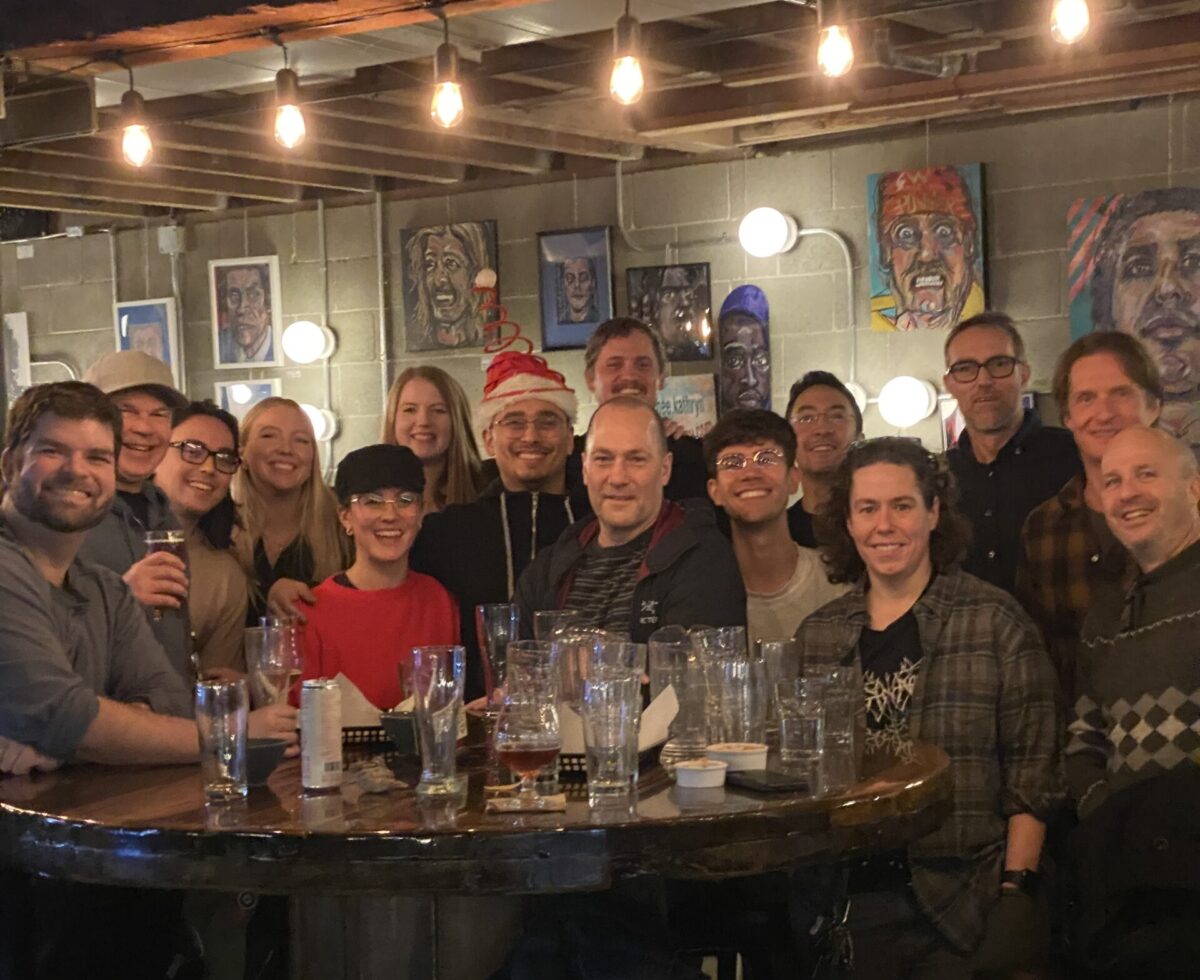
Joignez-vous à nous le 14 décembre pour un 5 à 7 des Fêtes à Vancouver. Nous allons souligner les Fêtes à EAST VAN BREWING COMPANY.

Venez célébrer le VIFF avec nous le 6 octobre à 19 h pour notre première soirée en chair et en os depuis 2019!
Les membres du CCE se verront offrir une première consommation gratuitement (alors assurez-vous de réserver votre place). Les non-membres sont également les bienvenu·e·s!
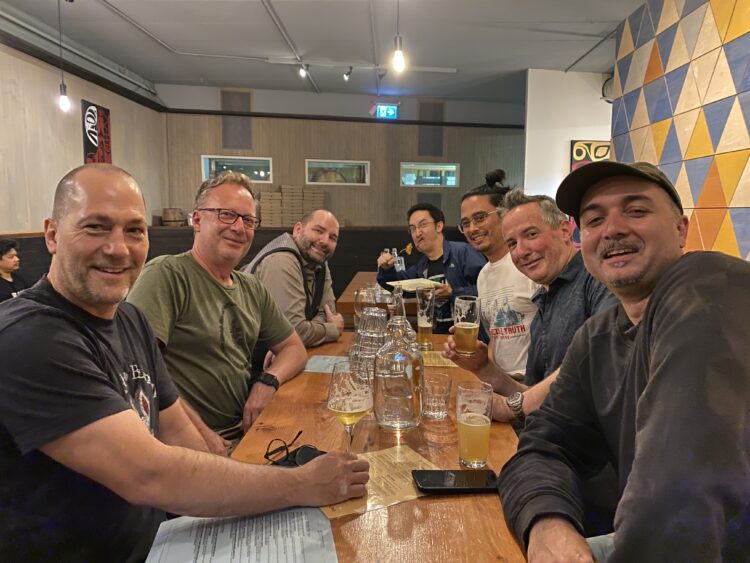
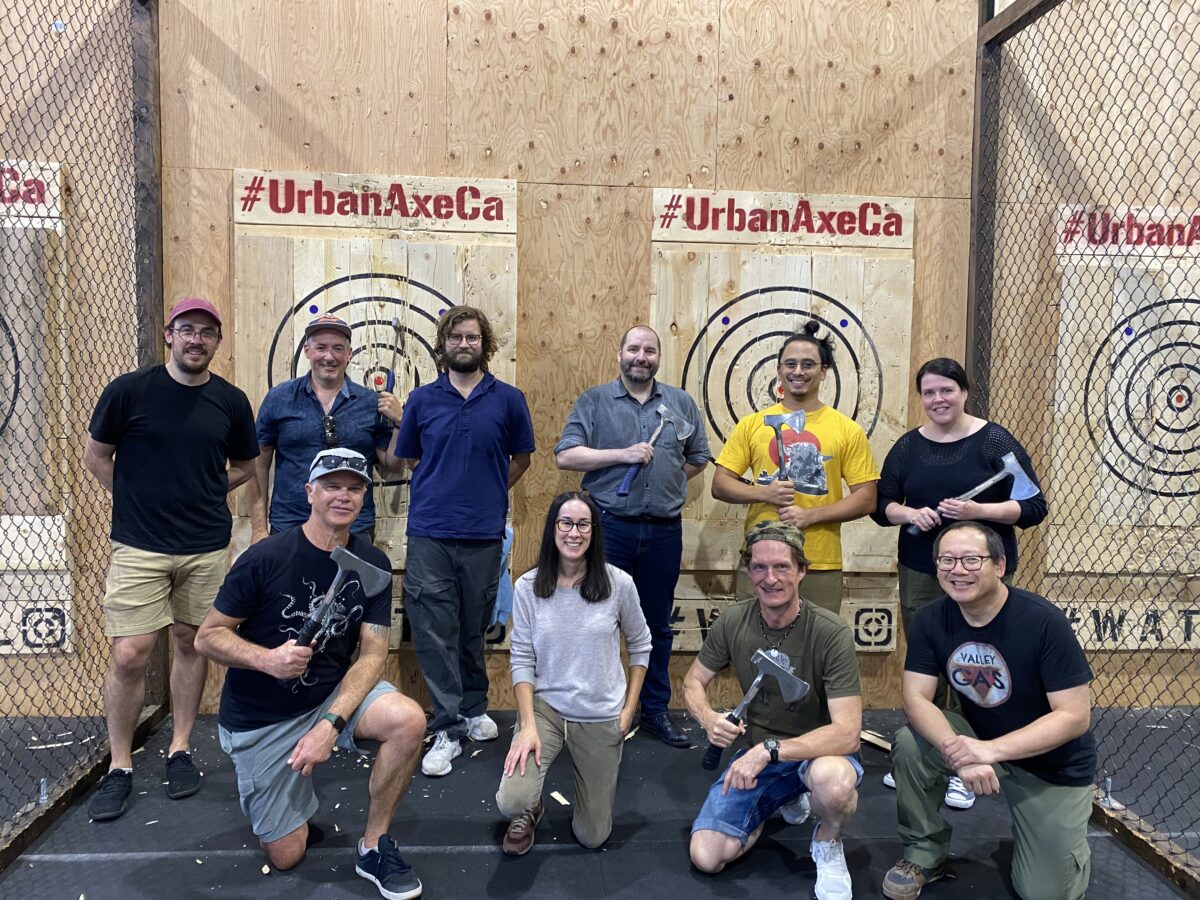
Join us in Vancouver on September 24th for our Offline Activity. We will be Axe Throwing – It’s like editing but you’re making cuts with dangerous heavy projectiles instead.


Le 14-15 mai 2022, membres et non membres se sont rassemblés dans des lieux différents partout au pays. Nous avons pris une pause de nos écrans pour sortir et marcher!
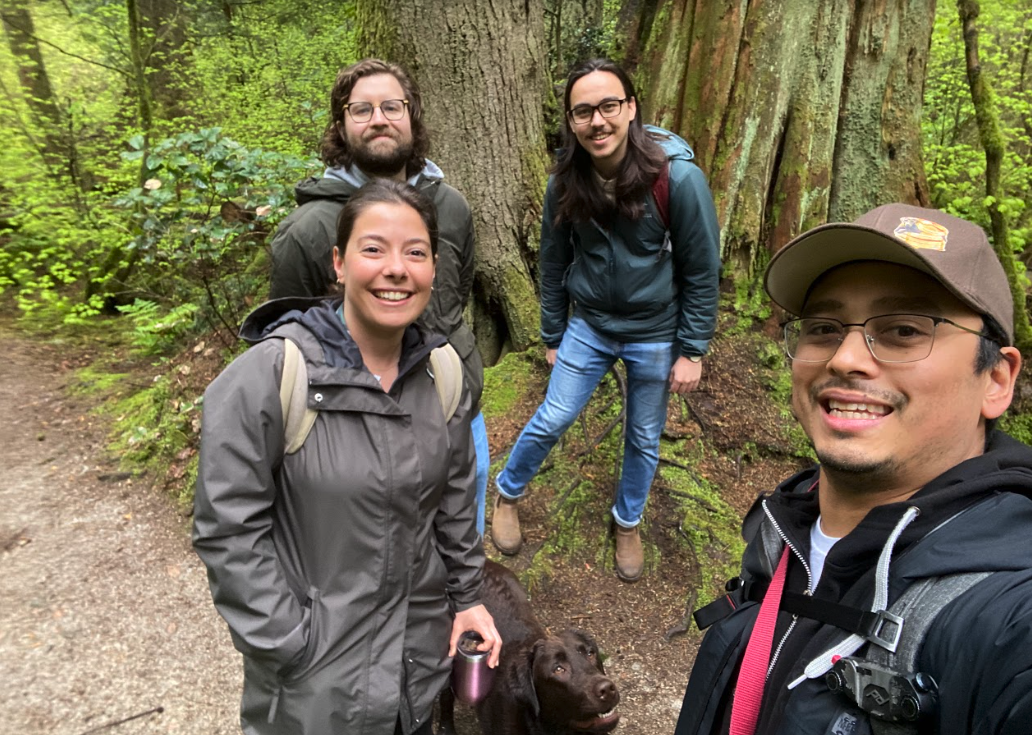
Les participants de Vancouver se sont rassemblés au parc régional Pacific Spirit.

Les participants d'Edmonton se sont rassemblés au parc Hawrelak.

Les participants d'Halifax se sont rassemblés à parc Shubie.

Les participants de Montréal se sont rassemblés à canal Lachine.
Les participants de Toronto se sont rassemblés à Brickworks.


Presented in English / Conférence en anglais
Une conversation avec des monteur·euse·s de partout au Canada. Joignez-vous à nous le 2 novembre alors que nous allons inviter des monteur·euse·s de partout au pays pour discuter de leur travail et de comment il peut être différent (ou semblable) en fonction de leurs régions. Nos invité·e·s seront de tous les horizons, de tous les domaines et de tous les genres de l’univers du montage.
Parmi les invité·e·s, il y aura Roderick Deogrades, CCE (CHAPELWAITE), de l’Ontario, Annie Ilkow, CCE (GHOSTS), du Québec, Jeremy Harty, CCE (TRAILER PARK BOYS), de la Nouvelle-Écosse, Lisa Binkley, CCE (ZOMBIES 3), de la Colombie-Britannique et Sarah Taylor (THE LAST BARON), de l’Alberta.
 Annie Ilkow is a Montreal-based editor whose recent work includes Ghosts (CBS, single-camera comedy), TRANSPLANT (2 seasons, for NBC/CTV), and BLOOD & TREASURE (2 seasons, CBS action-adventure). She also edited the critically-acclaimed drama 19-2, the seminal DURHAM COUNTY. A graduate of the film program at Concordia University, she earned her MFA in Cinema at the University of East Anglia, UK.
 Born in BC, Raised in NS, calls Halifax home since 1998. Met Mike Clattenburg and edited his low budget feature TRAILER PARK BOYS in 1999. Since then has been doing anything TRAILER PARK BOYS related. Started editing things with Cory Bowles whenever our schedules allowed. Married with three kids and owns and operates Digiboyz Inc. (Post Production) since 2001.
 Award winning film and television editor Lisa Binkley began her career in post-production after having studied theatre and film production at U.B.C. She graduated from the Media Resources Program at Capilano University. Since then she has worked on numerous feature films, MOWs and television series.
Her work was recognized when she received a Gemini Award (CSA) for her editing of the mini-series, HUMAN CARGO. This Canadian/South African co-production was directed by Brad Turner (HOMELAND & 24) and it received 17 Gemini Nominations and also won a Peabody Award.
Her work on MGM’s critically acclaimed science fiction series, THE OUTER LIMITS and Showtime’s, THE L WORD (Written and produced by by Ilene Chaiken) has given Lisa the opportunity to work with such directors as Marlee Gorris (Academy Award Winner – ANTONIA’S LINE), Moises Kaufman (THE LARAMIE PROJECT), Helen Shaver (VIKINGS), Lynne Stopkewich (KISSED), and Kimberley Peirce (BOYS DON’T CRY).
She is currently working on ZOMBIES 3 for Disney+, directed by Paul Hoen.
Lisa is a full member of IATSE 891, ACFC West and is a voting member of the Academy of Television Arts & Sciences. In 2008, she was inducted as a full member into the Canadian Cinema Editors (CCE) honourary society.
 Roderick is an award-winning Picture and Sound Editor who has worked in the film industry for over twenty years. His extensive knowledge of both sides of the post equation has proven invaluable. His experience in feature films, TV series, shorts and documentaries has established him as one of the industry’s most sought-after collaborators. On the picture side, he is known for his work on STILL MINE (2012), VICTORIA DAY (2009) and ONE WEEK (2008). For television, he has edited THE EXPANSE (Season 3 to 6), KILLJOYS (Season 4 & 5), and Chapelwaite (2021). He picture edited acclaimed documentaries such as 100 FILMS & A FUNERAL (2007), THE GHOSTS IN OUR MACHINE (2013), DAVID & ME (2014) and SILAS (2017). His sound editing work includes SPLICE (2009), PASSCHENDAELE (2008) and SILENT HILL (2006). He is currently picture editing the series BILLY THE KID.
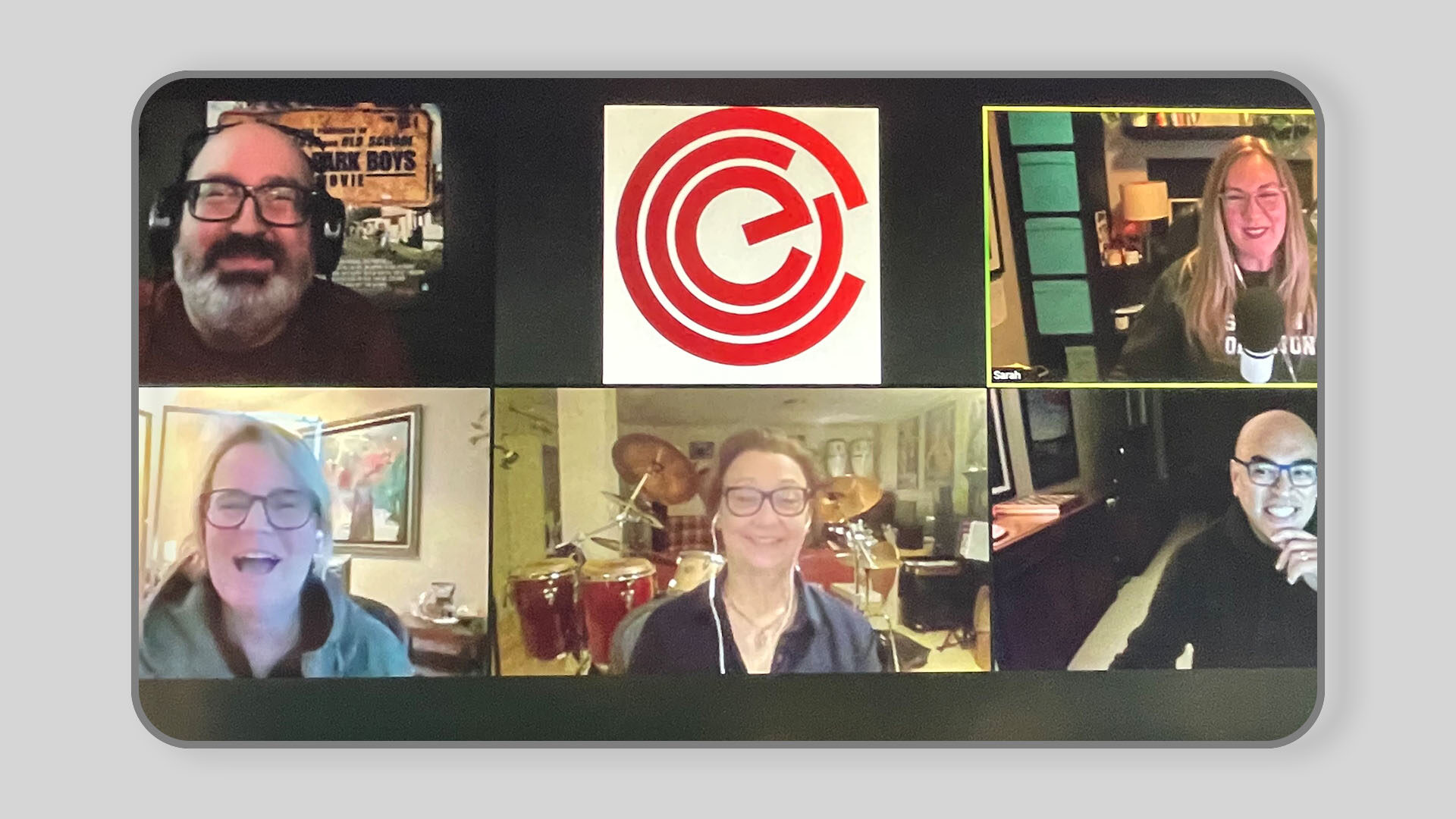
 Sarah Taylor is an award-winning editor with over eighteen years of experience. She has a passion for storytelling and has cut a wide range of documentaries, corporate videos, television programs, and full length feature films. Her work has been seen in festivals around the world including Sundance. She is a member of the Directors Guild of Canada (DGC) and is the host of the CCE podcast The Editor’s Cut.

The CCE relaunched its outdoor wellness group – Offline! On September 19th, members and non members gathered at locations all across Canada as we took a break from our screens, got outside and walked in support of the Terry Fox Foundation!

Les participants d'Edmonton se sont rassemblés au parc Hawrelak.

Les participants d'Halifax se sont rassemblés à Point Pleasant Drive.

Les participants de Montréal se sont rassemblés au parc du Mont-Royal.

Les participants de Toronto se sont rassemblés au Beaches Boardwalk.

Presented in English / Conférence en anglais
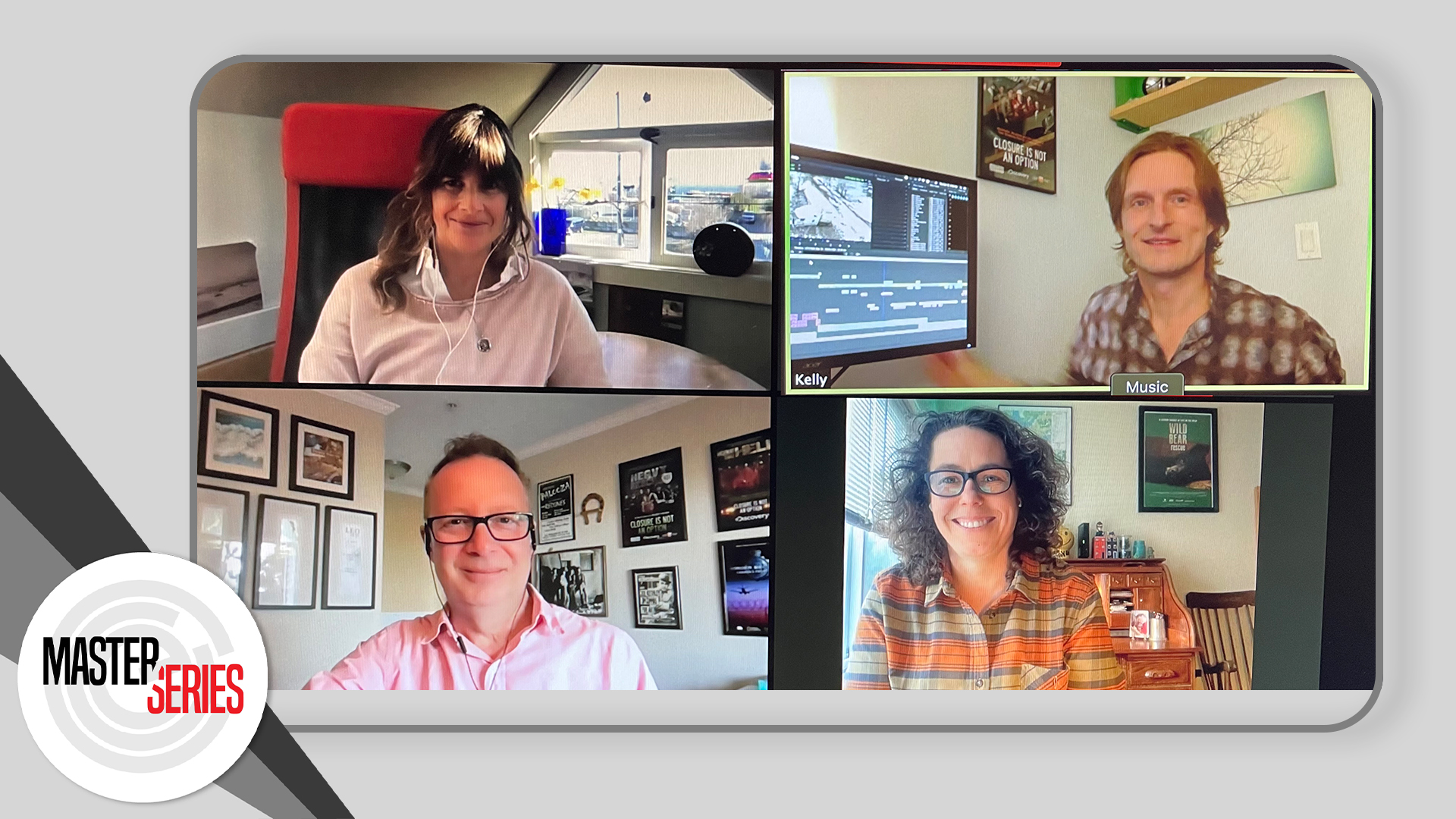
Join us on March 16th for In Conversation with Jenypher Fisher, CCE, Kelly Morris, CCE and Tim Wanlin, CCE. Veteran unscripted Vancouver editors Jenypher Fisher CCE, (RUST VALLEY RESTORERS) Kelly Morris CCE (HIGHWAY THRU HELL) and Tim Wanlin CCE (HEAVY RESCUE: 401) discuss their vast knowledge on crafting factual storytelling; the importance of finding the story’s truth, it’s language, and the importance of a strong, pivotal opening that will begin the audience’s emotional journey.
L’événement sera modéré par la créatrice, productrice, réalisatrice et scénariste Kelly McClughan.
La biographie suivante est uniquement rédigée dans la langue de présentation.
 A passion for factual story-telling and exploration has led me to some of the most remote and intriguing places on earth. I care about getting it right, thrive in challenging environments, and have successfully filmed in traditionally difficult to access communities. As a showrunner, producer, director and writer, I’ve created thousands of hours of factual television for Canadian, US and international markets, and am frequently consulted to help develop, shape and pitch TV projects. An extensive background in journalism has equipped me to apply my skills across multiple genres. As VP Production for Canadian factual producer Great Pacific Media from 2014-2019, I was involved in all aspects of pre-production, production and post, including hands-on story crafting, content oversight and development.
 Through hard work and determination, Editor Jenypher Fisher has developed a unique style, rivalled only by her keen sense of story and humour. Born and raised in Vancouver, British Columbia, for the past 20 years Jenypher has been responsible for crafting a wide and varied array of Canada’s unscripted series. Projects include RUST VALLEY RESTORERS, WILD BEAR RESCUE, ICE PILOTS, THE BACHELOR CANADA, JADE FEVER, YUKON GOLD, THIS IS HIGH SCHOOL, QUEEN OF THE OIL PATCH, THE NATURE OF THINGS, ER: LIFE & DEATH AT VGH, PARAMEDICS: LIFE ON THE LINE & EXPECTING!
 Kelly Morris CCE, is a Vancouver Based film and television editor and former president of the Canadian Cinema Editors, best known for his body of work in documentary and as senior editor for factual series. He has a passion for feature length film, investigative journalism and gritty reality. Series of note that he has worked on include Discovery Channel’s HIGHWAY THRU HELL, JADE FEVER and JETSTREAM, CBC’s HIGH ARCTIC HAULERS and investigative journalism series THE FIFTH ESTATE, natural history series BBC NATURAL WORLDLAND NAT GEO WILD, in addition to a wide breadth of documentary films, the most recent being Citizen Bio for Showtime. Shows he has worked on have received accolades including winner of the duPont-Columbia University Award for Broadcast Journalism (NUCLEAR JIHAD), a Sundance Grand Jury Prize Nomination (SEX: THE ANNABEL CHONG STORY), Gemini (THE FIFTH ESTATE) and CCE (A WOLD CALLED STORM) award nominations for Best Picture Editing.
 Tim Wanlin is based in Vancouver where he has been editing for the last thirty years. During that time his focus has been to seek out projects that allow him to draw out the strongest story, both visually and narratively. He has amassed over seventy documentary credits. Highlights include CTV’s Gemini Award winning, PEACE WARRIOR, WHEN THE DEVIL KNOCKS, which premiered in the 2010 Vancouver Film Festival and CBC’s Canadian Screen Award winning, WILD CANADIAN YEAR. More recently, while continuing to follow his passion for documentaries, Tim is busy with unscripted series work including BORDER SECURITY, JADE FEVER and his current project, HEAVY RESCUE: 401.

This episode is sponsored by Jaxx a Creative House and Annex Pro/ Avid.
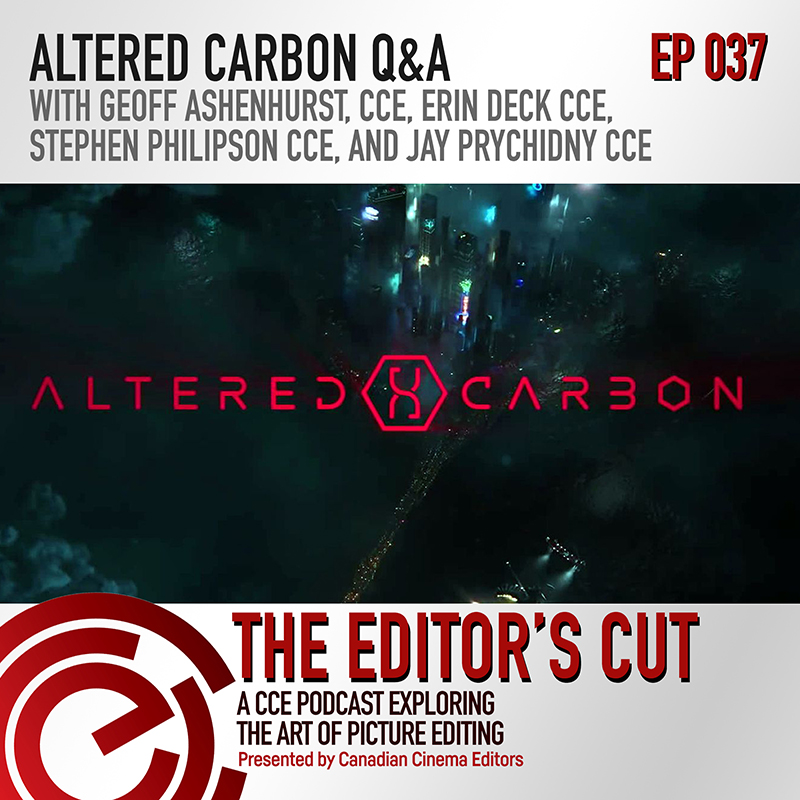
Geoff Ashenhurst, CCE, Erin Deck, CCE, Stephen Philipson CCE, et Jay Prychidny CCE discuss the creative and technical challenges of putting together the second season of one of the biggest VFX-based series Netflix has ever made.
This panel was moderated by Sarah Taylor.


The Editor’s Cut – Episode 037 – Altered Carbon (2020 Master Series)
Sarah Taylor:
This episode was generously sponsored by Jackson creative house, Annex Pro, and Avid.
Sarah Taylor:
Hello and welcome to The Editor’s Cut. I’m your host, Sarah Taylor. We would like to point out that the lands on which we have created this podcast and that many of you may be listening to us from are part of ancestral territory. It is important for all of us to deeply acknowledge that we are on ancestral territory that as long served as a place where indigenous peoples have lived, met, and interacted. We honour respect and recognize these nations that have never relinquished their rights or sovereign authority over the lands and waters on which we stand today. We encourage you to reflect on the history of the land, the rich culture, the many contributions, and the concerns that impact indigenous individuals and communities. Land acknowledgements are the start to a deeper action.
Sarah Taylor:
Before we get to today’s episode, I have a message from the Whistler Film Festival from December 1st to 20th, WFF would deliver its 20th anniversary edition, virtually to a national audience with over 100 films, including 30 features and seven short programs, all taking place over 20 days with film viewing access available until December 31st. WFF’s content summit welcomes establish industry leaders and content creators to our virtual mountain home to discover network and explore the ideas and actions shaping our new reality. From the global pandemic to calls for social change, along with policy changes in the Canadian media landscape, 2020 is a transformative year for the screen-based industry. Here’s your chance to keep your finger on the pulse and get a look at what the future holds. This episode was our first online master series event that took place on April 21st, 2020. It’s a panel discussion and Q&A with the editors of the Netflix hit series Altered Carbon. Geoff Ashenhurst CCE, Erin Deck CCE, Stephen Philipson CCE, and Jay Prychidny, CCE discuss the creative and technical challenges of putting together the second season of one of the biggest visual effects based series Netflix has ever made. This panel was moderated by me.
[show open] Sarah Taylor:
Welcome everybody to the first master series, zoom Q&A, which is Ultra Carbon, which is very exciting.
Erin Deck:
Yay.
Sarah Taylor:
And thank you all the people joining from around Canada and maybe even around the world, which is very exciting. So my first thing is I want each of you to introduce yourself, let us know kind of a little bit about your career, how you got onto the show and then what episodes you worked on. Let’s start with Jay because he’s in my top corner, top left corner right now.
Jay Prychidny:
So, I mean, I just always started as an editor, just out of school. I just started the editing right away. I started in kind of independent, low budget stuff, and that went up to network television and that went up to like on staff at a network. And then that went up to like reality and then went up to scripted.
Geoff Ashenhurst:
What do you mean when you say on-staff at a network?
Jay Prychidny:
I was cutting SexTV at CityTV.
Geoff Ashenhurst:
At city, right? Yeah.
Jay Prychidny:
It was awesome. [crosstalk 00:03:12] I mean, I don’t think they do shows like that anymore. They don’t like produce things that’ll shows that are that great, like in house.
Sarah Taylor:
Yeah.
Jay Prychidny:
But back in the day they did and at CityTV they did so and yeah, for Altered Carbon, they kind of just talked to every editor who had a certain level of credit. Which means credits that are known to American … the Netflix of the American distributor. So they kind of talked to everyone who had credits like that and they hired me for whatever their reasons were. [crosstalk 00:03:50].
Sarah Taylor:
And which episodes did you cut for season two?
Jay Prychidny:
So I cut episode four and seven.
Sarah Taylor:
Erin….
Erin Deck:
Hi. I was aan assistant editor for 13 years in Toronto, which was amazing because I got to work with tons and tons of amazing editors. And basically I’m all just luck. I had a friend who got me a job on an awesome show called Ghostly Encounters and that just kind of snowballed and got an agent and went from like Killjoys to stuff like that into, Into The Badlands. And then again, like Jay, I don’t know why they decided to pick me, but I got, I got the interview and then the second interview, and I guess they liked my smile.
Sarah Taylor:
I’m sure there was more than that. And which episodes did you edit?
Erin Deck:
I cut two and five.
Sarah Taylor:
Hey, Steve.
Stephen Philipson:
I guess I started sort of from an indie film background, I did indie features and shorts for many years and then started to get excited about series television. And many years ago, I had the very good fortune of doing a show called Hannibal, which kind of got me into one hour series TV, which is where I’ve been for the past eight or nine years. After Hannibal, I, the filmmakers went to LA to do a show called American Gods, which I did a few years ago. And after that, I was sort of unsure whether to be in LA or Toronto.
My family’s here and we weren’t quite ready to make the full move, but I got on a show called 10 days in the Valley, which my agent, I think pitched me for actually, because I could work in LA and Toronto. So I started in LA and moved to Toronto.
Stephen Philipson:
And on that show, I was lucky enough to work with somebody called Dieter Ismagil, who I think we’ll probably end up talking about quite a bit. He’s our post producer on the show ..
Jay Prychidny:
At Skydance.
Stephen Philipson:
That’s right. From a practical standpoint, it was good that I could work in both markets, but we also got along and he’s, he’s very, he’s a good guy. He takes good care of the people who work for him. And so we stayed in touch over the years and, and I got a call from him for the show, well actually almost a year before it started, He asked me if I was available in like February 4th, 2019, and you know how these shows always get pushed or whatever. So I’m like, okay, whatever. But I mean, we actually started on February 4th.
Sarah Taylor:
Wow.
Jay Prychidny:
It’s smart because he’d be like, are you available? And I’d be like, well,
Sarah Taylor: Yeah.
Jay Prychidny:
like a year from now. Yeah.
Sarah Taylor:
And you did episode one and episode…
Stephen Philipson:
Six.
Sarah Taylor:
And then Geoff, last but not least.
Geoff Ashenhurst:
All right, so I started out doing commercials and I guess, I would sit on commercials for like a year, year and a half. And then I got lucky because two of the editors left on the same day. Hey, you get a room now you’re an editor now. So I mean, I’d already done it. I’d done a bunch of smaller stuff up to that point. So I had a reel and stuff. So I came out doing commercials and music videos, but it was great because we had a great facility and I was able to cut shorts on the side basically like for five years or something, the probably longer actually I was kind of always doing the short, like evenings, weekends, and then commercials are short turnarounds. So sometimes I’d have a week between commercials or two weeks or whatever. And I just make the most of that time during shorts and then eventually some of those shorts turned out okay. And that led to a bad first independent movie. And then that led to a good first independent movie or I guess second, I don’t, I almost forgot about the first one now, but yeah. So then I didn’t need film for several years and still kind of like dabbling in commercials, which I still do from time to time. And then I got this show season two and three of Penny Dreadful. It was the Showtime series that take five in Toronto. And that was an amazing experience. And I think that was probably the biggest thing that kind of got me on their radar for this. And then I had a couple of interviews and I did up episode three and eight.
Sarah Taylor:
And then you also stayed on and did some other stuff at the end, right?
Geoff Ashenhurst:
Yeah. They, they … just because there’s so much visual facts in the show. And I think so… Yeah, so they wanted an editor to stay on because as the shots would come in and they’d get further along in their development, it’d be, well, actually it doesn’t really work with this shot that comes after anymore. And so just doing kind of smaller adjustments for the most part. But then there was also a few things where Alison, the showrunner, having like sat with the episode, as creative people like her do, like every time they watch it, they have some new idea. So they had me around for that too.
Erin Deck:
So how long did you stay on afterwards?
Geoff Ashenhurst:
Till like November… Mid-November I guess. [crosstalk 00:08:54] Because actually it would have been longer. It would have been like a week or two longer, but I had a trip booked and I was like…
Jay Prychidny:
Geez, I did whole other series. [crosstalk 00:00:09:02]
Geoff Ashenhurst:
That’s true.
Sarah Taylor:
Well, speaking of like schedule and stuff like that, kind of, what was your post like post team? There’s the four of you are the main editors. And did you each have assistants? Kind of let me know that stuff. And then the schedule of like, how long did you have for each episode? What were your, the length of time that you had with your directors, with the producers, the showrunners, that kind of thing?
Erin Deck:
Well, I think for the director’s cut normally it’s four days, but because it was all done remote, I think the directors got six days.
Geoff Ashenhurst:
I think I heard somewhere along the line, that’s like a DGA thing. If it’s remote,
Erin Deck:
Oh, okay.
Geoff Ashenhurst:
They get more time.
Sarah Taylor:
And maybe explain quickly, why were you all are cutting remote? And what was the setup there?
Jay Prychidny:
Well, the whole show was shot in Vancouver and season one was posted in a little bit in Vancouver and in LA. And for this season to save more money, I guess their main reason they did all of the post in Canada, and they decided that Toronto had a talent pool that they liked. So out of Canada, they chose to come to Toronto. So all the shooting was in Vancouver, all the executives were in LA and we were in Toronto. So, hardly anyone ever came to Toronto, it was really just the post team, which was 15 of us or have many there were. And yeah, so everything was done remote.
Sarah Taylor:
Who was the post team? What was it comprised of?
Stephen Philipson:
We each had our own assistant and I mean, our assistants were all busy, full time, cause there’s a lot going on. We had a VFX editor, the VFX editor had their own assistant. We had our post producer, Laurie, and then she had a team of two–
Erin Deck:
Katie and Mandy, yeah.
Geoff Ashenhurst:
Supervisors.
Stephen Philipson:
Then we had our post PA. Yeah. In terms of picture post yes.
Sarah Taylor:
And you all work together out of Deluxe?
Erin Deck:
Yeah. We had all one little area all together.
Sarah Taylor:
Now do each of you work differently with your assistants? Like is there, if you want to walk through how they help you kind of, because I’m sure every editor is a different.
Erin Deck:
I to keep mine under the table.
Sarah Taylor:
They rub your feet.
Erin Deck:
Yeah, that doesn’t sound good. [crosstalk 00:11:17]
Stephen Philipson:
I tried to use my assistant for creative reasons anyways. No, for me, it was more, I think to take some of the sort of temp sound work off my plate and the person that I brought up, I’d like to bring on people who can make a creative contribution and I try to give them scenes to cut, but just the volume of, and the speed of turnover and everything. Even though we were on the show for a long time, I really didn’t get a chance to give a lot of creative work to my assistant, unfortunately, but the sound, I mean, the sound was really her realm.
Erin Deck:
And VFX. They handled a lot of the go-between. I tried to give, I had Shelly and she was phenomenal. And one time there was like in episode two there’s this gunfight and there’s like slow-mo and stuff. And the director wanted to see all these variations, of have it all 24, have it all 48, have it all like at all these different speeds. And so I basically was busy cutting other things. And I just gave that to Shelly and I said, use all these shots and this is like the ins and the outs that I want but if you need to adjust that, please do. But so yeah, she did a fantastic job.
Geoff Ashenhurst:
And the holo-ads, right?
Erin Deck:
Yeah, yeah, yeah. She was fantastic at those,
Jay Prychidny:
I started as an editor with me being my own assistant not having an assistant. So it really took me a long time. And also in Canadian television, a lot of the time you’ll have one assistant for like multiple editors or something. So I was just kind of used to the idea of doing everything myself. So it’s kind of been a process over the past few years discovering, Oh, there are things that I can like work with an assistant on. So for this series, my assistant was Graham Tucker and he, so he ended up doing probably all of the sound. Maybe there was like one scene or something that was like, Oh, take this one. But he did the sound for all the episodes, and usually I have a lot of notes on the sound too and like really specific stuff. So, but it worked out really well. And the, in my episode was the only one where we didn’t have a sound house working on my episode. But I thought it sounded just as good.
Jay Prychidny:
You know, you can hire a post sound house for tons of money or you can hire Graham Tucker.
Stephen Philipson:
I’ll do a shout out to my assistant, Mary Juric as well, too. One thing she was great for was she did a lot of the VFX work. I mean, there are just maybe even, I don’t know if there was more on episode one just cause it was sort of a, sort of a pilot in a way, but she really helped out Dale, our VFX editor quite a bit. Like she would do temp keys and stuff like that. So it was great to have that as well. Cause there was quite a huge volume of effects, especially on the first episode I did.
Stephen Philipson:
I heard that the Guillermo Del Toro calls Mary, Mrs. X after Mr. X. Cause she’s so good at doing temp VFX. [crosstalk 00:14:27].
Stephen Philipson:
Oh really? [crosstalk 00:14:29] Let’s say it’s true.
Sarah Taylor:
And how about you, Geoff?
Geoff Ashenhurst:
I had Tom Lounsbury who was great. Sort of similar to all you guys like, cause I come from independent film, I’m used to doing a lot of stuff myself, but specifically the fight stuff. Cause Tom did I think one season of Into the Badlands.
Erin Deck:
Yeah. Tom did one. Shelly did two.
Geoff Ashenhurst:
Yeah. And I remember like first fight sequence in two or three or I needed the first pass on it. I was like, all right I could not have done as good a job with this. Like he was doing stuff, I guess just from that experience, I was like, you just added a lot in my friend. Good job. And I did, I didn’t– like Steve too. Like I love trying to give scenes and stuff, but with the pace of it, it was tough. But there was a few little things that I remember a couple of times I was like, ah, I’m finding this part tricky. Like, can you see if I’m missing something? And then he kind of figured it out. And I was like, all right.
Erin Deck:
I did that once with Shelley. I couldn’t, I couldn’t crack a scene. I just had such a hard time with it. And I was spending too much time and I knew I was going down a rabbit hole. So I, I just gave it to Shelly because she’s, she’s an editor on the side or for real,
Geoff Ashenhurst:
CCE-nominated editor…
Erin Deck:
Winner!
Geoff Ashenhurst:
Winner. Pardon me.
Erin Deck:
Winner. Yes. I just needed to see the scene from someone else’s perspective. Cause I just couldn’t make it happen. And it was amazing. Cause I, I saw her take an approach at the scene that I think I just wouldn’t have done and it was great. And it helped me kind of then build from that moment. So yeah, she’s, she’s fantastic.
Sarah Taylor:
Geoff touched on fights and fight scenes and clearly the show is very fight heavy. So I want to dive into your guys’ process on how you tackle fight scenes and what you ran into, what worked, what didn’t work, what your challenges were. Maybe we’ll go with Steve. Cause he did episode one and there was a big, it was a couple of big fights.
Stephen Philipson:
It’s one of the biggest scenes I’ve ever done. We had a fight scene that had, I think in the end it had 120 setups.
Sarah Taylor:
Wow.
Stephen Philipson:
The slate went through the alphabet twice and two cameras on every set up. And really, I don’t, I mean the challenge on that was really just the volume of material. I mean, I had a good sense of how the fight
was supposed to go together from the script. It was quite well planned and they did previous sequences with the stunt people that they sent to us to give us sort of sense of what they were thinking. Although the stunts did change a little bit on set. In that particular… I mean, for me at first, it’s always just a logistical challenge, figuring out how to process all that footage. I mean, some of it, they sort of would do like a 30-second chunk of the action and just shoot that from a bunch of angles.
Stephen Philipson:
And then other parts there do specific shots just for, for special things like something getting hit by a bullet on a table or something. So it was really just breaking it down into pieces and then just kind of building it piece by piece and figuring out which section went where. For me it’s, I think it’s sort of a, just a technical challenge laying it out at first, when you have that much footage, it’s just almost a logistical challenge. And then the creative fun for me comes after that first kind of pass where you get everything in place and then you sort of see what you got and then everything fits and then you can play with things a bit. I mean, it’s really quite a well covered fight considering how much Well, I guess, well
covered, obviously there’s a lot of footage, but I mean, all pieces were there, which is very exciting because it’s not always like that.
Stephen Philipson:
I think I was missing one reverse that I really needed that we had to cheat in the end. And it was a lot of fun to put together and I can’t remember how long it was probably one or two minutes, but when you got to fight that long it’s like a story. And so, I mean, you have to figure out what is the story of the fight and it’s got pacing and you sort of track the characters’ emotions through the feet. So it’s fun from that standpoint because there’s just so much going on narrative wise and the fight, and it was a good chance to be expressive and to use kind of pace and tone to kind of give a shape to the fight. Yeah. It was a lot of fun. And then the, the fight in the opening scene was quite extensive as well. And same thing. It’s just sort of figuring out the storytelling through the fight. Once you’ve gotten over the hump of just figuring out how to put everything together.
Sarah Taylor:
Yeah. And Erin you kind of already touched on there’s lots of different speed changes and the director wanting to see all the different options. So how did that in the end shape into the scene, the fight scenes that you cut?
Erin Deck:
I think for me, I liked fight scenes a lot, especially if the stunt team and the director work really well together, the stunt team we had was really great. And normally they’ll just do these tiny little chunks for like the fight and it’s a building block. And so it’s for me, I find fight scenes almost easy to put together. Cause they’ve, if they’ve done them right, they laid them out for you. They will shoot them all in slow motion so that you can adapt them. I usually, my first pass has way too much slow-mo in it. I make it way too. Like, bah bah bah The whole thing. And then I have to, I have to be like this isn’t artsy fighting. This is like for Altered Carbon. So you start to like pull back and you try and figure out what the, what the key elements are that need to be slow-mo because as soon as you put something in slow-mo everyone’s like laser focused into like, why is that in slow motion? So it either has to be like a good kick or a good fly in the air. Or like with that first scene, like the gun being thrown, it’s just playing, I think for me and just kind of feeling like when I, I try not to show my hand too much, I think, as an editor in a fight scene, because the more you try and slow things down, then you’re kind of showing yourself, you’re
starting to be like, look at what I’m doing. So I think it’s a balance of trying to make it fun and entertaining and creative, but also cool.
Jay Prychidny:
I think this is you, Erin, when you were doing your first fight scene a long time ago, whenever that was, did ask Michelle Conroy for advice?
Erin Deck:
When I was cutting Kill Joys. Yeah.
Jay Prychidny:
I remember she said, this stuck in my head for some reason. And I was doing a fight scene today and it was still in my head, but in my memory, which I may have made up, you asked her, how do you approach a fight scene? And she said “one punch at a time.”
Erin Deck:
That sounds like her.
Jay Prychidny:
I don’t know why that stuck in my head so much, but it’s like one punch at a time and you just take it punch by punch or whatever move or whatever, move and make that as cool as you can.
Erin Deck:
On punch at a time but it is kind of true, right. Because you’re just like, you just start from this pop and just work your way through it. Yeah. No, she’s great.
Sarah Taylor:
Geoff, you had the big execution.
Geoff Ashenhurst:
Yeah, sequence. Yeah.
Sarah Taylor:
Was there anything in there that you ran into that was challenging or changed or I don’t know. Your process for that?
Geoff Ashenhurst:
Yeah. I’m trying to remember when I do have the schedule right here, actually, I’m trying to remember how long they shot it for. It was like, at least a week they shot at for, but it was probably longer because I remember that it was like, okay, so they’re going to be shooting it on this set for like multiple days. So I should send MJ the director, like a work in progress cause they’ll have a chance to pick up anything that she might think they’re missing or isn’t happy with.
Geoff Ashenhurst:
So I remember I worked pretty furiously to like bang it together and Tom did a great job cause I was like, I couldn’t send it to her without having a sound pass done because I find like the believability of a lot of these strikes in a fight, you don’t buy them. But it’s amazing how once you have the right sound effect in how suddenly your brain will believe it. So yeah, so we sent it to her and I remember she called me, I hadn’t spoken to her at this point. We’d just been emailing prior to that. And she was like, so we sort of like small talk for like a minute or two and she’s like, so let me ask you this, have you done much action before?
Sarah Taylor:
Oh no.
Geoff Ashenhurst:
All right, cool.
Sarah Taylor:
Oh no.
Geoff Ashenhurst:
Then I was like, I just, then I just assured her. No, I was just throwing in this together so you can see like it live, I wouldn’t put this on TV [00:23:05]. She was like okay, okay, great, great, great. But then with the big change after that was that when you watch a sequence, there’s these sort of like kind of stylized, like hazy point of view shots. And I think she did a really like, literally were like Vaseline on the lens, like really old school. Then they also used lens baby a bit too, just because Kovacs is drugged. So they’re just trying to get in his, literally in his point of view, how he’s seeing these characters from his past and like the believability of it. And the more I kind of got into that footage, I was like, okay, this is cool. Like this, this could make, should make the fight kind of stand out from being just another fight sequence, which I think is partially what she was responding to the first time as well, that it was pretty kind of run of the mill fight stuff.
Geoff Ashenhurst:
Cause she’d done, there’s a show called Strike Back. It was on Cinemax for, I don’t even know, like six or seven seasons, like quite a long time. They shoot the set in Africa and she directed like a hundred episodes or something. So she’s really good at doing action and like covering everything off quickly and very experienced in it too. But then once I showed her like the next pass with all that point of view stuff cut in, basically when she’d shot everything, then she was like, Oh my God, it’s so fantastic. And she was, I didn’t, I found out later she was showing it to people on the set because remember I was working with Alison she’s, like in the old cut, there was this one shot. I was like, old cut. [crosstalk 00:24:23]
Geoff Ashenhurst:
I found out she was showing people on set. That was a, sort of a bit of a unique process on this one. But it was also the thing I was going to mention earlier was that I didn’t know about this kind of stuff till I’d done some action that the stunt teams usually shoot like a stunt viz or like a basically a previz where they’re in their gym. And they usually put on really bad music and cut it together and they try to act like the character that it makes you laugh. It makes you cry. But sometimes it can be a helpful guide for like how they thought it would fit together. And even too sometimes because they’re shooting it in pieces,
you’ll get the stuff and they’ll be like, okay, they’re on this side of the room. And now this shot there of like what happens in between or like they’re shooting that thing two days later on a cable.
Geoff Ashenhurst:
So you’re like, it’s I found it helpful a few times. Cause I was trying to figure out a way to connect A to B. But then I was looking at the stunt vids and be like, okay, they still have to do that shot. All right. Actually I remember in that first temp I sent the first work in progress. I would cut in the stunt viz for parts that we didn’t have yet to show–
Erin Deck:
So you were the one who started that. That’s why we all have to follow suit afterwards. No. That was actually really helpful. Cutting in like the previz of the section that either wasn’t shot or was shot poorly. If we had the previz, you could like slug that in to the middle of the fight and you could send that to the director and be like, this is what we need
Jay Prychidny:
Yeah it was helpful. Having that stunt vids.
Jay Prychidny:
… it is, I did episode seven, which had a bunch of fights and there was one fight that was in the construct virtual world and it kept going from place to place and… Just the way it was shot, it was very complicated. So, having the stunt visit was actually great because oftentimes you can piece it together, how the fight’s supposed to go together. But I looked at that stunt there’s a lot cuz I was like I didn’t know how the footage was supposed to go together at all. I didn’t know what they had in mind for a bunch of those shots. So that was actually really helpful.
Stephen Philipson:
I found… In my case, I’m jealous of you guys now because my stunt visits, I mean, they are good reference, but they were changed quite a bit on set I found.
Jay Prychidny:
They were changed, but I still got a lot of good information. I don’t know.
Jay Prychidny:
Yeah, it was interesting in episode seven, also there was like a real push and pull with the director on another one of the fight scenes because the director really wanted to do the whole fight in one shot. That just always make me crazy because you can’t really edit anything. So I wonder what am I doing?
Jay Prychidny:
I don’t know. It’s such a funny thing with directors sometimes. They really just love the idea of doing something in a single take.
Geoff Ashenhurst: Yeah.
Jay Prychidny:
Which is great if it works, but I think usually it doesn’t work. I mean, I don’t fully understand… I understand if it’s Children Of Men and you have like, an entire war going on in one shot and then you are like, “Oh”, like that’s impressive but it’s not-
Geoff Ashenhurst:
Yeah.
Jay Prychidny:
I don’t really understand the idea of doing like a fight… I’m not sure if the audience enjoys it more or if the audience even notices, anyway, long story short, like the shot was great like really but It’s still like 80% there and it’s like there’s no reason why you have to put up with only 80%, right? So, the producers decided to shoot a lot of… And it was the last block. So the producers decided to shoot a bunch of extra footage for that fight, in the event that it didn’t work, which thank goodness, they did, because we ended up using all of it. Actually that was fun because then I was like, really involved in the discussions on what they would shoot to make this one-shot work.
Erin Deck:
Oh, that’s cool.
Jay Prychidny:
So, in the end, I mean, there are still long sections that all play out, but in certain parts you have to cut away because if it’s not all in the shot, if it’s not all understandable from the shot and you don’t really understand what’s going on, you can’t just leave it like that.
Sarah Taylor:
So, what were the things that you were… When you were in the process of cutting from the one scene, the one-shot that you’re compelled to say, “You need to get this.” What were you looking for? Or how did you decide that?
Jay Prychidny:
It’s like when you don’t, like I’m so particular about really fully understanding, all the time, what’s going on. I hate the feeling of just a blur of stuff and you don’t really… Like there’s stuff happening and you’re like, “Yeah, sure.” But I hate that feeling. I always want to know precisely what’s happening. It’s just whenever I got confused, I put on my, kind of, audience dumb hat. I’m like, “I don’t understand this, I don’t understand that, what’s happening there. What’s going on there.” And for those moments, then I feel like I want a shot so I can understand this.
Geoff Ashenhurst:
And I think in those one take things as much as they try, there’s often times where the camera and the actors aren’t quite lined up.
Jay Prychidny: Yeah.
Geoff Ashenhurst:
So there ends up being unnatural pauses sometimes because the actors are waiting for the camera to turn around on them or to deliver a line. It just gets weird sometimes because it’s just all serving this complex technical part and it forces the actors not perform how they would instinctually let’s say, because they’re just overly cognizant of the technical parts of it. I think too, it’s more effective and justified I guess, when there’s actually a dramatic motivation for the character to be with them, for like the whole shot, like in the Battle Of The Bastards in Game of Thrones, I’m sure a lot of people have seen that, if not all of you guys. It’s not a one shot scene, but there’s a long shot with John when the horses are going around him and he’s totally isolated and it was just… I remember being really impressed with it because you just really felt like you were there with him and the peril of it was just overwhelming, but just a normal fight, it just becomes a bit indulgent and awful.
Jay Prychidny:
Yeah, like single shots are impressive when there’s something like really impressive happening.
Geoff Ashenhurst:
Yeah.
Jay Prychidny:
For me, it’s a lot of directors seem to think that the single shot in itself is impressive and it’s like no, no, no, no.
Stephen Philipson:
I just can’t help thinking of 1917, because I saw that recently and I mean, there’s so much work in that movie to think about how to use the camera movement for storytelling. Every beat is so well-planned. I think it’s probably really hard to have that level of attention to detail that you need to be able to rehearse and plan on a TV schedule.
Jay Prychidny:
Yeah.
Geoff Ashenhurst:
Yeah
Stephen Philipson:
Because if you’re going to do it in one shot, you’re really at the mercy of just the vision of the director, in terms of knowing exactly how the story is going to come across to the audience.
Jay Prychidny:
And I think the scene still feels… Like the one in seven, I think it still feels cool and unique because even though it’s not all in one shot, there are long stretches that are still in one shot. So, I think that’s still in and of itself cool, to me anyway, it feels cool that way, because you do feel like you are with him more. Just getting in some additional shots in there, I don’t think it really takes away from that feeling for an audience, but people have different ideas about that.
Sarah Taylor:
Well, that’s the big… People have different ideas about everything.
Jay Prychidny:
Of course.
Sarah Taylor:
Especially, you know things that the directors have shot and then when you get to the showrunner producer scenario of what you have to adjust and change, and then what finally gets to the end, with the audience. Was there big differences between what you got from director’s cut, to what the final episode was?
Stephen Philipson:
I can take that one because we had the first, I think it’s six or seven minutes of episode 201 and this was a bit of an issue of… I think we’ll probably talk about this a little bit later, but just the fact that Alison wasn’t in Vancouver, this is the Showrunner Allison Schapker.
Stephen Philipson:
So we did the first cut of the very first fight scene in the bar in Episode 201. She just reacted very negatively to a couple of things. One, I think the art direction wasn’t really what she was thinking, like it sort of had the wrong feel and look, visually. And she was very concerned because it was the very first thing the audience was going to see and so basically she threw the entire thing 4out and we reshot the whole thing. I mean, I give her kudos for having… The wherewithal… Anyway to just go to Netflix and say, “Look, this is not the way I want it”. And it’s not just the editing or the performances or whatever. It’s really, it’s like the look and feel and what we can achieve with the footage. And also the way the fight was originally shot.
Stephen Philipson:
It was very much from the point of view of the different Kovacs fighting in the bar. Whereas in reality, it’s…. Really Trepp’s point of view… Like that’s important at that point because we’re with Trepp, as we’re wondering who is the real Kovacs and I mean, I just didn’t have that originally. So yeah, there was this one scene that I worked on for weeks and weeks, lots of back and forth to see if we could make it work and then after a couple of weeks they threw out the entire thing and I mean, because I ended up actually working on Episode 201 pretty much chipping away at it, the entire time I was on the show, it was very much like a pilot for Season Two, like it was really the first thing you would see of the season that would really establish the new season, how it’s going to look and feel.
Stephen Philipson:
And also there’s a lot of attention to Kovacs performance to make sure that that was right, like it followed properly from Joel Kinnaman’s performance. So I was working on that scene, I think the entire time I was on the show, I mean, it was great to have that much time to work on one scene, but of course then they reshot it and it was even bigger than it was originally and so I got a massive amount of footage to deal with and then we had to cut it in the end very quickly at the end of the show.
Sarah Taylor:
Right.
Stephen Philipson:
But I’m really glad that they pulled the trigger on re-shooting. There was a lot of back and forth over whether or not it was a good idea, but it really is dramatically better in the final show and just, the cinematography is great. It’s the original director who came back to shoot it, so it wasn’t anything against the director. I think it was just with the craziness of Alison needing to be in the writers room and on top of everything that… The art direction got through to the set without her really… Well, I don’t know, I mean, I wasn’t there, I’m not sure exactly what happened, but she… I don’t think she saw everything, until it was too late.
Jay Prychidny:
Yeah.
Jay Prychidny:
Someone screwed up.
Geoff Ashenhurst:
That was it.
Erin Deck:
I think probably what happens with a lot of those like first… And because it was like a pilot that you were cutting, in that first scene. But I find that what happens with a lot of those first scenes is that, they always get reshot.
Stephen Philipson:
Yeah.
Erin Deck:
Because, I think they’re scared to put as much money and as much effort and as much time as they need to, into that first scene. And so they just treat it like how they’re going to treat all the other scenes and then when they realize, and they watch it and they’re like, “Oh, well that’s not an amazing first scene for the beginning of a season. And then they’re like, “Oh, okay. So we do have to go back and spend the money”. I think that happens a lot.
Stephen Philipson:
Yeah. The original scene, like it was great. It was very well done. It was a very complicated fight, there was lots of cool stuntwork.
Erin Deck:
I thought you did a really good job on that first version. Stephen Philipson:
Oh, well, no one’s seen it, so, but no, that’s a very good point. I think it wasn’t unique and special in the way that it could be. I think they planned to reshoot the whole thing in two days, which was very quick, but they really planned it properly and it had a lot of time to plan it. And so even though it was quite rushed to put together, I mean, it was quite spectacular too because they… I think everyone was comfortable with the scene and it was comfortable working together as well too. I think originally the scene was one of the first things that was shot. So I mean, by the time they reshot it, everyone had had a chance to work together for a few months and it really does look a lot more polished and a lot more spectacular.
Geoff Ashenhurst:
I find like every movie I’ve done, the stuff shot on the first two days is problematic up until the end, like without fail. And the smart ones end up scheduling like the most banal stuff for the first day or two. But then even then that stuff is still… It still has to be good, right?
Stephen Philipson:
Yeah.
Geoff Ashenhurst:
So, there’s always challenges for sure.
Stephen Philipson:
Well, there is always… There’s that period, I mean, the actors don’t quite know their characters yet. They may not be used to working with… They haven’t sort of developed the chemistry maybe with the other actors as well, too. So that always takes a little bit of time. I know Anthony Mackie, the first little while that he was shooting and we were really trying to figure out, should he just sort of ape Joel Kinnaman, or it should be more this way or that way. So there was a lot of working on the tone of his performance.
Erin Deck:
Oh, yeah, he also had to like… I think, figure out exactly how much to give of him because he’s such… Everyone loves him and he gave us tons of stuff to work with, but too much, then you start not liking the character.
Geoff Ashenhurst:
That was the biggest challenge in my episode, it was scaling back Poe, cuz I think he knows that he was one of the favorite characters from the first Season too, and really embraced like the comic relief aspects of the character and I was really surprised when she saw the directors cut… Like how put off she was and all these moments, she’s like, “There’s no tension in his storyline”. I’m like, “It’s a good point”, right?
Sarah Taylor:
Yeah.
Jay Prychidny:
He treated a lot of things very cavalierly.
Geoff Ashenhurst:
Yes.
Jay Prychidny:
So those are generally the notes were trying to make it seem like, he’s having a conflict.
Geoff Ashenhurst:
Yeah.
Jay Prychidny:
Or he’s emotionally invested and it’s like, you look at the footage and it’s like, uuh.
Jay Prychidny:
There was a lot of trickery from my part, for sure, in that way.
Stephen Philipson:
Well just to go back to what I can’t remember who said it earlier, just the fact that… Oh, I think it was you Geoff, you said that he sort of saw himself as comic relief and there… I mean, I found there was times where he maybe had a bit of a caricatured element to it or a cartoony element, but in the end, he ended up being a character with quite a lot of depth.
Erin Deck:
Yeah.
Jay Prychidny:
Oh, yeah.
Stephen Philipson:
So it wasn’t always appropriate for him to be sort of cartoony and he might’ve not have seen himself that way at the beginning, but that’s something that we did have to kind of bring out over the course of the edit. I think he’s one of the characters that people really attach to and like, and…
Geoff Ashenhurst:
Any press I ever read on the show that he was always a standout for the writer.
Sarah Taylor:
Yeah.
Jay Prychidny:
I mean, Alison the showrunner was very specific, like, very specific about what she wanted out of performances and directing and all those kinds of things. So, I think a lot of our challenges on the show were around that, where Alison’s expectations of things didn’t match up to the reality of what was on the screen, performance, point of view, like we’re talking about now and with some of the directing as
well, which was the original question back 20 minutes ago, was about the director, but there was– A lot of sequences changed dramatically in my episode. Like you wouldn’t even know if it was the same footage necessarily because the sequence has just changed so much to try to get closer back to what Alison was expecting to see or try something entirely different.
Jay Prychidny:
In episode four, there’s that whole sequence of them going into the decaying stack and the director shot that all as one-takes and it was kind of like a theatrical performance with single takes and then in the final cut, it’s all just a whole barrage of editing different shots, different all kinds of footage and stuff. So there was one example where the director’s vision is just completely gone. Even in my first cut in my editors cut of that episode, I put one edit in that scene, one edit and the director was like appalled-
Sarah Taylor:
Oh no.
Jay Prychidny:
… that I put any edit at all. You look at the final episode, it’s probably 300 edits. I don’t know.
Geoff Ashenhurst:
I remember because Jay, had an overlap. So he started our show a bit late and they asked me to just sort of throw his scenes together in case the producers ever needed to see something in a pinch to be like, “Do we have the scene?” Like that kind of thing. So, I guess Graham helped out as well actually with that. But I remember when I came to that stuff, I actually called her. I’m like, “So what did you have in mind for this scene?” Like, “How is this going to work?”, because there’s like a green screen and weird places and-
Stephen Philipson:
I think that I find,… I don’t know if you guys find this in series television because the editors are often a part of the tone meeting and I like to be just to get a sense of what’s in the showrunners head, but I mean, you go to the tone meeting and it’s like the showrunner and the director and all the department heads and the showrunners like, “This is how I see it. I want to see this, this, this, this, this, and this”.
Stephen Philipson:
And then I guess the show runner goes off to the writer’s room and starts worrying about storytelling and getting scripts out in time and then everyone else goes to the set and things evolve and change and some showrunners… I’ve worked with a lot who sort of liked the writing process and are more sort of in that zone and so when they see the scene again, I mean, I’m the first person who sees it. I’m like looking at my notes from the tone meeting and looking at the footage and going, “Yeah, that’s not matching up or whatever”, but you put it together as best you can and then you show it to the show runner and they’re like, “Well, that’s not matching up with what I’ve put out in the tone meeting”. So I find that happen sometimes.
Erin Deck: Yeah
Stephen Philipson:
And I’m sure it’s probably just… Especially in a shooting, like there’s just so much going on. It must be really, really hard for showrunners to really be able to manage every single element through the whole process.
Geoff Ashenhurst:
I’ve embraced Erin’s… I don’t know. It’s not really a trick, but when we listen in on the tone meetings, Erin would start recording them on her phone …
Stephen Philipson:
To have as evidence later, to be able to…
Erin Deck:
I can’t actually take full credit for that-
Geoff Ashenhurst:
Just take it.
Erin Deck:
… because I learned that from… Yeah, from Paul Day, because when we were on Badlands and we were working remote with the directors, he would just like hit record on his phone when the director was like giving notes over the phone and I was like, “Oh, that’s handy”. So I started doing it at the tone meetings, but it was helpful with Alison because she was very, very specific in how she wanted the tone and everything to be. So, yeah, because there was a lot of times I would get scenes that did not match what she wanted.
Stephen Philipson:
Yeah.
Jay Prychidny:
I mean, it is always super helpful to be in… To know the tone meeting but It was stressful after listening to the tone meeting, yeah, yeah. And then the footage comes in and you… No, no, no, and you’re just like putting things together and you know, it’s wrong.
Sarah Taylor:
Oh, no.
Geoff Ashenhurst:
It’s true. It does induce some anxiety, but it also, at least gives you a chance. Like, so when you… I found on 208, when I got to the producers cut, it was like, “I know what you’re going to say and yeah, its all we have. We don’t have the shot you are looking for”, and I’d already been able to start thinking about trying to… How to solve some of these issues and like the director was happy with it, but I knew that she wouldn’t be so I’d start getting ahead of it a bit. I found that to be, sort of, helpful and even putting the
scene together for myself when the director did get stuff right. I would assemble the scene and then I would go back and listen to it after I’d put it together.
Geoff Ashenhurst:
So for myself then I’d be like, “Okay, you missed this” beat like, “What happened?” And then I’d go back and dig things out that way. So I found it constructive that way. Because, I guess to be fair, like more often than not the scenes were in pretty good shape, but they certainly there were challenges we encountered, I think we can all attest to that.
Jay Prychidny:
Yes.
Stephen Philipson:
So, variation on the theme. So I think both the directors I worked with, I really enjoyed working with and I thought they did, like, they did a really good job just gathering the material that we needed on set. But one of the, one of them, like I put together, my editor’s cut and I really enjoyed it. And I thought there was some cool stuff and he really liked it and we worked on it.
Stephen Philipson:
But then over the course of the six days, we sort of worked on it and worked on it and worked on it. And it kind of started to get over baked, if that makes any sense. It’s like we worked on it too much to the point where people had a negative reaction to it at the producers cut stage. I kept saying, “No like this”, I think we’ve got some really good material here. I think the director did a really, really great job and I had to just help people realize that it was going to be very good show that maybe we just tightened up, like over-tightened things a little bit and then I had Alison say, close to the end of the project. She said, “You know, we were all really worried about the directing, but I think the director actually did a really great job”. And I just said, “Yeah, I mean, it was hard because I felt like we had the moments, but we just sort of… I think, I don’t know, we lost sight of them or something.
Sarah Taylor:
Well, I’m sure as you said, there’s the challenges and hard scenes. What were your favorite scenes to edit? And maybe they were your hard scenes, but ended up being your favorite scenes.
Stephen Philipson:
I think from myself, my favorite was just… And this is… Maybe I’m not quite answering the question, but for me from the beginning right up to the re-sleeving sequence was just for me a lot of fun because that’s the first thing of season two that the audience sees. And we were able to just do a lot of fun stuff. It’s just a lot of very expressive sort of dreamlike stuff when Anthony Mackie’s in the tank, but then sort of, the way that shifts very quickly to a very frenetic thing as he sort of wakes up and realizes that he’s underwater and doesn’t know where he is. So we got to sort of shift from a dream-like feel to a more frenetic action feel and we’re sort of bringing in flashbacks and images from everywhere. So we were able to be very expressive with the cutting and I enjoyed that because I think that was where we were sort of finding how season two was going to be.
Stephen Philipson:
And I really enjoy that sort of process of trying to figure out what the show is going to feel like and I mean, that’s kind of the biggest challenge as well, too, in the sense that we reshot six minutes of it. So having to process all that footage twice, but I’m just really proud of the way it sort of flows from the very first time the spotlight comes on to when you, sort of, meet Anthony Mackie in the re-sleeving tank and comes out and he’s, we sort of get into the story. So that’s a very long sequence, but it’s really where… For myself, where I really feel like I had a lot of input into the storytelling of it and how it would sort of lead the audience through all that and we’re just able to do some really fun cinematic stuff with it.
Sarah Taylor:
Yeah, it was really, it was good.
Stephen Philipson:
Thanks.
Sarah Taylor:
It got me to watch the series. So that was nice.
Stephen Philipson:
Thank you, mission accomplished. I suppose.
Jay Prychidny:
You know, really the scenes that come to mind are like the really simple scenes, as an editor, I approach everything from a standpoint of emotion and it’s like everything… It’s always about… For me, what is the emotion that I’m trying to convey and how do I generate that feeling in the viewer as well? So really the scenes that I like the most are where I feel like there’s a really clear emotion I want to convey and I feel like I’ve done it successfully.
Jay Prychidny:
So when they first pitched this season to me, when they told me what it was about… Was about this kind of love story and I really liked that idea of the love story of this woman who looks like the woman you loved, but she’s not the same woman. And what does that mean? And I think, I mean, in scifi I like scifi the best when it’s telling something emotional that we understand in an offbeat way, in like a context that we don’t understand, but that we connect to it based on the same emotion, whatever it is, and so this idea of seeing someone, Quell and her not being Quell, I think that’s like a real life thing can happen in crazy other ways, right?
Jay Prychidny:
So, people changing, people not seeming the same, relationships changing, this ephemeral thing in human relationships that we don’t really understand fully, intellectually. So I was really excited that episode four, my first episode was the one where Quell and Kovacs were coming back together in a real strong way with real [midi 00:50:16] scenes between them and I thought they both did a good job and performance, and I just really love the vibe of those scenes and Quell’s kind of loss and confusion and all of the emotions going on there. So those really, I enjoyed the moment and they’re really so simple, really like a lot of them, a lot of them are just two actors across from each other, but I think I did add something to it as well. That wasn’t necessarily, just wasn’t right there.
Sarah Taylor:
You mentioned that you… We paste things a bit slower than what they were shot as, and stuff like that, like you added extra emotion.
Jay Prychidny:
Yeah. I mean, because generally in these types of shows, like you have to just keep the pace going, going, going, and producers really start to get anxious, if things slow down too much. I always feel like I’m trying to get away with something by like playing something slowly. But when there’s moments like this, like I’m talking about with Quell, it’s like you have to play those slowly, I think for them to work and be effective. So for me, it’s often about like picking your moments and like trying to sneak them in whether people don’t know, like you are not only fast, fast, fast, slooooow, and then fast, fast, again. So they hopefully don’t notice things are slowing down, but yeah, with some of those Quell scenes. because normally everything’s faster than they shot it with a bunch of those scenes, it was
slower than they shot it, that dangerous stare.
Sarah Taylor:
Yeah.
Stephen Philipson:
You liked it. I know.
Stephen Philipson:
I always find producers are really worried, especially in the streaming age that people feel like it’s moving too slowly. They’re going to click and change to another show…
Jay Prychidny:
Yeah, you find when it’s compelling. If you-
Stephen Philipson:
Well, exactly. If it’s emotional If the viewer is engaged with these emotions, and you’ve successfully
drawn them into that emotion, if somebody is responding emotionally to something, they’re not going to want to change. So I just find it’s less the speed of what things are moving at, but more just-
Geoff Ashenhurst:
Yeah, exactly.
Jay Prychidny:
It’s engagement. It’s not about speed. It’s about engagement, and you always want engagement to be super high. As we know, sometimes things can be cut really fast, and your engagement is at an all time low, because it’s just boring.
Geoff Ashenhurst:
I find that on films a lot too. There’s often notes to tighten up at the beginning. The beginning is gotta to be faster, and you’re like, “No.” It’s like, “It can’t be too fast.” I gave a friend note recently and I was like,
“You guys have overcut the beginning. It’s just… It moves too fast to get absorbed by the characters. If you can’t… You can’t get absorbed by the story. It’s just… You got to slow down, give people a chance to connect with it.”
Stephen Philipson:
It is tricky though, because when you’re working on an indie feature, which I’ve been doing less and less of now, you got to believe on some level, that the people are going to… They’re trapped in a theater, so they’re not… It’ll not a lot to get them to actually get up and walk out of the theater. But I guess now the problem we face is that anyone can just leave the narrative space that you’re creating quickly and easily at any time, which is a little too bad. I think it does change the way we tell stories a little bit, that we do have to be engaging in a different way at the beginning, but I agree with you Geoff. If you go too far in that direction of just being… You have to trick people to stay engaged by, I don’t know, just throwing more stuff at them. It might be masking a deeper problem.
Sarah Taylor:
I’m assuming that they’re… Well, maybe not problems, but lots of visual effects, and a lot of amazing visual effects in the series. What did you receive in the edit suite? Did you get pre-viz…
Geoff Ashenhurst:
No,
Erin Deck:
No.
Sarah Taylor:
It didn’t work for you, and also I know that you mentioned scenes that were left, maybe 10 seconds ended up being much longer, when the visual effects came back. So, what happened with the workflow of the visual effects?
Erin Deck:
For me, the way that I started it, Shelly and I, I really considered her a complete equal partner when it came to the visual effects. And she knew the script, and she knew the visual effects inside and out, and we would get a scene that there were supposed to be VFX and things were just not adding up, and I had no idea. And her and I would talk it through and she would give ideas and I would give ideas, and we would start to kind of build it that way, obviously with, including the director, and that in the conversation. But I found at least to start, I really relied on Shelly’s input, and her just true knowledge of VFX. And we would just start building it together to see how it would work, and then I would take it from there and get the director involved. If I was running into any complications-
Geoff Ashenhurst:
But you should have pre-viz. At a show like this, at the end, because when we circled… because I was around to the end, of her saying, Alison. If we are lucky enough to do this again, we should really try to do more previews. She’s like, “Oh, don’t get me started. Everything’s going to be previews next time.”
Sarah Taylor:
So what would you do then if you didn’t have anything? You and your assistants would create-
Geoff Ashenhurst:
You have to guess sometimes. You’re like, “Remember that thing in 2008, there was… It was a full CG,” and I’m like, “I don’t know, five seconds, I could see that working.” And then sometimes the VFX… because we ended up switching VFX supervisors part way through, which ended up being a really good thing in the end, I think, because everyone was really comfortable and he was based in LA, and all these kinds of things that made it work. But remember sometimes he’d be like, “Yeah, you’ve ball-parked it pretty… It feels pretty good.” But then there was a couple of times when it was the opposite. It needed to be longer or shorter.
Geoff Ashenhurst:
I remember one time Dale’s like, “So they made this shot, the exact same length as the slug you put in.” And I was like, “Oh, that slug I just timed out, how long it would take someone to read everything on screen.” Like I never thought… So we adjusted that to make… I was like, “Make the shot as long as you need to you for it to be cool.”
Erin Deck:
Yeah. I forgot to mention though, Dale, was a huge part in helping figure out-
Jay Prychidny:
He was the VFX editor.
Erin Deck:
What we had the ability to do… because I think a lot of times… because we didn’t know what exactly… how far we could take it. Us as editors we’re like, “We want to take it as far as we could.” And Dale would help us figure out what actually can happen and what we can do, and he was a huge part of the process of figuring out the VFX and keeping it organized, and also… Because we would want to add more VFX in. I always… I like VFX, and so I would… And you can only get-
Geoff Ashenhurst:
You don’t have to pay for them though.
Erin Deck:
Four for this scene or two for this scene, and I had cut in like seven. So Dale would be like, “Okay. Well, let’s figure this out. How we can work it together.” So, yeah.
Stephen Philipson:
For me he ended up being really sort of a go between our post and the VFX producers who are in Vancouver, I think. Figure things out with Dale and then he would talk to them, and then they would talk to him, and [it sort of became a collaboration that way.
Jay Prychidny:
Yeah. He was really… He had a lot of skills in a lot of areas. It’s, I think, gave–
Stephen Philipson:
Diplomacy.
Jay Prychidny:
–him way more work, because people kept giving him work. He had so much to do, and… I remember he’d be on the phone with the producers, actually designing shots, for… Not for temp, but for the design that will be going forward. And I was like, “Dale, that’s not your job. The vendor is supposed to be designing these shots, not you.” And he’s like, “Oh, well no. I’ll do it.” But, he was way overworked, but that’s because people… And, like I asked, why are they having you design these shots as opposed to the vendor? And they were like, “Well, it’s just easier for them to communicate with me, than the vendor of your visual effects.” So I was like, “That’s a huge vote of confidence,” and they’re not even in the room with them, but they felt… The producers are is so confident working with him that they were like, “Just have Dale design the shots, and then give them to the vendor, just say this is what we want.”
Geoff Ashenhurst:
But another thing with him, because he was, he has a background, he was a visual effects producer at a company called Core in Toronto, for quite a while. He worked on Splice, I think. And I remember there’d be things where I’d asked Dale. I’d be like, “So if we were to do this, then… It’s not fully 3D. Could we cheat it in 2D?” And, he would always know like, “Well, you could do it up till here, but after that, then they’d have to do 3D, or this background element, they’d have to render…” I’m like, “Okay,” Just the feasibility of things, just so you’re not pitching shots that will make the producers hang up on you, kind of thing. It was awesome for that too. And all the work flow. Once they laid out the workflow, it was like, “Thank God we have this guy.”
Erin Deck:
Oh, I know.
Geoff Ashenhurst:
The tracking everything, I was like, “Yeah, I wouldn’t have known where to start with that stuff.”
Sarah Taylor:
Were there any scenes that you were blown away by when you watch them, when everything was finished?
Jay Prychidny:
Oh yeah. I thought the visual effects in this were fantastic.
Erin Deck:
All the visual effects?
Stephen Philipson: Yeah, they were great.
Jay Prychidny:
And, it’s often so much better than I imagine, which usually it’s the opposite. Usually you’re disappointed and I was never disappointed with anything.
Erin Deck:
Big Danica, in episode one-
Stephen Philipson:
Oh yeah.
Erin Deck:
In a square?
Sarah Taylor:
That one was great.
Erin Deck:
She looked awesome.
Stephen Philipson:
I was going to talk about that actually, because it’s a very… This is a point where Dale’s expertise, and him as a go between, between set and myself was very useful, because that scene… Again, we were chipping away at it for a long time, because they shot Danica a lot later. And so we had to prepare the scene as if she was there, pick all our angles, and just try to cheat them with… We cut her out of some of the concept art and just pasted in floating Danica wherever she needed to be. We figured out when to be on her close and went wide. We had to imagine it in our minds, but I was, I don’t know, I was excited about… It’s like animation.
Stephen Philipson:
You plan out everything before the animation is done. And then they’ve had to shoot the elements of Danica, but that became a bit of a problem, because they hired somebody with an array of 64 cameras. So what they were to do is they were going to shoot Danica with 64 cameras all around her, and they were just going to shoot her whole performance, and then just basically convert her into a 3D version of her doing the speech, and then put the 3D Danica wherever, and then fill in all the details, but there was a lot of anxiety. I was very anxious, because I was trying to figure out how we could get some temporary version of Danica, so that I could cut her performance and they were just like, “Oh, you can’t.” I’m like, “I feel like we’re going to need to choose takes and decide, which is better and if the performances…”
Stephen Philipson:
And they’re like, “Well, no, because all you’re going to get is you’re going to get 64 wide angle shots of Danica that are going to be totally useless. They’re just going to be a bulging cheek or a pan.” I really felt very anxious about that process, and tried to explain that to everyone, and they tried to ease our worries. And we were promised that we could have one shot that would be wider, that I could at least choose takes, so they did that, and so I chose all the takes. But then what they ended up doing, because there was a lot of anxiety over whether or not this huge array of cameras would actually work, they also just shot the actor against green screen, but putting her in exactly the right angle, with exactly the right
lens perspective and lens dynamics as the shots that I had picked originally, as they shot all those conventionally.
Stephen Philipson:
And then I put together two versions. I put together a version where we just did a temporary key of her and slapped her into the scene. And again, working with Dale, to figure out how that would look in 3D. If it was going to be passable or if they were going to have to cheat it too much, or if they could take these cut out Danica’s and give them volume. And then I did a version where it was one shot from the 3D camera array that I just put in a little box, so that we could see her performance.
Stephen Philipson:
And I think I… I don’t think they had made the decision before I ended the show. Geoff, you might know a little bit more about that. I think I just left those two versions and then moved on. But in the end the 64 camera array just failed. It didn’t work. They couldn’t do it for whatever reason, that’s… We ended up just using the 2D greenscreen versions of her, but I thought it worked out quite well. I think working with Dale and working with the VFX artist, the… We could cheat enough volumetric, and shifting perspective from the 2D green screenshots that it looked like a 3D Danica in square in the end. And I was very pleased with it. I think… I thought it had come together well. And it was as gratifying in the sense that it was the vision that I had, or how I imagined it, is how it wound up, after all that back and forth with the whole thing, which was cool.
Sarah Taylor:
I want to touch on the sound design thing for this… For the first three episodes you mentioned, the director’s cuts got extra sound work on them. So maybe just talk about why that happened and what was going on there.
Stephen Philipson:
Again, I think with 201 being the pilot, they really… This had its ups and downs, but they really wanted the director’s cut to… Or the first cut that they give to Skydance and all the execs, to really feel polished and have the signature sounds so that everyone would be comfortable with how it looked. So what we did is, we did the director’s cut. We gave it to the sound people.
Geoff Ashenhurst:
It was this company called OCD. That’s an LA based company. They did season one. I think they won some stuff for it, and they really wanted them… I think what you’re saying, Steve is part of it, but also I think for a bit of the passing the button to Sounddogs in Toronto. They wanted to see the security, for lack of a better term of knowing that the groundwork would be laid by these guys, so that the Sounddogs would have the elements and get a sense of how… There’d be some continuity with season one.
Stephen Philipson:
What was exciting about it for me was the chance to collaborate with sound people before locking, because, we can get into the technical challenges of it in a minute, but creatively, it was great.
Geoff Ashenhurst:
Yeah. They were good. They did a lot of cool stuff.
Stephen Philipson:
Yeah, and it really helped me-
Geoff Ashenhurst:
The stuff that we would not have done totally.
Stephen Philipson:
Totally. Oh, for sure.
Erin Deck:
See, and I-
Erin Deck:
For me, I don’t… I just wasn’t that blown away by it. They are amazing and they did some really great stuff, but I don’t know. I was actually… I didn’t have any creative input with them, because we gave them one cut, while we were still cutting, and they did all the sound to that one cut. And then we got it back like a week after. We had still been cutting, so we… I say we, but Shelly had to fit it all into what we were working with. And, there was a lot of stuff that we took forward and we really liked, but they just gave a blanket sound design, and not for even the whole show, just for specific parts, because I think they were really focused on one. And so two didn’t get us much, but they still gave great stuff back.
Stephen Philipson:
Yeah. It’s… Well, what I will say… I know I would… I think we did get a bit of back and forth, which I really enjoyed, but it… I think for me the most, where it really helped, was in the first six minutes that I was talking about earlier, because I think some of the… It’s funny, I watched the show a few days ago, and it really sounds exactly the same. I remember remarking. I’m like, “Wow, this sounds exactly like the temp score.” But, I think they must have just used the same elements in the mix. But I think that was very helpful for me, because we were trying to sell a very dreamlike tone off the top. And, if the sound had been wrong and they’d watched it, it might’ve felt too slow or too ethereal or too weird or whatever, but the sound became very much a part of that particular sequence.
Stephen Philipson:
And I think that helps sell it a lot, more so than what I’m used to, which is… It’s more of a passing the baton scenario, where you do your temp sound and then they redo everything. But that was one area where I thought it actually, did help us creatively to have that ahead of time. But then for the rest of the show, it was more of just a technical pain in the butt, of having to carry all these sound elements and edit with all these tracks of audio.
Jay Prychidny:
Yeah. It’s definitely… They do that on movies, larger movies and whatnot, where they do the sound mix early, and then editors are carrying those elements for a long time, which is just interesting. I’ve never done it. I was the only editor who didn’t do it on this show, which I was kind of grateful for really, because it’s always… I’ve encountered this on another show as well, where producers just kind of say,
“Oh, we’ll give it to the sound team and they’ll do it, and then they’ll send it back and then it’ll sound great.”
Jay Prychidny:
It’s like, “Well, but that’s actually not.” It’s usually more complicated than that. You’re not just giving everything to sound house, to do their thing, and then they send it back. There’s a lot more back and forth. There’s a lot of creative decisions that have to get made. Someone has to take a lead on the creative of a show, whoever that person is going to be, someone who’s going to take responsibility and carry all these things through.
Jay Prychidny:
So I would have found it really frustrating in this scenario because I would have been like, “Okay, I have a lot of ideas here, and I don’t want to just take what they’re giving me, and I don’t know why I should have to do that, but anyway.”
Geoff Ashenhurst:
But in this case, we had, at least for my episode, we had already temped it all. And I remember actually when we showed them the… When we were spotting it, I don’t think Alison was on. I think it was just James, but when we got to the big circle fight, and we watched a bunch of it, then we paused it, and it got… The sound I got from OCD was like, “All right. So we can just move on from this section, what’s next?”
Geoff Ashenhurst:
Tom had did such a great job temping it already. But there was other parts where… We have libraries of sound effects, but there’s oftentimes where it’s like, “Well, I don’t have that futuristic car sound or whatever, that gun sound.” I don’t know. So I did find it to be pretty useful and cool. I enjoyed it, the process that way.
Jay Prychidny:
Yeah. For sure, if it… If the process works, it’s great. But yeah, there’s just so many ways for it to go wrong.
Sarah Taylor:
My last question, before we open it up. There was a big shift from season one to season two, with the amount of nudity and sex. And I know that Jay had some specific notes about sex scenes and stuff. So I don’t know if you wanted to talk a little bit about why that happened, or what was the trouble there?
Jay Prychidny:
Yeah, totally the two seasons are quite different, and that was one of the things that I was really excited about. The new thing that I was excited about was to work on an extreme television show, because television shows often feel very watered down, because they’re for television, but like Altered Carbon season one was for Netflix, and it was like intense. A lot of nudity, a lot of risque stuff. And-
Sarah Taylor:
A lot of swearing and drugs.
Jay Prychidny:
Violence, and that nude fight with Raylene in season one. That was… I was stunned by that scene, as a scene, not just for a TV show, for anything. I thought it was incredible. So… But I do know that I had one of the only sex scenes in the series, in episode four, in season two. And interestingly, it wasn’t even really written in the script as a sex scene, it was… In the script, it’s basically they fall out of frame.
Jay Prychidny:
And then it was in a tone meeting where the director was like, “Okay, well it says, they fall out frame or whatever, but there’s not a lot of sex in the show, and this could be a big sex scene.” And in the tone meeting they were like, “Oh yeah. I guess that’s true. Yeah.” So they shot tons of footage on it. The scene is quite long, even as it is in the final cut. It’s quite a long scene, but it got a lot of notes in terms of removing frames, of nudity. And there was… I found that really strange, because I thought this was what we wanted. We wanted the big sex scene, but apparently, and Alison explained to me on that front that, Netflix said the nudity was a barrier for audience members in season one. So whatever their metrics are that determine these things, they found that, I don’t know, people were shutting off, or I don’t know, when people were nude.
Geoff Ashenhurst:
And the violence too. The violence was also flagged as a barrier as well.
Jay Prychidny:
Yeah, exactly. So it was an effort on season two to tone that stuff down, which I don’t know-
Erin Deck:
A little disappointing, because we toned it down, I think by 98%. I was quite surprised, because… I agree with you Jay, it would have been fun to work on an extreme show, but yeah, it was the PG version.
Jay Prychidny:
But didn’t someone say season two was really successful?
Geoff Ashenhurst:
My understanding is that it’s been more successful than season one.
Jay Prychidny:
So maybe they know what we’re talking about.
Sarah Taylor:
Let’s try opening it up to the audience.
Audience Question:
I actually have a question, so not necessarily about the show itself, but the process. I know you guys all briefly explained how you got onto the show, but I’m really curious about the interview process. How you prepare yourself for one of these kinds of higher profile shows, and what do you think you do well in the interview? I know you all said again that you’re not sure what essentially got you the job from the
interviews, but still, there must be something that perhaps you’re confident about going in . And sorry, and a second question on top of that is, how did the second interview differ from the first?
Jay Prychidny:
I want to tell my story around this. It’s quite funny and maybe it’s useful too, I don’t know. But it was funny, because I really didn’t think I was going to do this show, because I had another show that I was going to do instead, which was a really big show. Usually when I get offered interviews, I take them, whether I can do this show or not, just because I like meeting with people and whatever. Anyway, so I went into the interview, just hardly even prepared at all. I didn’t know that I wanted to do this show, even if I was available, I was like, “I don’t even know if I want to do this show.” So I went into it just very casual in that way. And I think maybe that had something to do with it, I don’t know.
Stephen Philipson:
Didn’t you play hard to get as well, Jay, didn’t you-
Jay Prychidny:
Oh, I did, because [crosstalk 01:13:59] “Oh, I can’t do it. No, it’s not going to work out.” I don’t know, that seemed to make them want me more. I don’t know, because I kept saying like, “Oh no, I can’t. My current show,” I was on Snowpiercer season one at the time, so I was like, “Oh, that’s going long. That’s going like a month long, and so I can’t do this show.” And they’re like, “No, we’ll get someone else to cut your dailies for you.” And I’m like, “No, that’s stupid. No, I can’t do the show. I’m busy.” But they just… I don’t know, they kept wanting me to do this show. But anyway, the point is, I think in the interview… So it was just very casual, and I connected with the… So we did two interviews.
Jay Prychidny:
We did one with the producer, James Middleton, and then we did another one with Middleton and the show runner, and it was just very cool just, because I wanted to meet him. I wanted to talk to him. That’s all I really wanted out of the interview, was just meet him, and talk to him about his experience and the kind of shows he does, and that’s… So he asked questions about my shows, and it was just a really interesting conversation, just about the business and different… “What’s your experience with this, and what’s your experience with this, and how do you deal with this, and how do you deal with that?” And, “Oh, interesting.” For me, it wasn’t even really about Altered Carbon, because I didn’t even really think I liked the show that much, but when they did just tell me what season two was about, I was like, “Oh, that’s actually kind of interesting.” So they did hook me a little bit in the interview.”
Erin Deck:
That’s so funny Jay, because I was such a massive fan of the first season. I watched it as soon as it came out, and I loved it. And so when I got the interview with James, I was so excited. I Googled James, I Googled Alison. Adam and I started rewatching Altered Carbon season one again, just because we could, because we both loved it. And I also found out that James was the producer on the remake of Terminators, Genisys in Terminator is my favorite franchise. So I buttered him up in the first interview being like, “I loved… I love your Terminator movies.” And he was like, “Even Genisys?” And I was like, “Yes.”
Jay Prychidny:
Here’s two extremely different approaches.
Erin Deck:
Yeah. It’s funny. I knew with James that I had to sell myself. I knew that I had to really show that he wanted me, but then when I got the second interview with Alison almost instantly, I realized I just needed to show that they would want to… Like to work with me. I’d gotten the second interview, so it wasn’t about my talent. It wasn’t about how well I knew the show. I understood that it was making Alison like me. And it was easy because she’s very easy to get along with and interview with, so that was my approach or what happened with me.
Geoff Ashenhurst:
Mine was similar, I guess. I did… I find it useful sometimes to do a bit of research on the genre, so you can sort of speak intelligently, and have some… Potentially some insights and references, and if you get into that conversation, at least you’re prepared for that.
Jay Prychidny:
That’s true. I made some SciFi references, and they were very impressed. I talked about Solaris, when they talked about the plot of season two and they were like, “Oh yes, Solaris.” I find that often helps in interviews, being able to pull out the right reference movie at the right time, and for everyone to go, “Oh.” Then, I don’t know. That’s worked for me in a bunch of interviews.
Geoff Ashenhurst:
Yeah. But they for sure can backfire if it’s wrong. Well, there’s that, or if you’re just trying to make it seem like you’re smart, and you’re just pulling out a reference that’s not… Not really naturally related to what you were just talking about.
Jay Prychidny:
Yes, don’t do that.
Geoff Ashenhurst:
Although, I will say Erin too what… It didn’t happen to me on this, but I’m pretty sure I lost a job one time because I had watched some stuff that the showrunner had done before and I remember him being like, “Yeah, you know it was pretty good. I only watched the first couple episodes. I’ve haven’t had time to watch,” and he’s like, “It’s terrible. I hate that show.” I’m like, “All right.” I’m like, “No, this character.” He’s, “Yeah. That show is the worst.” I’m like, “All right, nice to meet you. Take care. Good luck with the show.”
Geoff Ashenhurst:
But the other thing that I did find that is helpful in this one, and I’ve sort of adapted, moving forward to is, listening to … If you can find any interviews that those people have done. I remember I found a podcast that Alison was on. It was a writer’s podcast. It was her and four other writers. It was kind of like this, a round table discussion. But I found it was just sort of helpful just to make me feel more comfortable. I kind of knew her more just by having listened to her talking to people. So for me at least I find that helps in interviews. Just be a bit more comfortable because you’re walking in cold. It just helps me be… I feel like I know the person a little bit.
Stephen Philipson:
I only had one interview. I’m not sure why I think because I had a bit of an in with Dieter originally.
Stephen Philipson:
I only ended up having one, but I guess in terms of my preparation, I didn’t know the show very well, but I did watch the show and really tried to feel … tried to figure out how, well, I figured out what they were looking for and then sort of figure out how my approach and my background could help them. I always try to fit attention onto what they want in an interview for better or worse, rather than just try to sell myself. But I think they appreciated that. If you sort of try approach it as you’re trying to figure out what they want, and then once you do sort of say, well, here’s what I can offer. Here’s how I can help you achieve that or whatever. That’s sort of my general approach. But I think, and this is really … I really enjoyed working, well working with both James and Alison, but James, he was the type of person that you could just sort of chat with. Alison as well.
Stephen Philipson:
And yeah, so my memory of the interview is really kind of figuring out is this sort of someone I can work with and thankfully I guess they thought I was someone they could work with. We worked out really well.
Geoff Ashenhurst:
Yeah. I think you’re right, Erin. Once you get to that point, like the second interview, it’s like, is this a human that I want to hang out and make something with? Yeah?
Stephen Philipson:
Yeah.
Erin Deck:
Yeah.
Geoff Ashenhurst:
[inaudible 01:20:31] that kind of vibe with. It’s really that … Your work has been judged already then it’s just about your personality.
Jay Prychidny:
I think it’s so much about credits, kind of to an insane degree. A lot of the time, I think.
Sarah Taylor:
Anonymous asked, did Anthony Mackie
Sarah Taylor:
[crosstalk 01:20:50] his catchy phrase “Cut the check in the dailies”
Jay Prychidny:
Yeah. Whenever Anthony Mackie would do a performance, he thought was-
Erin Deck:
Was done.
Jay Prychidny:
-was satisfactory. Go, “Cut the check.”
Erin Deck:
Yeah. And sometimes he would do it after the first take.
Stephen Philipson:
I don’t remember ever getting “Cut the check.”
Erin Deck:
You never got “Cut the check”?
Stephen Philipson:
No. Maybe he just hated his performance in my episodes. [laughter] I hope he still got paid.
Jay Prychidny:
They only pay him when he says “Cut the check.”
Audience Question:
My question is … Well, I’m assuming the show was edited on Avid. And I’m curious to know from everybody, what do you think is the current status of the enemy world in the film industry. Do you think Adobe will be doing a big push for Premier Pro and Resolve becoming free software and being so powerful, do you think it’s changing? Or do you think the other entities are getting … More shows have been cut on something like the Premiere Pro or Resolve? What do you see happening in that regard and how does that affect the work of an assistant editor?
Erin Deck:
I’ve done a feature on Premiere and I’ve done a TV series on Premiere and I didn’t like it.
Geoff Ashenhurst:
What series is it?
Erin Deck:
It was for Apple TV. One of their new shows it’s called Ghostly Writers, no Ghost Writer. I think it was a remake of an older kid show called Ghost Writer. And we cut it on Premiere. So I’m not … I didn’t mind because I map my keyboard so I can easily jump between Avid and Final Cut and Premiere. But I’m not a fan of Premiere Pro, I like Avid. At least I like the smoothness. I know it. I know how to use it. The problem with Premiere Pro that we had on the feature was it’s a much harder workflow for the assistant editors, especially when it comes to locking. It’s not as seamless as it is with Avid. There’s a lot more challenges that kind of come up. I don’t know about Final Cut Pro. I haven’t worked on that since 7 died.
Stephen Philipson:
I mean, I’ve gotten very used to Avid and I’ve loved using it. I mean, at the end of the day, they’re just tools. So I mean, I tried to adapt to whatever I’m working with, but I think, just to go back to our conversation earlier about sound, I wonder if something that I would find very useful that I keep thinking is going to happen is that some of the tools allow for more collaboration. Like if there’s a way that OCD could have worked in our timelines and if the sound could have gone more seamlessly back and forth between the two timelines, maybe that would have really helped our process there. I believe DaVinci Resolve, which I’ve never used, but I think it has more collaboration sort of tools that can allow VFX people and sound people to work in your timeline, which kind of freaks me out a little bit because I don’t want someone else working in my world.
Stephen Philipson:
But at the same time, I think that would have helped us like better integration between sound and picture. Because talking to the OCD people, they were building all these soundscapes of hundreds of tracks and they just have to sort of bounce them down to one track that we would just have to kind of try to wedge in where we needed and if there were any sync elements that got really complicated. So I would think, hopefully I know DaVinci Resolve from what I understand, they are moving more towards this, but more kind of tools to allow easier transfer of material between timelines. I don’t know if that’s anything that anyone in the industry is thinking about, but I feel like it would be very useful.
Geoff Ashenhurst:
I can’t see it moving away from Avid anytime soon though. I don’t know. I think part of it’s the producers and the vendors are just more comfortable with it. Because there’s a longer track record using them of reliability. And also the editors that are working on it are more familiar with it, which doesn’t say Premiere won’t potentially in five years or whatever, take a market share. But I think it’ll take a little while.
Jay Prychidny:
Yeah. And at the moment, I’m not aware of really anything that doesn’t cut on Avid really. Like everything is on Avid-
Geoff Ashenhurst:
Pretty much yeah.
Jay Prychidny:
-in terms of the present moment. That’s why I was surprised. Erin said she did a show on Premiere. Like I’ve never heard of a show editing on anything other than Avid.
Erin Deck:
So it was with Sinking Ship. And so they do live action kind of, but also animated. And I think in reality, so I think that that’s where Premiere was a bit more feasible for them. And that’s what they stuck with in this. The show was their first DGC big show. So they stuck with Premiere Pro because I think they used mostly in-house editors. And I was the only one who came from the DGC.
Sarah Taylor:
Okay. We have a question from Scott and he said, what are the differences between cutting Canadian TV and the bigger American shows?
Jay Prychidny:
My experience with American shows is the cut is often kind of viewed much more like a next draft kind of thing. The director’s cut. The experiences on American shows is there’s a lot more money to reshoot like Steve was talking about. That would never happen on a Canadian show. It’s not like, “Oh, we don’t like the set. Let’s reshoot it.” Like …
Stephen Philipson:
It’s like no second part to that sentence. “Oh well.”
Jay Prychidny:
I mean, Erin and I worked on Into the Badlands, which is still my just mind-boggling experience of the amount that things would be reshot. The thing that just personally appalled is they opened season three with like a … They wanted to do like a Game of Thrones style opening battle to open season three. And so they shot it for a week or whatever it was. And then the showrunner saw it and he was like, “Oh, this isn’t really from my perspective of any of our characters. Let’s just cut it.” And we did end up repurposing parts of it in later parts of the season at a later date. But for a while they had shot this huge battle scene with a hundreds of extras or whatever it was for a week. And then it’s like … let’s get rid of it. And like why are … What are you talking about. You’re not even going to like explore… like using it a different way or trying to get one of our characters into the scene or something to save this battle.
They’re just like “ahh cut it.” That would never happen in a Canadian show in a million years.
Geoff Ashenhurst:
And there wasn’t a season four either though. Was there?
Erin Deck:
No.
Geoff Ashenhurst:
No.
Jay Prychidny:
And all the American shows that I’ve worked on, there’s something like that. Where just money is being burned at an alarming rate, to me. And it’s not even my money. I’m still upset by that.
Sarah Taylor:
It’s the Canadian in you.
Jay Prychidny:
Exactly. I’m used to like, “No. Let’s just take a piece of this and sell them this. [crosstalk 01:28:12] We can text you guys everything and then you’ll love it. And they’re like “Throw it out.”
Geoff Ashenhurst:
I think the schedules are definitely longer too in American TV.
Geoff Ashenhurst:
Yeah.
Jay Prychidny:
Yeah. Like-
Stephen Philipson:
Working on a slightly lower budget American show or I just finished … I mean, I love the show. It’s a great show. It’s called the Bold Type on Freeform. But I’m finding it more like we’re not throwing stuff out. But it’s sticking to a very tight schedule, but … Maybe because it’s a Network show, I don’t know. I mean the nice-
Jay Prychidny:
It’s an American-Canadian show?
Stephen Philipson:
It is shot in Canada. But, no, I think because it’s for … It’s like a network show and I think maybe just the funding is different. I mean, I don’t think it gets the big audience that a show like Altered Carbon would. And so it has more of that Canadian sort of mentality of like, okay, we just have only these pieces, how are we going to put them together? Which I kind of enjoy in a sense. It’s like trying to make … Whenever you have something where you don’t have the pieces, inevitably you come up with some great solution because you’re really trying to make these pieces work. And so you sort of come up with stuff you might not have otherwise, which I enjoy.
Stephen Philipson:
I really, from starting out in indie features in Canada, that was really … I mean, that’s what you do. Trying to make something out of nothing, which I think serves, you well. Or it’s served me well in my editing career. Because you’re always kind of trying to see how you can make things better than what they are. But yeah, it was nice on Altered Carbon. And where you got all the bells and whistles and we had time to work through everything. And so when we finally locked picture, I sort of felt like we really had the time to really try every different possibility and make sure we had the best possible product that we had, which is great. I mean, that’s a real luxury for sure.
Jay Prychidny:
You know, from the beginning of shooting to a director’s cut on like Orphan Black would be
two-and-a-half weeks to have your director’s cut. And on this showed to a director’s cut would have been what? Six weeks? Seven weeks?
Geoff Ashenhurst:
It was like 20 days of shooting.
Jay Prychidny:
And then … Yeah. If you were the second and the block, you had even more time. So that’s four weeks for a shooting-
Geoff Ashenhurst:
Sorry [crosstalk 00:01:30:17].
Geoff Ashenhurst:
– and the five weeks to your editors cut. Maybe you’re sitting around for a week. So it could be seven weeks or more to get to a director’s cut on this show. As opposed to two-and-a-half, I know from black.
Stephen Philipson:
I mean there’s times obviously where we were very rushed, if there was sort of a timely factor, visual effects factor or whatever, something we had to deal with. But at the end of the day, I think we really had the time to really work through everything properly, which was great.
Geoff Ashenhurst:
An even just keeping me on until the end. I know there’s things. I’m so glad we kind of figured this out. Because the dust settled and she had time to kind of marinate on it and come up with a new idea.
Sarah Taylor:
Is that a normal thing that happens where there’s one person that’s left?
Geoff Ashenhurst:
I think apparently on like bigger sort of Cable shows like this [inaudible 01:31:04] affects every shows. I’ve been told at least it’s more common. And then definitely on studio features, the editor stays on. Remember when I found that out, when I met Julian Clark after District 9 and we were at a party and I was like, “Whoa. Whoa. You, they paid you to go to the mix? You stayed on to the mix?” He was like, “Yeah.” Like “What/” Yeah. So-
Stephen Philipson:
Oh my God. And American Gods, season one was cut in the US. And so with American editors. So I talked to Dieter, I’m like, he’s like, “When are you available for 10 Days in the Valley?” I’m like, “Well the picture locks on March 21” or whatever it was. “So I could start March 22nd.” And then when March 22nd came around, all the other editors on the show, they were like done. But they’re like, “Okay, we’re on the show for another month.” So they’d come in every day for a couple hours and just drink wine because they kept them on. They got an effects shot or whatever. They could cut it in, but really they were just doing nothing for like months. I was like, okay. I wasn’t expecting that. And people… the producer said to me…Yeah, exactly. She’s like, “Oh, you want to leave early?” I’m like, “No.”
Geoff Ashenhurst:
[Laughing] You want to leave early! Stephen Philipson:
Anyways. I think they see it as in Canada, you got a bit of a bump from an equipment rental, which they don’t get in the US. From what I understand, they see a couple of extra weeks at the end of the show as like a little sort of pay bump. Because oftentimes the rates don’t … In TV the rate is what it is, but they’ll give you a few extra weeks at the end.
Sarah Taylor:
Oh, I see.
Stephen Philipson:
As a way of, just bumping up your pay a little bit.
Audience Question:
Thanks for doing this guys. It’s really good. I was just wondering if you could expand a bit more on what the notes were like coming from Netflix. And if they sort of evolved over time. Like if they were fewer or greater.
Jay Prychidny:
Netflix loved this show. They were so happy all the time, pretty much. For me, I don’t know. That was my experience.
Erin Deck:
I think for me, if I can remember, right, Netflix actually was very reasonable. I mean, they had some things that they would stick to, but I think they really let Alison guide the ship and really took kind of note from her. And I don’t know what happened between them and calls, but they would send, I think … What did they get? Three kicks at the can? Netflix. They got three rounds. Is that right?
Jay Prychidny:
I don’t know [crosstalk 01:33:30]
Stephen Philipson:
Thanks. So I have to believe it or not. I actually have a folder here on my computer for the show. And I have two text documents with notes or week apart.
Erin Deck:
Oh, nice. That’s amazing.
Sarah Taylor:
And what were the notes?
Geoff Ashenhurst:
And there’s not a lot of notes actually. Some are the typical like, “Can we have the sound effect be a bit sharper?” Like, “Yes.”
Jay Prychidny:
The more challenging part on the show is definitely pleasing the show producers. Definitely.
Stephen Philipson:
I got to meet a lot of the people from Netflix. Because I went to the mix in Los Angeles because I happened to be in LA at the time. And they were very excited about the show. And it was … I mean, at the mix, they didn’t have a lot to say, but I really felt like they were backing Alison and her vision. They were excited about it. And they’re very encouraging, which was cool. I know I’m on episode one, the “pilot,” I dealt a lot with Skydance. I had a lot of back and forth with them. They had a lot of notes before it went to Netflix. And so there was quite a bit of back and forth with Skydance. Because I think they wanted, I don’t … I mean, I don’t know if they were trying to sell Netflix on it. Probably not, but I mean, they really wanted it to sort of have their stamp, which was cool. I thought we ended up in a good place, but yeah, for me it was Skydance. They were the people who were more note heavy.
Geoff Ashenhurst:
I’m just looking at that, my last episode, the finale. And yeah, there’s not a lot of notes either to answer your question. I would say it’s probably about the same as two or three of the … Between my two episodes, at least the notes … There wasn’t a lot, but the volume didn’t really change much.
Sarah Taylor:
One more question from me. What are you working on now or what’s coming out soon for, for you?
Erin Deck:
I’m doing actually from about two weeks after finishing Altered Carbon, I started on another Netflix show. A drama. Well, a mother-daughter comedy drama. And I’m still on it. Yeah. And I think they’re hoping –called “Ginny and Georgia.” And I think they’re hoping for it to come out September, October. But yeah, no, I’ve been on that for almost nine months now.
Stephen Philipson:
I went back to a show that I did right before Altered Carbon called the Bold Type, which is on Freeform, which is very sadly, it’s not easily accessible in Canada. I think it’s on ABC Spark, but it’s a very, very different show than an Altered Carbon. It’s-
Geoff Ashenhurst:
Way more sex. Way more violent. [laughter]
Stephen Philipson:
But. Yeah, no, it’s a dialogue driven character based show about three young women. And it’s … I mean, there’s no effects, no fight scenes, which I kind of miss. But what I love about the show is it really is all about just the relationship between these characters and their friendship and their foibles and their ups and downs. And you just really get to love the characters, which is what I love about working on the show. It’s funny. Basically there’s no sort of all the things we usually like to do as editors like figure out pace or use a wide shot and then use a close-up to suggest this feeling or whatever. Like that’s all out the window. They just care about the dialogue. I mean, I could be on a shot of nothing as long as the dialogue was right. So it’s a very different show from that standpoint, but it’s exciting to sort of use a different muscle. And again, I really love the characters. So, yeah. Look out for it.
Jay Prychidny:
Most of my life is consumed by the show Snowpiercer. Doing season one and now I’m doing season two and it’s been such a difficult show and so long. I did Snowpiercer forever and then I did Altered Carbon for two months. Just two episodes, two months. Then I did another show even faster after Altered carbon, The Alien sequel, which is like, less than two months, I did two episodes in and out. And then back on Snowpiercer right. And it takes forever …I’m going crazy. But-
Geoff Ashenhurst:
You’re stuck on that train, Jay.
Erin Deck:
He just keeps going around and around.
Jay Prychidny:
[crosstalk 01:37:43] The Apocalyptic Wasteland. It’s all too close to life. But season one is coming out on Netflix next month. So please check it out. Because I have put so much of my life into this. And I wanted it to be worth something.
Sarah Taylor:
Everybody watch it.
Geoff Ashenhurst:
I managed to squeak in, with some difficulty and some long hours of low budget. Drama, a feature called Jasmine Road that was shot in Alberta. It’s about a Syrian refugee family that kind of ends up in cowboy country in Southern Alberta. So that was really fun. It’s just like a change of pace. It’s like a realist social drama and yeah. That was a really fun experience. But now I’m on a Sci-Fi show season one called Silver. That’s the working title I’m working on the producers cut for episode three of eight, no nine, I think.
Nine episodes. It films in Budapest and yeah. Who knows when we’ll get back to that, but I’ll probably be working for another three weeks or something.
Sarah Taylor:
Well, thank you, Jay and Erin and Steve and Geoff for joining us tonight. It was really fun to learn about all of the workings of Altered Carbon and your careers and your processes. I enjoyed it. It looks like the audience enjoyed it. Everybody is saying thank you. Thank you. Great Q&A. Yes. Thank you. And thank you everybody for joining us. Thank you so much.
Erin Deck: Thanks, Guys.
Jay Prychidny: Thank you.
Stephen Philipson: Take care, everyone.
Sarah Taylor:
Bye.
Stephen Philipson:
Bye.
Erin Deck:
Bye.
Sarah Taylor:
Thank you so much for joining us today. And a big thanks goes to our panelists and all the people that joined us live online. A special thanks goes to Jane MacRae. The main title sound design was created by Jane Tattersall. Additional ADR recording by Andrea Rusch. Original music provided by Chad Blain. This episode was mixed and mastered by Tony Bao. The CCE has been supporting Indspire – an organization that provides funding and scholarships to Indigenous post secondary students. We have a permanent portal on our website at cceditors.ca or you can donate directly at indspire.ca. The CCE is taking steps to build a more equitable ecosystem within our industry and we encourage our members to participate in any way they can.
If you’ve enjoyed this podcast, please rate and review us on Apple Podcasts and tell your friends to tune in. ‘Til next time I’m your host Sarah Taylor.
[Outtro]
The CCE is a non-profit organization with the goal of bettering the art and science of picture editing. If you wish to become a CCE member please visit our website www.cceditors.ca. Join our great community of Canadian editors for more related info.
Veuillez nous envoyer un courriel en mentionnant les sujets que vous aimeriez que nous abordions, ou les monteurs.euses dont vous aimeriez entendre parler, à :
A special thanks goes to the following people for helping to create EditCon 2020
Animé, produit et monté par
Mixé et masterisé par
Musique originale par

This episode is sponsored by Finalé Post: A Picture Company, Annex Pro/ Avid, Vancouver Post Alliance , IATSE 891 & Integral Artists.
Richard is a motion picture editor whose love of comedy sparked a career that includes credits on “Loudermilk”, “Dead Like Me”, “The Drew Carey Show”, “The Simpsons” and “Pee-Wee’s Playhouse.”
Over the years he’s had the good fortune of collaborating with such comedy icons as David Steinberg, Nora Ephron, Jason Alexander, Penny Marshall and the Farrelley brothers.
Richard’s latest project was editing fourteen chapters of the Farrelley’s, “The Now” for Quibi.
This Q&A was moderated by Maja Jacob.
The Editor’s Cut – Episode 036 – Talking Comedy with Richard Schwadel (2020 Master Series)
Sarah Taylor:
This episode was generously sponsored by Finale Post, a picture company, Annex Pro, Avid, Vancouver Post Alliance, IATSE 891, and Integral Artists. Hello, and welcome to The Editor’s Cut. I’m your host, Sarah Taylor. We would like to point out that the lands on which we have created this podcast, and that many of you may be listening to us from are part of ancestral territory. It is important for all of us to deeply acknowledge that we are on ancestral territory that has long served as a place where indigenous peoples have lived, met and interacted. We honor, respect, and recognize these nations that have never relinquished their rights, or sovereign authority over the lands, and waters on which we stand today. We encourage you to reflect on the history of the land, the rich culture, the many contributions, and the concerns that impact indigenous individuals and communities. Land acknowledgments are the start to a deeper action.
Today’s episode is the Zoom event that took place on May 5, 2020, Talking Comedy with Richard Schwadel. Richard is a motion picture editor whose love of comedy sparked a career that includes credits on Loudermilk, Dead Like Me, The Drew Carey Show, The Simpsons, and Pee Wee’s Playhouse. Over the years, he’s had the good fortune of collaborating with such comedy icons as David Steinberg, Nora Ephron, Jason Alexander, Penny Marshall, and the Farrelly brothers. Richard’s latest project was editing 14 chapters of the Farrelly’s The Now for Quibi. This Q&A was moderated by Maja Jacob. To see the notes that Richard refers to in this episode, please check out the episode webpage.
[show open]
Maja Jacob:
All right. Welcome, everyone to the CCE’s master series, Talking Comedy, featuring the one and only Richard Schwadel.
Richard Schwadel:
Woohoo.
Maja Jacob:
Yay. Hello from Toronto. I’m Maja Jacob, and I’ll be your moderator today. So, Richard, how’s Vancouver treating you?
Richard Schwadel:
Vancouver is great, unless you have to go to the bank. I just spent a half an hour in line at two banks, very frustrated, but it’s all good. I’m happy it’s sunny.
Maja Jacob:
And I heard you got an electric bike. So, you’re zooming around on the bike?
Richard Schwadel:
Yep. I had it almost a year now, and I’d love it. It’s really fun. It’s great. I would ride it year-round if I didn’t have to get wet all the time. It’s fun.
Maja Jacob:
Nice. Richard, can you give us a brief overview of your career path? And were there any people or shows that made a particular mark on you?
Richard Schwadel:
Yeah. I’ll just give a bird’s eye view of how my career went. I started as a PA, post production assistant on a sitcom. Unbeknownst to me at the time, it was a really top network sitcom. There wasn’t any cable at the time. To me, it was just a cool job. I didn’t know if I was really going to like it or not. But I hung in there, and ended up going from a post-PA to an assistant editor.
Richard Schwadel:
I did that job for a couple of years, and then wanted to try something different, and moved into what was then called reality TV, which was more like feature profiles of people. I worked on the show that some of you may know called Real People. It was a very popular network comedy. This is in the US. I’m from Los Angeles originally.
Richard Schwadel:
This show is like, it celebrated Americana, usually, really quirky, crazy stuff. And so, they go out and shoot little feature stories on people. It was an hour-long show. The editors, there were about 12 editors on that show, which was pretty amazing. We had our own building. That was a really good experience. And I worked in that genre for a while.
Richard Schwadel:
And then, went on to start directing in that genre doing kind of lifestyle stuff. I traveled around the US shooting stories on a couple of shows-
Maja Jacob:
You’re American, right?
Richard Schwadel:
Yeah.
Maja Jacob:
So, a lot of people don’t know that he’s actually a US dual citizen now.
Richard Schwadel:
I was born in LA. I grew up in LA, and then I moved to Canada. Actually, 25 years ago, this month. It’s pretty amazing. So, yes, from the lifestyle stuff. I then started working in skit shows. There were a couple of sketch shows on TV, and I edited a couple of those. A lot of the shows back then were 22 episodes. So, they were almost year-long gigs. And then, from there, I went back into sitcoms.
Richard Schwadel:
The first show I went back to was Anything But Love, which was Jamie Lee Curtis and Richard Lewis. It was a great show. It’s really funny. I had a great team of writers. Really cool show runner. We became close friends, and I then started all of these people who would work on these shows would get other shows. They’d write pilots, and I would work on their pilots.
Richard Schwadel:
They would get an order for a series. They’d asked me to work on the series. So, it really was, once somebody became familiar with your work as an editor, they wanted to continue working with you, which was very cool. The last sitcom I did in the US was The Drew Carey Show. I cut the pilot, and then ended up moving here to Vancouver, worked a little bit here.
Richard Schwadel:
But didn’t find much work, and then went back, and worked for, I don’t know how many episodes I did, a dozen or so Drew Carey episodes. And then, came back to Vancouver, worked on Police Academy with Daria. That was probably-
Maja Jacob:
Oh, nice.
Richard Schwadel:
… the first comedy series here. That was the TV version of the movie. It was a really hard transition going from solely comedy editing to dramatic, because all of the people here, the showrunners were like, “Well, you have no drama experience. We don’t know if you can cut drama.” And I would tell them, “Well, comedy is harder.” And they were like, “Yeah, whatever.”
Maja Jacob:
How did you get into the Vancouver market then being an LA editor, and then coming here, and try to find work? How did that go for you?
Richard Schwadel:
It was just a lot of banging on doors. I think Police Academy was the first series, and then trying to remember what I did the next one. I’d actually have to go to IMDb. It might have been The Crow. They did a TV version of The Crow, and I think I got hired on that after Police Academy. The Crow is like ’97 or something. And so, then once I had a couple of series that made things a little easier.
Maja Jacob:
And do you remember the first producer that you worked with in Vancouver? I’m just throwing this question out here.
Richard Schwadel:
I can’t remember who the first one was. Because Police Academy was a US show shooting here. The Crow was a US show shooting here. Might have been a show called These Arms of Mine, which I worked on. I can’t remember the year on that either. But anyways, in terms of just really quickly, any people, or shows that made a particular mark on me. They all do. They all have.
Richard Schwadel:
The ones I remember early on were the sitcom I worked on the first show was Barney Miller. And that show runner created the quad split. He is the first person to have stacked four cameras, and then make each one an isolated feed so that they would have more flexibility in the editing. And so, the technology, and stuff on that show was really impressive.
Richard Schwadel:
There were two editors on that show, two types of editors. There were the creative editors, and the assembly editors. I was an assembly editor. And what we did was the creative editors were film editors working in videotape. They had no clue about anything. Literally, they’re like, “What, how do I,” like you go right hand, and touch a button, or whatever, and help them.
Richard Schwadel:
Literally, this is all linear editing, okay? No nonlinear yet. They would write down the in and out time codes of every edit in the show, including audio-only edits into a log. They would hand it to the assembly editors. We would go into a different machine room, type it in, all the time code into the machine room with five different playback machines, one for each camera in the line cut.
Richard Schwadel:
And then, we would build their show, and then hand it back to them. And then, they make more notes. And it would go back and forth, back and forth. It was a really complex system. And I learned timecode in and out. But I also learned from these guys, how they made their decisions on how to cut, and where to cut, and how to separate picture from sound, which that was probably one of the best things I learned early on is how to cheat sound.
Richard Schwadel:
And then, the other thing that had a big impression on me was the show, Real People, where we would edit these feature, mostly comedy stories. It was an audience show. It was a one-hour show that was recorded live. It wasn’t broadcast live. And they would play back the stories for the audience. I could sit in the audience, and watch my story, and see how people reacted to it, which was great.
Maja Jacob:
That’s cool. That’s cool.
Richard Schwadel:
I really learned a lot. It was during that time that I learned that my sense of humor connected with people.
Maja Jacob:
And that you had a natural talent for comedy.
Richard Schwadel:
Yeah. I’ve always liked comedy, and I’ve been somewhat of a funny person, I think. I don’t tell a lot of jokes. But I have a funny bone, no doubt.
Maja Jacob:
So, you mentioned my next question is you experienced the crossover from linear to nonlinear offline editing firsthand. So, you were there in the beginning of digital editing. Tell us about the first time you saw the Avid software.
Richard Schwadel:
Yeah. On the Warner Brothers lot, I was editing sitcoms at the time. And they weren’t ready to sell their product yet to any shows, but they wanted people to see it. They do dog and pony shows, and go around, and invite editors. And then, I remembered going to look at it. And everybody was agreed the same thing. It was awesome. It was really cool.
Richard Schwadel:
But nobody is going to use it because in a wide shot, it was so pixelated, you couldn’t see a mouth moving. So, it’s like, it’s going to be great when they get that part down, but until then.
Maja Jacob:
Big giant pixels on the screen. That was the first Avid.
Richard Schwadel:
Yeah. They weren’t huge, but you could see the face, but you could barely see in a master, anyone’s mouth moving, so yeah,
Maja Jacob:
So, editing comedies, what makes editing comedy different than cutting drama?
Richard Schwadel:
So, before we get to that, I want to just say, ask me what the most important thing about comedy is?
Maja Jacob:
What’s the most important thing of-
Richard Schwadel:
Timing.
Maja Jacob:
All right.
Richard Schwadel:
Okay. I’m not going to say that dad joke again. But that really is it’s a setup, and it was a subverted expectation. I jumped in, and somebody might have been expecting an actual answer. So, some really interesting things about comedy that are really basic. Ricky Gervais said, “Comedy is just a normal person trying to do something big that they’re not equipped or ready for, and it really helps if they’re arrogant and stupid.”
Maja Jacob:
Nice.
Richard Schwadel:
That’s a great quote. I actually think comedies are more difficult to edit. Because a lot of times, you’re dealing with a wider range of emotions. And it could be in one scene, in a really short scene, even. Each beat has to really hit its mark. And if it’s going from a dramatic moment to a funny moment, sometimes the actors pull it off without having to do anything, or a lot of times they do.
Richard Schwadel:
But sometimes you need to stretch and compress stuff to make a joke land funnier. Whereas in drama, literally, you could just hang on a shot, and know the composer is going to add some music there, and the camera is going to push in, and someone’s eyes are going to tear up, and it’s like, “Ooh, there’s a moment.” I think comedy takes a lot more work in that way also.
Richard Schwadel:
Reactions, finding appropriate looks to play off of dialogue, line inflections, that the subtle difference of a line, inflection can change whether a joke works or not. Going into a comedy, if you’re working on a comedy, to me, the most important thing is know what the world that your characters are living in is.
Richard Schwadel:
You have to know that world because the joke will only work if it lives in that real environment. Even if it’s a broad comedy, a broad stupid comedy, if you go to like Dumb and Dumber. I’m sure there were things that were thrown out in Dumb and Dumber, that didn’t work in that world, for whatever reason. But I find constantly, all jokes, and character are measured by that yardstick.
Richard Schwadel:
And so, I’ve gotten into shows, I’m sure other people have too, where you may not have a chance to have big long discussions with the showrunners before you start. So, you almost have to figure that out based on the dailies you’re getting, and whatever brief snippets of conversations you can have with the show runners, or director.
Richard Schwadel:
But in the edit room, oftentimes, every show runner I’ve worked with will question, “Is it real, or is it over the top? Does this line work, or is it too much? Is that too broad for this, or is the right tone for the show?” And I think what I’ve learned to do is trust my gut. When I laugh watching dailies, I make a note of that, and I protect that. You have to because you’re going to see it 150 times.
Richard Schwadel:
When I’m screening for a network recut of something, often I’m not laughing at something that I was laughing at the first time I saw it. But I have to remember that I know it’s funny.
Maja Jacob:
Because you’ve seen it so many times, right?
Richard Schwadel:
You’ve seen it so many times, and there’re still things, like I’m going to show you clips of stuff that I still laugh at. And I was laughing the entire time. It just depends. It’s really important to trust your initial reaction to the material. Your decisions should never be arbitrary, or what you think the director wants. That was a big mistake I made early on was, “Oh, the director wants this,” or I’ll get into this later, but could have a seven-minute take that says director favourite. Well, there’s no way in hell, all seven minutes are great.
Maja Jacob:
And we’ll get into that later.
Richard Schwadel:
Yeah. We’ll get into that.
Maja Jacob:
Who has those seven-minute takes? There’s one question here regarding timing, can you fix bad timing?
Richard Schwadel:
Yes, to an extent. If the joke is funny, yeah, you can fix the timing. Absolutely. Assuming you have the coverage. I do that all the time. When I was cutting sitcoms, there were two ways that I would cut. We had ScriptSync, but we also had a live switching feature, where you could play all four cameras at once, and go A, B, C, X, not D camera, X is the fourth camera.
Richard Schwadel:
So, I would go and A, C, X, B, whatever, and play something. And I would only go 20 seconds before I knew I was going to pull something up or change it. Oftentimes, it would be 10 seconds. Even in a live play sitcom, where you think the timing is great, and all, and it’s awesome, it’s not. There are frames to be pulled out. There’s a lot of work to be done in material.
Richard Schwadel:
And so, you can fix it. But you got to have it there to fix, right? I read this in the Art of the Cut, which is a great book. “Your goal is to make the scene play as though it evolved, not that it was constructed.” I think that’s a great piece of advice.
Maja Jacob:
That’s awesome.
Richard Schwadel:
Yeah.
Maja Jacob:
Another question here is, do you have any rules that you follow regarding editing comedy?
Richard Schwadel:
No, keep it funny. Keep it moving and keep it funny. Story, obviously, you have to tell the story. So, you have to walk the line of does the story get in the way of the comedy, or the comedy get in the story, or is it how is that balanced? Hopefully, it’s balanced in the writing, and not falling on you. Because if it falls on you, in that case, I think you’re in trouble.
Maja Jacob:
Do you have some clips for us? Tell us what we’re going to see, and why? And I’m just going to give everyone an FYI, there is some explicit language in some of these clips. So, just giving you some warning. So, why don’t you tell us about some of the clips you’re going to be showing us today?
Richard Schwadel:
Okay. I’m going to show you from three different shows. I worked on a show a couple years ago called Hit the Road that nobody knows about with Jason Alexander, who was the lead, and also the show runner, and the creator. And then, I’ve got a clip of a Disney MOW that starred Zendaya, broader goofier comedy. And last, I’ve got a couple of clips of Loudermilk, which is what I did with the Farrelly’s. I’ve cut two seasons of Loudermilk with them.
Maja Jacob:
And then, you went on to edit the Quibi TV series with the Farrelly brothers, which is pretty awesome.
Richard Schwadel:
Yeah. I call it a serialized feature, not a TV series, but-
Maja Jacob:
Yeah. So, let’s start off with the first clip.
Richard Schwadel:
The first clip needs a lot of setup, the others won’t. So, Hit the Road. It was 10 episodes of basically, a dirty, nasty Partridge Family Band’s adventures on a tour bus touring around the US. I’m going to show a clip from the pilot towards the end. The story of the pilot was they’re about to start a US tour as an opening act for an old rock and roller who’s doing a tour, and the rock and roller dies midway into the episode.
Richard Schwadel:
So, Jason Alexander, his character is Ken, comes up with a plan for a memorial concert for the guy, but needs publicity. So, he goes to a local radio station, and tries to get a plug for publicity, begs, brings a kid with him for sympathy. It doesn’t really work. But the station salesguy he’s talking to says, “I’ll go ask the manager. We’ll see what he can do. But I got to tell you he’s a really weird dude.”
Richard Schwadel:
So, Jason Alexander says, “Yeah, whatever, I’m in rock and roll, I’ve seen it all.” The guy comes back, and tells him that the manager agreed to do the publicity, but only if Ken gives him a hand job. They actually showed him giving the hand job.
Maja Jacob:
That must have been interesting to cut.
Richard Schwadel:
It’s pretty funny. It’s sad because it went through many permutations because of the subject matter. And it ended up getting a little bit milktoasted down, but it’s still pretty funny. So, this is the scene that plays right after. And what I really love about this scene is the acting is amazing.
Richard Schwadel:
Pay attention to their reactions, their reactions to one another are great. It’s a scene between Ken and his wife, Meg. So, they’re all part of the band. They’re all singers. The kids aren’t in this part. But the ebb and flow of the scene is the way it was written and directed is just awesome.
Maja Jacob:
And this is a recent show, right?
Richard Schwadel:
[Clip plays]
Maja Jacob:
That was really funny. All right. So, we’re going to open up to questions. Hi.
Audience Question:
First off, thanks for doing this. This is great. That was an awesome cliff. I really like that. Is there a conscious effort to make Jason Alexander less George from Seinfeld? Because I feel like he’s always in that realm, and I don’t know if it was a conscious decision about that.
Richard Schwadel:
I think when he gets worked up, he goes into that mode. You just can’t help but think he’s George. I never once mentioned the name George Costanza because I’m sure he is so fucking sick of hearing those two words. No. to answer your question, Jerry Levine was the director. He’s an amazingly talented guy. He’s done everything from Sunny in Philadelphia to Everybody Hates Chris.
Richard Schwadel:
He’s done dramas, Hawaii Five-O. The way they shot this show was a 350-page script, which is all 10 episodes, and they just shoot it for 40 days. There were 10 really different episodes. I agree with you. He’s very George Costanza like in that scene. And he’s not that way throughout the series. So, yeah, I think it is more about that scene.
Maja Jacob:
So, Nancy has a question. Nancy.
Audience Question:
Hey, thank you, Richard. And thank you, Maja, and everybody, this is great. Richard, I’m wondering if you could talk a little bit about what your creative influence is as an editor in comedy. And if you’re given a nice breath to be creative with the material, and have the input to maybe change something up, or I don’t know…
Richard Schwadel:
I do it regardless, like you’re always fighting the schedule. In television, in particular, there’s never enough time to do anything the way you’d really like to do it in terms of living with something. We all know, if you cut something, let it sit in the drawer for a while, for a week, and then take it out of the drawer again, and look at it, you’re going to see all kinds of stuff that you’re going to want to change. And sadly, we don’t have that time to do that in the schedule. So, what I do is cut with my gut, and I find what I think is the funniest stuff. But if there’s a scene that I’m not sure of, I’ll always do different versions of it, or at least the part that I’m not sure about.
Richard Schwadel:
I’ll go to my assistants, or I’ll go to other people, or I’ll let it sit for a while, and then look at them. Or sometimes I won’t show anybody, and I’ll show the director when they come in and go, “Yeah, I’m not sure work the way I did it the first time, but I want you to look at this version, tell me if this is any better.” So, I think doing alts on things is a good idea.
Richard Schwadel:
But in terms of the creativity of it, you’re following the script, but you’re also following the movie, or show that you’re seeing as the editor. And we all know oftentimes, it’s two different things. It’s a joke. Typically, they’re shooting, a half-hour comedy would be three-and-a-half, four days of shooting. And then, you’d have about a day, day-and-a-half, maybe two days, if you’re lucky, after they wrap shooting to do your cut, and then the director’s in the room.
Richard Schwadel:
With these shows, because it was such a different schedule, I had a little more time because they shot 40 days in a row. And then, we figured out roughly, me and the post-super, “Okay, I need about this much time.” So, I could go back, and massage things, and look at things again, which really helped. But the typical television schedule is brutal. It’s really brutal.
Richard Schwadel:
And I’m going to show you in a bit, some paperwork from Loudermilk. When you get six hours of dailies, and you’ve got to cut ideally, all of that in one day. It’s really hard, and it’s really hard to keep a fresh eye without getting exhausted. So, yeah, there’s that.
Maja Jacob:
Thanks, Nancy.
Richard Schwadel:
Sure.
Maja Jacob:
I’m going to allow Daria to speak now.
Maja Jacob:
Hey, Daria.
Richard Schwadel:
Hi, Daria.
Audience Question:
Hi, guys. Hi. Richard, when you were talking earlier about finding those great moments, like the Adam McKay stuff you were talking about, would you ever prioritize something that is super hilarious over obvious discontinuity?
Richard Schwadel:
Oh, absolutely. Yeah. Continuity is so out the window now. Watch a Scorsese movie, watch Curb Your Enthusiasm, Curb jumps all over the place. I think if you’re working with somebody, and this often happens in the TV movie realm, where people go, “Oh, that glass moved. That’s a real problem for us.”
Richard Schwadel:
It’s like, “Okay, so we’ll put the glass where it should be, and you’ll have a crappy performance, do you prefer that?” Most of the smart people working in television today, they’ll pay attention to it, but they won’t let that dictate a performance change, I found.
Maja Jacob:
So, we have a question here for Paul St. Amand.
Audience Question:
I thought those clips were hilarious, by the way. Like laugh out loud moments, so that was great. Thank you.
Richard Schwadel:
Oh, cool.
Paul St. Amand:
Question that I have. Have you thought of, or maybe you’ve already done this, but transitioning from editor to directing?
Richard Schwadel:
Yeah. I’ve done some directing. It’s really hard now to be an old white guy, and get a job directing. Even people who are pretty busy, normally, aren’t working the landscape has changed. And it’s time for more women, and younger people, and people of color who are getting their chances now. So, I’m willing to step aside, and not fight that. It was something that I tried.
Richard Schwadel:
And I directed a Drew Carey Show. I directed a couple episodes of funny show that David Steinberg did here in Vancouver called Big Sound. It was about the music business. I directed a Flava Flav sitcom, which Daria knows well, because she worked on that as well. And also, for me, I’m not a real political person. And in that world, you have to really enjoy politics, and work politics.
Richard Schwadel:
It’s fun. It’s without a doubt, it’s really fun to do. But I don’t have any aspirations anymore. If somebody offered it to me, I would do it. I don’t think I would take a job though now saying, “Well, I want two episodes.” My advice, though, is if you’re an editor, and you want to direct is take an acting class, and understand how to talk to actors, and what their process is, because I did it, and it helped me immensely.
Maja Jacob:
That’s good advice. Definitely good advice.
Richard Schwadel:
Yeah. It was scary as hell, but worth doing.
Maja Jacob:
So, we are going to show another clip now. And this is from Zapped, and is the actress name is Zedekiah or how do you-
Richard Schwadel:
Zendaya.
Maja Jacob:
Zendaya. She’s a huge star now. She’s in the Spider-Man films, so you will recognize her.
Richard Schwadel:
So, what you’re going to see, I’ll just tell you the story briefly. She downloads a phone app because she’s living with this family with an out of control dog. And she thinks that this app is for controlling dogs. It makes this weird sound. But something happens to her phone before she downloads the app.
Richard Schwadel:
It gets thrown out a window, and weird electrical stuff happens. It slides down a solar panel, and it magically becomes a magical phone that doesn’t control dogs. It controls something else, and you’ll see what it controls in a minute. So, I selected this because much goofier style of comedy, obviously, less grounded in reality; Disney.
Richard Schwadel:
But more importantly, this was cut for score, and the score really helped drive the comedy of this scene, and call out to James Jandrisch’s score in this. He’s an amazing composer. He’s brilliant. And he did an incredible job in this show.
[Clip plays]
Maja Jacob:
So, do we have any questions regarding that clip? That’s the school in Vancouver?
Richard Schwadel:
I think that was like in Maple Ridge or something. It was out of the zone somewhere.
Maja Jacob:
All right. So, that’s obviously a different type of comedy compared to what we just saw with Hit the Road. It’s more of family-type comedy. Is there a difference between cutting family type comedy like that, compared to what we just saw in Hit the Road?
Richard Schwadel:
Well, that one in particular was more difficult because you had to have the phone sound before we saw how it affected the person. And then, you had to have the person do this. And then, all of that was a real tricky timing thing. And I remember in that instance, the sound, I can’t remember what I had temped in, I temped in something, like a whistle-y thing.
Richard Schwadel:
And it went back and forth once picture was locked for weeks, and weeks, and weeks before they finally decided what the sound was going to be. Obviously, it had to fit in the hole that was designed for it. But I noticed sometimes they would pitch it down at the end, which is cool. Again, it’s just make the jokes land, and play funny. I think there were certainly more rack focuses that I thought worked really well in that clip, which I like using if they work.
Maja Jacob:
Okay. So, let’s move on to our next clip, Loudermilk.
Richard Schwadel:
Loudermilk is a show that was created by Peter Farrelly and Bobby Mort. Bobby Mort used to work on The Colbert Report. I guess he started writing TV and-
Maja Jacob:
And do you want to explain to the audience if they don’t know who the Farrelly brothers are? What kind of movies they’ve done?
Richard Schwadel:
They did Dumb and Dumber, which put them on the map. They did There’s Something About Mary, they did The Three Stooges, Shallow Hal, the last movie they did was actually just Peter Farrelly. He directed Green Book, which won-
Maja Jacob:
Which won the Oscar.
Richard Schwadel:
Yeah. It won two. I think it won two. One for writing and one for, isn’t it win best picture?
Maja Jacob:
Well, we were working on Loudermilk together, that’s the season two, and it was — you were editing with him remotely while he was in LA. He was working on Green Book and some capacity. And we had no idea at that time that he was going to be nominated for an Oscar. So, that’s pretty cool. There’s another thing I feel like nowadays, remote editing with directors is a big thing now, as well.
Richard Schwadel:
Well, the funniest thing is I worked remotely. So, I did season two and season three of Loudermilk. We finished season three sometime towards the end of 2019. So, I did almost two years on Zoom. And when all this happened with COVID, people go, “Do you know Zoom? Can I call you with Zoom? I was like, “Yeah, I don’t want to Zoom.”
Richard Schwadel:
I had enough Zoom. I’ve been doing it too much every day. No, Zoom has been a great tool. But I think I worked with him for three, or four days, or a week. And then, he was off onto his next project. He’s a really busy guy. He’s constantly doing multiple things.
Maja Jacob:
And then, after Loudermilk, they called you up for the Quibi film long-
Richard Schwadel:
Yeah. I really was hoping that Quibi show would have dropped on so that we could play some clips because there’s some really great stuff, but I can’t, it hasn’t. So, I can only talk about some stuff.
Maja Jacob:
For the people that don’t know, I’ve worked with Richard on a couple of shows. And so, what he would do is, as an assistant, I would get all the paperwork, and he’d have a certain way that he would like things in his binder. So, you’ll see some of the paperwork they get.
Maja Jacob:
And then, every editor has their own way of putting binders together, even Avid bins. So, I actually got used to the way Richard would organize his Avid bins, and then I adopted a lot of that into how I edit now because of the way Richard did it. I don’t know if you know that Richard?
Richard Schwadel:
No, I didn’t. But then, yeah, everybody has got their own, I like my lined script and facing pages open. So, when I open, I see both. Some people like the facing pages at the back of the script. Every editor has got their own preferences. On Loudermilk, they would just because there were so many speaking roles in the group, I think there were like eight or nine principal actors, they, as directors, neither of them like to cross the line.
Richard Schwadel:
So, often, they’ll be shooting A, B, and C camera for one setup, for each of the setups so that sometimes the C camera may be rolling. You may have eight minutes of a scene, and the C camera may only be for two lines for an angle that was over somebody’s shoulder, or whatever. So, as an editor, you have to learn how to watch multiple-sunk cameras.
Richard Schwadel:
And know – you figure out where they’re needed, and where they’re not needed. And because I came from multicamera, I watch group clips. So, if there’s three cameras, I’ll watch them all at the same time. And I’ll make marks while I’m watching the dailies. So, for this scene in general, Loudermilk, I figured out, it was about a 50-to-1 shooting ratio.
Richard Schwadel:
So, for every one minute of finished material, there’s 50 minutes that are shot. So, my process is, the first thing I do is I look at the daily progress report. And I’m assuming most of you know how to read this. I’ll just go over it briefly of some stuff here. Here’s the biggie in this one. So, in this day, they shot 13 and three-eighths pages. That’s just huge. It’s a huge amount of material.
Richard Schwadel:
As soon as I saw that, I went, “Uh-oh.” So, I knew that I probably wouldn’t finish this day that I’d have to split it off some of it to the next day. Next, I’ll look at how many setups there were, 68 setups. So, a normal day is what, 30, 35? Huge, huge amounts of cameras, camera angles. And then, the other thing I’ll look at right next to it are the running times.
Richard Schwadel:
So, the estimated time is what the script supervisor estimated when she read the last version of the script. But there might be four versions after it. So, you never really know, ideally, how accurate this number is. You hope it’s accurate. The actual running time is what she, or he timed on set, and figured that’s how long it actually runs in production, not as edited.
Richard Schwadel:
And then, the plus minus is whether the difference between these two. In this, because they shoot a 350-page scripts, basically, my take going in was, “Guys, you can’t worry about our timings in editing, because there’s no way to tell how to time out a show, because you’re shooting every episode. You’re mixing everything up, you’re block shooting. We can’t time out an episode because the tail end of the episode may be all the group scenes, we have no clue.”
Richard Schwadel:
So, they’re like, “Don’t worry, we’re writing long.” So, we didn’t have to worry about that, thankfully, too much. And then, here, I’ll look at the scenes fully credited down here. And the first one is the monster. It’s six and two-eighths pages, seven minutes long. That’s a lot of work. That’s a full day right there. And ultimately, I had what, 10… I had, on this day, they shot a half of an episode basically, more than half of an episode. So, it can be incredibly overwhelming. So, when the-
Maja Jacob:
Especially, when you see the setups for the one-
Richard Schwadel:
Yeah. So, here’s setups. And if you look, I’ll scroll down here. So, just pay attention to the sevens. This is all seven, all seven to here. So, there were 33 setups.
Maja Jacob:
Of one scene.
Richard Schwadel:
In one scene. Yeah. I knew going in, I had my work cut out for me. It depends upon how I’m feeling on the day, whether I want to start with the big scene or not. But if I didn’t start with it, I would certainly start with the smaller scene to at least get going, and not get bogged down.
Richard Schwadel:
So, I would have done probably this one, one and three-eighths pages if I didn’t start cutting the big scene. So, then I would look at the lined script. I’m assuming all of you know how this works. I’ll just tell you briefly if you don’t. Let me just get my drawing tool here.
Maja Jacob:
So, a lot of squiggly lines and a lot of colors.
Richard Schwadel:
Anytime you see a straight line, that means that person is speaking on camera. Anytime you see a squiggly line, that means that they’re not speaking on camera. So, that means at this point here, this guy Tony, the first line isn’t covered in this take right here. I looked at this and went, “Holy shit,” holy crap, I mean. And because they had to dupe a page, because there was another setup here. So, it’s a tremendous amount of overwhelming things when you look at the entire thing, and you just go, “Oh my God, there’s so much-“
Maja Jacob:
This is not normal. This is not what you would normally see, maybe on a Farrelly’s.
Richard Schwadel:
With the Farrelly’s on the big group scenes, this is fairly normal, when there’s a lot of people talking. But also, this is a really long scene. This is a seven-page scene. So, then I would look at the facing page, which gives me the information that I will take into account, but not cut by, and I’ll tell you why. I use the facing pages as a general flow of information for me to know, and any red flags.
Richard Schwadel:
And also, it gives me a lay of the land looking at it where I go, “Okay, this is a long take, this is a short take, this has a lot of resets.” And for instance, right here. So, this is how long the scene ran on these three cameras. And then, as soon as you go down here, you go, “Oh, they did some resets from six minutes to 15 minutes.” So, this is a great example of a director saying, seeing in the script, director loves this take.
Richard Schwadel:
Okay, I’ve got a 15-minute take with two resets on a seven-page scene, he or she really loves the entire take top to bottom, no way. And with every project, it’s different. With the Farrelly’s, I do know, they like the editors to work off the last take. Because they don’t stop until they know they’re happy with what they’ve got. And so, typically, they do like, I don’t know, four takes, but resets in between stuff.
Richard Schwadel:
Again, what should have been like a six, seven-minute take, I’ve got nine minutes, I’ve got seven minutes, and I got eight minutes. It’s just a tremendous amount of material. So, the way that I attack it is, especially in a scene like this, I’m going to go back to the lined script here real quick. So, the way that I would attack this to stay sane, because here’s the deal.
Richard Schwadel:
If you’re an editor and you get all this, then you get, this day I know is over six hours of material. So, even if I watch just this scene, which was four plus hours, there’s no way I’d remember everything. It’s impossible. I would make markers. I put green markers on lines that I like. But it’s not going to help me when I have 33 setups, over four hours of material, and seven pages.
Richard Schwadel:
It’s too overwhelming. So, my process is I work in blocks. And what I’ll do is I’ll look at the script. I’ll read it through, and see how far I want to cut to. And so, in this instance, I took it to the point where this guy was telling his story and stopped. And then, Loudermilk, the lead calls out the guy who just walked in the room. So, it was a little over two pages.
Richard Schwadel:
So, what I would do then is I would go through all the takes up until that moment on the next page. And then, I would start editing that. And one thing I learned in this show in particular, that’s handy is if you’ve got three readings of a line, and you like all three, cut all three in. And then, move to the next line of dialogue.
Richard Schwadel:
And then, you can build a scene that way, watch it, and as you watch the scene, you’ll deselect stuff, and go, “No, I like that other one better. I like that one better,” or whatever. So, you may have two pages of this cut, which normally should have been a little under two minutes, and it may be three minutes because you’ve got the same person saying the same line.
Richard Schwadel:
It might be two different sizes. It might be funnier on one size, but the other size might be the one that you think you want to use. So, I found for me, it really helps to cut them both in, ignore it as I’m building it, until I’m watching it, and really deciding before I move forward to build the next part of the scene. And also, I always cut with waveforms initially when I build my first cut.
Richard Schwadel:
Because it’s much easier to cheat dialogue. You can tell immediately where presence is, and where there’s beats. And you can just get the flow of what it looks like, how the scene plays by looking at the waveforms also. I highly suggest working that way. I never cut music, or sound effects, or anything until I’m happy with my cut of the scene. I always keep it dry as long as possible.
Maja Jacob:
Now, did you want to show the corresponding scene of this paperwork?
Richard Schwadel:
So, this was day 10 of my first time working on this show. And if I had gotten this scene today, I would have cut it differently. I’m not happy ultimately with the way it is. Part of it, I realized after watching it, and looking at the script was how it was written. Part of it is just how I’ve evolved in my work. Some things that I would probably do a little bit different now.
Maja Jacob:
It’s always a learning process. You’re always changing it up, right?
Richard Schwadel:
Yeah.
Maja Jacob:
Even after how many years of editing?
Richard Schwadel:
Don’t ask.
[Clip plays]
Maja Jacob:
That’s really funny. And it’s just crazy how many reactions, and which reactions to choose. So, that’s the question like, which reactions do you choose with such a giant group like that?
Richard Schwadel:
Yeah. That’s where I’ve gotten caught up looking at it again. And I discovered part of it is the writing, because what I would have preferred to do was to hold off seeing him with the dart in his head, for as long as possible. That’s what I would want to do now. But the problem is, is he comes in the room, and he sits down, and the other guy starts telling a story.
Richard Schwadel:
But the way it’s played is everybody’s looking at the dude with a dart in his head. And so, if you play that entire thing without seeing him, it still wouldn’t work very well. Because it would go on so long, you can’t just cut to reactions of people while this dude is telling a story, wondering, what are they looking at? What are they looking at for so long? So, part was in the writing, but that was a really tough scene to do.
Maja Jacob:
How many versions of that scene did you end up doing?
Richard Schwadel:
We worked on it for a while, because I think we pulled some time out of it, too. But it’s still a long scene, it goes on, I think it’s still like five-and-a-half or six minutes. There’s a whole second half to it. It’s weird. One thing I find sometimes is, I don’t know if anybody else feels this way. But you may be successful at something that you cut, and your producers, and directors go, “Yeah, that’s great. We’re good.”
Richard Schwadel:
But you’re working so fast, you’re on such a tight schedule, that a week later, you may see things you may want to change the scene. You might find better things, just because that’s the nature of the business. The longer you live with it, the better it can get. So, I find sometimes the schedule is frustrating in that way.
Richard Schwadel:
And that I probably would have tried to take a whack at that scene again. But Peter said, it’s good. Let’s move on. And then, once it goes to the network, if you totally change a scene, I mean it’s done sometimes, but they want to know what you’ve done.
Maja Jacob:
So, we have a question here from Alad. Okay.
Audience Question:
How are you doing, Richard?
Richard Schwadel:
Good. How are you?
Audience Question:
Good. I wonder, so with a scene like this, where it really is big, and there’s a lot of players, can you speak a little bit about how you strategize before you jump in? And what’s your thought process when you’re trying to think about how to tackle a scene that’s as big as this?
Richard Schwadel:
Well, number one is story, how do you tell the story. In this particular scene, it wasn’t just telling the story, it was trying to protect the joke. Try and find some funny reactions, try and keep the dialogue of the story going, the guy talking about how he avoided taking a drink. And then, once the beat of the scene changes, and the guy, Mugsy, starts admitting or denying, “Hey, everything’s fine.”
Richard Schwadel:
It’s playing that reality from his point of view, but playing the reactions off of everybody else who knows, no, nothing’s fine with you, dude. He’s totally oblivious to it. So, then, it’s just again, looking at a gazillion cameras, and pulling stuff you like from those cameras, pulling the reactions you like.
Maja Jacob:
Is it like on a timeline, would you just have all the three clips there, group, and then just drag them onto the timeline as your favorites?
Richard Schwadel:
I typically mark an in and out, and cut it in. Like I was saying earlier, I might have three lines, or four. Typically, it’s lines, not looks, but I might have three versions of something that I move on to the next line of dialogue. And then, pare it down from there. If it’s a montage, I will make select reels of the material.
Richard Schwadel:
I usually don’t make select reels for dialogue, some people do. Some people line up every take of dialogue, and other feature editors, who have their assistants do that. Insane, but it’s one way to work, I guess.
Maja Jacob:
Jana is going to ask another question here.
Audience Question:
So, what was the deadline you had for this specific scene? Because you were saying that you took a while to work on that. I just wanted to know the deadline you work.
Richard Schwadel:
Typically, your deadline is the day you get it, because it’s not that you’re showing it to anybody, but you’ve got dailies coming the next day. So, if you only do half of that scene, and you’ve got that half of the scene, plus two other scenes that you have to do the next day, you’re going to you’re going to fall behind.
Richard Schwadel:
Which I do on occasion, and as long as the schedule allows for it. If it’s day 10 they’re shooting 40 days, and I look ahead at the schedule and go, “Oh, there’s going to be an easy day on Thursday. Here I am on Tuesday, I can stretch this out if I need to.” But one big consideration is, if they’re at a location that they’re about to leave, you have to have stuff cut up to camera.
Richard Schwadel:
Because somebody may phone you and say, “Are we good? Do we need any pickups? Do we need any inserts? Do we need blah-blah-blah, whatever?” Because we’re leaving the location, or this is that actor’s last day. So, you have to be aware of that too.
Maja Jacob:
And then, we have a written question here. If you’re running out of time, in many cases, you mentioned, and you’re happy with, let’s say, all eight of the takes for one line, are there any tips to avoid having to watch all eight takes before moving on to the next setup?
Richard Schwadel:
I would never cut all eight, and the most I would do would be three. Because to me, there’s always one that works the best. I would look at the three, and make a decision. And if I felt like I was unsure, then I would probably mark that section to do an alternate cut on it, and use the other take.
Maja Jacob:
And then, how many hours in a day is your typical work day?
Richard Schwadel:
For dailies, it’s about eight hours, eight or nine hours. I tend to work pretty fast. It depends upon how many hours of material I get. If I get three hours of dailies, it’s an eight-hour day. If I get six hours of dailies, it’s an 11-hour day.
Maja Jacob:
Okay. And then, here’s a question. Could you elaborate more on how you cheat sound? So, we’re talking off-screen dialogue. You mentioned first learning of this from film editors on the Barney Miller Show. So, explain how you would cheat sounds.
Richard Schwadel:
Yeah. A good trick for cheating sound. Typically, what I mean by that is stuffing dialogue from one take into another take. So, let’s say I’ve got a funny line that’s in a two shot, but I want to be on the single. So, I’ll cut in a single, and I’ll steal the dialogue from the two shot. If it lines up, using the waveform, you cut with the waveform on track one.
Richard Schwadel:
And then, you take the line on track two. And you cut it in, and you just move it frame by frame until it’s in sync. You can watch it, and gauge it, and then you listen to it. And it’ll either work or it won’t. And oftentimes, it usually works pretty well.
Maja Jacob:
So, basically, you’re actually seeing them speak, and you’re cheating the audio underneath it even though it’s a different take.
Richard Schwadel:
Yes. And then, the other cheating is when you’re on someone’s back, you can cheat any line of dialogue, as long as their chin isn’t hobbling, moving up, and down a lot, and it’s a short line. Anytime I’m stuffing dialogue into somebody over the shoulder or whatever, I’m really trying to make sure that it looks like they’re actually saying it.
Maja Jacob:
Now, on this show, ScriptSync was not used. But you mentioned that you used ScriptSync on the Quibi series The Now. Explain why that didn’t work on The Now because Bill Murray is actually an actor in that show.
Richard Schwadel:
Yeah. So, ScriptSync is an amazing tool. The big issue with ScriptSync is, it’s incredibly labor intensive for the assistants, as anybody who’s done it knows. And they need time built into the schedule, you have to fight for that time before you even start. When you’re looking at a schedule with the Post Super and go, “I want to use ScriptSync on this show. I need it, here’s why.
Richard Schwadel:
And we’re going to need to build time into the schedule.” Nine times out of 10, they’re going to say we can’t build the time into the schedule. With the Quibi show, because of how they were shooting it, and the amount of time I fought for it, and we did it. But we didn’t do it on everything. And I was hoping to be able to cut with it for my work because there was so much material.
Richard Schwadel:
The only thing we ended up using it for was director cuts, and producer cuts beyond the director cut, which was still great. Because when you’re working, and they want to hear six different reads of that line, rather than having to cut them all up. You just go bing, bang, boom, and you can listen to them. So, the bane of ScriptSync is somebody going off book.
Richard Schwadel:
Meaning, saying different dialogue than what’s scripted because it uses a phonetic algorithm. And what I’ve since learned is you can line a script for ScriptSync if there’s improv, and put markers manually in it. And by turning off the phonetics, and just so, if you’ve got a big long improv scene, you could ScriptSync it, and put the markers roughly where things are being said.
Richard Schwadel:
So, what happened to us with Bill Murray is first of all, I was amazed when I found out he was in this Quibi show. It was like I was just floored that I got to cut Bill Murray.
Maja Jacob:
I was so jealous. I was like, “What?” Yeah.
Richard Schwadel:
Yeah. It’s an amazing cast. It’s Bill Murray, Daryl Hannah, Dave Franco, O’Shea Jackson.
Maja Jacob:
Pete Davidson.
Richard Schwadel:
Pete Davidson has a short role. He’s hysterical in it. And this guy named Jimmy Tatro, who’s hysterical. This guy is going to be a star in no time. He’s so funny. So, Bill played this. It’s called The Now. He plays a hippy psychologist. He’s got a little rat tail. Dave Franco goes to him because Franco’s suicidal. And so, I think there’s about four scenes with the two of them, some of them fairly long.
Richard Schwadel:
And then, there’s a couple of other scenes with Bill. And so, when I got my first day’s dailies with Bill, it was like, “What’s happening here? He’s not saying what’s scripted.” It was like, “Where is he going?” And I went, “Okay, that’s take one.” Then I go to take two. Different than what he did in take one, and still not what was scripted.
Richard Schwadel:
I think I did a cut of a scene. And then, I went to set, and I cornered Pete. And I took him aside, and I said, “What’s the deal with Bill?” And I said, “I’m trying to cut his stuff, it’s great, but it’s not.” He goes, “Here’s the deal with Bill, you give him the script. And then, he does what he’s going to do. And you work with him from there.”
Richard Schwadel:
So, I was hoping to ScriptSync Bill scenes, we didn’t. What I ended up doing was having them transcribed. Because I figured that there would be a lot of work in those scenes. There was no other way to go through them without having a transcription of what his actual dialogue was.
Maja Jacob:
And that must have been tough choosing the best takes of it. I bet there’s a lot of good takes.
Richard Schwadel:
There was a lot of good stuff. They were long. Some of the scenes, the network felt like they were too long because it’s Quibi, and everything has to be short. A couple of our episodes were 10 minutes, which is their maximum, and they felt seven was ideal. So, they were always shooting to try and get to that seven-minute mark. There was one line of Bill’s that I loved.
Richard Schwadel:
And he did it three or four times, all of them really similar. But Pete ended up changing it. And I was like, “No, I really want that one.” And I tried to fight for it, but lost. But they were so close, but it was just something that got me that that’s, again, where you get into comedy words. It’s like a little bit inflection, or a little bit of pause makes me laugh more than another take.
Maja Jacob:
We have a question here with Leslie, and we’re going to let Leslie speak.
Audience Question:
Hi, there. Thank you, Richard. I was just curious if your experience with you being the type of thing where everybody’s got a slightly different taste or take on things. Suggestions that you have with dealing with executives or broadcasters who maybe don’t fully get the joke that you and the director trying to put across?
Richard Schwadel:
Yeah. That typically is up to, if it’s a series, it’s up to your show runner to fight that. What I found with series is the show runners, for me, whether it was Jason Alexander or Peter, if they didn’t agree with a note, they would fight it. And they would give their reason why they weren’t going to do it.
Richard Schwadel:
If it’s a TV movie, I found more often than not, it’s more up to the editor to fight over notes. Because more often than not, people tend to not fight notes as much, or they fight different notes, and maybe are willing to lose some things that you as an editor might find more valuable.
Maja Jacob:
Tell me about in The Now show, you are telling me about this one scene, the bookie scene. Just tell me about the bookie scene because this is like a typical, what do I do with this scene? Especially, with like working with Peter like, “Oh my God, how do I cut this?”
Richard Schwadel:
This was a really scary moment for me, a confidence moment. So, I had a scene. It was an actor. He was a secondary role, and he’s a bookie. He’s a Korean bookie guy, middle aged. And the scene is he goes to meet with Dave Franco to tell him that Dave Franco is responsible for his dead brother’s debt. And it’s like 70 grand or something.
Richard Schwadel:
Two people in the scene, four pages, and about four-and-a-half hours of dailies. I noticed immediately that there was a really big disparity in how this guy played his character. So, take the first few takes. He was very straight, and dry, and very businesslike. And then, as they went along, he got a little goofier and looser. And then, the last takes, he was broad as hell and nutso.
Richard Schwadel:
And it was such a huge difference. I was going, “I don’t know what to do here.” Because usually, these guys like to work with the last take. So, I just started building the scene. And I decided in watching it, the guy punches Dave Franco twice. The first time comes out of nowhere. He leans in, he goes, “There’s something you should know about me.” Boom. And he says, “I’m mean.”
Richard Schwadel:
And then, Franco goes, “What the hell, man?” And then, the guy says something else, and punches him again. And totally out of nowhere. So, what he did was in his giddy takes, he got, it was funny after he punched him, I noticed. He smiled, and laughed, and got happy. And so, what I figured was, and I thought, “This is what I think they want. But this is what I think I should do.”
Richard Schwadel:
It’s a combination of the two. As I played the bookie straight, all the way up until the punch, and as soon as he punched Franco, all of a sudden, he went nuts. He went giddy, and happy, and this guy just went nuts when he got violent. I cut that scene. I cut it that way. I showed it to my assistants. They laughed. And I was like, “I hope they’re laughing at the right places and all.” It feels like they are.
Richard Schwadel:
I had to work with Peter that day. And the scene was directed by his brother, by Bobby. Peter was off doing something else. I was working with Pete on something else. And I asked him, I said, “Have you looked at the dailies? What’s your take on this Jun Ho character? I’m not sure what to do.” And he goes, “Well, show me. Have you cut anything?” I said, “Yeah.”
Richard Schwadel:
And he goes, “Well, let me see it.” And I was like, “I’m not sure I want to show this to you.” He goes, “No, let me just look at it.” And so, I showed it to him. And he was like, “This is a great first cut. Love it. It’s great. I love the guy.” And what they ended up doing was a later scene that they were shooting, they said, “Play it straight until you punch the guy, and then go crazy.” So, it became this guy’s signature move. He’s really funny in it. It’s really-
Maja Jacob:
So, you created his character for the rest of… well, not I created, but-
Richard Schwadel:
Well, I didn’t create it, I chose it.
Maja Jacob:
You chose that.
Richard Schwadel:
I chose some options. And again, I went with my gut. It took a lot in that scene to decide, which way to do it. But then I went, “Okay, this is how I’m going to try and do it.” And I don’t even think I cut an alt in that scene. I think I just went, there’s four-and-a-half hours of dailies, this is going to be a long haul, but I’m going to do it this way. Yeah.
Maja Jacob:
And the way you chose it ended up being what that character was going to be throughout the rest of the series.
Richard Schwadel:
Well, no, there were two fight scenes. It was that and something else. But they liked it so much. That’s the way they went with the other fight scene, which I thought was cool. Yeah. Still, the amount of years I’ve been doing this, I still was really nervous when showing him that scene because there were so many options, and they were so different.
Maja Jacob:
For animation editing, such as dialogue for The Simpsons, what would you say was your biggest takeaway from this experience? Was it beneficial learning more about the editing process for comedy animation?
Richard Schwadel:
The Simpsons? No, to answer your question. The reason why is the edict on The Simpsons was no air. You just cut tight, tight, tight, tight, tight, tight, tight, no pauses, anything, unless somebody was walking and not talking. And so, when I worked there was a long time ago, they would record all the dialogue. They would do it in one giant room.
Richard Schwadel:
So, the entire cast, and the guest stars would come in, do the read. They record it for, like they wouldn’t re-record it. That was the official recording. And then, they get passed off the editor. And the editor would cut it together, and then they would listen to it as a radio show. Give suggestions on takes, changing takes, but it was always tighter, tighter, tighter, lose the air, lose the air, lose the air.
Richard Schwadel:
There really isn’t much I learned on that show, other than they don’t like air. Just one aside, sadly, when I was there, I don’t remember what season, it was early on. Sam Simon, who was one of the creators of the show with Matt Groening. The two of them were not getting along. So, the editors have to screen with them separately. And then, sometimes you got conflicting notes. And it was like, “What do I do?”
Maja Jacob:
Oh, man. We have a question here from James. I’m going to read it. Hey, Richard, thanks for all the great clips. My question goes in a different direction. Many editors will reach a point in their career, whether at the beginning or later, where they have to go into interviews, and defend some of their credits on their resume.
Maja Jacob:
Whether it’d be to convince a producer that you can cut their type of genre, or attitudes towards certain networks that appear on your resume. Richard and I have talked briefly about this in the past. And I wonder if he had more to elaborate on this?
Richard Schwadel:
Yeah. I’ll tell you a quick story about, I think I told you this, James, I can’t remember. But when I got hired on Hit the Road, they wanted an LA editor. They wanted the tax credits, but I could just tell they didn’t want to hire anyone out of Vancouver because of experience. And so, I met with a director in person here. And we got along, and we bonded.
Richard Schwadel:
And then, he talked me up to the guys. So, Jason, and the other producers, and then I had to do a phone call interview with them. There were like seven people in the room, I could tell. And I was sinking because they’re looking at my resume going, “We only see hallmark and lifetime movies. You cut a couple of series in Vancouver, but you’ve only done TV movies.”
Richard Schwadel:
And I said, “Go to IMDb and go further down.” Because I knew they were all looking at IMDb, actually. And they go, “No, I only see something called The Debaters.” I go, “Farther down, farther down.” I kept saying, “Farther down. Find my sitcoms.” And then, finally they went to the sitcoms I had cut.
Richard Schwadel:
And I had to pull every name in the book that I had ever worked with, drop every single name to let them know that back when I was cutting in LA, I was on the pilot list, which they wouldn’t let any editor do pilots unless you were on some special network list. And I was on that list after having cut sitcoms. So, that was a real struggle. And yeah, the TV movies don’t bode well for high-end LA producers, I can tell you that.
Maja Jacob:
So, here’s a question for someone starting out. What advice would you give to someone who is just starting out, and wants to make their first step into the industry as an editor?
Richard Schwadel:
Cut as much as you can. You have a lot more opportunities than I had when I was starting. You can cut people’s shorts. You’ve got software on your computer now. You can edit. You can teach yourself how to cut it, and then put yourself out there, and offer your services to people. Because you only get better by doing more.
Maja Jacob:
And that goes into the next question here. What makes Avid the software of choice for so many editors, especially here in Vancouver? I’m an Avid user, but I find myself using Premiere Pro a lot more because it seems a bit more user friendly.
Richard Schwadel:
It’s a preference. I typically don’t change edit systems until I have to. I’ve done a Premiere course with Gary Lam, and I remember a bunch of people keep asking, “Why do we have to do it that way?” A lot of it had to do with assisting, and not editing. So, we stick with the stuff we’re comfortable with.
Richard Schwadel:
And as long as people keep using Avid, and Avid workflow, and it works, and they’re comfortable with it, and it’s proven, it’s going to stay around. I think Premiere had some workflow issues with features, and I think that probably scared some TV post-sups, I’m guess.
Maja Jacob:
Here’s a fun question. Have you ever cried?
Richard Schwadel:
I cry all the time from dailies.
Maja Jacob:
From dailies, or just being in the cutting room, have you ever, “Oh my God, this is just crazy,” have you ever got a little emotion or cried? Come on, you’re a man.
Richard Schwadel:
No, I cry from footage all the time. If it doesn’t hit me emotionally, then I shouldn’t be doing what I’m doing because I’m the audience. You guys have to remember that. You’re the audience, and if you’re not feeling it, the audience isn’t going to feel it. Yeah. This stuff hits me all the time. There’s a scene with Dave Franco where he breaks down, and yeah, I was crying watching it.
Maja Jacob:
But have you ever cried looking at your workload like, “Oh, my God, this is a lot?” That kind of crying.
Richard Schwadel:
I just swear a lot. I don’t cry. I just swear.
Maja Jacob:
Do you ever find the quality of your work suffers if you are not in love with the project? If this was ever the case, how do you overcome this obstacle?
Richard Schwadel:
It’s weird. Well, not weird. I have a work ethic where I do the best I can with what I have. So, if I’m doing a project that isn’t the greatest, not the greatest script, maybe not the greatest directed show, I will always put my best into it. Because I think the only thing you have in this business is your reputation.
Richard Schwadel:
If you come in with an attitude, and you only look at the last take of every setup, and only use that, you can work that way. And you know that you’ll change it with the director and all, but I think as editors, we should know the material, and know where the best takes are.
Maja Jacob:
Okay. What was it like working on Pee Wee’s Playhouse?
Richard Schwadel:
Oh, God, it was awesome. It was linear editing at the time. I can’t remember what the edit system was exactly. But there were so many different creative elements on that show. There were little animation bits. There were the puppeteers on set. There were all different kinds of puppets, and puppeteers, and voices.
Richard Schwadel:
It was so much fun to put together. It almost put itself together because the genius of Paul Reubens, and that nothing was left on the cutting room floor, basically. Except, for tying a few things here and there from what I remember. It was just everything was timed out. Everything worked. Everything was funny, and everything was well done.
Maja Jacob:
It was a good experience. It was a good experience.
Richard Schwadel:
Yeah, it was great. I wish it lasted longer. I only did three episodes. And what happened to him was just so sad. Yeah. He’s such a talented guy. Great show.
Maja Jacob:
Here’s a question. How are the work prospects in Vancouver for scripted editors these days pre-pandemic?
Richard Schwadel:
Pre-pandemic, good thing you prefaced that. It’s pretty good. Things with the streamers, Netflix in particular, things were really busy. Quibi was doing a number of projects here. Netflix, and then the usuals. Yeah. It’s the busiest Vancouver has been that I can remember since I’ve been here.
Maja Jacob:
And for someone that is looking to edit, I worked with Richard as an assistant. And now, I’m moving into editing and directing. Richard is, I feel like he’s my mentor and good friend. And he would bring me into his room. And he would ask me what I would think about the scene, and we’d sit down, and I’d watch it. And I’ll say, “Well, I like this part, or whatever. And I’m not sure about this.”
Maja Jacob:
So, it was a really great experience to collaborate with someone like Richard. And that’s something that I’m not sure that all editors in Vancouver have the time to do. But he took that time for me. So, I just wanted to say thank you so much for that. And you’ll be my mentor and friend for life because of that.
Richard Schwadel:
Well, assistants are so overwhelmed with what they have to do that I know a lot of them want to cut. And I always encourage them to cut scenes. And sometimes, they just don’t have the time to do it, or they don’t have the time to do it to the way they really would have wanted to. So, I just encourage, that’s how I learned too, is I jumped on edit systems when people weren’t on them, and cut material.
Richard Schwadel:
I think it’s really good to do that. And don’t be afraid of your editor criticizing it because that’s how you’re going to learn. If you do it, never look at how they cut it until after you’ve done yours, and you’ve discussed with them what they like, and what they don’t like about it.
Maja Jacob:
This has been a great chat here. And I hope everyone enjoyed the Zoom show, the Masters’ Comedy Zoom show, and yeah. So, I think that’s it. I hope everyone enjoyed it.
Richard Schwadel:
That was great. Thank you all. Great questions, and I appreciate everybody attending. And thank you, Maja.
Maja Jacob:
And thank you, Richard. And thank you Alison, and the CCE. You guys are awesome. And all the sponsors, Finale, Vancouver Post Alliance, IATSE 891, Annex Pro, Avid, and Integral Artists.
Richard Schwadel:
Yay.
Maja Jacob:
Thank you.
Richard Schwadel:
Right.
Maja Jacob:
Bye.
Richard Schwadel:
Bye.
Sarah Taylor:
Thank you so much for joining us today, and a big thanks goes to Richard and Maja. A special thanks goes to Trevor Mirosh, Jane MacRae and Maureen Grant. This episode was edited by Nicolas Lehmann.
The main title sound design was created by Jane Tattersall. Additional ADR recording by Andrea Rusch. Original music provided by Chad Blain. This episode was mixed and mastered by Tony Bao. The CCE has been supporting Indspire – an organization that provides funding and scholarships to Indigenous post secondary students. We have a permanent portal on our website at cceditors.ca or you can donate directly at indspire.ca. The CCE is taking steps to build a more equitable ecosystem within our industry and we encourage our members to participate in a way they can.
If you’ve enjoyed this podcast, please rate and review us on Apple Podcasts and tell your friends to tune in. ‘Til next time I’m your host Sarah Taylor.
[Outtro]
The CCE is a non-profit organization with the goal of bettering the art and science of picture editing. If you wish to become a CCE member please visit our website www.cceditors.ca. Join our great community of Canadian editors for more related info.
Veuillez nous envoyer un courriel en mentionnant les sujets que vous aimeriez que nous abordions, ou les monteurs.euses dont vous aimeriez entendre parler, à :
Un grand Merci à
Animé, produit et monté par
Mixé et masterisé par
Musique originale par

Michael and Sabrina discuss her work on the Disney series Mech X4, Sisters and Brothers et Freaks.


Veuillez nous envoyer un courriel en mentionnant les sujets que vous aimeriez que nous abordions, ou les monteurs.euses dont vous aimeriez entendre parler, à :
Un grand Merci à
Hosted and Produced by
Preneur de son
Design sonore du générique d'ouverture
ADR Recording by
Mixed by
Featuring Music by
Narration by
 FR
FR  EN
EN